REVIEW 3 major objections 4 minor 1 cited by
Long-wavelength optical lattices from optical beatnotes: theory and applications
T0 review · 3 major / 4 minor · reviewed 2026-08-16 · deepseek-v4-flash
Pith's one-line read Two optical lattices with slightly different wavelengths generate an effective single lattice of much longer period, and the equivalence holds to a normalized RMS deviation below 10^-4 up to V0 = ER+.
desk verdict Solid theory follow-up to the group's own BNSL experiment; the regime analysis and three-beam double-well design are the real contributions, but the claimed 10^-4 validity bound overreaches because Eq. (5) drops the second-order mass term. read the letter →
The pith
A machine-rendered reading of the paper's core claim, the machinery that carries it, and where it could break.
The reading
What carries the argument
The load-bearing object is the envelope-function replacement of the fast oscillation amplitude by the slow beat envelope, applied to the second-order perturbative dispersion relation. The dispersion of the lowest Bloch band of a weak lattice, $\varepsilon(k) \simeq \hbar^2k^2/2m + V_0(1 - V_0\alpha^2/8E_{B+})$, is turned into a position-space Hamiltonian by $k \to -i\nabla$ and $\alpha \to \cos(k_-x)$, producing $V_{\mathrm{eff}}(x)$. The separation of scales is quantified by $n$ in $(n+1)\lambda_1=n\lambda_2$; the fast scale is $k_+ \simeq 2k_2$ and the slow scale is $k_- \simeq k_2/n$. The same machinery is extended in the appendices to unequal amplitudes, yielding a cosine effective potential with renormalized coefficients, and to three lattices, yielding the double-well effective potential of Eq. (A13).
What would settle it
Measure the lowest band structure of a BNSL with, say, $\lambda_1 = 1013.7$ nm and $n=20$ by momentum-resolved spectroscopy at $V_0 \approx E_{R+}$, and compare the first three bands to those of $V_{\mathrm{eff}}(x)=V_0[1-(V_0/8E_{B+})\cos^2(k_-x)]$. If the normalized RMS deviation of the band energies anywhere exceeds $10^{-4}$, or if the first band gap does not scale as $V_0^2/E_{B+}$, the central equivalence is contradicted. A cleaner operational test is to ramp a BEC into the BNSL at $V_0 = 10E_{B+}$ and measure single-site occupation, since the paper predicts 99% of the atoms end up in a single lattice site.
Extended reading notes
Core claim
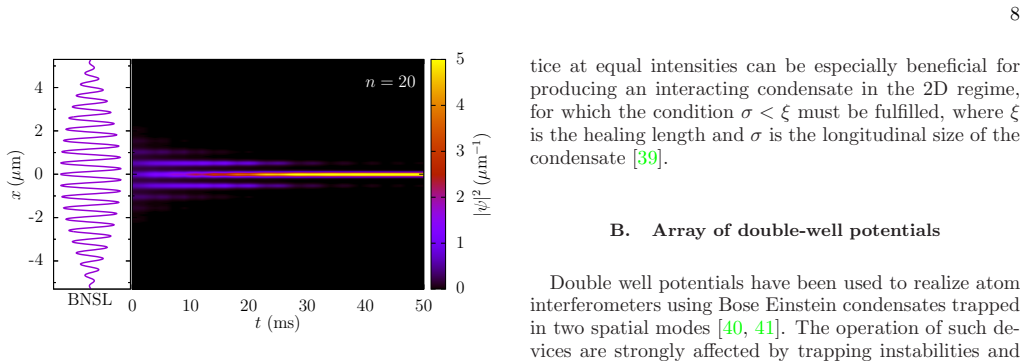
The paper's central claim is that in the perturbative regime $V_0 \ll E_{B+}$, the potential $V_B(x)=V_0[1-\cos(k_-x)\cos(k_+x)]$ is equivalent, for low-lying Bloch states, to the single lattice $V_{\mathrm{eff}}(x)=V_0[1-(V_0/8E_{B+})\cos^2(k_-x)]$, whose period $d_-=\pi/k_-$ is the beat-note distance of the two original lattices. The equivalence is derived by combining an envelope-function description with second-order perturbation theory for the fast-oscillating component at $k_+$, and it is confirmed numerically for the first three energy bands and the ground-state density across the Brillouin zone; the normalized RMS deviation of the spectra stays below $10^{-4}$ for $V_0 \le E_{R+}$. The authors further show that this effective description is robust against a phase shift between the two lattices and against breaking the exact commensurability condition $(n+1)\lambda_1=n\lambda_2$, because only the slow envelope survives to this order. Beyond the perturbative regime, the paper characterises how the analogy degrades, how the first two band gaps depend on $V_0$ and phase, and in what sense deep beat-note superlattices confine atoms more strongly than ordinary lattices of the same large period.
Load-bearing premise
The entire effective-lattice description rests on the assumption that the fast oscillations at $k_+$ can be eliminated locally, so that the slow beat $\cos(k_-x)$ acts as a position-dependent amplitude of a locally valid second-order perturbative dispersion; this separation of scales is plausible for $n\gg1$ but is only checked numerically rather than proven from the full Schrödinger equation.
Editorial extensions
If this is right
- For $V_0$ up to about one recoil energy of the fast lattice, a beat-note superlattice and the single effective lattice are spectroscopically equivalent to better than $10^{-4}$, so band-structure, tunneling, and Wannier-based descriptions of the effective lattice apply directly.
- Because the effective depth scales as $V_0^2/(8E_{B+})$ while the slow recoil energy $E_{R-}$ is much smaller, values $s \sim (n+1/2)^2/8$ are reachable near $V_0 \approx E_{B+}$, making inter-site tunneling exponentially small and letting each cell of the BNSL act as an independent trap.
- Deep beat-note superlattices develop a first band gap that grows linearly in $V_0$ and can exceed the gap of a single lattice with the same large periodicity at equal intensity, reducing the laser power needed for tight two-dimensional or one-dimensional confinement.
- A three-laser BNSL with wavelengths $n/(n+1)\lambda_2$, $\lambda_2$, and $n/(n-1)\lambda_2$ can produce a stable array of balanced double wells with large spacing, with the energy imbalance tunable through the phase $\varphi_3$.
- Time-pulsed BNSLs favour four-photon, small-momentum transfers $2\hbar k_-$ over two-photon, large-momentum transfers when the pulse duration obeys $\hbar/E_{2k_1} \ll T \ll \hbar/E_Q$, enabling Kapitza-Dirac and Bragg operation at metrologically well-defined small momentum.
Reading between the lines
- The equivalence formula implies a design rule beyond the paper's cosine envelopes: any slowly varying envelope of a fast lattice should generate a long-wavelength potential proportional to the square of that envelope, so custom large-period potentials could be engineered by shaping the beat envelope.
- The paper shows shallow-regime insensitivity to commensurability, which suggests the two lattice lasers need not be phase-locked to each other for the effective potential to exist; only the slow phase $\varphi_-$ matters as a rigid shift, and this could ease experimental implementation.
- The three-laser double-well construction is built from pairwise beatings plus one fast-lattice sum, so adding more commensurate wavelengths could plausibly generalise it to longer superlattice or multi-well arrays, although the paper does not pursue that extension.
- For atom interferometry, the suppression of large-momentum components suggests BNSL pulses could act as narrow-band beamsplitters with momentum $\hbar k_-$; the paper derives the amplitude ratio but does not analyse the resulting interferometric phase or sensitivity.
Signed reviews
Editorial analysis
A structured set of objections, weighed in public.
Referee Report
Summary. The manuscript develops a theory of beat-note superlattices (BNSLs), formed by superimposing two optical lattices with slightly different wavelengths. In the shallow-lattice regime it derives an effective long-wavelength potential, Eq. (6), via second-order perturbation theory and an envelope-function replacement, and validates this approximation by exact numerical diagonalization (Fig. 3). It then characterizes the intermediate- and large-depth regimes, the dependence of energy gaps on lattice phase and commensurability, and proposes applications including single-site loading, arrays of double wells, Kapitza-Dirac interferometry with small momentum transfer, and Bragg spectroscopy. The analysis is single-particle, and the treatment is based on standard Bloch-band and perturbation-theory methods.
Significance. If the effective-potential description is valid, BNSLs offer a practical route to large-spacing, interferometrically stable optical lattices, and the paper provides a useful design tool for the ultracold-gases community. The manuscript has clear strengths: the perturbative derivation is standard, the effective potential is parameter-free, and the central approximation is checked against exact diagonalization of the original Hamiltonian without fitting. The experimental demonstrations cited in Refs. [17,18] give independent support for the underlying phenomenon. The main weakness is a quantitative overreach: the paper claims a validity bound that is not supported by its own derivation and appears inconsistent with its own figures; one application equation also needs correction.
major comments (3)
- [Sec. III, Eq. (5)] Equation (5) omits the k^2 term that is part of the same second-order perturbative calculation. For V(x)=V0[1 - alpha cos(k+ x)], the low-k dispersion is epsilon(k) = (hbar^2 k^2/2m) + V0 - (alpha^2 V0^2 / (8 EB+)) [1 + 4 k^2/k+^2 + O(k^4/k+^4)]. After the replacement alpha -> cos(k- x) used to obtain Eq. (6), the neglected k^2 term becomes a periodic modulation of the kinetic operator, i.e. a position-dependent effective mass of relative size alpha^2 V0^2 cos^2(k- x)/(8 EB+^2). At V0=EB+ this is 12.5% at the envelope maxima, and at V0=4EB+ the expansion is meaningless. A scalar potential of the form (6) cannot represent this correction. This is precisely the failure seen in Fig. 3(c,d), where an ad hoc amplitude rescaling is needed at V0=EB+. The asymptotic equivalence for V0 << EB+ is correct, but the stated quantitative validity range is not.
- [Sec. III, Eq. (7)] The claim 'delta-epsilon-bar < 10^-4 for V0 <= ER+' is not reproducible and is internally inconsistent. ER+ is never defined in Sec. III; since k+ = 2 kB+, one has ER+ = hbar^2 k+^2/(2m) = 4 EB+. At V0 = 4 EB+ (the upper endpoint of the claimed range), Figs. 3(e,f) show that the BNSL spectrum and the effective-lattice spectrum differ qualitatively, and the text itself says the analogy breaks down. If ER+ is a typo for EB+, then the 12.5% mass correction at V0 = EB+ still produces spectral deviations far above 10^-4 in the first three bands. The authors should define ER+, recompute the bound, and restrict the delta-epsilon-bar < 10^-4 statement to the range in which the perturbative derivation actually applies.
- [Sec. V C, Eqs. (14)-(16)] The amplitude ratio in Eq. (16) does not follow from Eqs. (14) and (15) as printed. Taking the ratio of the two amplitudes and using |F(x)| ~ 2/|x| for large argument gives |A2k1/AQ| ~ (2/[V2(1/E2k1 + 1/E_{-2k2})]) |F(E2k1 T/hbar)/F(EQ T/hbar)|, which tends to 2 hbar/(V2 T) when E2k1 ~ E_{-2k2} and EQ T/hbar << 1. This scales as hbar/(V2 T), not as V2 hbar/(E^2 T) as in Eq. (16); in the shallow-lattice limit V2 << E the printed expression overestimates the suppression by a factor of order (E/V2)^2. The quantitative suppression factor is one of the claimed advantages for Kapitza-Dirac interferometry, so this equation should be corrected and the conclusions checked.
minor comments (4)
- [Sec. III, after Eq. (6)] The sentence 'Both the BNSL potential and the effective potential Veff(x) are shown in Fig. 2, for three different amplitudes V0' is printed twice in succession.
- [Sec. III / Sec. IV A] The energy scale ER+ is used in Sec. III and in Fig. 7 before it is defined; the definitions of ER+ and ER- should be introduced near Eq. (2) so that the validity statements can be checked.
- [Sec. III, Eq. (7)] The definition of delta-epsilon-bar should specify how the band indices are matched between the BNSL and the effective potential and what quasimomentum set K3 is used; the current description is insufficient to reproduce the numerical bound.
- [Sec. V C, Eqs. (13)-(16)] The notation for the function F(x) and the factors of 1/En in the second-order term should be made uniform; the arguments in Eqs. (14)-(16) mix E T/hbar and dimensionful prefactors in a way that makes the derivation hard to follow.
Circularity Check
Derivation is self-contained; the effective potential in Eq. (6) is derived by perturbation theory from the original BNSL potential and then validated numerically, not fitted.
full rationale
The central claim, Eq. (6), is a perturbative reduction of the original BNSL potential in Eq. (2). The paper derives it by standard second-order perturbation theory (Eq. (5)) and then substitutes the slowly varying envelope for the fast-oscillation amplitude. This is an approximation produced from the same Hamiltonian, not a quantity defined in terms of the prediction. The numerical comparison in Fig. 3 checks the effective potential against the exact spectrum of the same system; it is validation, not fitting, and no parameters are tuned to force the low-depth agreement. The only self-citation entering the formalism is Ref. [21] (Morandi and Modugno) for the general envelope-function transformation, but the paper also cites the independent Ref. [20] for the same effective-equation idea and rederives the result in its own perturbative language. Refs. [17,18] are experimental demonstrations and enter only as motivation and application examples, not as fitted inputs. The possible omission of a second-order k^2 term in Eq. (5), noted in the skeptic analysis, is a correctness/accuracy concern about the claimed quantitative range of validity; it does not make the derivation circular.
Assumptions & free parameters
assumptions (4)
- domain assumption The two wavelengths satisfy the commensurability condition (n+1)lambda1 = n lambda2, so the total potential is periodic with large period d- = n lambda2/2.
- domain assumption Separation of scales: the fast-oscillating component at k+ can be treated perturbatively, with the slowly varying amplitude cos(k- x) treated as locally constant (envelope-function approximation).
- domain assumption The dynamics are single-particle; the potential is a scalar ac-Stark shift with no interactions.
- standard math Standard Bloch theory and second-order perturbation theory for weak periodic potentials.
Cite this review
Pith. "Pith review of Long-wavelength optical lattices from optical beatnotes: theory and applications." pith.science (2026). https://pith.science/paper/7YIVKP7A
@misc{pith2026250412831,
  author       = {Pith},
  title        = {Pith review of: Long-wavelength optical lattices from optical beatnotes: theory and applications},
  year         = {2026},
  howpublished = {\url{https://pith.science/paper/7YIVKP7A}},
  note         = {Machine review of arXiv:2504.12831}
}
read the original abstract
We present a theoretical analysis of Beat-Note Superlattices (BNSLs), a recently demonstrated technique for generating periodic trapping potentials for ultracold atomic clouds, with arbitrarily large lattice spacings while maintaining interferometric stability. By combining two optical lattices with slightly different wavelengths, a beatnote intensity pattern is formed, generating, for low depths, an effective lattice potential with a periodicity equal to the wavelength associated to the difference between the wavevectors of the two lattices. We study the range of lattice depths and wavelengths under which this approximation is valid and investigate its robustness against perturbations. We present a few examples where the use of BNSLs could offer significant advantages in comparison to well established techniques for the manipulation of ultracold atomic gases. Our results highlight the potential of BNSLs for quantum simulation, atom interferometry, and other applications in quantum technologies.
Figures


Figures from the paper (9 more)




Forward citations
Cited by 1 Pith paper
-
Mach-Zehnder atom interferometry with non-interacting trapped Bose Einstein condensates
Non-interacting BECs in a double-well array operate as trapped Mach-Zehnder interferometers with differential gradiometry and spin-echo coherence times approaching 800 ms.
Reference graph
Works this paper leans on
-
[20]
T. C. Li, H. Kelkar, D. Medellin, and M. G. Raizen, Real-time control of the periodicity of a standing wave: an optical accordion, Opt. Express 16, 5465 (2008)
work page 2008
-
[1]
can be written as VB(x) = V0 [1 − cos(k− x + φ− ) cos(k+x + φ+)] , (2) where we have defined k± = k1 ± k2, and φ± similarly. The above expression reveals that, apart from a constant term V0, the potential consists of a fast-oscillating term with period λ+ = 2 π/k+, which is further modulated by a slowly varying periodic amplitude of wavelength FIG. 1. Sket...
- [2]
-
[3]
Their behavior as a function of V0 is shown in Fig. 5, along- side the band gaps ∆ eff n of the effective potential and the tunneling energy J between neighboring sites of the full BNSL lattice. The former nicely reproduce ∆ m in the low-depth, perturbative regime, for V0 ≲ EB+ , as expected. The tunneling J provides a typical reference scale. Indeed, it is...
-
[4]
0 FIG. 2. Plot of the BNSL potential VB(x) (blue solid line) along with the effective potential Veff for three different am- plitudes (red lines),V0/E B+ = 0. 25, 1, 4. Notice that energies are rescaled by a (dimensionless) scale factor of V0/E B+, so that VB(x) remains invariant in form. The orange line rep- resents the envelope of the BNSL, in the terminol...
-
[5]
08 0 1 2 3 4 5 6 7 8 9 10 ∆ 1 ∆ 2 ∆ eff 1 ∆ eff 2 J gap (units of EB+) V0/E B+ FIG. 5. Behavior of the first (blue solid line) and the second (red dashed line) energy gaps of the BNSL, ∆ n (n = 1, 2), along with those of Veff (see legend), as a function of V0, for φ 1 = φ 2 = 0. In addition, we plot the tunneling en- ergy J (dotted-dashed line) for a lattice ...
-
[6]
For sufficiently deep lattices, V0 = 7 EB+ in the figure, this configuration closely re- sembles that of a balanced double-well potential, in which the first two eigenstates correspond to nearly degenerate symmetric and antisymmetric wave functions (shown in the inset). In this case, the behavior of the gaps as a func- tion of the lattice depth V0 is similar t...
-
[7]
08 0 1 2 3 4 5 6 7 8 9 10 −1 1 ∆ 1 ∆ 2 ∆ eff 1 gap (units of EB+) V0/E B+ ψ x (µm) FIG. 6. Behavior of the first two band gaps of the BNSL, ∆ n (n = 1, 2), as a function ofV0, forφ 1 =φ 2 =π/ 2. Refer to the caption of Fig. 5 for a complete description of the symbols. The inset shows the wave function ψ (arbitrary units) for the ground state (blue, solid li...
Show all 69 references
-
[8]
5 (a) 0 10 20 30 0 20 40 60 80 100 120 140 (b) −10 10 n = 20 −2 2 n = 3 ∆ 1 ∆ − δ gap (units of EB+) ∆ 1 ∆ − ∆ + gap (units of EB+) V0/E B+ x (µm) x (µm) FIG. 9. Behavior of the first band gap ∆1 of a BNSL as a func- tion of V0, for (a) n = 20 and (b) n = 3. Also shown are: the...
-
[9]
small” momentum component ℏQ is generated by the four-photons processes whereas the “large
(dotted-dashed line, see text). The insets show a sketch of the BNSL potential (blue line) and the V− (x) po- tential (orange line), in arbitrary units. Here, φ 1 =φ 2 = 0. In Fig. 9 we show the behavior of the first energy gap ∆ 1 of the BNSL, deep into the large-depth regime....
-
[10]
A. D. Ludlow, M. M. Boyd, J. Ye, E. Peik, and P. O. Schmidt, Optical atomic clocks, Rev. Mod. Phys. 87, 637 (2015)
2015
-
[11]
A. D. Cronin, J. Schmiedmayer, and D. E. Pritchard, Optics and interferometry with atoms and molecules, Rev. Mod. Phys. 81, 1051 (2009)
2009
-
[12]
Saffman, T
M. Saffman, T. G. Walker, and K. Mølmer, 12 Quantum information with rydberg atoms, Rev. Mod. Phys. 82, 2313 (2010)
2010
-
[13]
Morsch and M
O. Morsch and M. Oberthaler, Dynamics of Bose-Einstein condensates in optical lattices, Rev. Mod. Phys. 78, 179 (2006)
2006
-
[14]
Kasevich and S
M. Kasevich and S. Chu, Atomic interfer- ometry using stimulated raman transitions, Phys. Rev. Lett. 67, 181 (1991)
1991
-
[15]
Bloch, Ultracold quantum gases in optical lattices, Nat
I. Bloch, Ultracold quantum gases in optical lattices, Nat. Phys. 1, 23 (2005)
2005
-
[16]
R. W. P. Drever, J. L. Hall, F. V. Kowalski, J. Hough, G. M. Ford, A. J. Munley, and H. Ward, Laser phase and frequency stabilization using an optical resonator, Applied Physics B 31, 97 (1983)
1983
-
[17]
Scheunemann, F
R. Scheunemann, F. S. Cataliotti, T. W. H¨ ansch, and M. Weitz, An optical lattice with single lat- tice site optical control for quantum engineering, J. Opt. B: Quantum Semiclass. Opt. 2, 313 (2000)
2000
-
[18]
K. D. Nelson, X. Li, and D. S. Weiss, Imag- ing single atoms in a three-dimensional array, Nat. Phys. 3, 556 – 560 (2007) , cited by: 281; All Open Access, Bronze Open Access
2007
-
[19]
Albiez, R
M. Albiez, R. Gati, J. F¨ olling, S. Hunsmann, M. Cris- tiani, and M. K. Oberthaler, Direct observation of tunnel- ing and nonlinear self-trapping in a single bosonic Joseph- son junction, Phys. Rev. Lett. 95, 010402 (2005)
2005
-
[21]
Valtolina, K
G. Valtolina, K. Matsuda, T. William, L. De Marco, and J. Ye, Dipolar evaporation of reactive molecules to below the Fermi temperature, Nature 588, 239 (2020)
2020
-
[22]
Hirthe, T
S. Hirthe, T. Chalopin, D. Bourgund, P. Bojovi´ c, A. Bohrdt, E. Demler, F. Grusdt, I. Bloch, and T. Hilker, Magnetically mediated hole pairing in fermionic ladders of ultracold atoms, Nature 613, 463 (2023)
2023
-
[23]
L.-C. Ha, L. W. Clark, C. V. Parker, B. M. An- derson, and C. Chin, Roton-maxon excitation spec- trum of Bose-Einstein in a shaken optical lattice, Phys. Rev. Lett. 114, 055301 (2015)
2015
-
[24]
Barredo, S
D. Barredo, S. de L´ es´ eleuc, V. Lienhard, T. La- haye, and A. Browaeys, An atom-by-atom assembler of defect-free arbitrary two-dimensional atomic arrays, Science 354, 1021 (2016)
2016
-
[25]
Beat-Note
L. Masi, T. Petrucciani, G. Ferioli, G. Semeghini, G. Modugno, M. Inguscio, and M. Fattori, Spatial Bloch Oscillations of a Quantum Gas in a “Beat-Note” Super- lattice, Phys. Rev. Lett. 127, 020601 (2021)
2021
-
[26]
L. Masi, T. Petrucciani, A. Burchianti, C. Fort, M. Ingus- cio, L. Marconi, G. Modugno, N. Preti, D. Trypogeorgos, M. Fattori, and F. Minardi, Multimode trapped interfer- ometer with noninteracting Bose-Einstein condensates, Phys. Rev. Res. 3, 043188 (2021)
2021
-
[27]
Sebby-Strabley, M
J. Sebby-Strabley, M. Anderlini, P. S. Jessen, and J. V. Porto, Lattice of double wells for manipulating pairs of cold atoms, Phys. Rev. A 73, 033605 (2006)
2006
-
[28]
Noviˇ cenko, J
V. Noviˇ cenko, J. Ruseckas, and E. Anisimovas, Quan- tum dynamics in potentials with fast spatial oscillations, Phys. Rev. A 99, 043608 (2019)
2019
-
[29]
Morandi and M
O. Morandi and M. Modugno, Multiband envelope func- tion model for quantum transport in a tunneling diode, Phys. Rev. B 71, 235331 (2005)
2005
-
[30]
N. W. Ashcroft and N. D. Mermin, Solid State Physics (Brooks Cole, 1976)
1976
-
[31]
Bloch, J
I. Bloch, J. Dalibard, and W. Zwerger, Many-body physics with ultracold gases, Rev. Mod. Phys. 80, 885 (2008)
2008
-
[32]
This approximation works reasonably well for n ≫ 1
-
[33]
Gerbier, A
F. Gerbier, A. Widera, S. F¨ olling, O. Mandel, T. Gericke, and I. Bloch, Interference pattern and visibility of a mott insulator, Phys. Rev. A 72, 053606 (2005)
2005
-
[34]
Na/suppress l¸ ecz, L
I. Na/suppress l¸ ecz, L. Masi, G. Ferioli, T. Petrucciani, M. Fattori, and J. Chwede´ nczuk, Sensitivity bounds of a spatial bloch-oscillation atom interferometer, Phys. Rev. A 102, 033318 (2020)
2020
-
[35]
Note that the dependence of the bandwidth on the ra- tio λ 2/λ 1 for low amplitudes, V0/E R+ ≪ 1, does not contradict the validity of the effective potential. It sim- ply reflects the fact that the value of k− , which defines the first Brillouin zone, increases with λ 2/λ 1, and c...
-
[36]
Hadzibabic, P
Z. Hadzibabic, P. Kr¨ uger, M. Cheneau, B. Battelier, and J. Dalibard, Berezinskii–Kosterlitz–Thouless crossover in a trapped atomic gas, Nature 441, 1118 (2006)
2006
-
[37]
For large n, this occurs when δ ≈ ℏω , leading to V0 ≈ 2[(2n + 1)/π ]4EB+
-
[38]
M. Boll, T. A. Hilker, G. Salomon, A. Omran, J. Nespolo, L. Pollet, I. Bloch, and C. Gross, Spin- and density- resolved microscopy of antiferromagnetic correlations in Fermi-Hubbard chains, Science 353, 1257 (2016)
2016
-
[39]
M. Gall, N. Wurz, J. Samland, C. F. Chan, and M. K¨ ohl, Competing magnetic orders in a bilayer hubbard model with ultracold atoms, Nature 589, 40–43 (2021)
2021
-
[40]
Hartke, B
T. Hartke, B. Oreg, N. Jia, and M. Zwier- lein, Doublon-hole correlations and fluctua- tion thermometry in a Fermi-Hubbard gas, Phys. Rev. Lett. 125, 113601 (2020)
2020
-
[41]
Hadzibabic, S
Z. Hadzibabic, S. Stock, B. Battelier, V. Bretin, and J. B. Dalibard, Interference of an Ar- ray of Independent Bose-Einstein Condensates, Phys. Rev. Lett. 93, 180403 (2004)
2004
-
[42]
Lechner and P
W. Lechner and P. Zoller, From classical to quantum glasses with ultracold polar molecules, Phys. Rev. Lett. 111, 185306 (2013)
2013
-
[43]
Cinti, D.-W
F. Cinti, D.-W. Wang, and M. Boninsegni, Phases of dipolar bosons in a bilayer geometry, Phys. Rev. A 95, 023622 (2017)
2017
-
[44]
Anich, N
G. Anich, N. H¨ ollrigl, M. Kreyer, R. Grimm, and E. Kirilov, Comprehensive characterization of an ap- paratus for cold electromagnetic dysprosium dipoles, Phys. Rev. A 110, 023311 (2024)
2024
-
[45]
J. F. Sherson, C. Weitenberg, M. Endres, M. Ch- eneau, I. Bloch, and S. Kuhr, Single-atom-resolved fluorescence imaging of an atomic mott insulator, Nature 467, 68–72 (2010)
2010
-
[46]
J. L. Ville, T. Bienaim´ e, R. Saint-Jalm, L. Corman, M. Aidelsburger, L. Chomaz, K. Kleinlein, D. Perconte, S. Nascimb` ene, J. Dalibard, and J. Beugnon, Loading and compression of a single two-dimensional Bose gas in an optical accordion, Phys. Rev. A 95, 013632 (2017)
2017
-
[47]
The longitudinal size σ is determined by the effective trapping frequency provided by the lattice potential at each lattice site, which is related to the first energy gap by the relation ∆ 1 ≃ ℏω eff
-
[48]
Y. Shin, M. Saba, T. A. Pasquini, W. Ketterle, D. E. Pritchard, and A. E. Leanhardt, Atom interferometry with Bose-Einstein condensates in a double-well poten- 13 tial, Phys. Rev. Lett. 92, 050405 (2004)
2004
-
[49]
Berrada, S
T. Berrada, S. van Frank, R. B¨ ucker, T. Schumm, J.-F. Schaff, and J. Schmiedmayer, Integrated mach–zehnder interferometer for Bose–Einstein conden- sates, Nat. Commun. 4, 2077 (2013)
2013
-
[50]
Est` eve, C
J. Est` eve, C. Gross, A. Weller, S. Giovanazzi, and M. K. Oberthaler, Squeezing and en- tanglement in a Bose–Einstein condensate, Nature 455, 1216–1219 (2008)
2008
-
[51]
Trenkwalder, G
A. Trenkwalder, G. Spagnolli, G. Semeghini, S. Coop, M. Landini, P. Castilho, L. Pezz` e, G. Modugno, M. In- guscio, A. Smerzi, and M. Fattori, Quantum phase tran- sitions with parity-symmetry breaking and hysteresis, Nat. Phys. 12, 826 (2016)
2016
-
[52]
Spagnolli, G
G. Spagnolli, G. Semeghini, L. Masi, G. Ferioli, A. Trenkwalder, S. Coop, M. Landini, L. Pezz` e, G. Modugno, M. Inguscio, A. Smerzi, and M. Fat- tori, Crossing over from attractive to repulsive in- teractions in a tunneling bosonic Josephson junction, Phys. Rev. Lett. 118, 23...
2017
-
[53]
Chalopin, P
T. Chalopin, P. Bojovi´ c, D. Bourgund, S. Wang, T. Franz, I. Bloch, and T. Hilker, Optical superlattice for engineering hubbard couplings in quantum simula- tion, Phys. Rev. Lett. 134, 053402 (2025)
2025
-
[54]
W. Li, T. He, and A. Smerzi, Multimode Kapitza- Dirac Interferometry with Trapped Cold Atoms, Phys. Rev. Lett. 113, 023003 (2014)
2014
-
[55]
Stenger, S
J. Stenger, S. Inouye, A. P. Chikkatur, D. M. Stamper-Kurn, D. E. Pritchard, and W. Ketterle, Bragg spectroscopy of a bose-einstein condensate, Phys. Rev. Lett. 82, 4569 (1999)
1999
-
[56]
Stringari and L
S. Stringari and L. Pitaevskii, Bose-Einstein condensa- tion (Clarendon Press Oxford, 2003)
2003
-
[57]
Bracewell, The Fourier Transform and Its Applica- tions, 3rd ed
R. Bracewell, The Fourier Transform and Its Applica- tions, 3rd ed. (McGraw-Hill, Singapore, 2000) Chap. The Hilbert Transform, pp. 359–367
2000
-
[58]
E. W. Weisstein, Hilbert transform, https://mathworld.wolfram.com/HilbertTransform.html (n.d.), from MathWorld–A Wolfram Web Resource
-
[59]
Trypogeorgos and C
D. Trypogeorgos and C. J. Foot, Cotrapping different species in ion traps using multiple radio frequencies, Phys. Rev. A 94, 023609 (2016)
2016
-
[60]
T. L. Harte, E. Bentine, K. Luksch, A. J. Barker, D. Try- pogeorgos, B. Yuen, and C. J. Foot, Ultracold atoms in multiple radio-frequency dressed adiabatic potentials , Phys. Rev. A 97, 013616 (2018)
2018
-
[61]
C. J. Foot, D. Trypogeorgos, E. Bentine, A. Gard- ner, and M. Keller, Two-frequency operation of a Paul trap to optimise confinement of two species of ions, Int. J. Mass Spectrom. 430, 117 (2018)
2018
-
[62]
Jordan and P
D. Jordan and P. Smith, Nonlinear Ordinary Differential Equations: An Introduction for Scientists and Engineers , 4th ed. (OUP Oxford, 2007)
2007
-
[63]
N. V. Konenkov, M. Sudakov, and D. J. Dou- glas, Matrix methods for the calculation of sta- bility diagrams in quadrupole mass spectrometry, J. Am. Soc. Mass Spectrom. 13, 597 (2002)
2002
-
[64]
Broer and C
H. Broer and C. Sim´ o, Hill’s equation with quasi-periodic forcing: resonance tongues, instability pockets and global phenomena, Bull. Braz. Math. Soc. 29, 253 (1998). 14 Appendix A: Multichromatic potentials
1998
-
[65]
Effective potential of a BNSL Let us first consider Eq. ( 1). By using the bisection trigonometric formula, it can be written as VB(x) = ∑ i=1, 2 Vi 2 [1 − cos(2kix + 2φi)] , (A1) which, by simple algebra, can be conveniently recast as VB(x) = V1 + V2 4 ∑ i=1, 2 [1 − cos(2kix + ...
-
[66]
Array of double-well potentials The above approach can be extended to the case of a potential obtained by superimposing by the three si- nusoidal lattices, as in Eq. ( 10). In particular, we consider the case in which the three wavelengths ful- fill the commensurate conditions ...
-
[67]
Optical potential Generally speaking, the optical potential as written in Eq. (
-
[68]
single-photon
amounts to the ac Stark shift of the atomic −1 0 1 −π 0 π V (y) y +φ − FIG. 12. Plot of the potential V (y) in Eq. ( B2), for n = 20, α = 0. 1, and two different values of phase: φ + = 0 (solid blue line) and φ + =π (solid orange line). The red line depicts the envelope |Va(y)|...
-
[69]
Bragg transitions Let’s first consider a single-frequency standing wave formed by adding two running waves with equal ampli- tudes A0: E(R) = A0 [exp(ikx) + c.c.] . Alongside the optical potential, arising from consider- ing the two running waves individually, we can calculate ...
Reviewed August 16, 2026 · model on record in the stance chip above.
Discussion (0). Continue with ORCID to comment.