REVIEW 3 major objections 5 minor 102 references
Psych-Occlusion: Using Visual Psychophysics for Aerial Detection of Occluded Persons during Search and Rescue
T0 review · 3 major / 5 minor · reviewed 2026-08-11 · deepseek-v4-flash
Pith's one-line read This paper claims that human search behavior on aerial images can be compressed into a distance- and occlusion-dependent accuracy surface, and that folding this surface into a detector's bounding-box regression loss improves detection of…
desk verdict Useful new behavioral dataset, but the loss experiment lacks the controls needed to attribute the reported 70 m gain to human data. read the letter →
The pith
A machine-rendered reading of the paper's core claim, the machinery that carries it, and where it could break.
The reading
What carries the argument
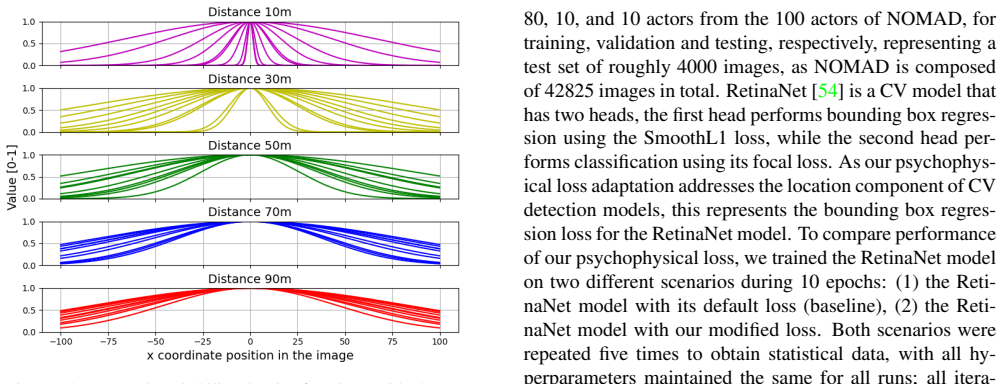
The psychophysical loss is the central mechanism: a center-distance penalty whose width is set by human accuracy at each distance $d$ and visibility $v$ through the identity $\sigma(d,v)=100-\mathrm{mAP@0.00}(d,v)$. The human penalty $p$ is blended with the default regression loss by $A\,p + B(1-p)\,\mathcal{L}_{\mathrm{default}}$, which makes the model concentrate on locating the person's center first and only later on tightening the box. This carries the argument because all reported gains flow from replacing the default loss with this human-modulated version while keeping the architecture, data split, and hyperparameters fixed.
What would settle it
Retrain the psychophysical-loss model after recomputing the human accuracy surface with all images of the ten test actors excluded; if mAP@0.50 at 70 m no longer beats the baseline, the reported improvement depends on information from the test set rather than on the psychophysical mechanism.
Extended reading notes
Core claim
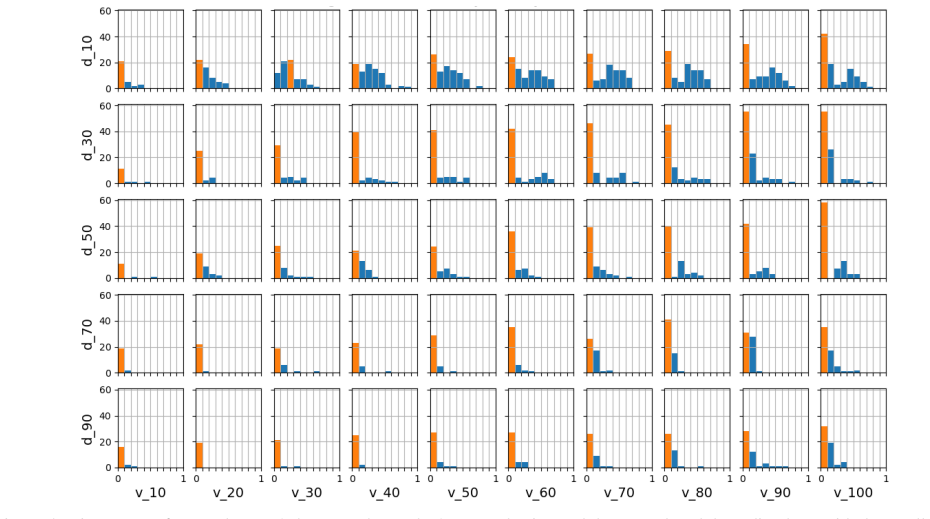
The central claim is that human accuracy data can guide the localization head of an object detector. From crowd responses on the NOMAD aerial dataset, the authors built a per-distance, per-visibility accuracy surface and turned it into a Gaussian penalty around each ground-truth center with variance $\sigma(d,v)=100-\mathrm{mAP@0.00}(d,v)$. The regression loss becomes $A\,p + B(1-p)\,\mathcal{L}_{\mathrm{default}}$, where $p=1-\exp(-((x_{\mathrm{pred}}-x_{\mathrm{gt}})^2+(y_{\mathrm{pred}}-y_{\mathrm{gt}})^2)/(2\sigma(d,v)^2))$, so human performance controls how much center error is punished: strict where humans find people easily, lenient where humans struggle. On a RetinaNet detector (a one-stage detector) trained on NOMAD, this psychophysical loss improves mAP@0.50 at 70 m across occlusion levels compared with the default regression loss, leaves lower distances unchanged, and does not degrade mAP@0.50:0.95.
Load-bearing premise
The whole comparison rests on the assumption that the human accuracy surface was measured without leaking the test actors into the loss, and that 'did the human find the person' is the right success measure for rescue detection.
Editorial extensions
If this is right
- A RetinaNet trained with the psychophysical loss beats the default-loss baseline at 70 m across occlusion levels when measured by mAP@0.50.
- The long-range gain does not come at the cost of box tightness: mAP@0.50:0.95 is not degraded relative to the baseline.
- The extra cost of the approach is confined to training; inference is unchanged, which matters for deployment on small drones with limited computing.
- Psych-ER, with accuracy, response time, and cursor search paths for more than 5,000 images, is a reusable resource for further human-guided detection research.
- Under the paper's framing, location accuracy rather than box tightness is what humans actually optimize when searching for people, so mAP@0.50 is the relevant success metric for emergency-response detection.
Reading between the lines
- A useful control would replace the human accuracy surface with a hand-designed sigma schedule that is strict at short range and loose at long range; if the 70 m gain persists, the improvement comes from the loss shape rather than from the human measurements.
- The same center-penalty mechanism could transfer to other low-resolution search tasks, such as maritime or post-disaster victim search, where human center-clicks are cheaper to collect than precise bounding boxes.
- Reaction-time and search-path data, which the paper collected but did not feed into the loss, could sharpen the sigma surface further, since humans respond faster on true-positive trials.
Editorial analysis
A structured set of objections, weighed in public.
Referee Report
Summary. This paper contributes Psych-ER, a crowdsourced behavioral dataset of human search on aerial NOMAD images, and uses the human accuracy data to define a psychophysical bounding-box regression loss for RetinaNet. The loss adds a Gaussian center penalty whose width is set per (distance, visibility) cell by sigma(d,v)=100-mAP@0.00(d,v) from Eq. (2). The authors train RetinaNet-R101-FPN with and without this loss under an 80/10/10 actor split, with five runs per condition, and report mAP@0.50 improvements at 70m across occlusion levels while not degrading performance at closer distances. They claim this is the first human-guided approach to the localization component of a detection model.
Significance. Psych-ER is a valuable dataset resource, and the paper is explicit about releasing code and data. The loss adaptation is cheap at inference, and the experimental protocol has real strengths: actor-level rather than image-level splits, five repeated runs, and evaluation stratified by distance and visibility. The idea that human accuracy data can inform a localization loss is interesting and, if established, would extend prior human-guided classification work to object detection. However, the current evidence for the headline 70m improvement is weakened by two confounds: sigma is computed from human responses on images of actors later used for testing, and no fixed-width center-penalty baseline is run. These are fixable, but they are load-bearing for the central empirical claim.
major comments (3)
- [Section 3.1, Section 5, Eq. (2)] Because Section 3.1 samples one Psych-ER image per actor per (distance, visibility) cell before Section 5 assigns the 10 test actors, the human responses used to compute sigma(d,v) include responses to images of the test actors. Eq. (4) uses this sigma to set the width of the Gaussian center penalty for all training samples in that cell, so the training objective is adjusted using statistics that depend on test-actor images. The 70m improvement in Fig. 11b could therefore be an artifact of this transductive leakage. Please recompute sigma excluding the 10 test actors (or use nested splits) and show that the improvement remains; an ablation with sigma estimated only from the 90 non-test actors is needed.
- [Section 5, Eq. (4)] Eq. (4) adds a center-penalty term to the SmoothL1 regression loss, but the paper never compares against a baseline with a fixed-width center penalty. Without such a baseline, one cannot tell whether the reported mAP@0.50 gains come from the human-derived sigma(d,v) or simply from adding any center-location prior to the regression head. Please include a fixed-sigma and/or constant-width Gaussian center-penalty baseline with identical hyperparameters, and report the same distance/visibility breakdown.
- [Section 5, Fig. 11] The manuscript says both scenarios were repeated five times 'to obtain statistical data,' but Fig. 11 presents only mean curves and no confidence intervals or hypothesis tests. The central claim is a per-cell improvement at 70m across occlusion levels; with five runs, paired per-run differences should be shown with intervals or tests to establish that the improvement is not within run-to-run variability.
minor comments (5)
- [Eq. (4)] Equation (4) contains the typo 'def aultloss'; it should read 'default loss'.
- [References] Reference [7] contains a stray '[ ?,' placeholder before '[8, 48, 73]' and should be cleaned.
- [Section 3.2] The text says the 10 positive images per survey had to be of 'different actor'; the wording should clarify whether all 10 actors are distinct or whether a few repeats are allowed.
- [Fig. 6] Figure 6's shaded areas are described as standard deviation from a 10-fold partition; the paper should specify what is being partitioned (images, actors, or worker responses).
- [Section 5] The hyperparameters A and B are fixed to 0.05 and 0.95 without any sensitivity analysis; a sentence justifying the choice or a small ablation would help.
Circularity Check
The psychophysical σ(d,v) in Eq. (2) is computed from human responses on images of every NOMAD actor, including those later assigned to the test split; the reported 70m improvement is therefore partly a re-statement of human localizability on test images.
-
fitted input called prediction
[Section 3.1 (stimulus selection) and Section 4, Eqs. (2)-(4), with the actor split in Section 5]
"We randomly selected a subset of NOMAD so that for every (distance, visibility) combination, we had one image of each actor. ... we created a random split of 80, 10, and 10 actors from the 100 actors of NOMAD, for training, validation and testing, respectively. ... σ(d, v) = 100− mAP @0.00(d, v)"
The Psych-ER stimulus subset covers all 100 NOMAD actors (one image per actor per cell). Section 5 then splits the same 100 actors into 80/10/10 without excluding the 10 test actors from the MTurk stimulus set, so the human mAP@0.00 surface in Eq. (2) includes responses on images of actors that later appear in the test split. That surface defines σ(d,v), which sets the Gaussian center-penalty width in Eqs. (3)-(4) for every training sample in each cell. The headline gain in mAP@0.50 at 70m on test actors is thus produced by a loss calibrated with human location performance on the very test-actor images being reported, making the improvement partly a re-statement of that fit. No ablation recomputes σ from the 90 non-test actors only, so the contamination magnitude is unknown.
full rationale
The central derivation is otherwise self-contained: the human accuracy surface is an external measurement independent of model outputs, so the loss is not fitting the evaluation metric to itself; the Gaussian center penalty in Eq. (1) is a standard construction citing CenterNet [97]; and the NOMAD self-citation [79] is appropriate because NOMAD is the testbed and is publicly available, with no uniqueness theorem invoked. The choice of mAP@0.50 as the main metric matches the center-localization objective the loss was designed to encourage, which is a design choice, and mAP@0.50:0.95 is also reported with no degradation. The one load-bearing self-referential element is the selection of the human data used in Eq. (2): Section 3.1 draws one image of each of the 100 actors, and Section 5's 80/10/10 split does not carve the 10 test actors out of that stimulus set, so σ(d,v) aggregates human responses on test-actor images and the training loss for each distance/visibility cell is tuned by them. The reported gain at 70m could therefore partly reflect transductive leakage rather than the psychophysical loss as such. Because the model must still learn and σ is a per-cell scalar diluted across 100 actors, the claim is not forced by construction, but the paper should rerun with σ computed only from training actors to establish the gain is real.
Assumptions & free parameters
free parameters (3)
- A =
0.05
- B =
0.95
- sigma(d,v) =
not tabulated; plotted as 100-mAP@0.00(d,v)
assumptions (3)
- domain assumption Human performance with IoU>0 is a valid measure of location accuracy and is the right objective for ER detection.
- domain assumption The human accuracy mAP@0.00(d,v) is stable enough per bin to transfer to model training for other actors.
- domain assumption RetinaNet with default hyperparameters and 10 epochs is an adequate testbed.
Cite this review
Pith. "Pith review of Psych-Occlusion: Using Visual Psychophysics for Aerial Detection of Occluded Persons during Search and Rescue." pith.science (2026). https://pith.science/paper/7YJ4W6LY
@misc{pith2026241205553,
  author       = {Pith},
  title        = {Pith review of: Psych-Occlusion: Using Visual Psychophysics for Aerial Detection of Occluded Persons during Search and Rescue},
  year         = {2026},
  howpublished = {\url{https://pith.science/paper/7YJ4W6LY}},
  note         = {Machine review of arXiv:2412.05553}
}
read the original abstract
The success of Emergency Response (ER) scenarios, such as search and rescue, is often dependent upon the prompt location of a lost or injured person. With the increasing use of small Unmanned Aerial Systems (sUAS) as "eyes in the sky" during ER scenarios, efficient detection of persons from aerial views plays a crucial role in achieving a successful mission outcome. Fatigue of human operators during prolonged ER missions, coupled with limited human resources, highlights the need for sUAS equipped with Computer Vision (CV) capabilities to aid in finding the person from aerial views. However, the performance of CV models onboard sUAS substantially degrades under real-life rigorous conditions of a typical ER scenario, where person search is hampered by occlusion and low target resolution. To address these challenges, we extracted images from the NOMAD dataset and performed a crowdsource experiment to collect behavioural measurements when humans were asked to "find the person in the picture". We exemplify the use of our behavioral dataset, Psych-ER, by using its human accuracy data to adapt the loss function of a detection model. We tested our loss adaptation on a RetinaNet model evaluated on NOMAD against increasing distance and occlusion, with our psychophysical loss adaptation showing improvements over the baseline at higher distances across different levels of occlusion, without degrading performance at closer distances. To the best of our knowledge, our work is the first human-guided approach to address the location task of a detection model, while addressing real-world challenges of aerial search and rescue. All datasets and code can be found at: https://github.com/ArtRuss/NOMAD.
Figures


Figures from the paper (7 more)




Reference graph
Works this paper leans on
-
[1]
Abraham, Zachariah Carmichael, Sreya Banerjee, Rosaura G
Sophia J. Abraham, Zachariah Carmichael, Sreya Banerjee, Rosaura G. VidalMata, Ankit Agrawal, Md Nafee Al Islam, Walter J. Scheirer, and Jane Cleland-Huang. Adaptive auton- omy in human-on-the-loop vision-based robotics systems. In 1st IEEE/ACM Workshop on AI Engineering - Software En- gineering for AI, WAIN@ICSE 2021, Madrid, Spain, May 30-31, 2021, page...
2021
-
[2]
Abraham, Benjamin Burger, Chichi Christine, Luke Fraser, John M
Ankit Agrawal, Sophia J. Abraham, Benjamin Burger, Chichi Christine, Luke Fraser, John M. Hoeksema, Sarah Hwang, Elizabeth Travnik, Shreya Kumar, Walter J. Scheirer, Jane Cleland-Huang, Michael Vierhauser, Ryan Bauer, and Steve Cox. The next generation of human-drone partnerships: Co-designing an emergency response system. In Regina Bernhaupt, Florian ’Fl...
2020
-
[3]
Configuring mission-specific behavior in a product line of collaborating small unmanned aerial systems.Journal of Systems and Software, 197:111543, 2023
Md Nafee Al Islam, Muhammed Tawfiq Chowdhury, Ankit Agrawal, Michael Murphy, Raj Mehta, Daria Kudriavt- seva, Jane Cleland-Huang, Michael Vierhauser, and Marsha Chechik. Configuring mission-specific behavior in a product line of collaborating small unmanned aerial systems.Journal of Systems and Software, 197:111543, 2023. 3
2023
-
[4]
hierarquicallyo: An automated search-and- rescue drone-based solution for victims localization
Antonio Albanese, Vincenzo Sciancalepore, and Xavier Costa-P´erez. hierarquicallyo: An automated search-and- rescue drone-based solution for victims localization. IEEE Transactions on Mobile Computing, 21(9):3312–3325, 2022. 3
2022
-
[5]
Low-power computer vi- sion: Status, challenges, and opportunities
Sergei Alyamkin, Matthew Ardi, Alexander C Berg, Achille Brighton, Bo Chen, Yiran Chen, Hsin-Pai Cheng, Zichen Fan, Chen Feng, Bo Fu, et al. Low-power computer vi- sion: Status, challenges, and opportunities. IEEE Journal on Emerging and Selected Topics in Circuits and Systems , 9(2):411–421, 2019. 3
2019
-
[6]
Multi-resolution face recognition with drones
Giuseppe Amato, Fabrizio Falchi, Claudio Gennaro, Fabio Valerio Massoli, and Claudio Vairo. Multi-resolution face recognition with drones. In Vit V ozenilek, editor, SSIP 2020: 2020 3rd International Conference on Sensors, Sig- nal and Image Processing, Prague, Czech Republic, October 9-11, 2020, pages 13–18. ACM, 2020. 3
2020
-
[7]
Real-time pedestrian detection using radar- camera fusion and clustering
Kirsnaragavan Arudpiragasam, Taraka Rama Krishna Kanth Kannuri, Klaus Schwarz, Michael Hartmann, and Reiner Creutzburg. Real-time pedestrian detection using radar- camera fusion and clustering. InMultimodal Image Exploita- tion and Learning 2023, volume 12526, pages 89–103. SPIE,
2023
-
[8]
Towards open world recognition
Abhijit Bendale and Terrance Boult. Towards open world recognition. In Proceedings of the IEEE conference on computer vision and pattern recognition, pages 1893–1902,
1902
Show all 102 references
-
[9]
Hi- erarchically organized computer vision in support of multi- faceted search for missing persons
Arturo Miguel Russell Bernal and Jane Cleland-Huang. Hi- erarchically organized computer vision in support of multi- faceted search for missing persons. In 2023 IEEE 17th Inter- national Conference on Automatic Face and Gesture Recog- nition (FG), pages 1–7. IEEE, 2023. 3
2023
-
[10]
Yolov4: Optimal speed and accuracy of object detection
Alexey Bochkovskiy, Chien-Yao Wang, and Hong- Yuan Mark Liao. Yolov4: Optimal speed and accuracy of object detection. arXiv preprint arXiv:2004.10934, 2020. 3
2004 arXiv
-
[11]
Human- aided saliency maps improve generalization of deep learning
Aidan Boyd, Kevin W Bowyer, and Adam Czajka. Human- aided saliency maps improve generalization of deep learning. In Proceedings of the IEEE/CVF Winter Conference on Ap- plications of Computer Vision, pages 2735–2744, 2022. 3
2022
-
[12]
Human saliency-driven patch- based matching for interpretable post-mortem iris recogni- tion
Aidan Boyd, Daniel Moreira, Andrey Kuehlkamp, Kevin Bowyer, and Adam Czajka. Human saliency-driven patch- based matching for interpretable post-mortem iris recogni- tion. In Proceedings of the IEEE/CVF Winter Conference on Applications of Computer Vision (WACV) Workshops, page...
2023
-
[13]
Cyborg: Blending human saliency into the loss im- proves deep learning-based synthetic face detection
Aidan Boyd, Patrick Tinsley, Kevin W Bowyer, and Adam Czajka. Cyborg: Blending human saliency into the loss im- proves deep learning-based synthetic face detection. In Pro- ceedings of the IEEE/CVF Winter Conference on Applica- tions of Computer Vision, pages 6108–6117, 2023. 3
2023
-
[14]
Deep learning approach in aerial imagery for supporting land search and rescue missions
Dunja Bozic-Stulic, Zeljko Marusic, and Sven Gotovac. Deep learning approach in aerial imagery for supporting land search and rescue missions. Int. J. Comput. Vis. , 127(9):1256–1278, 2019. 3
2019
-
[15]
Hayner, and Karen Leung
Daniel Broyles, Christopher R. Hayner, and Karen Leung. Wisard: A labeled visual and thermal image dataset for wilderness search and rescue. In 2022 IEEE/RSJ Interna- tional Conference on Intelligent Robots and Systems (IROS), pages 9467–9474, 2022. 3
2022
-
[16]
Teamwork makes the dream work, 2022
Brunswick County Sheriff’s Office, NC. Teamwork makes the dream work, 2022. https : / / www . facebook . com / brunswicksheriffNC / posts / 355462306611443, Last accessed on 2024-09-09. 2
2022
-
[17]
Casper and R.R
J. Casper and R.R. Murphy. Human-robot interactions dur- ing the robot-assisted urban search and rescue response at the world trade center. IEEE Transactions on Systems, Man, and Cybernetics, Part B (Cybernetics), 33(3):367–385, 2003. 3
2003
-
[18]
Italy police use drone to catch sus- pected arsonist in the act as wildfires char calabria,
CBS NEWS. Italy police use drone to catch sus- pected arsonist in the act as wildfires char calabria,
-
[19]
Self-adaptation of loosely coupled systems across a system of small uncrewed aerial systems
Theodore Chambers, Jane Cleland-Huang, and Michael Vierhauser. Self-adaptation of loosely coupled systems across a system of small uncrewed aerial systems. In Pro- ceedings of the 12th ACM/IEEE International Workshop on Software Engineering for Systems-of-Systems and Software ...
2024
-
[20]
Hifuzz: Human interaction fuzzing for small unmanned aerial vehicles
Theodore Chambers, Michael Vierhauser, Ankit Agrawal, Michael Murphy, Jason Matthew Brauer, Salil Purandare, Myra B Cohen, and Jane Cleland-Huang. Hifuzz: Human interaction fuzzing for small unmanned aerial vehicles. In Proceedings of the CHI Conference on Human Factors in Com...
2024
-
[21]
Occlusion detection and handling: a review
Himanshu Chandel and Sonia Vatta. Occlusion detection and handling: a review. International Journal of Computer Ap- plications, 120(10), 2015. 3 9
2015
-
[22]
Aerial and ground robot collabora- tion for autonomous mapping in search and rescue missions
Dimitrios Chatziparaschis, Michail G Lagoudakis, and Pana- giotis Partsinevelos. Aerial and ground robot collabora- tion for autonomous mapping in search and rescue missions. Drones, 4(4):79, 2020. 3
2020
-
[23]
A survey of the four pillars for small object detection: Multiscale represen- tation, contextual information, super-resolution, and region proposal
Guang Chen, Haitao Wang, Kai Chen, Zhijun Li, Zida Song, Yinlong Liu, Wenkai Chen, and Alois Knoll. A survey of the four pillars for small object detection: Multiscale represen- tation, contextual information, super-resolution, and region proposal. IEEE Transactions on systems...
2020
-
[24]
Occlusion cues for image scene layering
Xiaowu Chen, Qing Li, Dongyue Zhao, and Qinping Zhao. Occlusion cues for image scene layering. Computer Vision and Image Understanding, 117(1):42–55, 2013. 3
2013
-
[25]
Engineering challenges for ai-supported computer vision in small uncrewed aerial systems
Muhammed Tawfiq Chowdhury and Jane Cleland-Huang. Engineering challenges for ai-supported computer vision in small uncrewed aerial systems. In 2023 IEEE/ACM 2nd In- ternational Conference on AI Engineering – Software Engi- neering for AI (CAIN), pages 158–170, 2023. 1, 3
2023
-
[26]
Extending MAPE-K to support human-machine teaming
Jane Cleland-Huang, Ankit Agrawal, Michael Vierhauser, Michael Murphy, and Mike Prieto. Extending MAPE-K to support human-machine teaming. In Bradley R. Schmerl, Martina Maggio, and Javier C ´amara, editors, International Symposium on Software Engineering for Adaptive and Self...
2022
-
[27]
Human–machine teaming with small unmanned aerial systems in a mape-k environment
Jane Cleland-Huang, Theodore Chambers, Sebastian Zu- daire, Muhammed Tawfiq Chowdhury, Ankit Agrawal, and Michael Vierhauser. Human–machine teaming with small unmanned aerial systems in a mape-k environment. ACM Transactions on Autonomous and Adaptive Systems , 19(1):1–35, 2024. 1, 3
2024
-
[28]
Drone lifeguard saves 14-year-old from drowning,
CNN. Drone lifeguard saves 14-year-old from drowning,
-
[29]
Teaching ai to teach: Leveraging limited human salience data into unlimited saliency-based training
Colton R Crum, Aidan Boyd, Kevin Bowyer, and Adam Cza- jka. Teaching ai to teach: Leveraging limited human salience data into unlimited saliency-based training. arXiv preprint arXiv:2306.05527, 2023. 3
2023 arXiv
-
[30]
Mentor: Human perception-guided pretraining for iris presentation detection
Colton R Crum and Adam Czajka. Mentor: Human perception-guided pretraining for iris presentation detection. arXiv preprint arXiv:2310.19545, 2023. 3
2023 arXiv
-
[31]
Domain-specific human-inspired binarized statisti- cal image features for iris recognition
Adam Czajka, Daniel Moreira, Kevin Bowyer, and Patrick Flynn. Domain-specific human-inspired binarized statisti- cal image features for iris recognition. In 2019 IEEE Win- ter Conference on Applications of Computer Vision (WACV), pages 959–967, 2019. 1, 3
2019
-
[32]
Drone helps save hiker on table moun- tain, cape town, 2019
Drones.R.Africa. Drone helps save hiker on table moun- tain, cape town, 2019. https://dronenews.africa/ drone-helps-save-man-on-table-mountain- cape-town/, Last accessed on 2024-09-09. 2
2019
-
[33]
Centernet: Keypoint triplets for object detection
Kaiwen Duan, Song Bai, Lingxi Xie, Honggang Qi, Qing- ming Huang, and Qi Tian. Centernet: Keypoint triplets for object detection. In Proceedings of the IEEE/CVF inter- national conference on computer vision , pages 6569–6578,
-
[34]
Informing machine per- ception with psychophysics
Justin Dulay, Sonia Poltoratski, Till S Hartmann, Samuel E Anthony, and Walter J Scheirer. Informing machine per- ception with psychophysics. Proceedings of the IEEE , 112(2):88–96, 2024. 1, 3
2024
-
[35]
Using human per- ception to regularize transfer learning
Justin Dulay and Walter J Scheirer. Using human per- ception to regularize transfer learning. arXiv preprint arXiv:2211.07885, 2022. 3
2022 arXiv
-
[36]
Gallery aerial images reveal scale of earth- quake devastation in turkey and syria, 2023
EL PA ´IS. Gallery aerial images reveal scale of earth- quake devastation in turkey and syria, 2023. https : //english.elpais.com/international/2023- 02 - 09 / gallery - aerial - images - reveal - scale - of - earthquake - devastation - in - turkey-and-syria.html , Last access...
2023
-
[37]
Drone helps N.C
EMS1. Drone helps N.C. first responders res- cue missing teen, 2023. https : / / www . ems1 . com / drones / articles / drone - helps - nc - first - responders - rescue - missing - teen - igX40AfVSNKreUJk/, Last accessed on 2024-09-09. 2
2023
-
[38]
Towards gas discrimination and mapping in emergency response scenarios using a mobile robot with an electronic nose
Han Fan, Victor Hernandez Bennetts, Erik Schaffernicht, and Achim J Lilienthal. Towards gas discrimination and mapping in emergency response scenarios using a mobile robot with an electronic nose. Sensors, 19(3):685, 2019. 3
2019
-
[39]
Using human brain activity to guide machine learning
Ruth C Fong, Walter J Scheirer, and David D Cox. Using human brain activity to guide machine learning. Scientific reports, 8(1):5397, 2018. 3
2018
-
[40]
Yolo-ret: Towards high accuracy real- time object detection on edge gpus
Prakhar Ganesh, Yao Chen, Yin Yang, Deming Chen, and Marianne Winslett. Yolo-ret: Towards high accuracy real- time object detection on edge gpus. In Proceedings of the IEEE/CVF Winter Conference on Applications of Computer Vision (WACV), pages 3267–3277, January 2022. 3
2022
-
[41]
Psychophysics: the fundamentals
George A Gescheider. Psychophysics: the fundamentals . Psychology Press, 2013. 2
2013
-
[42]
Police drone locates missing 81-year- old woman in north carolina, 2017
Global News. Police drone locates missing 81-year- old woman in north carolina, 2017. https : / / globalnews.ca/news/3851197/police-drone- locates - missing - 81 - year - old - woman - in - north-carolina/, Last accessed on 2024-09-09. 2
2017
-
[43]
An environmentally complex requirement for safe separation distance between uavs
Pedro Antonio Alarcon Granadeno, Arturo Miguel Russell Bernal, Md Nafee Al Islam, and Jane Cleland-Huang. An environmentally complex requirement for safe separation distance between uavs. In 2024 IEEE 32nd International Requirements Engineering Conference Workshops (REW) , pag...
2024
-
[44]
Scheirer
Samuel Grieggs, Bingyu Shen, Greta Rauch, Pei Li, Jiaqi Ma, David Chiang, Brian Price, and Walter J. Scheirer. Mea- suring human perception to improve handwritten document transcription. IEEE Transactions on Pattern Analysis and Machine Intelligence, 44(10):6594–6601, 2022. 3
2022
-
[45]
Measuring human perception to improve open set recogni- tion
Jin Huang, Derek Prijatelj, Justin Dulay, and Walter Scheirer. Measuring human perception to improve open set recogni- tion. IEEE Transactions on Pattern Analysis and Machine Intelligence, 45(9):11382–11389, 2023. 3
2023
-
[46]
Adam: Adaptive monitoring of runtime anomalies in small uncrewed aerial systems
Md Nafee Al Islam, Jane Cleland-Huang, and Michael Vier- hauser. Adam: Adaptive monitoring of runtime anomalies in small uncrewed aerial systems. In Proceedings of the 19th International Symposium on Software Engineering for Adap- tive and Self-Managing Systems, pages 44–55, 2...
2024
-
[47]
Ultr- alytics YOLOv8, 2023
Glenn Jocher, Ayush Chaurasia, and Jing Qiu. Ultr- alytics YOLOv8, 2023. https : / / github . com / ultralytics/ultralytics, Last accessed on 2024- 09-09. 3, 5
2023
-
[48]
Towards open world object detec- tion
K J Joseph, Salman Khan, Fahad Shahbaz Khan, and Vi- neeth N Balasubramanian. Towards open world object detec- tion. In Proceedings of the IEEE/CVF Conference on Com- puter Vision and Pattern Recognition (CVPR), pages 5830– 5840, June 2021. 3
2021
-
[49]
Development of a separable search-and-rescue robot composed of a mobile robot and a snake robot
Tetsushi Kamegawa, Taichi Akiyama, Satoshi Sakai, Kento Fujii, Kazushi Une, Eitou Ou, Yuto Matsumura, Toru Kishutani, Eiji Nose, Yusuke Yoshizaki, et al. Development of a separable search-and-rescue robot composed of a mobile robot and a snake robot. Advanced Robotics, 34(2):132–139,
-
[50]
Deputies use drone to find 3- year-old missing in washington brush, 2023
KPRC 2 Click2Houston. Deputies use drone to find 3- year-old missing in washington brush, 2023. https:// www.youtube.com/watch?v=tlwG- f_lRnM , Last accessed on 2024-09-09. 2
2023
-
[51]
Cornernet: Detecting objects as paired keypoints
Hei Law and Jia Deng. Cornernet: Detecting objects as paired keypoints. In Proceedings of the European confer- ence on computer vision (ECCV), pages 734–750, 2018. 3
2018
-
[52]
Yolo with adaptive frame control for real-time object detection applications
Jeonghun Lee and Kwang-il Hwang. Yolo with adaptive frame control for real-time object detection applications. Multimedia Tools and Applications , 81(25):36375–36396,
-
[53]
Ferry Street fire update: 10 homes dam- aged need to be demolished, cause still probed, 2023
Lehighvalleylive. Ferry Street fire update: 10 homes dam- aged need to be demolished, cause still probed, 2023. https://www.lehighvalleylive.com/easton/ 2023 / 07 / ferry - street - fire - update - 10 - homes - damaged - need - to - be - demolished - cause-still-probed.html , ...
2023
-
[54]
Focal loss for dense object detection
Tsung-Yi Lin, Priya Goyal, Ross Girshick, Kaiming He, and Piotr Doll´ar. Focal loss for dense object detection. In Pro- ceedings of the IEEE international conference on computer vision, pages 2980–2988, 2017. 5, 7
2017
-
[55]
Learning what and where to attend
Drew Linsley, Dan Shiebler, Sven Eberhardt, and Thomas Serre. Learning what and where to attend. arXiv preprint arXiv:1805.08819, 2018. 3
2018 arXiv
-
[56]
Deep learning for generic object detection: A survey
Li Liu, Wanli Ouyang, Xiaogang Wang, Paul Fieguth, Jie Chen, Xinwang Liu, and Matti Pietik ¨ainen. Deep learning for generic object detection: A survey. International journal of computer vision, 128:261–318, 2020. 3
2020
-
[57]
Robotic wireless network connection of civilians for emer- gency response operations
Georgios Loukas, Stelios Timotheou, and Erol Gelenbe. Robotic wireless network connection of civilians for emer- gency response operations. In 2008 23rd International Sym- posium on Computer and Information Sciences , pages 1–6,
2008
-
[58]
Unmanned aerial vehicles for search and rescue: A survey
Mingyang Lyu, Yibo Zhao, Chao Huang, and Hailong Huang. Unmanned aerial vehicles for search and rescue: A survey. Remote Sensing, 15(13):3266, 2023. 1
2023
-
[59]
Open problems in com- puter vision for wilderness sar and the search for patricia wu- murad
Thomas Manzini and Robin Murphy. Open problems in com- puter vision for wilderness sar and the search for patricia wu- murad. arXiv preprint arXiv:2307.14527, 2023. 1, 3
2023 arXiv
-
[60]
Region proposal approach for human detec- tion on aerial imagery
ˇZeljko Maru ˇsi´c, Dunja Bo ˇzi´c-ˇStuli´c, Sven Gotovac, and Ton´co Maruˇsi´c. Region proposal approach for human detec- tion on aerial imagery. In2018 3rd International Conference on Smart and Sustainable Technologies (SpliTech), pages 1–
-
[61]
A survey on the convergence of edge computing and AI for UA Vs: Opportunities and challenges
Patrick McEnroe, Shen Wang, and Madhusanka Liyanage. A survey on the convergence of edge computing and AI for UA Vs: Opportunities and challenges. IEEE Internet of Things Journal, 9(17):15435–15459, 2022. 1, 3
2022
-
[62]
Balanced single- shot object detection using cross-context attention-guided network
Shuyu Miao, Shanshan Du, Rui Feng, Yuejie Zhang, Huayu Li, Tianbi Liu, Lin Zheng, and Weiguo Fan. Balanced single- shot object detection using cross-context attention-guided network. Pattern recognition, 122:108258, 2022. 3
2022
-
[63]
Performance of humans in iris recognition: The impact of iris condition and annotation- driven verification
Daniel Moreira, Mateusz Trokielewicz, Adam Czajka, Kevin Bowyer, and Patrick Flynn. Performance of humans in iris recognition: The impact of iris condition and annotation- driven verification. In 2019 IEEE Winter Conference on Applications of Computer Vision (WACV) , pages 941...
2019
-
[64]
Efficientlitedet: a real-time pedes- trian and vehicle detection algorithm
Chintakindi Balaram Murthy, Mohammad Farukh Hashmi, and Avinash G Keskar. Efficientlitedet: a real-time pedes- trian and vehicle detection algorithm. Machine Vision and Applications, 33(3):47, 2022. 3
2022
-
[65]
Object- detect: A real-time object detection framework for advanced driver assistant systems using yolov5
Jamuna S Murthy, GM Siddesh, Wen-Cheng Lai, BD Parameshachari, Sujata N Patil, and KL Hemalatha. Object- detect: A real-time object detection framework for advanced driver assistant systems using yolov5. Wireless Communica- tions and Mobile Computing, 2022, 2022. 3
2022
-
[66]
Emergency response to the nuclear ac- cident at the fukushima daiichi nuclear power plants using mobile rescue robots
Keiji Nagatani, Seiga Kiribayashi, Yoshito Okada, Kazuki Otake, Kazuya Yoshida, Satoshi Tadokoro, Takeshi Nishimura, Tomoaki Yoshida, Eiji Koyanagi, Mineo Fukushima, et al. Emergency response to the nuclear ac- cident at the fukushima daiichi nuclear power plants using mobile ...
2013
-
[67]
The state of aerial surveillance: A survey
Kien Nguyen, Clinton Fookes, Sridha Sridharan, Yingli Tian, Feng Liu, Xiaoming Liu, and Arun Ross. The state of aerial surveillance: A survey. arXiv preprint arXiv:2201.03080, 2022. 1, 3
2022 arXiv
-
[68]
Survey of pedestrian detection with occlusion
Chen Ning, Li Menglu, Yuan Hao, Su Xueping, and Li Yun- hong. Survey of pedestrian detection with occlusion. Com- plex & Intelligent Systems, 7:577–587, 2021. 3
2021
-
[69]
Deep reinforcement learning robot for search and res- cue applications: Exploration in unknown cluttered environ- ments
Farzad Niroui, Kaicheng Zhang, Zendai Kashino, and Goldie Nejat. Deep reinforcement learning robot for search and res- cue applications: Exploration in unknown cluttered environ- ments. IEEE Robotics and Automation Letters , 4(2):610– 617, 2019. 3
2019
-
[70]
Object detection based on satu- ration of visual perception
Chen Pan and Wei Qi Yan. Object detection based on satu- ration of visual perception. Multimedia Tools and Applica- tions, 79:19925–19944, 2020. 3
2020
-
[71]
Drones as an integral part of remote sensing technologies to help missing people
Maria Gaia Pensieri, Mauro Garau, and Pier Matteo Barone. Drones as an integral part of remote sensing technologies to help missing people. Drones, 4(2):15, 2020. 3
2020
-
[72]
Model focus improves performance of deep learning-based synthetic face detectors
Jacob C Piland, Adam Czajka, and Christopher Sweet. Model focus improves performance of deep learning-based synthetic face detectors. IEEE Access , 11:63430–63441,
-
[73]
Human activity recog- nition in an open world
Derek S Prijatelj, Samuel Grieggs, Jin Huang, Dawei Du, Ameya Shringi, Christopher Funk, Adam Kaufman, Eric 11 Robertson, and Walter J Scheirer. Human activity recog- nition in an open world. arXiv preprint arXiv:2212.12141,
-
[74]
Sensorfly: Controlled-mobile sensing platform for indoor emergency response applications
Aveek Purohit, Zheng Sun, Frank Mokaya, and Pei Zhang. Sensorfly: Controlled-mobile sensing platform for indoor emergency response applications. In Proceedings of the 10th ACM/IEEE International Conference on Information Pro- cessing in Sensor Networks, pages 223–234, 2011. 3
2011
-
[75]
Smurf software architecture for low power mo- bile robots: experience in search and rescue operations
Fr ´ed´eric Py, Giulia Robbiani, Giancarlo Marafioti, Yu Ozawa, Masahiro Watanabe, Kenichi Takahashi, and Satoshi Tadokoro. Smurf software architecture for low power mo- bile robots: experience in search and rescue operations. In 2022 IEEE International Symposium on Safety, Se...
2022
-
[76]
You only look once: Unified, real-time object de- tection
Joseph Redmon, Santosh Divvala, Ross Girshick, and Ali Farhadi. You only look once: Unified, real-time object de- tection. In Proceedings of the IEEE conference on computer vision and pattern recognition, pages 779–788, 2016. 3
2016
-
[77]
Anthony, and Walter J
Brandon RichardWebster, Samuel E. Anthony, and Walter J. Scheirer. Psyphy: A psychophysics driven evaluation frame- work for visual recognition. IEEE Transactions on Pattern Analysis and Machine Intelligence, 41(9):2280–2286, 2019. 3
2019
-
[78]
Visual psy- chophysics for making face recognition algorithms more ex- plainable
Brandon RichardWebster, So Yon Kwon, Christopher Clar- izio, Samuel E Anthony, and Walter J Scheirer. Visual psy- chophysics for making face recognition algorithms more ex- plainable. In Proceedings of the European conference on computer vision (ECCV), pages 252–270, 2018. 3
2018
-
[79]
Nomad: A natural, occluded, multi-scale aerial dataset, for emergency response scenarios
Arturo Miguel Russell Bernal, Walter Scheirer, and Jane Cleland-Huang. Nomad: A natural, occluded, multi-scale aerial dataset, for emergency response scenarios. InProceed- ings of the IEEE/CVF Winter Conference on Applications of Computer Vision, pages 8584–8595, 2024. 1, 2, 3, 5
2024
-
[80]
Oc- clusion handling in generic object detection: A review
Kaziwa Saleh, S ´andor Sz ´en´asi, and Zolt ´an V ´amossy. Oc- clusion handling in generic object detection: A review. In 2021 IEEE 19th World Symposium on Applied Machine In- telligence and Informatics (SAMI) , pages 000477–000484,
2021
-
[81]
Automatic person detection in search and rescue operations using deep CNN detectors
Sasa Sambolek and Marina Ivasic-Kos. Automatic person detection in search and rescue operations using deep CNN detectors. IEEE Access, 9:37905–37922, 2021. 3
2021
-
[82]
Search and rescue image dataset for person detection - SARD, 2021
Sasa Sambolek and Marina Ivasic-Kos. Search and rescue image dataset for person detection - SARD, 2021. IEEE Dataport, https://dx.doi.org/10.21227/ahxm- k331. 3
2021 doi
-
[83]
Scheirer, Samuel E
Walter J. Scheirer, Samuel E. Anthony, Ken Nakayama, and David D. Cox. Perceptual annotation: Measuring human vi- sion to improve computer vision. IEEE Transactions on Pat- tern Analysis and Machine Intelligence , 36(8):1679–1686,
-
[84]
Sawalmeh, Ala Al-Fuqaha, Zuochao Dou, Eyad Almaita, Issa Khalil, Noor Shamsiah Othman, Abdallah Khreishah, and Mohsen Guizani
Hazim Shakhatreh, Ahmad H. Sawalmeh, Ala Al-Fuqaha, Zuochao Dou, Eyad Almaita, Issa Khalil, Noor Shamsiah Othman, Abdallah Khreishah, and Mohsen Guizani. Un- manned aerial vehicles (uavs): A survey on civil applications and key research challenges. IEEE Access, 7:48572–48634,
-
[85]
A scenario for a multi-uav mapping and surveillance system in emergency response applications
Merlin Stampa, Andreas Sutorma, Uwe Jahn, Felix Willich, Sylvia Pratzler-Wanczura, J¨org Thiem, Christof R¨ohrig, and Carsten Wolff. A scenario for a multi-uav mapping and surveillance system in emergency response applications. In 2020 IEEE 5th International Symposium on Smart...
2020
-
[86]
The limits and potentials of deep learning for robotics
Niko S ¨underhauf, Oliver Brock, Walter Scheirer, Raia Had- sell, Dieter Fox, J¨urgen Leitner, Ben Upcroft, Pieter Abbeel, Wolfram Burgard, Michael Milford, et al. The limits and potentials of deep learning for robotics. The International journal of robotics research, 37(4-5):...
2018
-
[87]
Perception of image features in post-mortem iris recog- nition: Humans vs machines
Mateusz Trokielewicz, Adam Czajka, and Piotr Maciejew- icz. Perception of image features in post-mortem iris recog- nition: Humans vs machines. In 2019 IEEE 10th Interna- tional Conference on Biometrics Theory, Applications and Systems (BTAS), pages 1–8. IEEE, 2019. 3
2019
-
[88]
Yolov7: Trainable bag-of-freebies sets new state-of-the-art for real-time object detectors
Chien-Yao Wang, Alexey Bochkovskiy, and Hong- Yuan Mark Liao. Yolov7: Trainable bag-of-freebies sets new state-of-the-art for real-time object detectors. In Proceedings of the IEEE/CVF Conference on Computer Vision and Pattern Recognition (CVPR) , pages 7464–7475, June 2023. 3
2023
-
[89]
Three-dimensional reconstruction based on visual slam of mobile robot in search and rescue disaster scenarios
Hongling Wang, Chengjin Zhang, Yong Song, Bao Pang, and Guangyuan Zhang. Three-dimensional reconstruction based on visual slam of mobile robot in search and rescue disaster scenarios. Robotica, 38(2):350–373, 2020. 3
2020
-
[90]
Drones in emergency response–evidence from cross-border, multi-disciplinary usability tests.Interna- tional Journal of Disaster Risk Reduction, 65:102567, 2021
Christian Wankm ¨uller, Maximilian Kunovjanek, and Sebas- tian Mayrg¨undter. Drones in emergency response–evidence from cross-border, multi-disciplinary usability tests.Interna- tional Journal of Disaster Risk Reduction, 65:102567, 2021. 3
2021
-
[91]
Detectron2
Yuxin Wu, Alexander Kirillov, Francisco Massa, Wan-Yen Lo, and Ross Girshick. Detectron2. https://github. com/facebookresearch/detectron2, 2019. 5
2019
-
[92]
Detectron2 ModelZoo,
Yuxin Wu, Alexander Kirillov, Francisco Massa, Wan- Yen Lo, and Ross Girshick. Detectron2 ModelZoo,
-
[93]
Uc-owod: Unknown-classified open world object detection
Zhiheng Wu, Yue Lu, Xingyu Chen, Zhengxing Wu, Liwen Kang, and Junzhi Yu. Uc-owod: Unknown-classified open world object detection. In European Conference on Com- puter Vision, pages 193–210. Springer, 2022. 3
2022
-
[94]
Pp-yoloe: An evolved version of yolo
Shangliang Xu, Xinxin Wang, Wenyu Lv, Qinyao Chang, Cheng Cui, Kaipeng Deng, Guanzhong Wang, Qingqing Dang, Shengyu Wei, Yuning Du, et al. Pp-yoloe: An evolved version of yolo. arXiv preprint arXiv:2203.16250, 2022. 3
2022 arXiv
-
[95]
Detrs beat yolos on real-time object detection
Yian Zhao, Wenyu Lv, Shangliang Xu, Jinman Wei, Guanzhong Wang, Qingqing Dang, Yi Liu, and Jie Chen. Detrs beat yolos on real-time object detection. In Proceed- ings of the IEEE/CVF Conference on Computer Vision and Pattern Recognition, pages 16965–16974, 2024. 3
2024
-
[96]
Towards open-set object detection and discov- ery
Jiyang Zheng, Weihao Li, Jie Hong, Lars Petersson, and Nick Barnes. Towards open-set object detection and discov- ery. In Proceedings of the IEEE/CVF Conference on Com- puter Vision and Pattern Recognition (CVPR) Workshops , pages 3961–3970, June 2022. 3 12
2022
-
[97]
Ob- jects as points
Xingyi Zhou, Dequan Wang, and Philipp Kr ¨ahenb¨uhl. Ob- jects as points. arXiv preprint arXiv:1904.07850, 2019. 3, 6
1904 arXiv
-
[98]
Robustness of object recognition under ex- treme occlusion in humans and computational models.arXiv preprint arXiv:1905.04598, 2019
Hongru Zhu, Peng Tang, Jeongho Park, Soojin Park, and Alan Yuille. Robustness of object recognition under ex- treme occlusion in humans and computational models.arXiv preprint arXiv:1905.04598, 2019. 1, 3
1905 arXiv
-
[99]
Object detection in 20 years: A survey.Proceed- ings of the IEEE, 111(3):257–276, 2023
Zhengxia Zou, Keyan Chen, Zhenwei Shi, Yuhong Guo, and Jieping Ye. Object detection in 20 years: A survey.Proceed- ings of the IEEE, 111(3):257–276, 2023. 3 13
2023
-
[2019]
https://github.com/facebookresearch/ detectron2/blob/main/MODEL_ZOO.md , Last ac- cessed on 2024-09-09. 2, 5, 7
2024
-
[2022]
https://www.cnn.com/videos/us/2022/ 07 / 25 / drone - rescues - teenager - drowning - spain- orig- cb- aw.cnn, Last accessed on 2024-09-
2022
-
[2023]
https : / / www . cbsnews . com / news / italy- fire- drone- arson- suspect- arrest- calabria - wildfires - europe - algeria/, Last accessed on 2024-09-09. 2
2024
Reviewed August 11, 2026 · model on record in the stance chip above.
Discussion (0). Continue with ORCID to comment.