REVIEW 4 major objections 4 minor 56 references
Density-Informed Pseudo-Counts for Calibrated Evidential Deep Learning
T0 review · 4 major / 4 minor · reviewed 2026-08-03 · deepseek-v4-flash
Pith's one-line read This paper proves that standard evidential deep learning's uncertainty estimates are governed entirely by a free temperature parameter, and introduces a density-based reparametrization that ties uncertainty to local data density.
desk verdict The EDL-as-amortized-VI interpretation is a real contribution, but DIP-EDL's calibration claims rest on a theorem that assumes the conclusion and an implementation that violates the theorem's assumptions. read the letter →
The pith
A machine-rendered reading of the paper's core claim, the machinery that carries it, and where it could break.
The reading
What carries the argument
The central object is the Dirichlet variational distribution over class probabilities, with concentration parameters supplied by a network. The key identity is the pseudo-count construction for DIP-EDL: q_X = Dir(α + n DE^ψ(X) NN^φ(X)), where DE^ψ is any consistent estimator of the marginal density P*_X and NN^φ estimates P*_{Y|X}. It replaces EDL's global temperature ν with a local, data-dependent pseudo-count n·DE·NN, which is what makes uncertainty distributionally aware (low density → near-prior posterior) and asymptotically consistent (high density → concentration).
What would settle it
Train DIP-EDL on a dataset with known generative density (e.g., a Gaussian mixture) and measure predicted vacuity on inputs whose true density is very low. If vacuity does not approach its maximum (K/α0) for those inputs—or if a better density estimator on CIFAR-10 does not bring OOD Brier below the standard EDL baseline—the central claim that density-informed pseudo-counts yield calibrated OOD uncertainty is refuted.
Extended reading notes
Core claim
The central result is a precise characterization of what EDL actually learns. For any EDL model with regularization weight λ, the training objective is equivalent to amortized variational inference against a tempered categorical likelihood with temperature ν=1/λ. At the population optimum the variational distribution is exactly Dir(α+νP*_{Y|X}), so the concentration parameters are a global constant ν times the true class-probability vector; the vacuity K/(α0+ν) is therefore fixed by the user's choice of ν and does not vanish with data. The paper's proposed DIP-EDL reparametrizes the variational distribution as Dir(α+n DE^ψ(X) NN^φ(X)), where DE^ψ estimates the marginal covariate density and
Load-bearing premise
The premise is that the density estimator DE^ψ is sharply smaller on out-of-distribution inputs than on in-distribution inputs; the CIFAR-10 experiments in the paper show this premise does not hold for the Gaussian density estimator used there, so the calibration benefit in that setting is limited.
Editorial extensions
If this is right
- Standard EDL's uncertainty numbers (vacuity, Dirichlet spread) should not be read as calibrated epistemic uncertainty, because they are set by the hyperparameter ν, not by the data.
- DIP-EDL's uncertainty is distributionally aware by construction: it will report high uncertainty in regions of low training density without requiring OOD examples during training.
- As sample size grows, DIP-EDL's epistemic uncertainty vanishes and its predictive distribution concentrates on the true conditional label distribution (Theorem 3.2).
- DIP-EDL decouples classification from uncertainty magnitude, so the classifier can be trained independently of the density estimator, making the framework modular and architecture-agnostic.
- On high-dimensional inputs, the quality of the density estimator is the bottleneck: with a perfect density estimator, OOD predictions would collapse to the uniform prior, eliminating the high OOD Brier scores seen in the CIFAR-10 experiments.
Reading between the lines
- A straightforward extension suggested by the theory: on any dataset where the true marginal density is known (e.g., a Gaussian mixture), DIP-EDL's vacuity should be an exact monotone decreasing function of P*_X(X); testing this would isolate the density-estimation error from the framework's behavior.
- Because the critique of EDL depends only on the structure of the tempered posterior, it applies equally to other second-order classifiers whose concentration parameters are a constant multiple of a learned class-probability vector; the density pseudo-count idea is a template for fixing that whole family.
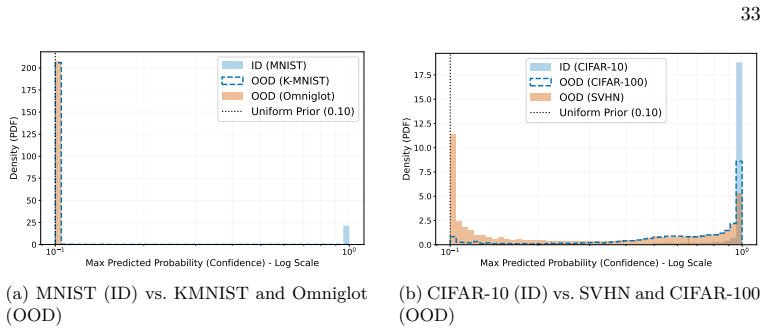
- The paper's CIFAR-10 results (OOD Brier 0.63 vs 0.065 for EDL) indicate that for far-OOD inputs the Gaussian density estimate is not sufficiently lower than in-distribution; a practical next step is to train the density estimator adversarially or with a latent-variable model to sharpen this contrast, which would convert the method's strong AUROC into low absolute confidence on OOD.
Editorial analysis
A structured set of objections, weighed in public.
Referee Report
Summary. The paper makes two main contributions. First, it provides a statistical interpretation of Evidential Deep Learning (EDL) by showing that the EDL loss corresponds to amortized variational inference in a hierarchical Bayesian model with a tempered pseudo-likelihood. Under a perfect-interpolation/expressive-network assumption, the paper shows that EDL's optimal variational distribution is Dir(α + ν P*_{Y|X}) and that its vacuity is K/(α0 + ν), demonstrating that standard EDL's uncertainty is controlled by an arbitrary temperature parameter and cannot separate epistemic from aleatoric uncertainty. Second, the paper proposes DIP-EDL, which replaces the temperature-scaled classifier output by a product n·DE(x)·NN(x), where DE is a marginal density estimator and NN is a conditional label estimator. The paper proves an asymptotic concentration result (Theorem 3.2) and reports experiments on MNIST and CIFAR-10 showing good AUROC/AUPR for OOD detection, though OOD Brier scores on CIFAR-10 are much worse than standard EDL.
Significance. If the central claims held, the variational-inference interpretation of EDL would be a valuable formalization of known critiques (Shen et al. 2024, Bengs et al. 2022), and DIP-EDL could offer a principled way to make EDL distribution-aware. The paper's theoretical derivation of EDL as amortized variational inference (Theorems 2.10, 2.15, 2.16 and Propositions 2.11, 2.13, 2.17) is rigorous, clearly presented, and correctly identifies the temperature parameter as the source of EDL's inability to separate uncertainty types. These results are a genuine contribution and match the recent literature. However, the DIP-EDL contribution is compromised by (i) the absence of a volume scale in the pseudo-count, (ii) the fact that Theorem 3.2 does not use the density's shape and is insensitive to any positive rescaling, and (iii) CIFAR-10 OOD Brier scores that are an order of magnitude worse than standard EDL, directly contradicting the abstract's claim of improved robustness and calibration under distributional shift. The paper's strengths are its clean derivation of the EDL objective and its explicit problematization of EDL's temperature dependence; the weaknesses are in the proposed method's
major comments (4)
- [Definition 3.1 and Appendix C.3] The pseudo-count n·DE^ψ(X_i) is not actually a count for continuous X. In a small neighborhood of volume Vol(A) around x, the expected number of training observations is n·P_X(x)·Vol(A), not n·P_X(x). The density has units of inverse volume, so the magnitude of n·DE(x) is arbitrary unless a reference volume is specified. The paper never provides such a volume. Appendix C.3 makes the problem concrete: raw log-densities are Z-score normalized using ID statistics before being exponentiated, so the quantity used as DE is not a consistent estimator of P_X. Consequently, Theorem 3.2's assumption DE → P_X is not satisfied by the algorithm actually deployed. This undermines the absolute uncertainty scale that the paper uses to interpret vacuity and OOD Brier scores.
- [Theorem 3.2 / Appendix B.11] The proof of Theorem 3.2 does not use the fact that DE estimates the density. It only requires that n·DE(X_i) → ∞ and NN → P_{Y|X}. Any positive scaling factor c·DE would yield exactly the same concentration: the mean converges to P_{Y|X} and the variance vanishes because the denominator α0 + n·c·P_X(X_i) diverges. Thus the theorem is a generic consistency statement for any positive weighting, not a demonstration that density information improves OOD calibration. To support the distributional-awareness claim, the paper needs a finite-sample or asymptotic result that shows how the functional form of DE controls the uncertainty magnitude, or at least an analysis of the actual Z-scored estimator used in practice.
- [Table 2 / Section 4.3] On CIFAR-10, DIP-EDL's OOD Brier scores are 0.6329 (CIFAR-100) and 0.5485 (SVHN), while standard EDL obtains 0.0654 and 0.0235 — an order of magnitude better. The paper's own discussion (Section 4.3, Section 4.4, Appendix D) attributes this to the density estimator, which is a central component of the proposed method. AUROC and AUPR are ranking metrics and do not assess absolute calibration; the OOD Brier score, computed against a uniform target, is the metric that measures whether the model says 'I don't know' on OOD inputs. The abstract's claim that DIP-EDL 'improves robustness and uncertainty calibration under distributional shift' is therefore not supported by the high-dimensional experiments; if anything, the results show the opposite for absolute confidence.
- [Section 3, Desiderata] The distributional-awareness property is imposed by construction: the Dirichlet concentration is proportional to DE(x), so low-density regions automatically yield diffuse posteriors. This is a reasonable design choice, but the paper's claim that density use 'naturally emerges from the model formulation without externally imposing it' is inaccurate — it is written directly into Definition 3.1. Furthermore, the connection to the covariate-indexed model (Definition 2.3) is heuristic: for continuous covariates the expected count in a neighborhood is n·P_X(x)·Vol(A), and the volume element is never specified. Without a volume scale, the analogy to pseudo-counts does not justify the particular scaling used in the method.
minor comments (4)
- [Appendix B.11] The proof heading says 'Proposition 3.2' but the statement in the main text is Theorem 3.2. Please correct the numbering.
- [Conclusion] Typo: 'gauranteeing' should be 'guaranteeing'.
- [Appendix C.3] The Z-score normalization is described only tersely. To be reproducible, specify the exact statistics (mean and standard deviation of which log-likelihoods, computed over which ID set) and whether the same transformation is applied to test and OOD inputs. This is important because the transformation changes the effective density estimator.
- [Table 3] The row '✓ ✓ ×' shows near-random ID accuracy (0.0980 on MNIST) while achieving almost perfect AUROC. The table caption says the best performance occurs when all three components are present, but the row '×✓ ✓' achieves the same AUROC with much better ID accuracy. Please clarify the role of n in this comparison.
Circularity Check
DIP-EDL's asymptotic-concentration theorem is built into Definition 3.1: its proof cancels the density term and reduces to the assumed consistency of the classifier; distributional awareness is likewise encoded by the density multiplier. The EDL critique is independent.
-
self definitional
[Definition 3.1 (Eq. 10) and Theorem 3.2; proof in Appendix B.11]
"Definition 3.1: qψ,ϕ_Xi = Dir(α + n DEψ_Xi NNϕ_Xi). Theorem 3.2: Assume that the density estimator and neural network estimators are consistent, DEψ_Xi → P*_X(Xi), NNϕ_Xi → P*_Y|X(·|Xi), then ... pi|X1:n,Y1:n → P*_Y|X(·|Xi)."
The theorem's conclusion is the consistency assumption on NN repackaged. In the proof B.11, E[pi|X1:n,Y1:n] = (α/n + DE·NN)/(α0/n + DE·NN) → P*_X(Xi)P*_Y|X(·|Xi)/P*_X(Xi) = P*_Y|X(·|Xi). The density estimator appears in both numerator and denominator and cancels; the only substantive input is NN → P*_Y|X. The Definition 3.1 parametrization was chosen precisely so this one-line limit holds. Thus the claimed asymptotic concentration is equivalent, by construction, to the plug-in consistency assumption rather than an independent derived result.
-
self definitional
[Section 3, paragraph after Definition 3.1 (desiderata (i)-(ii))]
"Moreover, this formulation satisfies both previously stated desiderata. (i, Distributational Awareness) in low-density regions with few nearby training samples the posterior predictive distribution contracts toward the prior. (ii, Asymptotic Consistency) q_Xi concentrates around the true conditional distribution P*_Y|X(·|Xi) as n → ∞ (see Theorem 3.2)."
Distributional awareness is not derived from the data-generating process or from the variational-inference objective; it is imposed by multiplying the Dirichlet concentrations by DEψ_Xi. If DEψ_Xi is small, then n·DE·NN ≈ 0, so q ≈ Dir(α) and the predictive distribution is the prior. This is exactly the behavior encoded in the defining formula Eq. (10). The paper presents this as a property satisfied by the model, but the property is built into the parametrization by design, making the 'awareness' a restatement of the definition rather than an emergent consequence.
full rationale
The paper contains no load-bearing self-citation: the EDL-as-amortized-VI and EDL-as-ERM derivations (Theorems 2.10, 2.15, 2.16, Proposition 2.17) are genuine analyses of the EDL objective, and the critique that EDL's vacuity is governed by the arbitrary temperature ν is supported by the algebra of the Dirichlet mean and does not reduce to an input. However, the central positive guarantees for DIP-EDL are not independent results: the variational family in Eq. (10) is defined as Dir(α + n·DE·NN), so both advertised properties—low-density collapse toward the prior and asymptotic concentration on P*_Y|X—follow immediately from that defining formula. The proof B.11 explicitly cancels the DE term, leaving only the assumed NN consistency, so Theorem 3.2 is essentially the consistency assumption restated as a posterior-concentration claim. This is construction-level circularity in the theoretical contribution. Separately, Appendix C.3 replaces raw log-densities by Z-scored ID statistics before exponentiating, so the deployed DE is not a consistent estimator of P_X and Theorem 3.2's assumption is not satisfied by the algorithm; and Table 2 shows DIP-EDL OOD Brier scores on CIFAR-10 of 0.6329 (CIFAR-100) and 0.5485 (SVHN) versus EDL's 0.0654 and 0.0235. These are correctness/empirical concerns rather than additional circularity, but they reinforce that the theoretical guarantee is disconnected from the high-dimensional OOD calibration claim. Overall the EDL critique is independent and the empirical work is mostly honest about its failures, but the headline DIP-EDL guarantees largely reduce by construction, giving a partial-circularity score of 6.
Assumptions & free parameters
free parameters (5)
- prior concentration α =
unspecified (likely 1)
- pseudo-count scale n (training set size) =
60,000 (MNIST); 50,000 (CIFAR-10)
- log-likelihood Z-score statistics (μ, σ) =
computed from in-distribution training log-likelihoods
- density estimator parameters ψ (MAF weights; GDA means/covariances) =
fitted on ID training data
- classifier parameters ϕ =
trained on ID data
assumptions (5)
- domain assumption P*_X is absolutely continuous with respect to Lebesgue measure on R^d
- domain assumption The unnormalized tempered categorical likelihood is treated as a pseudo-likelihood for Bayesian updating
- domain assumption The neural network class is sufficiently expressive and optimization attains the global minimum
- domain assumption Density estimator and classifier are consistent estimators of P*_X and P*_{Y|X}
- standard math Standard Dirichlet, KL-divergence, and Gibbs variational principle results
Cite this review
Pith. "Pith review of Density-Informed Pseudo-Counts for Calibrated Evidential Deep Learning." pith.science (2026). https://pith.science/paper/7YVHCVQN
@misc{pith2026260201477,
  author       = {Pith},
  title        = {Pith review of: Density-Informed Pseudo-Counts for Calibrated Evidential Deep Learning},
  year         = {2026},
  howpublished = {\url{https://pith.science/paper/7YVHCVQN}},
  note         = {Machine review of arXiv:2602.01477}
}
read the original abstract
Evidential Deep Learning (EDL) is a popular framework for uncertainty-aware classification that models predictive uncertainty via Dirichlet distributions parameterized by neural networks. Despite its popularity, its theoretical foundations and behavior under distributional shift remain poorly understood. In this work, we provide a principled statistical interpretation by proving that EDL training corresponds to amortized variational inference in a hierarchical Bayesian model with a tempered pseudo-likelihood. This perspective reveals a major drawback: standard EDL conflates epistemic and aleatoric uncertainty, leading to systematic overconfidence on out-of-distribution (OOD) inputs. To address this, we introduce Density-Informed Pseudo-count EDL (DIP-EDL), a new parametrization that decouples class prediction from the magnitude of uncertainty by separately estimating the conditional label distribution and the marginal covariate density. This separation preserves evidence in high-density regions while shrinking predictions toward a uniform prior for OOD data. Theoretically, we prove that DIP-EDL achieves asymptotic concentration. Empirically, we show that our method enhances interpretability and improves robustness and uncertainty calibration under distributional shift.
Figures
Reference graph
Works this paper leans on
-
[1]
The need for uncertainty quantification in machine-assisted medical decision making
Begoli, E., Bhattacharya, T., and Kusnezov, D. (2019). “The need for uncertainty quantification in machine-assisted medical decision making.”Nature Machine In- telligence, 1(1): 20–23. 1
2019
-
[2]
Pitfalls of epistemic uncer- tainty quantification through loss minimisation
Bengs, V., Hüllermeier, E., and Waegeman, W. (2022). “Pitfalls of epistemic uncer- tainty quantification through loss minimisation.”Advances in Neural Information Processing Systems, 35: 29205–29216. 6, 21
2022
-
[3]
On second-order scoring rules for epistemic uncertainty quantification
— (2023). “On second-order scoring rules for epistemic uncertainty quantification.” InInternational Conference on Machine Learning, 2078–2091. PMLR. 21
2023
-
[4]
A general framework for updating belief distributions
Bissiri, P. G., Holmes, C. C., and Walker, S. G. (2016). “A general framework for updating belief distributions.”Journal of the Royal Statistical Society Series B: Statistical Methodology, 78(5): 1103–1130. 5
2016
-
[5]
Weight uncertainty in neural network
Blundell, C., Cornebise, J., Kavukcuoglu, K., and Wierstra, D. (2015). “Weight uncertainty in neural network.” InInternational conference on machine learning, 1613–1622. PMLR. 1
2015
-
[6]
Density-regression: Efficient and distance-aware deepregressorforuncertaintyestimationunderdistributionshifts
Bui, H. M. and Liu, A. (2024). “Density-regression: Efficient and distance-aware deepregressorforuncertaintyestimationunderdistributionshifts.” InInternational Conference on Artificial Intelligence and Statistics, 2998–3006. PMLR. 9
2024
-
[7]
Posterior network: un- certainty estimation without OOD samples via density-based pseudo-counts
Charpentier, B., Zügner, D., and Günnemann, S. (2020). “Posterior network: un- certainty estimation without OOD samples via density-based pseudo-counts.” In Proceedings of the 34th International Conference on Neural Information Processing Systems, NIPS ’20. Red Hook, NY, USA: Curran Associates Inc. 9, 10, 20, 32
2020
-
[8]
R-EDL: Relaxing Nonessential Settings of Evidential Deep Learning
Chen, M., Gao, J., and Xu, C. (2024). “R-EDL: Relaxing Nonessential Settings of Evidential Deep Learning.” InThe Twelfth International Conference on Learning Representations. URLhttps://openreview.net/forum?id=Si3YFA641c10, 32
2024
Show all 56 references
-
[9]
R-edl: Relaxing nonessential settings of evidential deep learning
— (2024). “R-edl: Relaxing nonessential settings of evidential deep learning.” In The Twelfth International Conference on Learning Representations. 21
2024
-
[10]
Deep Learning for Classical Japanese Literature
Clanuwat, T., Bober-Irizar, M., Kitamoto, A., Lamb, A., Yamamoto, K., and Ha, D. (2018). “Deep Learning for Classical Japanese Literature.” 10
2018
-
[11]
Uncertainty Esti- mation by Fisher Information-based Evidential Deep Learning
Deng, D., Chen, G., Yu, Y., Liu, F., and Heng, P.-A. (2023). “Uncertainty Esti- mation by Fisher Information-based Evidential Deep Learning.” URLhttps://arxiv.org/abs/2303.0204510
2023 arXiv
-
[12]
Uncertainty estimation by fisher information-based evidential deep learning
— (2023). “Uncertainty estimation by fisher information-based evidential deep learning.” InInternational conference on machine learning, 7596–7616. PMLR. 20
2023
-
[13]
The MNIST Database of Handwritten Digit Images for Machine Learning Research [Best of the Web]
Deng, L. (2012). “The MNIST Database of Handwritten Digit Images for Machine Learning Research [Best of the Web].”IEEE Signal Processing Magazine, 29(6): 141–142. 9, 29
2012
-
[14]
nflows: nor- 16DIP–Evidential Deep Learning malizing flows in PyTorch
Durkan, C., Bekasov, A., Murray, I., and Papamakarios, G. (2020). “nflows: nor- 16DIP–Evidential Deep Learning malizing flows in PyTorch.” URLhttps://doi.org/10.5281/zenodo.429628729
2020 doi
-
[15]
Self-distribution distillation: efficient un- certainty estimation
Fathullah, Y. and Gales, M. J. (2022). “Self-distribution distillation: efficient un- certainty estimation.” InUncertainty in Artificial Intelligence, 663–673. PMLR. 20
2022
-
[16]
Dropout as a bayesian approximation: Repre- sentingmodeluncertaintyindeeplearning
Gal, Y. and Ghahramani, Z. (2016). “Dropout as a bayesian approximation: Repre- sentingmodeluncertaintyindeeplearning.” Ininternational conference on machine learning, 1050–1059. PMLR. 1, 10
2016
-
[17]
Bayesian uncertainty quantification for machine-learned models in physics
Gal, Y., Koumoutsakos, P., Lanusse, F., Louppe, G., and Papadimitriou, C. (2022). “Bayesian uncertainty quantification for machine-learned models in physics.”Na- ture Reviews Physics, 4(9): 573–577. 1
2022
-
[18]
A comprehensive survey on evi- dential deep learning and its applications
Gao, J., Chen, M., Xiang, L., and Xu, C. (2025). “A comprehensive survey on evi- dential deep learning and its applications.”IEEE Transactions on Pattern Analysis and Machine Intelligence. 2
2025
-
[19]
Conformal prediction with conditionalguarantees
Gibbs, I., Cherian, J. J., and Candès, E. J. (2025). “Conformal prediction with conditionalguarantees.”Journal of the Royal Statistical Society Series B: Statistical Methodology, qkaf008. 1
2025
-
[20]
On calibration of modern neural networks
Guo, C., Pleiss, G., Sun, Y., and Weinberger, K. Q. (2017). “On calibration of modern neural networks.” InInternational conference on machine learning, 1321–
2017
-
[21]
Discriminant Analysis by Gaussian Mix- tures
Hastie, T. J. and Tibshirani, R. (1996). “Discriminant Analysis by Gaussian Mix- tures.”Journal of the royal statistical society series b-methodological, 58: 155–176. URLhttps://api.semanticscholar.org/CorpusID:11869483910
1996
-
[22]
Bayesian evidential deep learning with PAC regularization
Haussmann, M., Gerwinn, S., and Kandemir, M. (2019). “Bayesian evidential deep learning with PAC regularization.”arXiv preprint arXiv:1906.00816. 20
2019 arXiv
-
[23]
Deep Residual Learning for Image Recognition
He, K., Zhang, X., Ren, S., and Sun, J. (2016). “Deep Residual Learning for Image Recognition.” In2016 IEEE Conference on Computer Vision and Pattern Recognition (CVPR), 770–778. 10, 31
2016
-
[24]
A survey on uncertainty quantification methods for deep learning
He, W., Jiang, Z., Xiao, T., Xu, Z., and Li, Y. (2025). “A survey on uncertainty quantification methods for deep learning.”ACM Computing Surveys. 1
2025
-
[25]
Probabilistic backpropagation for scalable learning of bayesian neural networks
Hernández-Lobato, J. M. and Adams, R. (2015). “Probabilistic backpropagation for scalable learning of bayesian neural networks.” InInternational conference on machine learning, 1861–1869. PMLR. 1
2015
-
[26]
Distilling the knowledge in a neural network
Hinton, G., Vinyals, O., and Dean, J. (2015). “Distilling the knowledge in a neural network.”arXiv preprint arXiv:1503.02531. 20
2015 arXiv
-
[27]
The effects of communicating uncertainty around statistics, on public trust
Kerr, J., Van Der Bles, A.-M., Dryhurst, S., Schneider, C. R., Chopurian, V., Freeman, A. L., and Van Der Linden, S. (2023). “The effects of communicating uncertainty around statistics, on public trust.”Royal Society Open Science, 10(11): 230604. 14 17
2023
-
[28]
Learning Multiple Layers of Features from Tiny Images
Krizhevsky, A. (2009). “Learning Multiple Layers of Features from Tiny Images.” 10
2009
-
[29]
Learning multiple layers of features from tiny images.(2009)
Krizhevsky, A., Hinton, G., et al. (2009). “Learning multiple layers of features from tiny images.(2009).” 9, 31
2009
-
[30]
Human-level con- cept learning through probabilistic program induction
Lake, B. M., Salakhutdinov, R., and Tenenbaum, J. B. (2015). “Human-level con- cept learning through probabilistic program induction.”Science, 350(6266): 1332– 1338. URLhttps://www.science.org/doi/abs/10.1126/science.aab305010
2015 doi
-
[31]
Simple and scal- able predictive uncertainty estimation using deep ensembles
Lakshminarayanan, B., Pritzel, A., and Blundell, C. (2017). “Simple and scal- able predictive uncertainty estimation using deep ensembles.”Advances in neural information processing systems, 30. 1, 10
2017
-
[32]
Gradient-based learning applied to document recognition
Lecun, Y., Bottou, L., Bengio, Y., and Haffner, P. (1998). “Gradient-based learning applied to document recognition.”Proceedings of the IEEE, 86(11): 2278–2324. 10, 29
1998
-
[33]
As Confidence Aligns: Understanding the Effect of AI Confidence on Human Self-confidence in Human-AI Decision Making
Li, J., Yang, Y., Liao, Q. V., Zhang, J., and Lee, Y.-C. (2025). “As Confidence Aligns: Understanding the Effect of AI Confidence on Human Self-confidence in Human-AI Decision Making.” InProceedings of the 2025 CHI Conference on Hu- man Factors in Computing Systems, 1–16. 14
2025
-
[34]
Predictive uncertainty estimation via prior networks
Malinin, A. and Gales, M. (2018). “Predictive uncertainty estimation via prior networks.”Advances in neural information processing systems, 31. 20
2018
-
[35]
Reverse kl-divergence training of prior networks: Improved uncertainty and adversarial robustness
— (2019). “Reverse kl-divergence training of prior networks: Improved uncertainty and adversarial robustness.”Advances in neural information processing systems,
2019
-
[36]
Ensemble distribution distil- lation
Malinin, A., Mlodozeniec, B., and Gales, M. (2019). “Ensemble distribution distil- lation.”arXiv preprint arXiv:1905.00076. 20
2019 arXiv
-
[37]
Amortized variational inference: When and why?
Margossian, C. C. and Blei, D. M. (2023). “Amortized variational inference: When and why?”arXiv preprint arXiv:2307.11018. 4
2023 arXiv
-
[38]
Benchmarking uncertainty dis- entanglement: Specialized uncertainties for specialized tasks
Mucsányi, B., Kirchhof, M., and Oh, S. J. (2024). “Benchmarking uncertainty dis- entanglement: Specialized uncertainties for specialized tasks.”Advances in neural information processing systems, 37: 50972–51038. 1
2024
-
[39]
Deep deterministic uncertainty: A simple baseline
Mukhoti, J., Kirsch, A., van Amersfoort, J., Torr, P. H., and Gal, Y. (2021). “Deep deterministic uncertainty: A simple baseline.”arXiv preprint arXiv:2102.11582. 9
2021 arXiv
-
[40]
Reading Digits in Natural Images with Unsupervised Feature Learning
Netzer,Y.,Wang,T.,Coates,A.,Bissacco,A.,Wu,B.,andNg,A.(2011). “Reading Digits in Natural Images with Unsupervised Feature Learning.” URLhttps://api.semanticscholar.org/CorpusID:1685251810
2011
-
[41]
Masked Autoregressive Flow for Density Estimation
Papamakarios, G., Pavlakou, T., and Murray, I. (2017). “Masked Autoregressive Flow for Density Estimation.” In Guyon, I., Luxburg, U. V., Bengio, S., Wallach, H., Fergus, R., Vishwanathan, S., and Garnett, R. (eds.),Advances in Neural Information Processing Systems, volume 30....
2017
-
[42]
(2019).PyTorch: an imperative style, high-performance deep learning library
Paszke, A., Gross, S., Massa, F., Lerer, A., Bradbury, J., Chanan, G., Killeen, T., Lin, Z., Gimelshein, N., Antiga, L., Desmaison, A., Köpf, A., Yang, E., DeVito, Z., Raison, M., Tejani, A., Chilamkurthy, S., Steiner, B., Fang, L., Bai, J., and Chintala, S. (2019).PyTorch: an...
2019
-
[43]
The effects of communicating scientific uncertainty on trust and decision making in a public health context
Schneider, C. R., Freeman, A. L., Spiegelhalter, D., and van der Linden, S. (2022). “The effects of communicating scientific uncertainty on trust and decision making in a public health context.”Judgment and Decision Making, 17(4): 849–882. 14
2022
-
[44]
Beyond deep ensembles: A large-scale evaluation of bayesian deep learning under distribution shift
Seligmann, F., Becker, P., Volpp, M., and Neumann, G. (2023). “Beyond deep ensembles: A large-scale evaluation of bayesian deep learning under distribution shift.”Advances in Neural Information Processing Systems, 36: 29372–29405. 1
2023
-
[45]
Uncertainty-aware deep classifiers using generative models
Sensoy, M., Kaplan, L., Cerutti, F., and Saleki, M. (2020). “Uncertainty-aware deep classifiers using generative models.” InProceedings of the AAAI conference on artificial intelligence, volume 34, 5620–5627. 20
2020
-
[46]
Evidential deep learning to quantify classification uncertainty
Sensoy, M., Kaplan, L., and Kandemir, M. (2018). “Evidential deep learning to quantify classification uncertainty.”Advances in neural information processing sys- tems, 31. 2, 5, 6, 10, 20, 32
2018
-
[47]
Are uncertainty quantification capabilities of evidential deep learning a mirage?
Shen, M., Ryu, J. J., Ghosh, S., Bu, Y., Sattigeri, P., Das, S., and Wornell, G. (2024). “Are uncertainty quantification capabilities of evidential deep learning a mirage?”Advances in Neural Information Processing Systems, 37: 107830–107864. 6, 7, 20, 21
2024
-
[48]
Information robust dirichlet networks for predictive un- certainty estimation
Tsiligkaridis, T. (2021). “Information robust dirichlet networks for predictive un- certainty estimation.” US Patent App. 17/064,046. 20
2021
-
[49]
Prior and posterior networks: A survey on evidential deep learning methods for uncertainty estimation
Ulmer, D., Hardmeier, C., and Frellsen, J. (2021). “Prior and posterior networks: A survey on evidential deep learning methods for uncertainty estimation.”arXiv preprint arXiv:2110.03051. 20
2021 arXiv
-
[50]
HybridFlow: Quantification of Aleatoric and Epistemic Uncertainty with a Single Hybrid Model
Van Katwyk, P. and Bergen, K. J. (2025). “HybridFlow: Quantification of Aleatoric and Epistemic Uncertainty with a Single Hybrid Model.”arXiv preprint arXiv:2510.05054. 9
2025
-
[51]
Pseudo-likelihoods for Bayesian inference
Ventura, L. and Racugno, W. (2016). “Pseudo-likelihoods for Bayesian inference.” InTopics on methodological and applied statistical inference, 205–220. Springer. 5
2016
-
[52]
Diversity-enhanced probabilistic ensemble for un- certainty estimation
Wang, H. and Ji, Q. (2023). “Diversity-enhanced probabilistic ensemble for un- certainty estimation.” InUncertainty in Artificial Intelligence, 2214–2225. PMLR. 1
2023
-
[53]
Uncertainty estimation by density aware evidential deep learning
Yoon, T. and Kim, H. (2024). “Uncertainty estimation by density aware evidential deep learning.” InProceedings of the 41st International Conference on Machine Learning, ICML’24. JMLR.org. 9, 10, 31, 32 19
2024
-
[54]
Quantifying clas- sification uncertainty using regularized evidential neural networks
Zhao, X., Ou, Y., Kaplan, L., Chen, F., and Cho, J.-H. (2019). “Quantifying clas- sification uncertainty using regularized evidential neural networks.”arXiv preprint arXiv:1910.06864. 20 20DIP–Evidential Deep Learning Appendix A: Related Literature. Thissectioncontextualizesth...
2019 arXiv
-
[55]
[47] for a comprehensive overview of existing limitations
for EDL-specific developments and Shen et al. [47] for a comprehensive overview of existing limitations. A.1 Contrasting DIP-EDL with Existing EDL Paradigms Following the taxonomy by Ulmer et al. [49], EDL methods for Dirichlet-based classifi- cation are primarily distinguishe...
-
[56]
The flow consists 30DIP–Evidential Deep Learning Table 4: LeNet-5 implementation details for MNIST
to model the data density directly on flattened28×28pixel inputs. The flow consists 30DIP–Evidential Deep Learning Table 4: LeNet-5 implementation details for MNIST. Layer Type Specifications Conv2d In: 1, Out: 20, Kernel:5×5, Stride: 1, Pad: 2, ReLU MaxPool2d Kernel:2×2, Stri...
2023
Reviewed August 3, 2026 · model on record in the stance chip above.
Discussion (0). Continue with ORCID to comment.