Sea-Scan: High-Accuracy, ML-based Dark Vessel Detection and Localisation via Weakly Supervised DAS Monitoring
Pith reviewed 2026-06-26 13:04 UTC · model grok-4.3
The pith
A weakly supervised ML model detects dark vessels at 97.8% rate and localizes them in DAS data.
A machine-rendered reading of the paper's core claim, the machinery that carries it, and where it could break.
Core claim
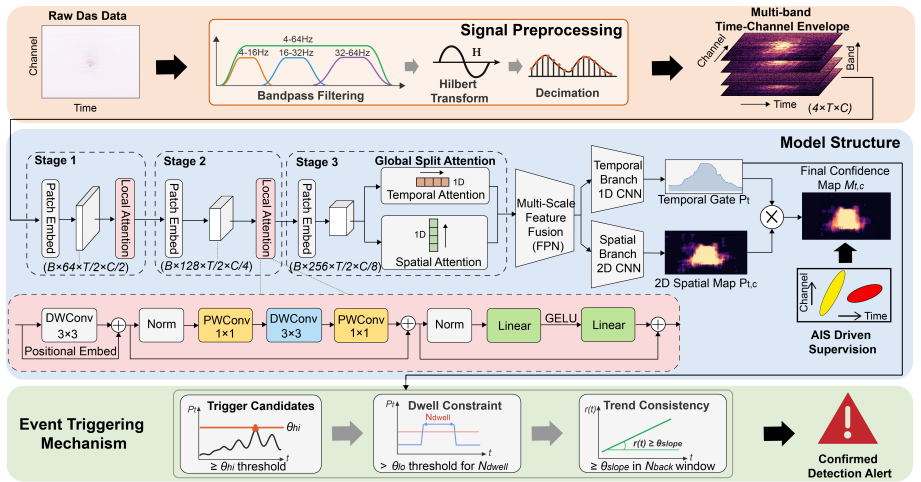
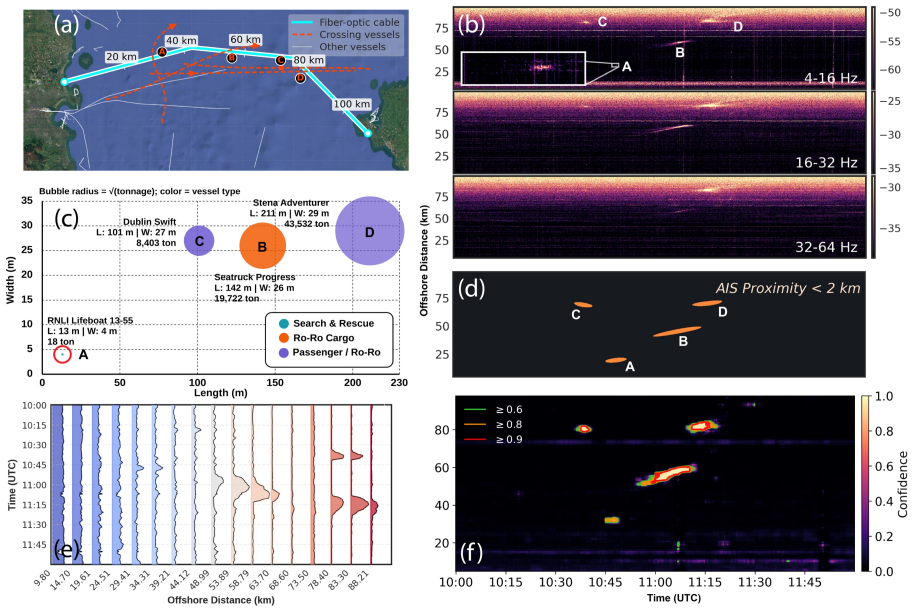
We present an ML-based vessel detection and localization system, trained with weak supervision from imperfect AIS labels, that achieves a 97.8% detection rate at 1.98% false-trigger rate, successfully identifies dark-vessel events from unlabeled data.
What carries the argument
Weakly supervised ML model trained on DAS acoustic data with AIS labels for vessel detection and localization
If this is right
- The system detects vessels absent from AIS records.
- It provides both detection and localization outputs.
- Performance holds on completely unlabeled DAS data.
- Weak supervision removes the need for precise per-event labels during training.
Where Pith is reading between the lines
- If the model generalizes across sea states and sensor deployments, it could support large-scale passive monitoring of exclusive economic zones.
- The same weak-supervision strategy might transfer to other acoustic or optical maritime sensors without new labeling campaigns.
- Cross-validation against satellite or radar dark-vessel catalogs would provide an external check on whether the reported rates hold in operational settings.
Load-bearing premise
Imperfect AIS labels supply enough reliable signal for the model to learn dark-vessel patterns that transfer to new unlabeled DAS recordings.
What would settle it
Running the trained model on a separate DAS dataset containing independently confirmed dark vessel positions and observing detection rates well below 97.8% or false-trigger rates well above 1.98%.
Figures
read the original abstract
We present an ML-based vessel detection and localization system, trained with weak supervision from imperfect AIS labels, that achieves a 97.8% detection rate at 1.98% false-trigger rate, successfully identifies dark-vessel events from unlabeled data.
Editorial analysis
A structured set of objections, weighed in public.
Referee Report
Summary. The manuscript presents Sea-Scan, an ML-based vessel detection and localization system trained via weak supervision from imperfect AIS labels on DAS data. It reports a 97.8% detection rate at 1.98% false-trigger rate and claims that the model successfully identifies dark-vessel events from unlabeled data.
Significance. If the generalization to truly unlabeled dark-vessel detection were quantitatively validated, the approach could offer a practical advance in maritime monitoring by leveraging existing imperfect AIS for training while extending to non-AIS vessels. The current evidence, however, does not yet establish this step.
major comments (2)
- [Abstract] Abstract: the headline performance numbers (97.8% detection rate, 1.98% FTR) are presented without any information on dataset size, train/test partitioning, validation procedure, baseline methods, or handling of label noise from imperfect AIS. This omission makes it impossible to determine whether the metrics support the stated claims.
- [Results] Results section (inferred from abstract claims): the assertion that the system 'successfully identifies dark-vessel events from unlabeled data' rests on an unquantified generalization step. Because dark vessels are defined by the absence of AIS, any numeric success rate must be supported by an independent verification method (expert review, synthetic dark-vessel injection, or cross-sensor confirmation) on unlabeled segments; the manuscript appears to report metrics exclusively on AIS-matched folds, leaving the central dark-vessel claim without direct quantitative backing.
minor comments (1)
- [Abstract] Abstract: a single sentence on the scale or characteristics of the DAS recordings would help readers contextualize the reported rates.
Simulated Author's Rebuttal
We thank the referee for the detailed and constructive review of our manuscript. We address each major comment below and describe the planned revisions.
read point-by-point responses
-
Referee: [Abstract] Abstract: the headline performance numbers (97.8% detection rate, 1.98% FTR) are presented without any information on dataset size, train/test partitioning, validation procedure, baseline methods, or handling of label noise from imperfect AIS. This omission makes it impossible to determine whether the metrics support the stated claims.
Authors: We agree that the abstract would benefit from additional experimental context. In the revised version we will expand the abstract to report dataset size, train/test partitioning, validation procedure, baseline comparisons, and the treatment of AIS label noise within the weak-supervision pipeline. revision: yes
-
Referee: [Results] Results section (inferred from abstract claims): the assertion that the system 'successfully identifies dark-vessel events from unlabeled data' rests on an unquantified generalization step. Because dark vessels are defined by the absence of AIS, any numeric success rate must be supported by an independent verification method (expert review, synthetic dark-vessel injection, or cross-sensor confirmation) on unlabeled segments; the manuscript appears to report metrics exclusively on AIS-matched folds, leaving the central dark-vessel claim without direct quantitative backing.
Authors: The referee correctly notes that quantitative metrics are computed on AIS-matched folds where ground truth is available. The manuscript currently supports the dark-vessel claim with qualitative examples on unlabeled segments. To strengthen the central claim we will add an independent quantitative validation step (synthetic injection or cross-sensor confirmation) on unlabeled data in the revised results section. revision: yes
Circularity Check
No circularity; empirical ML claims self-contained
full rationale
The provided abstract and context contain no equations, derivations, self-citations, or load-bearing steps matching any enumerated circularity pattern. The reported metrics (97.8% detection, 1.98% FTR) are standard held-out performance figures from a weakly supervised model; they do not reduce by construction to the AIS labels via self-definition or renaming. No uniqueness theorems, ansatzes, or fitted inputs presented as independent predictions appear. The paper's central claim rests on empirical generalization rather than any definitional equivalence to its inputs.
Axiom & Free-Parameter Ledger
Reference graph
Works this paper leans on
-
[1]
A novel anomaly detection ap- proach to identify intentional ais on-off switching,
F . Mazzarella, M. Vespe, A. Alessandrini, D. Tarchi, G. Aulicino, and A. Vollero, “A novel anomaly detection ap- proach to identify intentional ais on-off switching,”Expert Systems with Applications,vol. 78, 02 2017
2017
-
[2]
Ocean space surveillance and real-time event characterization using distributed acoustic sensing on submarine networks,
A. F . Bairdet al., “Ocean space surveillance and real-time event characterization using distributed acoustic sensing on submarine networks,”Seismol. Res. Lett., 96(2A), 691– 705, Jan. 2025
2025
-
[3]
Overview of distributed acoustic sensing: Theory and ocean applications,
A. Xenaki, P . Gerstoft, E. Williams, and S. Abadi, “Overview of distributed acoustic sensing: Theory and ocean applications,”J. Acoust. Soc. Am., 158(1), 801– 825, Jul. 2025
2025
-
[4]
Preliminary assessment of ship detection and trajectory evaluation using distributed acoustic sens- ing on an optical fiber telecom cable,
D. Rivetet al., “Preliminary assessment of ship detection and trajectory evaluation using distributed acoustic sens- ing on an optical fiber telecom cable,”J. Acoust. Soc. Am., 149(4), 2615–2627, Apr. 2021
2021
-
[5]
Sensing whales, storms, ships and earthquakes using an Arctic fibre optic cable,
M. Landrøet al., “Sensing whales, storms, ships and earthquakes using an Arctic fibre optic cable,”Sci. Rep., 12(1), 19226, Nov. 2022
2022
-
[6]
Leveraging distributed acoustic sensing for monitoring vessels using submarine fiber-optic cables,
B. Paapet al., “Leveraging distributed acoustic sensing for monitoring vessels using submarine fiber-optic cables,” Appl. Ocean Res., 154, 104422, Jan. 2025
2025
-
[7]
DAShip: A large-scale annotated dataset for ship detection using distributed acoustic sensing tech- nique,
W. Huanget al., “DAShip: A large-scale annotated dataset for ship detection using distributed acoustic sensing tech- nique,”IEEE J. Sel. Topics Appl. Earth Observ. Remote Sens., 18, 4093–4107, 2025
2025
-
[8]
E. E. Ramirez-Torreset al., “Vessel detection and local- ization using distributed acoustic sensing in submarine optical fiber cables,” arXiv:2509.11614, Sep. 2025
work page internal anchor Pith review Pith/arXiv arXiv 2025
-
[9]
C. Zhang, W. Zhu, B. A. Romanowicz, R. M. Allen, K. Soga, and Y . Wu, “A deep learning framework for marine acoustic and seismic monitoring with distributed acoustic sensing,” arXiv:2603.14844, Mar. 2026
work page internal anchor Pith review arXiv 2026
-
[10]
Tracking moving ships using distributed acoustic sensing data,
J. Shao, Y . Wang, Y . Zhang, X. Zhang, and C. Zhang, “Tracking moving ships using distributed acoustic sensing data,”IEEE Geosci. Remote Sens. Lett., 22, 1–5, 2025
2025
-
[11]
UniFormer: Unified transformer for efficient spatiotemporal representation learning,
K. Liet al., “UniFormer: Unified transformer for efficient spatiotemporal representation learning,” arXiv:2201.04676, 2022
discussion (0)
Sign in with ORCID, Apple, or X to comment. Anyone can read and Pith papers without signing in.