REVIEW 3 major objections 6 minor 65 references
Marker-driven hierarchical adaptive meshes let level-set interface transport match uniform-grid accuracy at far lower cost under severe deformations.
Reviewed by Pith at T0; open to challenge. T0 means a machine referee read the full paper against a public rubric. the ladder, T0–T4 →
T0 review · grok-4.5
2026-07-31 17:43 UTC pith:A22T55SB
load-bearing objection Solid kinematic AMR level-set module on unstructured FEM trees; evidence is clean for what it claims, and the only real gap is the still-untested NS coupling. the 3 major comments →
An Adaptive Finite Element Method for Marker-Driven Level-Set Transport on Hierarchical Meshes
The pith
A machine-rendered reading of the paper's core claim, the machinery that carries it, and where it could break.
Core claim
On severe kinematic interface deformations in two and three dimensions, across structured and unstructured meshes of several element families, marker-driven hierarchical AMR combined with semi-Lagrangian update achieves mass and geometric errors comparable to uniform discretizations at the same minimum spacing while using substantially fewer cells and retaining good conservation under aggressive adaptivity.
What carries the argument
Forward marker advection from cut elements rebuilds the multilevel tree hierarchy around the predicted interface; backward characteristic tracing then interpolates the level-set on the new finest level, with both steps driven by a multilevel point-location push-down through stored parent–child maps, plus a closest-point reinitialization triggered by a gradient-deviation indicator.
Load-bearing premise
Success on smooth, analytically prescribed, time-reversible velocity fields is enough to show the same hierarchy, point location, and reinitialization will stay accurate once the velocity comes from a coupled two-phase flow solver.
What would settle it
Couple the hierarchy to an incompressible two-phase Navier–Stokes solve with discontinuous density and interfacial stress, rerun a severe deformation or rising-bubble case, and check whether mass and geometric errors at matched finest spacing stay comparable to a uniform fine mesh while cell count still tracks the interface measure.
If this is right
- Interface resolution can be raised without paying full-domain degrees-of-freedom growth, because active cells scale like the interface measure.
- The same multilevel hierarchy is reusable as the data structure for multilevel or multigrid solvers on hanging-node finite-element spaces.
- Dynamic refinement and coarsening need no mesh-conformity propagation beyond a one-level grading rule, simplifying adaptivity on unstructured simplicial and hybrid meshes.
- The transport layer is designed to drop into existing level-set multiphase solvers that already use standard finite-element data structures.
Where Pith is reading between the lines
- If the kinematic-to-dynamic transfer holds, aggressive narrow-band AMR becomes practical for high-density-ratio flows where uniform fine grids are currently prohibitive.
- The reference-space refinement templates may transfer to other characteristic-based free-boundary problems beyond level sets, such as pure advection of passive scalars on evolving bands.
- Failure modes to watch after coupling are velocity interpolation at off-node Runge–Kutta stages and reinitialization-induced interface shift under strong interfacial forces.
Editorial analysis
A structured set of objections, weighed in public.
Referee Report
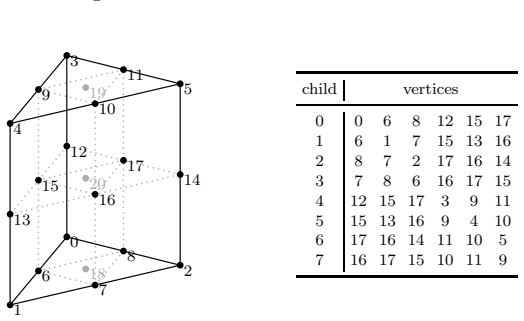
Summary. The manuscript develops a marker-driven adaptive finite-element scheme for kinematic level-set transport on hierarchical (tree-based) meshes. Refinement is performed in reference coordinates with fixed templates for Quad9, Tri7, Hex27, Tet15 and Wedge21 elements under a 2:1 grading constraint; Φ is stored only on the finest leaves. Each step uses forward marker advection to rebuild the hierarchy around the predicted interface, then backward semi-Lagrangian characteristic tracing (RK4) with multilevel push-down point location to update Φ, optionally followed by a closest-point / kd-tree reinitialization triggered by a gradient-deviation indicator D. Validation is restricted to prescribed, smooth, divergence-free, time-reversible velocity fields (vortex, rising-bubble on funnel meshes, rigid rotation) in 2D/3D on structured and unstructured grids. Tables report mass and geometric errors, observed orders, AMR-vs-uniform cell counts and wall times, reinitialization frequency, and a limited literature mass-error comparison, supporting accuracy comparable to uniform grids at the same h_min at substantially lower cost.
Significance. Within its stated kinematic scope the contribution is solid and practically useful: reference-space hierarchical AMR on mixed unstructured element families, combined with efficient multilevel point location and a marker-only geometric prediction step (markers do not reconstruct topology), is a clear engineering advance over Cartesian octree or conformity-constrained AFEM level-set schemes. The systematic multi-element, multi-geometry tables (including funnel and ball domains), AMR scaling consistent with interface measure, and explicit with/without-reinitialization study are strengths. The work is positioned as infrastructure for future multiphase NS coupling (FEMuS-compatible elements, hanging-node multigrid path); that transfer remains unproven, so the significance for the intended two-phase use case is prospective rather than demonstrated. No machine-checked proofs or public code release are claimed, but the algorithmic description (Algorithms 1–5) is detailed enough to be reproducible in principle.
major comments (3)
- [Abstract; §7; §9] Abstract and §9 assert that the framework “can be naturally integrated into level-set-based multiphase flow solvers,” yet all quantitative support (Tables 1–9, §8) uses analytically prescribed, smooth, divergence-free velocities with analytic exterior extension (§7). Once velocity is only nodal, discontinuous across the interface, and coupled to interfacial stresses, the accuracy of RK4 characteristic feet, multilevel inverse mappings (Alg. 3), and closest-point reinitialization (§6) is untested. Either add a minimal coupled demonstration or qualify the abstract/conclusions so the central efficiency claim is explicitly limited to kinematic transport.
- [Table 8; §8.6] Table 8 (Tet15, ball domain, rigid rotation): mass error Em decreases then saturates near 3e-5 for ℓmax≥8 while Eg continues to drop. The text attributes this to curved geometry, quadrature and round-off, but does not quantify which contribution dominates or whether the saturation worsens under non-rigid deformation. A short diagnostic (e.g., fixed-geometry interpolation test or higher-order quadrature) is needed to show that the hierarchical Tet15 path does not introduce a conservation floor that would undermine the “good conservation under aggressive adaptivity” claim on curved simplicial meshes.
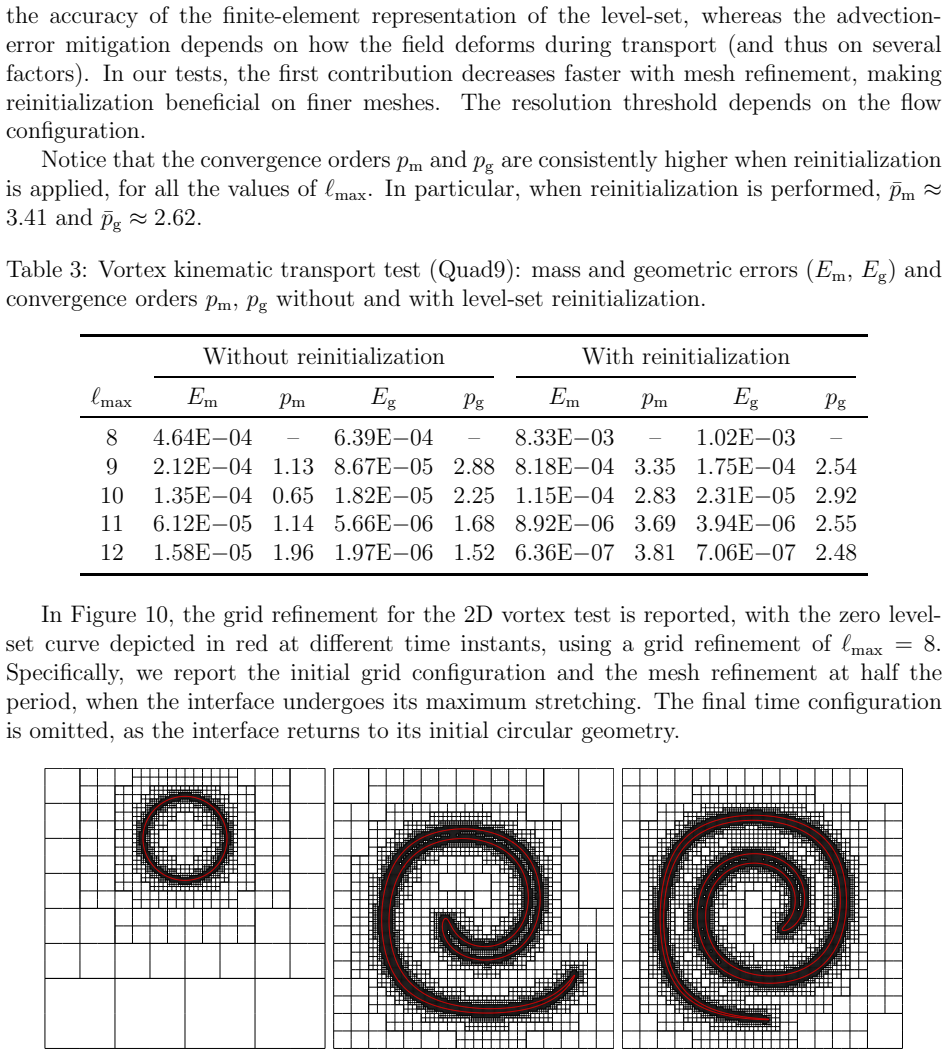
- [Table 3; §6.4; §8.4–8.5] Reinitialization benefit is demonstrated only for the 2D Quad9 vortex (Table 3). All other tables enable reinitialization with fixed τ_reinit=0.25. Given that reinitialization both reduces advection error and introduces interface shift (§6.2), and that the rising-bubble funnel case already shows boundary-induced artifacts at coarse ℓmax (Table 7, ℓ=8), a second with/without comparison (e.g., 3D vortex or funnel) would make the adaptive-frequency claim load-bearing rather than anecdotal.
minor comments (6)
- [Table 6; §8.4] Literature comparison (Table 6) is limited to one 2D AMR FEM reference at matched h_min. A brief note on particle level-set or semi-Lagrangian contouring mass errors at similar resolution would better situate the 0.058% figure.
- [§6.1; §6.3] Marker densities (≈10/h in 2D, 5/h in 3D for reinit; 3–4 markers per segment/triangle for advection) and mollifier ε are free parameters (§6.1, §6.3) with no sensitivity study. A one-sentence statement that reported orders are stable under moderate density changes would help.
- [Figures 10–13] Figures 10–13 show interface and near-interface wireframe well, but AMR grading away from the interface is invisible; a single inset or coarser-level overlay would illustrate the claimed narrow-band concentration.
- [§2 Adjacency choice] Adjacency rule differs by element family (face/edge for Quad/Hex, vertex for Tri/Tet/Wedge) without quantitative effect on N_cells or errors. A short remark or one comparative row would clarify robustness.
- [Abstract; passim] Minor typographical issues: “f or”, “trans port”, “redu cing” spacing artifacts in the abstract PDF text; “character istic” line breaks. Clean for the archival version.
- [§8.2] Eq. (8.1)–(8.2): phase indicator C_i is used without stating how it is computed from Φ_h on cut cells (area/volume fraction algorithm). One sentence would remove ambiguity for reproduction of Em, Eg.
Circularity Check
No significant circularity: kinematic accuracy claims rest on external analytic benchmarks, not on self-defined or fitted quantities.
full rationale
This is a numerical-methods paper whose central claims (AMR mass/geometric errors comparable to uniform grids at matched h_min, with interface-scaling cost) are established by running a fully specified algorithm on externally prescribed, divergence-free, time-reversible velocity fields and measuring Em and Eg against the exact recovered initial interface. The velocity fields (Eqs. 8.5–8.15), initial signed-distance data, and time-reversal property are independent of the method; τ_reinit=0.25 and marker densities are fixed parameters, not fitted to the reported orders. Self-citations ([46], FEMuS [49], multilevel hanging-node spaces [47], stabilization [48]) supply infrastructure and prior algorithmic context; they do not define or force the error numbers in Tables 3–8 or the scaling in Tables 1–2. There is no self-definitional loop, no fitted-input-called-prediction, and no uniqueness theorem imported to forbid alternatives. Within the paper’s stated kinematic scope the derivation chain is self-contained against external benchmarks.
Axiom & Free-Parameter Ledger
free parameters (4)
- τ_reinit (reinitialization trigger on mean log-gradient deviation D) =
0.25
- mollifier half-bandwidth ε and target gradient t_ε=3/(2ε)
- marker linear density for reinitialization (≈10/h in 2D, 5/h in 3D) =
10/h (2D), 5/h (3D)
- one-level (2:1) grading and adjacency rule (face vs vertex) =
face/edge for Quad/Hex; vertex for Tri/Tet/Wedge
axioms (4)
- standard math Velocity is Lipschitz in space uniformly in time so forward and backward characteristics exist and are unique on each time step.
- domain assumption Reference-space refinement templates for Quad9/Tri7/Hex27/Tet15/Wedge21 produce shape-regular children with uniformly bounded Jacobians (finite similarity classes for tets).
- ad hoc to paper Storing Φ only on the finest leaf level and re-evaluating analytically on coarser levels during marking does not degrade the discrete interface used for errors.
- domain assumption Kinematic reversible benchmarks with analytic divergence-free v adequately predict behavior inside coupled two-phase NS solvers.
read the original abstract
This work presents a new adaptive finite-element framework for level-set transport, achieving high accuracy in kinematic interface transport problems relevant to interface-capturing methods for two-phase flows while reducing computational cost. This framework accommodates dynamic refinement and coarsening, and is compatible with standard finite-element data structures. The algorithm is applicable to both structured and unstructured discretizations in two and three dimensions. The method uses a tree-based hierarchical mesh with dynamic local refinement that tracks the evolving interface, concentrating resolution in a narrow band around the zero level set while preserving a coarse discretization elsewhere. The level-set field is updated through marker transport on adaptively refined meshes, enabling interface prediction and the construction of an evolving adaptive hierarchy. Concurrently, backward characteristic tracing provides accurate evaluation of the advected level-set field. Both operations employ an efficient multilevel marker and point-location algorithm to identify containing elements across refinement levels. Numerical experiments on two- and three-dimensional structured and unstructured grids, including quadrilateral, simplicial, wedge, and hexahedral meshes, subjected to severe interface deformations, demonstrate that the adaptive strategy achieves accuracy comparable to uniform discretizations at a substantially lower cost, while maintaining good conservation properties under aggressive adaptivity. Consequently, the proposed approach provides an efficient and flexible framework that can be naturally integrated into level-set-based multiphase flow solvers.
Figures






Reference graph
Works this paper leans on
-
[1]
Osher, J
S. Osher, J. A. Sethian, Fronts propagating with curvature-d ependent speed: Algo- rithms based on Hamilton–Jacobi formulations, Journal of Comput ational Physics 79 (1) (1988) 12–49
1988
-
[2]
Sussman, P
M. Sussman, P. Smereka, S. Osher, A level set approach for co mputing solutions to incompressible two-phase flow, Journal of Computational physics 114 (1) (1994) 146– 159
1994
-
[3]
Osher, R
S. Osher, R. Fedkiw, K. Piechor, Level set methods and dynamic implicit surfaces, Appl. Mech. Rev. 57 (3) (2004) B15–B15
2004
-
[4]
Min, On reinitializing level set functions, Journal of Computatio nal Physics 229 (8) (2010) 2764–2772
C. Min, On reinitializing level set functions, Journal of Computatio nal Physics 229 (8) (2010) 2764–2772
2010
-
[5]
Jiang, D
G.-S. Jiang, D. Peng, Weighted ENO schemes for Hamilton–Jacobi equations, SIAM Journal on Scientific Computing 21 (6) (2000) 2126–2143
2000
-
[6]
Adalsteinsson, J
D. Adalsteinsson, J. A. Sethian, A fast level set method for pro pagating interfaces, Journal of Computational Physics 118 (2) (1995) 269–277
1995
-
[7]
Enright, R
D. Enright, R. Fedkiw, J. Ferziger, I. Mitchell, A hybrid particle lev el set method for improved interface capturing, Journal of Computational Physics 183 (1) (2002) 83–116
2002
-
[8]
Sussman, E
M. Sussman, E. G. Puckett, A coupled level set and volume-of-fl uid method for com- puting 3D and axisymmetric incompressible two-phase flows, Journa l of Computational Physics 162 (2) (2000) 301–337
2000
-
[9]
Gibou, R
F. Gibou, R. Fedkiw, S. Osher, A review of level-set methods and s ome recent applica- tions, Journal of Computational Physics 353 (2018) 82–109
2018
-
[10]
M. J. Berger, J. Oliger, Adaptive mesh refinement for hyperbo lic partial differential equations, Journal of Computational Physics 53 (3) (1984) 484– 512
1984
-
[11]
M. J. Berger, P. Colella, Local adaptive mesh refinement for sh ock hydrodynamics, Journal of Computational Physics 82 (1) (1989) 64–84
1989
-
[12]
Babuska, B
I. Babuska, B. A. Szabo, I. N. Katz, The p-version of the finit e element method, SIAM journal on numerical analysis 18 (3) (1981) 515–545
1981
-
[13]
Ntoukas, J
G. Ntoukas, J. Manzanero, G. Rubio, E. Valero, E. Ferrer, An entropy–stable p–adaptive nodal discontinuous galerkin for the coupled Navier–Stokes/Cahn–Hilliard system, Jour- nal of Computational Physics 458 (2022) 111093
2022
-
[14]
Mossier, D
P. Mossier, D. Appel, A. D. Beck, C.-D. Munz, An efficient hp-ada ptive strategy for a level-set ghost-fluid method, Journal of Scientific Computing 97 (2 ) (2023) 50. 37
2023
-
[15]
Sussman, A
M. Sussman, A. S. Almgren, J. B. Bell, P. Colella, L. H. Howell, M. L. Welcome, An adaptive level set approach for incompressible two-phase flows, J ournal of Computa- tional Physics 148 (1) (1999) 81–124
1999
-
[16]
Y. Zeng, H. Liu, Q. Gao, A. Almgren, A. P. S. Bhalla, L. Shen, A co nsistent adaptive level set framework for incompressible two-phase flows with high de nsity ratios and high reynolds numbers, Journal of Computational Physics 478 (2023) 111971
2023
-
[17]
Khokhlov, Fully threaded tree algorithms for adaptive refine ment fluid dynamics simulations, Journal of Computational Physics 143 (2) (1998) 519 –543
A. Khokhlov, Fully threaded tree algorithms for adaptive refine ment fluid dynamics simulations, Journal of Computational Physics 143 (2) (1998) 519 –543
1998
-
[18]
Popinet, Gerris: A tree-based adaptive solver for the incom pressible euler equations in complex geometries, Journal of Computational Physics 190 (2) ( 2003) 572–600
S. Popinet, Gerris: A tree-based adaptive solver for the incom pressible euler equations in complex geometries, Journal of Computational Physics 190 (2) ( 2003) 572–600
2003
-
[19]
Strain, Tree methods for moving interfaces, Journal of Co mputational Physics 151 (2) (1999) 616–648
J. Strain, Tree methods for moving interfaces, Journal of Co mputational Physics 151 (2) (1999) 616–648
1999
-
[20]
C. Min, F. Gibou, A second order accurate level set method on n on-graded adaptive cartesian grids, Journal of Computational Physics 225 (1) (2007 ) 300–321
2007
-
[21]
Popinet, A quadtree-adaptive multigrid solver for the Serre –Green–Naghdi equations, Journal of Computational Physics 302 (2015) 336–358
S. Popinet, A quadtree-adaptive multigrid solver for the Serre –Green–Naghdi equations, Journal of Computational Physics 302 (2015) 336–358
2015
-
[22]
Burstedde, L
C. Burstedde, L. C. Wilcox, O. Ghattas, p4est: Scalable algorit hms for parallel adaptive mesh refinement on forests of octrees, SIAM Journal on Scientifi c Computing 33 (3) (2011) 1103–1133
2011
-
[23]
Mirzadeh, A
M. Mirzadeh, A. Guittet, C. Burstedde, F. Gibou, Parallel level- set methods on adaptive tree-based grids, Journal of Computational Physics 322 (2016) 345–364
2016
-
[24]
Hergibo, Q
P. Hergibo, Q. Liang, T. N. Phillips, Z. Xie, A quadtree-based ada ptive moment-of-fluid method for interface reconstruction with filaments, Journal of C omputational Physics 499 (2024) 112719
2024
-
[25]
C.-H. Yang, G. Scovazzi, A. Krishnamurthy, B. Ganapathysub ramanian, Octree-based adaptive mesh refinement and the shifted boundary method for effi cient fluid dynamics simulations, Advances in Computational Science and Engineering 4 (2 025) 57–84
-
[26]
L. C. Ngo, H. G. Choi, A multi-level adaptive mesh refinement for an integrated fi- nite element/level set formulation to simulate multiphase flows with su rface tension, Computers & Mathematics with Applications 79 (4) (2020) 908–933
2020
-
[27]
Zhang, et al., A parallel algorithm for adaptive local refinem ent of tetrahedral meshes using bisection, Numer
L.-B. Zhang, et al., A parallel algorithm for adaptive local refinem ent of tetrahedral meshes using bisection, Numer. Math.: Theory, Methods and Applica tions 2 (65-89) (2009) 13
2009
-
[28]
N. R. Morgan, J. I. Waltz, 3D level set methods for evolving fro nts on tetrahedral meshes with adaptive mesh refinement, Journal of Computational Physics 336 (2017) 492–512. 38
2017
-
[29]
R. S. Sampath, G. Biros, A parallel geometric multigrid method fo r finite elements on octree meshes, SIAM Journal on Scientific Computing 32 (3) (2010 ) 1361–1392
2010
-
[30]
Shu, High order weighted essentially nonoscillatory scheme s for convection dom- inated problems, SIAM Review 51 (1) (2009) 82–126
C.-W. Shu, High order weighted essentially nonoscillatory scheme s for convection dom- inated problems, SIAM Review 51 (1) (2009) 82–126
2009
-
[31]
Staniforth, J
A. Staniforth, J. Cˆ ot´ e, Semi-lagrangian integration schemes for atmospheric models: A review, Monthly Weather Review 119 (9) (1991) 2206–2223
1991
-
[32]
A. W. Bargteil, T. G. Goktekin, J. F. O’brien, J. A. Strain, A semi- lagrangian contouring method for fluid simulation, ACM Transactions on Graphics (TOG) 25 ( 1) (2006) 19–38
2006
-
[33]
Kurioka, C
S. Kurioka, C. Hu, Improved particle level set method with highe r-order kernel func- tion correction: Enhancing accuracy and conservation, Compute rs & Fluids 291 (2025) 106571
2025
-
[34]
W. J. Rider, D. B. Kothe, Reconstructing volume tracking, Jou rnal of Computational Physics 141 (2) (1998) 112–152
1998
-
[35]
Z. Wang, J. Yang, B. Koo, F. Stern, A coupled level set and volu me-of-fluid method for sharp interface simulation of plunging breaking waves, Internation al Journal of Multi- phase Flow 35 (3) (2009) 227–246. doi:10.1016/j.ijmultiphaseflow.2008.11.004
-
[36]
A. Cervone, S. Manservisi, R. Scardovelli, S. Zaleski, A geometr ical predictor–corrector advection scheme and its application to the volume fraction function , Journal of Com- putational Physics 228 (2) (2009) 406–419. doi:10.1016/j.jcp.2008.09.016
-
[37]
V. A. Ramanuj, R. Sankaran, High order anchoring and reinitializ ation of level set function for simulating interface motion, Journal of Scientific Comp uting 81 (3) (2019) 1963–1986. doi:10.1007/s10915-019-01053-6
-
[38]
M. Shakoor, Review of level-set reinitialization methods in comput ational mechanics and materials science, Modelling and Simulation in Materials Science and E ngineering 33 (5) (2025)
2025
-
[39]
Sethian, Evolution, implementation, and application of level se t and fast marching methods for advancing fronts, Journal of Computational Physic s 169 (2) (2001) 503–555
J. Sethian, Evolution, implementation, and application of level se t and fast marching methods for advancing fronts, Journal of Computational Physic s 169 (2) (2001) 503–555
2001
-
[40]
Zhao, A fast sweeping method for eikonal equations, Mathe matics of Computation 74 (250) (2005) 603–627
H. Zhao, A fast sweeping method for eikonal equations, Mathe matics of Computation 74 (250) (2005) 603–627
2005
-
[41]
Olsson, G
E. Olsson, G. Kreiss, S. Zahedi, A conservative level set metho d for two phase flow, Journal of Computational Physics 225 (1) (2007) 785–807
2007
-
[42]
D. L. Chopp, Some improvements of the fast marching method, SIAM Journal on Sci- entific Computing 23 (1) (2001) 230–244
2001
-
[43]
Anumolu, M
L. Anumolu, M. F. Trujillo, Gradient augmented reinitialization sch eme for the level set method, International Journal of Numerical Methods in Fluids 73 (12) (2013) 1011– 1041. 39
2013
-
[44]
Henri, M
F. Henri, M. Coquerelle, P. Lubin, Geometrical level set reinitializ ation using closest point method and kink detection for thin filaments, topology change s and two-phase flows, Journal of Computational Physics 448 (2022) 110704
2022
-
[45]
Parolini, E
N. Parolini, E. Burman, A local projection reinitialization procedu re for the level set equation on unstructured grids, Tech. rep., Technical Report CM CS-REPORT-2007- 004, ´Ecole Polytechnique F´ ed´ erale de Lausanne (2007)
2007
-
[46]
Aulisa, G
E. Aulisa, G. Barbi, A. Chierici, S. Manservisi, A mixed marker and le vel-set front- tracking approximation for multiphase flows simulations, Journal of Computational Physics (2025) 114285
2025
-
[47]
Aulisa, G
E. Aulisa, G. Capodaglio, G. Ke, Construction of h-refined cont inuous finite element spaces with arbitrary hanging node configurations and applications to multigrid algo- rithms, SIAM Journal on Scientific Computing 41 (1) (2019) A480–A 507
2019
-
[48]
Gammanpila, E
H. Gammanpila, E. Aulisa, A. Chierici, Stabilized nitsche-type cip/g p cutfem for two- phase flow applications, Mathematics 13 (17) (2025) 2853
2025
-
[49]
Aulisa, FEMuS: A finite element multiphysics solver, https://github.com/eaulisa/MyFEMuS, gitHub repository (2024)
E. Aulisa, FEMuS: A finite element multiphysics solver, https://github.com/eaulisa/MyFEMuS, gitHub repository (2024)
2024
-
[50]
Aulisa, S
E. Aulisa, S. Bna, G. Bornia, A monolithic ale newton–krylov solver with multigrid- richardson–schwarz preconditioning for incompressible fluid-stru cture interaction, Com- puters & Fluids 174 (2018) 213–228
2018
-
[51]
Calandrini, E
S. Calandrini, E. Aulisa, Fluid-structure interaction simulations o f venous valves: A monolithic ale method for large structural displacements, Interna tional Journal for Nu- merical Methods in Biomedical Engineering 35 (2) (2019) e3156
2019
-
[52]
Calandrini, E
S. Calandrini, E. Aulisa, G. Ke, A field-split preconditioning techniq ue for fluid- structure interaction problems with applications in biomechanics, In ternational Journal for Numerical Methods in Biomedical Engineering 36 (3) (2020) e330 1
2020
-
[53]
Bey, Tetrahedral grid refinement, Computing 55 (2000) 35 5–378
J. Bey, Tetrahedral grid refinement, Computing 55 (2000) 35 5–378
2000
-
[54]
Rivara, Mesh refinement processes based on the genera lized bisection of simplices, SIAM Journal on Numerical Analysis 21 (3) (1984) 604–613
M.-C. Rivara, Mesh refinement processes based on the genera lized bisection of simplices, SIAM Journal on Numerical Analysis 21 (3) (1984) 604–613
1984
-
[55]
Kossaczky, A recursive approach to local mesh refinement in two and three dimensions, Journal of Computational and Applied Mathematics 55 (1994) 275– 288
I. Kossaczky, A recursive approach to local mesh refinement in two and three dimensions, Journal of Computational and Applied Mathematics 55 (1994) 275– 288
1994
-
[56]
Capodaglio, E
G. Capodaglio, E. Aulisa, A particle tracking algorithm for parallel finite element ap- plications, Computers & Fluids 159 (2017) 338–355
2017
-
[57]
J. L. Blanco, P. K. Rai, nanoflann: a C++ header-only fork of FL ANN, a library for nearest neighbor gitHub repository (2014). URL https://github.com/jlblancoc/nanoflann 40
2014
-
[58]
Shaakor, B
M. Shaakor, B. Scholtes, P.-O. Bouchard, M. Bernacki, An effic ient and parallel level set reinitialization method – application to micromechanics and microstruc tural evolutions, Applied Mathematical Modelling 39 (23-24) (2015) 7291–7302
2015
-
[59]
Q. Xia, J. Yang, Y. Li, On the conservative phase-field method w ith the n-component incompressible flows, Physics of Fluids 35 (1) (2023). doi:10.1063/5.0135490
-
[60]
Aulisa, S
E. Aulisa, S. Manservisi, R. Scardovelli, A mixed markers and volum e-of-fluid method for the reconstruction and advection of interfaces in two-phase and free-boundary flows, Journal of Computational Physics 188 (2) (2003) 611–639
2003
-
[61]
R. J. Leveque, High-resolution conservative algorithms for ad vection in incompressible flow, SIAM Journal on Numerical Analysis 33 (2) (1996) 627–665
1996
-
[62]
Aulisa, S
E. Aulisa, S. Manservisi, R. Scardovelli, A surface marker algorit hm coupled to an area-preserving marker redistribution method for three-dimens ional interface tracking, Journal of Computational Physics 197 (2) (2004) 555–584
2004
-
[63]
Aulisa, S
E. Aulisa, S. Manservisi, R. Scardovelli, S. Zaleski, Interface re construction with least- squares fit and split advection in three-dimensional cartesian geom etry, Journal of Com- putational Physics 225 (2) (2007) 2301–2319
2007
-
[64]
L. C. Ngo, H. G. Choi, A multi-level adaptive mesh refinement met hod for level set sim- ulations of multiphase flow on unstructured meshes, Internationa l Journal for Numerical Methods in Engineering 110 (10) (2017) 947–971
2017
-
[65]
Henri, M
F. Henri, M. Coquerelle, P. Lubin, Geometrical level set reinitializ ation using closest point method and kink detection for thin filaments, topology change s and two-phase flows, Journal of Computational Physics 448 (2022) 110704. 41
2022
discussion (0)
Sign in with ORCID, Apple, or X to comment. Anyone can read and Pith papers without signing in.