REVIEW 4 major objections 6 minor 22 references
Computational Methods and GPU Acceleration in Plasma Physics: A Empirical Analysis of arXiv Publications and Research Trends
T0 review · 4 major / 6 minor · reviewed 2026-08-08 · deepseek-v4-flash
Pith's one-line read A text-mining study of 5,522 arXiv papers reports that magnetohydrodynamics papers carry systematically longer abstracts than particle-in-cell or gyrokinetic papers, even though the latter two are the methods most associated with GPU…
desk verdict Useful new corpus and descriptive trends, but the team-size and temporal claims are contradicted by the paper's own Tobit results. read the letter →
The pith
A machine-rendered reading of the paper's core claim, the machinery that carries it, and where it could break.
The reading
What carries the argument
The analytical engine is a set of three regression models applied to a curated arXiv-derived dataset: ordinary least squares (OLS) for abstract word count, tobit regression for abstract length censored at 500 words, and logistic regression for the binary GPU-mention indicator. Abstract length is the operational proxy for methodological and algorithmic complexity, and method category dummies (PIC, gyrokinetic, with MHD as baseline), author count, and publication year serve as the predictors. The models work by testing whether method, team size, and time explain significant variation in how papers describe themselves, with the tobit model guarding against truncation and the logistic model connecting method choice to GPU adoption.
What would settle it
Select 100 MHD and 100 PIC papers from the same dataset, count equations and algorithm terms in the full-text methods sections, and check whether the MHD-vs-PIC ordering matches the abstract-length ordering; if the direct full-text complexity measure does not reproduce the abstract-length gap, the proxy underlying the paper's central claim is unsupported.
Extended reading notes
Core claim
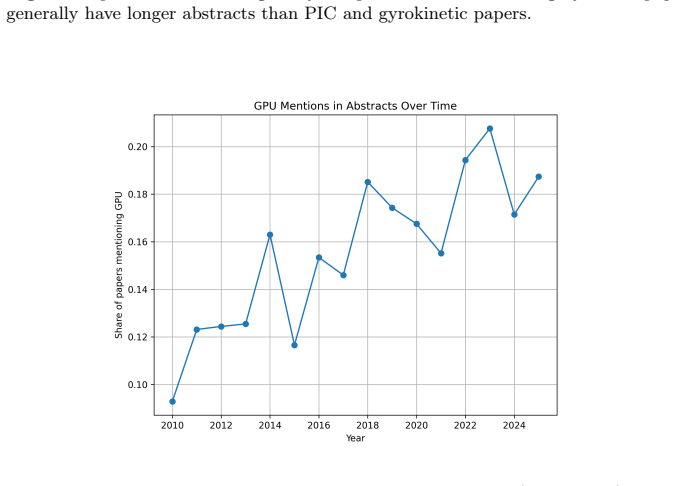
The central discovery is that abstract length, used as a proxy for methodological and algorithmic complexity, differs systematically across computational methods in plasma physics: MHD papers carry significantly longer abstracts than PIC and gyrokinetic papers after controlling for team size and publication year. Regression models (OLS, tobit, logistic) on 5,522 arXiv papers confirm the MHD verbosity advantage, and show that the number of authors has a modest positive effect on abstract length in the OLS specification, while the tobit model indicates a marginal negative effect on the latent length once censoring at 500 words is accounted for. The same models show that PIC papers are strongly associated with GPU mentions while gyrokinetic papers are not significantly associated, and that GPU mentions have increased over time. The paper concludes that methodological verbosity and method prevalence have decoupled: the most verbose method is not the one growing fastest.
Load-bearing premise
The paper assumes that abstract word count is a reliable proxy for the methodological and algorithmic complexity of a plasma physics paper, and that each paper can be cleanly assigned to a single method category.
Editorial extensions
If this is right
- If abstract length tracks methodological complexity, field-wide bibliometric scans can use abstracts alone to chart how computational complexity evolves across plasma physics subfields.
- The strong PIC-GPU link implies that GPU acceleration in plasma physics is being driven mainly by PIC and gyrokinetic simulations, so accelerator investments and code-porting efforts should target those methods first.
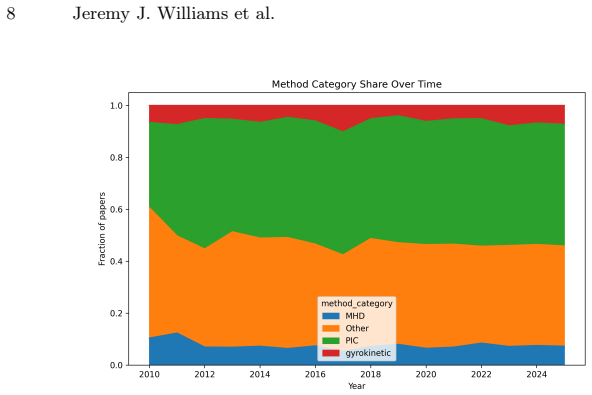
- The decoupling between verbosity and prevalence means that publication-count metrics under-represent the decline of MHD as a share of computational plasma physics.
- Since abstract length increases with team size, large collaborations may systematically produce more information-dense abstracts, which should be accounted for in any text-based meta-analysis of the literature.
- Temporal trends in the tobit model suggest abstracts have been getting more concise in recent years once censoring is accounted for, implying that conciseness norms are shifting even as the method mix changes.
Reading between the lines
- The paper's own results contain an internal tension: OLS says author count increases abstract length, while the tobit model says the latent length decreases marginally with each additional author; if the tobit specification is more trustworthy, the headline team-size result may be an artifact of uncensored OLS.
- Abstract length is a crude proxy; a direct test would compare abstracts from the same team or same code across methods, or measure the actual number of equations and solver details in full texts, to see whether the MHD ordering survives on direct complexity measures.
- The logistic finding that gyrokinetic papers are not significantly associated with GPU mentions, despite being grouped with PIC as computationally intensive, suggests the GPU-adoption story may be PIC-specific; separating gyrokinetic GPU usage in specific codes from field-wide trends could sharpen the conclusion.
- The method-categorization pipeline assigns each paper to a single category based on keywords; papers that combine methods (e.g., PIC-MHD) are forced into one bucket, which could bias the abstract-length comparisons; a multi-label extension would test whether the ordering is robust.
Signed reviews
Editorial analysis
A structured set of objections, weighed in public.
Referee Report
Summary. The paper presents a bibliometric analysis of 5,522 arXiv plasma physics papers published between 2010 and 2025, using abstract length as a proxy for methodological and algorithmic complexity. It applies OLS, Tobit, and logistic regressions to estimate how computational method category, number of authors, and publication year relate to abstract length and to GPU mentions. The central claims are that MHD papers have longer abstracts than PIC and gyrokinetic papers, that abstract length increases modestly with team size, that temporal trends in abstract length are detectable, and that PIC and gyrokinetic methods have grown in prevalence and are more strongly associated with GPU adoption.
Significance. If the quantitative claims were supported, the paper would provide a useful field-level descriptive contribution on how research communication and HPC adoption vary across computational methods in plasma physics. The paper's strengths include a large curated corpus, explicit inclusion and exclusion criteria, complementary regression models, and clear visualizations of temporal trends. However, the central team-size and temporal-length claims are currently undermined by an internal inconsistency between the OLS and Tobit analyses, and the proxy interpretation linking abstract length to methodological complexity is asserted rather than validated. The paper therefore has the ingredients of a useful empirical study, but the load-bearing statistical results and their interpretation need substantial reworking.
major comments (4)
- [§3.1, Fig. 6, Eqs. (2)–(3)] The Tobit results are reported with hazard ratios (HR = 0.9907 for n_authors and logHR = -0.0189 for year), but a Tobit model does not produce hazard ratios; these quantities come from a survival or Cox proportional hazards model. Moreover, the reported Tobit effects have opposite signs from the OLS results: OLS says each additional author increases abstract length and lengths rise over time, while the Tobit text says additional authors and later years decrease the latent abstract length. Because the 500-word cap should bind for only a small fraction of arXiv abstracts, a correctly specified Tobit should approximate the OLS estimates, not reverse their signs. This internal contradiction means the paper's robustness claim is invalid and the headline finding that abstract length increases modestly with team size is not established.
- [§2.2, §2.3, Eqs. (2)–(3)] The 500-word cap is introduced as a censoring mechanism, but arXiv abstracts are not naturally censored at 500 words; the authors artificially cap the dependent variable and then apply a Tobit model. A Tobit for this constructed variable estimates the effect of the authors' own transformation, not an underlying censorship mechanism. The text also uses 'censored' and 'truncated' interchangeably, which are distinct concepts. The authors should either justify that arXiv enforces a real upper limit that binds in their data, or remove the Tobit and present the OLS and logistic results as the primary analyses.
- [§1, §2.3, Abstract] The paper assumes without validation that 'abstract length is a proxy for methodological and algorithmic complexity.' The abstract and Discussion then interpret longer MHD abstracts as indicating 'more extensive methodological and physical exposition.' This is a labeling tautology: the conclusion restates the proxy definition rather than providing evidence for a link between length and complexity. To support the interpretation, the authors should validate the proxy against an external measure, such as code size, number of equations, full-text methods-section length, or expert ratings, or alternatively limit the conclusions to abstract verbosity itself.
- [§2.1, Table 1] The method-category assignment is underspecified. The filtering criteria list inclusive and exclusive keywords, but no rule is given for assigning each paper to exactly one of PIC, gyrokinetic, MHD, or other. Table 1 already shows ambiguous examples: a paper on the Boltzmann equation and current density is classified as 'Other,' and a paper on Rayleigh–Taylor turbulent mixing is classified as 'PIC.' Because every method comparison in the paper depends on this classification, the assignment pipeline must be described in sufficient detail, or the data and code should be made available so that the classifications can be checked.
minor comments (6)
- [Title] The title reads 'A Empirical Analysis' and should be corrected to 'An Empirical Analysis.'
- [§2.2] The derived variable 'Abstract length (number of words)' should specify whether the count includes the title, author list, or only the abstract body, and whether standard tokenization rules were applied.
- [§3.1, Fig. 5] The OLS model is reported with R² = 0.043 and p < 0.0001, but no F-statistic, intercept value, or confidence intervals are given; these should be included for reproducibility and to help readers assess effect sizes beyond the small R².
- [§3.1, Fig. 7] The logistic regression results report the PIC coefficient and the year coefficient, but omit the intercept, the gyrokinetic coefficient, and the baseline MHD log-odds; complete coefficient tables should be provided.
- [§5] The Discussion concedes that 'simple regression suggested a slight increase in abstract lengths over time, models accounting for censored abstracts indicated a shift toward more concise abstracts,' which directly reproduces the contradiction noted in the major comments; this conflict must be resolved before the paper can be considered internally consistent.
- [General] No data or code availability statement is included, even though the paper relies on a curated CSV dataset and custom filtering and regression code; for an empirical bibliometric study, sharing these artifacts is recommended.
Circularity Check
Minor self-definitional gloss: 'complexity' is abstract length; the empirical regressions are otherwise descriptive, not circular.
-
self definitional
[Abstract; Section 3.1 OLS Model; Section 5 Discussion]
"We analyze 5,522 computational plasma physics papers published on arXiv between 2010 and 2025 using large-scale text mining, employing abstract length as a proxy for methodological and algorithmic complexity. ... results show that MHD studies have longer abstracts than PIC and gyrokinetic papers, indicating more extensive methodological and physical exposition."
The construct 'methodological and algorithmic complexity' / 'methodological and physical exposition' is operationalized solely as abstract word count, which is exactly the dependent variable abstract_len in Eq. 1. No independent measure of exposition or complexity enters the analysis. Therefore, saying that longer MHD abstracts 'indicate' or 'reflect' more extensive exposition restates the chosen proxy in construct language rather than adding an empirical result. The only non-tautological content is the descriptive finding that MHD word counts are higher, which is a fitted fact about the same data, not a derived prediction or independent confirmation.
full rationale
No fitted parameter is renamed as a prediction: the OLS, Tobit, and logistic regressions describe the very data from which their coefficients are estimated, which is appropriate for the paper's stated descriptive goal. The main circular element is the interpretive gloss equating abstract length with 'methodological and physical exposition'; this is a labeling tautology rather than a load-bearing derivation. Self-citations (refs. 13–22) appear only as examples of specific code case studies and do not support the central regression claims. The Tobit section reports 'hazard ratio' language with signs opposite to the OLS estimates (HR=0.9907 for n_authors; logHR=−0.0189 for year), and the Discussion concedes the split between 'simple regression' and 'models accounting for censored abstracts' — this is an internal consistency or model-specification concern, not circularity. Overall, the paper's quantitative statements are self-contained descriptive statistics, so the circularity score is low and reflects only the proxy-labeling issue.
Assumptions & free parameters
free parameters (11)
- OLS intercept, beta_0 (MHD baseline abstract length) =
not reported in text
- OLS n_authors coefficient, beta_1 =
not reported in text
- OLS year coefficient, beta_2 =
not reported in text
- OLS PIC method coefficient, beta_3_PIC =
negative, value not reported
- OLS gyrokinetic method coefficient, beta_3_gyro =
negative, strongest effect, value not reported
- Tobit author coefficient =
HR=0.9907, p=0.0365
- Tobit year coefficient =
logHR=-0.0189, p<0.0001
- Logistic n_authors coefficient =
0.0871
- Logistic year coefficient =
0.0331
- Logistic PIC coefficient =
1.4873
- Censoring threshold =
500 words
assumptions (5)
- standard math OLS, Tobit, and logistic regression assumptions hold, including linearity, independent errors, and correct specification.
- domain assumption Abstract word count is a valid proxy for methodological and algorithmic complexity.
- domain assumption The keyword filter correctly identifies computational plasma physics papers and assigns one method category per paper.
- domain assumption GPU mention in an abstract indicates actual GPU adoption or accelerator relevance.
- ad hoc to paper A 500-word upper bound captures a real censorship mechanism in arXiv abstracts.
Cite this review
Pith. "Pith review of Computational Methods and GPU Acceleration in Plasma Physics: A Empirical Analysis of arXiv Publications and Research Trends." pith.science (2026). https://pith.science/paper/A2PDZEPS
@misc{pith2026260804171,
  author       = {Pith},
  title        = {Pith review of: Computational Methods and GPU Acceleration in Plasma Physics: A Empirical Analysis of arXiv Publications and Research Trends},
  year         = {2026},
  howpublished = {\url{https://pith.science/paper/A2PDZEPS}},
  note         = {Machine review of arXiv:2608.04171}
}
read the original abstract
Computational plasma physics increasingly relies on high-performance computing (HPC) methods, including particle-in-cell (PIC), gyrokinetic, and magnetohydrodynamic (MHD) simulations, yet field-wide evidence on how method choice, team size, and GPU adoption shape research outputs remains limited. We analyze 5,522 computational plasma physics papers published on arXiv between 2010 and 2025 using large-scale text mining, employing abstract length as a proxy for methodological and algorithmic complexity. Using ordinary least squares (OLS), tobit, and logistic regression models, we examine how abstract length and GPU mentions vary with computational method, number of authors, and publication year. Controlling for collaboration size and temporal trends, results show that MHD studies have longer abstracts than PIC and gyrokinetic papers, indicating more extensive methodological and physical exposition. Abstract length increases modestly with team size, while temporal effects suggest gradual changes in abstract conciseness over time. At the same time, PIC and gyrokinetic methods have grown substantially in relative prevalence over the past decade and are strongly linked to GPU adoption, reflecting their higher computational intensity and suitability for accelerator-based architectures. Together, these findings highlight a decoupling between methodological verbosity and method prevalence, offering a new bibliometric perspective on the evolution of HPC-driven plasma physics research.
Figures


Figures from the paper (4 more)


Reference graph
Works this paper leans on
-
[1]
Amemiya,T.:Tobitmodels:Asurvey.Journalofeconometrics24(1-2),3–61(1984)
work page 1984
-
[2]
Global Strategy Journal11(3), 331–355 (2021)
Amore, M.D., Murtinu, S.: Tobit models in strategy research: Critical issues and applications. Global Strategy Journal11(3), 331–355 (2021)
work page 2021
-
[3]
Journal of the Royal Statistical Society: Series B (Methodological)55(3), 693–706 (1993)
Carroll, R.J., Pederson, S.: On robustness in the logistic regression model. Journal of the Royal Statistical Society: Series B (Methodological)55(3), 693–706 (1993)
work page 1993
-
[4]
In: 2026 25th International Symposium on Parallel and Distributed Computing (ISPDC)
Chronaki, K., Gkolantas, E., et al.: Enabling Efficient Vectorization in Particle- In-Cell Monte Carlo Simulations on X86 and RISC-V. In: 2026 25th International Symposium on Parallel and Distributed Computing (ISPDC). pp. 30–38. IEEE (2026)
work page 2026
-
[5]
In: 2024 IEEE International Parallel and Distributed Processing Symposium Workshops (IPDPSW)
Coti, C., et al.: Integration of modern HPC performance tools in Vlasiator for exascale analysis and optimization. In: 2024 IEEE International Parallel and Distributed Processing Symposium Workshops (IPDPSW). pp. 996–1005. IEEE (2024)
work page 2024
-
[6]
Faj, J., et al.: MPI performance analysis in Vlasiator: unraveling communication bottlenecks. In: SC23: The International Conference for High Performance Com- puting, Networking, Storage, and Analysis (2023)
work page 2023
-
[7]
International Journal of Computa- tional and Experimental Science and Engineering6(1), 63–74 (2020)
Güneri, Ö.İ., Durmuş, B.: Dependent dummy variable models: An application of logit, probit and tobit models on survey data. International Journal of Computa- tional and Experimental Science and Engineering6(1), 63–74 (2020)
work page 2020
-
[8]
Future Generation Computer Systems p
Hegde, P.R., et al.: A hybrid quantum-classical particle-in-cell method for plasma simulations. Future Generation Computer Systems p. 108087 (2025)
work page 2025
Show all 22 references
-
[9]
In: European Conference on Parallel Processing
Medeiros, D., et al.: ARC-V: Vertical Resource Adaptivity for HPC Workloads in Containerized Environments. In: European Conference on Parallel Processing. pp. 175–189. Springer (2025)
2025
-
[10]
Research policy30(2), 245–262 (2001)
Nassimbeni, G.: Technology, innovation capacity, and the export attitude of small manufacturing firms: a logit/tobit model. Research policy30(2), 245–262 (2001)
2001
-
[11]
In: SC24: The International Conference for High Performance Computing, Networking, Storage, and Analysis, Atlanta, GA, USA, November 17-22 2024 (2024)
Trilaksono, J., et al.: Characterizing the Performance of the GENE-X Code for Gyrokinetic Turbulence Simulations. In: SC24: The International Conference for High Performance Computing, Networking, Storage, and Analysis, Atlanta, GA, USA, November 17-22 2024 (2024)
2024
-
[12]
In: Proceedings of the Platform for Advanced Scientific Computing Conference
Trilaksono, J., et al.: OpenACC and OpenMP-Accelerated Fortran/C++ Gyroki- netic Fusion Code GENE-X for Heterogeneous Architectures. In: Proceedings of the Platform for Advanced Scientific Computing Conference. pp. 1–12 (2025)
2025
-
[13]
In: European Con- ference on Parallel Processing
Williams, J.J., et al.: Leveraging HPC Profiling and Tracing Tools to Understand the Performance of Particle-in-Cell Monte Carlo Simulations. In: European Con- ference on Parallel Processing. pp. 123–134. Springer (2023)
2023
-
[14]
arXiv preprint arXiv:2408.01983 (2024)
Williams, J.J., et al.: Characterizing the performance of the implicit massively parallel particle-in-cell iPIC3D code. arXiv preprint arXiv:2408.01983 (2024)
2024 arXiv
-
[15]
In: 2024 IEEE International Conference on Cluster Computing Workshops (CLUSTER Workshops)
Williams, J.J., et al.: Enabling High-Throughput Parallel I/O in Particle-in-Cell Monte Carlo simulations with OpenPMD and Darshan I/O Monitoring. In: 2024 IEEE International Conference on Cluster Computing Workshops (CLUSTER Workshops). pp. 86–95. IEEE (2024)
2024
-
[16]
In: International Conference on Com- putational Science
Williams, J.J., et al.: Optimizing BIT1, a Particle-in-Cell Monte Carlo Code, with OpenMP/OpenACC and GPU Acceleration. In: International Conference on Com- putational Science. pp. 316–330. Springer (2024) Computational Methods and GPU Acceleration in Plasma Physics 13
2024
-
[17]
arXiv preprint arXiv:2407.00394 (2024)
Williams, J.J., et al.: Understanding large-scale plasma simulation challenges for fusion energy on supercomputers. arXiv preprint arXiv:2407.00394 (2024)
2024 arXiv
-
[18]
In: European Conference on Parallel Processing
Williams, J.J., et al.: Understanding the impact of OpenPMD on BIT1, a particle- in-cell monte carlo code, through instrumentation, monitoring, and In-Situ analy- sis. In: European Conference on Parallel Processing. pp. 214–226. Springer (2024)
2024
-
[19]
Journal of Computational Science p
Williams, J.J., et al.: Accelerating Particle-in-Cell Monte Carlo simulations with MPI, OpenMP/OpenACC and asynchronous multi-GPU programming. Journal of Computational Science p. 102590 (2025)
2025
-
[20]
arXiv preprint arXiv:2606.28534 (2026)
Williams, J.J., et al.: High-Performance Resilient Multi-GPU Hybrid Particle-in- Cell Monte Carlo Simulations at Scale. arXiv preprint arXiv:2606.28534 (2026)
2026 arXiv
-
[21]
The International Journal of High Performance Computing Applications (2026)
Williams, J.J., et al.: Integrating High Performance In-Memory Data Streaming and In-Situ Visualization in Hybrid MPI+ OpenMP PIC MC Simulations Towards Exascale. The International Journal of High Performance Computing Applications (2026)
2026
-
[22]
In: International Conference on Computational Science
Williams, J.J., et al.: Multi-GPU Hybrid Particle-in-Cell Monte Carlo Simulations for Exascale Computing Systems. In: International Conference on Computational Science. pp. 32–47. Springer (2026)
2026
Reviewed August 8, 2026 · model on record in the stance chip above.
Discussion (0). Continue with ORCID to comment.