REVIEW 3 major objections 4 minor 17 references
Mixed Voting Rules for Participatory Budgeting
T0 review · 3 major / 4 minor · reviewed 2026-08-02 · deepseek-v4-flash
Pith's one-line read Mixed rules that let a later proportional rule rebalance earlier choices can exceed the baseline guarantee; the paper proves this for a value-based MES variant and shows the trade-off on 313 real elections.
desk verdict A genuinely new framework for composing PB rules sequentially, with a sound main theorem and a few addressable loose ends; worth serious refereeing. read the letter →
The pith
A machine-rendered reading of the paper's core claim, the machinery that carries it, and where it could break.
The reading
What carries the argument
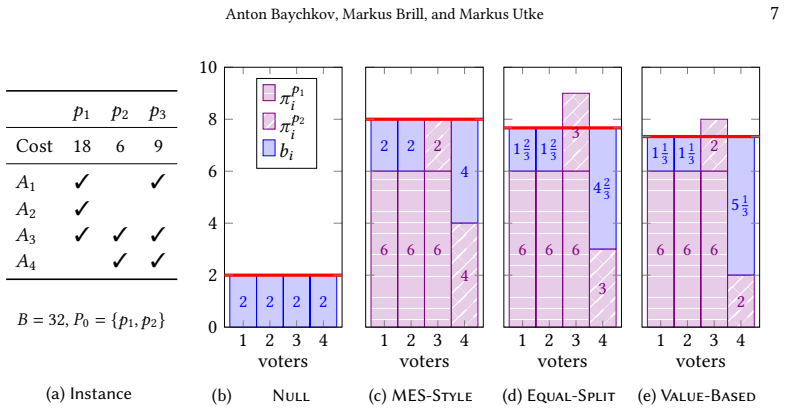
The key object is the Value-Based pre-allocation method inside an MES stage of a mixed rule. It defines the threshold value v* as the value (number of supporters, or welfare per cost) of the most valuable unselected project that could still be added once all pre-selected projects of at least its value are paid for, and it charges each voter at most 1/v* per unit satisfaction for pre-selected projects. This payment cap is what keeps the minimum voter budget share α_Value-Based high and makes the proof's per-unit-satisfaction argument go through. The paper also uses the parameterized axiom α-budget EJR+ up to any project to measure the resulting proportionality, and the monotone-property basel
What would settle it
Search small approval-budgeting instances for an outcome of MES with Value-Based pre-allocation that violates α_Value-Based-budget EJR+ up to any project; one such instance would disprove Theorem 2. A second, cheaper check is to audit the unpublished Strong EJR+ claim used in Theorem 5: if MES can fail Strong EJR+ up to any project under additive utilities, that extension dissolves.
Extended reading notes
Core claim
On the paper's own terms, the central claim is that MES with Value-Based pre-allocation achieves α_Value-Based-budget EJR+ up to any project whenever it is run with available budget share α and its minimum voter budget share α_Value-Based is at least α. Here α_Value-Based is the smallest total endowment (payments for pre-selected projects plus remaining MES budget) among all voters, measured as a fraction of the fair per-voter share B/n; it is always at least α and strictly larger whenever pre-selected projects exist. Because no rule can exceed the plain α-budget baseline for all instances, this is a genuine improvement in the class of instances the parameter identifies. The proof works by b
Load-bearing premise
The paper's broadest positive result depends on an unpublished theorem that MES satisfies Strong EJR+ up to any project; if that theorem is wrong, the additive-utility generalization collapses, though the core cost-satisfaction result does not depend on it.
Editorial extensions
If this is right
- Any mixed rule containing MES with Value-Based pre-allocation inherits the α_Value-Based-budget EJR+ up to any project guarantee, and adding later completion rules such as Greedy preserves the guarantee while making the outcome exhaustive.
- In the unit-cost multiwinner special case, the same arguments yield plain α_Value-Based-budget EJR+, a cleaner bound because the 'up to any project' caveat disappears.
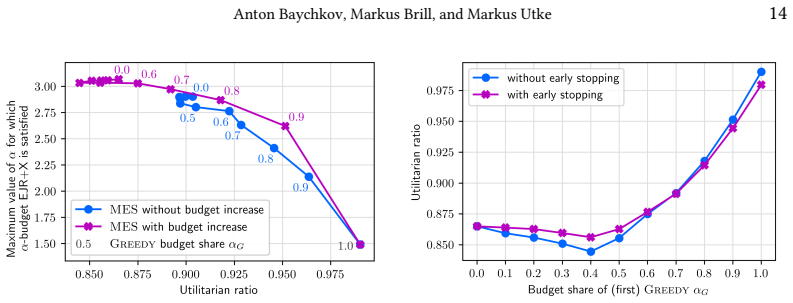
- When MES is run with the budget-increase heuristic, the guarantee holds with respect to the minimum voter budget share of the final iteration, which can exceed 1, so the practical heuristic used in elections does not void the theoretical result.
- If the unpublished Strong EJR+ theorem for MES is accepted, the Value-Based guarantee extends to all additive satisfaction functions, which covers settings where voters care about the number of approved projects rather than their cost.
Reading between the lines
- Editorial extension: α_Value-Based can be computed after a run, so the guarantee is usable as a per-outcome certificate—an administrator could report 'this result is α-budget EJR+ for α=0.92' rather than relying on a worst-case statement.
- Editorial extension: the pre-allocation idea transfers to any repeated or inherited-choice setting, where earlier commitments play the role of pre-selected projects; the threshold v* then measures the opportunity cost of past decisions.
- Editorial extension: replacing Greedy with other first-stage rules is a directly testable next step; the paper's experiments with other rules suggest the Value-Based mechanism, not the identity of the first rule, is what drives the improved trade-off.
Signed reviews
Editorial analysis
A structured set of objections, weighed in public.
Referee Report
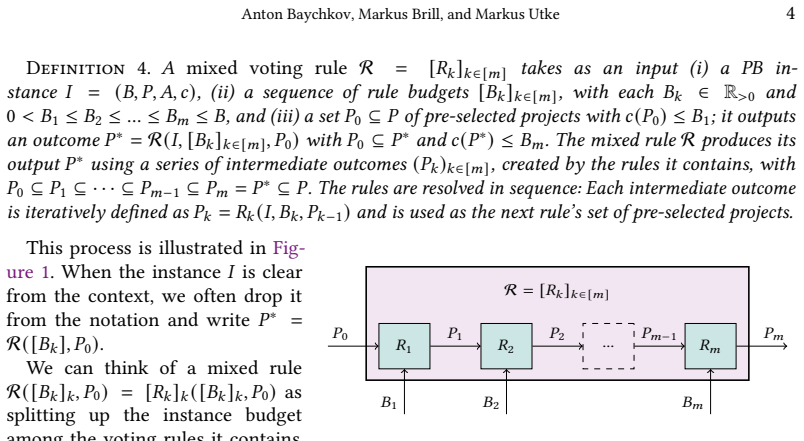
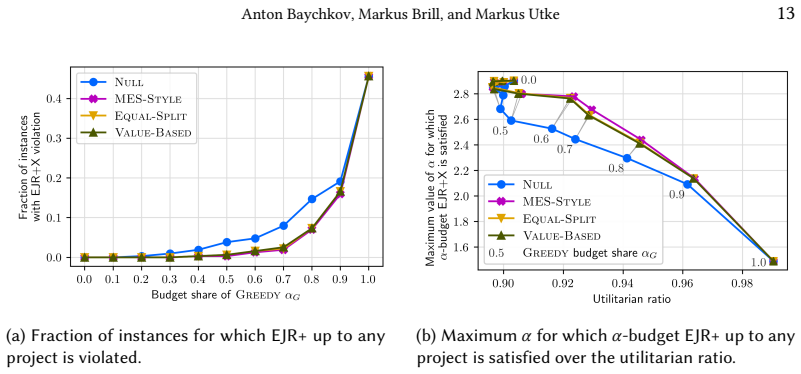
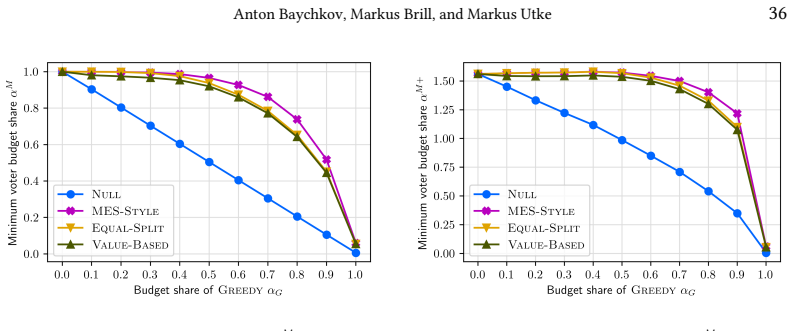
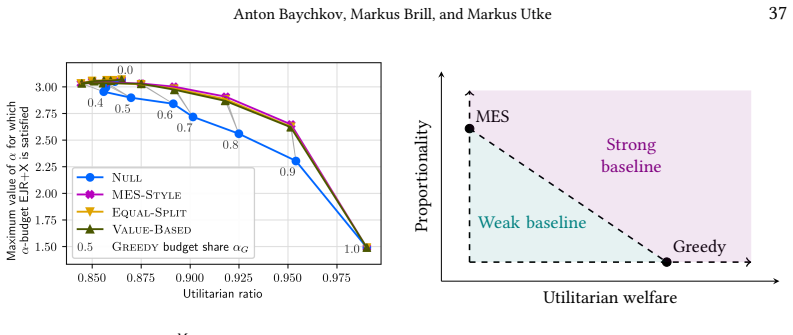
Summary. This paper introduces a framework for mixed participatory budgeting (PB) voting rules, in which a sequence of rules is executed with increasing rule budgets and each rule may spend the leftover budget of earlier rules. The main theoretical contribution is the adaptation of the Method of Equal Shares (MES) to a pre-selected set of projects P0 via four pre-allocation methods — Null, MES-Style, Equal-Split, and Value-Based — and a parameterized proportionality notion, α-budget EJR+ up to any project. Theorem 2 shows that the Value-Based method yields an α_Value-Based-budget EJR+ guarantee, which can exceed the universal α-budget baseline of Observation 1 when α_Value-Based > α. The paper also proves the baseline guarantee for Null (Theorem 1), a two-project guarantee for Equal-Split after Greedy (Theorem 3), negative results for Equal-Split and MES-Style (Theorem 4), an extension to general additive satisfaction functions (Theorem 5), and an optimality claim for Value-Based (Proposition 4). The experimental section evaluates mixed rules on 313 Pabulib instances, measuring utilitarian welfare and EJR+-based proportionality, with and without a budget-increase heuristic.
Significance. If Theorem 2 is correct, it is a meaningful contribution: it provides a PB completion method whose proportionality guarantee is strictly stronger than the universal α-budget baseline whenever the ex-post minimum voter budget share α_Value-Based exceeds α. The mixed-rule framework is novel and the empirical finding that a small MES component can restore proportionality after a Greedy first stage is practically relevant. The proof of Theorem 2 is carefully constructed and I found no gap in its two-case argument. The negative results in Theorem 4 are also useful for delineating the limits of the other pre-allocation methods. However, the paper’s advertised extension to additive utilities rests on an unpublished result (Skowron 2026, personal communication), and the experimental section omits key parameter values and dispersion information; these issues currently prevent full verification of the paper’s broader claims.
major comments (3)
- [§7.2, Theorem 5 and Appendix A] Theorem 5 is stated as a theorem, but its proof relies on the unpublished claim that MES satisfies Strong EJR+ up to any project (Skowron 2026, personal communication). The proof in Appendix A says 'following Skowron [2026], we can also show this bound' without giving the argument. Since the abstract advertises this additive-utility extension, the result is not self-contained or publicly verifiable. Please either include a complete proof of the Strong EJR+ property for MES in this setting, or explicitly state Theorem 5 as conditional on that external result and adjust the paper’s claims accordingly. This is load-bearing for the additive-utility contribution.
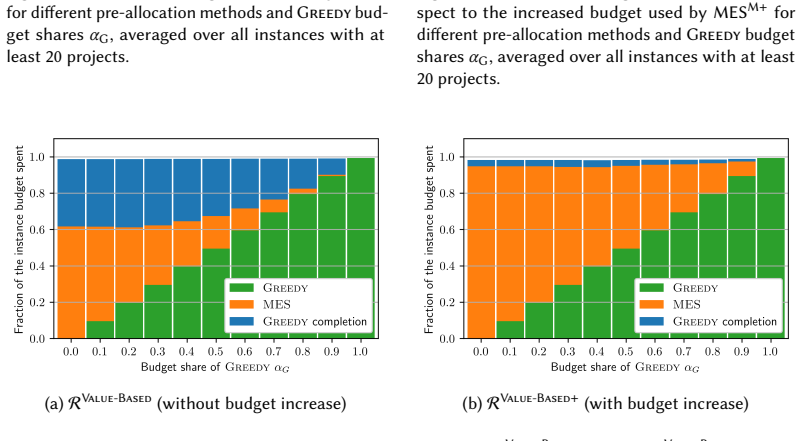
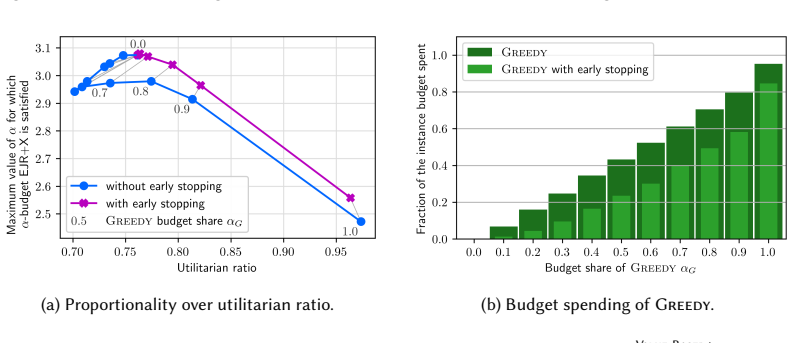
- [§6.2 and §D] The budget-increase heuristic MESM+ is central to the experimental section, but the increment β is never specified. The text says only 'increase the budget available to MES by some β' and never reports the value used in Figures 4, 5, 11, and 15. Without β and the exact stopping rule, the empirical results are not reproducible. In addition, all reported metrics are averages over 313 instances with no error bars, confidence intervals, or per-instance distributions, which makes it hard to assess the robustness of claims such as 'dominates the curve without budget increase' and 'best for greedy shares in 0.6–0.9'. Please report β, release code/data or per-instance results, and include dispersion measures.
- [§7.3, Proposition 4] The optimality claim for the Value-Based method is stated in terms of 'α_v-Strong EJR+', but the only formal definition in the paper is 'α-budget Strong EJR+ up to any project' (Definition 11). The relation between these notions is not established. Moreover, the proof uses Strong EJR+ violations in the cost-satisfaction setting, which is asserted to be a strengthening of EJR+ but depends on the same unpublished Skowron result as Theorem 5. Thus Proposition 4 is not currently verifiable independently of the issue raised in the first major comment, and the statement should be made conditional or supplied with a self-contained proof.
minor comments (4)
- [§4, Method 3 and throughout] The pre-allocation method is named 'Eqal-Split' in some places and 'Equal-Split' in others (e.g., Proposition 3, Theorem 3). Please standardize the spelling.
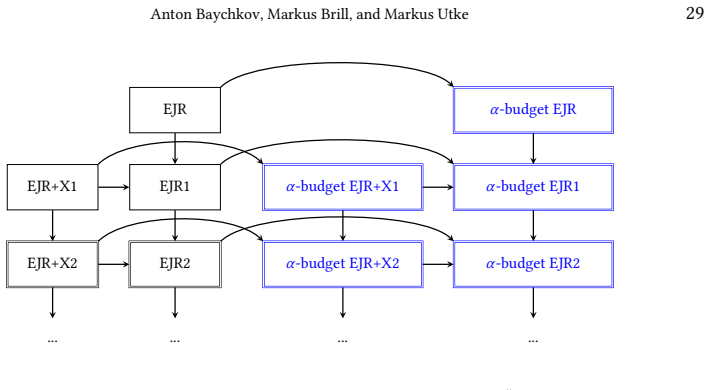
- [§2, Definition 3] In the definition of EJR+ up to any project, the group N' should be explicitly required to be nonempty, and the quantifier over p should be read as ranging over projects in the intersection of approvals of N'. This is minor but would improve precision.
- [§D, Proposition 10] The comparison of ex-ante, intermediate, and ex-post variants is dense; a small table of α values for each variant in the example would make the argument much easier to follow.
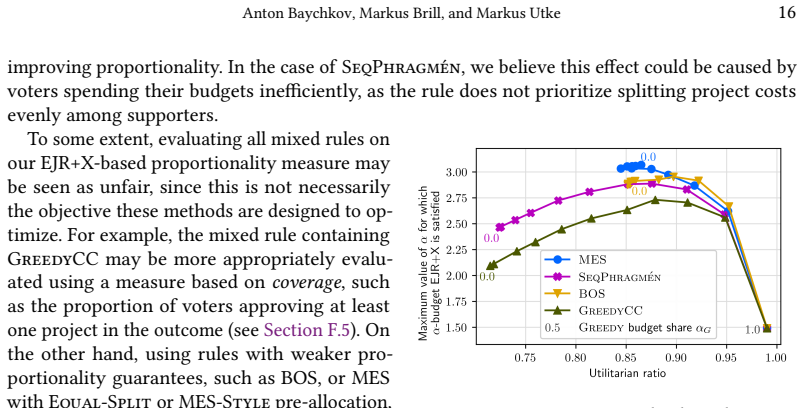
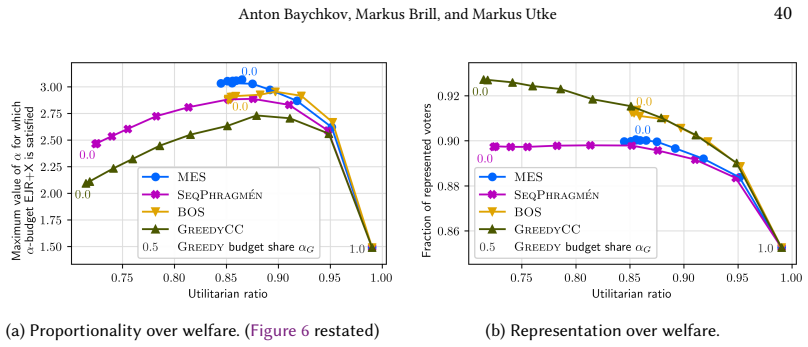
- [§6.4, Figure 6] The text notes that evaluating SeqPhragmén and GreedyCC with EJR+X may be unfair; this caveat is good. Consider adding the representation-based measure (Definition 16) to the main figures, since it is only shown in Appendix F.5.
Circularity Check
No significant circularity: Theorem 2's α_VB-parameterized EJR+ guarantee is proved for a method-derived value, not fitted; self-citations are non-load-bearing; Theorem 5's reliance on an unpublished result is flagged as a verification gap, not a circular step.
-
other
[Section 7.2 (Theorem 5 and its proof); References entry: 'P. Skowron. 2026. Robust Proportionality Axioms for Additive Utilities. (2026). Unpublished manuscript. Personal Communication.']
"Nevertheless, the outcome of MES always satisfies Strong EJR+ up to any project [Skowron, 2026]. ... Similarly, following Skowron [2026], we can also show this bound for any project p′∈(P∗\P0)∩Ai."
Flagged per the review rule as a missing-support / omitted-proof item, not as circularity. The additive-utility generalization (Theorem 5) delegates MES's key per-unit spending bound to an unpublished personal communication, as the reference entry itself discloses ('Unpublished manuscript. Personal Communication.'). The cited result is external to the present paper, concerns standard MES, and is not machine-checked, code-reproduced, or publicly falsifiable at this point, so it does not qualify as independent support under the hard rules. It weakens the verifiability of the extension; however, Theorem 2 (the core cost-satisfaction claim) has a complete proof in the text and does not depend on this step, so there is no circular reduction of the central claim.
full rationale
The central derivation chain is Theorem 2: MES_Value-Based with available budget share α satisfies α_VB-budget EJR+ up to any project, where α_VB := min_i (π_i + b_i)n/B (Definition 9). This is not equivalence-by-construction: α_VB is computed from voter payments and rebalanced budgets before the EJR+ condition is checked, and the proof contributes substantive content — the per-unit payment bound (≤ 1/v* during pre-allocation) and the Case-2 budget-shift argument with inequalities (1)–(4). The parameterization is forced by the paper's own Proposition 1 (no rule can improve the baseline for all instances), and the paper explicitly acknowledges the ex-post nature: 'we first need to partially run the rule R before determining how good a proportionality guarantee on its outcome we can give' (Section 5). The guarantee is not vacuous: Proposition 3 gives α_Null = α ≤ α_VB ≤ α_Equal-Split ≤ α_MES-Style, yet Equal-Split and MES-Style fail even α-budget EJR (Theorem 4); thus the Value-Based payment rule, not the parameterization, carries the content. Observation 1 and Proposition 1 are straightforward constructions, not fitted predictions. The only self-citation inside a proof is Proposition 2's reference to 'Proposition 4 of Baychkov et al. [2026]' (authors overlap), but it is paired with the independent knapsack reference (Kellerer et al. 2004) and is ancillary. The main caveat, flagged in the steps, is the unpublished Skowron (2026) support for the additive-utility extension; this is a verification gap, not a circular reduction. Overall: no load-bearing circularity; the core theorem is self-contained and externally testable.
Assumptions & free parameters
free parameters (1)
- Budget increase increment β (MES+ experiments) =
not specified in paper
assumptions (5)
- domain assumption Approval preferences and cost satisfaction functions
- domain assumption Additive satisfaction with no utility from unapproved projects and common satisfaction
- standard math MES satisfies EJR+ up to any project under cost satisfaction
- domain assumption MES satisfies Strong EJR+ up to any project for additive utilities
- standard math Greedy is efficient up to one project (knapsack bound)
Cite this review
Pith. "Pith review of Mixed Voting Rules for Participatory Budgeting." pith.science (2026). https://pith.science/paper/A2Q5MARS
@misc{pith2026260623320,
  author       = {Pith},
  title        = {Pith review of: Mixed Voting Rules for Participatory Budgeting},
  year         = {2026},
  howpublished = {\url{https://pith.science/paper/A2Q5MARS}},
  note         = {Machine review of arXiv:2606.23320}
}
read the original abstract
Designing and analyzing voting rules for Participatory Budgeting (PB) elections is an active research area in computational social choice. Many PB voting rules aim to optimize a specific objective. For instance, the ubiquitous Greedy rule attempts to maximize utilitarian welfare, while the Method of Equal Shares (MES) aims to achieve proportional representation. However, it is often desirable to achieve good outcomes on multiple objectives rather than a close-to-perfect outcome for one. Inspired by mixed-member systems for parliamentary elections, we introduce mixed voting rules for PB. These are composed of a sequence of two or more rules that can each spend some fraction of the overall budget in order to add projects to the set selected by earlier rules. We develop a theoretical framework for formulating and analyzing mixed PB voting rules, and explore how existing rules can be adapted to this framework. We particularly focus on MES and its potential to address imbalances in representation created by earlier rules. We propose different ways to adjust MES voter budgets based on how satisfied voters are with previously chosen projects, and examine how well the resulting rules approximate well-known proportionality axioms such as EJR+. In particular, we show that one of these methods improves upon a natural proportionality baseline. We also extend our main positive result to general additive satisfaction functions. We complement our theoretical results with an extensive empirical analysis of real-world PB elections. Our experiments show that mixed rules can achieve favorable trade-offs between utilitarian welfare and proportionality. We identify several refinements that further improve their performance, and apply our framework to PB rules beyond Greedy and MES.
Figures
Figures from the paper (10 more)
Reference graph
Works this paper leans on
-
[2026]
Robust Proportionality Axioms for Additive Utilities. (2026). Unpublished manuscript. Personal Communication.. W. Suksompong
2026
-
[1]
up to𝑘 projects
An “up to𝑘 projects” style notion has not been considered for the PB setting, and we define it here analogously to the definition of envy-freeness up to𝑘 goods in fair division literature (see, e.g., Suksompong [2021]). We can show that EJRk is a weaker axiom than𝐸𝐽𝑅up to any𝑘projects. Proposition 5.Fix 𝑃∗⊆𝑃 and𝑘∈N +. If𝑃∗ satisfies EJR+ up to any 𝑘 proje...
2021
-
[4]
The Price of Justified Representation.ACM Transactions on Economics and Computation12, 3 (2024), 11:1–11:27. P. Faliszewski, J. Fils, D. Peters, G. Pierczyński, P. Skowron, D. Stolicki, S. Szufa, and N. Talmon
2024
-
[7]
InProceedings of the 21st ACM Conference on Economics and Computation (ACM-EC)
Proportionality and the Limits of Welfarism. InProceedings of the 21st ACM Conference on Economics and Computation (ACM-EC). ACM Press, 793–794. Full version arXiv:1911.11747 [cs.GT]. S. Rey, F. Schmidt, and J. Maly. 2025.The (Computational) Social Choice Take on Indivisible Participatory Budgeting. Technical Report. arXiv:2303.00621 [cs.GT]. Anton Baychk...
arXiv 1911
-
[12]
be𝑃∗. Assume for contradiction that there this outcome violates Strong EJR+ up to any project, witnessed by project𝑝∉𝑃 ∗ and voter set𝑁 ′⊆𝑁with: ∑︁ 𝑝′∈(𝑃∗∪{𝑝})∩𝐴 𝑖 𝜇(𝑝′)min 𝑐(𝑝′) |𝑁′∩𝑁 𝑝′|𝜇(𝑝′), 𝑐(𝑝) |𝑁′∩𝑁 𝑝|𝜇(𝑝) ≤𝛼 𝑣 𝐵 𝑛,∀𝑖∈𝑁 ′. Let𝑣∗ be the threshold value, from our definition of theV alue-Basedpre-allocation method. Anton Baychkov, Markus Brill, and Ma...
2026
-
[13]
Suppose𝑖′ ∉𝑁 𝑝, which means that𝜋𝑉 𝑖′ = 0, and thus𝑏𝑉 𝑖 = 𝛼𝑣𝐵 𝑛
is a subset of{𝑝, ˆ𝑝}, as𝑖 ′ cannot afford𝑝∗. Suppose𝑖′ ∉𝑁 𝑝, which means that𝜋𝑉 𝑖′ = 0, and thus𝑏𝑉 𝑖 = 𝛼𝑣𝐵 𝑛 . Then𝑝∗ with𝑁′ ={𝑖} constitutes an EJR+ violation (and therefore a Strong EJR+ violation), as𝑐(𝑃∗∩𝐴𝑖)+𝑐(𝑝 ∗)≤𝑐(𝑝 ′)+𝑐(𝑝 ∗)< 𝑏𝑉 𝑖′ = 𝛼𝑣𝐵 𝑛 . If instead 𝑖′∈𝑁 𝑝, we know that 𝜋𝑉 𝑖′ = 𝑐(𝑝) |𝑁𝑝| from the definition of theValue-Based method, as|𝑁𝑝|≥𝑣 ∗...
2021
-
[15]
𝐵 .𝑃∗ does not necessarily satisfy the proportionality measure corresponding to that pre-allocation method in Table 2, with respect to the available budget share𝛼. Note that each of the counterexamples we construct in this section produce an exhaustive outcome, and thus these violations are not a consequence ofMESnot spending enough of its available budge...
2021
-
[16]
𝑃0 ={𝑝 ′ 0,𝑝 1,...,𝑝 100} is still exhaustive for a budget of11000, and thus the outcome of 𝛼V alue-Based(1) is𝑃∗ =𝑃 0.𝑃∗ satisfies0.605-EJR+ up to any project
However,𝛼V alue-Based(1) 𝐸𝑥−𝑎𝑛𝑡𝑒 = 0.605, as𝑐(𝑝′ 0)+𝑐(𝑝 ′ 1)≤ 11000, so the threshold value increases to 𝑣∗ =100. 𝑃0 ={𝑝 ′ 0,𝑝 1,...,𝑝 100} is still exhaustive for a budget of11000, and thus the outcome of 𝛼V alue-Based(1) is𝑃∗ =𝑃 0.𝑃∗ satisfies0.605-EJR+ up to any project. However,𝑝′ 1 certifies an1.1-EJR+ up to any project violation for any voter in vot...
2024
Show all 17 references
-
[17]
They call this rule Method of Equal Shares with Bounded Overspending(BOS)
propose a new rule that is based onMES, but produces an almost exhaustive outcome using a rounding procedure that allows voters to spend more than their remaining budget. They call this rule Method of Equal Shares with Bounded Overspending(BOS). Similarly toMES, every voter st...
2025
-
[301]
Full version arXiv:2302.01989 [cs.GT]. M. Brill and J. Peters
-
[2004]
and Proposition 4 of Baychkov et al. [2026]). Thus, according to Definition 6, 𝑃𝐺 is𝛼-efficient up to one project.□ A.1 Properties of the Minimum Voter Budget Share Observation 2.For any pre-allocation method M,𝛼 M lies betweenMES’s available budget share 𝛼, and the proportion...
2026
-
[2017]
Justified Representation in Approval-Based Committee Voting.Social Choice and Welfare48, 2 (2017), 461–485. H. Aziz, B. E. Lee, and N. Talmon
2017
-
[2019]
efficiency up to one project
A framework for approval-based budgeting methods. InProceedings of the 33rd AAAI Conference on Artificial Intelligence (AAAI). 2181–2188. B. Wampler, S. McNulty, and M. Touchton. 2021.Participatory Budgeting in Global Perspective. Oxford University Press. Anton Baychkov, Marku...
2021
-
[2020]
InProceedings of the 34th AAAI Conference on Artificial Intelligence (AAAI)
Perpetual Voting: Fairness in Long-Term Decision Making. InProceedings of the 34th AAAI Conference on Artificial Intelligence (AAAI). AAAI Press, 2103–2110. M. Lackner and P. Skowron. 2023.Multi-Winner Voting with Approval Preferences. Springer. M. Los, Z. Christoff, and D. Grossi
2023
-
[2021]
Constraints in fair division.SIGecom Exchanges19, 1 (2021), 46–61. N. Talmon and P. Faliszewski
2021
-
[2024]
Phragmén’s Voting Methods and Justified Representation.Mathematical Programming203, 1–2 (2024), 47–76. M. Brill and J. Peters
2024
-
[2025]
Dynamic Proportional Rankings.Social Choice and Welfare64, 1–2 (2025), 221–261. H. Kellerer, U. Pferschy, and D. Pisinger. 2004.Knapsack Problems. Springer. M. Kocot, A. Kolonko, E. Elkind, P. Faliszewski, and N. Talmon
2025
Reviewed August 2, 2026 · model on record in the stance chip above.
Discussion (0). Continue with ORCID to comment.