Research progress on quantum neural networks and quantum machine learning
Pith reviewed 2026-06-28 22:24 UTC · model grok-4.3
The pith
A survey reviews quantum neural network architectures and summarizes their performance in accuracy, training time, and resources.
A machine-rendered reading of the paper's core claim, the machinery that carries it, and where it could break.
Core claim
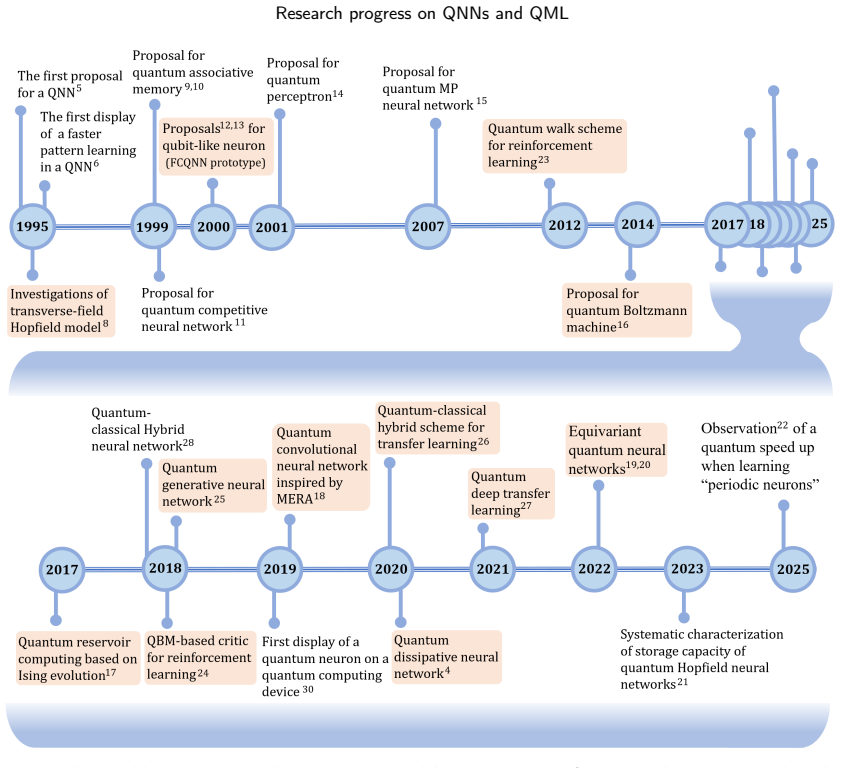
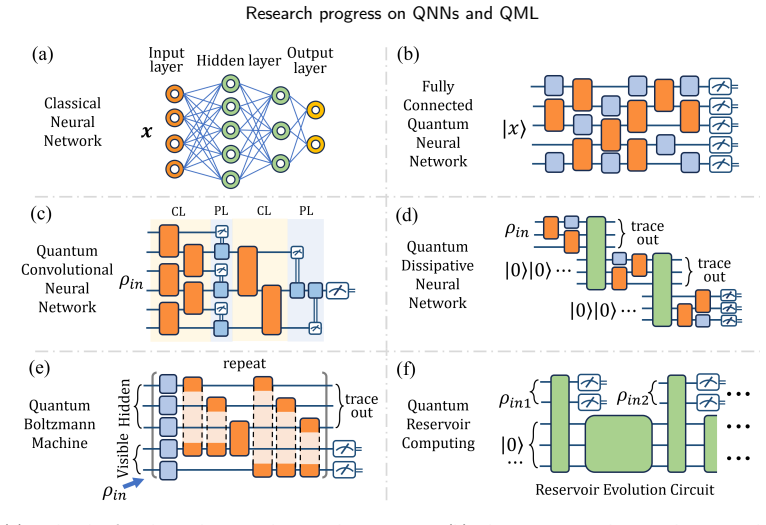
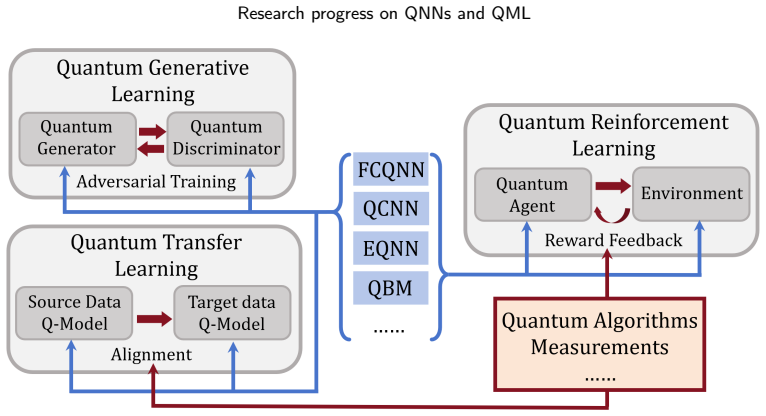
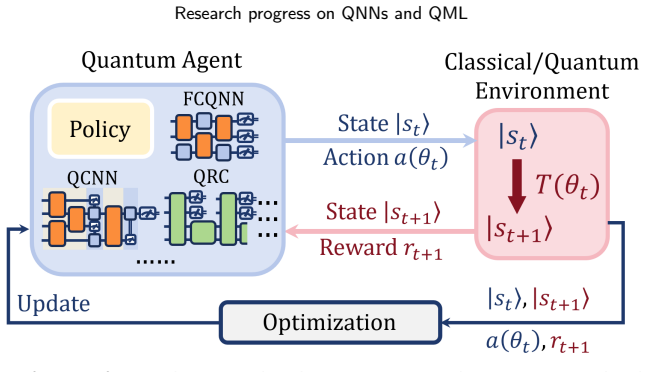
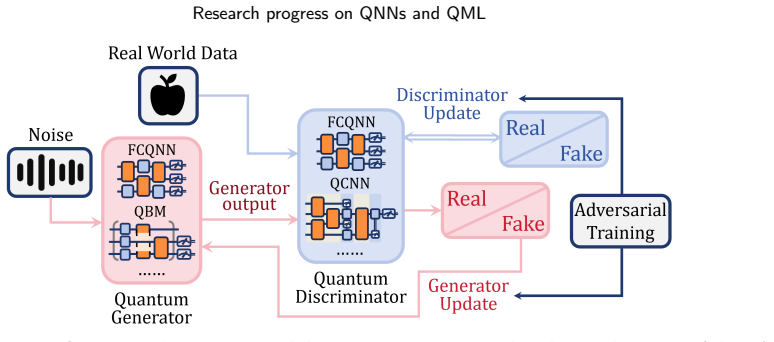
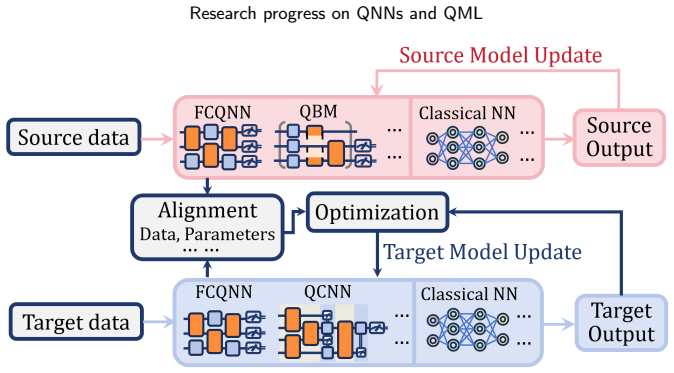
The survey examines various QNN approaches, including fully connected QNNs, quantum convolutional neural networks, equivariant QNNs, quantum Hopfield networks, quantum Boltzmann machines, quantum reservoir computing, and composite networks for quantum reinforcement learning, quantum generative learning, and quantum transfer learning. We summarize the relevant investigations on their performance, including learning accuracy, training time, and resource requirements, etc. Each QNN type has unique strengths and weaknesses, offering diverse solutions for different applications.
What carries the argument
The taxonomy of QNN types (fully connected, convolutional, equivariant, Hopfield, Boltzmann, reservoir, and composite) and the collection of their performance metrics across applications.
If this is right
- Each QNN type offers unique strengths and weaknesses suited to different machine learning applications.
- Performance in learning accuracy, training time, and resource requirements varies by architecture.
- Composite networks support quantum reinforcement learning, generative learning, and transfer learning.
Where Pith is reading between the lines
- Practitioners could match QNN type to task requirements to balance accuracy against hardware costs.
- Standardized reporting of metrics across studies would strengthen future comparisons of these architectures.
- The review implies that quantum effects in these networks may help address growing data volumes in classical machine learning.
Load-bearing premise
The reviewed studies provide comparable performance metrics that can be meaningfully summarized across different QNN architectures and applications without major inconsistencies in experimental setups or reporting standards.
What would settle it
Discovery that many reviewed studies use incompatible experimental setups or report metrics in non-comparable ways would prevent reliable cross-architecture summarization.
Figures
read the original abstract
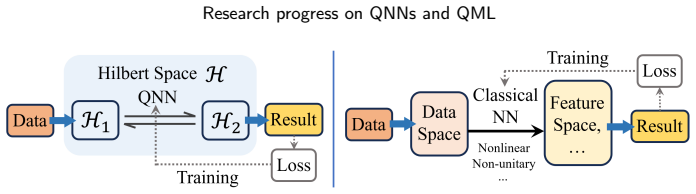
Machine learning holds fundamental computational significance due to the increasing demand for efficient solutions to complex tasks in data analysis, pattern recognition, and optimization, which are essential for addressing the multifaceted challenges of modern society. As the volume of data proliferates at an unprecedented rate, the need for more powerful machine learning strategies becomes increasingly evident. Quantum neural networks (QNNs) represent an emerging and transformative research field that seeks to harness the unique principles of quantum mechanics to enhance the capabilities of machine learning algorithms. This survey examines various QNN approaches, including fully connected QNNs, quantum convolutional neural networks, equivariant QNNs, quantum Hopfield networks, quantum Boltzmann machines, quantum reservoir computing, and composite networks for quantum reinforcement learning, quantum generative learning, and quantum transfer learning. We summarize the relevant investigations on their performance, including learning accuracy, training time, and resource requirements, etc. Each QNN type has unique strengths and weaknesses, offering diverse solutions for different applications.
Editorial analysis
A structured set of objections, weighed in public.
Referee Report
Summary. This manuscript is a survey reviewing quantum neural networks (QNNs) and quantum machine learning. It covers fully connected QNNs, quantum convolutional neural networks, equivariant QNNs, quantum Hopfield networks, quantum Boltzmann machines, quantum reservoir computing, and composite networks applied to quantum reinforcement learning, generative learning, and transfer learning. The central contribution is a summary of performance investigations across these architectures, including learning accuracy, training time, and resource requirements, along with notes on each type's unique strengths and weaknesses.
Significance. If the performance summaries can be reliably aggregated and compared, the survey could serve as a useful organizing reference for the quantum machine learning community. The work has no formal derivations or machine-checked proofs, and its value rests entirely on the quality and consistency of the literature compilation.
major comments (2)
- [Abstract] Abstract: The claim that the survey 'summarizes the relevant investigations on their performance, including learning accuracy, training time, and resource requirements' presupposes that metrics from the cited studies are sufficiently standardized for cross-architecture and cross-application comparison; the manuscript provides no discussion of experimental-setup heterogeneity, normalization procedures, or reporting biases that would support this aggregation.
- [Abstract] Abstract: No selection criteria, search strategy, or inclusion/exclusion rules for the reviewed literature are stated, making it impossible to assess whether the summarized performance claims are representative or subject to selection bias.
minor comments (1)
- [Abstract] The abstract lists seven QNN categories but does not indicate the approximate number of papers reviewed per category or the time period covered.
Simulated Author's Rebuttal
We thank the referee for the constructive comments. We agree that the abstract and manuscript would benefit from greater transparency regarding literature selection and the limitations of cross-study performance comparisons. We will revise accordingly.
read point-by-point responses
-
Referee: [Abstract] Abstract: The claim that the survey 'summarizes the relevant investigations on their performance, including learning accuracy, training time, and resource requirements' presupposes that metrics from the cited studies are sufficiently standardized for cross-architecture and cross-application comparison; the manuscript provides no discussion of experimental-setup heterogeneity, normalization procedures, or reporting biases that would support this aggregation.
Authors: We acknowledge that the manuscript does not discuss heterogeneity of experimental setups, normalization, or reporting biases. In the revised version we will add a short subsection (likely in the introduction or a new 'Limitations of Cross-Study Comparison' paragraph) that explicitly notes these issues and qualifies the performance summaries as illustrative rather than directly comparable. The abstract will also be rephrased to avoid implying standardized aggregation. revision: yes
-
Referee: [Abstract] Abstract: No selection criteria, search strategy, or inclusion/exclusion rules for the reviewed literature are stated, making it impossible to assess whether the summarized performance claims are representative or subject to selection bias.
Authors: The current manuscript does not state selection criteria or search strategy. We will add a concise 'Literature Selection' paragraph (or subsection) describing the approach used (e.g., keyword searches on arXiv and major journals, focus on papers reporting quantitative performance metrics for the listed architectures, and time window). The abstract will be updated to reference this methodology. This addresses the concern about potential selection bias. revision: yes
Circularity Check
No circularity: survey compiles external literature without derivations or self-referential predictions
full rationale
The paper is explicitly a survey reviewing QNN variants (fully connected, QCNN, equivariant, Hopfield, Boltzmann, reservoir, composite) and summarizing reported metrics from prior studies. No original equations, derivations, fitted parameters, or predictions appear in the abstract or described structure. All load-bearing content consists of citations to independent external work; no self-citation chains, ansatzes, or renamings reduce claims to the paper's own inputs. The noted assumption about cross-study metric comparability is an external-validity issue, not an internal circular reduction. Score 0 is the appropriate finding for a self-contained review.
Axiom & Free-Parameter Ledger
Reference graph
Works this paper leans on
-
[1]
Kussul, T
E. Kussul, T. Baidyk, D. C. Wunsch, Classical neural networks, in: Neural Networks and Micromechanics. Springer, Berlin, Heidelberg, 2010
2010
-
[2]
LeCun, Y
Y. LeCun, Y. Bengio, G. Hinton, Deep learning, Nature 521 (2015) 436–444
2015
-
[3]
Biamonte, P
J. Biamonte, P. Wittek, N. Pancotti, P. Rebentrost, N. Wiebe, S. Lloyd, Quantum machine learning, Nature 549 (2017) 195–202
2017
-
[4]
Beer, et al., Training deep quantum neural networks, Nat
K. Beer, et al., Training deep quantum neural networks, Nat. Commun. 11 (2020) 808
2020
-
[5]
Kak, Quantum neural computing, in: P
S. Kak, Quantum neural computing, in: P. W. Hawkes (Ed.), Advances in Imaging and Electron Physics, volume 94, Elsevier, 1995, pp. 259–313
1995
-
[6]
Menneer, A
T. Menneer, A. Narayanan, Quantum-inspired neural networks, Technical Report R329, CiteSeerX, 1995
1995
-
[7]
Y. Ma, C. Gong, Hopfield spin-glass model in a transverse field, Phys. Rev. B 48 (1993) 12778
1993
-
[8]
Y.Ma,C.Gong, StatisticalmechanicsofamulticonnectedHopfieldneural-networkmodelinatransversefield, Phys.Rev.E51(1995)1573
1995
-
[9]
Ventura, T
D. Ventura, T. Martinez, A quantum associative memory based on grover’s algorithm, in: Artificial Neural Nets and Genetic Algorithms, Springer, 1999, pp. 22–27
1999
-
[10]
Peruš, Neural networks as a basis for quantum associative networks, Neural Netw
M. Peruš, Neural networks as a basis for quantum associative networks, Neural Netw. World 10 (2000) 1001–1013
2000
-
[11]
Ventura, Implementing competitive learning in a quantum system, in: Proceedings of the 1999 International Joint Conference on Neural Networks (IJCNN’99), volume 1, IEEE, 1999, pp
D. Ventura, Implementing competitive learning in a quantum system, in: Proceedings of the 1999 International Joint Conference on Neural Networks (IJCNN’99), volume 1, IEEE, 1999, pp. 462–466
1999
-
[12]
(III Fundam
N.Matsui,M.Takai,H.Nishimura, Anetworkmodelbasedonqubitlikeneuroncorrespondingtoquantumcircuit, Electron.Commun.Jpn. (III Fundam. Electron. Sci.) 83 (2000) 67–73
2000
-
[13]
Kouda, N
N. Kouda, N. Matsui, H. Nishimura, F. Peper, Qubit neural network and its learning efficiency, Neural Comput. Appl. 14 (2005) 114–121
2005
-
[14]
M. Altaisky, Quantum neural network, arXiv quant-ph/0107012 (2001). Y. Sun, et al:Preprint submitted to ElsevierPage 40 of 47 Research progress on QNNs and QML
work page internal anchor Pith review Pith/arXiv arXiv 2001
-
[15]
R. Zhou, Q. Ding, Quantum m-p neural network, Int. J. Theor. Phys. 46 (2007) 3209–3215
2007
-
[16]
N. Wiebe, A. Kapoor, K. M. Svore, Quantum deep learning, arXiv 1412.3489 (2014)
work page internal anchor Pith review Pith/arXiv arXiv 2014
-
[17]
Fujii, K
K. Fujii, K. Nakajima, Harnessing disordered-ensemble quantum dynamics for machine learning, Phys. Rev. Appl. 8 (2017) 024030
2017
-
[18]
I. Cong, S. Choi, M. D. Lukin, Quantum convolutional neural networks, Nat. Phys. 15 (2019) 1273–1278
2019
-
[19]
Skolik, M
A. Skolik, M. Cattelan, S. Yarkoni, T. Bäck, V. Dunjko, Equivariant quantum circuits for learning on weighted graphs, npj Quantum Inf. 9 (2023) 47
2023
-
[20]
M. T. West, M. Sevior, M. Usman, Reflection equivariant quantum neural networks for enhanced image classification, Mach. Learn.: Sci. Technol. 4 (2023) 035027
2023
-
[21]
Bödeker, E
L. Bödeker, E. Fiorelli, M. Müller, Optimal storage capacity of quantum Hopfield neural networks, Phys. Rev. Res. 5 (2023) 023074
2023
- [22]
-
[23]
H. J. Briegel, G. De las Cuevas, Projective simulation for artificial intelligence, Sci. Rep. 2 (2012) 1
2012
-
[24]
Crawford, A
D. Crawford, A. Levit, N. Ghadermarzy, J. S. Oberoi, P. Ronagh, Reinforcement learning using quantum Boltzmann machines, Quantum Inf. Comput. 18 (2018) 51
2018
-
[25]
Lloyd, C
S. Lloyd, C. Weedbrook, Quantum adversarial generative learning, Phys. Rev. Lett. 121 (2018) 040502
2018
-
[26]
Gokhale, M
A. Gokhale, M. B. Pande, D. Pramod, Implementation of a quantum transfer learning approach to image splicing detection, Int. J. Quantum Inf. 18 (2020) 2050024
2020
-
[27]
L. Wang, Y. Sun, X. Zhang, Quantum deep transfer learning, New J. Phys. 23 (2021) 103010
2021
-
[28]
B.Gardas,M.M.Rams,J.Dziarmaga, Quantumneuralnetworkstosimulatemany-bodyquantumsystems, Phys.Rev.B98(2018)184304
2018
-
[29]
and Yoo, Jae Hyeon and Isakov, Sergei V
M. Broughton, et al., Tensorflow quantum: a software framework for quantum machine learning, arXiv 2003.02989 (2020)
-
[30]
Tacchino, C
F. Tacchino, C. Macchiavello, D. Gerace, D. Bajoni, An artificial neuron implemented on an actual quantum processor, npj Quantum Inf. 5 (2019) 1
2019
-
[31]
Chakraborty, T
S. Chakraborty, T. Das, S. Sutradhar, M. Das, S. Deb, An analytical review of quantum neural network models and relevant research, in: Proceedings of the Fifth International Conference on Communication and Electronics Systems (ICCES 2020), 2020, p. 48766
2020
-
[32]
L.Alchieri,D.Badalotti,P.Bonardi,S.Bianco, Anintroductiontoquantummachinelearning:fromquantumlogictoquantumdeeplearning, Quantum Mach. Intell. 3 (2021) 28
2021
- [33]
-
[34]
Mangini, F
S. Mangini, F. Tacchino, D. Gerace, D. Bajoni, C. Macchiavello, Quantum computing models for artificial neural networks, Europhys. Lett. 134 (2021) 10002
2021
-
[35]
Valdez, P
F. Valdez, P. Melin, A review on quantum computing and deep learning algorithms and their applications, Soft Comput. 27 (2023) 13217– 13236
2023
-
[36]
Abbas, et al., On quantum backpropagation, information reuse, and cheating measurement collapse, Adv
A. Abbas, et al., On quantum backpropagation, information reuse, and cheating measurement collapse, Adv. Neural Inf. Process. Syst. 36 (2023) 44792–44819
2023
-
[37]
J. R. McClean, S. Boixo, V. N. Smelyanskiy, R. Babbush, H. Neven, Barren plateaus in quantum neural network training landscapes, Nat. Commun. 9 (2018) 4812
2018
-
[38]
Larocca, et al., Barren plateaus in variational quantum computing, Nat
M. Larocca, et al., Barren plateaus in variational quantum computing, Nat. Rev. Phys. 7 (2025) 174–189
2025
-
[39]
G. E. Crooks, Gradients of parameterized quantum gates using the parameter-shift rule and gate decomposition, arXiv 1905.13311 (2019)
work page internal anchor Pith review Pith/arXiv arXiv 1905
-
[40]
Banchi, G
L. Banchi, G. E. Crooks, Measuring analytic gradients of general quantum evolution with the stochastic parameter shift rule, Quantum 5 (2021) 386
2021
-
[41]
Wierichs, J
D. Wierichs, J. Izaac, C. Wang, C. Y.-Y. Lin, General parameter-shift rules for quantum gradients, Quantum 6 (2022) 677
2022
-
[42]
Stokes, J
J. Stokes, J. Izaac, N. Killoran, G. Carleo, Quantum natural gradient, Quantum 4 (2020) 269
2020
-
[43]
Z. Tao, J. Wu, Q. Xia, Q. Li, Laws: look around and warm-start natural gradient descent for quantum neural networks, in: Proceedings of the 2023 IEEE International Conference on Quantum Software (QSW), IEEE, 2023, pp. 76–82
2023
-
[44]
J. C. Spall, Multivariate stochastic approximation using a simultaneous perturbation gradient approximation, IEEE Trans. Autom. Control 37 (1992) 332–341
1992
-
[45]
A.Kandala,etal.,Hardware-efficientvariationalquantumeigensolverforsmallmoleculesandquantummagnets,Nature549(2017)242–246
2017
-
[46]
Lamata, U
L. Lamata, U. Alvarez-Rodriguez, J. D. Martín-Guerrero, M. Sanz, E. Solano, Quantum autoencoders via quantum adders with genetic algorithms, Quantum Sci. Technol. 4 (2018) 014007
2018
-
[47]
Z. Li, T. Xiao, X. Deng, G. Zeng, W. Li, Optimizing variational quantum neural networks based on collective intelligence, Mathematics 12 (2024) 1627
2024
-
[48]
J. A. Nelder, R. Mead, A simplex method for function minimization, Comput. J. 7 (1965) 308–313
1965
-
[49]
S. Aminpour, Y. Banad, S. Sharif, Strategic data re-uploads: a pathway to improved quantum classification data re-uploading strategies for improved quantum classifier performance, arXiv 2405.09377 (2024)
-
[50]
Bonet-Monroig, et al., Performance comparison of optimization methods on variational quantum algorithms, Phys
X. Bonet-Monroig, et al., Performance comparison of optimization methods on variational quantum algorithms, Phys. Rev. A 107 (2023) 032407
2023
-
[51]
D.Dong,C.Chen,H.Li,T.-J.Tarn, Quantumreinforcementlearning, IEEETrans.Syst.ManCybern.PartBCybern.38(2008)1207–1220
2008
-
[52]
G. D. Paparo, et al., Quantum speedup for active learning agents, Phys. Rev. X 4 (2014) 031002
2014
-
[53]
Marias, et al., Quantum transfer learning for image classification, Quantum Mach
K. Marias, et al., Quantum transfer learning for image classification, Quantum Mach. Intell. 3 (2021) 1–10
2021
-
[54]
Bermejo, P
P. Bermejo, P. Braccia, M. S. Rudolph, Z. Holmes, L. Cincio, M. Cerezo, Quantum convolutional neural networks are effectively classically simulable, PRX Quantum 7 (2026) 020304
2026
-
[55]
Rebentrost, M
P. Rebentrost, M. Mohseni, S. Lloyd, Quantum support vector machine for big data classification, Phys. Rev. Lett. 113 (2014) 130503
2014
-
[56]
Lloyd, M
S. Lloyd, M. Mohseni, P. Rebentrost, Quantum principal component analysis, Nat. Phys. 10 (2014) 631
2014
-
[57]
Giovannetti, S
V. Giovannetti, S. Lloyd, L. Maccone, Quantum random access memory, Phys. Rev. Lett. 100 (2008) 160501. Y. Sun, et al:Preprint submitted to ElsevierPage 41 of 47 Research progress on QNNs and QML
2008
-
[58]
Araujo, F
P. Araujo, F. Petruccione, A. J. Da Silva, Projective simulation artificial intelligence, Sci. Rep. 11 (2021) 6329
2021
-
[59]
Larose, B
R. Larose, B. Coyle, Physically motivated ansatz variational quantum algorithms, Phys. Rev. A 102 (2020) 032420
2020
-
[60]
Z. Yang, X. Zhang, Entanglement-based quantum deep learning, New J. Phys. 22 (2020) 033041
2020
-
[61]
Ballarin, S
M. Ballarin, S. Mangini, S. Montangero, C. Macchiavello, R. Mengoni, Entanglement entropy production in quantum neural networks, Quantum 7 (2023) 1023
2023
-
[62]
H. Shen, P. Zhang, Y.-Z. You, H. Zhai, Information scrambling in quantum neural networks, Phys. Rev. Lett. 124 (2020) 200504
2020
-
[63]
Zhang, J
B. Zhang, J. Liu, X.-C. Wu, L. Jiang, Q. Zhuang, Dynamical transition in controllable quantum neural networks with large depth, Nat. Commun. 15 (2024) 9354
2024
-
[64]
Sannia, F
A. Sannia, F. Tacchino, I. Tavernelli, G. L. Giorgi, R. Zambrini, Engineered dissipation to mitigate barren plateaus, npj Quantum Inf. 10 (2024) 81
2024
-
[65]
Larocca, Barren plateaus variational quantum computing, npj Quantum Inf
M. Larocca, Barren plateaus variational quantum computing, npj Quantum Inf. 10 (2024) 174–189
2024
-
[66]
Friedrich, J
L. Friedrich, J. Maziero, Quantum neural network with ensemble learning to mitigate barren plateaus and cost function concentration, Res. Sq. (2024)
2024
-
[67]
Havlíček, et al., Supervised learning with quantum-enhanced feature spaces, Nature 567 (2019) 209–212
V. Havlíček, et al., Supervised learning with quantum-enhanced feature spaces, Nature 567 (2019) 209–212
2019
-
[68]
Li, D.-L
W. Li, D.-L. Deng, Recent advances for quantum classifiers, Sci. China Phys. Mech. Astron. 65 (2022) 220301
2022
-
[69]
Abbas, et al., The power of quantum neural networks, Nat
A. Abbas, et al., The power of quantum neural networks, Nat. Comput. Sci. 1 (2021) 403–409
2021
-
[70]
Zhao, X.-S
C. Zhao, X.-S. Gao, Qdnn: deep neural networks with quantum layers, Quantum Mach. Intell. 3 (2021) 15
2021
-
[71]
S. Wu, Y. Zhang, J. Li, Quantum data parallelism in quantum neural networks, Phys. Rev. Res. 7 (2025) 013177
2025
-
[72]
Vidal, Classical simulation of infinite-size quantum lattice systems in one spatial dimension, Phys
G. Vidal, Classical simulation of infinite-size quantum lattice systems in one spatial dimension, Phys. Rev. Lett. 98 (2007) 070201
2007
-
[73]
Evenbly, G
G. Evenbly, G. Vidal, Tensor network renormalization yields the multiscale entanglement renormalization ansatz, Phys. Rev. Lett. 115 (2015) 200401
2015
-
[74]
Grant, Hierarchical quantum classifiers, npj Quantum Inf
E. Grant, Hierarchical quantum classifiers, npj Quantum Inf. 4 (2018) 65
2018
-
[75]
Pesah, et al., Absence of barren plateaus in quantum convolutional neural networks, Phys
A. Pesah, et al., Absence of barren plateaus in quantum convolutional neural networks, Phys. Rev. X 11 (2021) 041011
2021
-
[76]
S. Oh, J. Choi, J. Kim, A tutorial on quantum convolutional neural networks (qcnn), in: 2020 Int. Conf. Inf. Commun. Technol. Converg. (ICTC), IEEE, 2020, pp. 236–239
2020
-
[77]
Mahmud, R
J. Mahmud, R. Mashtura, S. A. Fattah, M. Saquib, Quantum convolutional neural networks with interaction layers for classification of classical data, Quantum Mach. Intell. 6 (2024) 1–20
2024
-
[78]
M. C. Caro, et al., Generalization in quantum machine learning from few training data, Nat. Commun. 13 (2022) 4919
2022
-
[79]
J.Herrmann,etal., Realizingquantumconvolutionalneuralnetworksonasuperconductingquantumprocessortorecognizequantumphases, Nat. Commun. 13 (2022) 4144
2022
-
[80]
T. Hur, L. Kim, D. K. Park, Quantum convolutional neural network for classical data classification, Quantum Mach. Intell. 4 (2022) 3
2022
discussion (0)
Sign in with ORCID, Apple, or X to comment. Anyone can read and Pith papers without signing in.