REVIEW 2 major objections 5 minor 11 references
The SST-1M stereoscopic system
T0 review · 2 major / 5 minor · reviewed 2026-08-06 · deepseek-v4-flash
Pith's one-line read Two 4-meter telescopes at 510 m altitude reproduce the Crab Nebula gamma-ray spectrum and position.
desk verdict A solid, honest ICRC status report; the Crab benchmark is already published, so the fresh value is the first-look source results and the SWGO hybrid claim, both still preliminary. read the letter →
The pith
A machine-rendered reading of the paper's core claim, the machinery that carries it, and where it could break.
The reading
What carries the argument
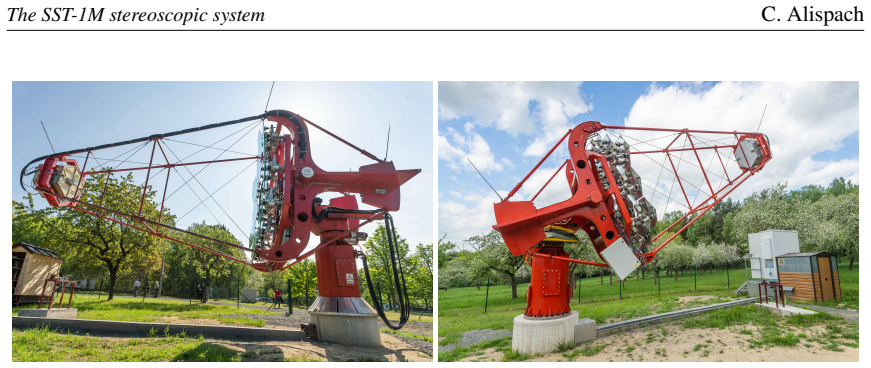
The argument is carried by the full SST-1M chain rather than by any single mathematical identity. Structurally, each telescope is a Davies-Cotton design: 18 hexagonal mirror facets arranged in a 4-meter spherical dish with 6.47 m² effective area, focusing onto DigiCam, a camera of 1296 hexagonal silicon-photomultiplier pixels with 0.24-degree angular size and about 9-degree field of view, read out by free-running digitizers with White Rabbit synchronization. Two such units spaced 152.5 m apart view the same air shower, and the stereo geometry is what enables background rejection and energy reconstruction. The calibration machinery then does the heavy lifting: dark-count runs give per-pixel gain, dark rate, crosstalk and noise; muon-ring images give a monitor of optical throughput that catches mirror-reflectivity decline; and night-sky-background corrections recover the photoelectron scale in the SiPM camera. Monte Carlo simulations model the instrument response and atmospheric transmission, are tuned to match the data, and convert the shower images into spectra, sky maps, and sensitivity curves, all processed by the open-source pipeline sst1mpipe.
What would settle it
Re-analyze the Crab data with an independently built instrument response that uses directly measured on-site atmospheric transparency rather than the tuned simulations; if the spectral index shifts by more than the quoted 0.08 systematic beyond statistical uncertainty, the central validation claim fails. A concrete cross-check is to compare the muon-ring-derived optical throughput with a direct measurement of mirror reflectivity on the same nights.
Extended reading notes
Core claim
On its own terms, the paper's claim is that the SST-1M stereoscopic system, two 4-meter single-mirror telescopes equipped with DigiCam silicon-photomultiplier cameras and separated by 152.5 meters, detects and reconstructs very-high-energy gamma rays from a low-altitude site. The Crab Nebula is the load-bearing case: with per-pixel dark-run calibration, muon-ring optical-efficiency tracking, night-sky-background corrections, and Monte Carlo simulations tuned to the data, the mono and stereo analyses return consistent power-law spectra over 2.5–50 TeV, a stereo spectral index of 2.78 ± 0.10 (stat) ± 0.08 (sys), and flux normalizations in line with previous measurements from major TeV observatories. The reconstructed centroid sits within 0.02 degrees of the Crab coordinates, and the pixel aligned with the Crab shows modulation linked to the Crab pulsar's optical pulsations, evidence of timing precision. Beyond the Crab, the paper reports a detected flare from the active galaxy Markarian 421, resolved components in the VER J2019+368 region, and a 3.5σ excess toward CTA 1 with upper limits. The conclusion is that the system's instrument model and open-source analysis pipeline are validated, making the telescopes ready for targeted multi-TeV science, with a future higher-altitude site and array concepts already under study.
Load-bearing premise
The claim stands or falls on whether the Monte Carlo instrument response, which is tuned to data taken at 510 m altitude under high night-sky background, correctly describes atmospheric transmission and the SiPM camera's behavior; the paper itself states that accurate calibration and simulation benchmarking are still ongoing.
Editorial extensions
If this is right
- If the central claim holds, similar small-telescope arrays can deliver competitive multi-TeV science from modest-altitude sites, not only from high mountain observatories.
- The agreement of mono and stereo spectra with the Crab benchmark validates using the open-source pipeline for future public datasets, making the analyses reproducible.
- The pulsar-correlated modulation in the Crab-aligned pixel implies the timing chain is accurate enough for pulsar and transient studies with an SiPM camera.
- The paper's reported hybrid study with water-Cherenkov detectors projects about 30% better sensitivity above 10 TeV, supporting the idea of combining SST-1M-type imagers with particle detectors.
- Moving the system to a higher-altitude site, as the paper discusses, should improve atmospheric transparency and reduce systematic uncertainties, extending energy reach.
Reading between the lines
- Because the statistical error on the stereo index is larger than the systematic error, more Crab exposure will tighten the index; a more decisive test is replacing the tuned Monte Carlo with direct on-site atmospheric transmission measurements.
- The paper's muon-ring monitoring already quantifies a 2–5% monthly optical decline; a natural next step, not discussed, is to automate that monitor into a maintenance trigger for a full array.
- If the CTA 1 excess is real, background-limited scaling from 3.5σ in 30 hours implies roughly double the exposure would reach a firm 5σ detection; that is an extrapolation, not a paper claim.
- The reported 30% hybrid sensitivity gain above 10 TeV could be validated independently by simulating the same water-Cherenkov-plus-imager combination at different zenith angles and comparing with the standalone sensitivity curve.
Editorial analysis
A structured set of objections, weighed in public.
Referee Report
Summary. The paper reports on the SST-1M stereoscopic system, two small-size imaging atmospheric Cherenkov telescopes installed at the Ondrejov Observatory at 510 m altitude. It describes the telescope design, the SiPM-based DigiCam camera, calibration procedures including dark runs and muon analysis, and observations of the Crab Nebula, Mrk 421, VER J2019+368, and CTA 1. The central validation claim is that 33 hours of stereo Crab observations yield a spectral index of 2.78 +/- 0.10 (stat) +/- 0.08 (sys), flux normalizations consistent with MAGIC, VERITAS, HAWC, and LHAASO, and a source position within 0.02 degrees of the Crab coordinates, thereby validating the instrument model, the calibration chain, and the open-source sst1mpipe analysis pipeline. The paper also presents sensitivity curves and discusses a future higher-altitude deployment.
Significance. If the validation claim is fully supported, the result is significant: it demonstrates that a low-cost, low-altitude SiPM-based IACT system can reconstruct the Crab spectrum and position in agreement with established observatories, and it validates an open-source analysis pipeline (sst1mpipe) that is publicly available. The external benchmarking against MAGIC, VERITAS, HAWC, and LHAASO is a genuine strength, as is the honest labeling of CTA 1 as a sub-threshold 3.5-sigma excess rather than a detection. The source detection and position measurement are robust because they depend only weakly on the energy-scale assumptions. However, the spectral-index agreement inherits the Monte Carlo instrument response, and the paper states that the simulations were tuned to observed data while the absolute calibration and simulation benchmark are ongoing; this makes the quoted systematic uncertainty of +/- 0.08 under-constrained and the spectral validation not yet fully independent.
major comments (2)
- [Section 3.1 (Crab Nebula)] The claim that the Monte Carlo simulations 'were tuned to match the observed data' (Section 3.1), combined with the abstract's statement that 'the accurate calibration of the detector and the simulation benchmark are ongoing', leaves the quoted systematic uncertainty of +/- 0.08 on the stereo spectral index (Section 3.1) under-constrained. The paper does not state which MC parameters were tuned, which data sets were used for the tuning, or whether the Crab spectrum itself entered the tuning; if the Crab spectrum was used, the agreement with MAGIC, VERITAS, HAWC, and LHAASO is not a fully independent validation. Because an energy-dependent bias of a few percent in the effective area can tilt the reconstructed spectrum, I request that the authors specify the tuning procedure, derive the 0.08 systematic from explicit sources such as muon-based optical efficiency, NSB baseline-shift corrections, and atmospheric transmission, and show residuals of the Crab SED versus energy as a check on energy-dependent biases.
- [Section 3.2 (Galactic sources and AGNs)] The abstract states that the system is 'detecting galactic sources and flares of AGNs', but in Section 3.2 CTA 1 is reported at only 3.5 sigma with a 0.25-degree offset and only upper limits, while the VER J2019+368 result is described as a 'preliminary sky-map' with no significance quoted. Please either quote the significances and analysis cuts for each source, or soften the detection wording to avoid overstating sub-threshold results. This does not affect the Crab-based validation, but it does affect the paper's broader claim of scientific readiness.
minor comments (5)
- [Figure 5] The text refers to 'Figure 5-left' and 'Figure 5-center', but the figure caption has only 'Left' and 'Right' panels; the temporal-evolution panel appears to be the right panel, so the in-text references should be corrected.
- [Section 3.1] The paper reports 33 hours of stereo data for the first Crab campaign, while Section 3.2 states that 92.2 hours of Crab observations have been accumulated since September 2023; please clarify whether the latter includes later campaigns and how the two figures relate.
- [Section 3.2] The sentence 'The VHE sources coordinates in the region are indicated' has a grammatical error and should read 'The VHE source coordinates in the region are indicated.'
- [Section 4] The claims about the performance at the Indian Astronomical Observatory and Pierre Auger site, and the 30% improvement from the hybrid SWGO analysis, are delegated to other proceedings papers; the text should label these as external results so readers do not mistake them for results established in this manuscript.
- [Abstract] The phrase 'almost deadtime free up to few kHz' should read 'up to a few kHz' for grammatical correctness.
Circularity Check
MC instrument response tuned to observed Crab data makes the spectral 'validation' partially circular; external cross-calibration and source localization retain independent content.
-
fitted input called prediction
[Section 3.1 (Crab Nebula)]
"Monte Carlo (MC) simulations were extensively used to model the instrument response and atmospheric conditions, and were tuned to match the observed data. Spectral analysis of the Crab Nebula was performed using a power-law model over the 2.5–50 TeV range. The results were consistent across both telescopes and the stereo system, with spectral indices 2.78 ± 0.10stat ± 0.08sys (for the stereo) and flux normalizations in agreement with previous measurements from MAGIC, VERITAS, HAWC, and LHAASO."
The IRFs that set reconstructed energies and effective areas were 'tuned to match the observed data'—the same Crab observations whose spectrum is then presented as validating the instrument model and pipeline. If the tuning used the Crab data, the derived spectral index and flux normalization are not independent predictions; they inherit the tuned acceptance and energy scale. The agreement with MAGIC/VERITAS/HAWC/LHAASO is an external benchmark and partly breaks the circularity, but the paper does not state which parameters were tuned, which data were used, or how the ±0.08 systematic was derived.
full rationale
The paper's central claim—that SST-1M detects the Crab Nebula and reconstructs its spectrum and position—has genuine independent anchors: the measured source position (0.02° from the Crab coordinates) does not depend on MC spectral tuning, and the comparison of flux normalization and spectral index against MAGIC, VERITAS, HAWC, and LHAASO is an external cross-check by other collaborations. These prevent a high circularity score. The main circularity risk is internal to the analysis chain: Section 3.1 states the MC simulations were 'tuned to match the observed data,' and the same observed data are then used to validate the instrument response and pipeline. Without specifying the tuning parameters and the data used, the reconstructed spectrum is not fully independent of the tuning input, and the quoted systematic error of ±0.08 is under-constrained. The paper's own abstract acknowledges that calibration and simulation benchmark are ongoing, further tempering the validation claim. No load-bearing self-citation chain is present; the cited companion papers contain the detailed analyses, but the external Crab measurements supply independent evidence. Overall this is partial circularity (score 3), not a full reduction by construction.
Assumptions & free parameters
free parameters (3)
- MC instrument-response tuning parameters =
undisclosed
- Night-sky-background baseline-shift corrections =
8 to 28 ADC
- Gaussian smoothing kernel for the VER J2019+368 sky map =
0.25 degrees
assumptions (5)
- domain assumption Muon Cherenkov ring charge versus radius is a valid monitor of telescope optical efficiency
- domain assumption The Crab Nebula is a stable standard candle with known position and spectrum
- domain assumption MC air-shower and atmospheric models are valid at 510 m altitude under high night-sky background
- domain assumption The Crab spectrum is a single power law over 2.5-50 TeV
- ad hoc to paper NSB-induced SiPM voltage drop is correctly modeled by the baseline-shift correction procedure
Cite this review
Pith. "Pith review of The SST-1M stereoscopic system." pith.science (2026). https://pith.science/paper/A36SS4CH
@misc{pith2026250716498,
  author       = {Pith},
  title        = {Pith review of: The SST-1M stereoscopic system},
  year         = {2026},
  howpublished = {\url{https://pith.science/paper/A36SS4CH}},
  note         = {Machine review of arXiv:2507.16498}
}
read the original abstract
The Single-Mirror Small-Size Telescope (SST-1M) is an Imaging Atmospheric Cherenkov Telescope designed for detecting very high-energy gamma rays. With a compact design achieved through the adoption of silicon-photomultiplier pixels and a lightweight structure, SST-1M offers a large field of view of about 9{\deg} and features a mirror system of 4 m diameter with an optical PSF (at 80% of photon inclusion) of 0.08{\deg} on axis and 0.21{\deg} at 4{\deg} off-axis, and a fully digitizing readout almost deadtime free up to few kHz. The SST-1M achieved a high-performance and cost-effective solution for implementing an array of small-sized telescopes. The stereoscopic system of two SST-1Ms is temporarily installed at the Ond\v{r}ejov Observatory in the Czech Republic. From an altitude of only about 510 m and in harsh meteorological conditions, the system is detecting galactic sources and flares of AGNs. The accurate calibration of the detector and the simulation benchmark are ongoing. The results of its performance are shown. A future final location is being considered and a future performance outlook is discussed.
Figures


Figures from the paper (4 more)


Reference graph
Works this paper leans on
-
[1]
write newline
" write newline "" before.all 'output.state := FUNCTION blank.sep after.quote 'output.state := FUNCTION fin.entry output.state after.quoted.block = 'skip 'add.period if write newline FUNCTION new.block output.state before.all = 'skip output.state after.quote = after.quoted.block 'output.state := after.block 'output.state := if if FUNCTION new.sentence out...
-
[2]
C. Alispach et al., The SST-1M imaging atmospheric Cherenkov telescope for gamma-ray astrophysics , https://doi.org/10.1088/1475-7516/2025/02/047 JCAP 02 (2025) 047
-
[3]
D. Mandat et al., Operation of the SST-1M Cherenkov telescope gamma ray stereoscopic system , PoS ICRC2025 (2026)
work page 2026
-
[4]
Alispach, C. et al., Observation of the crab nebula with the single-mirror small-size telescope stereoscopic system at low altitude, https://doi.org/10.1051/0004-6361/202555292 A&A 699 (2025) A255
-
[5]
Lacave et al., SST-1M Observation of CTA 1 , PoS ICRC2025 (2026)
B. Lacave et al., SST-1M Observation of CTA 1 , PoS ICRC2025 (2026)
work page 2026
-
[6]
J. Jury s ek et al., Observation of VER 2019+368 with the SST-1M stereoscopic system , PoS ICRC2025 (2026)
work page 2026
-
[7]
Reddy et al., SST-1M observation of Markarian 421 , PoS ICRC2025 (2026)
M.S. Reddy et al., SST-1M observation of Markarian 421 , PoS ICRC2025 (2026)
work page 2026
-
[8]
T. Tavernier et al., Calibration and Performance Validation of the SST-1M Telescopes Using Crab Nebula Observations , PoS ICRC2025 (2026)
work page 2026
Show all 11 references
-
[9]
Bakalova et al., Hybrid concept of detection for a wide-field gamma-ray observatory using Cherenkov telescopes , PoS ICRC2025 (2026)
A. Bakalova et al., Hybrid concept of detection for a wide-field gamma-ray observatory using Cherenkov telescopes , PoS ICRC2025 (2026)
2026
-
[10]
Heller et al., An innovative silicon photomultiplier digitizing camera for gamma-ray astronomy , https://doi.org/10.1140/epjc/s10052-017-4609-z EPJ C 77 (2017) 47
M. Heller et al., An innovative silicon photomultiplier digitizing camera for gamma-ray astronomy , https://doi.org/10.1140/epjc/s10052-017-4609-z EPJ C 77 (2017) 47
2017 doi
-
[11]
Cechvala et al., Stereo performance of SST-1M at different altitudes , PoS ICRC2025 (2026)
P. Cechvala et al., Stereo performance of SST-1M at different altitudes , PoS ICRC2025 (2026)
2026
Reviewed August 6, 2026 · model on record in the stance chip above.
Discussion (0). Sign in to comment.