Max-Min Secrecy Rate Optimization for Secure ISAC Networks: Global Optimization and Low-Complexity Algorithm
Pith reviewed 2026-06-27 05:37 UTC · model grok-4.3
The pith
Branch-and-bound solves the max-min secrecy rate problem to global optimality in secure ISAC networks while a successive convex approximation method reaches near-optimal performance at lower cost.
A machine-rendered reading of the paper's core claim, the machinery that carries it, and where it could break.
Core claim
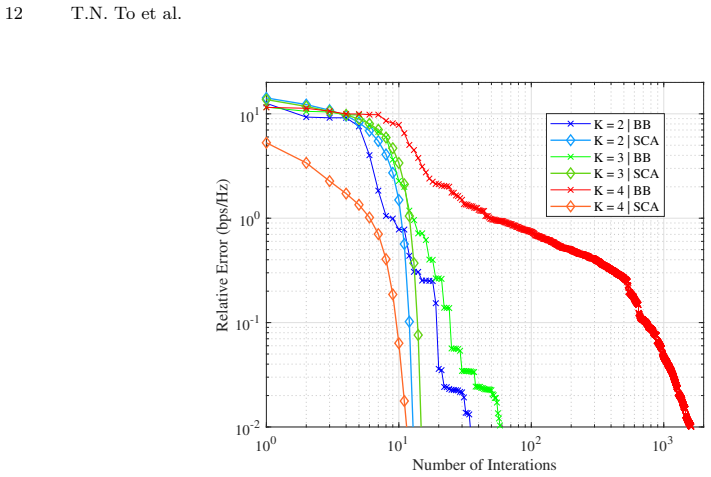
The branch-and-bound algorithm, built on semidefinite relaxation and successive convex relaxations, returns the globally optimal max-min secrecy rate subject to the transmit power budget and the beampattern matching error constraints; the successive convex approximation algorithm produces a locally optimal solution whose secrecy performance is nearly identical but whose run time is substantially smaller.
What carries the argument
Branch-and-bound framework applied after semidefinite relaxation of the non-convex secrecy-rate and beampattern constraints.
If this is right
- The branch-and-bound solution serves as an exact performance benchmark against which other secure ISAC algorithms can be measured.
- The SCA algorithm converges to a stationary point of the relaxed problem and therefore supplies a usable operating point under tight latency constraints.
- Maximizing the minimum secrecy rate directly enforces fairness across communication users even when sensing users act as potential eavesdroppers.
- Beampattern matching error constraints translate the sensing-quality requirement into a form that remains compatible with the secrecy-rate objective.
Where Pith is reading between the lines
- The global optimum obtained by branch-and-bound can be used to quantify the sub-optimality gap of any future heuristic proposed for larger ISAC deployments.
- Because the SCA iterates are convex, the same successive-approximation template could be reused for related ISAC problems that add mobility or imperfect channel state information.
- If real radar performance deviates from the beampattern matching error metric, the reported secrecy rates would need recalibration against measured range or angle estimation error.
Load-bearing premise
The semidefinite relaxation together with the convex relaxations inside branch-and-bound produces solutions whose gap to the original non-convex problem is negligible.
What would settle it
On a small instance with two communication users and two sensing users, run both the branch-and-bound solver and the SCA solver to completion and check whether the secrecy-rate values differ by more than a few percent while both satisfy the beampattern error limit.
Figures



read the original abstract
In this paper, we investigate a secure integrated sensing and communication (ISAC) system in which multiple communication users (CUs) coexist with multiple untrusted sensing users (SUs) that may eavesdrop on the confidential information intended for the CUs. To promote security fairness among users, we formulate a max-min secrecy rate optimization problem subject to a transmit power budget and sensing quality requirements characterized by beampattern matching error constraints. The resulting design problem is highly non-convex due to the secrecy rate expressions and non-convex sensing constraints. To address these challenges, we first reformulate the problem using semidefinite relaxation (SDR). Based on the reformulated problem, we develop a branch-and-bound (BB) framework combined with convex relaxations to obtain the globally optimal solution within a prescribed accuracy. To further reduce computational complexity, we propose a low-complexity algorithm based on successive convex approximation (SCA), which iteratively solves a sequence of convex subproblems and converges to a local solution. Numerical results demonstrate that the proposed BB algorithm achieves the global optimum and provides a benchmark for performance evaluation. Moreover, the proposed SCA-based algorithm attains near-optimal secrecy performance with significantly lower computational complexity, making it attractive for practical ISAC deployments.
Editorial analysis
A structured set of objections, weighed in public.
Referee Report
Summary. The paper formulates a max-min secrecy rate optimization problem for a secure ISAC system with multiple CUs and untrusted SUs that may eavesdrop, subject to a transmit power budget and beampattern matching error constraints for sensing quality. The resulting non-convex problem is addressed via SDR reformulation, followed by a branch-and-bound framework with convex relaxations to obtain a globally optimal solution within prescribed accuracy, and a low-complexity SCA algorithm that iteratively solves convex subproblems to a local solution. Numerical results are presented to show that BB achieves the global optimum (serving as benchmark) while SCA attains near-optimal secrecy performance at lower complexity.
Significance. If the SDR tightness and beampattern surrogate are validated to produce negligible gaps, the work supplies a useful global benchmark and practical low-complexity method for fairness-oriented secure ISAC designs; the combination of global and approximate solvers is a standard but valuable contribution in this domain when accompanied by reproducible validation.
major comments (2)
- [Abstract] Abstract (and BB algorithm description): the central claim that the BB algorithm achieves the global optimum of the original problem rests on the assertion that SDR plus the convex relaxations inside the branch-and-bound framework produce bounds whose gap to the non-convex max-min secrecy-rate objective (involving differences of log(1+SINR) terms) and the quadratic beampattern matching error constraints is negligible. No explicit rank-1 recovery guarantee, optimality-gap analysis, or comparison against the original non-convex formulation is referenced; without this, the global-optimality statement cannot be verified from the given material.
- [Abstract] Abstract (sensing constraints): the beampattern matching error is adopted as the sole sensing-quality metric, yet its relationship to standard sensing figures of merit (CRLB, detection probability, or estimation variance) is not quantified. If the surrogate deviates materially from the actual sensing requirement, both the global optimum reported by BB and the near-optimality claimed for SCA become surrogate-specific rather than directly applicable to practical ISAC sensing performance.
minor comments (1)
- The abstract states that the SCA algorithm converges but supplies no convergence rate, monotonicity argument, or stopping criterion; a brief reference to the relevant theorem or lemma would improve clarity.
Simulated Author's Rebuttal
We thank the referee for the constructive comments. We address each major comment below and indicate the revisions planned for the manuscript.
read point-by-point responses
-
Referee: [Abstract] Abstract (and BB algorithm description): the central claim that the BB algorithm achieves the global optimum of the original problem rests on the assertion that SDR plus the convex relaxations inside the branch-and-bound framework produce bounds whose gap to the non-convex max-min secrecy-rate objective (involving differences of log(1+SINR) terms) and the quadratic beampattern matching error constraints is negligible. No explicit rank-1 recovery guarantee, optimality-gap analysis, or comparison against the original non-convex formulation is referenced; without this, the global-optimality statement cannot be verified from the given material.
Authors: The branch-and-bound procedure is applied to the SDR-relaxed formulation to compute its global optimum to within a prescribed accuracy. Numerical experiments in the manuscript show that the resulting covariance matrices are rank-1 in the evaluated scenarios, permitting recovery of feasible beamformers for the original problem. We agree, however, that an explicit tightness analysis, rank-1 recovery guarantee, or quantitative optimality-gap bound relative to the original non-convex problem is absent. In the revision we will add a dedicated subsection that (i) states the global optimum is obtained for the SDR problem, (ii) reports the observed rank-1 property together with the empirical gap to the original objective, and (iii) clarifies the abstract and introduction accordingly. revision: yes
-
Referee: [Abstract] Abstract (sensing constraints): the beampattern matching error is adopted as the sole sensing-quality metric, yet its relationship to standard sensing figures of merit (CRLB, detection probability, or estimation variance) is not quantified. If the surrogate deviates materially from the actual sensing requirement, both the global optimum reported by BB and the near-optimality claimed for SCA become surrogate-specific rather than directly applicable to practical ISAC sensing performance.
Authors: The beampattern matching error is a widely adopted surrogate in the ISAC literature because it directly enforces similarity between the transmitted covariance and a prescribed sensing beampattern, which is relevant for applications that require controlled angular illumination. A quantitative mapping to CRLB, detection probability, or estimation variance is not derived in the present work. We will revise the manuscript to include a short discussion of this modeling choice, its relation to practical sensing metrics, and an explicit statement that the reported performance is with respect to the adopted surrogate. revision: yes
Circularity Check
No significant circularity detected
full rationale
The paper formulates a max-min secrecy rate problem and applies standard SDR reformulation followed by branch-and-bound with convex relaxations for global optimality and SCA for local solutions. No self-definitional steps, fitted inputs renamed as predictions, load-bearing self-citations, uniqueness theorems imported from prior author work, ansatzes smuggled via citation, or renamings of known results appear in the provided text. The derivation chain consists of applying established convex optimization techniques to the stated non-convex problem, remaining self-contained without reduction of claims to inputs by construction.
Axiom & Free-Parameter Ledger
axioms (1)
- domain assumption Semidefinite relaxation yields a solution whose optimality gap is negligible for the secrecy-rate and beampattern constraints in this problem class.
Reference graph
Works this paper leans on
-
[1]
IEEE Transactions on Vehicular Technology 73(5), 7345–7350 (2024)
Bao, J., Cao, Y., Tang, J., Xu, L., Zhao, N., Wang, X.: Secrecy energy efficiency enhancement of active irs aided miso networks. IEEE Transactions on Vehicular Technology 73(5), 7345–7350 (2024)
2024
-
[2]
In: 2025 IEEE Information Theory Workshop (ITW)
Chen, L., Zhao, M.M., Li, M., Lei, M., Zhao, M., Zhang, R.: Global and efficient local optimization for movable antenna enabled isac. In: 2025 IEEE Information Theory Workshop (ITW). pp. 1–6. IEEE (2025)
2025
-
[3]
Journal of Ma- chine Learning Research 17(83), 1–5 (2016)
Diamond, S., Boyd, S.: Cvxpy: A python-embedded modeling language for convex optimization. Journal of Ma- chine Learning Research 17(83), 1–5 (2016)
2016
-
[4]
IEEE Journal on Selected Areas in Communications 42(11), 3125–3139 (2024) 14 T.N
Hou, K., Zhang, S.: Optimal beamforming for secure integrated sensing and communication exploiting target location distribution. IEEE Journal on Selected Areas in Communications 42(11), 3125–3139 (2024) 14 T.N. To et al
2024
-
[5]
IEEE Communications Surveys & Tutorials 24(2), 994–1034 (2022)
Liu, A., Huang, Z., Li, M., Wan, Y., Li, W., Han, T.X., Liu, C., Du, R., Tan, D.K.P., Lu, J., Shen, Y., Colone, F., Chetty, K.: A survey on fundamental limits of integrated sensing and communication. IEEE Communications Surveys & Tutorials 24(2), 994–1034 (2022)
2022
-
[6]
IEEE Internet of Things Journal 12(24), 53202–53214 (2025)
Liu, F., Mu, J., Xu, W., Miao, J., Bazzi, W., Mumtaz, S.: Toward secure and energy-efficient isac in low-altitude iot: A game-theoretic drl framework with adaptive sensing. IEEE Internet of Things Journal 12(24), 53202–53214 (2025)
2025
-
[7]
IEEE Transactions on Signal Processing 68, 3929–3944 (2020)
Liu, X., Huang, T., Shlezinger, N., Liu, Y., Zhou, J., Eldar, Y.C.: Joint transmit beamforming for multiuser mimo communications and mimo radar. IEEE Transactions on Signal Processing 68, 3929–3944 (2020). https: //doi.org/10.1109/TSP.2020.3004739
-
[8]
IEEE Journal on Selected Areas in Communications 37(1), 216–232 (2019)
Lu, Y., Xiong, K., Fan, P., Ding, Z., Zhong, Z., Letaief, K.B.: Global energy efficiency in secure miso swipt systems with non-linear power-splitting eh model. IEEE Journal on Selected Areas in Communications 37(1), 216–232 (2019)
2019
-
[9]
In: ICC 2022-IEEE International Conference on Communications
Ren, Z., Qiu, L., Xu, J.: Optimal transmit beamforming for secrecy integrated sensing and communication. In: ICC 2022-IEEE International Conference on Communications. pp. 5555–5560. IEEE (2022). https://doi.org/10. 1109/ICC45855.2022.9838753
-
[10]
IEEE Transactions on Communications 71(9), 5549–5564 (2023)
Ren, Z., Qiu, L., Xu, J., Ng, D.W.K.: Robust transmit beamforming for secure integrated sensing and communi- cation. IEEE Transactions on Communications 71(9), 5549–5564 (2023)
2023
-
[11]
IEEE Journal on Selected Areas in Communications 42(11), 3217–3231 (2024)
Ren, Z., Xu, J., Qiu, L., Ng, D.W.K.: Secure cell-free integrated sensing and communication in the presence of information and sensing eavesdroppers. IEEE Journal on Selected Areas in Communications 42(11), 3217–3231 (2024)
2024
-
[12]
Springer (1998)
Tuy, H., Hoang, T., Hoang, T., Mathématicien, V.n., Hoang, T., Mathematician, V.: Convex analysis and global optimization. Springer (1998)
1998
-
[13]
IEEE Transactions on Cognitive Communications and Networking 8(1), 170–185 (2022)
Wu, X., Ma, J., Xing, Z., Gu, C., Xue, X., Zeng, X.: Secure and energy efficient transmission for irs-assisted cognitive radio networks. IEEE Transactions on Cognitive Communications and Networking 8(1), 170–185 (2022)
2022
-
[14]
In: 2023 21st International Symposium on Modeling and Optimization in Mobile, Ad Hoc, and Wireless Networks (WiOpt)
Xu, D., Xu, Y., Wei, Z., Song, S., Ng, D.W.K.: Sensing-enhanced secure communication: Joint time allocation and beamforming design. In: 2023 21st International Symposium on Modeling and Optimization in Mobile, Ad Hoc, and Wireless Networks (WiOpt). pp. 673–680. IEEE (2023)
2023
-
[15]
IEEE Transactions on Wireless Communications (2025)
Xu, Y., Zheng, M., Xu, D., Song, S., Da Costa, D.B.: Sensing-aided near-field secure communications with mobile eavesdroppers. IEEE Transactions on Wireless Communications (2025)
2025
discussion (0)
Sign in with ORCID, Apple, or X to comment. Anyone can read and Pith papers without signing in.