REVIEW 3 major objections 6 minor 41 references
Video Compression With Rate-Distortion Autoencoders
T0 review · 3 major / 6 minor · reviewed 2026-08-14 · deepseek-v4-flash
Pith's one-line read A learned video compressor built from a 3D autoencoder and an autoregressive prior matches H.265/HEVC without motion compensation or interpolation.
desk verdict Clean, simple learned video codec with an overreaching comparison claim - worth refereeing, but the SOTA result needs the missing baselines. read the letter →
The pith
A machine-rendered reading of the paper's core claim, the machinery that carries it, and where it could break.
The reading
What carries the argument
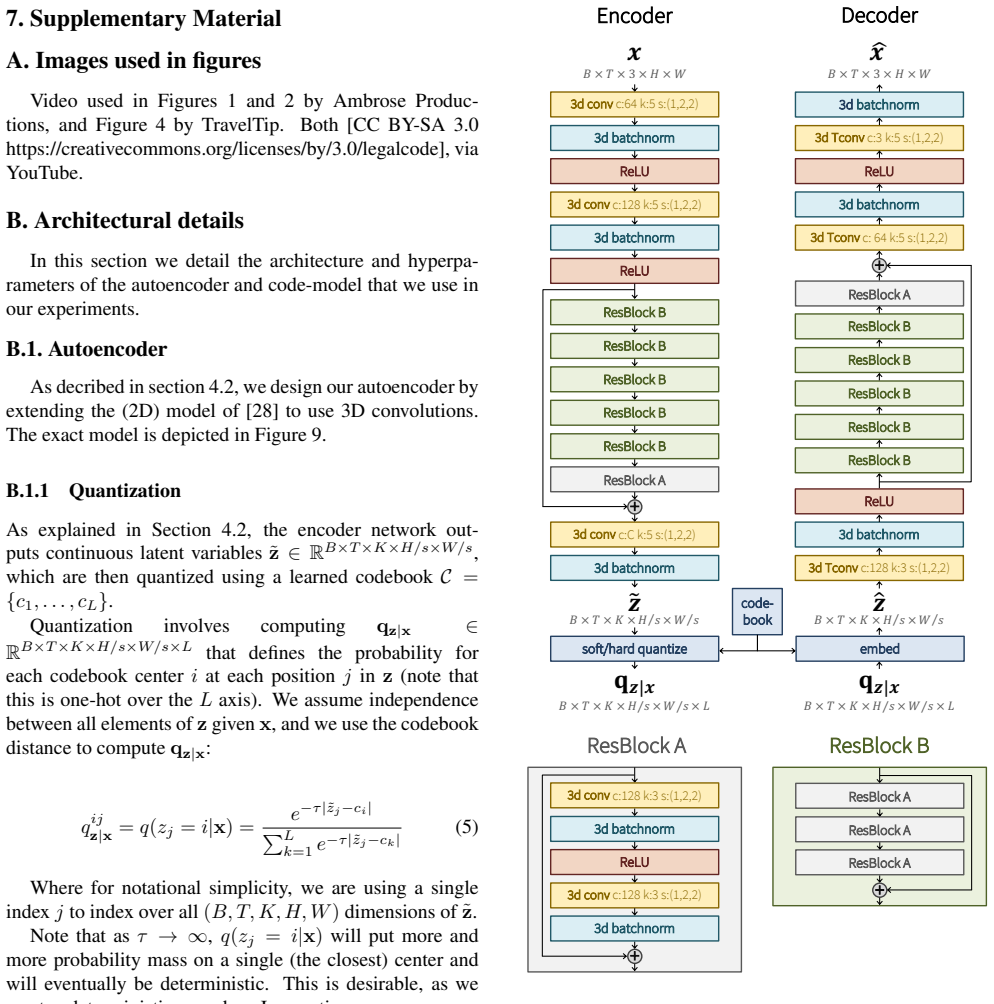
The load-bearing object is the rate-distortion autoencoder: an encoder that maps an 8-frame, 160x160 RGB chunk to a discrete latent tensor (32 channels, 8x spatial downsampling, learned codebook of L centers), a decoder that reconstructs from quantized latents, and an autoregressive code model p(z) that estimates the per-symbol distribution for adaptive arithmetic coding. The prior is a gated PixelCNN, optionally conditioned on the previous latent frame or on a Conv-GRU state. Training minimizes L = E[-log p(x|z) - beta log p(z)], with MS-SSIM as distortion and cross-entropy as rate; the encoder gradients pass through the code model, so the encoder learns to produce latents the prior can predict cheaply.
What would settle it
Run the trained adaptive arithmetic coder on the quantized latents for the UVG test clips at each beta value, tally the actual bitstream bytes, and compare the resulting bpp with the reported -log p(z) rate loss; if actual bpp is consistently higher, the curves shift right and the claimed parity with H.265/HEVC weakens.
Extended reading notes
Core claim
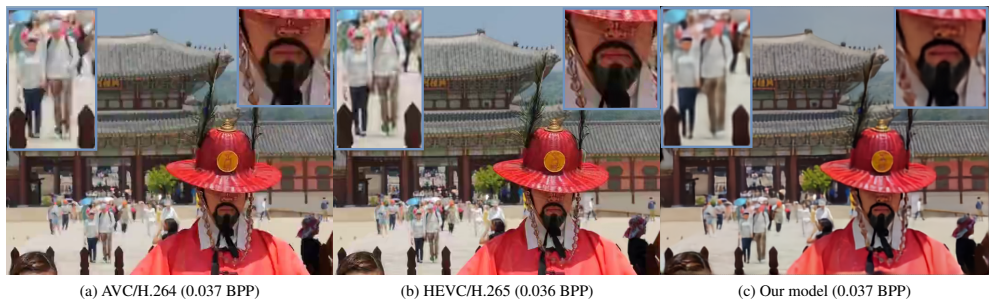
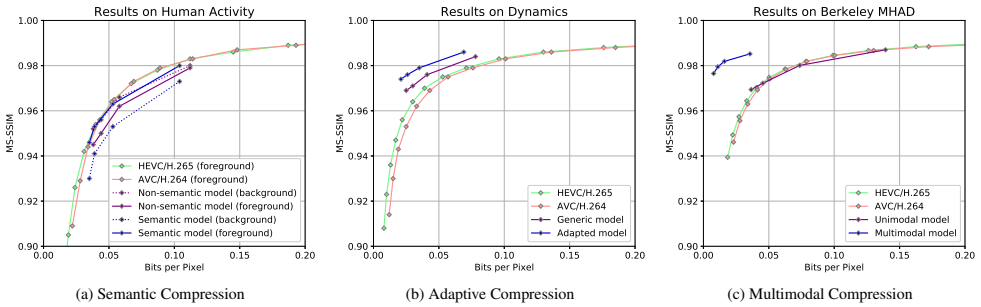
The central claim is that lossy video compression can be framed as learning a discrete latent-variable model, with the encoder producing a quantized code and an autoregressive prior providing the bitrate; optimizing the cross-entropy-based rate plus an MS-SSIM distortion term is the right training objective. The authors show that, unlike ordinary VAEs, a deterministic encoder is preferable for lossy compression because bits-back coding, which would refund the encoder's entropy, is unavailable, so any stochasticity only adds rate without improving distortion. Their best model uses a ResNet-style autoencoder with 3D convolutions over 8-frame chunks and a gated PixelCNN prior conditioned on the previous latent frame; it outperforms learned baselines based on flow and interpolation, and is on par with H.265/HEVC in default FFmpeg settings. They further argue that the same architecture enables semantic bit allocation, domain fine-tuning, and joint compression of multiple camera modalities.
Load-bearing premise
Every reported bitrate for the proposed method is the cross-entropy rate loss, not a measured arithmetic-coded bitstream, so the rate-distortion comparison against H.265/HEVC assumes the entropy coder is efficient enough that the proxy matches real bpp.
Editorial extensions
If this is right
- Because the 3D autoencoder alone removes most temporal redundancy, the autoregressive prior can be a simple frame-conditioned PixelCNN; latency-sensitive applications can trade a bit of rate for a much cheaper prior.
- Learned codecs need not include flow estimation, interpolation, or residual coding to beat other learned methods; this lowers the engineering barrier for learned video compression.
- Semantic compression lets a codec spend bits where visual tasks care about them, reversing the usual quality gap between foreground and background.
- Domain adaptation by fine-tuning a pretrained compressor yields large rate-distortion gains on predictable footage such as autonomous-driving video.
- Joint compression of synchronized multi-view video with a single network outperforms compressing each view separately with H.265/H.264, by exploiting inter-view redundancy.
Reading between the lines
- If the rate-loss proxy is replaced by actual arithmetic-coded bitstream lengths, the reported curves could shift; a fair comparison to H.265/HEVC should be re-run with measured bytes, since the paper's own supplementary notes that rate loss is only a proxy.
- The semantic weighting recipe suggests a general plug-in: any per-pixel importance mask obtained from a detector or saliency model can be folded into the rate and distortion losses, which would let codecs be tuned for faces, text, or object-detection performance rather than raw MS-SSIM.
- The success of 3D convolutions at temporal decorrelation hints that longer chunks or higher resolutions may shift the trade-off further toward the autoencoder and away from the prior; this is a testable scaling prediction the paper does not make.
- The multimodal result implies that the same architecture could jointly compress RGB+depth or stereo pairs, where classical codecs would need separate streams; the gain should depend on how well the modalities are aligned.
Editorial analysis
A structured set of objections, weighed in public.
Referee Report
Summary. The paper presents a deep generative approach to lossy video compression based on a 3D autoencoder with a discrete latent space and an autoregressive prior (gated PixelCNN) trained jointly with a rate-distortion loss. The method is evaluated on standard and internal datasets, with ablations over autoencoder and prior variants, and comparisons to classical codecs (H.264/AVC, H.265/HEVC) and two learned video codecs. The authors report that their best model outperforms the learned baselines and approaches H.265/HEVC under default settings. The paper also introduces three extensions: semantic compression, where rate and distortion losses are weighted by object importance; adaptive compression, where a pretrained model is fine-tuned to a target domain; and multimodal compression, where multiple camera streams are compressed jointly. A theoretical section derives the rate-distortion loss from the variational bound and argues for deterministic encoders in lossy compression.
Significance. If the reported results are substantiated, the paper offers a simple and theoretically grounded baseline for learned video compression and demonstrates useful practical extensions. The ablations are informative, the extensions are novel, and the theoretical clarification of the relation between rate-distortion autoencoders and VAEs is a useful contribution. The main weaknesses are the incomplete set of learned baselines used for comparison and the reliance on an expected-rate proxy instead of actual bitstream lengths, both of which affect the headline comparative claims. These issues are addressable but require additional experimental evidence.
major comments (3)
- [5.4, Figure 6; Section 2] The claim that the method outperforms the state-of-the-art learned video codecs is supported only by comparisons to Wu et al. [40] and Lu et al. [27], with curves taken from their respective papers. The related work (Section 2) also cites Rippel et al. [33] and Han et al. [15] as recent learned video compression methods, but neither is included in Figure 6. The paper does not report the evaluation protocol for the baselines (number of UVG frames used, whether the full 3900 frames or a subset were evaluated, the preprocessing, or the exact MS-SSIM implementation), and no code or bitstreams are released. Because the headline conclusion depends on this comparison, the authors should include the missing baselines or justify their exclusion, and document the evaluation conditions for every compared method.
- [Supplementary C.3] All reported bitrates for the proposed method are computed from the cross-entropy rate loss converted to bpp, rather than from the actual lengths of the arithmetic-coded bitstream, while the H.264/H.265 bitrates are obtained from actual compressed file sizes. The paper states that this proxy is justified by a high correlation with actual bpp (citing [27]) but provides no measurements for its own model. If the arithmetic coder is less efficient than the entropy bound, the rate-distortion curves in Figures 6 and 11 would shift and the conclusion that the method is on par with H.265/HEVC could change. Please report actual bitstream lengths on the evaluation datasets, or at least a comparison of expected versus actual rates.
- [4.1, 5.1, 5.4] The evaluation procedure on UVG is underspecified. The model is described as processing crops fixed to 160x160 (Section 4.1), yet UVG frames are 1920x1080. The paper does not state whether full frames were processed, how the fully convolutional network was applied at full resolution, or how the rate was accumulated over each sequence. This ambiguity directly affects the bpp values in Figure 6 and the comparison with the baselines. Please specify the exact test-time procedure: full-frame processing, tiling, or cropping, and the number of frames evaluated per sequence.
minor comments (6)
- [Abstract] The phrase 'we present a a deep generative model' contains a duplicated article.
- [4.4] The word 'en-ncoder' should be 'encoder', and 'bitstreambj' should be 'bitstream bj'.
- [4.2] The codebook size L is defined but its numeric value is never reported. Please state L and, if available, its effect on rate-distortion performance.
- [Supplementary D.1] The sentence 'for bitrates higher than 1.2 bpp' appears to be a typo for '0.12 bpp'; as written it is inconsistent with Figure 11.
- [5.1] The Dynamics dataset is described as internal and is not publicly available; please state its availability or provide additional details to allow reproducibility of the adaptive compression results.
- [5.7] The word 'monocluar' should be 'monocular'.
Circularity Check
No circularity: the paper's rate-distortion derivation and evaluations are self-contained and anchored to external benchmarks.
full rationale
The paper's central theoretical derivation, from the variational bound to the rate-distortion loss L(x) = E_q[-log p(x|z) - beta log p(z)], is a standard and self-contained argument: it starts from the intractable log-likelihood, introduces an approximate posterior, explains why the cross-entropy rather than the KL is the correct rate term for lossy compression, and justifies the use of a deterministic encoder by the absence of bits-back coding. No step in this chain defines rate or distortion in terms of the final experimental comparison, and no fitted parameter is later renamed as a prediction. The main experimental claims are comparisons against external, non-learned codecs (H.264/AVC, H.265/HEVC) and previously published learned methods (Lu et al., Wu et al.), using rate-distortion curves that come from independent papers. The paper explicitly uses the cross-entropy rate loss as a proxy for actual bitrate (Supplementary C.3), which is an engineering approximation, not a circularity: the rate loss is a well-defined information-theoretic quantity computed from the model, not fitted to the benchmark. The ablations and extensions (semantic, adaptive, multimodal) are evaluated by training on specified datasets and testing on held-out data, again against external codecs. There is no use of a self-citation as load-bearing evidence, no uniqueness theorem imported from the authors' prior work, and no ansatz smuggled in via citation. The claimed limitation that learned methods do not yet beat traditional codecs under optimal settings is stated honestly and does not indicate circular reasoning. Overall, the derivation chain is self-contained and the experimental protocol, while it has reproducibility caveats regarding baseline curves, is not circular.
Assumptions & free parameters
free parameters (3)
- beta (rate-distortion tradeoff) =
0.03, 0.05, 0.1, 0.3, 0.5, 0.7 on UVG; 0.1, 0.3, 0.5, 0.7 elsewhere
- alpha (semantic weighting) =
0.95
- codebook size L =
not reported in main text
assumptions (5)
- standard math Variational bound and cross-entropy as coding cost (Section 3)
- domain assumption MS-SSIM is a valid distortion measure for optimization and evaluation (Section 4.4)
- domain assumption Cross-entropy rate loss is an accurate proxy for the arithmetic-coded bitstream length (Supplementary C.3)
- domain assumption Training on downscaled Kinetics transfers to test datasets (Section 5.1)
- standard math Straight-through gradient estimation of the quantizer yields valid training (Section 4.2, Eq. 5)
Cite this review
Pith. "Pith review of Video Compression With Rate-Distortion Autoencoders." pith.science (2026). https://pith.science/paper/A3AGG4K2
@misc{pith2026190805717,
  author       = {Pith},
  title        = {Pith review of: Video Compression With Rate-Distortion Autoencoders},
  year         = {2026},
  howpublished = {\url{https://pith.science/paper/A3AGG4K2}},
  note         = {Machine review of arXiv:1908.05717}
}
read the original abstract
In this paper we present a a deep generative model for lossy video compression. We employ a model that consists of a 3D autoencoder with a discrete latent space and an autoregressive prior used for entropy coding. Both autoencoder and prior are trained jointly to minimize a rate-distortion loss, which is closely related to the ELBO used in variational autoencoders. Despite its simplicity, we find that our method outperforms the state-of-the-art learned video compression networks based on motion compensation or interpolation. We systematically evaluate various design choices, such as the use of frame-based or spatio-temporal autoencoders, and the type of autoregressive prior. In addition, we present three extensions of the basic method that demonstrate the benefits over classical approaches to compression. First, we introduce semantic compression, where the model is trained to allocate more bits to objects of interest. Second, we study adaptive compression, where the model is adapted to a domain with limited variability, e.g., videos taken from an autonomous car, to achieve superior compression on that domain. Finally, we introduce multimodal compression, where we demonstrate the effectiveness of our model in joint compression of multiple modalities captured by non-standard imaging sensors, such as quad cameras. We believe that this opens up novel video compression applications, which have not been feasible with classical codecs.
Figures


Figures from the paper (7 more)




Reference graph
Works this paper leans on
-
[40]
Video Compression through Image Interpolation
Chao-Yuan Wu, Nayan Singhal, and Philipp Kr ¨ahenb¨uhl. Video Compression through Image Interpolation. In ECCV, pages 416–431, 2018
work page 2018
-
[27]
DVC: An End-to-end Deep Video Compression Framework
Guo Lu, Wanli Ouyang, Dong Xu, Xiaoyun Zhang, Chunlei Cai, and Zhiyong Gao. DVC: An End-to-end Deep Video Compression Framework. arXiv:1812.00101, Nov. 2018
arXiv 2018
-
[33]
Oren Rippel, Sanjay Nair, Carissa Lew, Steve Branson, Alexander G. Anderson, and Lubomir Bourdev. Learned Video Compression. arXiv:1811.06981 [cs, eess, stat], Nov. 2018
work page Pith review arXiv 2018
-
[15]
Deep Probabilistic Video Compression
Jun Han, Salvator Lombardo, Christopher Schroers, and Stephan Mandt. Deep Probabilistic Video Compression. arXiv:1810.02845, 2018
arXiv 2018
-
[1]
Ultra video group test sequences. http://ultravideo. cs.tut.fi/. Accessed: 2019-03-18
work page 2019
-
[2]
Soft-to-Hard Vector Quantization for End-to-End Learning Compressible Representations
Eirikur Agustsson, Fabian Mentzer, Michael Tschannen, Lukas Cavigelli, Radu Timofte, Luca Benini, and Luc V Gool. Soft-to-Hard Vector Quantization for End-to-End Learning Compressible Representations. In NIPS, pages 1141–1151. Curran Associates, Inc., 2017
work page 2017
-
[3]
Alemi, Ben Poole, Ian Fischer, Joshua V
Alexander A. Alemi, Ben Poole, Ian Fischer, Joshua V . Dil- lon, Rif A. Saurous, and Kevin Murphy. Fixing a Broken ELBO. arXiv:1711.00464, Nov. 2017
arXiv 2017
-
[4]
Learning to Inpaint for Image Compression
Mohammad Haris Baig, Vladlen Koltun, and Lorenzo Torre- sani. Learning to Inpaint for Image Compression. In NIPS, pages 1246–1255, 2017
work page 2017
Show all 41 references
-
[5]
End- to-end Optimized Image Compression
Johannes Ball ´e, Valero Laparra, and Eero P Simoncelli. End- to-end Optimized Image Compression. 2016
2016
-
[6]
Variational Image Compression with a Scale Hyperprior
Johannes Ball ´e, David Minnen, Saurabh Singh, Sung Jin Hwang, and Nick Johnston. Variational Image Compression with a Scale Hyperprior. arXiv preprint arXiv:1802.01436, 2018
2018 arXiv
-
[7]
Es- timating or Propagating Gradients Through Stochastic Neu- rons for Conditional Computation
Yoshua Bengio, Nicholas L ´eonard, and Aaron Courville. Es- timating or Propagating Gradients Through Stochastic Neu- rons for Conditional Computation. 2013
2013
-
[8]
Pattern Recognition and Machine Learning
Christopher M Bishop. Pattern Recognition and Machine Learning. Springer, 1st ed. 20 edition, Oct. 2006
2006
-
[9]
Quo vadis, action recognition? A new model and the kinetics dataset
Joao Carreira and Andrew Zisserman. Quo vadis, action recognition? A new model and the kinetics dataset. InCVPR, 2017
2017
-
[10]
Kingma, Tim Salimans, Yan Duan, Pra- fulla Dhariwal, John Schulman, Ilya Sutskever, and Pieter Abbeel
Xi Chen, Diederik P. Kingma, Tim Salimans, Yan Duan, Pra- fulla Dhariwal, John Schulman, Ilya Sutskever, and Pieter Abbeel. Variational Lossy Autoencoder. arXiv:1611.02731, 2016
2016 arXiv
-
[11]
Learning for Video Compression
Zhibo Chen, Tianyu He, Xin Jin, and Feng Wu. Learning for Video Compression. IEEE Transactions on Circuits and Systems for Video Technology, Apr. 2019
2019
-
[12]
The Zettabyte Era: Trends and Analysis
Cisco. The Zettabyte Era: Trends and Analysis. Technical report, 2017
2017
-
[13]
Cover and Joy A
Thomas M. Cover and Joy A. Thomas. Elements of Infor- mation Theory. Wiley-Interscience, New York, NY , USA, 2006
2006
-
[14]
Deep AutoRegressive Networks
Karol Gregor, Ivo Danihelka, Andriy Mnih, Charles Blun- dell, and Daan Wierstra. Deep AutoRegressive Networks. arXiv:1310.8499, Oct. 2013
2013 arXiv
-
[16]
Mask R-CNN
Kaiming He, Georgia Gkioxari, Piotr Doll ´ar, and Ross Gir- shick. Mask R-CNN. arXiv:1703.06870, Mar. 2017
2017 arXiv
-
[17]
Deep Residual Learning for Image Recognition
K He, X Zhang, S Ren, and J Sun. Deep Residual Learning for Image Recognition. In CVPR, 2016
2016
-
[18]
Keeping Neural Networks Simple by Minimizing the Description Length of the Weights
Geoffrey E Hinton and Drew van Camp. Keeping Neural Networks Simple by Minimizing the Description Length of the Weights. In ACM Conf. on Computational Learning The- ory, 1993
1993
-
[19]
Autoencoders, Minimum Description Length and Helmholtz Free Energy
Geoffrey E Hinton and Richard S Zemel. Autoencoders, Minimum Description Length and Helmholtz Free Energy. In NIPS, pages 3–10, 1994
1994
-
[20]
Honkela and H
A. Honkela and H. Valpola. Variational Learning and Bits-Back Coding: An Information-Theoretic View to Bayesian Learning. IEEE Transactions on Neural Networks, 15(4):800–810, July 2004
2004
-
[21]
Batch Normalization: Accelerating Deep Network Training by Reducing Internal Covariate Shift
Sergey Ioffe and Christian Szegedy. Batch Normalization: Accelerating Deep Network Training by Reducing Internal Covariate Shift. arXiv:1502.03167, Feb. 2015
2015 arXiv
-
[22]
Improved Lossy Image Com- pression with Priming and Spatially Adaptive Bit Rates for Recurrent Networks
Nick Johnston, Damien Vincent, David Minnen, Michele Covell, Saurabh Singh, Troy Chinen, Sung Jin Hwang, Joel Shor, and George Toderici. Improved Lossy Image Com- pression with Priming and Spatially Adaptive Bit Rates for Recurrent Networks. In CVPR, 2017
2017
-
[23]
Video Pixel Networks
Nal Kalchbrenner, Aaron van den Oord, Karen Simonyan, Ivo Danihelka, Oriol Vinyals, Alex Graves, and Koray Kavukcuoglu. Video Pixel Networks. In ICML, pages 1771– 1779, 2017
2017
-
[24]
Adam: A Method for Stochastic Opti- mization
D Kingma and J Ba. Adam: A Method for Stochastic Opti- mization. In ICLR, 2015
2015
-
[25]
Kingma and Max Welling
Diederik P. Kingma and Max Welling. Auto-Encoding Vari- ational Bayes. arXiv:1312.6114, Dec. 2013
2013 arXiv
-
[26]
Learning convolutional networks for content- weighted image compression
Mu Li, Wangmeng Zuo, Shuhang Gu, Debin Zhao, and David Zhang. Learning convolutional networks for content- weighted image compression. In CVPR, pages 3214–3223, 2018
2018
-
[28]
Conditional Probabil- ity Models for Deep Image Compression
Fabian Mentzer, Eirikur Agustsson, Michael Tschannen, Radu Timofte, and Luc Van Gool. Conditional Probabil- ity Models for Deep Image Compression. In CVPR, pages 4394–4402, Jan. 2018
2018
-
[29]
Berkeley MHAD: A comprehensive Multimodal Human Action Database
Ferda Ofli, Rizwan Chaudhry, Gregorij Kurillo, Rene Vi- dal, and Ruzena Bajcsy. Berkeley MHAD: A comprehensive Multimodal Human Action Database. In IEEE Workshop on Applications of Computer Vision , pages 53–60, Clearwater Beach, FL, USA, Jan. 2013
2013
-
[30]
End-to-End Learning of Video Compression us- ing Spatio-Temporal Autoencoders
Jorge Pessoa, Helena Aidos, Pedro Tom ´as, and M ´ario AT Figueiredo. End-to-End Learning of Video Compression us- ing Spatio-Temporal Autoencoders. 2018
2018
-
[31]
Stochastic Backpropagation and Approximate Inference in Deep Generative Models
Danilo Jimenez Rezende, Shakir Mohamed, and Daan Wierstra. Stochastic Backpropagation and Approximate Inference in Deep Generative Models. arXiv preprint arXiv:1401.4082, 2014
2014 arXiv
-
[32]
Real-Time Adaptive Im- age Compression
Oren Rippel and Lubomir Bourdev. Real-Time Adaptive Im- age Compression. In ICML, pages 2922–2930, 2017
2017
-
[34]
Genera- tive compression
Shibani Santurkar, David Budden, and Nir Shavit. Genera- tive compression. In Picture Coding Symposium, pages 258– 262, 2018
2018
-
[35]
Lossy Image Compression with Compressive Au- toencoders
Lucas Theis, Wenzhe Shi, Andrew Cunningham, and Ferenc Husz´ar. Lossy Image Compression with Compressive Au- toencoders. arXiv preprint arXiv:1703.00395, Mar. 2017
2017 arXiv
-
[36]
Full Resolution Image Compression With Recurrent Neural Networks
George Toderici, Damien Vincent, Nick Johnston, Sung Jin Hwang, David Minnen, Joel Shor, and Michele Covell. Full Resolution Image Compression With Recurrent Neural Networks. In CVPR, pages 5306–5314, 2017
2017
-
[37]
Condi- tional Image Generation with PixelCNN Decoders
Aaron van den Oord, Nal Kalchbrenner, Lasse Espeholt, Ko- ray Kavukcuoglu, Oriol Vinyals, and Alex Graves. Condi- tional Image Generation with PixelCNN Decoders. In NIPS, pages 4790–4798. Curran Associates, Inc., 2016
2016
-
[38]
Wainwright and Michael I
Martin J. Wainwright and Michael I. Jordan. Graphical Mod- els, Exponential Families, and Variational Inference. Foun- dations and Trends R© in Machine Learning , 1(1–2):1–305, 2007
2007
-
[39]
Image quality assessment: from error visibility to structural similarity
Zhou Wang, Alan C Bovik, Hamid R Sheikh, Eero P Simon- celli, et al. Image quality assessment: from error visibility to structural similarity. IEEE Trans. on Image Processing , 13(4):600–612, 2004
2004
-
[41]
# Softmax embed c:1 $
Supplementary Material A. Images used in figures Video used in Figures 1 and 2 by Ambrose Produc- tions, and Figure 4 by TravelTip. Both [CC BY-SA 3.0 https://creativecommons.org/licenses/by/3.0/legalcode], via YouTube. B. Architectural details In this section we detail the arc...
Reviewed August 14, 2026 · model on record in the stance chip above.
Discussion (0). Continue with ORCID to comment.