REVIEW 5 major objections 6 minor 1 cited by
ASP2LJ : An Adversarial Self-Play Laywer Augmented Legal Judgment Framework
T0 review · 5 major / 6 minor · reviewed 2026-08-07 · deepseek-v4-flash
Pith's one-line read Adversarial self-play between simulated lawyers sharpens legal arguments enough that Qwen1.5-7B-Chat beats GPT-4 on legal-article recall.
desk verdict The self-play lawyer idea is worth referee time, but the weak-model-beats-GPT-4 claim rests mainly on a recall gap that the retriever—not the lawyer evolution—likely drives. read the letter →
The pith
A machine-rendered reading of the paper's core claim, the machinery that carries it, and where it could break.
The reading
What carries the argument
The load-bearing mechanism is the adversarial self-play lawyer-evolution loop, built on direct preference optimization (DPO), a training method that reinforces high-scoring outputs and suppresses low-scoring ones. In each round, plaintiff and defendant lawyers must state a position, retort the opponent, and cite legal articles or precedents; GPT-4o then gives each argument 0-5 scores on citation quality, logical rebuttal, and case comprehension, and provides feedback. The highest-scoring argument of each case is paired against the lowest for DPO, so the model learns to argue in the style the rubric rewards. A second module generates training cases by sampling law articles and having GPT-4o write facts, indictment, and plea without a judgment, and the same generated cases are used to fine-tune the BGE-M3 retriever that supplies articles and precedents to the judge.
What would settle it
Have legal practitioners blind-rank arguments from the evolved and unevolved lawyers on real cases, with no GPT-4o in the loop, and then feed the human-preferred arguments to an independently trained judge model; if human rankings disagree with GPT-4o's or the preferred arguments do not improve judgments, the self-play signal is not improving legal quality. A cheaper check is to run the same pipeline on LAiW, LawBench, or CAIL and see whether the 7B model still surpasses GPT-4 without GPT-4o scoring the judge's civil and administrative outputs.
Extended reading notes
Core claim
On its own terms, ASP2LJ's central discovery is that a self-play loop over lawyer arguments creates a training signal that transfers to real legal judgment. Cases are manufactured by sampling Chinese law articles and asking GPT-4o to write facts, an indictment, and a defense without a final judgment; lawyers argue over these cases for three rounds, and GPT-4o scores each round on citation relevance, logical rebuttal, and case comprehension. Arguments with the highest and lowest scores form preference pairs for direct preference optimization, producing lawyers whose later arguments on real cases are more useful to the judge. The paper reports legal-article recall about eight percentage points above GPT-4 on SimuCourt and broad gains for the 7B base model, while stressing that on the new RareCases benchmark every model including GPT-4 loses substantial ground, so the long-tail problem is mitigated but not solved.
Load-bearing premise
The framework assumes that GPT-4o's rubric-based scores reflect true legal argument quality, not just GPT-4o's stylistic preferences, and that cases generated from randomly sampled law articles are realistic enough that skills learned on them transfer to real rare cases.
Editorial extensions
If this is right
- If lawyers improve through self-play, the judge's legal-article, charge, term, and fine predictions improve when the refined debate records are supplied.
- If generated cases are realistic enough, training on them reduces the need for human-annotated judgments and supplies rare-case experience that real corpora under-provide.
- If the framework's results hold, a 7B open model can beat a much larger proprietary model on the legal-article subtask, which changes the cost calculus for deployable legal AI.
- If RareCases is a fair test, then all current models, including GPT-4, still fail substantially on long-tail legal cases, so the benchmark can track future progress.
Reading between the lines
- A human-expert blind comparison of evolved versus base lawyer arguments would test whether the GPT-4o reward signal tracks legal quality or GPT-4o's own style; the paper does not include this check.
- The same self-play design could be ported to other adversarial reasoning domains with an LLM judge, but the reward's validity would need to be established per domain.
- Because generated cases oversample the long tail relative to real frequencies, conditioning generation on rare case causes may yield larger gains than uniform random article sampling; the paper does not test this.
- Running the pipeline on independent benchmarks such as LAiW, LawBench, or CAIL would separate generalizable gains from gains tied to SimuCourt and RareCases; the paper leaves this for future work.
Editorial analysis
A structured set of objections, weighed in public.
Referee Report
Summary. The paper proposes ASP2LJ, a legal judgment prediction (LJP) framework with three main components: automatic generation of synthetic court cases from randomly sampled Chinese legal articles; an adversarial courtroom simulation in which plaintiff and defendant lawyer agents argue over multiple rounds and receive GPT-4o-scored feedback; and DPO-based 'lawyer evolution' that trains the lawyer agents against that feedback. A judge agent then predicts legal articles, criminal charge/term/fine, and civil/administrative outcomes using retrieval-augmented generation. The paper also introduces RareCases, a dataset of 120 rare Chinese legal cases, and reports experiments on SimuCourt and RareCases claiming that a weak open-source model, Qwen1.5-7B-Chat, can surpass GPT-4 when wrapped in the framework, particularly in legal-article recall.
Significance. If the claims were fully supported, the framework would be a useful contribution: it demonstrates a possible mechanism for weak open-source models to improve through simulated courtroom experience, contributes a new rare-case benchmark, and shows that retrieval fine-tuning on synthetic legal cases can improve recall. The authors state that datasets and code will be released, which is valuable for reproducibility. The strongest objective evidence is the legal-article recall improvement and the retrieval gains in Table 4, and the human check of generated-case realism in Table 3 is a useful sanity check. However, the significance is conditional: the evaluation design leaves open the possibility that part of the reported gains come from GPT-4o-based reward conformity and from the fine-tuned retriever rather than from the adversarial self-play lawyer evolution itself.
major comments (5)
- [Section 3.4, Table 9] The ablation does not isolate the self-play loop. Removing the retriever is the largest ablation for legal articles (F1 drops from 0.127 to 0.094), while removing lawyer evolution drops F1 only to 0.114. Since the retriever was fine-tuned on 10,000 GPT-4o-generated cases (Section 2.2), the headline 8-point recall advantage over GPT-4 on SimuCourt (Section 3.3.1, Table 5) cannot be attributed to adversarial self-play; it is at least partly a retriever-fine-tuning effect. Moreover, Table 5 shows ASP2LJ's legal-article precision (0.151) is below GPT-4's (0.181) and F1 differs by only 0.015, so the claim should be stated as a recall-only gap, not an overall superiority in legal-article prediction.
- [Sections 2.1.1-2.1.3 and Appendix D] The evaluation loop is partially closed: GPT-4o generates and filters the synthetic cases (Section 2.1.1), scores every lawyer argument for DPO training using the rubric in Section 2.1.3 and Table 10, and is also the evaluator that summarizes and judges civil/administrative outputs (Appendix D, Prompt 1 and Prompt 2). The framework therefore optimizes lawyer behavior against GPT-4o's rubric and then evaluates part of the downstream task with the same model. The civil/admin improvements in Table 5 could reflect conformity to the evaluator's stylistic preferences rather than better legal reasoning. The authors should add a human evaluation of argument quality and of civil/admin verdicts on a held-out sample, or an independent, non-GPT-4o evaluator, before claiming that evolved arguments improve judicial accuracy. I acknowledge that legal-article extraction uses regex (Appendix D) and is not circular.
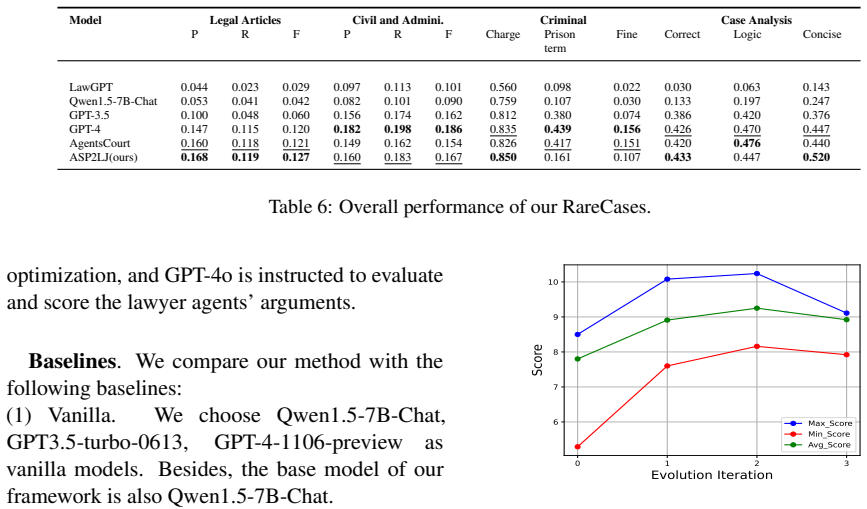
- [Section 3.3.2 and Table 6] RareCases contains only 120 cases, and the paper reports no confidence intervals or significance tests. Most differences against baselines are small; for example, legal-article F1 on RareCases is 0.127 for ASP2LJ versus 0.121 for AgentsCourt, while ASP2LJ is below GPT-4 in criminal prison-term and fine accuracy. The concluding statement that Qwen1.5-7B-Chat 'surpass[es] powerful models like GPT-4' is not supported by Table 6 and is contradicted by the authors' own text in Section 3.3.2, which concedes that in prison term and fine tasks ASP2LJ scores are much lower than GPT-4. The claim should be restricted to the specific metrics and settings where the advantage is consistent.
- [Section 3.2, Baselines] The AgentsCourt baseline is run with GPT-3.5-turbo-1106 as its base model, while ASP2LJ uses Qwen1.5-7B-Chat plus a fine-tuned retriever. The comparison is therefore not controlled for base model, retrieval, or argument module. At minimum, the authors should report an AgentsCourt variant using Qwen1.5-7B-Chat, or a Qwen1.5-7B-Chat baseline with the same retrieval but no lawyer-evolution component, to separate the contribution of the lawyer-evolution mechanism.
- [Section 3.4, Tables 7-8 and Figure 3] The iterative-evolution evidence is weak on its own. Table 8 shows that iteration 2 is not consistently better than iteration 1 (e.g., civil/admin F1 drops from 0.34 to 0.32), Table 7 is based on only 60 cases, and the argument scores in Figure 3 are GPT-4o's own scores. The paper needs a direct measure of whether evolved lawyer arguments improve judge outputs independently of the reward model; currently that inference relies on the ablation, which also conflates the retriever effect.
minor comments (6)
- [Title and Abstract] The title and abstract contain the typo 'Laywer' for 'Lawyer'; please fix it throughout the manuscript.
- [Section 3.3.2] The subsection heading says 'RareCourt' but the dataset is called 'RareCases' in the rest of the paper; please unify the naming.
- [Section 1] The Introduction contains an unresolved reference 'Figure ??' for the long-tail distribution figure; the cross-reference should be fixed.
- [Overall structure] Related Work appears after the Conclusion and Limitations (Section 6 after Section 5), which is an unusual ordering; consider moving Related Work before the Method section.
- [Tables 5-6 and throughout] Model naming is inconsistent ('lawGPT' vs 'LawGPT', 'Qwen1.5-7B-Chat' vs 'Qwen-1.5-7B-Chat'), and the column header 'Civil and Admini.' should be 'Civil and Administrative'.
- [Appendix A] Appendix A says 'As shown in Table 7, 8, and 9' when referring to argument-evaluation results, but Tables 7-9 in the main text are performance and ablation tables; the cross-references are misleading and should be corrected.
Circularity Check
Lawyer-evolution evidence is the DPO reward itself, and GPT-4o scores both training and civil/admin evaluation; central LJP metrics remain independently regex/human-checked.
-
fitted input called prediction
[Section 3.2 (Finetune) and Section 3.4 (Fine-tune Iteratively, Figure 3)]
"From these evaluations, we select the arguments with the highest and lowest scores to conduct DPO training. ... The evolved agents’ performance was then evaluated on 50 true cases, where we recorded the highest, lowest, and average argument scores. As illustrated in Figure 4, as the tuning iterations progress, all three categories of scores have improved and gradually stabilized."
The 'scores' in both quoted sentences are GPT-4o's subjective rubric scores from Table 10. DPO training selects the highest- and lowest-scoring arguments and optimizes the lawyer to maximize exactly this score, so reporting the same GPT-4o score afterward as evidence that lawyer evolution improved argument quality is reporting the training objective itself, not an independent measurement. The downstream LJP metrics are separate, but this direct evidence for the lawyer-evolution mechanism is circular by construction.
-
fitted input called prediction
[Section 3.2 (Finetune) and Appendix D (Metric)]
"GPT-4o is instructed to evaluate and score the lawyer agents’ arguments. ... For civil and administrative cases, the answers are flexible and hard to extract by regular expressions. So we employ GPT-4o to summarize the answers as several points and judge the number of correct answers."
The same model, GPT-4o, supplies the DPO reward that shapes the lawyer/judge pipeline and later serves as the scorer for civil and administrative outputs. Because the judge's verdicts are influenced by arguments trained to maximize GPT-4o's rubric, the reported civil/admin improvements are measured by the very model whose preferences were optimized, so they are not a fully external check on legal correctness. This is a partial reduction rather than a complete one, since legal-article and criminal metrics use regex or human evaluation.
full rationale
The central LJP results are not wholly circular: legal-article predictions are scored by regex extraction against gold articles, criminal charge/term/fine are extracted by regex, and case analysis is human-rated, so the headline 'weak model surpasses GPT-4' claim has independent content. The legal-article recall result is also not a pure tautology, though Table 9 shows that removing the retriever is the largest single ablation, and the retriever was fine-tuned on 10,000 GPT-4o-generated cases, so the +8% recall gain is not isolated to the adversarial self-play loop. The clearest circular step is the paper's own evidence for lawyer evolution: the 'argument scores' reported in the iterative fine-tuning analysis are the same GPT-4o scores used to select DPO training pairs, so improvement on that curve is the training objective by construction. A second, partial loop is that GPT-4o is both the DPO reward model and the evaluator of civil/admin outputs, making those reported gains susceptible to reward-model conformity rather than objective legal quality. Self-citations to AgentsCourt and SimuCourt are not load-bearing: they use a public benchmark and are not invoked as a uniqueness theorem. Overall, the independent regex/human metrics keep this from being a fully circular derivation, but the training-reward/evaluation overlap and the self-referential argument-quality evidence justify a moderate partial-circularity score of 5.
Assumptions & free parameters
free parameters (6)
- Number of argument rounds =
3
- Number of generated cases for retriever fine-tuning =
10,000
- DPO training iterations =
2
- Retrieval top-k for law articles =
200
- Retrieval top-k for argument records and cases =
100 candidates then 1 selected
- Rejection sampling threshold for generated cases =
unspecified
assumptions (4)
- domain assumption GPT-4o scoring of lawyer arguments is a valid reward signal for argument quality
- domain assumption Synthetic cases generated from random law articles are realistic enough to improve retrieval on real cases
- domain assumption Ground truth labels in SimuCourt and RareCases are correct and consistently extracted
- domain assumption Three law students' evaluations of generated cases (0.99/0.99/0.98) are reliable
Cite this review
Pith. "Pith review of ASP2LJ : An Adversarial Self-Play Laywer Augmented Legal Judgment Framework." pith.science (2026). https://pith.science/paper/A3ELEKTP
@misc{pith2026250618768,
  author       = {Pith},
  title        = {Pith review of: ASP2LJ : An Adversarial Self-Play Laywer Augmented Legal Judgment Framework},
  year         = {2026},
  howpublished = {\url{https://pith.science/paper/A3ELEKTP}},
  note         = {Machine review of arXiv:2506.18768}
}
read the original abstract
Legal Judgment Prediction (LJP) aims to predict judicial outcomes, including relevant legal charge, terms, and fines, which is a crucial process in Large Language Model(LLM). However, LJP faces two key challenges: (1)Long Tail Distribution: Current datasets, derived from authentic cases, suffer from high human annotation costs and imbalanced distributions, leading to model performance degradation. (2)Lawyer's Improvement: Existing systems focus on enhancing judges' decision-making but neglect the critical role of lawyers in refining arguments, which limits overall judicial accuracy. To address these issues, we propose an Adversarial Self-Play Lawyer Augmented Legal Judgment Framework, called ASP2LJ, which integrates a case generation module to tackle long-tailed data distributions and an adversarial self-play mechanism to enhance lawyers' argumentation skills. Our framework enables a judge to reference evolved lawyers' arguments, improving the objectivity, fairness, and rationality of judicial decisions. Besides, We also introduce RareCases, a dataset for rare legal cases in China, which contains 120 tail-end cases. We demonstrate the effectiveness of our approach on the SimuCourt dataset and our RareCases dataset. Experimental results show our framework brings improvements, indicating its utilization. Our contributions include an integrated framework, a rare-case dataset, and publicly releasing datasets and code to support further research in automated judicial systems.
Figures


Figures from the paper (2 more)


Forward citations
Cited by 1 Pith paper
-
Does the Competitive Component of Adversarial Self-Play Improve Legal Reasoning? A Controlled Negative Result
A small controlled comparison found that an adversary plus survival reward produced no reliable benefit over a matched non-competitive legal-reasoning training run.
Reference graph
Works this paper leans on
-
[1]
URL: " 'urlintro :=
ENTRY address author booktitle chapter edition editor howpublished institution journal key month note number organization pages publisher school series title type volume year eprint doi pubmed url lastchecked label extra.label sort.label short.list INTEGERS output.state before.all mid.sentence after.sentence after.block STRINGS urlintro eprinturl eprintpr...
-
[2]
write newline
" write newline "" before.all 'output.state := FUNCTION n.dashify 't := "" t empty not t #1 #1 substring "-" = t #1 #2 substring "--" = not "--" * t #2 global.max substring 't := t #1 #1 substring "-" = "-" * t #2 global.max substring 't := while if t #1 #1 substring * t #2 global.max substring 't := if while FUNCTION word.in bbl.in capitalize " " * FUNCT...
-
[3]
James M Anderson and Paul Heaton. 2012. How much difference does the lawyer make: The effect of defense counsel on murder case outcomes. Yale LJ, 122:154
work page 2012
-
[4]
Jinze Bai, Shuai Bai, Yunfei Chu, Zeyu Cui, Kai Dang, Xiaodong Deng, Yang Fan, Wenbin Ge, Yu Han, Fei Huang, Binyuan Hui, Luo Ji, Mei Li, Junyang Lin, Runji Lin, Dayiheng Liu, Gao Liu, Chengqiang Lu, Keming Lu, Jianxin Ma, Rui Men, Xingzhang Ren, Xuancheng Ren, Chuanqi Tan, Sinan Tan, Jianhong Tu, Peng Wang, Shijie Wang, Wei Wang, Shengguang Wu, Benfeng X...
arXiv 2023
-
[5]
Marius B \"u ttner and Ivan Habernal. 2024. https://aclanthology.org/2024.eacl-long.122/ Answering legal questions from laymen in G erman civil law system . In Proceedings of the 18th Conference of the European Chapter of the Association for Computational Linguistics (Volume 1: Long Papers), pages 2015--2027, St. Julian ' s, Malta. Association for Computa...
work page 2024
-
[6]
Ilias Chalkidis, Manos Fergadiotis, Prodromos Malakasiotis, Nikolaos Aletras, and Ion Androutsopoulos. 2020. Legal-bert: The muppets straight out of law school. arXiv preprint arXiv:2010.02559
arXiv 2020
-
[7]
Guhong Chen, Liyang Fan, Zihan Gong, Nan Xie, Zixuan Li, Ziqiang Liu, Chengming Li, Qiang Qu, Shiwen Ni, and Min Yang. 2024 a . http://arxiv.org/abs/2408.08089 Agentcourt: Simulating court with adversarial evolvable lawyer agents
arXiv 2024
-
[8]
Jianlv Chen, Shitao Xiao, Peitian Zhang, Kun Luo, Defu Lian, and Zheng Liu. 2024 b . http://arxiv.org/abs/2402.03216 Bge m3-embedding: Multi-lingual, multi-functionality, multi-granularity text embeddings through self-knowledge distillation
arXiv 2024
Show all 47 references
-
[9]
Xi Chen, Mao Mao, Shuo Li, and Haotian Shangguan. 2025. http://arxiv.org/abs/2504.05358 Debate-feedback: A multi-agent framework for efficient legal judgment prediction
2025 arXiv
-
[10]
Junyun Cui, Xiaoyu Shen, Feiping Nie, Zheng Wang, Jinglong Wang, and Yulong Chen. 2022. http://arxiv.org/abs/2204.04859 A survey on legal judgment prediction: Datasets, metrics, models and challenges
2022 arXiv
-
[11]
Yongfu Dai, Duanyu Feng, Jimin Huang, Haochen Jia, Qianqian Xie, Yifang Zhang, Weiguang Han, Wei Tian, and Hao Wang. 2024. http://arxiv.org/abs/2310.05620 Laiw: A chinese legal large language models benchmark
2024 arXiv
-
[12]
Stella Douka, Hadi Abdine, Michalis Vazirgiannis, Rajaa El Hamdani, and David Restrepo Amariles. 2021. Juribert: A masked-language model adaptation for french legal text. arXiv preprint arXiv:2110.01485
2021 arXiv
-
[13]
Zhiwei Fei, Xiaoyu Shen, Dawei Zhu, Fengzhe Zhou, Zhuo Han, Songyang Zhang, Kai Chen, Zongwen Shen, and Jidong Ge. 2023. http://arxiv.org/abs/2309.16289 Lawbench: Benchmarking legal knowledge of large language models
2023 arXiv
-
[14]
Yi Feng, Chuanyi Li, and Vincent Ng. 2022. Legal judgment prediction via event extraction with constraints. In Proceedings of the 60th annual meeting of the association for computational linguistics (volume 1: long papers), pages 648--664
2022
-
[15]
Yi Feng, Chuanyi Li, and Vincent Ng. 2024. https://doi.org/10.18653/v1/2024.acl-long.350 Legal case retrieval: A survey of the state of the art . In Proceedings of the 62nd Annual Meeting of the Association for Computational Linguistics (Volume 1: Long Papers), pages 6472--648...
2024 doi
-
[16]
Cheng Gao, Chaojun Xiao, Zhenghao Liu, Huimin Chen, Zhiyuan Liu, and Maosong Sun. 2024. http://arxiv.org/abs/2410.06581 Enhancing legal case retrieval via scaling high-quality synthetic query-candidate pairs
2024 arXiv
-
[17]
Brandon L Garrett. 2011. Convicting the innocent: Where criminal prosecutions go wrong. Harvard University Press
2011
-
[18]
Samuel R Gross, Barbara O’brien, Chen Hu, and Edward H Kennedy. 2014. Rate of false conviction of criminal defendants who are sentenced to death. Proceedings of the National Academy of Sciences, 111(20):7230--7235
2014
-
[19]
Ivan Habernal, Daniel Faber, Nicola Recchia, Sebastian Bretthauer, Iryna Gurevych, Indra Spiecker genannt D \"o hmann, and Christoph Burchard. 2024. Mining legal arguments in court decisions. Artificial Intelligence and Law, 32(3):1--38
2024
-
[20]
Zhitao He, Pengfei Cao, Chenhao Wang, Zhuoran Jin, Yubo Chen, Jiexin Xu, Huaijun Li, Kang Liu, and Jun Zhao. 2024. https://doi.org/10.18653/v1/2024.findings-emnlp.549 A gents C ourt: Building judicial decision-making agents with court debate simulation and legal knowledge augm...
2024 doi
-
[21]
Abe Bohan Hou, Orion Weller, Guanghui Qin, Eugene Yang, Dawn Lawrie, Nils Holzenberger, Andrew Blair-Stanek, and Benjamin Van Durme. 2024. http://arxiv.org/abs/2406.17186 Clerc: A dataset for legal case retrieval and retrieval-augmented analysis generation
2024 arXiv
-
[22]
Wanhong Huang, Yi Feng, Chuanyi Li, Honghan Wu, Jidong Ge, and Vincent Ng. 2024. https://doi.org/10.18653/v1/2024.findings-acl.351 CMDL : A large-scale C hinese multi-defendant legal judgment prediction dataset . In Findings of the Association for Computational Linguistics: AC...
2024 doi
-
[23]
Yeeun Kim, Young Rok Choi, Eunkyung Choi, Jinhwan Choi, Hai Jin Park, and Wonseok Hwang. 2024. http://arxiv.org/abs/2410.08731 Developing a pragmatic benchmark for assessing korean legal language understanding in large language models
2024 arXiv
-
[24]
Ang Li, Yiquan Wu, Ming Cai, Adam Jatowt, Xiang Zhou, Weiming Lu, Changlong Sun, Fei Wu, and Kun Kuang. 2025 a . https://aclanthology.org/2025.naacl-long.355/ Legal judgment prediction based on knowledge-enhanced multi-task and multi-label text classification . In Proceedings ...
2025
-
[25]
Haitao Li, Yunqiu Shao, Yueyue Wu, Qingyao Ai, Yixiao Ma, and Yiqun Liu. 2023. http://arxiv.org/abs/2310.17609 Lecardv2: A large-scale chinese legal case retrieval dataset
2023 arXiv
-
[26]
Ting Li, Lewen Mi, Xiangyu Meng, Yongju Jia, Lin Zhao, Qi Zhao, Zihao Wei, Guandong Gao, and Xiangxian Li. 2025 b . https://api.semanticscholar.org/CorpusID:276486735 Addressing long-tailed distribution in judicial text for criminal motive classification: a balanced contrastiv...
2025
-
[27]
Li, Ting , Mi, Lewen , Meng, Xiangyu , Jia, Yongju , Zhao, Lin , Zhao, Qi , Wei, Zihao , Gao, Guandong , and Li, Xiangxian . 2025. https://doi.org/10.1140/epjds/s13688-025-00533-1 Addressing long-tailed distribution in judicial text for criminal motive classification: a balanc...
2025 doi
-
[28]
Nut Limsopatham. 2021. Effectively leveraging bert for legal document classification. In Proceedings of the Natural Legal Language Processing Workshop 2021, pages 210--216
2021
-
[29]
Luyao Ma, Yating Zhang, Tianyi Wang, Xiaozhong Liu, Wei Ye, Changlong Sun, and Shikun Zhang. 2021. https://doi.org/10.1145/3404835.3462945 Legal judgment prediction with multi-stage case representation learning in the real court setting . In Proceedings of the 44th Internation...
2021
-
[30]
Meladel Mistica, Geordie Z Zhang, Hui Chia, Kabir Manandhar Shrestha, Rohit Kumar Gupta, Saket Khandelwal, Jeannie Paterson, Timothy Baldwin, and Daniel Beck. 2020. Information extraction from legal documents: A study in the context of common law court judgements. In Proceedin...
2020
-
[31]
Joel Niklaus, Ilias Chalkidis, and Matthias Stürmer. 2021. http://arxiv.org/abs/2110.00806 Swiss-judgment-prediction: A multilingual legal judgment prediction benchmark
2021 arXiv
-
[32]
OpenAI, Josh Achiam, Steven Adler, Sandhini Agarwal, Lama Ahmad, Ilge Akkaya, Florencia Leoni Aleman, Diogo Almeida, Janko Altenschmidt, Sam Altman, Shyamal Anadkat, Red Avila, Igor Babuschkin, Suchir Balaji, Valerie Balcom, Paul Baltescu, Haiming Bao, Mohammad Bavarian, Jeff ...
2024 arXiv
-
[33]
Nicholas Pipitone and Ghita Houir Alami. 2024. http://arxiv.org/abs/2408.10343 Legalbench-rag: A benchmark for retrieval-augmented generation in the legal domain
2024 arXiv
-
[34]
Emily S Taylor Poppe and Jeffrey J Rachlinski. 2015. Do lawyers matter? the effect of legal representation in civil disputes. Pepp. L. Rev., 43:881
2015
-
[35]
Weicong Qin, Zelin Cao, Weijie Yu, Zihua Si, Sirui Chen, and Jun Xu. 2024. https://doi.org/10.1145/3626772.3657717 Explicitly integrating judgment prediction with legal document retrieval: A law-guided generative approach . In Proceedings of the 47th International ACM SIGIR Co...
2024
-
[36]
Guilherme Moraes Rosa, Ruan Chaves Rodrigues, Roberto Lotufo, and Rodrigo Nogueira. 2021. http://arxiv.org/abs/2105.05686 Yes, bm25 is a strong baseline for legal case retrieval
2021 arXiv
-
[37]
Gil Semo, Dor Bernsohn, Ben Hagag, Gila Hayat, and Joel Niklaus. 2022. https://doi.org/10.18653/v1/2022.nllp-1.3 C lass A ction P rediction: A challenging benchmark for legal judgment prediction of class action cases in the US . In Proceedings of the Natural Legal Language Pro...
2022 doi
-
[38]
Brian Sheppard and Andrew Moshirnia. 2012. For the sake of argument: A behavioral analysis of whether and how legal argument matters in decisionmaking. Fla. St. UL Rev, 40:537
2012
-
[39]
Jenkin Chan Shiu-fan. 1983. The role of lawyers in the chinese legal system. Hong Kong LJ, 13:157
1983
-
[40]
Yen-Hsiang Wang, Feng-Dian Su, Tzu-Yu Yeh, and Yao-Chung Fan. 2024. http://arxiv.org/abs/2410.11450 A cross-lingual statutory article retrieval dataset for taiwan legal studies
2024 arXiv
-
[41]
Yiquan Wu, Siying Zhou, Yifei Liu, Weiming Lu, Xiaozhong Liu, Yating Zhang, Changlong Sun, Fei Wu, and Kun Kuang. 2023. http://arxiv.org/abs/2310.09241 Precedent-enhanced legal judgment prediction with llm and domain-model collaboration
2023 arXiv
-
[42]
Chaojun Xiao, Haoxi Zhong, Zhipeng Guo, Cunchao Tu, Zhiyuan Liu, Maosong Sun, Yansong Feng, Xianpei Han, Zhen Hu, Heng Wang, and Jianfeng Xu. 2018. http://arxiv.org/abs/1807.02478 Cail2018: A large-scale legal dataset for judgment prediction
2018 arXiv
-
[43]
Nuo Xu, Pinghui Wang, Long Chen, Li Pan, Xiaoyan Wang, and Junzhou Zhao. 2020. Distinguish confusing law articles for legal judgment prediction. arXiv preprint arXiv:2004.02557
2020 arXiv
-
[44]
Shunyu Yao, Jeffrey Zhao, Dian Yu, Nan Du, Izhak Shafran, Karthik Narasimhan, and Yuan Cao. 2023. http://arxiv.org/abs/2210.03629 React: Synergizing reasoning and acting in language models
2023 arXiv
-
[45]
Ale s Zavr s nik. 2021. Algorithmic justice: Algorithms and big data in criminal justice settings. European Journal of criminology, 18(5):623--642
2021
-
[46]
Haoxi Zhong, Zhipeng Guo, Cunchao Tu, Chaojun Xiao, Zhiyuan Liu, and Maosong Sun. 2018. Legal judgment prediction via topological learning. In Proceedings of the 2018 conference on empirical methods in natural language processing, pages 3540--3549
2018
-
[47]
Zhi Zhou, Jiang-Xin Shi, Peng-Xiao Song, Xiao-Wen Yang, Yi-Xuan Jin, Lan-Zhe Guo, and Yu-Feng Li. 2024. http://arxiv.org/abs/2406.04614 Lawgpt: A chinese legal knowledge-enhanced large language model
2024 arXiv
Reviewed August 7, 2026 · model on record in the stance chip above.
Discussion (0). Sign in to comment.