REVIEW 3 major objections 5 minor 34 references
LELANTE: LEveraging LLM for Automated ANdroid TEsting
T0 review · 3 major / 5 minor · reviewed 2026-08-16 · deepseek-v4-flash
Pith's one-line read An LLM-driven framework executes natural-language Android test case descriptions directly as UI actions, reaching a 73% test execution success rate across 390 cases from 10 apps.
desk verdict A useful LLM-based Android test execution framework, but the 73% headline is conditional on human-rewritten test descriptions—65% on original wording—and the distilled model matches only that lower bar. read the letter →
The pith
A machine-rendered reading of the paper's core claim, the machinery that carries it, and where it could break.
The reading
What carries the argument
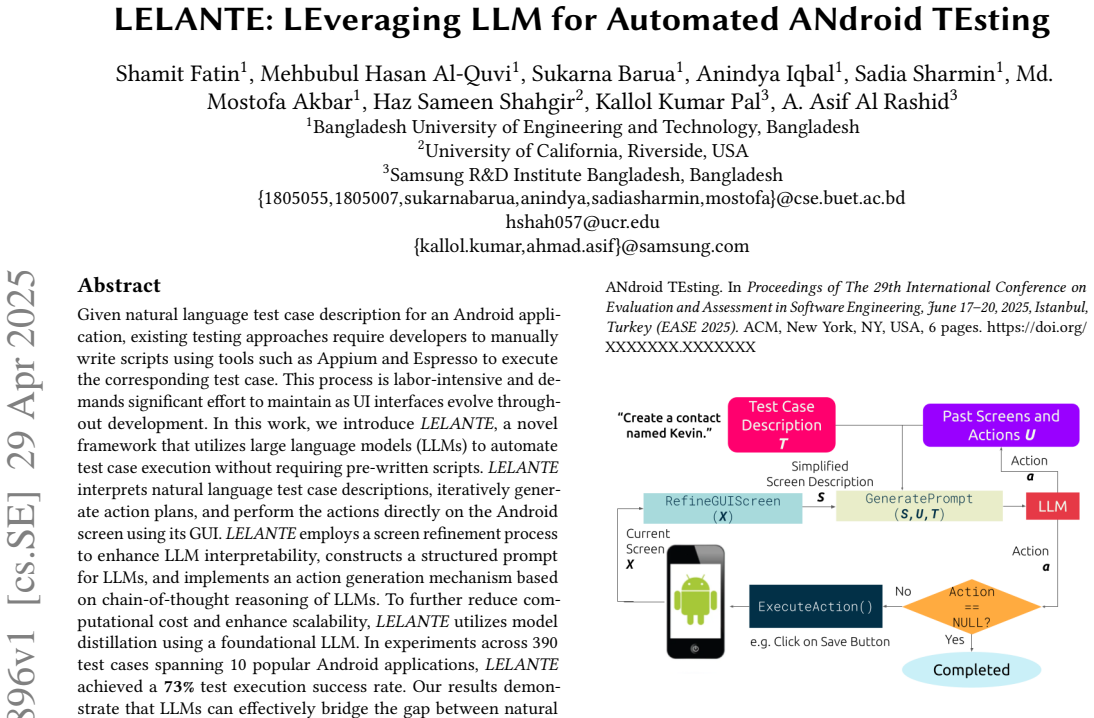
The load-bearing mechanism is a chain-of-thought prompting loop over a refined screen representation. Each screen's raw Android XML is compressed into a list of interactive elements with unique numeric IDs, plus explicit Back and scroll actions, and an icon classifier converts icons into words. The structured prompt forces the model to output a goal action plan, a summary of past actions, a no-further-action boolean, the selected element ID, and any text input, with the special ID -1 signaling completion. This loop carries the entire argument: it maps the natural-language goal to concrete UI actions, allows the model to declare the goal finished, and supports backtracking when an action repeats or fails.
What would settle it
Run LELANTE on the original, unmodified 390 test descriptions without human rewriting; if the success rate reaches 73% rather than staying near the reported 65%, the ambiguity-resolution premise is not load-bearing, and if it stays at 65%, the headline result depends on the preprocessing step.
Extended reading notes
Core claim
The central claim is that a large language model, guided by a distilled textual representation of the Android screen and a structured prompt, can convert a natural-language test case description into a usable action sequence without any pre-written test script. LELANTE performs this loop iteratively: it refines each screen's XML into interactive elements with unique IDs, asks the model to reason step by step about the goal and action history, executes the selected action on the device, and uses an explicitly added Back action to undo mistakes. In the evaluation, 73% of the 390 test cases were executed completely, with a 78% error recovery rate and an average of 11.8 seconds per step. The paper presents this as evidence that LLM-driven execution can replace brittle, manually maintained UI test scripts.
Load-bearing premise
The reported 73% success rate applies to test cases whose descriptions were manually rewritten to remove ambiguity; if the intended claim is that LELANTE executes descriptions exactly as originally written, the measured success rate is 65%.
Editorial extensions
If this is right
- If the measured success transfers beyond the 10 evaluation apps, QA teams could execute existing natural-language test suites directly, removing the need to write or maintain UI automation scripts as apps change.
- The explicit Back action and reasoning loop make error recovery a first-class behavior: the reported 78% recovery rate means most wrong touches are detected and corrected automatically.
- The distilled 8-billion-parameter model retains most of the success (65% vs 73%) at similar per-step speed, so low-cost local execution is plausible rather than requiring paid foundational-model APIs.
- Longer test cases succeed less often, so the practical benefit is strongest for short-to-medium scenarios; the remaining gap is in ambiguity handling and error propagation.
- A human still must verify the final app state because LELANTE cannot autonomously check whether the expected result was achieved.
Reading between the lines
- Going beyond the paper, the 73% headline is an upper bound achieved after humans rewrite ambiguous descriptions; executing the original descriptions as written yields 65%, so a fair comparison for as-written automation should use the 65% figure.
- A natural extension would be to measure success as a function of description clarity, using independent QA authors and no rewriting guidelines; the paper's own table predicts that clearer descriptions close most of the gap.
- The same screen-refinement and structured-prompt loop is not Android-specific, so porting it to iOS or Web UI automation is a plausible test of the mechanism's generality.
- The framework's inability to self-verify outcomes suggests that coupling it to an automatic assertion or screenshot-comparison step would convert 'executed completely' into true pass-or-fail verdicts; this is speculative but directly addresses the stated limitation.
Signed reviews
Editorial analysis
A structured set of objections, weighed in public.
Referee Report
Summary. The paper introduces LELANTE, a framework that uses large language models to execute Android test cases from natural-language descriptions without pre-written scripts. The system refines GUI XML into a compact textual representation, prompts an LLM with a structured chain-of-thought template, executes selected actions via Appium, and supports backtracking-based error recovery. It also distills GPT-4o traces into a fine-tuned LLaMA-3.1 8B model for cheaper inference. The evaluation uses 390 test cases across 10 Android apps and reports a 73% test execution success rate, 78% error recovery, and 11.8 seconds per step for GPT-4o, compared against AutoDroid; Table 2 further reports that success drops to 65% on original, unmodified test-case descriptions. The paper concludes that LLM-driven execution is promising but notes limitations in natural-language understanding, lack of autonomous outcome verification, and slow backtracking.
Significance. If the reported results are robust, LELANTE would be a useful step toward reducing manual effort in Android UI test execution: it compares against an existing LLM-based baseline (AutoDroid), provides an explicit error-recovery mechanism, and evaluates a distilled open-source model, which addresses a realistic deployment concern. The authors also deserve credit for disclosing in Section 6 and Table 2 that performance depends on human rewriting of descriptions, and for publishing the Appendix A guidelines that make the evaluated input format concrete. However, the headline success rate is conditional on those rewritten descriptions, the statistical evidence is thin (no error bars, repeated runs, or per-app breakdowns), and the success-validation protocol is underspecified. These issues do not invalidate the framework, but they do change the scope of the central claim and need to be addressed before the paper can be accepted.
major comments (3)
- [Abstract, Section 1, Table 2, Section 6] The abstract and Section 1 report a 73% test execution success rate without qualification, but Table 2 and Section 6 show that this rate applies only after human testers rewrite descriptions according to the Appendix A guidelines, while original unmodified test cases achieve 65%. Because the paper's central claim is that LELANTE executes natural-language test descriptions as written, this is a load-bearing qualification: the as-written success rate is 8 percentage points lower, and the abstract's unqualified statement materially overstates the result. Please report both figures in the abstract, state how many of the 390 test cases were rewritten and by whom, and frame the contribution as executing descriptions formatted according to the stated guidelines.
- [Table 1, Section 4] Table 1 reports success, recovery, and timing comparisons (e.g., LELANTE vs. AutoDroid: 73% vs. 71.3% success) without confidence intervals, repeated runs, or per-application breakdowns. The 1.7-percentage-point success advantage over AutoDroid is well within the range that could arise from test-set or run-to-run variation, and Figure 3 shows that success is strongly dependent on test-case length. Without per-app results, run counts, and a statistical test or uncertainty quantification, RQ1 and the comparative claim against AutoDroid are not established at the claimed precision. Please add per-app and per-length results and report uncertainty or significance.
- [Section 3.3, Section 4] The paper states that a human tester manually validates whether the final application state matches the intended outcome, and defines error recovery as the rate at which LELANTE 'autonomously detects mistakes, navigates backward, and chooses the correct alternative step.' The manuscript does not specify the validation protocol, who performs it, or whether the 'correct alternative step' judgment is independently verified. Since the two headline metrics depend on this assessment, please provide a precise operational criterion for success and for correct recovery, and report inter-rater agreement or at least a detailed rubric.
minor comments (5)
- [Abstract] The abstract contains a grammatical issue: 'iteratively generate action plans' should be 'iteratively generates action plans.'
- [Appendix B] The prompt template contains apparent spacing artifacts (e.g., 'goa l_action_ plan', 'p a s t _ a c t i o n s _ s u m m a r y'). This is likely a typesetting issue, but the prompt should be reproduced cleanly so readers can copy it and verify the evaluation.
- [Figure 3] The right-hand histogram of success rate versus test-case length would benefit from explicit axis labels and error bars or counts per bin, since the text draws a monotonicity conclusion from it.
- [Section 4] The definition of 'test case length' as 'minimum number of test steps needed to complete a test case' is ambiguous: it is unclear whether this is the human-annotated minimal length or the length of the executed path, and the two can differ substantially when backtracking occurs.
- [Section 3.4, Section 4] The distillation section says the fine-tuning data came from 30 applications not in the final evaluation set, but the paper never states whether the 10 evaluation applications overlap with those 30; please clarify the relationship between the training and evaluation app sets.
Circularity Check
No circularity: the 73% success rate is an external measurement against an external baseline; the Appendix A rewriting is a validity caveat, not a derivation-level circularity.
full rationale
LELANTE is an empirical systems paper; its central claims are measurements, not derivations. The 73% test execution success rate is reported on a 390-test-case benchmark and compared with AutoDroid, an external baseline, so it is not a fitted parameter or a quantity defined in terms of the paper's own outputs. The distillation procedure trains on 30 applications excluded from the final evaluation set, so the fine-tuned LLaMA-3.1 8B result of 65% is an independent transfer measurement rather than a retrodiction of the training data. Test success is defined by matching an expected final state implied by the test case description and is confirmed by human validation, so it is not definitionally tied to the model's self-assessment. The only notable concern is that Table 2 and Section 6 reveal that the 73% figure applies to test descriptions rewritten by humans according to Appendix A guidelines, whereas unmodified descriptions reach 65%. This is a scope and validity threat about input preprocessing, not circularity: the rewritten descriptions are still natural language and the system must still map them to GUI actions, and the paper explicitly concedes this limitation in Section 6. No self-citation chain, uniqueness theorem, or ansatz-smuggling citation is load-bearing. Therefore no circular step meets the evidentiary bar of exhibiting a specific reduction of the derivation to its own inputs.
Assumptions & free parameters
assumptions (5)
- domain assumption The screen XML obtained via Appium is complete and correctly parsed into the refined representation.
- domain assumption The LLM's structured JSON output is always parseable and the selected action IDs are valid.
- domain assumption Human validation of the final application state is an acceptable ground truth for test success.
- domain assumption The ViT icon classifier correctly labels icon images as text.
- ad hoc to paper Reported 73% success presumes test descriptions are rewritten according to the Appendix A formatting guidelines.
Cite this review
Pith. "Pith review of LELANTE: LEveraging LLM for Automated ANdroid TEsting." pith.science (2026). https://pith.science/paper/A3MBDJL3
@misc{pith2026250420896,
  author       = {Pith},
  title        = {Pith review of: LELANTE: LEveraging LLM for Automated ANdroid TEsting},
  year         = {2026},
  howpublished = {\url{https://pith.science/paper/A3MBDJL3}},
  note         = {Machine review of arXiv:2504.20896}
}
read the original abstract
Given natural language test case description for an Android application, existing testing approaches require developers to manually write scripts using tools such as Appium and Espresso to execute the corresponding test case. This process is labor-intensive and demands significant effort to maintain as UI interfaces evolve throughout development. In this work, we introduce LELANTE, a novel framework that utilizes large language models (LLMs) to automate test case execution without requiring pre-written scripts. LELANTE interprets natural language test case descriptions, iteratively generate action plans, and perform the actions directly on the Android screen using its GUI. LELANTE employs a screen refinement process to enhance LLM interpretability, constructs a structured prompt for LLMs, and implements an action generation mechanism based on chain-of-thought reasoning of LLMs. To further reduce computational cost and enhance scalability, LELANTE utilizes model distillation using a foundational LLM. In experiments across 390 test cases spanning 10 popular Android applications, LELANTE achieved a 73% test execution success rate. Our results demonstrate that LLMs can effectively bridge the gap between natural language test case description and automated execution, making mobile testing more scalable and adaptable.
Figures


Reference graph
Works this paper leans on
-
[1]
Josh Achiam, Steven Adler, Sandhini Agarwal, Lama Ahmad, Ilge Akkaya, Floren- cia Leoni Aleman, Diogo Almeida, Janko Altenschmidt, Sam Altman, Shyamal Anadkat, et al. 2023. Gpt-4 technical report. arXiv preprint arXiv:2303.08774 (2023)
arXiv 2023
-
[2]
Riccardo Coppola, Luca Ardito, Maurizio Morisio, and Marco Torchiano. 2020. Mobile testing: new challenges and perceived difficulties from developers of the Italian industry. IT Professional 22, 5 (2020), 32–39
work page 2020
-
[3]
Android Developers. 2025. Espresso Testing Framework - Android Developers. https://developer.android.com/training/testing/espresso Accessed: 2025-03-03
work page 2025
-
[4]
Gianluca Dini, Fabio Martinelli, Ilaria Matteucci, Marinella Petrocchi, Andrea Saracino, and Daniele Sgandurra. 2018. Risk analysis of Android applications: A user-centric solution. Future Generation Computer Systems 80 (2018), 505–518
work page 2018
-
[5]
Alexey Dosovitskiy, Lucas Beyer, Alexander Kolesnikov, Dirk Weissenborn, Xi- aohua Zhai, Thomas Unterthiner, Mostafa Dehghani, Matthias Minderer, Georg Heigold, Sylvain Gelly, Jakob Uszkoreit, and Neil Houlsby. 2021. An Image is Worth 16x16 Words: Transformers for Image Recognition at Scale. In Interna- tional Conference on Learning Representations . http...
2021
-
[6]
Hossein Falaki, Ratul Mahajan, Srikanth Kandula, Dimitrios Lymberopoulos, Ramesh Govindan, and Deborah Estrin. 2010. Diversity in smartphone usage. In Proceedings of the 8th International Conference on Mobile Systems, Applications, and Services (San Francisco, California, USA)(MobiSys ’10). Association for Computing Machinery, New York, NY, USA, 179–194. ...
arXiv 2010
-
[7]
Jianping Gou, Baosheng Yu, Stephen J Maybank, and Dacheng Tao. 2021. Knowl- edge distillation: A survey. International Journal of Computer Vision 129, 6 (2021), 1789–1819
2021
-
[8]
Giovanni Grano, Adelina Ciurumelea, Sebastiano Panichella, Fabio Palomba, and Harald C Gall. 2018. Exploring the integration of user feedback in automated testing of android applications. In 2018 IEEE 25Th international conference on software analysis, evolution and reengineering (SANER) . IEEE, 72–83
work page 2018
Show all 34 references
-
[9]
Jiaqi Guo, Shuyue Li, Jian-Guang Lou, Zijiang Yang, and Ting Liu. 2019. Sara: self- replay augmented record and replay for android in industrial cases. InProceedings of the 28th acm sigsoft international symposium on software testing and analysis . 90–100
2019
-
[10]
Xinyi Hou, Yanjie Zhao, Yue Liu, Zhou Yang, Kailong Wang, Li Li, Xiapu Luo, David Lo, John Grundy, and Haoyu Wang. 2024. Large language models for software engineering: A systematic literature review. ACM Transactions on Software Engineering and Methodology 33, 8 (2024), 1–79....
2024
-
[11]
Edward J Hu, Yelong Shen, Phillip Wallis, Zeyuan Allen-Zhu, Yuanzhi Li, Shean Wang, Lu Wang, Weizhu Chen, et al. 2022. Lora: Low-rank adaptation of large language models. ICLR 1, 2 (2022), 3
2022
-
[12]
ANDROID THE MOBILE OPERATING SYSTEM AND ARCHITECTURE
Manishaben Jaiswal. 2018. Android the mobile operating system and architec- ture. Manishaben Jaiswal, " ANDROID THE MOBILE OPERATING SYSTEM AND ARCHITECTURE", International Journal of Creative Research Thoughts (IJCRT), ISSN (2018), 2320–2882
2018
-
[13]
Pingfan Kong, Li Li, Jun Gao, Kui Liu, Tegawendé F Bissyandé, and Jacques Klein
-
[14]
Metin Konuk, Cem Baglum, and Ugur Yayan. 2024. Evaluation of Large Language Models for Unit Test Generation. In 2024 Innovations in Intelligent Systems and Applications Conference (ASYU). IEEE, 1–6
2024
-
[15]
Wing Lam, Zhengkai Wu, Dengfeng Li, Wenyu Wang, Haibing Zheng, Hui Luo, Peng Yan, Yuetang Deng, and Tao Xie. 2017. Record and replay for android: Are we there yet in industrial cases?. In Proceedings of the 2017 11th joint meeting on foundations of software engineering . 854–859
2017
-
[16]
Youwei Li, Yangyang Li, and Yangzhao Yang. 2024. Test-Agent: A Multimodal App Automation Testing Framework Based on the Large Language Model. In 2024 IEEE 4th International Conference on Digital Twins and Parallel Intelligence (DTPI). IEEE, 609–614
2024
-
[17]
Jun-Wei Lin, Navid Salehnamadi, and Sam Malek. 2020. Test automation in open- source android apps: A large-scale empirical study. In Proceedings of the 35th IEEE/ACM International Conference on Automated Software Engineering . 1078– 1089
2020
-
[18]
Jiawei Liu, Chunqiu Steven Xia, Yuyao Wang, and Lingming Zhang. 2024. Is your code generated by chatgpt really correct? rigorous evaluation of large language models for code generation. Advances in Neural Information Processing Systems 36 (2024)
2024
-
[19]
Zhe Liu, Cheng Li, Chunyang Chen, Junjie Wang, Boyu Wu, Yawen Wang, Jun Hu, and Qing Wang. 2024. Vision-driven automated mobile gui testing via multimodal large language model. arXiv preprint arXiv:2407.03037 (2024)
2024 arXiv
-
[20]
Ke Mao, Mark Harman, and Yue Jia. 2016. Sapienz: Multi-objective automated testing for android applications. InProceedings of the 25th international symposium on software testing and analysis . 94–105
2016
-
[21]
Bahman Rashidi and Carol J Fung. 2015. A Survey of Android Security Threats and Defenses. J. Wirel. Mob. Networks Ubiquitous Comput. Dependable Appl. 6, 3 (2015), 3–35
2015
-
[22]
Onur Sahin, Assel Aliyeva, Hariharan Mathavan, Ayse Coskun, and Manuel Egele
-
[23]
Kabir S Said, Liming Nie, Adekunle A Ajibode, and Xueyi Zhou. 2020. GUI testing for mobile applications: objectives, approaches and challenges. In Proceedings of the 12th Asia-Pacific Symposium on Internetware . 51–60
2020
-
[24]
Anirban Sarkar, Ayush Goyal, David Hicks, Debadrita Sarkar, and Saikat Hazra
-
[25]
Ting Su, Guozhu Meng, Yuting Chen, Ke Wu, Weiming Yang, Yao Yao, Geguang Pu, Yang Liu, and Zhendong Su. 2017. Guided, stochastic model-based GUI testing of Android apps. In Proceedings of the 2017 11th joint meeting on foundations of software engineering. 245–256
2017
-
[26]
Appium Team. 2025. Appium Documentation. https://appium.io/docs/en/latest/ Accessed: 2025-03-03
2025
-
[27]
In 2019 Third International conference on I-SMAC (IoT in Social, Mobile, Analytics and Cloud)(I-SMAC)
Android application development: a brief overview of android platforms and evolution of security systems. In 2019 Third International conference on I-SMAC (IoT in Social, Mobile, Analytics and Cloud)(I-SMAC) . IEEE, 73–79
2019
-
[28]
Jason Wei, Xuezhi Wang, Dale Schuurmans, Maarten Bosma, Fei Xia, Ed Chi, Quoc V Le, Denny Zhou, et al. 2022. Chain-of-thought prompting elicits reasoning in large language models. Advances in neural information processing systems 35 (2022), 24824–24837
2022
-
[29]
Hao Wen, Yuanchun Li, Guohong Liu, Shanhui Zhao, Tao Yu, Toby Jia-Jun Li, Shiqi Jiang, Yunhao Liu, Yaqin Zhang, and Yunxin Liu. 2024. Autodroid: Llm-powered task automation in android. In Proceedings of the 30th Annual International Con- ference on Mobile Computing and Network...
2024
-
[30]
Hugo Touvron, Thibaut Lavril, Gautier Izacard, Xavier Martinet, Marie-Anne Lachaux, Timothée Lacroix, Baptiste Rozière, Naman Goyal, Eric Hambro, Faisal Azhar, et al. 2023. Llama: Open and efficient foundation language models. arXiv preprint arXiv:2302.13971 (2023)
2023 arXiv
-
[31]
Add category inside the Edit Category window
Daniel Zimmermann and Anne Koziolek. 2023. GUI-Based Software Testing: An Automated Approach Using GPT-4 and Selenium WebDriver. In 2023 38th IEEE/ACM International Conference on Automated Software Engineering Workshops (ASEW). IEEE, 171–174. A Guidelines for Formatting Test C...
2023
-
[33]
Qinzhuo Wu, Weikai Xu, Wei Liu, Tao Tan, Liujian Liujianfeng, Ang Li, Jian Luan, Bin Wang, and Shuo Shang. 2024. MobileVLM: A Vision-Language Model for Better Intra- and Inter-UI Understanding. In Findings of the Association for Computational Linguistics: EMNLP 2024 , Yaser Al...
2024 doi
-
[2018]
IEEE Transactions on Reliability 68, 1 (2018), 45–66
Automated testing of android apps: A systematic literature review. IEEE Transactions on Reliability 68, 1 (2018), 45–66
2018
-
[2019]
In 2019 34th IEEE/ACM International Conference on Automated Software Engineering (ASE)
Randr: Record and replay for android applications via targeted runtime instrumentation. In 2019 34th IEEE/ACM International Conference on Automated Software Engineering (ASE). IEEE, 128–138
2019
Reviewed August 16, 2026 · model on record in the stance chip above.
Discussion (0). Continue with ORCID to comment.