REVIEW 4 major objections 5 minor 103 references
Large-Scale Topology Optimisation of Time-dependent Thermal Conduction Using Space-Time Finite Elements and a Parallel Space-Time Multigrid Preconditioner
T0 review · 4 major / 5 minor · reviewed 2026-08-05 · deepseek-v4-flash
Pith's one-line read Treating time as a spatial dimension and solving the whole transient heat-conduction problem at once with a space-time multigrid preconditioner cuts time-to-solution for thermal topology optimization by up to 52x and scales to 4.2 billion d
desk verdict Solid proof-of-concept with a defensible ~20x speed-up; the 52x headline rests on a baseline that was never actually run. read the letter →
The pith
A machine-rendered reading of the paper's core claim, the machinery that carries it, and where it could break.
The reading
What carries the argument
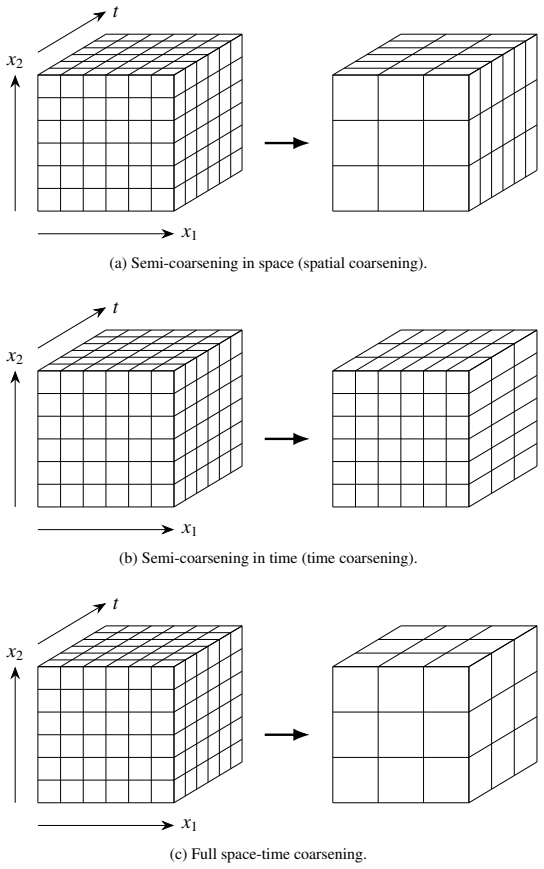
The central object is the all-at-once discrete system $\mathbf{J}\mathbf{s}=\mathbf{f}$ from a stabilised continuous Galerkin discretisation with time as a third coordinate and artificial time-direction diffusion $\hat{k}_{\mathrm{ad}}=\tfrac12 C\Delta t$. The solver is FGMRES preconditioned by a space-time multigrid V-cycle. The hierarchy follows a semi-coarsening rule: compute $\lambda_{\mathrm{eff},l-1}=D_{\mathrm{eff}}\Delta t_{l-1}/\Delta x_{l-1}^2$; if below $0.5$, double $\Delta t$ (coarsen in time), else double $\Delta x$ (coarsen in space). This keeps cheap pointwise-style smoothers effective on the anisotropic parabolic operator, which is what makes the all-at-once solve fast enoug
What would settle it
Run the comparison problem (Example 1) with the reference time-stepping solver at the full 1280 time steps and 100 or more design iterations, with enough memory and identical tolerances, and compare wall-clock time at 120 and 400 nodes. If the ratio of space-time to time-stepping time is not close to the quoted 25x and 52x, the extrapolated speed-up was the artifact. Separately, a sweep of the threshold $\lambda_{\mathrm{crit}}$ for the CG-STFE discretisation would test whether the semi-coarsening rule is transferable; poor convergence at $\lambda_{\mathrm{crit}}=0.5$ would weaken the method's
Extended reading notes
Core claim
Central claim: a stabilised continuous Galerkin space-time finite element method, solved all-at-once by a Krylov solver preconditioned with a semi-coarsened space-time multigrid, cuts time-to-solution for transient thermal topology optimisation by over an order of magnitude. Evidence: 52.1x speed-up over a backward-Euler reference (16.4 s vs 855 s), 4.2 billion DOFs solved in ~17 minutes, near-linear scaling from 8 to 400 nodes. Semi-coarsening is load-bearing: state iterations fall 9.7 to 5.6, adjoint 55.6 to 9.4. Time-varying designs are demonstrated, with the authors noting energy conservation is not yet enforced.
Load-bearing premise
The headline speed-ups assume that the time-stepping reference cost grows linearly from the measured 10 steps / 10 iterations to 1280 steps / 100 iterations, and that the semi-coarsening threshold chosen for an earlier discretisation remains the right one for the new space-time Galerkin method; if either gives way, the quoted ratios overstate the gain.
Editorial extensions
If this is right
- A transient thermal optimisation that takes roughly 15 hours with time-stepping is claimed to finish in under an hour on the same class of machine at about 2.4x the core-hours, changing how many design iterations a developer can afford per day.
- Spatiotemporal resolutions of billions of unknowns (e.g., 1280x1280x2560 elements) become solvable in minutes, bringing time-dependent design closer to the scale of static large-scale topology optimisation.
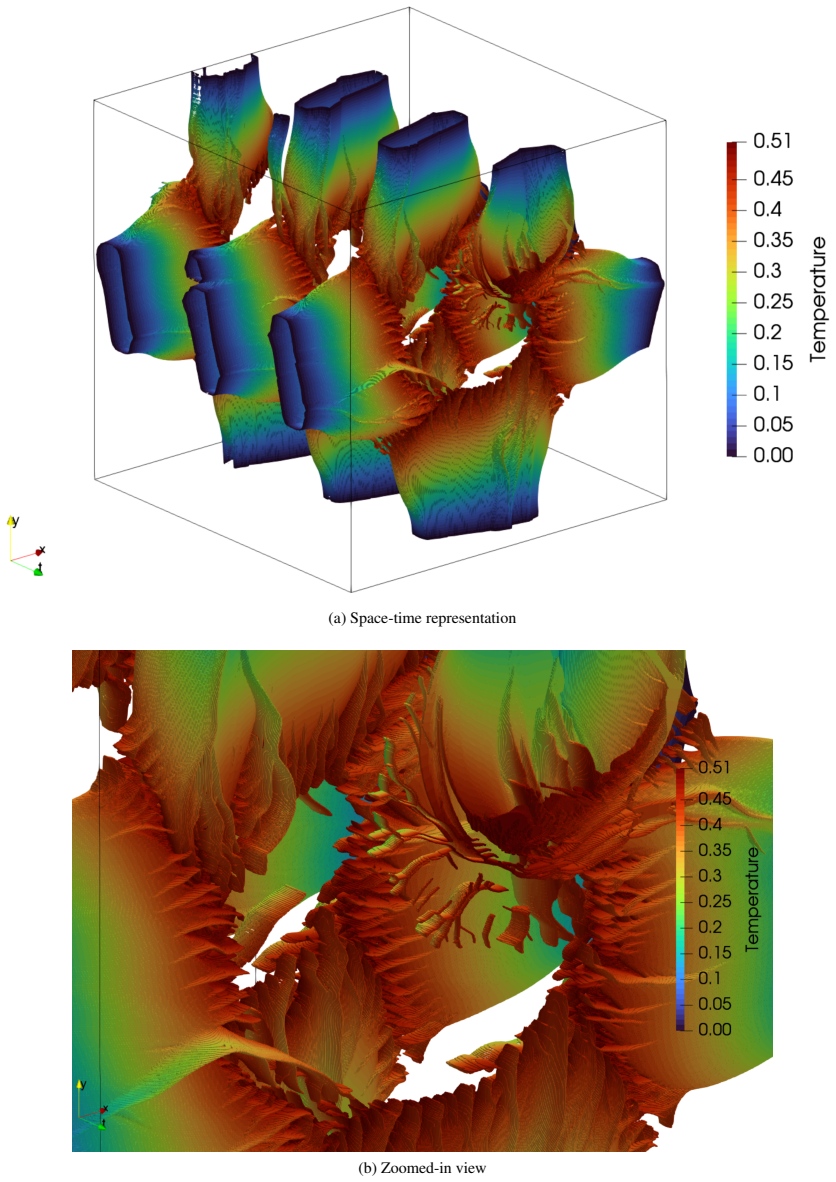
- Time-varying design fields, not just time-constant ones, become optimisable, as shown by conductive spirals tracking a moving heat source.
- The semi-coarsening choice is worth roughly two-fold fewer state iterations and six-fold fewer adjoint iterations than full coarsening on the fine benchmark, making the preconditioner's hierarchy design the practical key to the speed-up.
- Because the underlying equation is a linear diffusion equation, the authors expect the same machinery to extend to mass diffusion, charge diffusion, and porous flow, where transient optimisation faces the same time-to-solution bottleneck.
Reading between the lines
- Extension: the authors' own Section 6.1 caveat that time-varying designs do not conserve energy means the morphing-structure results are best read as demonstrations of solver capability, not yet as physically predictive designs; adding the missing $\partial C/\partial t$ term is a natural next step.
- Extension: the comparison normalizes by wall-clock time, not by energy or monetary cost; if a user's real constraint is core-hours or budget, the optimum operating point may be the 25x-at-4.8x-cost configuration rather than the 52x-at-7.7x-cost one.
- Extension: the 52x figure depends on a time-stepping baseline that saturates at around 1000 cores because the 2D spatial problem is small; on problems with genuinely large 3D spatial meshes, time-stepping would scale better, so the space-time advantage might shrink or move to different core counts.
- Extension: a direct extension suggested by the paper's own framing is to tune coarsening strategies specifically for the adjoint equation, which the results show is harder to converge than the state equation; that could cut the dominant cost in optimisation.
Signed reviews
Editorial analysis
A structured set of objections, weighed in public.
Referee Report
Summary. The paper proposes a space-time topology optimization framework for transient thermal conduction. Time is treated as an extra spatial dimension, the governing equation is discretized with a stabilized continuous Galerkin space-time finite element method, and the resulting all-at-once system is solved with FGMRES preconditioned by a parallel space-time multigrid method using semi-coarsening. The framework is implemented on distributed-memory supercomputers and demonstrated on two benchmark problems, including time-constant and time-varying design fields, with up to 4.2 billion DOFs. The central quantitative claim is a speed-up of up to 52.1× over traditional time-stepping, at moderate increases in core-hour cost.
Significance. If the reported performance is representative, this is a significant contribution: it is among the first demonstrations of parallel-in-time multigrid preconditioning inside large-scale transient topology optimization, and it provides measured scalability data on a leadership-class machine. The paper is transparent about many caveats, lists all solver parameters, reports iteration counts and timings for multiple material cases, and includes a clear validation against a prior coarse-mesh result. The reproducibility-oriented details and the honest discussion of limitations (memory, extrapolated baselines, energy conservation for time-varying designs) strengthen the paper. However, the headline speed-up is conditional on an extrapolated and infeasible time-stepping baseline, and the semi-coarsening criterion is justified only by preliminary tests for the new discretization. These points do not invalidate the method, but they must be addressed before the central claims can be taken at face value.
major comments (4)
- [Section 4, Section 4.3 (Fig. 9), Section 5.1.2] The headline 52.1× speed-up is based on a time-stepping reference that was not run at the full time horizon. Section 4 states that only 10 time steps and 10 design iterations were executed for time-stepping, and the 855-second reference is obtained by scaling linearly to 1280 time steps. The paper itself notes that a real 1280-step run exceeds single-node memory, so the comparison excludes memory pressure and any checkpointing/extra-node costs that a feasible run would incur. Linear scaling in the number of time steps is asserted, not demonstrated across this range, and per-step cost can grow through adjoint storage and later optimization iterations. Notably, when the authors supply a more realistic 100-iteration estimate in Section 5.1.2, the speed-up drops to 18.6–20.8×. The 52× figure should either be replaced by a measured full-horizon comparison or be explicitly presented only as a
- [Section 3.2.1, Algorithm 1] The multigrid convergence and all scaling results rely on the semi-coarsening criterion (D_eff, λ_eff, λ_crit=0.5), but the manuscript reports only that the formulas were validated for a finite-element-in-space/backward-Euler discretization in prior work [69] and that 'preliminary tests' indicate they work for the CG-STFE discretization. This is a load-bearing assumption: the reported iteration counts in Tables 3 and 5, and therefore the timing comparisons, depend on the chosen coarsening path. The paper should provide quantitative evidence for the CG-STFE case, e.g., convergence factors for representative meshes and material contrasts, or a sensitivity study with respect to λ_crit.
- [Section 4.1, Section 5.1.2, Figure 21] The scaling and speed-up comparisons in Section 4 are performed with only 10 design iterations. Section 5.1.2 and Figure 21 show that the number of linear iterations increases substantially later in the optimization, especially for the adjoint solve and for high-contrast designs. Therefore, the Section 4 speed-ups do not directly translate to a full optimization run. The authors acknowledge this, but the abstract and highlights nevertheless state the 52× figure without this qualifier. I recommend reporting the full-optimization timings as the primary comparison and clearly labelling the 10-iteration numbers as a solver-level scaling study.
- [Section 5.2.2 and Section 6.1] For the time-varying design examples, the paper states that energy conservation is not ensured because the time derivative of the volumetric capacity is omitted, and that this likely explains the non-physical temperature behaviour in Example 2C. Since time-varying designs are presented as a full capability of the proposed framework, this limitation should be addressed more prominently in the abstract and results: either implement the missing capacity-derivative term, or explicitly restrict the claims for time-varying designs to 'illustrative' rather than physically validated. At minimum, the potential impact on the optimized designs (Figs. 17–20) should be discussed in the main text, not only in the limitations section.
minor comments (5)
- [Figure 18] The caption refers to 'Example 2A', but the surrounding text (Section 5.2.2) describes Example 2B with a time-varying design. The caption should be corrected.
- [Section 3.1.1, Eq. (21)] The artificial diffusion coefficient is introduced as \hat{k}_{ad} in Eq. (20) but the notation in Eq. (21) and surrounding text is not fully consistent. Please define the symbol once and use it uniformly. Also, the text contains typographical artifacts such as 'P ´eclet' and 'di ffusion'.
- [References] Reference [65] contains a typo in the title ('fro' should be 'for'). Please also check the rendering of accented characters throughout the reference list.
- [Abstract and Highlights] The abstract and highlights state 'up to 52× speed-up' without the caveats that Section 4 itself acknowledges. Consider adding a qualifier such as 'projected' or 'for a 10-iteration comparison' so that the summary matches the body's more cautious statements.
- [Section 4.1 and Figure 7] The unusual sub-node scaling and the performance drops at 140/160 nodes are left unexplained. Even a brief discussion of possible partitioning/load-balancing effects would help the reader interpret the scaling curve.
Circularity Check
No significant circularity: the headline speed-up is an empirically measured comparison, and the self-cited semi-coarsening strategy is additionally validated in-paper against full coarsening.
full rationale
The paper's central claim is a timing comparison: a 16.4 s space-time solve on 400 nodes versus an 855 s time-stepping reference (Section 4.3). The reference is extrapolated from a 10-time-step, 10-iteration run to 1280 time steps using an explicitly stated linear-scaling assumption, and the paper repeatedly cautions that 'the speed-up estimates should be taken with some uncertainty'. This is a robustness/fairness concern about the baseline, not a definitional identity: no equation defines the speed-up in terms of the extrapolated baseline, and the space-time runtime itself is measured. The mathematical derivation (weak form Eq. 19, discretized system Eq. 22, adjoint system Eq. 38) is self-contained and independent of the results. The semi-coarsening strategy is taken from the authors' prior work [69], but the paper does not rely solely on that citation: Section 5.1.2 compares semi-coarsening to full coarsening within the paper (5.6 vs 9.7 state iterations and 9.4 vs 55.6 adjoint iterations), providing independent empirical support for the load-bearing solver choice. The setting λcrit=0.5 is stated as a practical observed choice rather than fitted to the headline result. Self-citations appear, but they are not the basis for the central quantitative claim. No fitted parameter is renamed as a prediction, and no result is equivalent to its input by construction. Therefore the paper does not exhibit circularity; the main risks lie in baseline extrapolation and limited design iterations, which are validity threats, not circular reasoning.
Assumptions & free parameters
free parameters (5)
- lambda_crit =
0.5
- SIMP exponents (pk, pc) =
pk=3, pc=2
- Projection sharpness beta =
32
- p-norm exponent P =
20
- Filter radii (rx, rt) =
rx=2.4 dx, rt=2.4 dt (default); rt=0.3 for Examples 2B-C
assumptions (4)
- domain assumption Artificial diffusion k_ad = 0.5 * C * Delta t stabilizes the CG space-time formulation.
- ad hoc to paper The semi-coarsening indicator lambda_eff computed with Deff is reliable for CG-STFE discretizations.
- domain assumption For time-varying design fields, C(xi) * dT/dt without a dC/dt term conserves energy sufficiently.
- standard math Galerkin projection of matrices gives correct coarse-grid operators.
Cite this review
Pith. "Pith review of Large-Scale Topology Optimisation of Time-dependent Thermal Conduction Using Space-Time Finite Elements and a Parallel Space-Time Multigrid Preconditioner." pith.science (2026). https://pith.science/paper/A42FLPQF
@misc{pith2026250809589,
  author       = {Pith},
  title        = {Pith review of: Large-Scale Topology Optimisation of Time-dependent Thermal Conduction Using Space-Time Finite Elements and a Parallel Space-Time Multigrid Preconditioner},
  year         = {2026},
  howpublished = {\url{https://pith.science/paper/A42FLPQF}},
  note         = {Machine review of arXiv:2508.09589}
}
read the original abstract
This paper presents a novel space-time topology optimisation framework for time-dependent thermal conduction problems, aiming to significantly reduce the time-to-solution. By treating time as an additional spatial dimension, we discretise the governing equations using a stabilised continuous Galerkin space-time finite element method. The resulting large all-at-once system is solved using an iterative Krylov solver preconditioned with a parallel space-time multigrid method employing a semi-coarsening strategy. Implemented in a fully parallel computing framework, the method yields a parallel-in-time method that demonstrates excellent scalability on a distributed-memory supercomputer, solving problems up to 4.2 billion degrees of freedom. Comparative studies show up to 52x speed-up over traditional time-stepping approaches, with only moderate increases in total computational cost in terms of core-hours. The framework is validated on benchmark problems with both time-constant and time-varying designs, and its flexibility is demonstrated through variations in material properties. These results establish the proposed space-time method as a promising approach for large-scale time-dependent topology optimisation in thermal applications.
Figures


Figures from the paper (21 more)




Reference graph
Works this paper leans on
-
[69]
Space-Time Multigrid Methods Suitable for Topology Optimisation of Transient Heat Conduction
M. Appel, J. Alexandersen, Space-time multigrid methods suitable for topology optimisation of transient heat conduction, Preprint available on arXiv:2505.10168 (2025)
work page Pith review arXiv 2025
-
[1]
M. P. Bendsøe, N. Kikuchi, Generating optimal topologies in structural design using a homogenization method, Computer Methods in Applied Mechanics and Engineering 71 (1988) 197–224. doi:https://doi.org/10.1016/0045-7825(88)90086-2
-
[2]
M. P. Bendsøe, O. Sigmund, Topology Optimization: Theory, Methods, and Applications, 2 ed., Springer-Verlag Berlin Heidelberg, 2004. doi:10.1007/978-3-662-05086-6
-
[3]
J. D. Deaton, R. V . Grandhi, A survey of structural and multidisciplinary continuum topology optimization: post 2000, Structural and Multidisciplinary Optimization 49 (2014) 1–38. doi:10.1007/s00158-013-0956-z
-
[4]
G. M. Amdahl, Validity of the single processor approach to achieving large scale computing capabilities, in: Proceedings of the April 18-20, 1967, Spring Joint Computer Conference, AFIPS ’67 (Spring), Association for Computing Machinery, 1967, p. 483–485. doi:10.1145/1465482.1465560
-
[5]
S. Mukherjee, D. Lu, B. Raghavan, P. Breitkopf, S. Dutta, M. Xiao, W. Zhang, Accelerating large-scale topology optimization: state-of-the- art and challenges, Archives of Computational Methods in Engineering (2021) 1–23. doi:10.1007/s11831-021-09544-3
-
[6]
T. Borrvall, J. Petersson, Large-scale topology optimization in 3d using parallel computing, Computer Methods in Applied Mechanics and Engineering 190 (2001) 6201–6229. doi:10.1016/S0045-7825(01)00216-X
-
[7]
A. Evgrafov, C. J. Rupp, K. Maute, M. L. Dunn, Large-scale parallel topology optimization using a dual-primal substructuring solver, Structural and Multidisciplinary Optimization 36 (2008) 329–345. doi:10.1007/s00158-007-0190-7. 32
Show all 103 references
-
[8]
N. Aage, B. S. Lazarov, Parallel framework for topology optimization using the method of moving asymptotes, Structural and Multidisci- plinary Optimization 47 (2013) 493–505. doi:10.1007/s00158-012-0869-2
2013 doi
-
[9]
O. Amir, N. Aage, B. S. Lazarov, On multigrid-CG for e fficient topology optimization, Structural and Multidisciplinary Optimization 49 (2014) 815–829. doi:10.1007/s00158-013-1015-5
2014 doi
-
[10]
N. Aage, E. Andreassen, B. S. Lazarov, Topology optimization using PETSc: An easy-to-use, fully parallel, open source topology optimiza- tion framework, Structural and Multidisciplinary Optimization 51 (2015) 565–572. doi:10.1007/s00158-014-1157-0
2015 doi
-
[11]
Balay, S
S. Balay, S. Abhyankar, M. F. Adams, S. Benson, J. Brown, P. Brune, K. Buschelman, E. Constantinescu, L. Dalcin, A. Dener, V . Ei- jkhout, J. Faibussowitsch, W. D. Gropp, V . Hapla, T. Isaac, P. Jolivet, D. Karpeev, D. Kaushik, M. G. Knepley, F. Kong, S. Kruger, D. A. May, L. ...
-
[12]
N. Aage, E. Andreassen, B. S. Lazarov, O. Sigmund, Giga-voxel computational morphogenesis for structural design, Nature 550 (2017) 84–86. doi:10.1038/nature23911
2017 doi
-
[13]
Baandrup, O
M. Baandrup, O. Sigmund, H. Polk, N. Aage, Closing the gap towards super-long suspension bridges using computational morphogenesis, Nature Communications 11 (2020) 2735. doi:10.1038/s41467-020-16599-6
2020 doi
-
[14]
Alexandersen, O
J. Alexandersen, O. Sigmund, N. Aage, Large scale three-dimensional topology optimisation of heat sinks cooled by natural convection, International Journal of Heat and Mass Transfer 100 (2016) 876–891. doi:10.1016/j.ijheatmasstransfer.2016.05.013
2016 doi
-
[15]
L. C. Høghøj, D. R. Nørhave, J. Alexandersen, O. Sigmund, C. S. Andreasen, Topology optimization of two fluid heat exchangers, Interna- tional Journal of Heat and Mass Transfer 163 (2020) 120543. doi:https://doi.org/10.1016/j.ijheatmasstransfer.2020.120543
2020
-
[16]
Rogi ´e, C
B. Rogi ´e, C. S. Andreasen, Design complexity tradeo ffs in topology optimization of forced convection laminar flow heat sinks, Structural and Multidisciplinary Optimization 66 (2022) 6. doi:10.1007/s00158-022-03449-w
2022 doi
-
[17]
Y . Zhou, C. Ye, Y . Liu, S. Fu, E. T. Chung, A robust solver for large-scale heat transfer topology optimization, 2025. URL: https://arxiv.org/abs/2410.06850. arXiv:2410.06850
2025 arXiv
-
[18]
Herrero-P ´erez, S
D. Herrero-P ´erez, S. G. Pic ´o-Vicente, A parallel geometric multigrid method for adaptive topology optimization, Structural and Multidis- ciplinary Optimization 66 (2023) 225. doi:10.1007/s00158-023-03675-w
2023 doi
-
[19]
S. Luo, F. Yang, Y . Wang, An e fficient isogeometric topology optimization based on the adaptive damped geometric multigrid method, Advances in Engineering Software 196 (2024) 103712. doi:10.1016/j.advengsoft.2024.103712
2024
-
[20]
S. Min, N. Kikuchi, Y . C. Park, S. Kim, S. Chang, Optimal topology design of structures under dynamic loads, Structural optimization 17 (1999) 208–218. doi:10.1007/BF01195945
1999 doi
-
[21]
Q. Li, G. Steven, Y . M. Xie, Thermoelastic topology optimization for problems with varying temperature fields, Journal of Thermal Stresses 24 (2001) 347–366. doi:10.1080/01495730151078153
2001 doi
-
[22]
Zhuang, Z
C. Zhuang, Z. Xiong, H. Ding, Topology optimization of the transient heat conduction problem on a triangular mesh, Numerical Heat Transfer, Part B: Fundamentals 64 (2013) 239–262. doi:10.1080/10407790.2013.791785
2013
-
[23]
Zhuang, Z
C. Zhuang, Z. Xiong, Temperature-constrained topology optimization of transient heat conduction problems, Numerical Heat Transfer, Part B: Fundamentals 68 (2015) 366–385. doi:10.1080/10407790.2015.1033306
2015
-
[24]
S. Wu, Y . Zhang, S. Liu, Topology optimization for minimizing the maximum temperature of transient heat conduction structure, Structural and Multidisciplinary Optimization 60 (2019) 69–82. doi:10.1007/s00158-019-02196-9
2019 doi
-
[25]
T. Zeng, H. Wang, M. Yang, J. Alexandersen, Topology optimization of heat sinks for instantaneous chip cooling using a transient pseudo-3d thermofluid model, International Journal of Heat and Mass Transfer 154 (2020) 119681. doi:10.1016/j.ijheatmasstransfer.2020.119681
2020
-
[26]
Srinivas, G
V . Srinivas, G. Ananthasuresh, Analysis and topology optimization of heat sinks with a phase- change material on COMSOL multiphysics platform, in: Proceedings of the COMSOL Users Conference 2006 Bangalore, 2006. URL: https://www.researchgate.net/publication/267679913
2006
-
[27]
Pizzolato, A
A. Pizzolato, A. Sharma, K. Maute, A. Sciacovelli, V . Verda, Topology optimization for heat transfer enhancement in latent heat thermal energy storage, International Journal of Heat and Mass Transfer 113 (2017) 875–888. doi:10.1016/j.ijheatmasstransfer.2017.05.098
2017 doi
-
[28]
Lundgaard, K
C. Lundgaard, K. Engelbrecht, O. Sigmund, A density-based topology optimization methodology for thermal energy storage systems, Structural and Multidisciplinary Optimization 60 (2019) 2189–2204. doi:10.1007/s00158-019-02375-8
2019 doi
-
[29]
Q. Yao, C. Zhao, Y . Zhao, H. Wang, W. Li, Topology optimization for heat transfer enhancement in latent heat storage, International Journal of Thermal Sciences 159 (2021) 106578. doi:10.1016/j.ijthermalsci.2020.106578
2021
-
[30]
M. B. M. Christensen, J. Alexandersen, Topology optimisation of heat sinks embedded with phase-change material for minimising temper- ature oscillations, 2023. URL: https://hal.science/hal-04185641, working paper or preprint
2023
-
[31]
Y . Li, K. Saitou, N. Kikuchi, Topology optimization of thermally actuated compliant mechanisms considering time-transient e ffect, Finite Elements in Analysis and Design 40 (2004) 1317–1331. doi:10.1016/j.finel.2003.05.002
2004 doi
-
[32]
Y . Guo, S. Cheng, Y . Wang, X. Lai, L. Chen, Topology optimization for transient thermoelastic structures under time-dependent loads, Engineering with Computers 40 (2024) 1677–1693. doi:10.1007/s00366-023-01878-9
2024 doi
-
[33]
Michaleris, D
P. Michaleris, D. A. Tortorelli, C. A. Vidal, Tangent operators and design sensitivity formulations for transient non-linear coupled problems with applications to elastoplasticity, International Journal for Numerical Methods in Engineering 37 (1994) 2471–2499. doi:10.1002/nme....
1994 doi
-
[34]
J. Dahl, J. S. Jensen, O. Sigmund, Topology optimization for transient wave propagation problems in one dimension, Structural and Multidisciplinary Optimization 36 (2008) 585–595. doi:10.1007/s00158-007-0192-5
2008 doi
-
[35]
Elesin, B
Y . Elesin, B. S. Lazarov, J. S. Jensen, O. Sigmund, Time domain topology optimization of 3D nanophotonic devices, Photonics and Nanostructures - Fundamentals and Applications 12 (2014) 23–33. doi:https://doi.org/10.1016/j.photonics.2013.07.008
2014 doi
-
[36]
Co ffin, K
P. Co ffin, K. Maute, A level-set method for steady-state and transient natural convection problems, Structural and Multidisciplinary Optimization 53 (2016) 1047–1067. doi:10.1007/s00158-015-1377-y
2016 doi
-
[37]
Kristiansen, N
H. Kristiansen, N. Aage, An open-source framework for large-scale transient topology optimization using petsc, Structural and Multidisci- plinary Optimization 65 (2022) 295. doi:10.1007/s00158-022-03312-y. 33
2022 doi
-
[38]
D. S. Makhija, P. S. Beran, Concurrent shape and topology optimization for unsteady conjugate heat transfer, Structural and Multidisci- plinary Optimization 62 (2020) 1275–1297. doi:10.1007/s00158-020-02554-y
2020 doi
-
[39]
Griewank, Achieving logarithmic growth of temporal and spatial complexity in reverse automatic di fferentiation 1 (1992) 35–54
A. Griewank, Achieving logarithmic growth of temporal and spatial complexity in reverse automatic di fferentiation 1 (1992) 35–54
1992
-
[40]
Griewank, A
A. Griewank, A. Walther, Algorithm 799: revolve: an implementation of checkpointing for the reverse or adjoint mode of computational differentiation, ACM Trans. Math. Softw. 26 (2000) 19–45. doi:10.1145/347837.347846
2000
-
[41]
A.-S. I. Margetis, E. M. Papoutsis-Kiachagias, K. C. Giannakoglou, Reducing memory requirements of unsteady adjoint by synergistically using check-pointing and compression, International Journal for Numerical Methods in Fluids 95 (2023) 23–43. doi:https://doi.org/10.1002/fld.5136
2023 doi
-
[42]
N. K. Yamaleev, B. Diskin, E. J. Nielsen, Local-in-time adjoint-based method for design optimization of unsteady flows, Journal of Computational Physics 229 (2010) 5394–5407. doi:10.1016/j.jcp.2010.03.045
2010 doi
-
[43]
C. Chen, K. Yaji, T. Yamada, K. Izui, S. Nishiwaki, Local-in-time adjoint-based topology optimization of unsteady fluid flows using the lattice boltzmann method, Mechanical Engineering Journal 4 (2017) 17–00120–17–00120. doi:10.1299/mej.17-00120
2017 doi
-
[44]
K. Yaji, M. Ogino, C. Chen, K. Fujita, Large-scale topology optimization incorporating local-in-time adjoint-based method for unsteady thermal-fluid problem, Structural and Multidisciplinary Optimization 58 (2018) 817–822. doi:10.1007/s00158-018-1922-6
2018 doi
-
[45]
M. J. B. Theulings, R. Maas, L. No ¨el, F. van Keulen, M. Langelaar, Reducing time and memory requirements in topology optimization of transient problems, International Journal for Numerical Methods in Engineering 125 (2024) e7461. doi:10.1002/nme.7461
2024 doi
-
[46]
J. Hyun, S. Wang, Systematically engineered thermal metastructure for rapid heat dissipation /diffusion by considering the thermal eigen- value, Applied Thermal Engineering 157 (2019) 113487. doi:https://doi.org/10.1016/j.applthermaleng.2019.03.058
2019 doi
-
[47]
J. Hyun, H. A. Kim, Level-set topology optimization for e ffective control of transient conductive heat response using eigenvalue, Interna- tional Journal of Heat and Mass Transfer 176 (2021) 121374. doi:10.1016/j.ijheatmasstransfer.2021.121374
2021
-
[48]
Onodera, T
S. Onodera, T. Yamada, A topology optimization method for managing transient thermal and vibration e ffects with eigenvalues and steady- state constraints, International Journal of Heat and Mass Transfer 246 (2025) 127083. doi:10.1016/j.ijheatmasstransfer.2025.127083
2025
-
[49]
Isiklar, R
G. Isiklar, R. E. Christiansen, O. Sigmund, Topology optimization of thermal initial value problems exploiting e fficient harmonic analysis,
-
[50]
K. Yan, D. Liu, J. Yan, Topology optimization method for transient heat conduction using the lyapunov equation, International Journal of Heat and Mass Transfer 231 (2024) 125815. doi:10.1016/j.ijheatmasstransfer.2024.125815
2024
-
[51]
E. C. Hooijkamp, F. v. Keulen, Topology optimization for linear thermo-mechanical transient problems: Modal reduction and adjoint sensitivities, International Journal for Numerical Methods in Engineering 113 (2018) 1230–1257. doi:10.1002/nme.5635
2018 doi
-
[52]
van der Kolk, E
M. van der Kolk, E. C. Hooijkamp, M. Langelaar, F. van Keulen, Using exact particular solutions and modal reduction in topology optimization of transient thermo-mechanical problems, in: A. Schumacher, T. Vietor, S. Fiebig, K.-U. Bletzinger, K. Maute (Eds.), Advances in Structu...
2018
-
[53]
S. Li, J. Yin, X. Jiang, Y . Zhang, H. Wang, A novel reduced basis method for adjoint sensitivity analysis of dynamic topology optimization, Engineering Analysis with Boundary Elements 162 (2024) 403–419. doi:10.1016/j.enganabound.2024.03.001
2024 doi
-
[54]
S. Li, J. Yin, Y . Zhang, H. Wang, An online reduced-order method for dynamic sensitivity analysis, Engineering Analysis with Boundary Elements 175 (2025) 106198. doi:10.1016/j.enganabound.2025.106198
2025
-
[55]
M. J. Gander, 50 years of time parallel time integration, in: T. Carraro, M. Geiger, S. K ¨orkel, R. Rannacher (Eds.), Multiple Shooting and Time Domain Decomposition Methods, Springer International Publishing, Cham, 2015, pp. 69–113
2015
-
[56]
B. W. Ong, J. B. Schroder, Applications of time parallelization, Computing and Visualization in Science 23 (2020) 11. doi:10.1007/s00791- 020-00331-4
2020 doi
-
[57]
Lions, Y
J.-L. Lions, Y . Maday, G. Turinici, R ´esolution d’edp par un sch´ema en temps parar´eel, Comptes Rendus de l’Acad ´emie des Sciences - Se- ries I - Mathematics 332 (2001) 661–668. URL: https://www.sciencedirect.com/science/article/pii/S0764444200017936. doi:https://doi.org/1...
2001 doi
-
[58]
Friedho ff, R
S. Friedho ff, R. D. Falgout, T. Kolev, S. MacLachlan, J. B. Schroder, A multigrid-in-time algorithm for solving evolution equations in parallel, Technical Report, Lawrence Livermore National Lab.(LLNL), Livermore, CA (United States), 2012
2012
-
[59]
D. E. Womble, A time-stepping algorithm for parallel computers, SIAM Journal on Scientific and Statistical Computing 11 (1990) 824–837. URL: https://doi.org/10.1137/0911049. doi:10.1137/0911049
1990 doi
-
[60]
Emmett, M
M. Emmett, M. Minion, Toward an e fficient parallel in time method for partial di fferential equations, Communications in Applied Mathe- matics and Computational Science 7 (2012) 105–132
2012
-
[61]
Hahne, B
J. Hahne, B. Polenz, I. Kulchytska-Ruchka, S. Friedho ff, S. Ulbrich, S. Sch ¨ops, Parallel-in-time optimization of induction motors, Journal of Mathematics in Industry 13 (2023) 6
2023
-
[62]
X. Du, M. Sarkis, C. E. Schaerer, D. B. Szyld, Inexact and truncated parareal-in-time krylov subspace methods for parabolic optimal control problems, Electronic Transactions on Numerical Analysis 40 (2013) 36–57
2013
-
[63]
G ¨otschel, M
S. G ¨otschel, M. L. Minion, Parallel-in-time for parabolic optimal control problems using pfasst, in: P. E. Bjørstad, S. C. Brenner, L. Halpern, H. H. Kim, R. Kornhuber, T. Rahman, O. B. Widlund (Eds.), Domain Decomposition Methods in Science and Engineering XXIV , Springer I...
2018
-
[64]
N. R. G. S. G ¨unther, J. B. Schroder, A non-intrusive parallel-in-time approach for simultaneous optimization with unsteady pdes, Optimiza- tion Methods and Software 34 (2019) 1306–1321. doi:10.1080/10556788.2018.1504050
2019
-
[65]
Appel, J
M. Appel, J. Alexandersen, One-shot Parareal approach fro topology optimisation of transient heat flow, Preprint available on arXiv:2411.19030 (2024)
2024 arXiv
-
[66]
Hackbusch, Parabolic multi-grid methods, in: R
W. Hackbusch, Parabolic multi-grid methods, in: R. Glowinski, J.-L. Lions (Eds.), Computing methods in applied sciences and engineering VI, Elsevier science publishers B.V ., 1983, pp. 189–197
1983
-
[67]
R. D. Falgout, S. Friedho ff, T. V . Kolev, S. P. MacLachlan, J. B. Schroder, S. Vandewalle, Multigrid methods with space–time concurrency, Computing and Visualization in Science 18 (2017) 123–143. doi:10.1007/s00791-017-0283-9
2017 doi
-
[68]
Horton, S
G. Horton, S. Vandewalle, A space-time multigrid method for parabolic partial differential equations, SIAM Journal on Scientific Computing 16 (1995) 848–864. 34
1995
-
[70]
Alexandersen, Towards fast topology optimisation of transient problems: parallel space-time multigrid, 2023
J. Alexandersen, Towards fast topology optimisation of transient problems: parallel space-time multigrid, 2023. URL: https://easychair.org/smart-program/CM2023/2023-04-18.html#talk:214721. doi:10.13140 /RG.2.2.12680.33283, 21st Copper Mountain Conference on Multigrid Methods
2023
-
[71]
Alexandersen, M
J. Alexandersen, M. Appel, Towards fast topology optimisation of transient heat conduction using parallel space-time methods, 2025. doi:10.13140/RG.2.2.26102.10563, 16th World Congress on Structural and Multidisciplinary Optimization
2025
-
[72]
Sigmund, K
O. Sigmund, K. Maute, Topology optimization approaches, Structural and Multidisciplinary Optimization 48 (2013) 1031–1055. doi:10.1007/s00158-013-0978-6
2013 doi
-
[73]
J. S. Jensen, Space–time topology optimization for one-dimensional wave propagation, Computer Methods in Applied Mechanics and Engineering 198 (2009) 705–715. doi:10.1016/j.cma.2008.10.008
2009 doi
-
[74]
Jensen, Optimization of space-time material layout for 1d wave propagation with varying mass and sti ffness parameters, volume 39, Sciendo, 2010, pp
J. Jensen, Optimization of space-time material layout for 1d wave propagation with varying mass and sti ffness parameters, volume 39, Sciendo, 2010, pp. 599–614. Workshop On Optimization with PDE Constraints ; Conference date: 01-01-2008 Through 01-01-2008
2010
-
[75]
W. Wang, D. Munro, C. C. L. Wang, F. van Keulen, J. Wu, Space-time topology optimization for additive manufacturing, Structural and Multidisciplinary Optimization 61 (2020) 1–18. doi:10.1007/s00158-019-02420-6
2020 doi
-
[76]
B. L. Hulme, One-step piecewise polynomial galerkin methods for initial value problems, Mathematics of Computation 26 (1972) 415–426. doi:10.2307/2005168
1972 doi
-
[77]
Winther, A stable finite element method for initial-boundary value problems for first-order hyperbolic systems, Mathematics of Compu- tation - Math
R. Winther, A stable finite element method for initial-boundary value problems for first-order hyperbolic systems, Mathematics of Compu- tation - Math. Comput. 36 (1981) 65–65. doi:10.1090/S0025-5718-1981-0595042-6
1981 doi
-
[78]
A. K. Aziz, P. Monk, Continuous finite elements in space and time for the heat equation, Mathematics of Computation 52 (1989) 255–274
1989
-
[79]
G. M. Hulbert, T. J. Hughes, Space-time finite element methods for second-order hyperbolic equations, Computer Methods in Applied Mechanics and Engineering 84 (1990) 327–348. doi:10.1016/0045-7825(90)90082-W
1990 doi
-
[80]
Steinbach, H
O. Steinbach, H. Yang, 7. Space-time finite element methods for parabolic evolution equations: discretization, a posteriori error estimation, adaptivity and solution, De Gruyter, Berlin, Boston, 2019, pp. 207–248. doi:10.1515/9783110548488-007
2019 doi
-
[81]
Langer, M
U. Langer, M. Neum ¨uller, A. Schafelner, Space-Time Finite Element Methods for Parabolic Evolution Problems with Variable Coefficients, Springer International Publishing, Cham, 2019, pp. 247–275. doi:10.1007/978-3-030-14244-5 13
2019 doi
-
[82]
von Danwitz, I
M. von Danwitz, I. V oulis, N. Hosters, M. Behr, Time-continuous and time-discontinuous space-time finite elements for advection-diffusion problems, International Journal for Numerical Methods in Engineering 124 (2023) 3117–3144. doi:10.1002/nme.7241
2023 doi
-
[83]
A. N. Brooks, T. J. Hughes, Streamline upwind/petrov-galerkin formulations for convection dominated flows with particular emphasis on the incompressible navier-stokes equations, Computer Methods in Applied Mechanics and Engineering 32 (1982) 199–259. doi:10.1016/0045- 7825(82)90071-8
1982 doi
-
[84]
Strang, G
G. Strang, G. Fix, An Analysis of the Finite Element Method, Prentice-Hall, 1973
1973
-
[85]
T. J. Hughes, The finite element method: linear static and dynamic finite element analysis, Prentice-Hall, 1987
1987
-
[86]
Hansbo, A crank–nicolson type space–time finite element method for computing on moving meshes, Journal of Computational Physics 159 (2000) 274–289
P. Hansbo, A crank–nicolson type space–time finite element method for computing on moving meshes, Journal of Computational Physics 159 (2000) 274–289. doi:10.1006/jcph.2000.6436
2000
-
[87]
Saad, A flexible inner-outer preconditioned gmres algorithm, SIAM Journal on Scientific Computing 14 (1993) 461–469
Y . Saad, A flexible inner-outer preconditioned gmres algorithm, SIAM Journal on Scientific Computing 14 (1993) 461–469
1993
-
[88]
Y . Saad, M. H. Schultz, Gmres: A generalized minimal residual algorithm for solving nonsymmetric linear systems, SIAM Journal on Scientific and Statistical Computing 7 (1986) 856–869. doi:10.1137/0907058
1986 doi
-
[89]
M. J. Gander, M. Neum ¨uller, Analysis of a new space-time parallel multigrid algorithm for parabolic problems, SIAM Journal on Scientific Computing 38 (2016) A2173–A2208. URL: https://doi.org/10.1137/15M1046605. doi:10.1137/15M1046605
2016 doi
-
[90]
S. R. Franco, F. J. Gaspar, M. A. Villela Pinto, C. Rodrigo, Multigrid method based on a space-time approach with standard coarsening for parabolic problems, Applied Mathematics and Computation 317 (2018) 25–34. URL: https://www.sciencedirect.com/science/article/pii/S009630031...
2018 doi
-
[91]
B. S. Lazarov, O. Sigmund, Filters in topology optimization based on helmholtz-type di fferential equations, International Journal for Numerical Methods in Engineering 86 (2011) 765–781. doi:10.1002/nme.3072
2011 doi
-
[92]
B. Wang, Y . Zhou, K. Tian, G. Wang, Novel implementation of extrusion constraint in topology optimization by helmholtz-type anisotropic filter, Structural and Multidisciplinary Optimization 62 (2020) 2091–2100. doi:10.1007/s00158-020-02597-1
2020 doi
-
[93]
J. K. Guest, J. H. Pr ´evost, T. Belytschko, Achieving minimum length scale in topology optimization using nodal design variables and projection functions, International journal for numerical methods in engineering 61 (2004) 238–254
2004
-
[94]
F. Wang, B. S. Lazarov, O. Sigmund, On projection methods, convergence and robust formulations in topology optimization, Structural and multidisciplinary optimization 43 (2011) 767–784
2011
-
[95]
Svanberg, The method of moving asymptotes—a new method for structural optimization, International Journal for Numeri- cal Methods in Engineering 24 (1987) 359–373
K. Svanberg, The method of moving asymptotes—a new method for structural optimization, International Journal for Numeri- cal Methods in Engineering 24 (1987) 359–373. URL: https://onlinelibrary.wiley.com/doi/abs/10.1002/nme.1620240207. doi:https://doi.org/10.1002/nme.1620240207
1987 doi
-
[96]
J. K. Guest, A. Asadpoure, S.-H. Ha, Eliminating beta-continuation from heaviside projection and density filter algorithms, Structural and Multidisciplinary Optimization 44 (2011) 443–453
2011
-
[97]
Accessed: 2025-07-15
Lumi-c specifications, https://docs.lumi-supercomputer.eu/hardware/lumic/, 2025. Accessed: 2025-07-15
2025
-
[98]
S. Yan, F. Wang, O. Sigmund, On the non-optimality of tree structures for heat conduction, International Journal of Heat and Mass Transfer 122 (2018) 660–680. doi:10.1016/j.ijheatmasstransfer.2018.01.114
2018 doi
-
[99]
B. S. Lazarov, Topology optimization using multiscale finite element method for high-contrast media, in: I. Lirkov, S. Margenov, J. Wa ´sniewski (Eds.), Large-Scale Scientific Computing, Springer Berlin Heidelberg, Berlin, Heidelberg, 2014, pp. 339–346. doi:10.1007/978-3-662-4...
2014 doi
-
[100]
Alexandersen, B
J. Alexandersen, B. S. Lazarov, Topology optimisation of manufacturable microstructural details without length scale separation using a spectral coarse basis preconditioner, Computer Methods in Applied Mechanics and Engineering 290 (2015) 156–182. doi:0.1016/j.cma.2015.02.028. 35
2015
-
[101]
G ¨otschel, M
S. G ¨otschel, M. Minion, D. Ruprecht, R. Speck, Twelve ways to fool the masses when giving parallel-in-time results, in: B. Ong, J. Schroder, J. Shipton, S. Friedhoff (Eds.), Parallel-in-Time Integration Methods, Springer International Publishing, Cham, 2021, pp. 81–94
2021
-
[102]
G. E. Myers, The critical time step for finite-element solutions to two-dimensional heat-conduction transients, Journal of Heat Transfer 100 (1978) 120–127. doi:10.1115/1.3450485. 36
1978 doi
-
[2024]
URL: https://www.researchsquare.com/article/rs-3984636/v1, preprint
Reviewed August 5, 2026 · model on record in the stance chip above.
Discussion (0). Continue with ORCID to comment.