Disentangle RG Running Parameters with Medium-Baseline Reactor Experiments
Pith reviewed 2026-06-25 23:32 UTC · model grok-4.3
The pith
RG running of neutrino mixing parameters interferes with mass ordering measurements at JUNO, but the near detector restores sensitivity by measuring those parameters.
A machine-rendered reading of the paper's core claim, the machinery that carries it, and where it could break.
Core claim
The fast oscillation mode at JUNO, which primarily determines the neutrino mass ordering, receives corrections from the beta functions of the Dirac CP phase and one Majorana CP phase; these effects can be disentangled and removed using supplementary measurements of the running parameters from the JUNO-TAO near detector.
What carries the argument
The RG beta functions of the PMNS parameters (specifically β_s for the solar mixing angle, β_δD for the Dirac phase, and β_M1, β_M3 for the Majorana phases) that alter the amplitudes and phases of the slow and fast oscillation modes.
If this is right
- The amplitude of the slow mode receives a correction from the solar-angle beta function β_s.
- The phase of the slow mode is shifted by the Majorana-phase beta function β_M1.
- The fast mode receives corrections from the Dirac-phase beta function β_δD and the Majorana-phase beta function β_M3.
- These corrections can reduce sensitivity to the neutrino mass ordering.
- The JUNO-TAO near detector supplies the measurements needed to restore that sensitivity.
Where Pith is reading between the lines
- Analyses of other medium-baseline reactor setups may need to treat RG running parameters as additional nuisance parameters when extracting mass ordering.
- Global neutrino fits that combine multiple experiments could incorporate energy-dependent running to avoid systematic biases in mass-ordering determinations.
Load-bearing premise
The beta functions of the mixing angles and CP phases are known well enough that their effects on the oscillation modes can be isolated and corrected using near-detector data without introducing new degeneracies.
What would settle it
A calculation showing that the RG corrections to the fast mode cannot be separated from the mass-ordering signal even after including constraints from the near detector.
Figures
read the original abstract
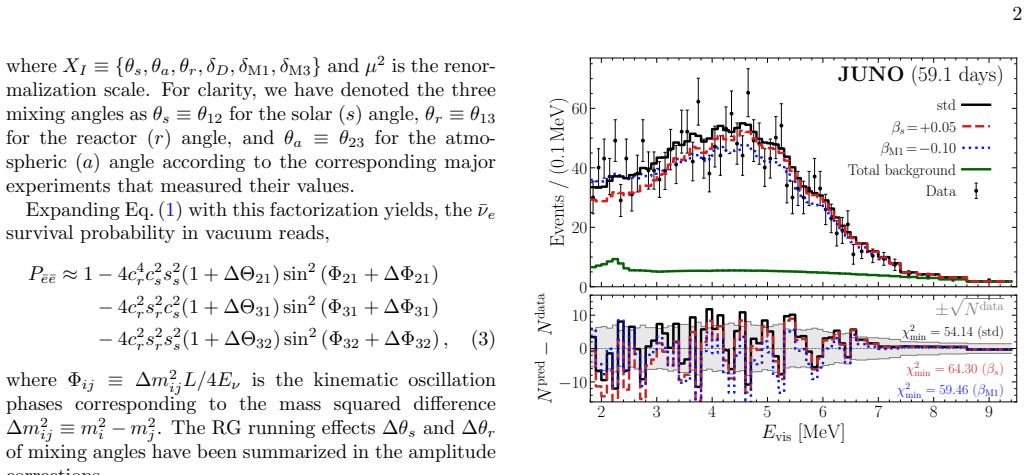
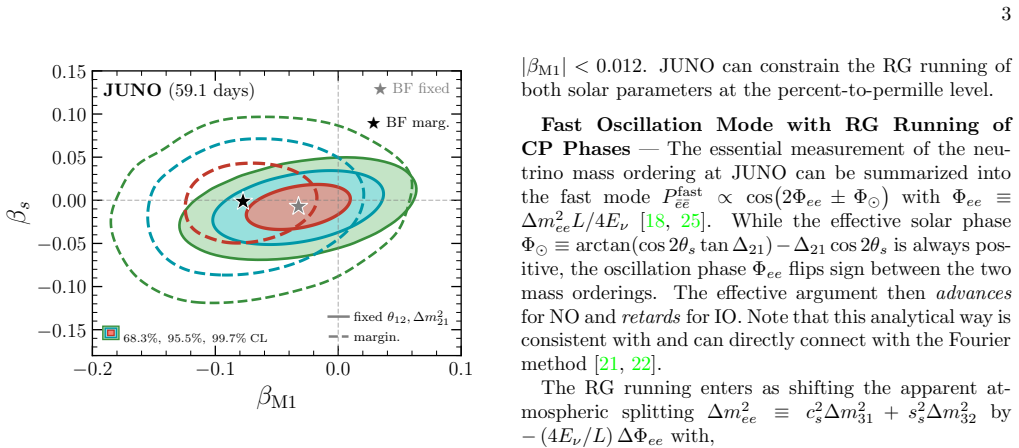
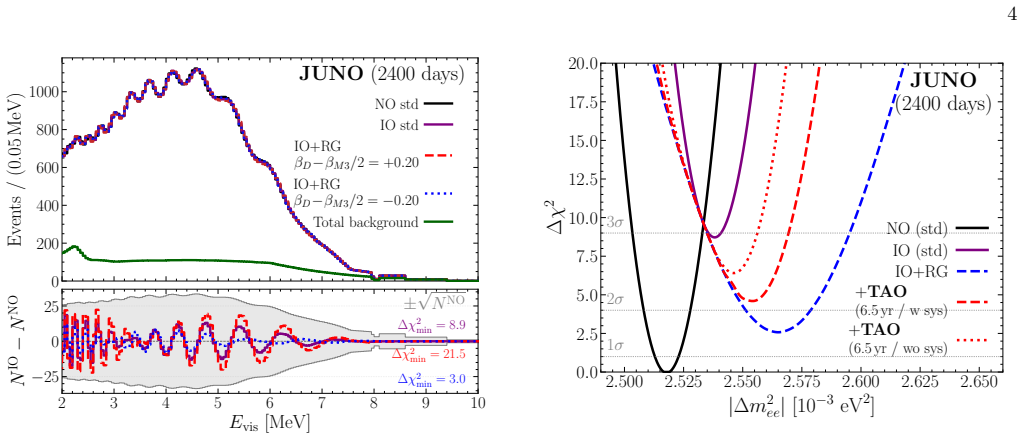
We study how the renormalization group running beta functions of mixing angles and leptonic CP phases affect the slow and fast oscillation modes at JUNO. While the slow mode is modulated by the solar parameters, its amplitude can also be affected by the solar angle beta function $\beta_s$ and its phase by the Majorana CP phase counterpart $\beta_{\rm M1}$. On the other hand, the fast mode also receives corrections from the beta functions of the Dirac CP phase $\delta_D$ and the Majorana CP phase $\delta_{\rm M3}$. Since the fast mode is essentially the one measuring the neutrino mass ordering, the RG running effect can then interfere to deteriorate the sensitivity. Fortunately, the JUNO-TAO near detector can provide supplementary measurements of the RG running parameters to restore the mass ordering sensitivity.
Editorial analysis
A structured set of objections, weighed in public.
Referee Report
Summary. The manuscript examines how renormalization group (RG) running beta functions of the neutrino mixing angles and leptonic CP phases modify the slow and fast oscillation modes at JUNO. It argues that corrections from β_s and β_M1 affect the slow mode while β_δD and β_M3 affect the fast mode, with the latter interfering with mass-ordering extraction; the JUNO-TAO near detector is proposed to measure the RG parameters and thereby restore the ordering sensitivity.
Significance. If the claimed separability holds and the near-detector data can isolate the beta-function effects without new degeneracies, the result would be relevant for precision analyses at medium-baseline reactor experiments, identifying a previously under-appreciated systematic in mass-ordering determinations and illustrating a concrete use for near-detector constraints.
major comments (2)
- [Abstract] Abstract: the central claim that JUNO-TAO restores mass-ordering sensitivity by supplying independent measurements of the RG beta functions (β_s, β_δD, β_M1, β_M3) is load-bearing but unsupported by any explicit demonstration that these parameters can be extracted from the near-detector spectrum without introducing correlations with Δm²_31 or θ_13 that would degrade the ordering fit.
- [Abstract] Abstract: the statement that RG running 'can then interfere to deteriorate the sensitivity' of the fast mode assumes the beta functions remain separable from the standard PMNS parameters in the oscillation probability; no quantitative test or degeneracy analysis is referenced to establish that this separability survives in a joint fit.
minor comments (1)
- Notation for the beta functions (β_s, β_δD, β_M1, β_M3) is introduced without reference to the explicit renormalization-group equations or the effective mixing parameters they modify at reactor baselines.
Simulated Author's Rebuttal
We thank the referee for the careful review and constructive comments on our manuscript. The two major comments correctly identify that the abstract claims would benefit from explicit supporting analysis on parameter extraction and separability. We address each point below and will revise the manuscript to incorporate the requested demonstrations.
read point-by-point responses
-
Referee: [Abstract] Abstract: the central claim that JUNO-TAO restores mass-ordering sensitivity by supplying independent measurements of the RG beta functions (β_s, β_δD, β_M1, β_M3) is load-bearing but unsupported by any explicit demonstration that these parameters can be extracted from the near-detector spectrum without introducing correlations with Δm²_31 or θ_13 that would degrade the ordering fit.
Authors: We agree that the abstract presents the restoration claim without referencing the supporting near-detector fits. The body of the manuscript contains simulations of the TAO spectrum used to constrain the beta functions, but we will add an explicit discussion of the extracted parameter correlations (including with Δm²_31 and θ_13) and update the abstract to reference these results. A new paragraph and correlation table will be included in the revised version. revision: yes
-
Referee: [Abstract] Abstract: the statement that RG running 'can then interfere to deteriorate the sensitivity' of the fast mode assumes the beta functions remain separable from the standard PMNS parameters in the oscillation probability; no quantitative test or degeneracy analysis is referenced to establish that this separability survives in a joint fit.
Authors: The manuscript derives the RG-corrected probability and performs fits that treat the beta functions as additional parameters, implicitly assuming separability due to their distinct functional forms. However, we acknowledge the absence of an explicit joint-fit degeneracy study. We will add a dedicated subsection with multi-parameter fit results demonstrating that the beta-function effects remain separable from the standard PMNS parameters without significant degradation of the mass-ordering sensitivity. revision: yes
Circularity Check
No significant circularity in derivation chain
full rationale
The paper's central claim treats RG beta functions (β_s, β_δD, β_M1, β_M3) as external inputs whose effects on slow/fast oscillation modes are analyzed at JUNO baselines, with JUNO-TAO positioned as an independent supplementary measurement. No quoted equations or steps reduce any prediction to a fitted quantity defined by the same data, nor invoke self-citation chains or ansatze that collapse the result to its inputs by construction. The derivation remains self-contained against the standard PMNS framework and external RG evolution assumptions.
Axiom & Free-Parameter Ledger
Reference graph
Works this paper leans on
-
[1]
Looking ahead to the projected exposure, we repeat the analysis on an Asimov data set for the full JUNO
(207.2 days), the corresponding limits improve to βs ∈[−0.016,+0.025] andβ M1 ∈[−0.073,−0.010] at 90% C.L.. Looking ahead to the projected exposure, we repeat the analysis on an Asimov data set for the full JUNO
-
[2]
Review of particle physics,
generated under the normal ordering (NO) with the NuFIT 6.1 best-fit parameters [33] for the standard os- cillation scenario. After 2400 effective detector days, the projected 90% C.L. bounds improve to|β s|<0.0066 and |βM1|<0.012. JUNO can constrain the RG running of both solar parameters at the percent-to-permille level. F ast Oscillation Mode with RG R...
2024
-
[3]
NuFit-6.0: updated global analysis of three-flavor neutrino oscillations,
Ivan Esteban, M. C. Gonzalez-Garcia, Michele Maltoni, Ivan Martinez-Soler, Jo˜ ao Paulo Pinheiro, and Thomas Schwetz, “NuFit-6.0: updated global analysis of three-flavor neutrino oscillations,” JHEP12(2024) 216, [arXiv:2410.05380[hep-ph]]
Pith/arXiv arXiv 2024
-
[4]
Neutrino masses and mixing: Entering the era of subpercent precision,
Francesco Capozzi, William Giar` e, Eligio Lisi, Antonio Marrone, Alessandro Melchiorri, and Antonio Palazzo, “Neutrino masses and mixing: Entering the era of subpercent precision,” Phys. Rev. D111no. 9, (2025) 093006, [arXiv:2503.07752[hep-ph]]
arXiv 2025
-
[5]
2020 global reassessment of the neutrino oscillation picture,
P. F. de Salas, D. V. Forero, S. Gariazzo, P. Mart´ ınez-Mirav´ e, O. Mena, C. A. Ternes, M. T´ ortola, and J. W. F. Valle, “2020 global reassessment of the neutrino oscillation picture,” JHEP 02(2021) 071, [arXiv:2006.11237[hep-ph]]
Pith/arXiv arXiv 2020
-
[6]
Neutrinoless Double beta Decay in SU(2)×U(1) Theories,
J. Schechter and J. W. F. Valle, “Neutrinoless Double beta Decay in SU(2)×U(1) Theories,” Phys. Rev. D 25(1982) 2951
1982
-
[7]
Neutrinoless Double-Beta Decay: Status and Prospects,
Michelle J. Dolinski, Alan W. P. Poon, and Werner Rodejohann, “Neutrinoless Double-Beta Decay: Status and Prospects,” Ann. Rev. Nucl. Part. Sci.69(2019) 219–251, [arXiv:1902.04097[nucl-ex]]
arXiv 2019
-
[8]
Toward the discovery of matter creation with neutrinolessββ decay,
Matteo Agostini, Giovanni Benato, Jason A. Detwiler, Javier Men´ endez, and Francesco Vissani, “Toward the discovery of matter creation with neutrinolessββ decay,” Rev. Mod. Phys.95no. 2, (2023) 025002, [arXiv:2202.01787[hep-ex]]
arXiv 2023
-
[9]
Neutrinoless Double-Beta Decay: A Roadmap for Matching Theory to Experiment,
Vincenzo Cirigliano et al., “Neutrinoless Double-Beta Decay: A Roadmap for Matching Theory to Experiment,” [arXiv:2203.12169[hep-ph]]
-
[10]
Mass hierarchy, 2-3 mixing and CP-phase with Huge Atmospheric Neutrino Detectors,
E. Kh. Akhmedov, Soebur Razzaque, and A. Yu. Smirnov, “Mass hierarchy, 2-3 mixing and CP-phase with Huge Atmospheric Neutrino Detectors,” JHEP02 (2013) 082, [arXiv:1205.7071[hep-ph]]. [Erratum: JHEP 07, 026 (2013)]
Pith/arXiv arXiv 2013
-
[11]
Mathieu Ribordy and Alexei Yu Smirnov, “Improving the neutrino mass hierarchy identification with inelasticity measurement in PINGU and ORCA,” Phys. Rev. D87no. 11, (2013) 113007, [arXiv:1303.0758 [hep-ph]]
Pith/arXiv arXiv 2013
-
[12]
A Novel Approach to Study Atmospheric Neutrino Oscillation,
Shao-Feng Ge, Kaoru Hagiwara, and Carsten Rott, “A Novel Approach to Study Atmospheric Neutrino Oscillation,” JHEP06(2014) 150, [arXiv:1309.3176 [hep-ph]]
Pith/arXiv arXiv 2014
-
[13]
Physics Reach of Atmospheric Neutrino Measurements at PINGU,
Shao-Feng Ge and Kaoru Hagiwara, “Physics Reach of Atmospheric Neutrino Measurements at PINGU,” JHEP09(2014) 024, [arXiv:1312.0457[hep-ph]]. [13](IceCube Collaboration)*, IceCubeCollaboration, R. Abbasi et al., “Measurement of atmospheric neutrino mixing with improved IceCube DeepCore calibration and data processing,” Phys. Rev. D108no. 1, (2023) 012014, ...
Pith/arXiv arXiv 2014
-
[14]
S. T. Petcov and M. Piai, “The LMA MSW solution of the solar neutrino problem, inverted neutrino mass hierarchy and reactor neutrino experiments,” Phys. Lett. B533(2002) 94–106, [arXiv:hep-ph/0112074]
Pith/arXiv arXiv 2002
-
[15]
Precision neutrino oscillation physics with an intermediate baseline reactor neutrino experiment,
Sandhya Choubey, S. T. Petcov, and M. Piai, “Precision neutrino oscillation physics with an intermediate baseline reactor neutrino experiment,” Phys. Rev. D68 (2003) 113006, [arXiv:hep-ph/0306017]
Pith/arXiv arXiv 2003
-
[16]
Another possible way to determine the neutrino mass hierarchy,
Hiroshi Nunokawa, Stephen J. Parke, and Renata Zukanovich Funchal, “Another possible way to determine the neutrino mass hierarchy,” Phys. Rev. D 72(2005) 013009, [arXiv:hep-ph/0503283]
Pith/arXiv arXiv 2005
-
[17]
H. Minakata, H. Nunokawa, Stephen J. Parke, and R. Zukanovich Funchal, “Determining neutrino mass hierarchy by precision measurements in electron and muon neutrino disappearance experiments,” Phys. Rev. D74(2006) 053008, [arXiv:hep-ph/0607284]
Pith/arXiv arXiv 2006
-
[18]
Hisakazu Minakata, Hiroshi Nunokawa, Stephen J. Parke, and Renata Zukanovich Funchal, “Determination of the Neutrino Mass Hierarchy via the Phase of the Disappearance Oscillation Probability with a Monochromatic¯νe Source,” Phys. Rev. D76(2007) 053004, [arXiv:hep-ph/0701151]. [Erratum: Phys.Rev.D 76, 079901 (2007)]
Pith/arXiv arXiv 2007
-
[19]
Quantifying the sensitivity of oscillation experiments to the neutrino mass ordering,
Mattias Blennow, Pilar Coloma, Patrick Huber, and Thomas Schwetz, “Quantifying the sensitivity of oscillation experiments to the neutrino mass ordering,” JHEP03(2014) 028, [arXiv:1311.1822[hep-ph]]
Pith/arXiv arXiv 2014
-
[20]
Mass ordering sum rule for the neutrino disappearance channels in T2K, NOvA, and JUNO,
Stephen J. Parke and Renata Zukanovich-Funchal, “Mass ordering sum rule for the neutrino disappearance channels in T2K, NOvA, and JUNO,” Phys. Rev. D 111no. 1, (2025) 013008, [arXiv:2404.08733[hep-ph]]
arXiv 2025
-
[21]
Determination of the Neutrino Mass Hierarchy at an Intermediate Baseline,
Liang Zhan, Yifang Wang, Jun Cao, and Liangjian Wen, “Determination of the Neutrino Mass Hierarchy at an Intermediate Baseline,” Phys. Rev. D78(2008) 111103, [arXiv:0807.3203[hep-ex]]
Pith/arXiv arXiv 2008
-
[22]
Experimental Requirements to Determine the Neutrino Mass Hierarchy Using Reactor Neutrinos,
Liang Zhan, Yifang Wang, Jun Cao, and Liangjian Wen, “Experimental Requirements to Determine the Neutrino Mass Hierarchy Using Reactor Neutrinos,” Phys. Rev. D79(2009) 073007, [arXiv:0901.2976[hep-ex]]
Pith/arXiv arXiv 2009
-
[23]
X. Qian, D. A. Dwyer, R. D. McKeown, P. Vogel, W. Wang, and C. Zhang, “Mass Hierarchy Resolution in Reactor Anti-neutrino Experiments: Parameter Degeneracies and Detector Energy Response,” Phys. Rev. D87no. 3, (2013) 033005, [arXiv:1208.1551 [physics.ins-det]]
Pith/arXiv arXiv 2013
-
[24]
Determination of mass hierarchy with medium baseline reactor neutrino experiments,
Shao-Feng Ge, Kaoru Hagiwara, Naotoshi Okamura, and Yoshitaro Takaesu, “Determination of mass hierarchy with medium baseline reactor neutrino experiments,” JHEP05(2013) 131, [arXiv:1210.8141 6 [hep-ph]]. [25]JUNOCollaboration, Fengpeng An et al., “Neutrino Physics with JUNO,” J. Phys. G43no. 3, (2016) 030401, [arXiv:1507.05613[physics.ins-det]]. [26]JUNOC...
Pith/arXiv arXiv 2013
-
[25]
Energy-dependent neutrino mixing parameters at oscillation experiments,
K. S. Babu, Vedran Brdar, Andr´ e de Gouvˆ ea, and Pedro A. N. Machado, “Energy-dependent neutrino mixing parameters at oscillation experiments,” Phys. Rev. D105no. 11, (2022) 115014, [arXiv:2108.11961 [hep-ph]]
arXiv 2022
-
[26]
Neutrino CP measurement in the presence of RG running with mismatched momentum transfers,
Shao-Feng Ge, Chui-Fan Kong, and Pedro Pasquini, “Neutrino CP measurement in the presence of RG running with mismatched momentum transfers,” Phys. Rev. D110no. 1, (2024) 015003, [arXiv:2310.04077 [hep-ph]]
arXiv 2024
-
[27]
Testing the RG running of the leptonic Dirac CP phase with reactor neutrinos,
Shao-Feng Ge, Chui-Fan Kong, and Pedro Pasquini, “Testing the RG running of the leptonic Dirac CP phase with reactor neutrinos,” Phys. Rev. D111no. 11, (2025) 115031, [arXiv:2411.18251[hep-ph]]
arXiv 2025
-
[28]
Renormalization group running of neutrino parameters,
Tommy Ohlsson and Shun Zhou, “Renormalization group running of neutrino parameters,” Nature Commun.5(2014) 5153, [arXiv:1311.3846[hep-ph]]
Pith/arXiv arXiv 2014
-
[29]
JUNO’s prospects for determining the neutrino mass ordering,
David V. Forero, Stephen J. Parke, Christoph A. Ternes, and Renata Zukanovich Funchal, “JUNO’s prospects for determining the neutrino mass ordering,” Phys. Rev. D104no. 11, (2021) 113004, [arXiv:2107.12410[hep-ph]]
arXiv 2021
-
[30]
NuFIT 6.1 (2025), Global Analysis of Neutrino Oscillation Data
Ivan Esteban, Concha Gonzalez Garcia, Michele Maltoni, Ivan Martinez Soler, Jo˜ ao Paulo Pinheiro, and Thomas Schwetz, “NuFIT 6.1 (2025), Global Analysis of Neutrino Oscillation Data.”www.nu-fit.org, 2025. Accessed in June of 2026. [34]JUNOCollaboration, Angel Abusleme et al., “TAO Conceptual Design Report: A Precision Measurement of the Reactor Antineutr...
arXiv 2025
-
[31]
Lessons from the first JUNO results,
Ivan Esteban, M. C. Gonzalez-Garcia, Michele Maltoni, Ivan Martinez-Soler, Joao Paulo Pinheiro, and Thomas Schwetz, “Lessons from the first JUNO results,” JHEP 04(2026) 089, [arXiv:2601.09791[hep-ph]]
Pith/arXiv arXiv 2026
-
[32]
Angular distribution of neutron inverse beta decay, anti-neutrino(e) + p —> e+ + n,
P. Vogel and John F. Beacom, “Angular distribution of neutron inverse beta decay, anti-neutrino(e) + p —> e+ + n,” Phys. Rev. D60(1999) 053003, [arXiv:hep-ph/9903554]. [38]Daya BayCollaboration, F. P. An et al., “Comprehensive Measurement of the Reactor Antineutrino Spectrum and Flux at Daya Bay,” Phys. Rev. Lett.134no. 20, (2025) 201802, [arXiv:2501.0074...
Pith/arXiv arXiv 1999
-
[33]
On the determination of anti-neutrino spectra from nuclear reactors,
Patrick Huber, “On the determination of anti-neutrino spectra from nuclear reactors,” Phys. Rev. C84(2011) 024617, [arXiv:1106.0687[hep-ph]]. [Erratum: Phys.Rev.C 85, 029901 (2012)]
Pith/arXiv arXiv 2011
-
[34]
Improved Predictions of Reactor Antineutrino Spectra,
Th. A. Mueller et al., “Improved Predictions of Reactor Antineutrino Spectra,” Phys. Rev. C83(2011) 054615, [arXiv:1101.2663[hep-ex]]. [41]JUNOCollaboration, Angel Abusleme et al., “Initial performance results of the JUNO detector*,” Chin. Phys. C50no. 4, (2026) 043001, [arXiv:2511.14590 [hep-ex]]. [42]Daya BayCollaboration, F. P. An et al., “Antineutrino...
Pith/arXiv arXiv 2011
-
[35]
Combined Neyman–Pearson chi-square: An improved approximation to the Poisson-likelihood chi-square,
Xiangpan Ji, Wenqiang Gu, Xin Qian, Hanyu Wei, and Chao Zhang, “Combined Neyman–Pearson chi-square: An improved approximation to the Poisson-likelihood chi-square,” Nucl. Instrum. Meth. A961(2020) 163677, [arXiv:1903.07185[physics.data-an]]. 7 Supplementary Material JUNO Analysis The reactor antineutrino signal is detected through the inverse beta decay (...
arXiv 2020
discussion (0)
Sign in with ORCID, Apple, or X to comment. Anyone can read and Pith papers without signing in.