REVIEW 3 major objections 5 minor 67 references
Unlearning Algorithmic Biases over Graphs
T0 review · 3 major / 5 minor · reviewed 2026-08-07 · deepseek-v4-flash
Pith's one-line read This paper reframes graph unlearning as a training-free bias-mitigation tool with certified guarantees.
desk verdict Theorem 2's proof in the appendix is broken, so the paper's central certifiable-bias-mitigation claim does not hold; the empirical debiasing method is still worth knowing. read the letter →
The pith
A machine-rendered reading of the paper's core claim, the machinery that carries it, and where it could break.
The reading
What carries the argument
The central object is the one-step Newton update in equation (2), $\tilde{w}=w^\star+H_{w^\star}^{-1}\Delta$, where $\Delta$ accumulates the per-node gradient differences between the original aggregated representations $Z=P^L X$ and the post-removal $\tilde{Z}$. Under the framework of [5], a small enough post-update gradient norm translates into an $(\epsilon,\delta)$-certified removal, so the paper's technical program is to keep that norm small. Three selection scores feed the update: features ranked by $|\rho_f|$ (Pearson correlation with the sensitive attribute), edges scored by $b_e(e_{ij})=\mathbb{I}\{s_i=s_j\}/\min(d_i,d_j)$, and nodes scored by $b_n(v_i)=d_i^\omega/(1+d_i^\chi)\cdot 1/d_i$. The link from these scores to fairness is Theorem 3, which upper-bounds raw statistical parity by a constant times $\|\rho\|$.
What would settle it
Inspect the training loop described in Section 5.1 and Appendix H: if no Gaussian noise was added to the objective, then Theorem 1 cannot be invoked for those models and the certified-removal chain does not apply; one can also compute $\|\nabla L(\tilde{w};\tilde{D}_G)\|$ after the update and compare it with the Theorem 2 bound to see whether the certificate would hold.
Extended reading notes
Core claim
On its own terms, the paper's discovery is that algorithmic bias in a pre-trained graph ML model can be treated as a deletion problem: zero out the $k$ nodal features whose columns correlate most with the sensitive attribute, or delete selected intra-edges and low-degree nodes, and then apply the single Newton step $\tilde{w}=w^\star+H_{w^\star}^{-1}\Delta$ to the weights. Theorem 2 gives a high-probability bound $\|\nabla L(\tilde{w};\tilde{D}_G)\|\le \frac{\gamma_2}{m}(2c\sqrt{F}+c_1\sqrt{(F-k)m}/(\lambda\sqrt{F}))^2$, sublinear in the training-set size, so the update meets the certified-removal criterion of the underlying unlearning framework. Theorem 3 bounds raw statistical parity by a constant times $\|\rho\|$, the norm of correlations between features and the sensitive attribute, which is exactly what the feature selection score reduces. The experiments show the updated model matching retraining accuracy while cutting statistical parity and equal-opportunity gaps by up to 75%, at 9×–27× lower runtime.
Load-bearing premise
The whole certificate chain assumes the pre-trained model is the exact minimizer of a noisy objective with Gaussian noise added during training; without that noise, the bounded-gradient theorem that turns a small gradient norm into a certified removal guarantee does not apply.
Editorial extensions
If this is right
- Unlearning the top-$\|\rho\|$ features lowers the Theorem 3 upper bound on raw statistical parity, so a practitioner gets a fairness improvement directly tied to a measurable quantity.
- The certified feature-unlearning bound of Theorem 2 grows sublinearly with the number of affected samples, which makes fine-grained feature removal practical on large graphs rather than limited by the linear scaling of prior feature-unlearning certificates.
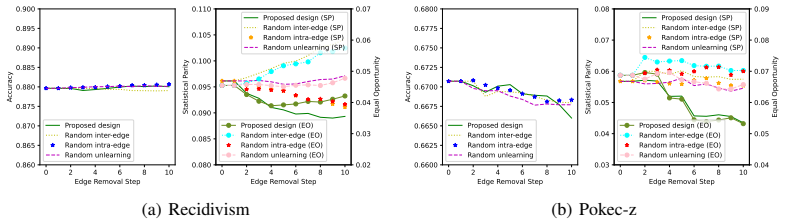
- Removing selected intra-edges or low-degree bias-propagating nodes preserves node-classification accuracy while reducing statistical parity and equal-opportunity gaps on the four benchmark networks.
- Because the whole update is one Newton step, the method runs roughly 9×–27× faster than retraining from scratch while matching its utility.
Reading between the lines
- The paper's own limitations statement confines the theoretical guarantees to models trained with DP-SGD on the linear head, so the reported speedups are empirical findings and the certificates transfer only if the pre-trained model satisfies the noisy-objective condition.
- Because Theorem 2's bound is sublinear in training-set size and the feature update works with $P=I$, the same correlation-based feature forgetting could be used to debias tabular classifiers, a direction the paper names but does not benchmark.
- The selection scores target statistical parity through $\|\rho\|$; equal-opportunity gaps may respond differently, so the fairness gain is tied to the metric rather than guaranteed across all group-fairness definitions.
Editorial analysis
A structured set of objections, weighed in public.
Referee Report
Summary. The paper proposes to mitigate algorithmic bias in pre-trained graph ML models by treating bias removal as a certified unlearning problem. Given a pre-trained model, it selects nodal features, edges, or nodes that are most correlated with sensitive attributes, and applies a single Newton step to update the weights. The authors derive a high-probability gradient-norm bound for feature unlearning (Theorem 2), a statistical-parity bound in terms of feature correlations (Theorem 3), and invoke a known certified-removal result (Theorem 1 from [5]) to claim (epsilon, delta)-guarantees for the updated model. Experiments on Credit Defaulter, Recidivism, German Credit, and Pokec-z show that the proposed feature, edge, and node selection strategies reduce statistical parity and equal-opportunity gaps with utility close to that of retraining, at 10-20x lower runtime.
Significance. The paper introduces a genuinely new application of certified unlearning: using data removal as a training-free post-processing debiasing tool for graph models. The proposed bias scores for edges and nodes are simple, interpretable, and empirically effective on standard fair graph benchmarks, and the experiments are well structured with ablations and retraining comparisons. If the theoretical guarantees were valid, the one-step Newton update would be an attractive practical contribution to fair graph ML. However, the theoretical core is currently not established: the proof of the main unlearning bound (Theorem 2) contains an incorrect convexity claim and inconsistent final algebra, and the certified-removal framework does not cover the models used in the experiments. These are load-bearing issues, not presentation concerns.
major comments (3)
- [Appendix A, Eqs. (17)-(30)] The proof of Theorem 2 contains a load-bearing error. The objective L(w;D') = sum_{v_i in V_tr} ell(z~_i^T w, y_i) + (lambda/2)||w||^2 is lambda-strongly convex, not lambda m-strongly convex, because its Hessian is sum_{v_i in V_tr} ell''(z~_i^T w) z~_i z~_i^T + lambda I >= lambda I. Hence ||H^{-1}_{w*}|| <= 1/lambda, not 1/(lambda m) as stated after Eq. (17). This changes Eq. (17) and propagates to the final bound. Independently, the algebra in Eq. (30) does not follow from the bounds proved earlier: using Eq. (29), which gives ||o|| <= c_1 sqrt((F-k)m/F), and Eq. (21), which gives ||Delta|| <= 2c + ||o||, the bracket after division by lambda m (or by lambda) is 2c + c_1 sqrt((F-k)m/F) over (lambda m) (or over lambda), not [2c sqrt(F) + c_1 sqrt((F-k)m)/(lambda sqrt(F))]; the factor 5 in the intermediate line also disappears without justification. Theorem 2, and hence Eq. (3), is therefore not proved as written. Since Eq. (3) is the bridge that makes Theorem 1 applicable to feature unlearning, this invalidates the central certified-bias-mitigation claim.
- [Sections 4, 5.1, Appendix H, Section 6] The certified-removal chain relies on Theorem 1 from [5], which applies only when the pre-trained model is the minimizer of the noisy objective L_b(w;D_G) with b drawn from a Normal distribution. The problem formulation in Section 4 defines w* as the unique minimizer of the noiseless objective L(w;D_G), and Appendix H states that models are trained with L-BFGS without mentioning DP noise or a noisy objective. The Limitations section explicitly concedes that the framework requires a graph ML model pre-trained in a DP-SGD manner for the theoretical unlearning guarantees to hold. Consequently, the (epsilon, delta)-certified removal conclusion does not cover the models evaluated in Sections 5.2-5.4, and the abstract's phrase 'certifiable bias mitigation' is not supported for the experimental system.
- [Section 5.3 and Remark 3] The edge-unlearning experiments use mini-batched updates (10 batches, 1% of edges per update), and the text states that 'even if certified unlearning guarantees do not directly translate into this setting.' This is an explicit admission that the reported edge-unlearning results are not covered by the certified-removal theory, despite Remark 3 referring to 'Certified Structural Unlearning' and the abstract claiming certifiable mitigation. The claims need to be scoped to the settings in which the guarantees actually hold, or the mini-batch setting needs its own analysis.
minor comments (5)
- [Appendix B, Eq. (31)] The second average in the displayed difference should be (1/|S_1|) sum_{v_j in S_1} x_j; as printed, both averages use |S_0|, which is a typo that should be corrected because it obscures the relation to the correlation vector rho.
- [Appendix F, caption of Fig. 7] The text says 'in addition to the proposed strategy and random feature selection' but the figure and surrounding discussion concern edge selection; 'feature' should be replaced with 'edge'.
- [Section 5.3, last paragraph] 'Despite using mini matches' should read 'despite using mini-batches.'
- [Section 4.1, paragraph after Theorem 3] The statement that because Z = P^L X is a linear transformation, 'the correlation between the input features and the sensitive attributes will be equivalent to the correlation between the aggregated representations and sensitive attributes' is not generally true; a row-stochastic linear map can change correlation structure. The bound should simply be applied with rho defined on Z.
- [Appendix G, Figure 9 legend] Several legend entries appear as '-based(SP)' and '-based(EO)' without the prefix 'alpha'; the legend labels should be completed.
Circularity Check
No significant circularity: the certified-removal bound and the bias-correlation bound are genuine algebraic statements, and the one self-citation is supporting prior work rather than a reduction to the paper's own inputs.
full rationale
The paper's derivation chain is not circular. Theorem 2 is an upper bound on ||∇L(˜w;˜DG)|| obtained in Appendix A from Lemma 1's identity plus Assumptions i)-iv); the conclusion is not assumed in the proof, and the bound does not reduce to a fitted parameter. Theorem 3 is proved in Appendix B by directly relating the Pearson correlation vector ρ to the group-mean difference and then using ||w*|| ≤ c/λ; the feature selection rule (5) then reduces ||ρ||, which is a genuine bound rather than a relabeling of the measured fairness metric. The certified-removal step is imported from the external Theorem 1 of [5], and the paper's contribution is to supply the gradient bound required by that theorem. The structural selection scores be and bn are motivated by Eq. (6) from the authors' own prior work [21]; this is a self-citation, but it is a published theorem used as motivation, and the experiments include ablations against random and alternative selection rules (Figs. 7-9), so the empirical claim does not reduce to the citation. Several non-circular concerns should be noted: Section 6 honestly states that the theoretical guarantee requires a model pre-trained in a DP-SGD manner, while Appendix H reports L-BFGS training; this is a soundness/applicability gap, not circularity. In addition, Appendix A's assertion that L(·,D') is λm-strongly convex and the final algebra leading to Eq. (30) appear incorrect, so Theorem 2 may be unproved as written; again, this is a proof-correctness issue rather than an equivalence between input and output.
Assumptions & free parameters
free parameters (3)
- L (number of propagation hops) =
3
- Unlearning budget k (features/edges/nodes) =
k=1 or 4/5 features; 10% of edges; 500 or 50 nodes
- Regularization parameter λ =
10
assumptions (5)
- domain assumption Assumptions i)-iv): bounded gradients, c1-bounded first derivative, γ2-Lipschitz second derivative, and i.i.d. Gaussian nodal features
- standard math Theorem 1 of Guo et al. [5]: minimizer of L_b(w;D) with b drawn from Normal gives (ε,δ)-certified removal
- standard math Row-stochastic propagation P such that ∥P^L x∥≤∥x∥
- domain assumption Homophily-based α1/α2 characterization of graph correlation from [21]
- domain assumption Gaussian concentration with 5σ implies ∥x_i∥≤1 with probability above 0.99 for F≤59
Cite this review
Pith. "Pith review of Unlearning Algorithmic Biases over Graphs." pith.science (2026). https://pith.science/paper/A4EIIVWY
@misc{pith2026250514945,
  author       = {Pith},
  title        = {Pith review of: Unlearning Algorithmic Biases over Graphs},
  year         = {2026},
  howpublished = {\url{https://pith.science/paper/A4EIIVWY}},
  note         = {Machine review of arXiv:2505.14945}
}
read the original abstract
The growing enforcement of the right to be forgotten regulations has propelled recent advances in certified (graph) unlearning strategies to comply with data removal requests from deployed machine learning (ML) models. Motivated by the well-documented bias amplification predicament inherent to graph data, here we take a fresh look at graph unlearning and leverage it as a bias mitigation tool. Given a pre-trained graph ML model, we develop a training-free unlearning procedure that offers certifiable bias mitigation via a single-step Newton update on the model weights. This way, we contribute a computationally lightweight alternative to the prevalent training- and optimization-based fairness enhancement approaches, with quantifiable performance guarantees. We first develop a novel fairness-aware nodal feature unlearning strategy along with refined certified unlearning bounds for this setting, whose impact extends beyond the realm of graph unlearning. We then design structural unlearning methods endowed with principled selection mechanisms over nodes and edges informed by rigorous bias analyses. Unlearning these judiciously selected elements can mitigate algorithmic biases with minimal impact on downstream utility (e.g., node classification accuracy). Experimental results over real networks corroborate the bias mitigation efficacy of our unlearning strategies, and delineate markedly favorable utility-complexity trade-offs relative to retraining from scratch using augmented graph data obtained via removals.
Figures


Figures from the paper (6 more)



Reference graph
Works this paper leans on
-
[56]
Machine unlearning of features and labels,
A. Warnecke, L. Pirch, C. Wressnegger, and K. Rieck, “Machine unlearning of features and labels,” arXiv preprint arXiv:2108.11577, 2021
arXiv 2021
-
[21]
Demystifying and mitigating bias for node representation learning,
O. D. Kose and Y . Shen, “Demystifying and mitigating bias for node representation learning,” IEEE Transactions on Neural Networks and Learning Systems (TNNLS), 2023
work page 2023
-
[5]
Certified data removal from machine learning models,
C. Guo, T. Goldstein, A. Hannun, and L. Van Der Maaten, “Certified data removal from machine learning models,” in International Conference on Machine Learning (ICML), 2020, pp. 3832–3842
work page 2020
-
[1]
C. Sudlow, J. Gallacher, N. Allen, V . Beral, P. Burton, J. Danesh, P. Downey, P. Elliott, J. Green, M. Landray et al., “Uk biobank: an open access resource for identifying the causes of a wide range of complex diseases of middle and old age,” PLoS medicine, vol. 12, no. 3, p. e1001779, 2015
work page 2015
-
[2]
Making AI forget you: Data deletion in machine learning,
A. Ginart, M. Guan, G. Valiant, and J. Y . Zou, “Making AI forget you: Data deletion in machine learning,” Advances in Neural Information Processing Systems (NeurIPS), vol. 32, 2019
work page 2019
-
[3]
What is GDPR, the EU’s new data protecion law?
“What is GDPR, the EU’s new data protecion law?” https://gdpr.eu/what-is-gdpr/, accessed: 2025-05-311
work page 2025
-
[4]
Remember what you want to forget: Algorithms for machine unlearning,
A. Sekhari, J. Acharya, G. Kamath, and A. T. Suresh, “Remember what you want to forget: Algorithms for machine unlearning,” Advances in Neural Information Processing Systems (NeurIPS), vol. 34, pp. 18 075–18 086, 2021
work page 2021
-
[6]
L. Bourtoule, V . Chandrasekaran, C. A. Choquette-Choo, H. Jia, A. Travers, B. Zhang, D. Lie, and N. Papernot, “Machine unlearning,” in IEEE Symposium on Security and Privacy (SP) , 2021, pp. 141–159
work page 2021
Show all 67 references
-
[7]
Approximate data deletion from machine learning models,
Z. Izzo, M. A. Smart, K. Chaudhuri, and J. Zou, “Approximate data deletion from machine learning models,” inInternational Conference on Artificial Intelligence and Statistics (AISTATS), 2021, pp. 2008–2016
2021
-
[8]
Descent-to-delete: Gradient-based methods for machine unlearning,
S. Neel, A. Roth, and S. Sharifi-Malvajerdi, “Descent-to-delete: Gradient-based methods for machine unlearning,” in Algorithmic Learning Theory, 2021, pp. 931–962
2021
-
[9]
Graph representation learning,
W. L. Hamilton, “Graph representation learning,”Synthesis Lectures on Artificial Intelligence and Machine Learning, vol. 14, no. 3, pp. 1–159, 2020
2020
-
[10]
GIF: A general graph unlearning strategy via influence function,
J. Wu, Y . Yang, Y . Qian, Y . Sui, X. Wang, and X. He, “GIF: A general graph unlearning strategy via influence function,” in Proc. ACM Web Conference, 2023, pp. 651–661
2023
-
[11]
Certified graph unlearning,
E. Chien, C. Pan, and O. Milenkovic, “Certified graph unlearning,” in NeurIPS Workshop: New Frontiers in Graph Learning, 2022
2022
-
[12]
Certified edge unlearning for graph neural networks,
K. Wu, J. Shen, Y . Ning, T. Wang, and W. H. Wang, “Certified edge unlearning for graph neural networks,” in Proc. ACM Conference on Knowledge Discovery and Data Mining (SIGKDD), 2023, pp. 2606–2617. 10
2023
-
[13]
IDEA: A flexible framework of certified unlearning for graph neural networks,
Y . Dong, B. Zhang, Z. Lei, N. Zou, and J. Li, “IDEA: A flexible framework of certified unlearning for graph neural networks,” in Proc. ACM Conference on Knowledge Discovery and Data Mining (SIGKDD), 2024, pp. 621–630
2024
-
[14]
Unlearning graph classifiers with limited data resources,
C. Pan, E. Chien, and O. Milenkovic, “Unlearning graph classifiers with limited data resources,” in Proc. ACM Web Conference, 2023, pp. 716–726
2023
-
[15]
Say no to the discrimination: Learning fair graph neural networks with limited sensitive attribute information,
E. Dai and S. Wang, “Say no to the discrimination: Learning fair graph neural networks with limited sensitive attribute information,” in Proc. ACM International Conference on Web Search and Data Mining (WSDM), 2021, pp. 680–688
2021
-
[16]
Fairness in graph mining: A survey,
Y . Dong, J. Ma, S. Wang, C. Chen, and J. Li, “Fairness in graph mining: A survey,” IEEE Transactions on Knowledge and Data Engineering (TKDE), 2023
2023
-
[17]
Fast model debias with machine unlearning,
R. Chen, J. Yang, H. Xiong, J. Bai, T. Hu, J. Hao, Y . Feng, J. T. Zhou, J. Wu, and Z. Liu, “Fast model debias with machine unlearning,” Advances in Neural Information Processing Systems (NeurIPS), vol. 36, pp. 14 516–14 539, 2023
2023
-
[18]
Debayes: A Bayesian method for debiasing network embeddings,
M. Buyl and T. De Bie, “Debayes: A Bayesian method for debiasing network embeddings,” in International Conference on Machine Learning (ICML), 2020, pp. 1220–1229
2020
-
[19]
Compositional fairness constraints for graph embeddings,
A. Bose and W. Hamilton, “Compositional fairness constraints for graph embeddings,” in International Conference on Machine Learning (ICML), 2019, pp. 715–724
2019
-
[20]
Towards a unified framework for fair and stable graph representation learning,
C. Agarwal, H. Lakkaraju, and M. Zitnik, “Towards a unified framework for fair and stable graph representation learning,” in Uncertainty in Artificial Intelligence (UAI), 2021, pp. 2114–2124
2021
-
[22]
Fairdrop: Biased edge dropout for en- hancing fairness in graph representation learning,
I. Spinelli, S. Scardapane, A. Hussain, and A. Uncini, “Fairdrop: Biased edge dropout for en- hancing fairness in graph representation learning,” IEEE Transactions on Artificial Intelligence, vol. 3, no. 3, pp. 344–354, 2021
2021
-
[23]
Graph unlearning,
M. Chen, Z. Zhang, T. Wang, M. Backes, M. Humbert, and Y . Zhang, “Graph unlearning,” in Proc. ACM Conference on Computer and Communications Security (SIGSAC) , 2022, pp. 499–513
2022
-
[24]
Inductive graph unlearning,
C.-L. Wang, M. Huai, and D. Wang, “Inductive graph unlearning,” in32nd USENIX Security Symposium (USENIX Security 23), 2023, pp. 3205–3222
2023
-
[25]
Graph unlearning with efficient partial retraining,
J. Zhang, “Graph unlearning with efficient partial retraining,” inCompanion Proc. ACM Web Conference, 2024, pp. 1218–1221
2024
-
[26]
GNNDelete: A general strategy for unlearning in graph neural networks,
J. Cheng, G. Dasoulas, H. He, C. Agarwal, and M. Zitnik, “GNNDelete: A general strategy for unlearning in graph neural networks,” in International Conference on Learning Representations (ICLR), 2023
2023
-
[27]
Towards effective and general graph unlearning via mutual evolution,
X. Li, Y . Zhao, Z. Wu, W. Zhang, R.-H. Li, and G. Wang, “Towards effective and general graph unlearning via mutual evolution,” in Proc. Conference on Artificial Intelligence (AAAI), vol. 38, no. 12, 2024, pp. 13 682–13 690
2024
-
[28]
Toward scalable graph unlearning: A node influence maximization based approach,
X. Li, B. Fan, Z. Wu, Z. Li, R.-H. Li, and G. Wang, “Toward scalable graph unlearning: A node influence maximization based approach,” arXiv preprint arXiv:2501.11823, 2025
2025 arXiv
-
[29]
Distill to delete: Unlearning in graph networks with knowledge distillation,
Y . Sinha, M. Mandal, and M. Kankanhalli, “Distill to delete: Unlearning in graph networks with knowledge distillation,” arXiv preprint arXiv:2309.16173, 2023
2023 arXiv
-
[30]
When contrastive learning meets graph unlearning: Graph contrastive unlearning for link prediction,
T.-H. Yang and C.-T. Li, “When contrastive learning meets graph unlearning: Graph contrastive unlearning for link prediction,” in IEEE International Conference on Big Data (BigData), 2023, pp. 6025–6032
2023
-
[31]
Efficiently forgetting what you have learned in graph representation learning via projection,
W. Cong and M. Mahdavi, “Efficiently forgetting what you have learned in graph representation learning via projection,” in International Conference on Artificial Intelligence and Statistics (AISTATS), 2023, pp. 6674–6703
2023
-
[32]
A survey on fairness for machine learning on graphs,
M. Choudhary, C. Laclau, and C. Largeron, “A survey on fairness for machine learning on graphs,” arXiv preprint arXiv:2205.05396, 2022
2022 arXiv
-
[33]
Fairness in graph machine learning: Recent advances and future prospectives,
Y . Dong, O. D. Kose, Y . Shen, and J. Li, “Fairness in graph machine learning: Recent advances and future prospectives,” in Proc. ACM Conference on Knowledge Discovery and Data Mining (SIGKDD), 2023, pp. 5794–5795. 11
2023
-
[34]
Fairwalk: Towards fair graph embedding,
T. Rahman, B. Surma, M. Backes, and Y . Zhang, “Fairwalk: Towards fair graph embedding,” in Proc. International Joint Conference on Artificial Intelligence, 2019, pp. 3289–3295
2019
-
[35]
Debiasing graph representations via metadata-orthogonal train- ing,
J. Palowitch and B. Perozzi, “Debiasing graph representations via metadata-orthogonal train- ing,” in IEEE International Conference on Advances in Social Networks Analysis and Mining (ASONAM), 2020, pp. 435–442
2020
-
[36]
Individual fairness for graph neural networks: A ranking based approach,
Y . Dong, J. Kang, H. Tong, and J. Li, “Individual fairness for graph neural networks: A ranking based approach,” inProc. ACM Conference on Knowledge Discovery & Data Mining (SIGKDD), 2021, pp. 300–310
2021
-
[37]
GUIDE: Group equality informed individual fairness in graph neural networks,
W. Song, Y . Dong, N. Liu, and J. Li, “GUIDE: Group equality informed individual fairness in graph neural networks,” in Proc. ACM Conference on Knowledge Discovery and Data Mining (SIGKDD), 2022, pp. 1625–1634
2022
-
[38]
Learning fair node representations with graph counterfactual fairness,
J. Ma, R. Guo, M. Wan, L. Yang, A. Zhang, and J. Li, “Learning fair node representations with graph counterfactual fairness,” inProc. ACM International Conference on Web Search and Data Mining (WSDM), 2022, pp. 695–703
2022
-
[39]
Towards fair graph neural networks via graph counterfactual,
Z. Guo, J. Li, T. Xiao, Y . Ma, and S. Wang, “Towards fair graph neural networks via graph counterfactual,” in Proc. ACM International Conference on Information and Knowledge Man- agement, 2023, pp. 669–678
2023
-
[40]
EDITS: Modeling and mitigating data bias for graph neural networks,
Y . Dong, N. Liu, B. Jalaian, and J. Li, “EDITS: Modeling and mitigating data bias for graph neural networks,” in Proc. ACM Web Conference, 2022, pp. 1259–1269
2022
-
[41]
Fair contrastive learning on graphs,
O. D. Kose and Y . Shen, “Fair contrastive learning on graphs,”IEEE Transactions on Signal and Processing over Networks, vol. 8, pp. 475–488, 2022
2022
-
[42]
Debiasing knowledge graph embeddings,
J. Fisher, A. Mittal, D. Palfrey, and C. Christodoulopoulos, “Debiasing knowledge graph embeddings,” in Proc. Conference on Empirical Methods in Natural Language Processing (EMNLP), 2020, pp. 7332–7345
2020
-
[43]
Learning fair representations via distance correlation minimization,
D. Guo, C. Wang, B. Wang, and H. Zha, “Learning fair representations via distance correlation minimization,” IEEE Transactions on Neural Networks and Learning Systems (TNNLS), 2022
2022
-
[44]
Endowing pre-trained graph models with provable fairness,
Z. Zhang, M. Zhang, Y . Yu, C. Yang, J. Liu, and C. Shi, “Endowing pre-trained graph models with provable fairness,” in Proc. ACM Web Conference, 2024, pp. 1045–1056
2024
-
[45]
Bursting the filter bubble: Fairness-aware network link prediction,
F. Masrour, T. Wilson, H. Yan, P.-N. Tan, and A. Esfahanian, “Bursting the filter bubble: Fairness-aware network link prediction,” in Proc. Conference on Artificial Intelligence (AAAI), vol. 34, no. 01, 2020, pp. 841–848
2020
-
[46]
Inform: Individual fairness on graph mining,
J. Kang, J. He, R. Maciejewski, and H. Tong, “Inform: Individual fairness on graph mining,” in Proc. ACM International Conference on Knowledge Discovery & Data Mining (SIGKDD), 2020, pp. 379–389
2020
-
[47]
Machine unlearning: Taxonomy, metrics, applications, challenges, and prospects,
N. Li, C. Zhou, Y . Gao, H. Chen, Z. Zhang, B. Kuang, and A. Fu, “Machine unlearning: Taxonomy, metrics, applications, challenges, and prospects,” IEEE Transactions on Neural Networks and Learning Systems (TNNLS), 2025
2025
-
[48]
Fair machine unlearning: Data removal while mitigating disparities,
A. Oesterling, J. Ma, F. Calmon, and H. Lakkaraju, “Fair machine unlearning: Data removal while mitigating disparities,” inInternational Conference on Artificial Intelligence and Statistics (AISTATS), 2024, pp. 3736–3744
2024
-
[49]
To be forgotten or to be fair: Unveiling fairness implications of machine unlearning methods,
D. Zhang, S. Pan, T. Hoang, Z. Xing, M. Staples, X. Xu, L. Yao, Q. Lu, and L. Zhu, “To be forgotten or to be fair: Unveiling fairness implications of machine unlearning methods,” AI and Ethics, vol. 4, no. 1, pp. 83–93, 2024
2024
-
[50]
Exploring fairness in educational data mining in the context of the right to be forgotten,
W. Qian, A. Chen, C. Zhao, Y . Li, and M. Huai, “Exploring fairness in educational data mining in the context of the right to be forgotten,” arXiv preprint arXiv:2405.16798, 2024
2024 arXiv
-
[51]
Can machine unlearning reduce social bias in language models?
O. Dige, D. Arneja, T. F. Yau, Q. Zhang, M. Bolandraftar, X. Zhu, and F. Khattak, “Can machine unlearning reduce social bias in language models?” in Proc. Conference on Empirical Methods in Natural Language Processing: Industry Track, 2024, pp. 954–969
2024
-
[52]
FROG: Fair removal on graphs,
Z. Chen, J. Cheng, G. Tolomei, S. Liu, H. Amiri, Y . Wang, K. Nag, and L. Lin, “FROG: Fair removal on graphs,” arXiv preprint arXiv:2503.18197, 2025
2025
-
[53]
Simplifying graph convolutional networks,
F. Wu, A. Souza, T. Zhang, C. Fifty, T. Yu, and K. Weinberger, “Simplifying graph convolutional networks,” in International Conference on Machine Learning (ICML), 2019, pp. 6861–6871. 12
2019
-
[54]
Semi-supervised classification with graph convolutional networks,
T. N. Kipf and M. Welling, “Semi-supervised classification with graph convolutional networks,” in International Conference on Learning Representations (ICLR), 2017
2017
-
[55]
Improving fairness in graph neural networks via mitigating sensitive attribute leakage,
Y . Wang, Y . Zhao, Y . Dong, H. Chen, J. Li, and T. Derr, “Improving fairness in graph neural networks via mitigating sensitive attribute leakage,” inProc. ACM Conference on Knowledge Discovery and Data Mining (SIGKDD), 2022, pp. 1938–1948
2022
-
[57]
Don’t forget too much: Towards machine unlearning on feature level,
H. Xu, T. Zhu, W. Zhou, and W. Zhao, “Don’t forget too much: Towards machine unlearning on feature level,” IEEE Transactions on Dependable and Secure Computing, 2024
2024
-
[58]
Efficient attribute unlearning: Towards selective removal of input attributes from feature representations,
T. Guo, S. Guo, J. Zhang, W. Xu, and J. Wang, “Efficient attribute unlearning: Towards selective removal of input attributes from feature representations,” arXiv preprint arXiv:2202.13295, 2022
2022 arXiv
-
[59]
Post-training attribute unlearning in recommender systems,
C. Chen, Y . Zhang, Y . Li, J. Wang, L. Qi, X. Xu, X. Zheng, and J. Yin, “Post-training attribute unlearning in recommender systems,” ACM Transactions on Information Systems, vol. 43, no. 1, pp. 1–28, 2024
2024
-
[60]
Towards fair classifiers without sensitive attributes: Exploring biases in related features,
T. Zhao, E. Dai, K. Shu, and S. Wang, “Towards fair classifiers without sensitive attributes: Exploring biases in related features,” in Proc. ACM International Conference on Web Search and Data Mining (WSDM), 2022, pp. 1433–1442
2022
-
[61]
Fairness through awareness,
C. Dwork, M. Hardt, T. Pitassi, O. Reingold, and R. Zemel, “Fairness through awareness,” in Proc. Innovations in Theoretical Computer Science Conf., Jan. 2012, pp. 214–226
2012
-
[62]
Thirteen ways to look at the correlation coefficient,
J. Lee Rodgers and W. A. Nicewander, “Thirteen ways to look at the correlation coefficient,” The American Statistician, vol. 42, no. 1, pp. 59–66, 1988
1988
-
[63]
On convergence and stability of GANs,
N. Kodali, J. Abernethy, J. Hays, and Z. Kira, “On convergence and stability of GANs,”arXiv preprint arXiv:1705.07215, 2017
2017 arXiv
-
[64]
Towards a unified framework for fair and stable graph representation learning,
C. Agarwal, H. Lakkaraju, and M. Zitnik, “Towards a unified framework for fair and stable graph representation learning,” in Uncertainty in artificial intelligence (UAI), 2021, pp. 2114–2124
2021
-
[65]
GNNExplainer: Generating explanations for graph neural networks,
Z. Ying, D. Bourgeois, J. You, M. Zitnik, and J. Leskovec, “GNNExplainer: Generating explanations for graph neural networks,” Advances in Neural Information Processing Systems (NeurIPS), vol. 32, 2019
2019
-
[66]
On the limited memory BFGS method for large scale optimization,
D. C. Liu and J. Nocedal, “On the limited memory BFGS method for large scale optimization,” Mathematical Programming, vol. 45, no. 1, pp. 503–528, 1989. 13 A Proof of Theorem 2 Theorem. For the node feature scheme proposed in Section 4.1, and forZ = PLX and P = ¯D−1 ¯A, it hol...
1989
-
[67]
ℓ′ ˜z⊤ i w∗, yi [ ¯Al]ij dl i #2 σ2 ≤ ol ≤ 5 L + 1 vuuut X vi∈Vtr X vj ∈Nl(vi)
proves that ∥Plxi∥ ≤1 for any l = 0, · · ·, Lif ∥xi∥ ≤1. Thus, with high probability, the following inequality holds, ∥zi∥ ≤ 1 L + 1 LX l=0 ∥Plxi∥, ≤ 1 L + 1L + 1, = 1. (37) We also show in Appendix A that given ∥zi∥ ≤1, it is guaranteed that ∥˜zi∥ ≤1 for the proposed feature ...
2012
Reviewed August 7, 2026 · model on record in the stance chip above.
Discussion (0). Sign in to comment.