REVIEW 5 major objections 6 minor 45 references
Refugees' path to legal stability is long and systematically unequal
T0 review · 5 major / 6 minor · reviewed 2026-08-07 · deepseek-v4-flash
Pith's one-line read This paper claims that in Austria the time to legal stability for refugees varies from about two months for Ukrainians to 20 months for Afghans, with the gap shaped by nationality, gender, and how people enter the country.
desk verdict A genuinely useful descriptive study of legal-status transitions whose headline waiting times are model outputs from an untestable Markov assumption. read the letter →
The pith
A machine-rendered reading of the paper's core claim, the machinery that carries it, and where it could break.
The reading
What carries the argument
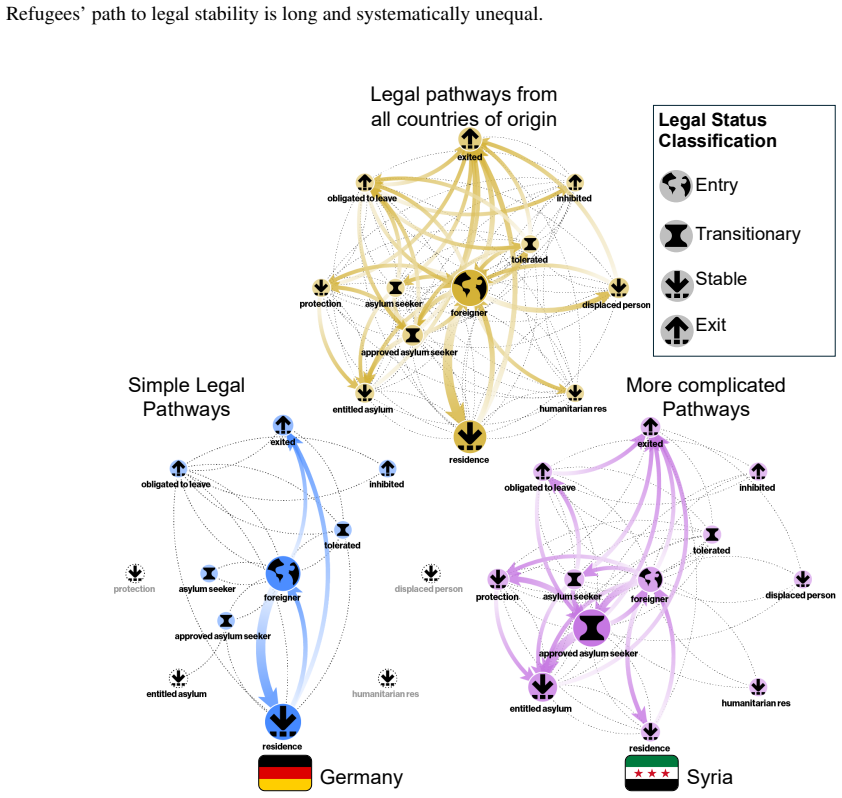
The load-bearing object is the transition matrix $T$ with entries $T_{ij} = P(X_{t+1}=j \mid X_t=i)$, estimated per country of origin (and per gender) from daily counts of switches among 11 legal statuses plus an absorbing 'exit' state. The matrix encodes each country's legal-pathway 'signature,' and it is used two ways: to simulate 10,000 synthetic migrants through a year or a decade, and to compute mean first-passage (settling) times by solving $(I - T + \varepsilon I)h = b$. The entire analysis—including the unequal timelines and entry-mode comparisons—flows through these simulated trajectories, so the Markov assumption and the constant transition probabilities carry the argument.
What would settle it
Estimate the transition matrices from the first observed year of the Austrian records, then use them to predict the status distribution and number of transitions in the second year; if the predicted counts differ substantially from what was actually recorded, the constant-Markov assumption fails and the simulated settlement times are unreliable. A direct comparison of simulated settling-time curves with raw cohort Kaplan-Meier curves would give the same verdict.
Extended reading notes
Core claim
The central claim is that a person's path from arrival to legal stability in Austria is strongly conditioned by nationality, gender, and mode of entry, and that these differences are visible in the structure of legal-status transition networks. Using daily administrative records, the authors estimate country-specific 12x12 Markov transition matrices, observe that 70% of migrants change status at least once within 734 days, and simulate cohorts of 10,000 migrants to compute settling probabilities and times. The headline results are the unequal timelines—two months for Ukrainian 'displaced persons,' nine months for Syrians reaching asylum or subsidiary protection, and twenty months for Afghans—and the entry-mode gap, where asylum seekers who bypass official border controls face two-to-four-times higher first-year exit rates and reduced chances of stable protection. A consistent female advantage appears for Syrian and Afghan women, with Afghan women settling in about 14 months versus 30 for men.
Load-bearing premise
The model assumes that a migrant's next legal status depends only on the current status and that the daily transition probabilities stay constant over a decade, yet the data average only about one status switch per person over 734 days—and the authors explicitly state in the supplementary material that this is too little history to test the Markov assumption.
Editorial extensions
If this is right
- If the unequal timelines are real, policy interventions that shorten waiting times for Afghan and Syrian applicants would directly compress the legal phase in which refugees lack housing, work, and health security.
- Channeling legal aid toward groups with high instability and toward those who enter through irregular border crossings could reduce the two-to-four-fold exit gap seen in the first year.
- Standardizing processing timelines and clarifying eligibility for stable statuses would be the levers the paper points to for narrowing nationality-based disparities.
- The transition-matrix approach can serve as an early-warning instrument: repeated analysis of daily records could flag emerging bottlenecks or unequal treatment in real time.
Reading between the lines
- The entry-mode contrast is observational, and the paper does not control for selection: people who cross irregularly may differ in vulnerability, legal representation, or case quality, so the two-to-four-fold exit gap should not be read as purely causal without further identification.
- The numerical settling times are tied to the paper's definition of 'stable status' and the absorbing exit assumption; regrouping statuses or allowing re-entry would shift the numbers even if the ordering by nationality stayed similar.
- Extending the same daily-transition method to other countries' registers would test whether the Austrian inequality pattern is a national administrative artifact or a more general property of asylum systems.
- A natural next step is a semi-Markov or Cox model that lets transition probabilities depend on time already spent in a status; the paper's own data weaknesses point to that as the decisive robustness check.
Editorial analysis
A structured set of objections, weighed in public.
Referee Report
Summary. The manuscript uses administrative daily residence-status records for 358,327 migrants who entered Austria between November 2022 and 2024 to construct a 12-state Markov chain of legal statuses (11 legal statuses plus exit) for each country of origin and gender. From these fitted chains the authors simulate first-year status distributions and decade-long trajectories, reporting mean times to 'stable' status (residence permit for general migrants; asylum, subsidiary protection, humanitarian permit, or displaced-person status for refugees). The headline results are that Ukrainian refugees reach stability in about two months, Syrians about nine months, Afghans about 20 months (30 for Afghan men); that entering as an asylum seeker rather than as a foreigner is associated with two- to four-fold higher one-year exit rates; and that women have higher probabilities of gaining protection. The paper also introduces a network visualization of legal transitions as country-specific 'signatures.'
Significance. The paper addresses an important and understudied aspect of migrant integration—the dynamics of legal status itself—using a uniquely large administrative dataset (140 million daily records). The descriptive network signatures and raw transition counts are a valuable contribution, and the qualitative finding of inequality across nationalities and genders is plausible from the observed data. The authors are also transparent about a key limitation (SI 5.2: the Markov assumption cannot be tested with roughly one transition per person). If the headline waiting times were supported by robustness checks, the paper would be a significant policy-relevant result. In the current form, however, the quantitative claims are entirely model outputs from an assumption that the authors state they cannot validate, with no sensitivity analysis or out-of-sample validation; the significance is therefore conditional on additional evidence.
major comments (5)
- [Section 4.2, SI 5.2, Figure 5] The headline settling times (2, 9, 20, and 30 months) are first-passage times of a time-homogeneous Markov chain fitted to daily transitions, extrapolated over a decade from a 734-day observation window. SI 5.2 states that the average number of status changes per person is about 1.02 (Table 3), with no group exceeding 1.5, making the Markov assumption impossible to test with these data. Because the long-run behaviour of the chain is governed by the estimated self-loop probabilities and rare off-diagonal transitions, small errors in those probabilities will compound exponentially over a simulated decade. The manuscript provides no confidence intervals, perturbation analysis, or comparison with a semi-Markov model with realistic sojourn distributions. Please add such robustness checks, or explicitly present the decade projections as illustrative rather than empirical estimates.
- [Section 2.3, Table 1] The comparison of 'stable' status across refugee groups is not apples-to-apples: for Ukraine the absorbing stable state is 'displaced person', a temporary protection status under the Displaced Persons Act, while for Syria and Afghanistan the stable states are durable asylum statuses ('entitled to asylum' and 'subsidiary protection'). The manuscript classifies all of these as 'stable' but does not demonstrate that the legal quality and long-term security of displaced-person status are comparable to asylum. If they are not, the headline contrast (two months for Ukrainians versus nine and 20 months for Syrians and Afghans) may reflect the different nature of the endpoint rather than the speed of legal integration. Please either justify the equivalence or restrict the headline comparison to comparable durable statuses.
- [Section 2.3, Figure 5] The reported mean time to stability is not precisely defined. For Afghanistan, Figure 5 shows that only 56% of the simulated population reaches a stable status within a decade; the text reports an 'average around 20 months'. It is unclear whether this mean is taken over those who settle (with the rest excluded), over all simulated individuals with censoring at the horizon, or over the finite-horizon first-passage times including an infinite value for non-settlers. Each definition changes the number substantially and affects cross-country comparability because settling fractions differ. Please state the estimator precisely and report medians or quantiles alongside the means.
- [Section 2.2, Discussion] The comparison of 'entering as asylum seeker' versus 'entering as foreigner' is presented with causal language ('entry status plays a critical role in determining the likelihood of asylum acceptance') but is based on raw comparisons between two groups that very likely differ in observed and unobserved characteristics (age composition in Table 5, family status, circumstances of flight). The Discussion itself concedes that 'these differences may reflect, in part, variation in the profiles of those applying at the border'. Since the data include age and gender, the authors could at least stratify or adjust for these variables; otherwise the claims of two- to four-fold higher exit rates should be framed as descriptive associations, not as causal effects of entry mode.
- [Section 4.2, Section 2.3] The manuscript repeatedly uses the term 'predict' for the Markov-chain projections, but no out-of-sample or temporal validation is provided. Since the data span November 2022 through late 2024, a natural check would be to fit the transition matrices on the first year and compare the projected one-year distributions and settling times with the actually observed second-year outcomes. Even in the absence of code (data are privacy-restricted), the modelling code could be released, and a synthetic-data illustration would allow readers to assess sensitivity. Without any validation, the quantitative predictions are not empirically secure.
minor comments (6)
- [Section 4.1] The phrase 'we observe 367,146 legal switches daily' should read 'over the 734-day observation period', because 367,146 is the total number of switches, not a daily count.
- [Section 4.2] The notation 'state at weekt' appears to contain a typo; the time unit is elsewhere defined as days, so please make the notation consistent.
- [Figure 5] The x-axis label appears to contain a stray character ('ž') before 'Population %'.
- [Figure 2] The caption states 'dashed nodes have no migrants' but then describes dashed edges as indicating fewer than 100 migrants; please clarify what dashed nodes signify, since the node style is not otherwise explained.
- [Section 4.1] The treatment of re-entry is under-specified: 'If a migrant leaves and returns within the two years of observation, we treat this as a continuation of their original stay' conflicts with the statement that exit is an absorbing state; please explain how this rule is implemented in the transition counts and whether exit remains absorbing in the model.
- [Supplementary Information] The interactive figure URLs are a helpful resource, but please also provide archival or persistent links (e.g., DOI or repository) so that the visualizations remain accessible.
Circularity Check
No significant circularity: the reported waiting times are Markov-simulation outputs computed from the observed transition matrix, not fitted quantities renamed as predictions, and the untestable Markov assumption is explicitly flagged in SI 5.2.
full rationale
Section 4.2 defines the 12x12 transition matrix from observed daily status switches, and Section 2.3 computes settling times by simulating that matrix over a decade, with SI 5.5 giving the hitting-time linear system. This is a transparent model-based estimate: the settling time is a deterministic functional of the transition matrix, but it is not used to define or fit that matrix, and no fitted parameter is relabelled as an independent prediction. The Markov assumption is the only structural addition, and SI 5.2 explicitly concedes that the data cannot test it (about 1.02 switches per person on average); that is a robustness or correctness caveat, not circularity. Self-citations appear (refs 3, 14, 36), but only as background statistics or examples of Markov modelling, not as load-bearing premises or imported uniqueness theorems. The headline figures of two, nine, twenty, and thirty months are model outputs, and the paper identifies them as simulated estimates; the raw transition counts independently support the qualitative inequality pattern. No equation reduces by construction to a parameter fitted to the claimed outcome, and no known result is merely relabelled.
Assumptions & free parameters
free parameters (2)
- Country- and gender-specific transition matrices T =
estimated from observed daily status switches
- Simulation population size per group =
10,000
assumptions (4)
- domain assumption Legal status transitions form a time-homogeneous Markov chain with daily steps.
- domain assumption Exit is an absorbing state; re-entry within the observation period is treated as continuation of the original stay.
- domain assumption The 12 statuses and their grouping into entry, transitionary, stable, and exit categories are a faithful representation of the Austrian legal system.
- domain assumption Daily observation granularity captures meaningful legal status changes.
Cite this review
Pith. "Pith review of Refugees' path to legal stability is long and systematically unequal." pith.science (2026). https://pith.science/paper/A4EVFC6I
@misc{pith2026250607916,
  author       = {Pith},
  title        = {Pith review of: Refugees' path to legal stability is long and systematically unequal},
  year         = {2026},
  howpublished = {\url{https://pith.science/paper/A4EVFC6I}},
  note         = {Machine review of arXiv:2506.07916}
}
read the original abstract
Legal systems shape not only the recognition of migrants and refugees but also the pace and stability of their integration. Refugees often shift between multiple legal classifications, a process we refer to as the "legal journey". This journey is frequently prolonged and uncertain. Using a network-based approach, we analyze legal transitions for over 350,000 migrants in Austria (2022 to 2024). Refugees face highly unequal pathways to stability, ranging from two months for Ukrainians to nine months for Syrians and 20 months for Afghans. Women, especially from these regions, are more likely to gain protection; Afghan men wait up to 30 months on average. We also find that those who cross the border without going through official border controls face higher exit rates and lower chances of securing stable status. We show that legal integration is not a uniform process, but one structured by institutional design, procedural entry points, and unequal timelines.
Figures


Figures from the paper (3 more)


Reference graph
Works this paper leans on
-
[1]
Estimation of international migration flow tables in Europe
Guy J Abel. “Estimation of international migration flow tables in Europe”. In: Journal of the Royal Statistical Society Series A: Statistics in Society 173.4 (2010), pp. 797–825
work page 2010
-
[2]
Quantifying global international migration flows
Guy J Abel and Nikola Sander. “Quantifying global international migration flows”. In: Science 343.6178 (2014), pp. 1520–1522
work page 2014
-
[3]
Quantifying the stability of refugee populations: a case study in Austria
Ola Ali et al. “Quantifying the stability of refugee populations: a case study in Austria”. In: Genus (2024)
work page 2024
-
[4]
Limbo or leverage? Asylum waiting and refugee integra- tion
Olof Åslund, Mattias Engdahl, and Olof Rosenqvist. “Limbo or leverage? Asylum waiting and refugee integra- tion”. In: Journal of Public Economics 234 (2024), p. 105118
work page 2024
-
[5]
Asylum Information Database (AIDA). Austria Statistics. Accessed: 2024-11-13. 2023. URL: https : / / asylumineurope.org/reports/country/austria/statistics/
work page 2024
-
[6]
Asylum Information Database (AIDA). Temporary Protection: Austria. https://asylumineurope.org/wp- content/uploads/2023/05/AIDA- AT_Temporary- Protection_2022.pdf . Accessed on: 2024-06-06. 2022
work page 2023
-
[7]
“The importance of resources and security in the socio- economic integration of refugees
Linda Bakker, Jaco Dagevos, and Godfried Engbersen. “The importance of resources and security in the socio- economic integration of refugees. A study on the impact of length of stay in asylum accommodation and residence status on socio-economic integration for the four largest refugee groups in the Netherlands”. In: Journal of International Migration and ...
work page 2014
-
[8]
Refugees’ trajectories in Switzerland: Impact of residence permits on labour market integration
Anne-Laure Bertrand. “Refugees’ trajectories in Switzerland: Impact of residence permits on labour market integration”. In: Quetelet Journal 7.1 (2019), pp. 71–99
work page 2019
Show all 45 references
-
[9]
Migration in Austria after the Fall of the Iron Curtain
Gudrun Biffl. “Migration in Austria after the Fall of the Iron Curtain”. In: Austrian History Yearbook (2024), pp. 1–15
2024
-
[10]
Research-Policy Dialogues in Austria
Maren Borkert. “Research-Policy Dialogues in Austria”. In: Integrating Immigrants in Europe: Research-Policy Dialogues. Ed. by Peter Scholten et al. Cham: Springer International Publishing, 2015, pp. 143–164. ISBN : 978-3-319-16256-0. DOI: 10.1007/978-3-319-16256-0\_9
2015 doi
-
[11]
EU law and the detainability of asylum-seekers
Cathryn Costello and Minos Mouzourakis. “EU law and the detainability of asylum-seekers”. In: Refugee Survey Quarterly 35.1 (2016), pp. 47–73
2016
-
[12]
Inside Asylum Bureaucracy: Organizing Refugee Status Determination in Austria
Julia Dahlvik. “Inside Asylum Bureaucracy: Organizing Refugee Status Determination in Austria”. In: Cham: Springer International Publishing, 2018, E3–E3. ISBN : 978-3-319-63306-0. DOI: 10.1007/978-3-319-63306- 0\_12
2018 doi
-
[13]
Gender in waiting: Men and women asylum seekers in European reception facilities
Giorgia Demarchi and Giorgia Demarchi. Gender in waiting: Men and women asylum seekers in European reception facilities. https://documents1.worldbank.org/curated/en/532181547235243643/133693- Gender-in-Waiting-Men-and-Women-Asylum-Seekers-in-European-Reception-Facilities.pdf ....
2024
-
[14]
Healthcare Utilization Patterns Among Migrant Populations: Increased Readmissions Suggest Poorer Access. A Population-Wide Retrospective Cohort Study
Elma Dervi´c et al. “Healthcare Utilization Patterns Among Migrant Populations: Increased Readmissions Suggest Poorer Access. A Population-Wide Retrospective Cohort Study”. In: arXiv preprint arXiv:2408.16317 (2024)
2024 arXiv
-
[15]
Migration and Education
Christian Dustmann and Albrecht Glitz. “Migration and Education”. In:Handbook of the Economics of Education. V ol. 4. Radarweg 29, 1043 NX Amsterdam, The Netherlands: Elsevier, 2011, pp. 327–439
2011
-
[16]
Access to counsel in immigration court
Ingrid Eagly and Steven Shafer. “Access to counsel in immigration court”. In: American Immigration Council 28 (2016)
2016
-
[17]
Access to the Labour Market and Labour Market Integration of Asylum-Seekers in Austria
Petra Ebner. Access to the Labour Market and Labour Market Integration of Asylum-Seekers in Austria. Report. Vienna: International Organization for Migration (IOM), 2023
2023
-
[18]
Asylum applications - annual statistics
Eurostat. Asylum applications - annual statistics. Accessed: 2025-05-05. 2024. URL: %7Bhttps://ec.europa. eu / eurostat / statistics - explained / index . php ? title = Asylum _ applications_ - _annual _ statistics#Main_trends_in_the_number_of_asylum_applicants%7D
2025
-
[19]
Settlement and Residence
Federal Ministry Replublic of Austria European and International Affairs. Settlement and Residence. https: //www.bmeia.gv.at/en/travel-stay/entrance-and-residence-in-austria/settlement-and- residence. Accessed: 2024-12-16. 2024
2024
-
[20]
Education for Refugee and Asylum Seeking Children: Access and Equality in England, Scotland and Wales
Catherine Gladwell and Georgina Chetwynd. Education for Refugee and Asylum Seeking Children: Access and Equality in England, Scotland and Wales. Tech. rep. UNICEF UK, July 2018. URL: https://www.unicef. org.uk/wp-content/uploads/2018/09/Access-to-Education-report-PDF.pdf
2018
-
[21]
When lives are put on hold: Lengthy asylum processes decrease employment among refugees
Jens Hainmueller, Dominik Hangartner, and Duncan Lawrence. “When lives are put on hold: Lengthy asylum processes decrease employment among refugees”. In: Science Advances 2.8 (2016), e1600432
2016
-
[22]
The Missing Link: Connecting Eligible Asylees and Asylum Seekers with Benefits and Services
Stephanie Heredia. The Missing Link: Connecting Eligible Asylees and Asylum Seekers with Benefits and Services. Tech. rep. Migration Policy Institute, July 2022. URL: https://www.migrationpolicy.org/research/ asylees-asylum-seekers-benefits . 10 Refugees’ path to legal stabili...
2022
-
[23]
Prolonged periods of waiting for an asylum de- cision and the risk of psychiatric diagnoses: a 22-year longitudinal cohort study from Denmark
Camilla Hvidtfeldt, Jørgen Holm Petersen, and Marie Norredam. “Prolonged periods of waiting for an asylum de- cision and the risk of psychiatric diagnoses: a 22-year longitudinal cohort study from Denmark”. In:International Journal of Epidemiology 49.2 (2020), pp. 400–409
2020
-
[24]
Waiting for family reunification and the risk of mental disorders among refugee fathers: a 24-year longitudinal cohort study from Denmark
Camilla Hvidtfeldt, Jørgen Holm Petersen, and Marie Norredam. “Waiting for family reunification and the risk of mental disorders among refugee fathers: a 24-year longitudinal cohort study from Denmark”. In: Social Psychiatry and Psychiatric Epidemiology (2022), pp. 1–12
2022
-
[25]
The Organization of Asylum and Migration Policies in Austria
International Organization for Migration. The Organization of Asylum and Migration Policies in Austria. Tech. rep. 17 Route des Morillons, P.O. Box 17, 1211 Geneva 19, Switzerland: International Organization for Migration (IOM), 2015, p. 109
2015
-
[26]
Barriers to health care access and service utilization of refugees in Austria: evidence from a cross-sectional survey
Judith Kohlenberger et al. “Barriers to health care access and service utilization of refugees in Austria: evidence from a cross-sectional survey”. In: Health Policy 123.9 (2019), pp. 833–839
2019
-
[27]
Waiting as probation: selecting self-disciplining asylum seekers
Nick Gill Lorenzo Vianelli and Nicole Hoellerer. “Waiting as probation: selecting self-disciplining asylum seekers”. In: Journal of Ethnic and Migration Studies 48.5 (2022), pp. 1013–1032. DOI: 10.1080/1369183X. 2021.1926942
2022
-
[28]
From refugees to workers: mapping labour market integration support measures for asylum- seekers and refugees in EU member states
Iván Martin et al. “From refugees to workers: mapping labour market integration support measures for asylum- seekers and refugees in EU member states”. In: Volume I: Comparative Analysis and Policy Findings(2016)
2016
-
[29]
Migration, labor markets, and integration of migrants: An overview for Europe
Rainer Münz. “Migration, labor markets, and integration of migrants: An overview for Europe”. In: (2007)
2007
-
[30]
Stuck in reception: How refugees in Austria and Germany experience long-term reception constellations
Alexander-Kenneth Nagel and Ursula Reeger. “Stuck in reception: How refugees in Austria and Germany experience long-term reception constellations”. In: Politics of Subsidiarity in Refugee Reception. England, UK: Routledge, 2023, pp. 11–23
2023
-
[31]
Making integration work: Refugees and others in need of protection
OECD. Making integration work: Refugees and others in need of protection. Paris, France: OECD Publishing, 2016
2016
-
[32]
ODA In-Donor Refugee Costs: Austria
OECD. ODA In-Donor Refugee Costs: Austria. Accessed: 2025-01-29. 2021. URL: https://www.oecd.org/ content/dam/oecd/en/topics/policy-issue-focus/in-donor-refugee-costs-in-oda/oda-in- donor-refugee-costs-austria.pdf
2025
-
[33]
A female advantage in asylum application decisions? A gendered analysis of decisions on asylum applications in Italy from 2008 to 2022
Livia Elisa Ortensi, Giorgio Piccitto, and Sara Morlotti. “A female advantage in asylum application decisions? A gendered analysis of decisions on asylum applications in Italy from 2008 to 2022”. In: Genus 80.1 (2024), p. 13
2024
-
[34]
Stochastic processes
Emanuel Parzen. Stochastic processes. Philadelphia, USA: Society for Industrial and Applied Mathematics (SIAM), 1999
1999
-
[35]
The violence of uncertainty: Empirical evidence on how asylum waiting time undermines refugee health
Jenny Phillimore and Sin Yi Cheung. “The violence of uncertainty: Empirical evidence on how asylum waiting time undermines refugee health”. In: Social Science & Medicine 282 (2021), p. 114154
2021
-
[36]
Mobility between Colombian cities is predominantly repeat and return migration
Rafael Prieto Curiel et al. “Mobility between Colombian cities is predominantly repeat and return migration”. In: Computers, Environment and Urban Systems 94 (2022), p. 101774
2022
-
[37]
The diaspora model for human migration
Rafael Prieto-Curiel et al. “The diaspora model for human migration”. In: PNAS nexus 3.5 (2024), pgae178
2024
-
[38]
Implementing and rethinking the European Union’s asylum legislation: the asylum proce- dures directive
Karin Schittenhelm. “Implementing and rethinking the European Union’s asylum legislation: the asylum proce- dures directive”. In: International Migration 57.1 (2019), pp. 229–244
2019
-
[39]
The educational and mental health needs of Syrian refugee children
Selcuk R Sirin and Lauren Rogers-Sirin. The educational and mental health needs of Syrian refugee children. Washington, DC: Migration Policy Institute, 2015
2015
-
[40]
Markov chain analysis and specialization in criminal careers
Julian Stander et al. “Markov chain analysis and specialization in criminal careers”. In: The British Journal of Criminology 29.4 (1989), pp. 317–335
1989
-
[41]
Migration and Naturalisation rates in Austria
Statistik Austria. Migration and Naturalisation rates in Austria . https : / / www . statistik . at / en / statistics / population - and - society / population / migration - and - naturalisation / naturalisation. Accessed: 2025-03-26
2025
-
[42]
UNHCR Refugee Statistics
UNHCR. UNHCR Refugee Statistics. https://www.unhcr.org/refugee-statistics. Accessed: 2024-05-
2024
-
[43]
Family Reunification in Austria
UNHCR Austria. Family Reunification in Austria . https : / / help . unhcr . org / austria / family - reunification/. Accessed: 2025-01-29. 2025
2025
-
[44]
Crime in a Birth Cohort
Marvin E. Wolfgang. “Crime in a Birth Cohort”. In: Proceedings of the American Philosophical Society 117.5 (1973), pp. 404–411. ISSN : 0003049X. URL: http://www.jstor.org/stable/986609 (visited on 02/06/2025)
1973
-
[45]
Waiting in the Austrian asylum system: The well-being of asylum-seeking children in a phase of liminality
Stella Wolter, Rosa Tatzber, and Birgit Sauer. “Waiting in the Austrian asylum system: The well-being of asylum-seeking children in a phase of liminality”. In: Children & Society 37.3 (2023), pp. 806–819. 11 Refugees’ path to legal stability is long and systematically unequal....
2023
Reviewed August 7, 2026 · model on record in the stance chip above.
Discussion (0). Sign in to comment.