REVIEW 3 major objections 5 minor 87 references
Three-Majorana Cotunneling Interferometer for Non-Abelian Braiding and Topological Quantum Gate Implementation
T0 review · 3 major / 5 minor · reviewed 2026-08-07 · deepseek-v4-flash
Pith's one-line read Cotunneling interference in a three-Majorana island with reference arms yields a flux-tunable Majorana coupling, and a half-flux echo cancels dynamic phases so that braiding produces high-fidelity Clifford gates and a purely geometric T…
desk verdict A genuinely new cotunneling-interference braiding scheme with a nice echo protocol, but the partial-braiding angle is asserted rather than derived and the T gate's sign is not pinned down. read the letter →
The pith
A machine-rendered reading of the paper's core claim, the machinery that carries it, and where it could break.
The reading
What carries the argument
The load-bearing object is the cotunneling interferometer formed by each pair of leads. Electrons cross the island by two interfering avenues — direct tunneling through a reference arm with amplitude $t_{R,\alpha\alpha'}$, and a second-order cotunneling step through the Majorana pair with amplitude $O_{\alpha\alpha'} = t_{M,\alpha\alpha'} i\gamma_\alpha\gamma_{\alpha'}$, where $t_{M,\alpha\alpha'} = i\,2\lambda^*_\alpha\lambda_{\alpha'}/E_C$ — and tracing out the leads yields the Lamb-shift Hamiltonian $H_{LS} = \sum_{\alpha>\alpha'}\Delta_{\alpha\alpha'} i\gamma_\alpha\gamma_{\alpha'}$ with the flux-dependent cosine form. The second mechanism is the half-flux echo: applying $\Phi_0/2$ reverses the sign of every $t_R$ and hence every $\Delta_{\alpha\alpha'}$, so the second half of any braiding segment accumulates the inverse dynamic phase while the geometric phase is unaffected, converting an uncontrolled energy-splitting error into a self-cancelling one.
What would settle it
Numerically integrate the Schrödinger equation for $H = \Delta_{10}\sigma_x + \Delta_{20}\sigma_y + \Delta_{21}\sigma_z$ along the sequence of Eq. (C21) for $\theta = \pi/8$, subtract the dynamical phase, and check that the geometric unitary is exactly $\exp(\tfrac{\pi}{16}\gamma_1\gamma_2)$ and independent of the sweep waveform; a deviation at the level required for magic-state distillation refutes the T-gate claim. On the experimental side, measure the conductance interference oscillations of the three-terminal Majorana island at $\Phi = 0$ and $\Phi = \Phi_0/2$ and confirm both the cosine law and the predicted coupling scale of roughly 0.38 meV, since the echo protocol's time and energy budget rest on that magnitude.
Extended reading notes
Core claim
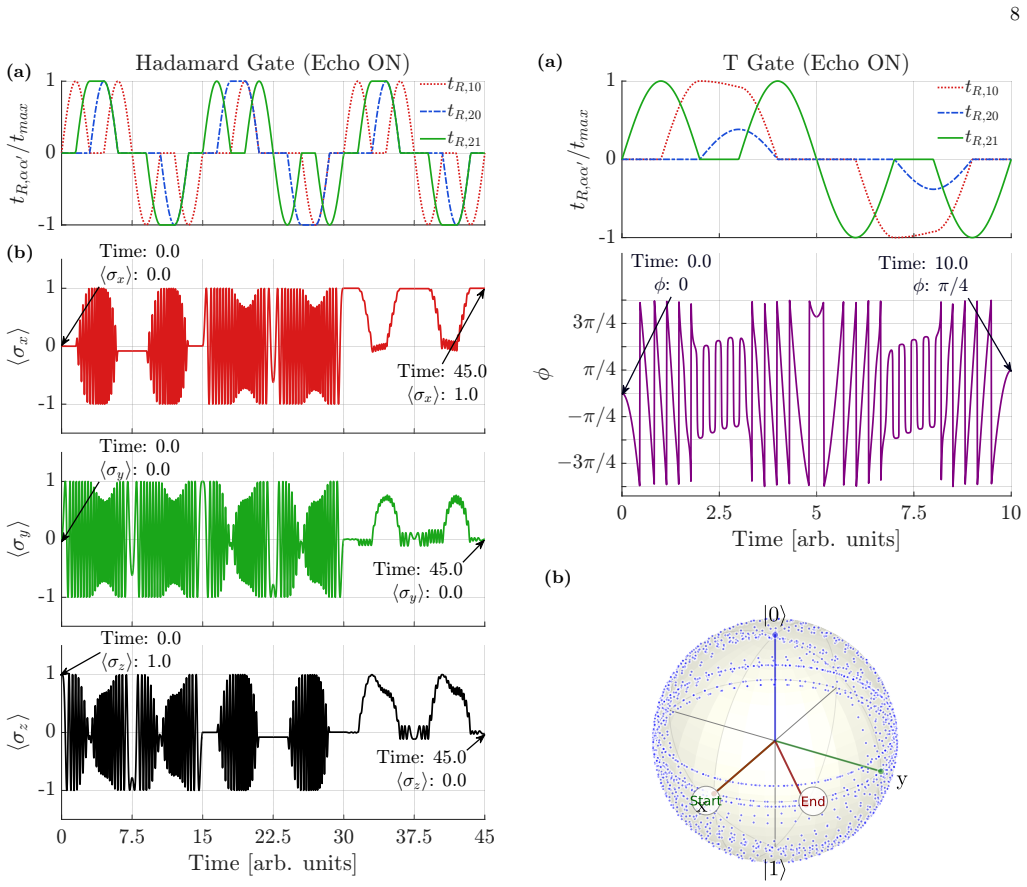
The central claim is that interference between the direct reference-arm amplitude $t_{R,\alpha\alpha'}$ and the MZM-mediated cotunneling amplitude $O_{\alpha\alpha'} = t_{M,\alpha\alpha'} i\gamma_\alpha\gamma_{\alpha'}$ produces a coherent Lamb-shift coupling $\Delta_{\alpha\alpha'} = -2\nu^2\Lambda\,|t^*_{R,\alpha\alpha'} t_{M,\alpha\alpha'}|\cos(2\pi\Phi_{\alpha\alpha'}/\Phi_0)$ between pairs of Majoranas. Because the cosine factor is flux-tunable through a full sign reversal at half a flux quantum, the couplings can be swept adiabatically through the braiding sequence $\Delta_{21}\to\Delta_{10}\to\Delta_{20}\to\Delta_{21}$, and an echo step inverts the Hamiltonian mid-cycle so the dynamic phase accumulated in the second half exactly cancels the first while the geometric phase adds. The paper generalizes the sequence with the ratio $\Delta_{20}/\Delta_{10} = \tan\theta$ to obtain arbitrary braids $B_{12}(\theta) = \exp\!\big(\tfrac{\theta}{2}\gamma_1\gamma_2\big)$, which yields the Clifford gates at $\theta=\pi/4$ and the T gate as $B_{21}(\pi/8)^2$, all verified with Lindblad master-equation simulations.
Load-bearing premise
Every gate in the paper depends on the assertion, stated after Eq. (C22) without a derivation, that sweeping the couplings through the path with $\Delta_{20}/\Delta_{10} = \tan\theta$ produces exactly the unitary $B_{12}(\theta) = \exp(\tfrac{\theta}{2}\gamma_1\gamma_2)$; if the geometric phase accumulated on that specific path is not exactly $\theta/2$, the Clifford gates and the T gate all inherit that error.
Editorial extensions
If this is right
- Braiding becomes a stationary operation: no Majorana is physically moved, only reference-arm gates and a flux pulse are exercised, so the same three-terminal device used for parity readout can perform the braid.
- The half-flux echo turns the dynamic phase — normally an uncontrolled error once Majoranas hybridize — into a self-cancelling contribution, leaving adiabaticity and dissipation as the main fidelity limits.
- Any braiding sequence can be decomposed into echo-protected $\pi/4$ segments, so asymmetric gates such as the Hadamard chain $B_{10}B_{21}B_{10}$ become echo-compatible.
- A non-Clifford $T$ gate is generated from pure geometric phase as $B_{21}(\pi/8)B_{21}(\pi/8)$ under echo protection, completing a Clifford-plus-$T$ universal topological gate set.
Reading between the lines
- The paper's entire gate set turns on the unproven holonomy identity $B_{12}(\theta)=\exp(\tfrac{\theta}{2}\gamma_1\gamma_2)$ for the path in Eq. (C21); an independent holonomy computation or a direct measurement of the gate angle would either confirm the T gate or show that it needs calibration.
- The half-flux echo is plausibly transplantable to conventional Y-junction braiding, where finite-size Majorana splittings cause the same dynamic-phase errors; a simulation of Y-junction braiding with the echo included would be a direct test of that generalization.
- A staged experimental route suggests itself: first reproduce the $h/e$-periodic conductance oscillations seen in existing Majorana-island interferometers, then verify the half-flux sign reversal of the coherent coupling, and only then attempt the echo-protected braid sequence.
Editorial analysis
A structured set of objections, weighed in public.
Referee Report
Summary. The manuscript proposes a cotunneling-based three-Majorana interferometer in which reference-arm interference produces a tunable coherent coupling Δαα′ between pairs of MZMs. The authors derive this coupling via a Lindblad master equation, use adiabatic sequences of these couplings to implement braiding operations, and introduce a half-flux echo that reverses the sign of all couplings so that dynamic phases cancel while geometric phases survive. They present master-equation simulations for NOT, Hadamard, and T gates, and argue that the T gate is obtained purely from geometric phase, completing a topologically protected universal gate set.
Significance. The proposal is original and, if the central unitary mapping is correct, would be an important advance: the same interferometer can in principle be used for parity readout and gate operations, and the half-flux echo is a clean way to remove dynamic-phase errors. The paper has real strengths: the effective coupling is derived from a stated microscopic model rather than postulated; the master-equation approach includes dissipation; the simulation code is made available; and the link to conductance oscillations in Ref. [60] gives a concrete experimental calibration route. The main weakness is that the geometric-phase calculation underlying all gates is not actually carried out, and there is a sign ambiguity in the central formula that affects the T gate.
major comments (3)
- [Appendix C, Eqs. (C21)–(C23)] The assertion that the sequence Δ21→Δ10→(Δ10=Δ⊥cosθ, Δ20=Δ⊥sinθ)→Δ21 yields B12(θ)=exp(θ/2 γ1γ2) is the load-bearing step for every gate in the paper, but it is not derived. For the Hamiltonian H=Δ10σx+Δ20σy+Δ21σz in Eq. (C14), this is a spin-1/2 Berry-phase problem; for the natural orientation of the stated path with all Δ positive, the geometric unitary is exp(−iθ/2 σz)=exp(−θ/2 γ1γ2)=B21(θ), not B12(θ). The sign is not fixed by the text because the signs of the Δs and the choice of eigenstate branch are not specified, and the ramp from zero coupling used in the simulations is outside the sequence (C21). This is not a bookkeeping detail: Protocol 3 needs B21(π/8) to produce T=e^{-iπ/8σz}; with the claimed B12(π/8) the gate would be T†. The simulation in Fig. 5 reports a final azimuthal phase +π/4, which indicates the implemented unitary is B21(π/8), in conflict with Eq. (C23). Please provide an explicit Berry-phase derivation with definite signs, or correct Eq. (C23) and the associated text.
- [Section IV and Section V] The claim that the T gate is “topologically protected” is overstated. The gate angle is set by the ratio Δ20/Δ10=tanθ in Eq. (C22); a small error in this ratio or in the flux controlling the Δs changes the geometric phase by a first-order amount, so the gate is geometric but not topologically protected in the sense used for braiding. The paper should either provide an error-sensitivity analysis showing robustness, or qualify the conclusion to say that only the Clifford gates are topologically protected.
- [Section III and Appendix D] The implemented protocol ramps all tR,αα′ from zero to a maximum and back to zero, so the actual path in parameter space starts and ends at the degenerate point H=0. The mapping in Eq. (C21) describes a closed path on the Bloch sphere with nonzero couplings and does not include these ramps. Since the adiabatic phase is ambiguous at a degeneracy, the paper needs to show that the ramp-up and ramp-down segments contribute no net geometric phase, or otherwise include them in the derivation; otherwise the claimed unitary B12(θ) is not the unitary of the simulated protocol.
minor comments (5)
- [Appendix B, Eq. (B13) vs Eq. (B20)] The dissipator rates are first given as Γ=2πν²T independent of t_M, but Eq. (B20) uses Γαα′=4πν²T t_M²; please clarify that the latter is the coefficient after projecting onto the MZM subspace and dropping the t_R-only terms.
- [Appendix C, Eq. (C6)] The notation in Eq. (C6), e−πzτz iπ/4, is garbled; please rewrite it as a proper exponential with the imaginary unit and operator in the exponent.
- [Abstract and Appendix A] The abstract's “requiring only three MZMs” should be reconciled with Appendix A, where a fourth MZM is used to define the parity sector; suggest rephrasing to “three MZMs participate in the braiding, with a fourth MZM fixing the parity sector.”
- [Section II B, Eq. (7)] The sign of Δ in Eq. (7) depends on Re(t_R* t_M); the text should state the phase convention for t_R and t_M, since the simulations set t_M real and this sign determines the orientation of the geometric path.
- [Figure 5 caption] The caption contains garbled annotations (“!3:=4 !:=4 :=4 3:=4”); the intended θ and φ values should be typeset correctly.
Circularity Check
No circularity found: the cotunneling coupling and echo protocols are derived or simulated from stated master-equation inputs, not from their target gate outputs.
full rationale
The central derivation chain is self-contained. The effective MZM coupling in Eq. (7), Δαα′ = −2ν²Λ|t*_R,αα′ t_M,αα′|cos(2πΦαα′/Φ0), is obtained from a stated second-order perturbation/master-equation calculation in Appendices A and B, with explicit assumptions (large Coulomb charging energy, constant lead density of states ν, bandwidth cutoff Λ, zero bias). No parameter is fitted to a target gate. The order-of-magnitude estimate |Δαα′| ≈ 0.38 meV uses the external experimental conductance amplitude from Ref. [60] as an input, not as a fitted output, and no gate prediction is claimed from that estimate. The Clifford echo protocols and the geometric T gate are implemented by choosing reference-arm modulation functions and flux; the gate angles are target values verified by master-equation numerics, not outputs of a fit to data. No load-bearing self-citation appears: Ref. [60] is an independent experimental paper, and no 'uniqueness theorem' from the present authors is invoked. The skeptical reader's concern that Eq. (C23) states B12(θ) = exp(θ/2 γ1γ2) without an explicit Berry-phase derivation, and with a possible sign ambiguity, is a correctness or missing-derivation concern, not circularity: the claimed unitary is not defined as the output of the coupling sequence, and the sequence is not fitted or defined in terms of the desired unitary. The derivation chain therefore does not reduce to its own inputs.
Assumptions & free parameters
free parameters (2)
- Reference arm tunneling amplitudes t_R,αα′ =
t_max = 0.5 (in simulations)
- Ratio Δ₂₀/Δ₁₀ = tan θ for partial braiding =
θ = π/8 for T gate
assumptions (5)
- domain assumption Strong Coulomb blockade: EC is the largest energy scale, so single-electron tunneling is suppressed and only cotunneling processes are relevant.
- domain assumption Born-Markov approximation: The leads act as a Markovian bath weakly coupled to the system.
- standard math Adiabatic theorem: The slowly varying couplings trace the instantaneous eigenstate and accumulate the geometric phase as described.
- domain assumption Zero-temperature limit of the leads: The dissipative rates Γαα′ = 2πν²T vanish in the simulations (T = 1e-10).
- domain assumption Total fermion parity is fixed, reducing the 3-MZM plus fourth MZM system to a two-level qubit.
Cite this review
Pith. "Pith review of Three-Majorana Cotunneling Interferometer for Non-Abelian Braiding and Topological Quantum Gate Implementation." pith.science (2026). https://pith.science/paper/A4FMKH3E
@misc{pith2026250603553,
  author       = {Pith},
  title        = {Pith review of: Three-Majorana Cotunneling Interferometer for Non-Abelian Braiding and Topological Quantum Gate Implementation},
  year         = {2026},
  howpublished = {\url{https://pith.science/paper/A4FMKH3E}},
  note         = {Machine review of arXiv:2506.03553}
}
abstract
We propose a novel scheme for performing Majorana zero mode (MZM) braiding utilizing cotunneling processes in a three-MZM system incorporating reference arms. This approach relies on the interference between cotunneling paths through the MZMs and reference arms, establishing an effective, tunable coupling between the MZMs. The strength and sign of this coupling can be manipulated via the reference arms and applied magnetic flux. Notably, the introduction of a half quantum flux reverses the coupling sign, enabling an echo-like protocol to eliminate dynamic phases during braiding. Our setup, requiring only three MZMs, represents a minimal platform for demonstrating non-Abelian braiding statistics. We demonstrate that this system facilitates the implementation of Clifford gates via braiding and, significantly, permits the realization of non-Clifford gates, such as the $T$ gate, by geometric phase, thereby offering a potential pathway towards universal topological quantum computation.
Figures


Figures from the paper (5 more)


Reference graph
Works this paper leans on
-
[60]
D. Wang, L. Kong, P. Fan, H. Chen, S. Zhu, W. Liu, L. Cao, Y. Sun, S. Du, J. Schneeloch, R. Zhong, G. Gu, L. Fu, H. Ding, and H.-J. Gao, Evidence for Majorana bound states in an iron-based superconductor, Science 362, 333 (2018)
2018
-
[1]
Perform a complete braiding operation B10 over a duration Tbraid, accumulating both dynamic phase Udyn,1 and geometric phase Ugeom
-
[2]
Apply a π-flux (Φ → Φ+Φ 0/2) to invert the Hamil- tonian
-
[3]
5 1 (a) 1 (b) FIG
Repeat the identical braiding operation B10 over another duration Tbraid, Due to step 2 now H → −H, the dynamic phase accumulation follows Udyn,2 = U † dyn,1, while the geometric phase con- tribution remains identical. 5 1 (a) 1 (b) FIG. 2. Comparison of two MZM braiding schemes, shown in (a) and (b). From left to right, the sequence shows the adiabatic b...
-
[4]
For each exchange operation Bαβ in the se- quence, decompose it into two operations: Bαβ = Bαβ(π/4) Bαβ(π/4)
-
[5]
For a single exchange, apply an echo protocol: (a) Perform Bαβ(π/4) over duration Thalf , accu- mulating Udyn,1 and U 1/2 geom (b) Apply a π-flux to invert the Hamiltonian (c) Perform the same operation again, accumulat- ing U † dyn,1 and another U 1/2 geom
-
[6]
standard
Combine these echo-protected operations to form the complete gate This strategy enables the implementation of any Clif- ford gate through a sequence of echo-protected opera- tions, preserving topological protection despite the pres- ence of non-zero energy splittings. In the following, we present numerical evidence validating our framework. 6 tR;,,0=tmax ...
-
[7]
Apply a π-flux to invert the couplings: ∆ αα′ → −∆αα′
Show all 87 references
-
[8]
9 The coherent coupling ∆αα′ sequence to realize B21( π 8 ) can be found in Appendix C
Repeat B21( π 8 ). 9 The coherent coupling ∆αα′ sequence to realize B21( π 8 ) can be found in Appendix C. Due to the echo, the dynamic phase cancels out. The total accumulated geometric phase shift between the qubit states | ↑⟩and | ↓⟩is π/4. To demonstrate the feasibility of...
-
[9]
Following Proto- col 2, we implement the NOT gate operation given by Eq
Effects of Different Modulation F unctions Here we take the NOT gate as an example to demon- strate the robustness of our braiding protocol across various tR,αα′ modulation functions. Following Proto- col 2, we implement the NOT gate operation given by Eq. (8). Figure 7 shows ...
-
[10]
We examine cases with Thalf = 0.5, 1.0, 2.5, and 10 .0 time units
Adiabaticity and Gate Operation Time To investigate the adiabaticity requirements of our pro- tocol, here following Protocol 2, we define Thalf as the duration required to implement B10( π 4 ), and simulate the NOT gate operation with different Thalf , where the system interna...
-
[11]
Figure 9 demonstrates successful π/4 rotation around ˆz axis for two representative initial states: |ψ⟩ = 1√ 2 | ↑⟩+ eiπ/4 √ 2 | ↓⟩ and |ψ⟩ = cos(π/8)| ↑⟩+ eiπ/4 sin(π/8)| ↓⟩
T Gate Effectiveness for Different Initial States To demonstrate the effectiveness of our T gate protocol for different initial states, we performed simulations with various initial qubit states following Protocol 3. Figure 9 demonstrates successful π/4 rotation around ˆz axis...
-
[12]
Majorana, Teoria simmetrica dell’ elettrone e del positrone, Il Nuovo Cimento 14, 171 (1937)
E. Majorana, Teoria simmetrica dell’ elettrone e del positrone, Il Nuovo Cimento 14, 171 (1937)
1937
-
[13]
D. A. Ivanov, Non-abelian statistics of half-quantum vor- tices in p-wave superconductors, Phys. Rev. Lett.86, 268 (2001)
2001
-
[14]
A. Y. Kitaev, Unpaired Majorana fermions in quantum wires, Phys. Usp. 44, 131 (2001)
2001
-
[15]
Kitaev, Fault-tolerant quantum computation by anyons, Ann
A. Kitaev, Fault-tolerant quantum computation by anyons, Ann. Phys. (N.Y.) 303, 2 (2003)
2003
-
[16]
Nayak, S
C. Nayak, S. H. Simon, A. Stern, M. Freedman, and S. Das Sarma, Non-Abelian anyons and topological quan- tum computation, Rev. Mod. Phys. 80, 1083 (2008)
2008
-
[17]
Trebst, M
S. Trebst, M. Troyer, Z. Wang, and A. W. W. Ludwig, A Short Introduction to Fibonacci Anyon Models, Prog. Theor. Phys. Suppl. 176, 384 (2008)
2008
-
[18]
R. M. Lutchyn, J. D. Sau, and S. Das Sarma, Majo- rana Fermions and a Topological Phase Transition in Semiconductor-Superconductor Heterostructures, Phys. Rev. Lett. 105, 077001 (2010)
2010
-
[19]
Y. Oreg, G. Refael, and F. von Oppen, Helical Liquids and Majorana Bound States in Quantum Wires, Phys. Rev. Lett. 105, 177002 (2010)
2010
-
[20]
Alicea, Y
J. Alicea, Y. Oreg, G. Refael, F. von Oppen, and M. P. A. Fisher, Non-Abelian statistics and topological quantum information processing in 1D wire networks, Nat. Phys. 7, 412 (2011)
2011
-
[21]
Alicea, New directions in the pursuit of Majorana fermions in solid state systems, Rep
J. Alicea, New directions in the pursuit of Majorana fermions in solid state systems, Rep. Prog. Phys. 75, 076501 (2012)
2012
-
[22]
Zhang, D
H. Zhang, D. E. Liu, M. Wimmer, and L. P. Kouwen- hoven, Next steps of quantum transport in Majorana nanowire devices, Nat. Commun. 10, 5128 (2019)
2019
-
[23]
Beenakker, Search for non-Abelian Majorana braiding statistics in superconductors, SciPost Phys
C. Beenakker, Search for non-Abelian Majorana braiding statistics in superconductors, SciPost Phys. Lect. Notes , 15 (2020)
2020
-
[24]
Yazdani, F
A. Yazdani, F. von Oppen, B. I. Halperin, and A. Yacoby, Hunting for majoranas, Science 380, eade0850 (2023)
2023
-
[25]
Fu and C
L. Fu and C. L. Kane, Superconducting proximity effect and majorana fermions at the surface of a topological insulator, Phys. Rev. Lett. 100, 096407 (2008)
2008
-
[26]
Leijnse and K
M. Leijnse and K. Flensberg, Parity qubits and poor man’s Majorana bound states in double quantum dots, Phys. Rev. B 86, 134528 (2012)
2012
-
[27]
Nadj-Perge, I
S. Nadj-Perge, I. K. Drozdov, J. Li, H. Chen, S. Jeon, J. Seo, A. H. MacDonald, B. A. Bernevig, and A. Yaz- dani, Observation of Majorana fermions in ferromagnetic atomic chains on a superconductor, Science 346, 602 (2014)
2014
-
[28]
Pientka, A
F. Pientka, A. Keselman, E. Berg, A. Yacoby, A. Stern, and B. I. Halperin, Topological Superconductivity in a Planar Josephson Junction, Phys. Rev. X 7, 021032 (2017)
2017
-
[29]
Fornieri, A
A. Fornieri, A. M. Whiticar, F. Setiawan, E. Por- tol´ es, A. C. C. Drachmann, A. Keselman, S. Gronin, C. Thomas, T. Wang, R. Kallaher, G. C. Gardner, E. Berg, M. J. Manfra, A. Stern, C. M. Marcus, and F. Nichele, Evidence of topological superconductivity in planar Josephson j...
2019
-
[30]
H. Ren, F. Pientka, S. Hart, A. T. Pierce, M. Kosowsky, L. Lunczer, R. Schlereth, B. Scharf, E. M. Hankiewicz, L. W. Molenkamp, B. I. Halperin, and A. Yacoby, Topo- logical superconductivity in a phase-controlled Josephson junction, Nature 569, 93 (2019)
2019
-
[31]
Livanas, M
G. Livanas, M. Sigrist, and G. Varelogiannis, Alternative paths to realize Majorana Fermions in Superconductor- Ferromagnet Heterostructures, Sci. Rep. 9, 6259 (2019)
2019
-
[32]
Prada, P
E. Prada, P. San-Jose, M. W. A. de Moor, A. Geresdi, E. J. H. Lee, J. Klinovaja, D. Loss, J. Nyg ˚ ard, R. Aguado, and L. P. Kouwenhoven, From Andreev to Majorana bound states in hybrid superconductor–semiconductor nanowires, Nat. Rev. Phys. 2, 575 (2020)
2020
-
[33]
C. Chen, K. Jiang, Y. Zhang, C. Liu, Y. Liu, Z. Wang, and J. Wang, Atomic line defects and zero-energy end states in monolayer Fe(Te,Se) high-temperature super- conductors, Nat. Phys. 16, 536 (2020)
2020
-
[34]
Thomson, I
A. Thomson, I. M. Sorensen, S. Nadj-Perge, and J. Al- icea, Gate-defined wires in twisted bilayer graphene: From electrical detection of intervalley coherence to in- ternally engineered Majorana modes, Phys. Rev. B 105, L081405 (2022). 17
2022
-
[35]
T. Dvir, G. Wang, N. van Loo, C.-X. Liu, G. P. Mazur, A. Bordin, S. L. D. ten Haaf, J.-Y. Wang, D. van Driel, F. Zatelli, X. Li, F. K. Malinowski, S. Gazibegovic, G. Badawy, E. P. A. M. Bakkers, M. Wimmer, and L. P. Kouwenhoven, Realization of a minimal Kitaev chain in coupled...
2023
-
[36]
M. A. et al. (Microsoft Quantum), InAs-Al hybrid devices passing the topological gap protocol, Phys. Rev. B 107, 245423 (2023)
2023
-
[37]
Marra, D
P. Marra, D. Inotani, T. Mizushima, and M. Nitta, Ma- jorana modes in striped two-dimensional inhomogeneous topological superconductors, npj Quantum Mater. 9, 59 (2024)
2024
-
[38]
Seoane Souto and R
R. Seoane Souto and R. Aguado, Subgap States in Semiconductor-Superconductor Devices for Quantum Technologies: Andreev Qubits and Minimal Majorana Chains, in Lect. Notes Phys.(2024) pp. 133–223
2024
-
[39]
J. D. Torres Luna, A. M. Bozkurt, M. Wimmer, and C.- X. Liu, Flux-tunable Kitaev chain in a quantum dot ar- ray, SciPost Phys. Core 7, 065 (2024)
2024
-
[40]
S. L. D. ten Haaf, Q. Wang, A. M. Bozkurt, C.-X. Liu, I. Kulesh, P. Kim, D. Xiao, C. Thomas, M. J. Manfra, T. Dvir, M. Wimmer, and S. Goswami, A two-site Kitaev chain in a two-dimensional electron gas, Nature 630, 329 (2024)
2024
-
[41]
Kezilebieke, M
S. Kezilebieke, M. N. Huda, V. Vaˇ no, M. Aapro, S. C. Ganguli, O. J. Silveira, S. G lodzik, A. S. Foster, T. Oja- nen, and P. Liljeroth, Topological superconductivity in a van der Waals heterostructure, Nature 588, 424 (2020)
2020
-
[42]
K. T. Law, P. A. Lee, and T. K. Ng, Majorana Fermion Induced Resonant Andreev Reflection, Phys. Rev. Lett. 103, 237001 (2009)
2009
-
[43]
Flensberg, Tunneling characteristics of a chain of Ma- jorana bound states, Phys
K. Flensberg, Tunneling characteristics of a chain of Ma- jorana bound states, Phys. Rev. B 82, 180516 (2010)
2010
-
[44]
J. Liu, A. C. Potter, K. T. Law, and P. A. Lee, Zero- Bias Peaks in the Tunneling Conductance of Spin-Orbit- Coupled Superconducting Wires with and without Ma- jorana End-States, Phys. Rev. Lett. 109, 267002 (2012)
2012
-
[45]
Kells, D
G. Kells, D. Meidan, and P. W. Brouwer, Near-zero- energy end states in topologically trivial spin-orbit cou- pled superconducting nanowires with a smooth confine- ment, Phys. Rev. B 86, 100503 (2012)
2012
-
[46]
S. M. Albrecht, A. P. Higginbotham, M. Madsen, F. Kuemmeth, T. S. Jespersen, J. Nyg ˚ ard, P. Krogstrup, and C. M. Marcus, Exponential protection of zero modes in Majorana islands, Nature 531, 206 (2016)
2016
-
[47]
T. O. Rosdahl, A. Vuik, M. Kjaergaard, and A. R. Akhmerov, Andreev rectifier: A nonlocal conductance signature of topological phase transitions, Phys. Rev. B 97, 045421 (2018)
2018
-
[48]
G. C. M´ enard, G. L. R. Anselmetti, E. A. Martinez, D. Puglia, F. K. Malinowski, J. S. Lee, S. Choi, M. Pend- harkar, C. J. Palmstrøm, K. Flensberg, C. M. Mar- cus, L. Casparis, and A. P. Higginbotham, Conductance- Matrix Symmetries of a Three-Terminal Hybrid Device, Phys. Re...
2020
-
[49]
Valentini, M
M. Valentini, M. Borovkov, E. Prada, S. Mart ´ ı-S´ anchez, M. Botifoll, A. Hofmann, J. Arbiol, R. Aguado, P. San- Jose, and G. Katsaros, Majorana-like Coulomb spec- troscopy in the absence of zero-bias peaks, Nature 612, 442 (2022)
2022
-
[50]
Pan and S
H. Pan and S. Das Sarma, On-demand large conduc- tance in trivial zero-bias tunneling peaks in Majorana nanowires, Phys. Rev. B 105, 115432 (2022)
2022
-
[51]
R. Hess, H. F. Legg, D. Loss, and J. Klinovaja, Triv- ial Andreev Band Mimicking Topological Bulk Gap Re- opening in the Nonlocal Conductance of Long Rashba Nanowires, Phys. Rev. Lett. 130, 207001 (2023)
2023
-
[52]
Mourik, K
V. Mourik, K. Zuo, S. M. Frolov, S. R. Plissard, E. P. A. M. Bakkers, and L. P. Kouwenhoven, Signa- tures of Majorana Fermions in Hybrid Superconductor- Semiconductor Nanowire Devices, Science 336, 1003 (2012)
2012
-
[53]
M. T. Deng, S. Vaitiek˙ enas, E. B. Hansen, J. Danon, M. Leijnse, K. Flensberg, J. Nyg ˚ ard, P. Krogstrup, and C. M. Marcus, Majorana bound state in a coupled quantum-dot hybrid-nanowire system, Science 354, 1557 (2016)
2016
-
[54]
R. M. Lutchyn, E. P. A. M. Bakkers, L. P. Kouwen- hoven, P. Krogstrup, C. M. Marcus, and Y. Oreg, Ma- jorana zero modes in superconductor-semiconductor het- erostructures, Nat. Rev. Mater. 3, 52 (2018)
2018
-
[55]
van Loo, G
N. van Loo, G. P. Mazur, T. Dvir, G. Wang, R. C. Dekker, J.-Y. Wang, M. Lemang, C. Sfiligoj, A. Bordin, D. van Driel, G. Badawy, S. Gazibegovic, E. P. A. M. Bakkers, and L. P. Kouwenhoven, Electrostatic control of the proximity effect in the bulk of semiconductor- superconduct...
2023
-
[56]
S. L. D. ten Haaf, Y. Zhang, Q. Wang, A. Bordin, C.-X. Liu, I. Kulesh, V. P. M. Sietses, C. G. Prosko, D. Xiao, C. Thomas, M. J. Manfra, M. Wimmer, and S. Goswami, Observation of edge and bulk states in a three-site Kitaev chain, Nature 641, 890 (2025)
2025
-
[57]
Harper, A
F. Harper, A. Pushp, and R. Roy, Majorana braiding in realistic nanowire Y-junctions and tuning forks, Phys. Rev. Res. 1, 033207 (2019)
2019
-
[58]
J. D. Torres Luna, S. R. Kuppuswamy, and A. R. Akhmerov, Design of a Majorana trijunction, SciPost Phys. 16, 044 (2024)
2024
-
[59]
Karzig, C
T. Karzig, C. Knapp, R. M. Lutchyn, P. Bonder- son, M. B. Hastings, C. Nayak, J. Alicea, K. Flens- berg, S. Plugge, Y. Oreg, C. M. Marcus, and M. H. Freedman, Scalable designs for quasiparticle-poisoning- protected topological quantum computation with Majo- rana zero modes, Ph...
2017
-
[61]
Zhang, K
P. Zhang, K. Yaji, T. Hashimoto, Y. Ota, T. Kondo, K. Okazaki, Z. Wang, J. Wen, G. D. Gu, H. Ding, and S. Shin, Observation of topological superconductivity on the surface of an iron-based superconductor, Science360, 182 (2018)
2018
-
[62]
L. Kong, S. Zhu, M. Papaj, H. Chen, L. Cao, H. Isobe, Y. Xing, W. Liu, D. Wang, P. Fan, Y. Sun, S. Du, J. Schneeloch, R. Zhong, G. Gu, L. Fu, H.-J. Gao, and H. Ding, Half-integer level shift of vortex bound states in an iron-based superconductor, Nat. Phys. 15, 1181 (2019)
2019
-
[63]
S. Zhu, L. Kong, L. Cao, H. Chen, M. Papaj, S. Du, Y. Xing, W. Liu, D. Wang, C. Shen, F. Yang, J. Schnee- loch, R. Zhong, G. Gu, L. Fu, Y.-Y. Zhang, H. Ding, and H.-J. Gao, Nearly quantized conductance plateau of vor- tex zero mode in an iron-based superconductor, Science 367,...
2020
-
[64]
Hu and R.-X
L.-H. Hu and R.-X. Zhang, Dislocation Majorana bound states in iron-based superconductors, Nat. Commun. 15, 2337 (2024)
2024
-
[65]
van Heck, A
B. van Heck, A. R. Akhmerov, F. Hassler, M. Burrello, and C. W. J. Beenakker, Coulomb-assisted braiding of Majorana fermions in a Josephson junction array, New J. Phys. 14, 035019 (2012)
2012
-
[66]
Bonderson, M
P. Bonderson, M. Freedman, and C. Nayak, Measurement-only topological quantum computation, Phys. Rev. Lett. 101, 010501 (2008)
2008
-
[67]
Bonderson, Measurement-only topological quantum computation via tunable interactions, Phys
P. Bonderson, Measurement-only topological quantum computation via tunable interactions, Phys. Rev. B 87, 035113 (2013)
2013
-
[68]
Vijay and L
S. Vijay and L. Fu, Teleportation-based quantum infor- mation processing with Majorana zero modes, Phys. Rev. B 94, 235446 (2016)
2016
-
[69]
A. Tran, A. Bocharov, B. Bauer, and P. Bonderson, Op- timizing clifford gate generation for measurement-only topological quantum computation with majorana zero modes, SciPost Phys. 8, 091 (2020)
2020
-
[70]
Fu, Electron Teleportation via Majorana Bound States in a Mesoscopic Superconductor, Phys
L. Fu, Electron Teleportation via Majorana Bound States in a Mesoscopic Superconductor, Phys. Rev. Lett. 104, 056402 (2010)
2010
-
[71]
A. M. Whiticar, A. Fornieri, E. C. T. O’Farrell, A. C. C. Drachmann, T. Wang, C. Thomas, S. Gronin, R. Kalla- her, G. C. Gardner, M. J. Manfra, C. M. Marcus, and F. Nichele, Coherent transport through a Majorana is- land in an Aharonov-Bohm interferometer, Nat. Com- mun. 11, 3...
2020
-
[72]
M. A. et al. (Microsoft Quantum), Interferometric single- shot parity measurement in inas–al hybrid devices, Na- ture 638, 651 (2025)
2025
-
[73]
Manousakis, C
J. Manousakis, C. Wille, A. Altland, R. Egger, K. Flens- berg, and F. Hassler, Weak Measurement Protocols for Majorana Bound State Identification, Phys. Rev. Lett. 124, 096801 (2020)
2020
-
[74]
Breuer and F
H.-P. Breuer and F. Petruccione, The theory of open quantum systems (OUP Oxford, 2002)
2002
-
[75]
H. M. Wiseman and G. J. Milburn, Quantum measure- ment and control(Cambridge university press, 2009)
2009
-
[76]
S. D. Sarma, M. Freedman, and C. Nayak, Majorana zero modes and topological quantum computation, npj Quantum Inf. 1, 15001 (2015)
2015
-
[77]
Hyart, B
T. Hyart, B. van Heck, I. C. Fulga, M. Burrello, A. R. Akhmerov, and C. W. J. Beenakker, Flux-controlled quantum computation with majorana fermions, Phys. Rev. B 88, 035121 (2013)
2013
-
[78]
Dittrich, P
T. Dittrich, P. H¨ anggi, G.-L. Ingold, B. Kramer, G. Sch¨ on, and W. Zwerger,Quantum transport and dis- sipation, Vol. 3 (Wiley-VCH, Weinheim, 1998)
1998
-
[79]
Aasen, M
D. Aasen, M. Hell, R. V. Mishmash, A. Higginbotham, J. Danon, M. Leijnse, T. S. Jespersen, J. A. Folk, C. M. Marcus, K. Flensberg, and J. Alicea, Milestones toward majorana-based quantum computing, Phys. Rev. X 6, 031016 (2016)
2016
-
[80]
F. v. Oppen, Y. Peng, and F. Pientka, 387topolog- ical superconducting phases in one dimension, in Topological Aspects of Condensed Matter Physics: Lecture Notes of the Les Houches Summer School: Vol- ume 103, August 2014 (Oxford University Press, 2017) https://academic.oup.co...
2014
-
[81]
D. J. Clarke, J. D. Sau, and S. Das Sarma, Probability and braiding statistics in majorana nanowires, Phys. Rev. B 95, 155451 (2017)
2017
-
[82]
Coopmans, S
L. Coopmans, S. Dooley, I. Jubb, K. Kavanagh, and G. Kells, Dynamical phase error in interacting topological quantum memories, Phys. Rev. Res. 3, 033105 (2021)
2021
-
[83]
Cheng, R
M. Cheng, R. M. Lutchyn, V. Galitski, and S. Das Sarma, Splitting of majorana-fermion modes due to intervortex tunneling in a px + ipy superconductor, Phys. Rev. Lett. 103, 107001 (2009)
2009
-
[84]
Cayao, P
J. Cayao, P. San-Jose, A. M. Black-Schaffer, R. Aguado, and E. Prada, Majorana splitting from critical currents in josephson junctions, Phys. Rev. B 96, 205425 (2017)
2017
-
[85]
Cheng, V
M. Cheng, V. Galitski, and S. Das Sarma, Nonadiabatic effects in the braiding of non-abelian anyons in topolog- ical superconductors, Phys. Rev. B 84, 104529 (2011)
2011
-
[86]
Qin, X.-Q
L. Qin, X.-Q. Li, A. Shnirman, and G. Sch¨ on, Transport signatures of a Majorana qubit and read-out-induced de- phasing, New J. Phys. 21, 043027 (2019)
2019
-
[87]
The simulation code, plotting scripts, and com- plementary Bloch sphere animations depicting the state evolution corresponding to each figure in this article are available at https://gitee.com/moduli/ cotunneling-braiding-plot
Reviewed August 7, 2026 · model on record in the stance chip above.
Discussion (0). Continue with ORCID to comment.