REVIEW 1 major objections 1 minor 37 references
First-Quantized Relativistic Quantum Simulation with Periodic and Dirichlet Boundary Conditions
T0 review · 1 major / 1 minor · reviewed 2026-06-30 · grok-4.3
Pith's one-line read Weakly relativistic lattice Hamiltonians on finite domains are built from boundary-consistent momentum moments reconstructed via cyclic translations or finite differences.
desk verdict The paper gives a concrete method to reconstruct boundary-consistent <P²> and <P⁴> for weak relativistic corrections on 1D lattices using translations for PBC and finite differences plus local overlaps for DBC. read the letter →
The pith
A machine-rendered reading of the paper's core claim, the machinery that carries it, and where it could break.
The reading
What carries the argument
Boundary-consistent discretized momentum moments ⟨P̂²⟩ and ⟨P̂⁴⟩ reconstructed from a unitary cyclic translation (PBC) or open-chain finite-difference (DBC) to supply the leading relativistic correction.
What would settle it
A side-by-side computation of the reconstructed Hamiltonian spectrum versus the exact eigenvalues of the positive-energy relativistic operator on the identical finite lattice, showing deviations exceeding the weak-relativistic truncation error.
Extended reading notes
Core claim
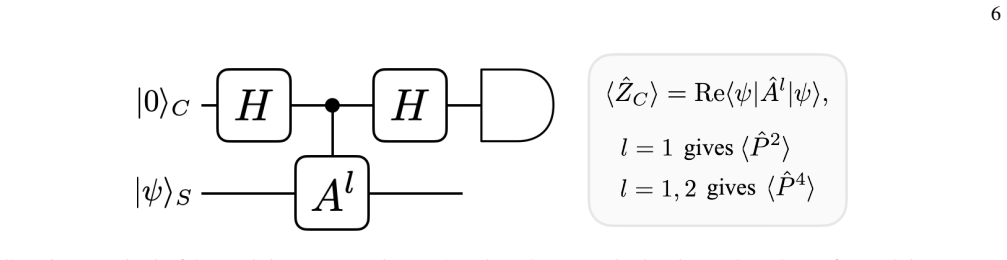
Starting from the positive-energy relativistic kinetic operator, we construct weakly relativistic lattice Hamiltonians whose leading correction requires the boundary-consistent discretized momentum moments ⟨P̂²⟩ and ⟨P̂⁴⟩. These moments are reconstructed in the PBC Hamiltonian from moments of a unitary cyclic translation while the DBC Hamiltonian uses the open-chain finite-difference. In a qubit-register implementation, it can be evaluated as the corresponding cyclic translation estimator plus boundary-local terms that remove the unphysical wrap-around link. The resulting energy-estimation workflow uses translation measurements for the kinetic terms, a small number of endpoints and near-endp
Load-bearing premise
The leading relativistic correction is accurately captured by the specific discretized moments ⟨P²⟩ and ⟨P⁴⟩ reconstructed via the chosen translation or finite-difference operators without significant contamination from higher-order terms or boundary artifacts.
Editorial extensions
If this is right
- The PBC version evaluates the kinetic correction as a cyclic translation estimator plus boundary-local correction terms that remove the wrap-around link.
- The DBC version requires only a small number of endpoint and near-endpoint overlap probabilities in addition to translation measurements.
- Energy estimation combines translation measurements for kinetic terms with position-basis sampling for any diagonal potential.
- Benchmark tests on no-potential, cosine, infinite-square-well, and harmonic cases separate finite-grid, truncation, and sampling errors while matching direct matrix results.
Reading between the lines
- The separation of discretization, truncation, and measurement errors may simplify error analysis when the same estimators are run on quantum hardware.
- Because the method stays inside a first-quantized qubit register, it could be combined with existing position-basis sampling techniques for potentials without requiring second quantization.
- Extension to time-dependent or driven potentials would follow directly once the same momentum-moment estimators are available at each time step.
Editorial analysis
A structured set of objections, weighed in public.
Referee Report
Summary. The paper develops a first-quantized approach to weakly relativistic quantum simulation on 1D lattices with periodic (PBC) and Dirichlet (DBC) boundary conditions. Starting from the positive-energy relativistic kinetic operator, it constructs lattice Hamiltonians whose leading correction depends on boundary-consistent discretized moments ⟨P̂²⟩ and ⟨P̂⁴⟩. These are obtained from moments of a unitary cyclic translation (PBC) or open-chain finite-difference operators (DBC), with additional local endpoint/near-endpoint overlap probabilities added for DBC to remove wrap-around or boundary artifacts. Energy estimation proceeds via translation measurements for kinetic terms, a small number of overlap probabilities for DBC, and position-basis sampling for potentials. Benchmarks on free-particle, cosine (PBC), infinite-well, and harmonic (DBC) potentials demonstrate agreement between the estimator reconstruction and direct matrix evaluation while separating finite-grid discretization, weak-relativistic truncation, and finite-shot measurement errors.
Significance. If the boundary-consistent reconstructions hold, the work supplies a practical, measurement-efficient route to including leading relativistic corrections in first-quantized lattice simulations under the two most common boundary conditions. The explicit separation of error sources and the use of translation estimators plus position sampling are implementation-friendly features. The finite-shot sampling tests in the benchmarks provide concrete evidence of estimator performance.
major comments (1)
- [DBC Hamiltonian construction] DBC construction (abstract and associated derivation): the claim that a small number of endpoint/near-endpoint overlap probabilities suffice to remove all boundary artifacts from the open-chain finite-difference reconstruction of ⟨P̂⁴⟩ requires explicit verification. Repeated finite-difference stencils on an open chain generically produce O(a^{-2}) or non-local boundary contributions; nothing in the provided description demonstrates exact cancellation for the specific linear combination entering the positive-energy relativistic correction.
minor comments (1)
- [Abstract] Abstract: 'valdate' is a typographical error and should read 'validate'.
Simulated Author's Rebuttal
We thank the referee for the careful reading and the recommendation for major revision. The single major comment is addressed below with a commitment to strengthen the explicit verification of the DBC construction.
read point-by-point responses
-
Referee: [DBC Hamiltonian construction] DBC construction (abstract and associated derivation): the claim that a small number of endpoint/near-endpoint overlap probabilities suffice to remove all boundary artifacts from the open-chain finite-difference reconstruction of ⟨P̂⁴⟩ requires explicit verification. Repeated finite-difference stencils on an open chain generically produce O(a^{-2}) or non-local boundary contributions; nothing in the provided description demonstrates exact cancellation for the specific linear combination entering the positive-energy relativistic correction.
Authors: We agree that the manuscript would benefit from an explicit verification of the cancellation. The DBC construction (Section III B) obtains ⟨P̂²⟩ and ⟨P̂⁴⟩ from the open-chain finite-difference operator and augments it with a finite set of local overlap probabilities at the two endpoints and their immediate neighbors. These corrections are derived to cancel the wrap-around and boundary-induced terms that appear when the fourth-moment stencil is applied to a finite open chain. Because the relativistic correction is a specific linear combination of these moments, the leading O(a^{-2}) and non-local boundary contributions cancel identically within that combination. To address the referee’s concern directly, the revised manuscript will add an appendix containing the term-by-term expansion of the boundary artifacts and their explicit cancellation for the positive-energy operator. revision: yes
Circularity Check
Derivation chain is self-contained; no circular reductions identified
full rationale
The paper constructs weakly relativistic lattice Hamiltonians by starting from the positive-energy relativistic kinetic operator and explicitly reconstructing the required discretized moments ⟨P̂²⟩ and ⟨P̂⁴⟩ via standard unitary cyclic translation (PBC) or open-chain finite-difference (DBC) operators, plus local boundary corrections. These steps are presented as direct operator definitions and reconstructions rather than predictions fitted to the paper's own outputs or reduced by self-citation chains. No load-bearing premise relies on a uniqueness theorem or ansatz imported from the authors' prior work, and the benchmarks compare the estimator reconstruction against direct matrix evaluation without circular redefinition of the target quantities. The central claims therefore remain independently verifiable from the stated discretization rules.
Assumptions & free parameters
assumptions (1)
- domain assumption The positive-energy relativistic kinetic operator admits a weak-relativistic expansion whose leading correction is captured by the second and fourth momentum moments.
Cite this review
Pith. "Pith review of First-Quantized Relativistic Quantum Simulation with Periodic and Dirichlet Boundary Conditions." pith.science (2026). https://pith.science/paper/A4H2YVVF
@misc{pith2026260621794,
  author       = {Pith},
  title        = {Pith review of: First-Quantized Relativistic Quantum Simulation with Periodic and Dirichlet Boundary Conditions},
  year         = {2026},
  howpublished = {\url{https://pith.science/paper/A4H2YVVF}},
  note         = {Machine review of arXiv:2606.21794}
}
abstract
In this work, we present a methodology for first-quantized relativistic quantum simulation on one-dimensional finite domains under the two boundary conditions most commonly used in lattice models: periodic boundary conditions (PBC) and Dirichlet boundary conditions (DBC). Starting from the positive-energy relativistic kinetic operator, we construct weakly relativistic lattice Hamiltonians whose leading correction requires the boundary-consistent discretized momentum moments $\langle \hat{P}^{2}\rangle$ and $\langle \hat{P}^{4}\rangle$. These moments are reconstructed in the PBC Hamiltonian from moments of a unitary cyclic translation while the DBC Hamiltonian uses the open-chain finite-difference. In a qubit-register implementation, it can be evaluated as the corresponding cyclic translation estimator plus boundary-local terms that remove the unphysical wrap-around link. The resulting energy-estimation workflow uses translation measurements for the kinetic terms, a small number of endpoints and near-endpoints overlap probabilities for DBC, and position-basis sampling for diagonal potentials. We valdate the framework of the relativistic quantum simulation in various benchmark potentials such as no potential and a cosine potential for PBC as well as an infinite square well and a harmonic potential for DBC, with finite-shot sampling tests. These benchmarks show good agreement between the estimator reconstruction and direct matrix evaluation while separating the finite-grid discretization, weak-relativistic truncation, and measurement errors.
Figures


Figures from the paper (9 more)


Reference graph
Works this paper leans on
-
[1]
R. P. Feynman, International Journal of Theoretical Physics21, 467 (1982)
work page 1982
- [2]
-
[3]
I. M. Georgescu, S. Ashhab, and F. Nori, Reviews of Modern Physics86, 153 (2014)
work page 2014
- [4]
-
[5]
A. J. Daley, I. Bloch, C. Kokail, S. Flannigan, N. Pearson, M. Troyer, and P. Zoller, Nature607, 667 (2022)
work page 2022
-
[6]
Fauseweh, Nature Communications15, 2123 (2024)
B. Fauseweh, Nature Communications15, 2123 (2024)
work page 2024
-
[7]
C. W. Bauer, Z. Davoudi, A. B. Balantekin, T. Bhattacharya, M. Carena, W. A. de Jong, et al., PRX Quantum4, 027001 (2023)
work page 2023
-
[8]
A. Di Meglio, K. Jansen, I. Tavernelli, C. Alexandrou, S. Arunachalam, C. W. Bauer, et al., PRX Quantum5, 037001 (2024)
work page 2024
Show all 37 references
-
[9]
J. J. Sakurai and J. Napolitano,Modern Quantum Mechanics, 3rd ed. (Cambridge University Press, Cambridge, 2020)
2020
-
[10]
Gerritsma, G
R. Gerritsma, G. Kirchmair, F. Zahringer, E. Solano, R. Blatt, and C. F. Roos, Nature463, 68 (2010)
2010
-
[11]
J. Li, B. A. Jones, and S. Kais, Science Advances9, eadg4576 (2023)
2023
-
[12]
On a finite lattice, these are replaced by moments of a lattice momentum operator
-
[13]
A. M. Childs, J. Leng, T. Li, J.-P. Liu, and C. Zhang, Quantum6, 860 (2022)
2022
-
[14]
P. C. S. Costa, S. Jordan, and A. Ostrander, Physical Review A99, 012323 (2019)
2019
-
[15]
A. M. Childs, J.-P. Liu, and A. Ostrander, Quantum5, 574 (2021)
2021
-
[16]
Kassal, S
I. Kassal, S. P. Jordan, P. J. Love, M. Mohseni, and A. Aspuru-Guzik, Proceedings of the National Academy of Sciences105, 18681 (2008)
2008
-
[17]
Babbush, C
R. Babbush, C. Gidney, D. W. Berry, N. Wiebe, J. R. McClean, A. Paler, A. Fowler, and H. Neven, Physical Review X8, 041015 (2018)
2018
-
[18]
Babbush, D
R. Babbush, D. W. Berry, J. R. McClean, and H. Neven, npj Quantum Information5, 92 (2019)
2019
-
[19]
Y . Su, D. W. Berry, N. Wiebe, N. C. Rubin, and R. Babbush, PRX Quantum2, 040332 (2021)
2021
-
[20]
Babbush, W
R. Babbush, W. J. Huggins, D. W. Berry, H. Neven, et al., Nature Communications14, 4058 (2023)
2023
-
[21]
D. W. Berry, N. C. Rubin, A. O. Elnabawy, G. Ahlers, A. E. DePrince, J. Lee, C. Gogolin, and R. Babbush, npj Quantum Information10, 130 (2024)
2024
-
[22]
T. N. Georges, M. Bothe, C. Sunderhauf, B. K. Berntson, R. Izsak, and A. V . Ivanov, npj Quantum Information11, 55 (2025)
2025
-
[23]
Lubasch, J
M. Lubasch, J. Joo, P. Moinier, M. Kiffner, and D. Jaksch, Physical Review A101, 010301(R) (2020)
2020
-
[24]
Joo and H
J. Joo and H. Moon, arXiv:2109.09216
-
[25]
Joo and T
J. Joo and T. P. Spiller, New Journal of Physics25, 083041 (2023)
2023
-
[26]
Vedral, A
V . Vedral, A. Barenco, and A. K. Ekert, Physical Review A54, 147 (1996)
1996
-
[27]
A. K. Ekert, C. M. Alves, D. K. L. Oi, M. Horodecki, P. Horodecki, and L. C. Kwek, Physical Review Letters88, 217901 (2002)
2002
-
[28]
C. M. Alves, P. Horodecki, D. K. L. Oi, L. C. Kwek, and A. K. Ekert, Physical Review A68, 032306 (2003)
2003
-
[29]
Y . Cao, J. Romero, J. P. Olson, M. Degroote, P. D. Johnson, M. Kieferova, I. D. Kivlichan, T. Menke, B. Peropadre, N. P. D. Sawaya, S. Sim, L. Veis, and A. Aspuru-Guzik, Chemical Reviews119, 10856 (2019)
2019
-
[30]
McArdle, S
S. McArdle, S. Endo, A. Aspuru-Guzik, S. C. Benjamin, and X. Yuan, Reviews of Modern Physics92, 015003 (2020)
2020
-
[31]
Robledo-Moreno, M
J. Robledo-Moreno, M. Motta, H. Haas, A. Javadi-Abhari, P. Jurcevic, W. Kirby, S. Martiel, A. Mezzacapo, et al., Science Advances11, eadu9991 (2025)
2025
-
[32]
Peruzzo, J
A. Peruzzo, J. McClean, P. Shadbolt, M.-H. Yung, X.-Q. Zhou, P. J. Love, A. Aspuru-Guzik, and J. L. O’Brien, Nature Communications 5, 4213 (2014)
2014
-
[33]
Cerezo, A
M. Cerezo, A. Arrasmith, R. Babbush, S. C. Benjamin, S. Endo, K. Fujii, J. R. McClean, K. Mitarai, X. Yuan, L. Cincio, and P. J. Coles, Nature Reviews Physics3, 625 (2021)
2021
-
[34]
Bharti, A
K. Bharti, A. Cervera-Lierta, T. H. Kyaw, T. Haug, S. Alperin-Lea, A. Anand, M. Degroote, H. Heimonen, J. S. Kottmann, T. Menke, et al., Reviews of Modern Physics94, 015004 (2022)
2022
-
[35]
Tilly, H
J. Tilly, H. Chen, S. Cao, D. Picozzi, K. Setia, Y . Li, E. Grant, L. Wossnig, I. Rungger, G. H. Booth, and J. Tennyson, Physics Reports 986, 1 (2022)
2022
-
[36]
Fomichev, K
S. Fomichev, K. Hejazi, M. S. Zini, M. Kiser, J. Fraxanet Morales, P. A. Moreno Casares, A. Delgado, J. Huh, A.-C. V oigt, J. E. Mueller, and J. M. Arrazola, PRX Quantum5, 040339 (2024)
2024
-
[37]
W. J. Huggins, O. Leimkuhler, T. F. Stetina, and K. B. Whaley, PRX Quantum6, 020319 (2025)
2025
Reviewed June 30, 2026 · model on record in the stance chip above.
Discussion (0). Continue with ORCID to comment.