REVIEW 3 major objections 5 minor 1 cited by
Dynamically Induced Topology and Quantum Monodromies in a Proximity Quenched Gapless Wire
T0 review · 3 major / 5 minor · reviewed 2026-08-14 · deepseek-v4-flash
Pith's one-line read A sudden quench coupling a topologically trivial gapless wire to fractional or Majorana bound states turns those bound states into mobile anyons whose fractional charge, fermion parity, and exchange statistics remain measurable over many…
desk verdict Useful extension of Majorana quench interferometry with solid exact solutions, but the statistical-phase extraction rests on an unproven cancellation. read the letter →
The pith
A machine-rendered reading of the paper's core claim, the machinery that carries it, and where it could break.
The reading
What carries the argument
The engine of the argument is the boundary-changing operator (BCO). In the low-energy limit the quench acts like a $\mathbb{Z}_2$ branch cut on the chiral field of the wire, and the post-quench state is $\sigma(\ell,t)\sigma(0,t)|\Omega_0\rangle$, where $\sigma$ is the twist field of the Ising conformal field theory (conformal dimension $h_\sigma=1/16$). The fidelity and the statistical phases are read from the four-point correlator of these twist fields, whose analytic continuation produces the quantum monodromies. Exchange phases are isolated through the ratio-of-overlaps phase in Eq. (1), $\theta = \arg[O_{q_Lq_R,p_Lp_R}(t)/O_{q'_Lq'_R,p'_Lp'_R}(t)]$, which is asserted to remove the dynamical phase. The exact single- and two-bound-state evolutions are carried by functions $g_{ab}(t)$ built from Laguerre polynomials, with peak amplitudes decaying as $n^{-1/3}$ after $n$ revivals, which gives the long coherence time.
What would settle it
Compute the full time-resolved overlaps $O_{q_Lq_R,p_Lp_R}(t)$ in a finite wire and test whether $\theta_s^{SSH}(t)=\frac{1}{2}\arg[O_{11,11}(t)/O_{10,10}(t)]$ stays flat over successive revival windows once the non-interacting evolution is exactly accounted for; any drift with the revival number $n$ would show that a non-statistical dynamical contribution has leaked into the extracted phase.
Extended reading notes
Core claim
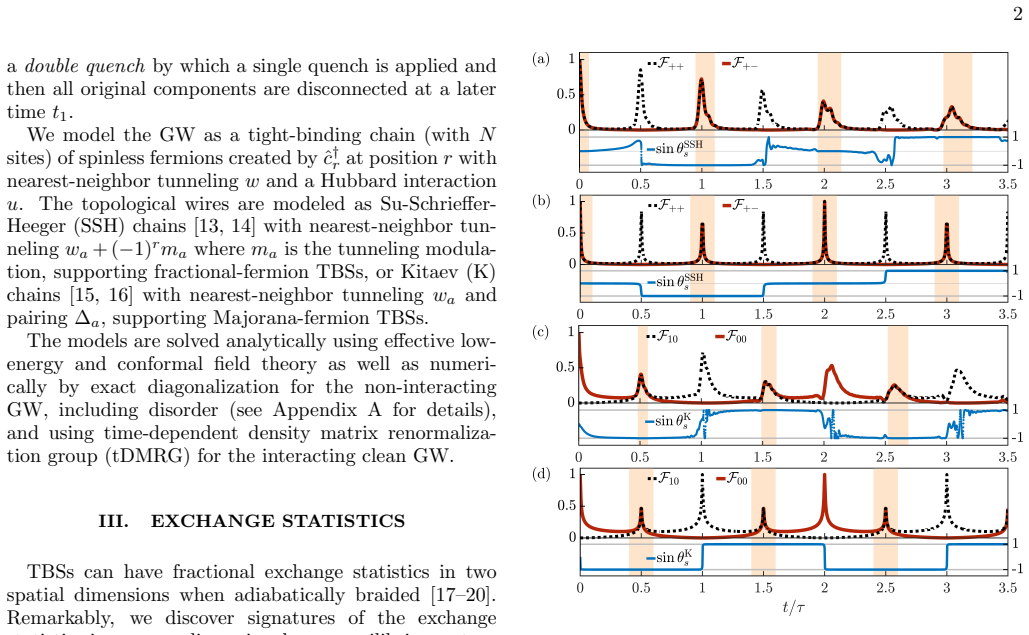
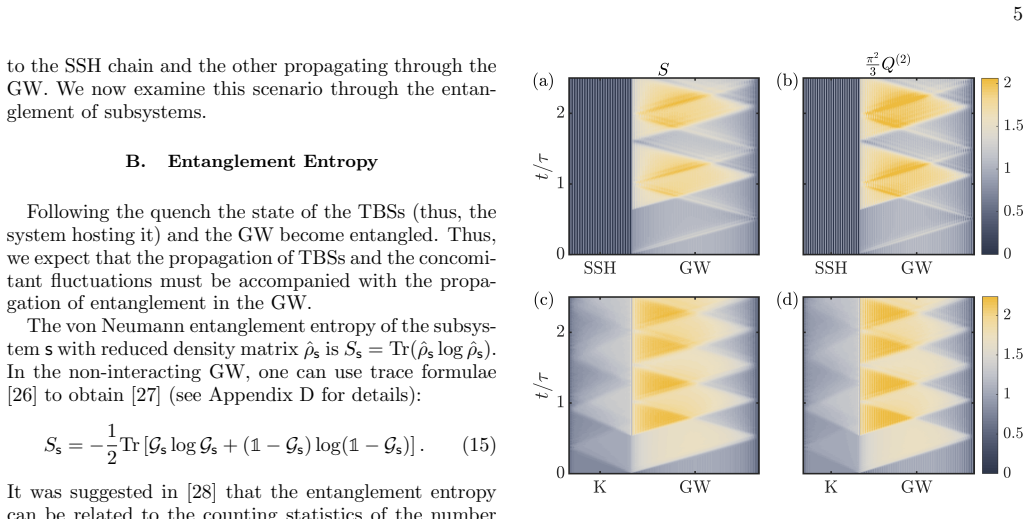
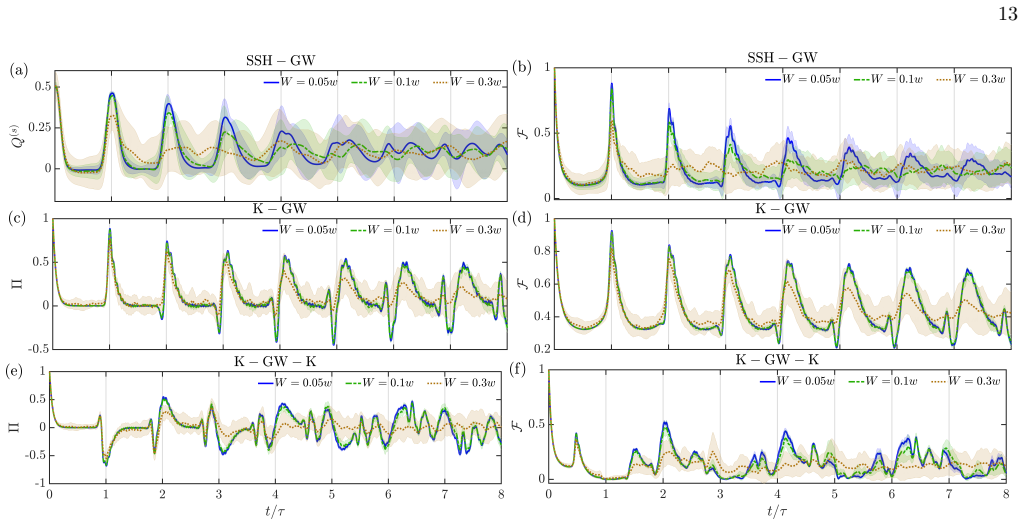
The central claim is that a sudden coupling of a gapless wire to topological bound states—fractional SSH solitons or Kitaev Majoranas—dynamically induces topological properties in the wire that remain observable over a long coherence time. After the quench the bound states enter the wire as mobile anyons: the SSH soliton propagates as a charge-$1/2$ excitation with suppressed local charge fluctuations, while a propagating Majorana forces the fermion parity of every subsystem lying between it and its remote partner to zero. The paper further claims that exchange statistics are visible in the revival dynamics: for two Majoranas the non-Abelian Ising statistics appears as a doubled period of fidelity revivals, and for two SSH solitons the Abelian statistical phase $\theta_s^{SSH}=\frac{1}{2}\theta_{11,11}^{10,10}$ is accumulated in the relative phase between parity-resolved overlaps, with a corresponding Majorana phase $\theta_s^K=\theta_{11,00}^{00,00}$. Analytical low-energy results based on the Ising conformal field theory agree with exact diagonalization, and time-dependent density matrix renormalization group calculations show that short-range interactions can sharpen the propagating soliton charge. The parent topology is therefore imprinted on the wire in time, not in space.
Load-bearing premise
The extraction of exchange statistics rests on the assumption that the relative phase between two overlap amplitudes cancels the dynamical phase exactly, so that what remains is purely the statistical phase; the paper does not prove that the two processes acquire identical dynamical phases.
Editorial extensions
If this is right
- A single quench lets a fractional SSH soliton enter the wire as a mobile charge-$1/2$ excitation; at its center the local charge fluctuations nearly vanish, so the fractional charge behaves as a good quantum number while moving.
- With two Kitaev chains, the non-Abelian Ising statistics of the Majorana pair is visible as a doubling of the fidelity revival period, and the fermion parity of every subsystem between a propagating Majorana and its remote partner is zero.
- The statistical phases $\theta_s^{SSH}$ and $\theta_s^K$ are encoded in the relative phases of parity-resolved overlaps and remain coherent over many return times even though the revival amplitude decays as $n^{-1/3}$.
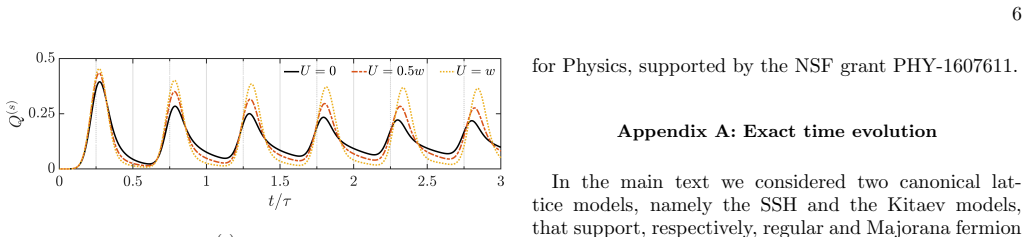
- Short-range interactions in the wire can reduce the decay of the soliton charge and sharpen its revival peaks; modest disorder leaves the first few fidelity, parity, and charge peaks sharp.
- A double quench creates, at the moment of disconnection, a particle-hole pair for the SSH case and a Majorana pair for the Kitaev case, with one member trapped near the interface and the other propagating through the wire.
Reading between the lines
- The one-dimensional revival monodromy is treated as a stand-in for two-dimensional braiding; a direct comparison of these phases with a genuine braiding protocol in the same microscopic model would test that equivalence, but the paper does not carry it out.
- If the same boundary-changing-operator structure holds for parafermions, fidelity revivals should exhibit richer non-Abelian monodromies than the Ising case; the authors only gesture at this extension.
- The two-copy interference idea sketched for measuring entanglement could be adapted to measure the relative statistical phase directly, making the protocol testable in nanowire or cold-atom arrays.
- Because interactions sharpen the soliton charge, tuning interactions might be used to increase the visibility of the statistical phase, a consequence the paper does not discuss.
Signed reviews
Editorial analysis
A structured set of objections, weighed in public.
Referee Report
Summary. This paper considers a one-dimensional gapless wire that is suddenly coupled at its ends to topological bound states from SSH chains (fractional solitons) or Kitaev chains (Majorana zero modes). The authors claim that after the quench the bound states leak into the wire, propagate as mobile anyons, and leave measurable signatures of the parent topology: quantized fractional charge, zero subsystem fermion parity, entanglement-entropy patterns, and relative phases between parity-resolved overlaps that are interpreted as Abelian and non-Abelian exchange-statistics phases. The analytical framework combines exact equations-of-motion solutions (Eqs. (8)-(10), Appendix C) with a conformal-field-theory description in which the quench inserts Ising twist fields acting as boundary-changing operators, and the overlap of Eq. (7) is expressed through four-twist correlators. The analytical results are compared with exact diagonalization and tDMRG simulations for clean, disordered, and interacting wires.
Significance. The proposed effect is conceptually interesting and, if established, would generalize the topological proximity effect to the time domain and provide experimentally accessible signatures of fractional statistics in a 1D quench setup. Strengths of the paper include the parameter-free analytical solutions (given the model), the explicit derivation of the equations-of-motion propagators and the Pfaffian/Onishi overlap formulas, and the independent numerical checks by exact diagonalization and tDMRG. The main caveat is that the central phase-extraction procedure in Eq. (1) and the identification of 1D revival monodromies with braiding statistics are asserted rather than derived; unless these are supplied, the quantitative claims about exchange statistics remain a conjecture.
major comments (3)
- [Section III, Eq. (1)] The statement that the overlap ratio 'encodes various non-Abelian statistical phases by removing the dynamical phase' is the central load-bearing assumption and is not proved. After the quench the Hamiltonian is time-independent, so each overlap is a sum of oscillating eigenstate contributions, O_{q,p}(t)=Σ_n ⟨Ω_q(0)|n⟩⟨n|Ω_p(0)⟩e^{-iE_nt}; the ratio of two such sums does not in general factor as a common dynamical phase times a statistical phase. The exact solutions in Appendix C and the four-twist correlator (C25) may imply a factorization, but the paper does not show it, nor does it demonstrate that the sinh and cutoff-dependent prefactors of (C25) cancel in the parity-specific ratio. This matters because the plateau values θ_SSH^s and θ_K^s are the quantitative evidence for statistics; if the cancellation fails, these phases contain non-universal contributions. Please add a derivation of Eq. (1) from the overlap formulas, or explicitly state and justify the conditions under which the dynamical phase cancels.
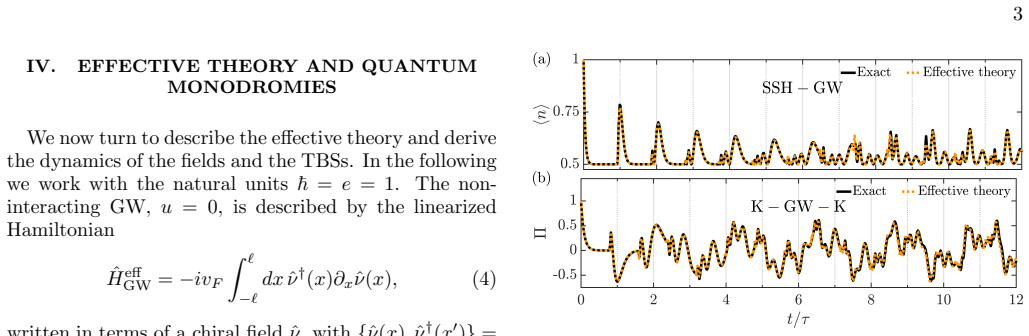
- [Section IV and Appendix C, Eqs. (7), (C18)-(C25)] The connection between the CFT overlap (7) and the parity-resolved overlaps entering Eq. (1) is not spelled out. Equation (7) is the fidelity amplitude of the full many-body state, whereas Eq. (1) involves overlaps between states with different initial/final parities (p_L,p_R) and (q_L,q_R). The text mentions that the SSH case uses conformal blocks D_± = B_+^2 ± B_-^2 and the Kitaev case uses B_±, but it never derives which block corresponds to which overlap O_{q_L q_R,p_L p_R}(t), nor how the ratio in Eq. (1) follows from (C25). Without this mapping the analytical curves in Fig. 2(b),(d) are not independently checkable from the printed equations. Please provide the explicit parity-resolved overlap expressions and the resulting formula for θ.
- [Section III (paragraph after Eq. (7)) and Section VI] The identification of the revival-phase monodromies with 'exchange statistics' or 'braiding' of mobile anyons in one dimension is under-motivated. In 2+1D braiding is defined by worldlines that avoid each other, while in a 1D wire two TBSs propagating through the same channel must meet unless a precise chiral-separation mechanism is specified; the phrase 'they effectively braid, keeping their chirality intact' is not a definition. The paper should either supply a concrete mapping from the time evolution of Eqs. (6)-(10) to the braid group (even in a restricted sense), or clearly state the weaker claim that the extracted phases equal the BCO monodromies of the conformal blocks, and that this is a signature rather than a proof of exchange statistics.
minor comments (5)
- [Eq. (8)] The k=0 term is not well defined because the binomial coefficient (j-1 choose k-1) is used for k=0 and j≥0; the expression should either follow the Laguerre representation in Eq. (C9) or state the convention for the k=0 term.
- [Fig. 6 caption] The caption contains the typo 'Soltion charge'; please also specify the charge window and the smoothing length used in the figure.
- [Appendix D heading] The heading 'formulea' should read 'formulae'.
- [Section V.A, Eq. (11)] The smoothing length l is a free parameter; the figures show a single value (l=20), and a convergence statement or a short discussion of the dependence of Q^{(s)} on l would help the reader assess the robustness of the fractional-charge claim.
- [Fig. 2 and Eqs. (2)-(3)] The superscript/subscript notation for θ_SSH^s and θ_K^s in the caption differs from Eqs. (2)-(3); please unify the notation.
Circularity Check
No significant circularity: the overlap phases and monodromies are computed from the quench Hamiltonian, checked by exact diagonalization, and the self-citation to Ref. [9] is not load-bearing.
full rationale
The paper's central derivation is self-contained rather than circular. The statistical phases θ_SSH_s and θ_K^s are not fitted parameters; they are obtained from exact diagonalization of the lattice model (Appendix A) and from independent analytic solutions of the effective equations of motion (Appendix C, Eqs. (8)-(10)), which are then compared in Fig. 2 with no adjustable target. The BCO/twist-field overlap calculation, Eq. (7) and Eqs. (C18)-(C25), follows from the stated low-energy limit λ ≫ v_F/√ℓ and is validated against exact diagonalization (Fig. 3), so the monodromy result is a derived consequence of the model, not an input. The only self-citation of note is Ref. [9] for the Majorana period-doubling interpretation; that prior result is disclosed, and the present paper independently derives the relevant revival dynamics and parity formulas, so the citation is not load-bearing. The assertion in Eq. (1) that the overlap-ratio phase 'encodes' exchange statistics by removing the dynamical phase is an interpretive step whose dynamical-phase cancellation is not fully proven; that is a correctness/justification concern, not a circular reduction, since the value of the ratio is computed rather than inserted by definition. I therefore find no circular step under the stated criteria.
Assumptions & free parameters
free parameters (1)
- smoothing length l =
20 (lattice sites)
assumptions (6)
- domain assumption The low-energy linearized chiral field theory (Eq. 4) with local coupling to TBSs (Eq. 5) accurately describes the lattice SSH/Kitaev chains coupled to the gapless wire at half filling.
- ad hoc to paper In the strong-coupling limit lambda >> v_F/sqrt(l), the quench is equivalent to inserting a Z2 branch cut implemented by Ising twist fields sigma(0,t) sigma(l,t) acting as boundary-changing operators.
- ad hoc to paper The relative phase between two overlap processes in Eq. (1) cancels the dynamical phase and isolates the exchange statistics phase.
- standard math Standard CFT correlators for the Ising model and the conformal map from strip to plane apply to the non-interacting unfolded chiral fermion and give the correct monodromies.
- domain assumption SSH solitons carry charge 1/2 with Abelian statistics and Kitaev Majorana modes obey Ising non-Abelian statistics.
- standard math The Onishi/Pfaffian overlap formula and the Nambu-Green's function trace formulas correctly compute overlaps, parity, and entanglement for the noninteracting system.
Cite this review
Pith. "Pith review of Dynamically Induced Topology and Quantum Monodromies in a Proximity Quenched Gapless Wire." pith.science (2026). https://pith.science/paper/A4QFK63Y
@misc{pith2026190806111,
  author       = {Pith},
  title        = {Pith review of: Dynamically Induced Topology and Quantum Monodromies in a Proximity Quenched Gapless Wire},
  year         = {2026},
  howpublished = {\url{https://pith.science/paper/A4QFK63Y}},
  note         = {Machine review of arXiv:1908.06111}
}
read the original abstract
We study the quench dynamics of a topologically trivial one-dimensional gapless wire following its sudden coupling to topological bound states. We find that as the bound states leak into and propagate through the wire, signatures of their topological nature survive and remain measurable over a long lifetime. Thus, the quench dynamically induces topological properties in the gapless wire. Specifically, we study a gapless wire coupled to fractionally charged solitons or Majorana fermions and characterize the dynamically induced topology in the wire, in the presence of disorder and short-range interactions, by analytical and numerical calculations of the dynamics of fractional charge, fermion parity, entanglement entropy, and fractional exchange statistics. In a dual effective description, this phenomenon is described by correlators of boundary changing operators, which, remarkably, generate topologically non-trivial monodromies in the gapless wire, both for abelian and non-abelian quantum statistics of the bound states.
Figures

Figures from the paper (5 more)


Forward citations
Cited by 1 Pith paper
-
Boundary quenches in (1+1)-dimensional conformal field theory
A boundary quench in a (1+1)-d CFT makes one-point functions switch from old to new ground state across a light cone and makes adjacent-region entanglement jump by log(g_b/g_a).
Reference graph
Works this paper leans on
-
[1]
Derivation of the TBS dynamics In the following we assume λa∈ R and start with the case that λL⁄= 0, λR = 0. For a single Majorana TBS coupled to the GW only ˆη2 remains coupled, thus we ob- tain similar equations of motion for the Kitaev and SSH case. We unify the notation by setting ˆν = ˆψ (ˆν = ˆη/ √ 2, ˆη≡ ˆη2) for SSH (Kitaev). Thus we obtain the eq...
-
[2]
for SSH (Kitaev) mod- els, respectively, and xL = 0, xR = 𝓁. The factor of 2 accounts for the fact that the full fermion field ˆΨ(xa) = 2 ˆψ(xa), up to a phase eikFxa that is absorbed intoλa. Note that λa in the continuum Hamiltonian has dimensions of√velocity× energy (in natural units). The coupling to the end Majorana fermions is 2i ∑ a,j λaj(t)ˆηj(xa)ˆγ...
-
[3]
Boundary changing operators and monodromies The non-interacting, clean limit of the gapless wire is described by two copies of the chiral part of the Z2 Ising conformal field theory. Each copy contains three primary fields, the identity I (with conformal dimension hI = 0), a real fermion field η(x,t ) (hη = 1/2) and the twist field σ(x,t ) (hσ = 1/16). Here σ...
-
[4]
For the lead, we have ˆψ(x,t ) = ˆψ(0+,t−x/vF ) =− i 2λ(∂s− Γ) ˆf(s) ⏐⏐ s=t−x/vF
Effective theory of fractional charge propagation The occupation of the bound state N(t) ≡ ⟨ ˆf†(t) ˆf(t)⟩ = e−2ΓtN(0) decays for 0 < t < τr, and is revived forτr <t< 2τr asN(t)≈ 4Γ2(t−τr)2e−2Γ(t−τr) with a maximum valueN(τr +1/Γ)/N(0) = 4/e2≈ 0.54, irrespective of ζ. For the lead, we have ˆψ(x,t ) = ˆψ(0+,t−x/vF ) =− i 2λ(∂s− Γ) ˆf(s) ⏐⏐ s=t−x/vF . (C15) ...
-
[5]
C. L. Kane and E. J. Mele. Z2 Topological Order and the Quantum Spin Hall Effect . Phys. Rev. Lett. 95, 146802 (2005)
work page 2005
-
[6]
Entanglement Entropy We use the first trace formula to calculate the entan- glement entropy of a subsystem s with reduced matrixρs using the replica trick, S = Trs(ˆρs log ˆρs) =− lim n→1 ∂nTrs ˆρn s (D3) Starting with the ground state|Ω⟩ of the system, we write the reduced density matrix ˆρs = Tr¯s|Ω⟩⟨Ω| =κse− ˆAs, (D4) where ¯s is the complementary subsy...
-
[7]
Counting statistics and parity We now employ the second trace formula to calculate the full counting statistics, generating the moments of the charge operator in subsystem s. This generating function can be found from the expectation value of the operator ˆχs(φ) =eiφ ˆQs = exp [iφ 2 ( ˆΨ†Σz ˆΨ +Ns )] (D13) where Ns is the number of sites in subsystem s, a...
-
[8]
P. D. Sacramento. Fate of Majorana fermions and Chern numbers after a quantum quench . Phys. Rev. E 90, 032138 (2014)
work page 2014
Show all 51 references
-
[9]
is plotted in Fig. 7 . Appendix E: Robustness In this Appendix, we formulate and study of the effects of short-range interactions and disorder in the GW
-
[10]
(C3) as ˆψ±(x)∼ 1√ 2πae−i √ 2π ˆφ±(x), (E1) where φ± are bosonic fields
Effects of short-range interactions Now we apply bosonization techniques for the GW and write the right and left-moving fields of Eq. (C3) as ˆψ±(x)∼ 1√ 2πae−i √ 2π ˆφ±(x), (E1) where φ± are bosonic fields. It can be shown that the corresponding normal ordered densities are relat...
-
[11]
Effects of disorder We study the effects of disorder on the quench by taking a finite width W for the disorder potential, see Eq. (A2). Technically, we take a large number of realiza- tions and average the different observables at each time, while keeping track of the standard dev...
-
[12]
Holm and W
R. Holm and W. Meissner. Messungen mit Hilfe von ߬ ussigem Helium. XIII. Z. Phys. 74, 715 (1932)
1932
-
[13]
Jackiw and C
R. Jackiw and C. Rebbi. Solitons with fermion number 1/2. Phys. Rev. D 13, 3398 (1976). 14
1976
-
[14]
Arovas, J
D. Arovas, J. R. Schrieffer, and F. Wilczek. Fractional Statistics and the Quantum Hall Effect . Phys. Rev. Lett. 53, 722 (1984)
1984
-
[15]
F. D. M. Haldane. Model for a quantum Hall effect with- out Landau levels: Condensed-matter realization of the” parity anomaly”. Phys. Rev. Lett. 61, 2015 (1988)
1988
-
[16]
B. A. Bernevig, T. L. Hughes, and S.-C. Zhang. Quantum spin Hall effect and topological phase transition in HgTe quantum wells . Science 314, 1757 (2006)
2006
-
[17]
Vasseur, J
R. Vasseur, J. P. Dahlhaus, and J. E. Moore. Universal Nonequilibrium Signatures of Majorana Zero Modes in Quench Dynamics. Phys. Rev. X 4, 041007 (2014)
2014
-
[18]
D. A. Ivanov. Non-Abelian Statistics of Half-Quantum Vortices in p-Wave Superconductors . Phys. Rev. Lett. 86, 268 (2001)
2001
-
[19]
Dahan, M
D. Dahan, M. T. Ahari, G. Ortiz, B. Seradjeh, and E. Grosfeld. Non-Abelian fermion parity interferometry of Majorana bound states in a Fermi sea . Phys. Rev. B 95, 201114(R) (2017)
2017
-
[20]
DeGottardi, D
W. DeGottardi, D. Sen, and S. Vishveshwara. Topological phases, Majorana modes and quench dynamics in a spin ladder system. New J. Phys. 13, 065028 (2011)
2011
-
[21]
Rajak and A
A. Rajak and A. Dutta. Survival probability of an edge Majorana in a one-dimensional p-wave superconducting chain under sudden quenching of parameters . Phys. Rev. E 89, 042125 (2014)
2014
-
[22]
Hegde, V
S. Hegde, V. Shivamoggi, S. Vishveshwara, and D. Sen. Quench dynamics and parity blocking in Majorana wires . New J. Phys. 17, 053036 (2015)
2015
-
[23]
W. P. Su, J. R. Schrieffer, and A. J. Heeger. Solitons in Polyacetylene. Phys. Rev. Lett. 42, 1698 (1979)
1979
-
[24]
E. J. Meier, F. A. An, and B. Gadway. Observation of the topological soliton state in the Su-Schrieffer-Heeger model. Nature Comm. 7, 13986 (2016)
2016
-
[25]
A. Y. Kitaev. Unpaired Majorana fermions in quantum wires. Physics Uspekhi 44, 131 (2001)
2001
-
[26]
anyon trains
to obtain [27] (see Appendix D for details): Ss =−1 2Tr [Gs logGs + (1−G s) log(1−G s)]. (15) It was suggested in [28] that the entanglement entropy can be related to the counting statistics of the number operator through the generating function χs(φ). For a normal system, i.e...
-
[27]
E. Lieb, T. Schultz, and D. Mattis. Two soluble models of an antiferromagnetic chain . Ann. Phys. 16, 407 (1961)
1961
-
[28]
Read and D
N. Read and D. Green. Paired states of fermions in two dimensions with breaking of parity and time-reversal sym- metries and the fractional quantum Hall effect . Phys. Rev. B 61, 10267 (2000)
2000
-
[29]
A. Y. Kitaev. Fault-tolerant quantum computation by anyons. Ann. Phys. 303, 2 (2003)
2003
-
[30]
Alicea, Y
J. Alicea, Y. Oreg, G. Refael, F. von Oppen, and M. P. A. Fisher. Non-Abelian statistics and topological quantum information processing in 1D wire networks . Nature Phys. 7, 412 (2011)
2011
-
[31]
Onishi and S
N. Onishi and S. Yoshida. Generator coordinate method applied to nuclei in the transition region. Nucl. Phys. 80, 367 (1966)
1966
-
[32]
L. M. Robledo. Sign of the overlap of Hartree-Fock- Bogoliubov wave functions . Phys. Rev. C 79, 021302 (2009)
2009
-
[33]
A. T. Bolukbasi and J. Vala. Rigorous calculations of non-Abelian statistics in the Kitaev honeycomb model . New J. Phys. 14, 045007 (2012)
2012
-
[34]
Francesco, P
P. Francesco, P. Mathieu, and D. S´ en´ echal.Conformal field theory, (Springer Science & Business Media2012)
-
[35]
Kivelson and J
S. Kivelson and J. R. Schrieffer. Fractional charge, a sharp quantum observable. Phys. Rev. B 25, 6447 (1982)
1982
-
[36]
I. Klich. A note on the full counting statistics of paired fermions. J. Stat. Mech.: Theory Exp. 11, 11006 (2014)
2014
-
[37]
A. Sen, S. Nandy, and K. Sengupta. Entanglement gen- eration in periodically driven integrable systems: Dynam- ical phase transitions and steady state . Phys. Rev. B 94, 214301 (2016)
2016
-
[38]
Klich and L
I. Klich and L. Levitov. Quantum Noise as an Entangle- ment Meter. Phys. Rev. Lett. 102, 100502 (2009)
2009
-
[39]
B. Hsu, E. Grosfeld, and E. Fradkin. Quantum noise and entanglement generated by a local quantum quench. Phys. Rev. B 80, 235412 (2009)
2009
-
[40]
H. F. Song, S. Rachel, and K. Le Hur. General relation between entanglement and fluctuations in one dimension . Phys. Rev. B 82, 012405 (2010)
2010
-
[41]
H. F. Song, C. Flindt, S. Rachel, I. Klich, and K. Le Hur. Entanglement entropy from charge statistics: Exact relations for noninteracting many-body systems . Phys. Rev. B 83, 161408 (2011)
2011
-
[42]
H. F. Song, S. Rachel, C. Flindt, I. Klich, N. Laflorencie, and K. Le Hur. Bipartite fluctuations as a probe of many- body entanglement. Phys. Rev. B 85, 035409 (2012)
2012
-
[43]
Herviou, C
L. Herviou, C. Mora, and K. Le Hur. Bipartite charge fluctuations in one-dimensional Z 2 superconductors and insulators. Phys. Rev. B 96, 121113 (2017)
2017
-
[44]
E. Sela, A. Altland, and A. Rosch. Majorana fermions in strongly interacting helical liquids . Phys. Rev. B 84, 085114 (2011)
2011
-
[45]
Fidkowski, J
L. Fidkowski, J. Alicea, N. H. Lindner, R. M. Lutchyn, and M. P. Fisher. Universal transport signatures of Ma- jorana fermions in superconductor-Luttinger liquid junc- tions. Phys. Rev. B 85, 245121 (2012)
2012
-
[46]
Affleck and D
I. Affleck and D. Giuliano. Topological superconductor– Luttinger liquid junctions . J. Stat. Mech.: Theory Exp. 2013, P06011 (2013)
2013
-
[47]
Takahashi, Thermodynamics of one- dimensional solvable problems, Cambridge University Press, (1999)
See, e.g., M. Takahashi, Thermodynamics of one- dimensional solvable problems, Cambridge University Press, (1999)
1999
-
[48]
Affleck and A
I. Affleck and A. W. W. Ludwig. The Fermi edge sin- gularity and boundary condition changing operators . J. Phys. A: Math. Gen. 27, 5375 (1994)
1994
-
[49]
Islam, R
R. Islam, R. Ma, P. M. Preiss, M. Eric Tai, A. Lukin, M. Rispoli, and M. Greiner. Measuring entanglement en- tropy in a quantum many-body system . Nature (London) 528, 77 (2015)
2015
-
[50]
Fradkin and L
E. Fradkin and L. P. Kadanoff. Disorder variables and para-fermions in two-dimensional statistical mechanics . Nucl. Phys. B 170, 1 (1980)
1980
-
[51]
P. Fendley. Free parafermions. J. Phys. A: Math. Gen. 47, 075001 (2014)
2014
Reviewed August 14, 2026 · model on record in the stance chip above.
Discussion (0). Continue with ORCID to comment.