REVIEW 4 major objections 4 minor 26 references
A New Dataset and Benchmark for Grounding Multimodal Misinformation
T0 review · 4 major / 4 minor · reviewed 2026-08-04 · deepseek-v4-flash
Pith's one-line read This paper introduces GroundLie360, the first real-world benchmark that localizes falsehoods in misinformation videos across title, speech, and visuals.
desk verdict Worth engaging: a new grounded-video-misinformation benchmark that needs its labeling protocol opened up before the 'first' claim can be fully trusted. read the letter →
The pith
A machine-rendered reading of the paper's core claim, the machinery that carries it, and where it could break.
The reading
What carries the argument
The load-bearing object is the three-level annotation schema: Level 1 binary veracity from Snopes ratings, Level 2 six fake types (false title, false speech, temporal edit, CGI, contradictory content, unsupported content), Level 3 grounding (text token spans, frame-index intervals, bounding boxes). On the method side, FakeMark's four prompt-based analyses (text, video temporal, video spatial, cross-modal) produce analyses that a binary classifier, multilabel classifier, and four localizers consume; scene segmentation (TransNetV2) and object tracking (SAM 2) anchor temporal and visual grounding.
What would settle it
Re-annotate a stratified sample of the 2,044 videos with an independent panel and report Cohen's kappa for veracity and for each of the six fake types; if kappa falls well below the levels implied by the annotation pipeline, or if FakeMark's ranking changes when evaluated on the adjudicated subset, the core claim of a reliable grounding benchmark gives way.
Extended reading notes
Core claim
On its own terms, the central discovery is that grounding video misinformation can be turned into a measurable benchmark. GroundLie360 covers 2,044 target videos (995 real, 1,049 fake) drawn from 1,466 Snopes-investigated events, annotated at three levels: binary veracity, six fake types, and grounding. Each video can carry multiple type labels, and annotations locate false spans in text, speech, temporal edit timestamps, and CGI regions. The paper argues this is the first comprehensive benchmark for grounding video misinformation, extending the earlier DGM4 text-image manipulation task to real video posts spanning visual, auditory, and textual modalities.
Load-bearing premise
The ground truth rests on Snopes ratings plus annotator judgment, and the paper reports agreement only for grounding spans (IoU), not for the binary veracity or fake-type labels; if those labels are unstable, every benchmark score measured against them is unstable.
Editorial extensions
If this is right
- Researchers get a public benchmark that measures localization quality, so future systems can be compared on whether they identify the exact false title, false utterance, edit point, or CGI region.
- The six-type taxonomy lets downstream work study how misinformation types co-occur; the paper reports most samples contain at least two fake types, so multi-label evaluation becomes standard.
- Because grounding is tied to upstream binary and type classification, pipeline evaluation makes error propagation visible; fixing early classification is a precondition for localization.
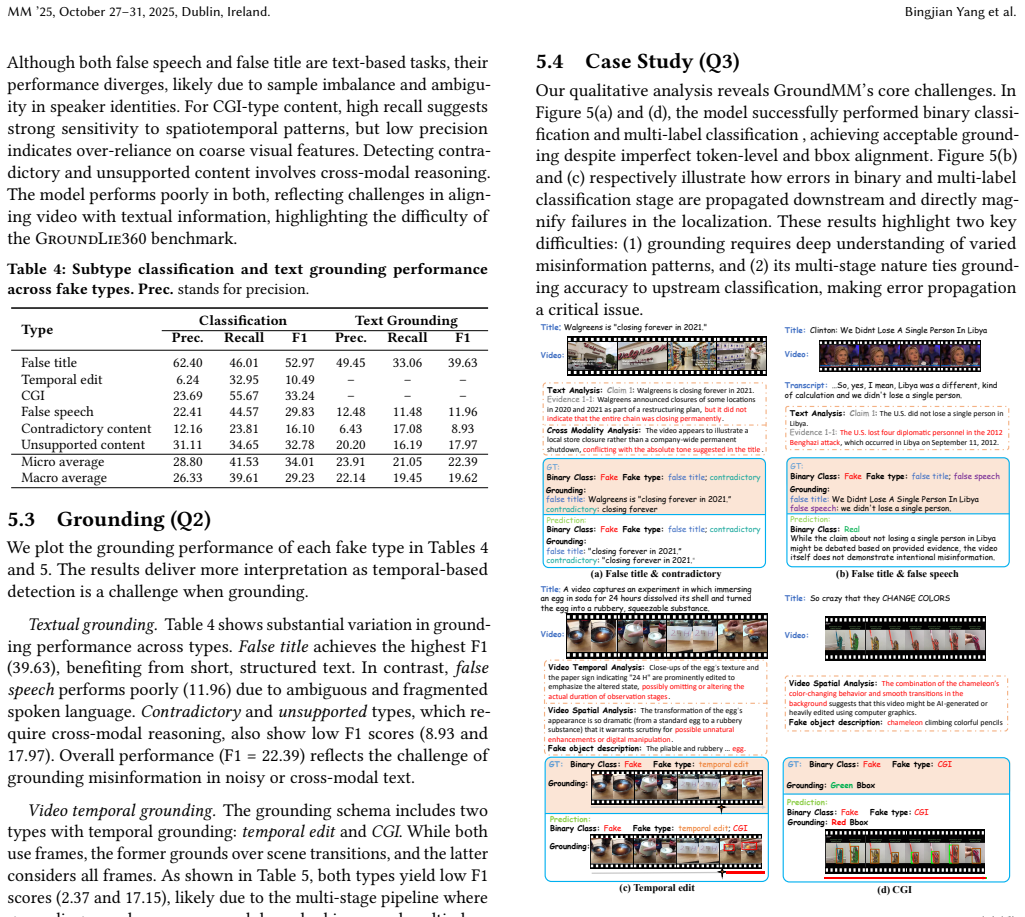
- The low baseline scores (e.g., temporal-edit grounding F1 of 2.37) define clear headroom that motivates specialized grounding architectures.
Reading between the lines
- The dataset's Snopes-derived evidence could be repurposed as retrieval ground truth for end-to-end fact-checking models, though the paper itself only uses it to create labels.
- If fake types co-occur as reported, a natural next benchmark would isolate error propagation: evaluate grounding conditioned on oracle type labels to separate 'failure to detect' from 'failure to localize' — the paper's case study hints at this but does not quantify it.
- The annotation subjectivity problem suggests a testable stress test: re-annotate a subset with an independent panel and measure type-label agreement; the paper does not report this, so the benchmark's ceiling is not yet known.
- Because most fake video segments are short and near the start, systems optimized for early-frame evidence may get disproportionate gains; this is an empirical prediction, not a paper claim.
Editorial analysis
A structured set of objections, weighed in public.
Referee Report
Summary. The paper defines a new task, Grounding Multimodal Misinformation (GroundMM), and introduces GroundLie360, a dataset of 2,044 Snopes-derived real-world videos with three annotation levels: binary veracity, six fake types, and fine-grained grounding of text, speech, temporal edits, and visual regions. The authors also propose FakeMark, a training-free VLM/LLM pipeline that performs binary classification, multi-label fake-type classification, and multimodal grounding. Experiments report that the task is challenging: FakeMark achieves macro F1 29.23 for sub-type classification and low grounding F1 across most modalities, which the authors interpret as evidence that the benchmark is non-trivial.
Significance. If the dataset is released with reliable labels, this is a useful contribution. Existing DGM4 datasets are limited to image-text pairs, and video deepfake datasets typically target a single manipulation type; a real-world video benchmark with token-level, temporal, and spatial grounding would fill a real gap. The paper is also honest about the low performance of its baseline, which is appropriate for a new benchmark. However, the value of the contribution is currently unverifiable: the dataset is not accessible, the label-construction protocol is underspecified, and inter-annotator reliability is reported only for grounding spans. These issues directly affect the benchmark's central claim of being a reliable first benchmark for grounding video misinformation.
major comments (4)
- [§3.1–3.2] Ground-truth label construction is underspecified in a load-bearing way. §3.1 says Level 1 is 'automatically labeled as Real or Fake based on fact-check ratings (e.g., from Snopes)', but §3.2 says two annotators independently annotate each sample and a third expert resolves disagreements on 'binary veracity and fake types'. If the L1 label is automatic, it is unclear what annotators disagree about; if they are validating the automatic mapping, that procedure is not described. Moreover, Snopes rulings are not binary (e.g., 'Mixture', 'Unproven', 'Mostly true'), and no mapping from those ratings to Real/Fake is given. The only inter-annotator statistic reported is IoU on grounding spans (0.74/0.84/0.98); no agreement measure is reported for L1 or L2. Since all results in §5 are computed against these labels, an arbitrary binarization or unstable type labels would directly affect the benchm
- [§5.1, Tables 4–5] The evaluation protocol is not fully specified, making the reported numbers non-reproducible. First, the Problem Definition in §4 defines the fake-type vector c only when y=1; it is not stated whether sub-type metrics are computed only for fake instances, whether a 'Real' prediction contributes zeros to all sub-types, or how multi-label predictions are thresholded. Second, token-level textual grounding lacks a matching criterion (exact span, partial overlap, or token F1 independent of position). Third, frame-level temporal grounding lacks a tolerance for matching predicted transition indices to ground-truth edited timestamps. These definitions are essential for a benchmark; otherwise other researchers cannot apply the metric consistently.
- [Abstract, §3, §6] The dataset is the central deliverable, yet the manuscript only states it 'will be released' at a GitHub URL and provides no sample annotations, annotation guidelines, or exact per-type counts in the paper or supplement. I could not audit the claimed 2,044 videos, the 995T/1049F split, or the grounding distributions from the text alone. For a dataset/benchmark paper, accessibility and reproducibility of the dataset are load-bearing. Please make the data and annotations available for review, or include a detailed datasheet/supplement with statistics, sample entries, and the annotation instrument.
- [§5.2] The zero-shot claim is weakened by possible pretraining contamination and by an incomparable evaluation setting. FakeMark uses GPT-4o-mini and InternVL-8B, both trained on large public web corpora; GroundLie360 is derived from Snopes pages spanning 2016–2024, so the model may have memorized the fact-check outcomes for some samples. The paper does not test on a subset with a post-training cutoff or otherwise assess contamination. In addition, Table 3 reports FakeMark on the entire dataset but SVFEND and FakingRecipe on a 70/15/15 split, so the rows are not directly comparable. Please report results on the same test partition and address contamination, for example by evaluating on a recently fact-checked held-out set or by ablating with evidence retrieval disabled.
minor comments (4)
- [§3.3] The statistical-analysis text contains confusing figure references. The sentence 'As shown in Figure 1 2' appears garbled, and the discussion of text vs. video segment counts assigns Figure 3(j) to text and Figure 3(k) to video, while the caption defines (i) as per-sample fake text segments and (j) as per-sample fake video segments. Please correct the cross-references.
- [§4] The ASR/transcription pipeline is not described. Since false-speech grounding is a core modality of the benchmark, please specify which ASR system was used, its language coverage, and whether transcript errors were corrected during annotation.
- [Table 1] The table header is dense and abbreviations such as 'M.A.', 'Annotation', and 'Range' are ambiguous. A legend or table notes section would improve readability.
- [References] GPT-4o-mini is cited via the GPT-4 Technical Report [1]; if GPT-4o-mini is used, cite its model documentation or API specification for reproducibility.
Circularity Check
No significant circularity: labels come from external Snopes fact-checks and annotators; FakeMark is a zero-shot baseline with no fitted parameters, so no prediction is equivalent to its input by construction.
full rationale
The paper's central deliverable is a dataset and a zero-shot baseline. The GroundLie360 labels are sourced from external fact-checking (Snopes) and human annotation, not derived from the baseline or from a fitted model. Section 3.1 states Level 1 binary veracity is 'automatically labeled as Real or Fake based on fact-check ratings (e.g., from Snopes)', and Level 2/3 labels are produced by annotators with expert resolution (Section 3.2). These are independent evidence sources for the benchmark. FakeMark is evaluated zero-shot (Section 5.1), so there is no training or parameter fitting that could make the reported predictions forced by the labels. The only self-citation is [8] (Niu et al., AAAI 2025), which is cited in related work as a prior explainable video fact-checking dataset and method; it is not invoked to justify the uniqueness, validity, or derivation of GroundLie360 or FakeMark, so it is not load-bearing. There is an internal tension worth noting but not circular: Section 3.1 says Level 1 is automatic while Section 3.2 says annotators resolve disagreements on binary veracity, and the paper does not report inter-annotator agreement for veracity or fake-type labels, nor the exact Snopes-rating-to-binary mapping. This is a benchmark-validity and reproducibility concern, not a case where a claimed prediction reduces to its input by definition or by self-citation. No equation-level circularity is present.
Assumptions & free parameters
assumptions (5)
- domain assumption Snopes fact-check ratings provide reliable ground truth for video veracity.
- domain assumption Annotators can reliably distinguish the six fake types and grounding spans following the provided guidelines.
- domain assumption Scene transitions detected by TransNetV2 align with temporal edit manipulation boundaries.
- domain assumption VLM reasoning on 16 uniformly sampled frames is sufficient to detect temporal edits and CGI.
- domain assumption The LLM's parametric knowledge can supply fact-checking evidence without an external retrieval tool.
invented entities (2)
-
GroundLie360 dataset
-
GroundMM task formalization
Cite this review
Pith. "Pith review of A New Dataset and Benchmark for Grounding Multimodal Misinformation." pith.science (2026). https://pith.science/paper/A4YVTDI2
@misc{pith2026250908008,
  author       = {Pith},
  title        = {Pith review of: A New Dataset and Benchmark for Grounding Multimodal Misinformation},
  year         = {2026},
  howpublished = {\url{https://pith.science/paper/A4YVTDI2}},
  note         = {Machine review of arXiv:2509.08008}
}
read the original abstract
The proliferation of online misinformation videos poses serious societal risks. Current datasets and detection methods primarily target binary classification or single-modality localization based on post-processed data, lacking the interpretability needed to counter persuasive misinformation. In this paper, we introduce the task of Grounding Multimodal Misinformation (GroundMM), which verifies multimodal content and localizes misleading segments across modalities. We present the first real-world dataset for this task, GroundLie360, featuring a taxonomy of misinformation types, fine-grained annotations across text, speech, and visuals, and validation with Snopes evidence and annotator reasoning. We also propose a VLM-based, QA-driven baseline, FakeMark, using single- and cross-modal cues for effective detection and grounding. Our experiments highlight the challenges of this task and lay a foundation for explainable multimodal misinformation detection.
Figures


Figures from the paper (2 more)

Reference graph
Works this paper leans on
-
[1]
Josh Achiam, Steven Adler, Sandhini Agarwal, Lama Ahmad, Ilge Akkaya, Floren- cia Leoni Aleman, Diogo Almeida, Janko Altenschmidt, Sam Altman, Shyamal Anadkat, et al. 2023. Gpt-4 technical report.arXiv preprint arXiv:2303.08774 (2023)
arXiv 2023
-
[2]
John C. Blanchar and Catherine J. Norris. 2024. Trump, Twitter, and Truth Judgments: The Effects of “Disputed” Tags and Political Knowledge on the Judged Truthfulness of Election Misinformation.HKS Misinformation Review (September 2024). https://misinforeview.hks.harvard.edu/article/trump-twitter- and-truth-judgments-the-effects-of-disputed-tags-and-polit...
work page 2024
-
[3]
Yuyan Bu, Qiang Sheng, Juan Cao, Peng Qi, Danding Wang, and Jintao Li. 2024. Fakingrecipe: Detecting fake news on short video platforms from the perspective of creative process. InProceedings of the 32nd ACM International Conference on Multimedia. 1351–1360
2024
-
[4]
Zhixi Cai, Shreya Ghosh, Aman Pankaj Adatia, Munawar Hayat, Abhinav Dhall, Tom Gedeon, and Kalin Stefanov. 2024. AV-Deepfake1M: A large-scale LLM- driven audio-visual deepfake dataset. InProceedings of the 32nd ACM International Conference on Multimedia. 7414–7423. doi:10.1145/3664647.3680795
arXiv 2024
-
[5]
Lizhi Chen, Zhong Qian, Peifeng Li, and Qiaoming Zhu. 2025. Multi- modal Fake News Video Explanation: Dataset, Analysis and Evaluation. arXiv:2501.08514 [cs.CV] https://arxiv.org/abs/2501.08514
arXiv 2025
-
[6]
Zhe Chen, Jiannan Wu, Wenhai Wang, Weijie Su, Guo Chen, Sen Xing, Muyan Zhong, Qinglong Zhang, Xizhou Zhu, Lewei Lu, et al . 2024. Internvl: Scaling up vision foundation models and aligning for generic visual-linguistic tasks. In Proceedings of the IEEE/CVF conference on computer vision and pattern recognition. 24185–24198
2024
-
[7]
Kartik Narayan, Harsh Agarwal, Kartik Thakral, Surbhi Mittal, Mayank Vatsa, and Richa Singh. 2023. DF-Platter: Multi-Face Heterogeneous Deepfake Dataset. In Proceedings of the IEEE/CVF Conference on Computer Vision and Pattern Recognition (CVPR). 9739–9748
work page 2023
-
[8]
Kaipeng Niu, Danni Xu, Bingjian Yang, Wenxuan Liu, and Zheng Wang. 2025. Pioneering Explainable Video Fact-Checking with a New Dataset and Multi-role Multimodal Model Approach. InProceedings of the AAAI Conference on Artificial Intelligence, Vol. 39. 28276–28283
work page 2025
Show all 26 references
-
[9]
Ethan Porter and Thomas J. Wood. 2021. The global effectiveness of fact-checking: Evidence from simultaneous experiments in Ar- gentina, Nigeria, South Africa, and the United Kingdom.Proceed- ings of the National Academy of Sciences118, 37 (2021), e2104235118. arXiv:https://ww...
2021 doi
-
[10]
Peng Qi, Yuyan Bu, Juan Cao, Wei Ji, Ruihao Shui, Junbin Xiao, Danding Wang, and Tat-Seng Chua. 2023. Fakesv: A multimodal benchmark with rich social context for fake news detection on short video platforms. InProceedings of the AAAI Conference on Artificial Intelligence, Vol....
2023
-
[11]
Peng Qi, Yuyan Bu, Juan Cao, Wei Ji, Ruihao Shui, Junbin Xiao, Danding Wang, and Tat-Seng Chua. 2023. FakeSV: A Multimodal Benchmark with Rich Social Context for Fake News Detection on Short Video Platforms. InProceedings of the AAAI Conference on Artificial Intelligence. AAAI
2023
-
[12]
Peng Qi, Zehong Yan, Wynne Hsu, and Mong Li Lee. 2024. SNIFFER: Multimodal Large Language Model for Explainable Out-of-Context Misinformation Detec- tion. InProceedings of the IEEE/CVF Conference on Computer Vision and Pattern Recognition (CVPR). 13052–13062
2024
-
[13]
Nikhila Ravi, Valentin Gabeur, Yuan-Ting Hu, Ronghang Hu, Chaitanya Ryali, Tengyu Ma, Haitham Khedr, Roman Rädle, Chloe Rolland, Laura Gustafson, et al. 2024. Sam 2: Segment anything in images and videos.arXiv preprint arXiv:2408.00714(2024)
2024 arXiv
-
[14]
Lanyu Shang, Yang Zhang, Yawen Deng, and Dong Wang. 2025. MultiTec: A Data-Driven Multimodal Short Video Detection Framework for Healthcare Misinformation on TikTok.IEEE Transactions on Big Data(2025), 1–18. doi:10. 1109/TBDATA.2025.3533919
2025
-
[15]
Rui Shao, Tianxing Wu, and Ziwei Liu. 2023. Detecting and Grounding Multi- Modal Media Manipulation. InIEEE Conference on Computer Vision and Pattern Recognition (CVPR)
2023
-
[16]
Rui Shao, Tianxing Wu, Jianlong Wu, Liqiang Nie, and Ziwei Liu. 2024. Detecting and Grounding Multi-Modal Media Manipulation and Beyond.IEEE Transactions on Pattern Analysis and Machine Intelligence (TPAMI)(2024)
2024
-
[17]
Tomás Soucek and Jakub Lokoc. 2024. Transnet v2: An effective deep network architecture for fast shot transition detection. InProceedings of the 32nd ACM International Conference on Multimedia. 11218–11221
2024
-
[18]
Cristian Vaccari and Andrew Chadwick. 2020. Deepfakes and disinformation:ma Exploring the impact of synthetic political video on deception, uncertainty, and trust in news.Social media+ society6, 1 (2020), 2056305120903408
2020
-
[19]
Yihao Wang, Lizhi Chen, Zhong Qian, and Peifeng Li. 2024. Official-NV: An LLM-Generated News Video Dataset for Multimodal Fake News Detection.arXiv preprint arXiv:2407.19493(2024)
2024 arXiv
-
[20]
Mika Westerlund. 2019. The emergence of deepfake technology: A review.Tech- nology Innovation Management Review9, 11 (2019), 39–52
2019
-
[21]
Zhuohan Xie, Rui Xing, Yuxia Wang, Jiahui Geng, Hasan Iqbal, Dhruv Sahnan, Iryna Gurevych, and Preslav Nakov. 2025. FIRE: Fact-checking with Iterative Retrieval and Verification. InFindings of the Association for Computational Lin- guistics: NAACL 2025, Luis Chiruzzo, Alan Rit...
2025
-
[22]
Kaiying Yan, Moyang Liu, Yukun Liu, Ruibo Fu, Zhengqi Wen, Jianhua Tao, Xuefei Liu, and Guanjun Li. 2025. MTPareto: A MultiModal Targeted Pareto Framework for Fake News Detection. arXiv:2501.06764 [cs.LG] https://arxiv.org/abs/2501. 06764
2025 arXiv
-
[23]
Barry Menglong Yao, Aditya Shah, Lichao Sun, Jin-Hee Cho, and Lifu Huang. 2023. End-to-end multimodal fact-checking and explanation generation: A challenging dataset and models. InProceedings of the 46th International ACM SIGIR Conference on Research and Development in Informa...
2023
-
[24]
Zhu Zhang, Zhou Zhao, Yang Zhao, Qi Wang, Huasheng Liu, and Lianli Gao
-
[25]
Weihao Zhong, Yinhao Xiao, Minghui Xu, and Xiuzhen Cheng. 2024. VMID: A Multimodal Fusion LLM Framework for Detecting and Identifying Misinforma- tion of Short Videos. arXiv:2411.10032 [cs.CV] https://arxiv.org/abs/2411.10032
2024 arXiv
-
[2020]
InProceedings of the IEEE/CVF Conference on Computer Vision and Pattern Recognition
Where does it exist: Spatio-temporal video grounding for multi-form sentences. InProceedings of the IEEE/CVF Conference on Computer Vision and Pattern Recognition. 10668–10677
Reviewed August 4, 2026 · model on record in the stance chip above.
Discussion (0). Continue with ORCID to comment.