REVIEW 4 major objections 5 minor 14 references
Spatio-Temporal Representation with Deep Neural Recurrent Network in MIMO CSI Feedback
T0 review · 4 major / 5 minor · reviewed 2026-08-14 · deepseek-v4-flash
Pith's one-line read This paper claims that adding recurrent memory and decoupled spatio-temporal convolutions to a CSI feedback autoencoder improves MIMO channel recovery at every tested compression ratio.
desk verdict A plausible incremental improvement to RNN-based CSI feedback whose central claim is not yet established because the closest baseline, CsiNet-LSTM, is never evaluated. read the letter →
The pith
A machine-rendered reading of the paper's core claim, the machinery that carries it, and where it could break.
The reading
What carries the argument
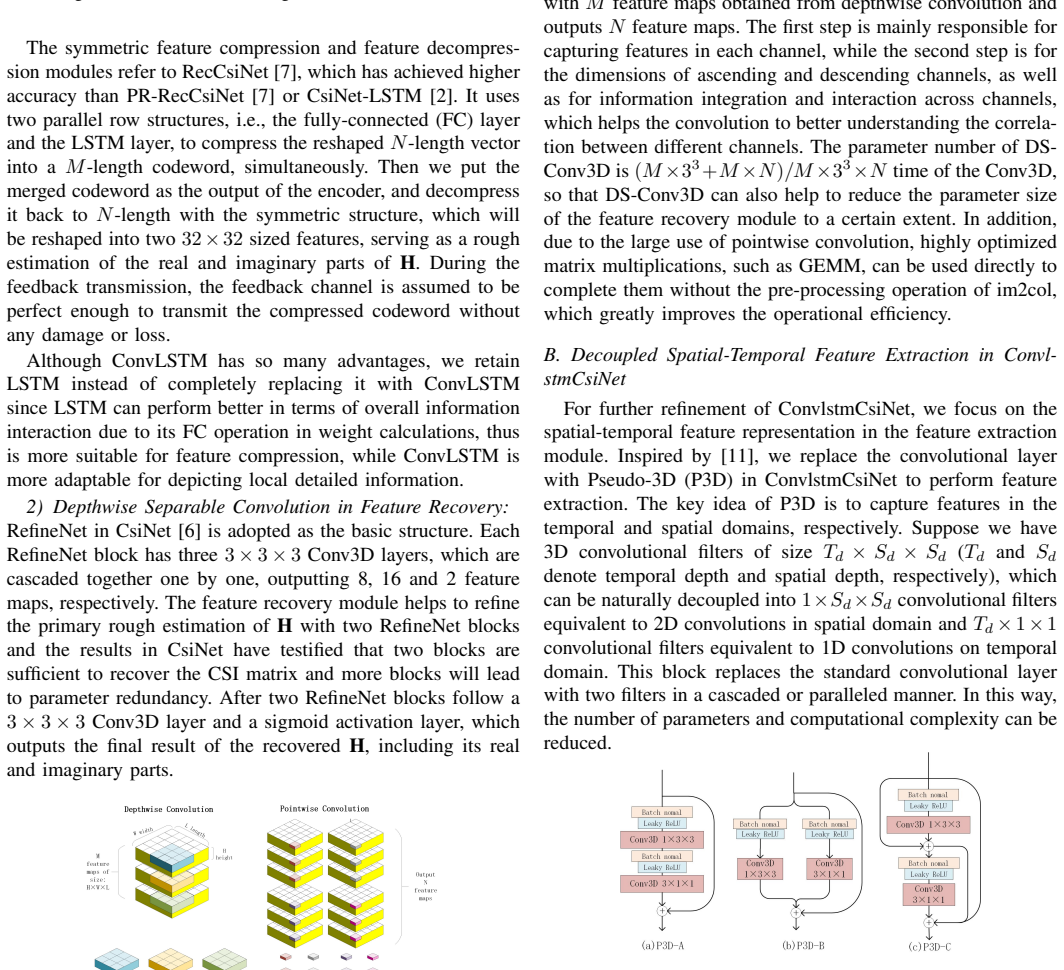
Two named mechanisms carry the argument. ConvLSTM is a convolutional long short-term memory layer that lets the encoder accumulate temporal context while keeping local spatial detail; it sits in the feature-extraction module. P3D blocks are the paper's main refinement: a 3D convolution of size $T_d\times S_d\times S_d$ is decoupled into a $1\times S_d\times S_d$ spatial filter and a $T_d\times 1\times 1$ temporal filter, arranged in three ways (A cascaded, B parallel, C combined), with the cascaded P3D-A giving the best results. Depthwise separable convolution in the recovery module splits each Conv3D into a per-channel depthwise step and a $1\times1\times1$ pointwise step, shrinking parameters and enabling cross-channel information mixing. These pieces work together to make the autoencoder both smaller and more accurate than its predecessors.
What would settle it
Train and test ConvlstmCsiNet-A and RecCsiNet on the same COST2100 channels but with time evolution generated by a Jakes Doppler spectrum (or by measured channel traces) instead of Eq. (3), at CR 1/4 and 1/32; if ConvlstmCsiNet-A no longer beats RecCsiNet by the reported margins, the claim is bound to the AR(1) data model.
Extended reading notes
Core claim
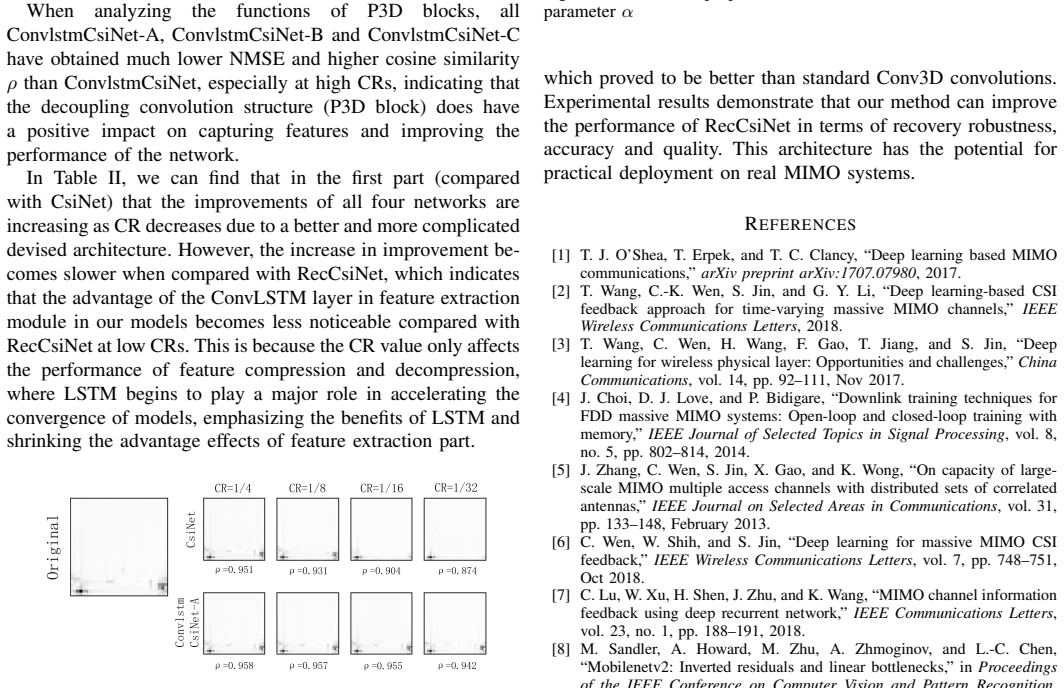
The paper's central claim is that a CSI feedback autoencoder that separates spatial and temporal feature extraction and injects recurrent memory at the encoder recovers time-varying MIMO channels more accurately than prior deep-learning feedback networks. ConvlstmCsiNet-A, the variant with cascaded P3D-A blocks, reports the best normalized mean-square error and cosine similarity at every tested compression ratio, with the largest gain relative to CsiNet appearing at the most aggressive ratio (114.9% NMSE improvement at CR 1/32). The improvement over RecCsiNet is smaller but still positive at all ratios, and reconstruction quality degrades gracefully as the temporal correlation parameter $\alpha$ rises, confirming that the network is exploiting the assumed time-sequence structure.
Load-bearing premise
The load-bearing premise is that successive channel matrices follow a first-order autoregressive law $H_{t+1}=(1-\alpha^2)H_t+\alpha^2 u_t$ with a single correlation parameter $\alpha=0.1$; if real massive MIMO channels move differently, the temporal-correlation gains reported here may not transfer.
Editorial extensions
If this is right
- At all four compression ratios (1/4, 1/8, 1/16, 1/32), the proposed ConvlstmCsiNet-A reports lower NMSE and higher cosine similarity than CsiNet and RecCsiNet on the indoor COST2100 scenario.
- The relative gain over CsiNet grows monotonically as compression tightens, so recurrent temporal modelling is most valuable exactly when the feedback codeword is shortest.
- Decoupling spatial and temporal filters (P3D) improves on a single 3D convolution, so the architectural change is independently useful beyond the recurrent layer.
- Replacing standard Conv3D with depthwise separable convolution reduces parameter count and computation, making the accuracy gains compatible with practical deployment constraints.
Reading between the lines
- Beyond the paper: the temporal model in Eq. (3) uses one scalar $\alpha$ for the whole channel; a direct extension would train on measured time sequences with per-subcarrier or per-path Doppler and test whether ConvLSTM still buys the same margin.
- Beyond the paper: because P3D and depthwise separable convolution are modular substitutions, they could be combined with quantization-aware training or attention mechanisms to push CSI feedback toward real bit-rate constraints, something this letter does not evaluate.
- Beyond the paper: the reported gains are in reconstruction NMSE and cosine similarity, not in end-to-end throughput; whether the better reconstruction translates into spectral-efficiency gains under actual precoding is an open testable question.
Signed reviews
Editorial analysis
A structured set of objections, weighed in public.
Referee Report
Summary. The manuscript proposes ConvlstmCsiNet, an autoencoder for massive MIMO CSI feedback that extends RecCsiNet by adding a ConvLSTM feature-extraction layer, replacing standard 3D convolutions in the RefineNet recovery module with depthwise separable convolutions, and substituting P3D blocks for the feature-extraction convolution. The paper reports NMSE and cosine-similarity results on the COST2100 indoor scenario at four compression ratios, with channel time sequences generated by the first-order state-space model in Eq. (3), and claims that the proposed ConvlstmCsiNet-A outperforms existing DL-based CSI feedback methods.
Significance. If the claims hold, the architecture would be a useful improvement: all proposed variants outperform CsiNet and RecCsiNet on the tested scenario, with the largest gain at CR 1/4 (log-NMSE -28.4 dB versus -21.5 dB for RecCsiNet), and the qualitative reconstruction figure supports the numerical result. The paper also clearly describes the training protocol and data preprocessing. However, the significance is tempered by the absence of the closest published RNN baseline, CsiNet-LSTM, and by the fact that the temporal correlation is injected by the synthetic AR(1) model rather than measured from a time-varying channel; the general claim 'outperforms existing DL-based methods' is therefore broader than the tested comparison set.
major comments (4)
- [Section IV, Tables I and II] CsiNet-LSTM [2], which the Introduction explicitly identifies as an RNN-based extension of CsiNet that exploits temporal correlation, is never evaluated. Since the proposed architecture's main novelty is temporal-correlation modeling and it builds directly on RecCsiNet, the claimed superiority over 'existing DL-based methods' is not established against the most relevant published baseline. Please add CsiNet-LSTM to Tables I and II and discuss the margins over it for all compression ratios.
- [Section II, Eq. (3), and Section IV data generation] The temporal sequence is generated from the state-space model H_{t+1} = F H_t + G u_t with F = (1-alpha^2)I, G = alpha^2 I, and alpha = 0.1, and the same model generates the training and test data. The ConvLSTM and RNN components are precisely designed to exploit this injected temporal correlation, so the benchmark is tailored to the method. Please validate on measured or independently simulated time-varying channels (for example, true COST2100 time evolution or channel traces) and report whether the reported gains persist under more realistic temporal dynamics.
- [Section III.A.2] One of the two stated contributions is that depthwise separable convolution 'shrink[s] the model,' but no parameter count, FLOPs, or runtime comparison is reported for any model. Without these numbers, the model-compression claim is unverified. Please report parameter counts for CsiNet, RecCsiNet, and the proposed variants, together with the corresponding NMSE results.
- [Tables I and II] No error bars, multiple independent runs, or statistical significance test are reported. This matters because some improvements are small: for example, ConvlstmCsiNet versus RecCsiNet at CR 1/32 is reported as a 0.75% improvement in Table II, which corresponds to roughly 0.1 dB in log-NMSE. The authors should report mean and standard deviation over repeated training runs, or otherwise indicate which small-margin entries are reproducible.
minor comments (5)
- [Section IV, Table II] The 'percentage improvement' values in Table II appear to be computed on the log-NMSE values in Table I (for example, 64.0% matches (-28.4 + 17.5)/(-17.5) rather than a ratio of linear NMSE). Please define this metric explicitly; reporting linear NMSE ratios would be more physically meaningful.
- [Section IV] There is a typo in 'Tabel II,' and 'spacial' in the Conclusion should be 'spatial.'
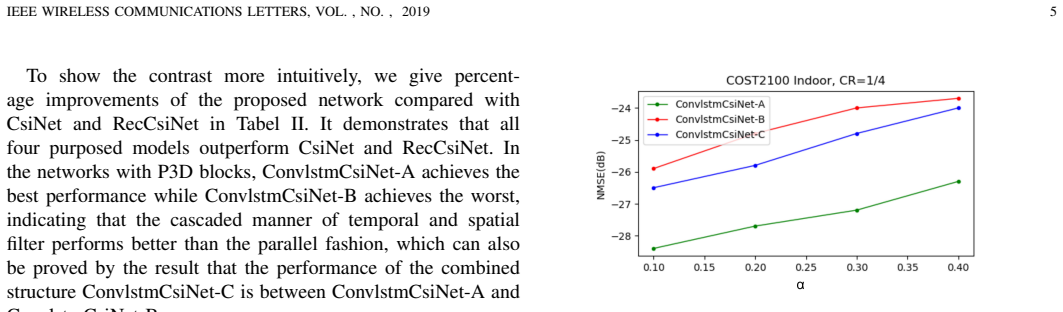
- [Section IV, Figure 6] Figure 6 is referenced in the text but the caption and axis labels are not described in the manuscript body; please add them and indicate whether the same trend is observed for the baselines.
- [Section III.B] The sentence stating that P3D blocks 'replace the convolution in feature compression module' seems to contradict the surrounding text and Figure 1, which place P3D in the feature extraction module; please clarify.
- [Section III.A, Eq. (5)] The displayed loss divides by MT but not by the number of spatial elements Nt*Nc, so it is not exactly the mean squared error as written; this constant scaling does not change the training dynamics, but the formula should be corrected.
Circularity Check
No circularity: the paper's claims are experimental architecture comparisons, with no fitted parameter relabeled as a prediction and no load-bearing self-citation chain.
full rationale
This is an empirical architecture paper rather than a derivation chain, so there is no analytical result that could reduce to its own inputs. The only potentially concerning choice is that training and test channels are generated from the state-space model in Eq. (3), H_{t+1} = F H_t + G u_t with F=(1-alpha^2)I and G=alpha^2 I, which injects the temporal correlation that the RNN/ConvLSTM components are designed to exploit. That is experimental design, not circularity: the paper does not fit a parameter from the test set and then present that fit as a prediction, and the synthetic channel model is explicitly attributed to an external reference ([9]) rather than to the authors' own prior results. All baselines compared in Tables I and II, namely CsiNet [6] and RecCsiNet [7], are external works, and the cited CsiNet-LSTM [2] is also from other authors; there are no self-citations, uniqueness theorems imported from the authors, or ansatzes smuggled in via the authors' prior work. The omission of CsiNet-LSTM from the experimental comparison is a legitimate concern about the breadth of the 'outperforms existing DL-based methods' claim, but that is a baseline-completeness/fairness issue, not a circular derivation. No circular step can be exhibited with a specific equation-to-equation reduction, so the appropriate finding is no significant circularity.
Assumptions & free parameters
free parameters (3)
- alpha =
0.1 for main results; varied in Fig. 6
- sigma_u =
1e-3
- T =
4
assumptions (4)
- domain assumption The angular-delay domain CSI matrix is sparse after 2D DFT, and only the first Nc columns contain significant energy.
- ad hoc to paper The time-varying channel follows H_{t+1} = F H_t + G u_t, with F = (1-alpha^2)I and G = alpha^2 I (Eq. 3).
- domain assumption COST2100 with the default indoor picocellular settings at 5.3 GHz is a realistic channel model.
- domain assumption The feedback channel transmits the compressed codeword without loss or quantization error.
Cite this review
Pith. "Pith review of Spatio-Temporal Representation with Deep Neural Recurrent Network in MIMO CSI Feedback." pith.science (2026). https://pith.science/paper/A5B7JRDG
@misc{pith2026190807934,
  author       = {Pith},
  title        = {Pith review of: Spatio-Temporal Representation with Deep Neural Recurrent Network in MIMO CSI Feedback},
  year         = {2026},
  howpublished = {\url{https://pith.science/paper/A5B7JRDG}},
  note         = {Machine review of arXiv:1908.07934}
}
read the original abstract
In multiple-input multiple-output (MIMO) systems, it is crucial of utilizing the available channel state information (CSI) at the transmitter for precoding to improve the performance of frequency division duplex (FDD) networks. One of the mainchallenges is to compress a large amount of CSI in CSI feedback transmission in massive MIMO systems. In this paper, we propose a deep learning (DL)-based approach that uses a deep recurrent neural network (RNN) to learn temporal correlation and adopts depthwise separable convolution to shrink the model. The feature extraction module is also elaborately devised by studyingdecoupled spatio-temporal feature representations in different structures. Experimental results demonstrate that the proposed approach outperforms existing DL-based methods in terms of recovery quality and accuracy, which can also achieve remarkable robustness at low compression ratio (CR).
Figures


Figures from the paper (2 more)
Reference graph
Works this paper leans on
-
[2]
Deep learning-based CSI feedback approach for time-varying massive MIMO channels,
T. Wang, C.-K. Wen, S. Jin, and G. Y . Li, “Deep learning-based CSI feedback approach for time-varying massive MIMO channels,” IEEE Wireless Communications Letters, 2018
work page 2018
-
[1]
Deep learning based MIMO communications,
T. J. O’Shea, T. Erpek, and T. C. Clancy, “Deep learning based MIMO communications,” arXiv preprint arXiv:1707.07980 , 2017
arXiv 2017
-
[3]
Deep learning for wireless physical layer: Opportunities and challenges,
T. Wang, C. Wen, H. Wang, F. Gao, T. Jiang, and S. Jin, “Deep learning for wireless physical layer: Opportunities and challenges,” China Communications, vol. 14, pp. 92–111, Nov 2017
work page 2017
-
[4]
J. Choi, D. J. Love, and P. Bidigare, “Downlink training techniques for FDD massive MIMO systems: Open-loop and closed-loop training with memory,” IEEE Journal of Selected Topics in Signal Processing , vol. 8, no. 5, pp. 802–814, 2014
work page 2014
-
[5]
J. Zhang, C. Wen, S. Jin, X. Gao, and K. Wong, “On capacity of large- scale MIMO multiple access channels with distributed sets of correlated antennas,” IEEE Journal on Selected Areas in Communications , vol. 31, pp. 133–148, February 2013
work page 2013
-
[6]
Deep learning for massive MIMO CSI feedback,
C. Wen, W. Shih, and S. Jin, “Deep learning for massive MIMO CSI feedback,” IEEE Wireless Communications Letters , vol. 7, pp. 748–751, Oct 2018
work page 2018
-
[7]
MIMO channel information feedback using deep recurrent network,
C. Lu, W. Xu, H. Shen, J. Zhu, and K. Wang, “MIMO channel information feedback using deep recurrent network,” IEEE Communications Letters , vol. 23, no. 1, pp. 188–191, 2018
work page 2018
-
[8]
Mobilenetv2: Inverted residuals and linear bottlenecks,
M. Sandler, A. Howard, M. Zhu, A. Zhmoginov, and L.-C. Chen, “Mobilenetv2: Inverted residuals and linear bottlenecks,” in Proceedings of the IEEE Conference on Computer Vision and Pattern Recognition , pp. 4510–4520, 2018
work page 2018
Show all 14 references
-
[9]
An EM-based forward-backward kalman filter for the estimation of time-variant channels in OFDM,
T. Y . Al-Naffouri, “An EM-based forward-backward kalman filter for the estimation of time-variant channels in OFDM,” IEEE Transactions on Signal Processing, vol. 55, no. 7, pp. 3924–3930, 2007
2007
-
[10]
Convolutional LSTM network: A machine learning approach for precipitation nowcasting,
S. Xingjian, Z. Chen, H. Wang, D.-Y . Yeung, W.-K. Wong, and W.-c. Woo, “Convolutional LSTM network: A machine learning approach for precipitation nowcasting,” in Advances in neural information processing systems, pp. 802–810, 2015
2015
-
[11]
Learning spatio-temporal representation with pseudo-3d residual networks,
Z. Qiu, T. Yao, and T. Mei, “Learning spatio-temporal representation with pseudo-3d residual networks,” in proceedings of the IEEE International Conference on Computer Vision , pp. 5533–5541, 2017
2017
-
[12]
Inception-v4, inception-resnet and the impact of residual connections on learning,
C. Szegedy, S. Ioffe, and V . Vanhoucke, “Inception-v4, inception-resnet and the impact of residual connections on learning,” AAAI Conference on Artificial Intelligence, 02 2016
2016
-
[13]
Identity mappings in deep residual networks,
K. He, X. Zhang, S. Ren, and J. Sun, “Identity mappings in deep residual networks,” in European conference on computer vision , pp. 630–645, Springer, 2016
2016
-
[14]
The COST 2100 MIMO channel model,
L. Liu, C. Oestges, J. Poutanen, K. Haneda, P. Vainikainen, F. Quitin, F. Tufvesson, and P. De Doncker, “The COST 2100 MIMO channel model,” IEEE Wireless Communications, vol. 19, no. 6, pp. 92–99, 2012
2012
Reviewed August 14, 2026 · model on record in the stance chip above.
Discussion (0). Continue with ORCID to comment.