REVIEW 4 major objections 5 minor 2 cited by
I Know What You Said: Unveiling Hardware Cache Side-Channels in Local Large Language Model Inference
T0 review · 4 major / 5 minor · reviewed 2026-08-15 · deepseek-v4-flash
Pith's one-line read A spy process can reconstruct both the prompt and the reply of a local LLM session from cache timing alone.
desk verdict First credible demonstration that a co-resident unprivileged process can recover both sides of a local LLM conversation via cache side channels, but the claim needs to be scoped to zero-copy, file-backed deployments. read the letter →
The pith
A machine-rendered reading of the paper's core claim, the machinery that carries it, and where it could break.
The reading
What carries the argument
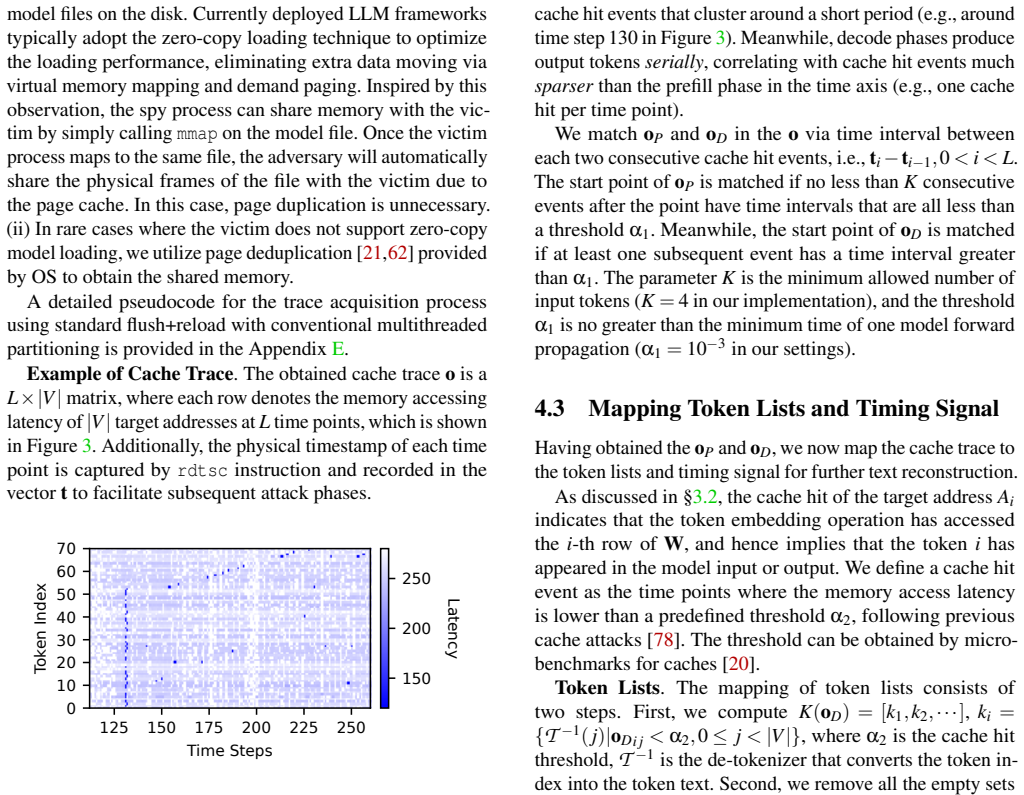
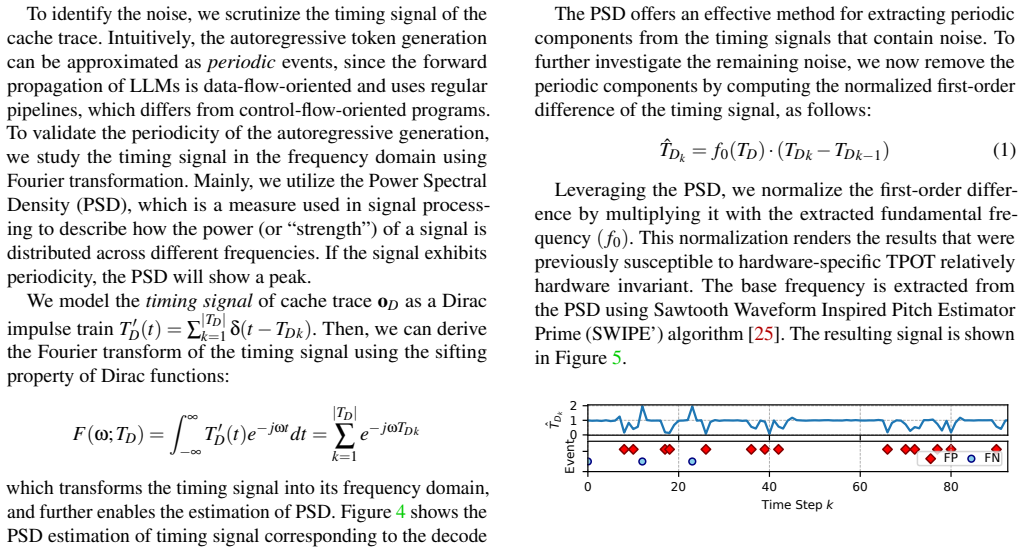
The load-bearing object is the token embedding table W: with one-hot input, the embedding step is E_i = W[token_i], so each token fetches exactly one row of W into cache, turning vocabulary membership into a reproducible address trace. The attack probes the vocabulary-sized set of addresses inside W with the flush+reload technique and treats a cache hit on row j as evidence that token j was processed. The second mechanism is the timing signal: decode phases are modeled as a Dirac impulse train that is approximately periodic, and the paper uses the power spectral density and the SWIPE' pitch estimator to extract the fundamental period, then normalizes the first-order differences of hit timestamps to make the signal hardware-invariant. These two signals are consumed by two fine-tuned LLMs that act as learned denoisers and reorderers, so the framework's text-recovery power comes from combining a microarchitectural leak with statistical language-model priors.
What would settle it
Run the identical cache-trace capture against a victim deployment that disables zero-copy model loading and has kernel page deduplication turned off: if no periodic embedding-row hit pattern with a clear PSD peak appears during decode phases, the claimed side channel does not exist for that configuration; a complementary check would be to store the embedding table under a secret random row permutation and see whether the recovered token indices still correlate with the true tokens.
Extended reading notes
Core claim
The central discovery is that two ordinary properties of LLM inference form a side channel. First, because token embedding is a lookup of one row per token from a large embedding table, every token a model reads or writes is reflected in which cache lines of that table were fetched. Second, because autoregressive decoding is strictly serial, each generated token lands at a roughly periodic timestamp, and the paper observes this periodicity in the power spectral density of cache-hit events. On that basis, the paper argues that a spy who shares the model file's memory pages with the victim can run flush+reload to harvest a token list, separate the prefill phase from the decode phases by hit density, and use the timing signal to distinguish genuine tokens from false positives and missing tokens. The paper then claims that fine-tuned LLMs can complete the reconstruction: one fuses the token list with the normalized timing waveform to recover the output text, and another restores the original order of the shuffled input tokens using the recovered output as context. The evaluations across multiple model families, inference frameworks, CPUs, and operating systems are presented as evidence that this eavesdropping path is practical, not just theoretical.
Load-bearing premise
The attack requires the spy and victim to share the physical memory of the embedding table, normally via zero-copy file mapping or OS page deduplication; if both are disabled, the flush+reload probe sees nothing and the whole recovery chain collapses.
Editorial extensions
If this is right
- Process isolation alone no longer protects local LLM sessions: an unprivileged co-located application can extract the text a user types and the model writes back.
- Because the vulnerability stems from the standard embedding-lookup design and the autoregressive loop, it applies to a broad class of local deployments, not to a single bug in one framework.
- Output text is recoverable near-verbatim, with average Levenshtein similarity of 94.8%, so side-channel eavesdropping is a realistic route to extracting names, addresses, and other personally identifiable information from local chat sessions.
- Input recovery preserves semantics even for long prompts, with cosine similarity above 92% in the worst reported case, though character-level fidelity drops as input length grows, consistent with a factorial reordering search space.
- The main countermeasures have real costs: disabling zero-copy loading costs loading latency and extra memory, and hardware cache partitioning is usually unavailable on consumer CPUs.
Reading between the lines
- A testable extension would be to randomize or permute the row-to-address mapping of the embedding table; if the spy's address-to-token dictionary is broken, the token-value leak is blocked without changing the model, and the paper does not evaluate this countermeasure.
- The attack's dependence on strict periodicity suggests that speculative decoding, variable batch sizes, or CPU frequency scaling that jitters the per-token interval would degrade the timing channel; measuring how much timing noise is needed to hide the PSD peak would bound the attack's applicability.
- Since tokenizers are publicly documented, the same address-dictionary method could be applied to future model formats that store the embedding table in column-major or quantized layouts, provided the row recovery is adjusted accordingly.
- The reconstruction LLMs themselves are reusable: the same 'noisy token list plus waveform to text' formulation could denoise other shared-memory side channels, such as page-table or prefetcher-based leaks, without retraining from scratch.
Signed reviews
Editorial analysis
A structured set of objections, weighed in public.
Referee Report
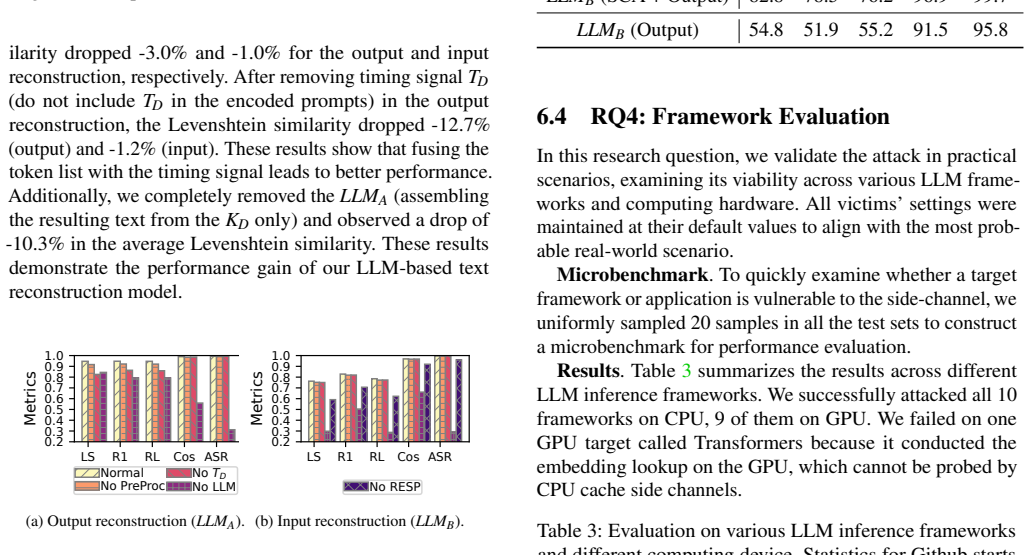
Summary. The paper proposes the first hardware cache side-channel attack against local LLM inference, claiming to reconstruct both the victim's prompt and the model's response. The attack exploits cache access patterns of the token embedding table to infer token values and the timing of autoregressive decode phases to infer token positions. The authors implement flush+reload over a shared model-file mapping, map cache hits to tokens, and fine-tune two LLMs (LLMA and LLMB) on synthetically generated noisy traces to reconstruct output and input text. They report high accuracy across several LLMs, frameworks, and machines, with average Levenshtein similarity of 94.8% for output and 82.7% for input against llama.cpp, and cosine similarity near 98%. The paper also includes ablations, a framework survey, a hardware survey, countermeasure discussion, and an open-source artifact.
Significance. If the claims are supported, this is a significant contribution: it extends hardware side-channel attacks from discriminative DNNs to full-text extraction from generative LLM inference, and it does so without direct interaction with the victim model. The paper is commendable for shipping an artifact, running end-to-end attacks against real deployments such as llama.cpp and Ollama, and providing ablations that separate the contributions of the timing signal, the reconstructed output context, and the SCA data. The core mechanism—observing secret-dependent accesses to the embedding table—is plausible. However, the paper's headline claims are broader than the evaluated threat model: the physical-layer signal depends on shared memory between spy and victim, and the fallback path via page deduplication is asserted but never demonstrated. The central evaluation and terminology in Section 4.4 also need correction. With scoped claims and a few fixes, this would be a solid and important result.
major comments (4)
- [§3.1, §4.1, §7.1] The attack's flush+reload primitive requires the spy and victim to share the physical frames of the embedding table. Section 4.1 obtains this via zero-copy mmap of the model file, with page deduplication only asserted as a fallback. All experiments appear to rely on the mmap path, and Section 7.1 admits that disabling zero-copy loading removes the mmap channel. The page-deduplication fallback is not evaluated anywhere, and on Linux it is not a reliable substitute: KSM merges anonymous pages that are explicitly marked mergeable, not a file-backed page-cache mapping against a victim's private anonymous copy. The Abstract and Section 1 should therefore scope the claim to deployments using zero-copy, file-backed model loading (e.g., llama.cpp's default), or the authors should provide a concrete, evaluated page-deduplication scenario. Without this, the headline 94.8%/82.7% figures do not transfer to configurations that disable zero-copy loading.
- [§4.4] The peak/valley analysis of the normalized timing signal swaps the terms false positive and false negative. The text says 'Assuming that we remove the i-th true positive to create a false positive'—removing a true positive creates a false negative (a missing token)—and then says 'most false negatives correlate with the valleys' while explaining that an inserted false positive between two true positives produces a small interval. The operationally correct reading is that gaps (peaks) correspond to missing tokens to be filled, and valleys correspond to inserted tokens to be removed. As written, this is internally inconsistent and makes the preprocessing stage confusing; it must be corrected.
- [§6.4, Table 3] Table 3 reports input-recovery cosine similarities of 74.5% for HuggingFace Transformers on CPU and 74.5% for BitNet on GPU, while the text states 'We successfully attacked all 10 frameworks on CPU, 9 of them on GPU.' These values are below the paper's own ASR threshold of φ > 0.77 established in Section 5. The claim of 'successfully attacked' is therefore inconsistent with the paper's success criterion. Either the notion of success for the framework survey must be redefined, or the affected rows should be reported as failures/partial leaks, and the 'all 10 frameworks' claim should be revised.
- [Table 1 and Figures 8–10] The central evaluation reports only averages over test sentences, with no error bars, standard deviations, confidence intervals, or numbers of repeated runs for each configuration. Given the noise inherent in cache side-channel traces and the stochasticity of LLM-based reconstruction, the paper should report per-sample variance (e.g., min/max or interquartile range) and ideally at least three repeated attacks per setup. This is needed to assess the reliability of the headline averages, especially the 94.8% and 82.7% Levenshtein-similarity figures.
minor comments (5)
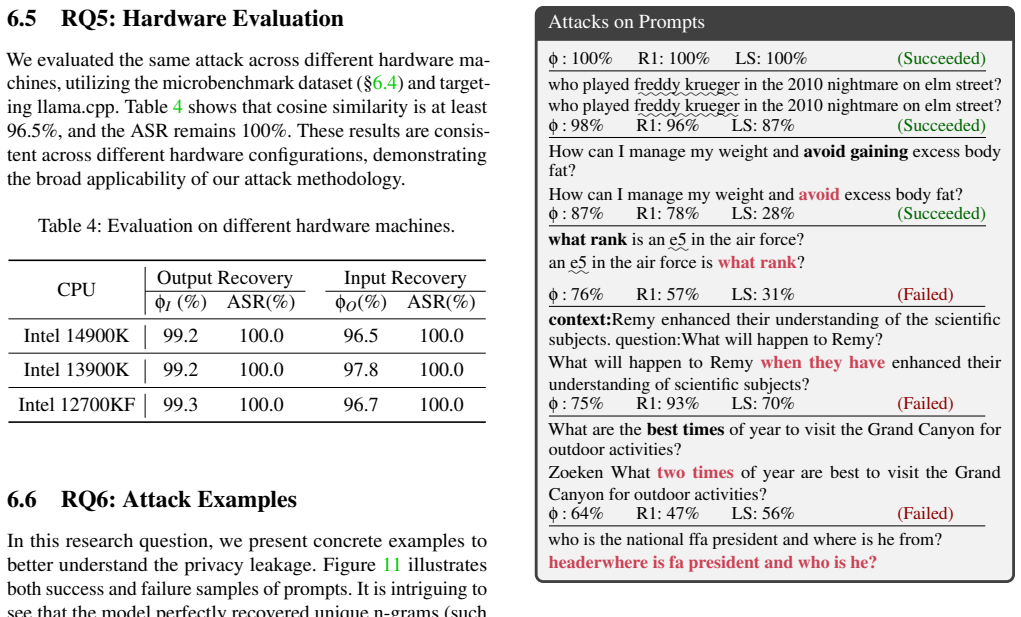
- [§5, Metrics] The ASR threshold of φ > 0.77 is calibrated using a human survey over the attack's own outputs; while this is a reasonable subjective calibration, the paper should state clearly that ASR is not an independent measure of exact-text recovery and that the 99%+ ASR figures inherit the survey threshold.
- [§6.2, Figure 8] In the discussion of σ sensitivity, the text says 'the output reconstruction performance peaks at s = 0.08' where the variable is σ; the notation should be consistent.
- [§6.5, Table 4] The hardware evaluation uses only the 20-sample microbenchmark from Section 6.4; the paper should state this explicitly so readers do not infer that the full test set was used on each CPU.
- [§7.1] The performance cost of disabling zero-copy loading (17% loading-latency increase and 32% extra memory overhead) is reported without experimental detail; a citation or a brief methodology note would help.
- [§4.1] The claim that 'the malicious code can open the model file in read-only mode and call mmap' should be stated as an assumption in the threat model rather than as an unconditioned capability, since not all deployments expose the model file to the adversary's user.
Circularity Check
No significant circularity: the attack pipeline is evaluated against external ground truth and the reconstruction models are trained on independent synthetic data.
full rationale
The paper's derivation chain is not circular. The token-value leakage is modeled as the standard secret-dependent embedding-table lookup (Section 3.2: 'Ei = W[ti], i.e., retrieving the ti-th row of W'), and the token-position leakage is the timing of autoregressive decode phases; neither leakage is defined in terms of the reconstructed text. The reconstruction models LLMA and LLMB are fine-tuned on independently synthesized datasets (Algorithm 1 and Section 4.5) and then evaluated on real cache traces against external ground-truth text (Table 1), so the reported Levenshtein, ROUGE, and cosine-similarity figures are not forced by construction. The cache-hit threshold alpha2 is obtained by micro-benchmarks, and the prefetcher countermeasures follow prior published techniques. There are no load-bearing self-citations: the cited works are external (flush+reload [78], SWIPE' [25], the human-survey methodology [70]) and none is an authors' own uniqueness theorem. The only mild self-reference is the ASR threshold of cosine similarity above 0.77 (Section 5), which is calibrated by a human survey over the attack's own outputs and then used to define success; this calibrates the binary success metric rather than determining the reconstructed text, so it does not constitute a circular derivation. Overall, the paper's central claim is self-contained and externally validated.
Assumptions & free parameters
free parameters (6)
- alpha_1 (phase boundary threshold) =
10^-3 seconds
- alpha_2 (cache hit threshold) =
from microbenchmark
- K (minimum prefill events) =
4
- p (synthetic noise probability) =
0.2 (default), tested 0.1 to 0.8
- sigma (decode period jitter) =
0.08 (default)
- ASR cosine threshold =
0.77
assumptions (4)
- domain assumption Token embedding executes on the CPU in victim frameworks.
- domain assumption The model file is mapped into shared memory via mmap or page deduplication.
- domain assumption Autoregressive decode phases are approximately periodic, so power spectral density separates true hits from noise.
- domain assumption Embedding table layout and tokenizer vocabulary are publicly known.
Cite this review
Pith. "Pith review of I Know What You Said: Unveiling Hardware Cache Side-Channels in Local Large Language Model Inference." pith.science (2026). https://pith.science/paper/A5E3JYT5
@misc{pith2026250506738,
  author       = {Pith},
  title        = {Pith review of: I Know What You Said: Unveiling Hardware Cache Side-Channels in Local Large Language Model Inference},
  year         = {2026},
  howpublished = {\url{https://pith.science/paper/A5E3JYT5}},
  note         = {Machine review of arXiv:2505.06738}
}
read the original abstract
Large Language Models (LLMs) that can be deployed locally have recently gained popularity for privacy-sensitive tasks, with companies such as Meta, Google, and Intel playing significant roles in their development. However, the security of local LLMs through the lens of hardware cache side-channels remains unexplored. In this paper, we unveil novel side-channel vulnerabilities in local LLM inference: token value and token position leakage, which can expose both the victim's input and output text, thereby compromising user privacy. Specifically, we found that adversaries can infer the token values from the cache access patterns of the token embedding operation, and deduce the token positions from the timing of autoregressive decoding phases. To demonstrate the potential of these leaks, we design a novel eavesdropping attack framework targeting both open-source and proprietary LLM inference systems. The attack framework does not directly interact with the victim's LLM and can be executed without privilege. We evaluate the attack on a range of practical local LLM deployments (e.g., Llama, Falcon, and Gemma), and the results show that our attack achieves promising accuracy. The restored output and input text have an average edit distance of 5.2% and 17.3% to the ground truth, respectively. Furthermore, the reconstructed texts achieve average cosine similarity scores of 98.7% (input) and 98.0% (output).
Figures


Figures from the paper (7 more)


Forward citations
Cited by 2 Pith papers
-
Leaky Language Models: Stealing Architecture and Inference Optimizations via Per-Token Timing
Per-token generation timing leaks speculative decoding and draft-model context length from Gemini, and recovers layer count and hidden size of Llama-family models with top-5 accuracy up to 65% when both are unknown.
-
Securing Deep Learning Hardware: A Survey of Side-Channel Vulnerabilities and Countermeasures
Hardware side-channel attacks can recover deep-learning model architecture, parameters and inputs; this survey taxonomizes the leaks, attacks and countermeasures.
Reference graph
Works this paper leans on
-
[1]
https://huggingface.co/ datasets/WynterJones/chatgpt-roles
Chatgpt-roles. https://huggingface.co/ datasets/WynterJones/chatgpt-roles
-
[2]
https://pytorch.org/blog/ tensor-memory-format-matters/
Efficient PyTorch: Tensor memory format matters. https://pytorch.org/blog/ tensor-memory-format-matters/
-
[3]
https://falconllm.tii.ae/falcon3/ index.html
Falcon3. https://falconllm.tii.ae/falcon3/ index.html
-
[4]
https://ai.google.dev/gemma
Gemma. https://ai.google.dev/gemma
-
[5]
https:// github.com/huggingface/transformers
HuggingFace Transformers: State-of-the-art machine learning for jax, pytorch and tensorflow. https:// github.com/huggingface/transformers
-
[6]
https://github.com/ intel-analytics/ipex-llm
Intel IPEX-LLM: Accelerate local llm infer- ence and finetuning. https://github.com/ intel-analytics/ipex-llm
- [7]
-
[8]
https://www.llama.com/?ref= hacktheprompt
Llama. https://www.llama.com/?ref= hacktheprompt
Show all 84 references
-
[9]
https://www.llama.com/docs/ llama-everywhere
Llama everywhere. https://www.llama.com/docs/ llama-everywhere
-
[10]
https://github.com/mudler/ LocalAI
LocalAI: The free, open source alternative to openai, claude and others. https://github.com/mudler/ LocalAI
-
[11]
https://github.com/microsoft/BitNet
Microsoft BitNet: Official inference framework for 1-bit llms. https://github.com/microsoft/BitNet
-
[12]
https://ai.azure
Microsoft phi-3.5 mini. https://ai.azure. com/explore/models/Phi-3.5-mini-instruct/ version/6/registry/azureml
-
[13]
https://mistral.ai
Mistral. https://mistral.ai
-
[14]
https://chatgpt.com/
Openai chatgpt. https://chatgpt.com/
-
[15]
https://peps
PEP 3154 - pickle protocol version 4. https://peps. python.org/pep-3154/
-
[16]
https://huggingface.co/docs/ safetensors/index
Safetensors. https://huggingface.co/docs/ safetensors/index
-
[17]
The new era of the ai pc: What does the ai pc mean for users, and how does it work for them? Technical report, Intel, 2023
2023
-
[18]
https://huggingface.co/docs/transformers/perf_infer_cpu, 2024
Hugging face transformers - cpu inference. https://huggingface.co/docs/transformers/perf_infer_cpu, 2024
2024
-
[19]
https://github.com/ollama/ollama, 2024
Ollama: Get up and running with large language mod- els locally. https://github.com/ollama/ollama, 2024
2024
-
[20]
nanobench: A low- overhead tool for running microbenchmarks on x86 sys- tems
Andreas Abel and Jan Reineke. nanobench: A low- overhead tool for running microbenchmarks on x86 sys- tems. In 2020 IEEE International Symposium on Per- formance Analysis of Systems and Software (ISPASS), pages 34–46, 2020
2020
-
[21]
In- creasing memory density by using ksm
Andrea Arcangeli, Izik Eidus, and Chris Wright. In- creasing memory density by using ksm. In Proceedings of the linux symposium, pages 19–28. Citeseer, 2009
2009
-
[22]
CSI NN: Reverse engineering of neural net- work architectures through electromagnetic side chan- nel
Lejla Batina, Shivam Bhasin, Dirmanto Jap, and Stjepan Picek. CSI NN: Reverse engineering of neural net- work architectures through electromagnetic side chan- nel. In 28th USENIX Security Symposium (USENIX Security 19), pages 515–532, Santa Clara, CA, August
-
[23]
Samsung bans staff’s AI use after spotting ChatGPT data leak
bloomberg. Samsung bans staff’s AI use after spotting ChatGPT data leak. https://www.bloomberg.com/news/articles/2023- 05-02/samsung-bans-chatgpt-and-other-generative-ai- use-by-staff-after-leak, 2023
2023
-
[24]
Brown, Benjamin Mann, Nick Ryder, Melanie Subbiah, Jared Kaplan, Prafulla Dhariwal, and et al
Tom B. Brown, Benjamin Mann, Nick Ryder, Melanie Subbiah, Jared Kaplan, Prafulla Dhariwal, and et al. Lan- guage models are few-shot learners. In Proceedings of the 34th International Conference on Neural Informa- tion Processing Systems, NIPS ’20, Red Hook, NY , USA,
-
[25]
Arturo Camacho and John G. Harris. A sawtooth waveform inspired pitch estimator for speech and mu- sic. The Journal of the Acoustical Society of America, 124(3):1638–1652, 09 2008
2008
-
[26]
Topic modeling using latent dirichlet allocation: A survey.ACM Comput
Uttam Chauhan and Apurva Shah. Topic modeling using latent dirichlet allocation: A survey.ACM Comput. Surv., 54(7), September 2021
2021
-
[27]
GoFetch: Breaking Constant-Time cryptographic implementations using data Memory-Dependent prefetchers
Boru Chen, Yingchen Wang, Pradyumna Shome, Christopher Fletcher, David Kohlbrenner, Riccardo Paccagnella, and Daniel Genkin. GoFetch: Breaking Constant-Time cryptographic implementations using data Memory-Dependent prefetchers. In 33rd USENIX Security Symposium (USENIX Securit...
2024
-
[28]
Palm: Scaling language modeling with pathways
Aakanksha Chowdhery, Sharan Narang, Jacob Devlin, Maarten Bosma, Gaurav Mishra, Adam Roberts, and et al. Palm: Scaling language modeling with pathways. J. Mach. Learn. Res., 24:240:1–240:113, 2023
2023
-
[29]
Reconstruct your previous conversations! com- prehensively investigating privacy leakage risks in con- versations with gpt models, 2024
Junjie Chu, Zeyang Sha, Michael Backes, and Yang Zhang. Reconstruct your previous conversations! com- prehensively investigating privacy leakage risks in con- versations with gpt models, 2024
2024
-
[30]
Aes proposal: Rijndael, 1999
Joan Daemen. Aes proposal: Rijndael, 1999
1999
-
[31]
Flashattention-2: Faster attention with better parallelism and work partitioning
Tri Dao. Flashattention-2: Faster attention with better parallelism and work partitioning. In The Twelfth Inter- national Conference on Learning Representations, ICLR 2024, Vienna, Austria, May 7-11, 2024. OpenReview.net, 2024
2024
-
[32]
Choquette-Choo, Matthew Jagielski, Mi- lad Nasr, Eric Wallace, and Florian Tramèr
Edoardo Debenedetti, Giorgio Severi, Nicholas Carlini, Christopher A. Choquette-Choo, Matthew Jagielski, Mi- lad Nasr, Eric Wallace, and Florian Tramèr. Privacy side channels in machine learning systems. In 33rd USENIX Security Symposium (USENIX Security 24), pages 6861– 6848,...
2024
-
[33]
The case for 4- bit precision: k-bit inference scaling laws
Tim Dettmers and Luke Zettlemoyer. The case for 4- bit precision: k-bit inference scaling laws. In Interna- tional Conference on Machine Learning, ICML 2023, 23-29 July 2023, Honolulu, Hawaii, USA, volume 202 of Proceedings of Machine Learning Research, pages 7750–7774. PMLR, 2023
2023
-
[34]
BERT: Pre-training of deep bidirec- tional transformers for language understanding
Jacob Devlin, Ming-Wei Chang, Kenton Lee, and Kristina Toutanova. BERT: Pre-training of deep bidirec- tional transformers for language understanding. In Pro- ceedings of the 2019 Conference of the North American Chapter of the Association for Computational Linguis- tics: Human...
2019
-
[35]
Enhancing chat language models by scaling high-quality instructional conversations
Ning Ding, Yulin Chen, Bokai Xu, Yujia Qin, Zhi Zheng, Shengding Hu, Zhiyuan Liu, Maosong Sun, and Bowen Zhou. Enhancing chat language models by scaling high-quality instructional conversations. arXiv preprint arXiv:2305.14233, 2023
2023 arXiv
-
[36]
Deeptheft: Stealing dnn model ar- chitectures through power side channel
Yansong Gao, Huming Qiu, Zhi Zhang, Binghui Wang, Hua Ma, Alsharif Abuadbba, Minhui Xue, Anmin Fu, and Surya Nepal. Deeptheft: Stealing dnn model ar- chitectures through power side channel. In 2024 IEEE Symposium on Security and Privacy (SP), pages 3311– 3326, 2024
2024
-
[37]
ggerganov/llama.cpp: Port of Face- book’s LLaMA model in C/C++
Georgi Gerganov. ggerganov/llama.cpp: Port of Face- book’s LLaMA model in C/C++. https://github. com/ggerganov/llama.cpp, 2024
2024
-
[38]
Side-channel-assisted reverse-engineering of encrypted dnn hardware accelerator ip and attack surface explo- ration
Cheng Gongye, Yukui Luo, Xiaolin Xu, and Yunsi Fei. Side-channel-assisted reverse-engineering of encrypted dnn hardware accelerator ip and attack surface explo- ration. In 2024 IEEE Symposium on Security and Pri- vacy (SP), pages 4678–4695, 2024
2024
-
[39]
Flush+flush: A fast and stealthy cache attack
Daniel Gruss, Clémentine Maurice, Klaus Wagner, and Stefan Mangard. Flush+flush: A fast and stealthy cache attack. In Detection of Intrusions and Malware, and Vul- nerability Assessment - 13th International Conference, DIMVA 2016, San Sebastián, Spain, July 7-8, 2016, Pro- cee...
2016
-
[40]
Cache template attacks: Automating attacks on inclusive Last-Level caches
Daniel Gruss, Raphael Spreitzer, and Stefan Mangard. Cache template attacks: Automating attacks on inclusive Last-Level caches. In 24th USENIX Security Sympo- sium (USENIX Security 15), pages 897–912, Washing- ton, D.C., August 2015. USENIX Association
2015
-
[41]
Large language models are zero-shot time se- ries forecasters
Nate Gruver, Marc Finzi, Shikai Qiu, and Andrew G Wilson. Large language models are zero-shot time se- ries forecasters. In Advances in Neural Information Processing Systems, volume 36, pages 19622–19635. Curran Associates, Inc., 2023
2023
-
[42]
Mamba: Linear-time sequence modeling with selective state spaces, 2024
Albert Gu and Tri Dao. Mamba: Linear-time sequence modeling with selective state spaces, 2024
2024
-
[43]
Intel® 64 and ia-32 architectures software developer’s manual
Part Guide. Intel® 64 and ia-32 architectures software developer’s manual. Volume 3B: System programming Guide, Part, 2(11):0–40, 2011
2011
-
[44]
Cache games – bringing access-based cache attacks on aes to practice
David Gullasch, Endre Bangerter, and Stephan Krenn. Cache games – bringing access-based cache attacks on aes to practice. In 2011 IEEE Symposium on Security and Privacy, pages 490–505, 2011
2011
-
[45]
Deepsniffer: A dnn model extraction framework based on learning architectural hints
Xing Hu, Ling Liang, Shuangchen Li, Lei Deng, Pengfei Zuo, Yu Ji, Xinfeng Xie, Yufei Ding, Chang Liu, Timo- thy Sherwood, and Yuan Xie. Deepsniffer: A dnn model extraction framework based on learning architectural hints. In Proceedings of the Twenty-Fifth International Confere...
2020
-
[46]
Edward Suh
Weizhe Hua, Zhiru Zhang, and G. Edward Suh. Reverse engineering convolutional neural networks through side- channel information leaks. In Proceedings of the 55th Annual Design Automation Conference, DAC ’18, New York, NY , USA, 2018. Association for Computing Ma- chinery
2018
-
[47]
Pleak: Prompt leaking attacks against large language model applications, 2024
Bo Hui, Haolin Yuan, Neil Gong, Philippe Burlina, and Yinzhi Cao. Pleak: Prompt leaking attacks against large language model applications, 2024
2024
-
[48]
Cross processor cache attacks
Gorka Irazoqui, Thomas Eisenbarth, and Berk Sunar. Cross processor cache attacks. ASIA CCS ’16, page 353–364, New York, NY , USA, 2016. Association for Computing Machinery
2016
-
[49]
Natural questions: a benchmark for question answering research
Tom Kwiatkowski, Jennimaria Palomaki, Olivia Red- field, Michael Collins, Ankur Parikh, Chris Alberti, Danielle Epstein, Illia Polosukhin, Jacob Devlin, Kenton Lee, et al. Natural questions: a benchmark for question answering research. Transactions of the Association for Compu...
2019
-
[50]
Efficient memory man- agement for large language model serving with page- dattention
Woosuk Kwon, Zhuohan Li, Siyuan Zhuang, Ying Sheng, Lianmin Zheng, Cody Hao Yu, Joseph Gonzalez, Hao Zhang, and Ion Stoica. Efficient memory man- agement for large language model serving with page- dattention. In Proceedings of the 29th Symposium on Operating Systems Principle...
2023
-
[51]
AoE: Angle-optimized em- beddings for semantic textual similarity
Xianming Li and Jing Li. AoE: Angle-optimized em- beddings for semantic textual similarity. In Proceedings of the 62nd Annual Meeting of the Association for Com- putational Linguistics (Volume 1: Long Papers), pages 1825–1839, Bangkok, Thailand, August 2024. Associa- tion for ...
2024
-
[52]
Jamba: A hybrid transformer-mamba language model, 2024
Opher Lieber, Barak Lenz, Hofit Bata, Gal Cohen, Jhonathan Osin, Itay Dalmedigos, and et al. Jamba: A hybrid transformer-mamba language model, 2024
2024
-
[53]
Side channel-assisted inference attacks on machine learning-based ecg classification
Jialin Liu, Houman Homayoun, Chongzhou Fang, Ning Miao, and Han Wang. Side channel-assisted inference attacks on machine learning-based ecg classification. In 2023 IEEE/ACM International Conference on Computer Aided Design (ICCAD), pages 1–9, 2023
2023
-
[54]
LM Studio: Discover, download, and run local llms
Lms. LM Studio: Discover, download, and run local llms. https://lmstudio.ai/, 2024
2024
-
[55]
Llm- pruner: On the structural pruning of large language mod- els
Xinyin Ma, Gongfan Fang, and Xinchao Wang. Llm- pruner: On the structural pruning of large language mod- els. In Advances in Neural Information Processing Systems 36: Annual Conference on Neural Information Processing Systems 2023, NeurIPS 2023, New Orleans, LA, USA, December ...
2023
-
[56]
Remote power side-channel attacks on bnn accelerators in fpgas
Shayan Moini, Shanquan Tian, Daniel Holcomb, Jakub Szefer, and Russell Tessier. Remote power side-channel attacks on bnn accelerators in fpgas. In 2021 Design, Automation & Test in Europe Conference & Exhibition (DATE), pages 1639–1644, 2021
2021
-
[57]
GPT4All: A free-to-use, locally running, privacy-aware chatbot
Nomic. GPT4All: A free-to-use, locally running, privacy-aware chatbot. no GPU or internet required. https://gpt4all.io/index.html?ref=localhost, 2024
2024
-
[58]
Learn about language model tokenization
OpenAI. Learn about language model tokenization. https://platform.openai.com/tokenizer
-
[59]
Shamir, and Eran Tromer
Dag Arne Osvik, A. Shamir, and Eran Tromer. Cache attacks and countermeasures: The case of aes. The Cryptographer’s Track at RSA Conference, pages 1–20,
-
[60]
Know what you don’t know: Unanswerable questions for SQuAD
Pranav Rajpurkar, Robin Jia, and Percy Liang. Know what you don’t know: Unanswerable questions for SQuAD. In Proceedings of the 56th Annual Meeting of the Association for Computational Linguistics (Vol- ume 2: Short Papers), Melbourne, Australia, July 2018. Association for Com...
2018
-
[61]
Social IQa: Commonsense reasoning about social interactions
Maarten Sap, Hannah Rashkin, Derek Chen, Ronan Le Bras, and Yejin Choi. Social IQa: Commonsense reasoning about social interactions. In Proceedings of the 2019 Conference on Empirical Methods in Natural Language Processing and the 9th International Joint Conference on Natural ...
2019
-
[62]
Singleton: system-wide page deduplication in virtual environments
Prateek Sharma and Purushottam Kulkarni. Singleton: system-wide page deduplication in virtual environments. In Proceedings of the 21st International Symposium on High-Performance Parallel and Distributed Computing, HPDC ’12, page 15–26, New York, NY , USA, 2012. Association fo...
2012
-
[63]
whisper- ing mlaas
Shubhi Shukla, Manaar Alam, Sarani Bhattacharya, Pabitra Mitra, and Debdeep Mukhopadhyay. "whisper- ing mlaas" exploiting timing channels to compromise user privacy in deep neural networks.IACR Trans. Cryp- togr. Hardw. Embed. Syst., 2023(2):587–613, 2023
2023
-
[64]
Robust website fingerprinting through the cache occupancy channel
Anatoly Shusterman, Lachlan Kang, Yarden Haskal, Yosef Meltser, Prateek Mittal, Yossi Oren, and Yuval Yarom. Robust website fingerprinting through the cache occupancy channel. In 28th USENIX Security Sympo- sium (USENIX Security 19), pages 639–656, Santa Clara, CA, August 2019...
2019
-
[65]
The early bird catches the leak: Unveiling timing side channels in llm serving systems, 2024
Linke Song, Zixuan Pang, Wenhao Wang, Zihao Wang, XiaoFeng Wang, Hongbo Chen, Wei Song, Yier Jin, Dan Meng, and Rui Hou. The early bird catches the leak: Unveiling timing side channels in llm serving systems, 2024
2024
-
[66]
PowerInfer: Fast large language model serving with a consumer-grade GPU
Yixin Song, Zeyu Mi, Haotong Xie, and Haibo Chen. PowerInfer: Fast large language model serving with a consumer-grade GPU. CoRR, abs/2312.12456, 2023
2023 arXiv
-
[67]
Supercharged ai inference on modern cpus
Lawrence Spracklen and Subutai Ahmad. Supercharged ai inference on modern cpus. In 2023 IEEE Hot Chips 35 Symposium (HCS), pages 1–21, 2023
2023
-
[68]
Gomez, Łukasz Kaiser, and Illia Polosukhin
Ashish Vaswani, Noam Shazeer, Niki Parmar, Jakob Uszkoreit, Llion Jones, Aidan N. Gomez, Łukasz Kaiser, and Illia Polosukhin. Attention is all you need. In Proceedings of the 31st International Conference on Neural Information Processing Systems, NIPS’17, page 6000–6010, Red H...
2017
-
[69]
Stealthy inference attack on dnn via cache-based side- channel attacks
Han Wang, Syed Mahbub Hafiz, Kartik Patwari, Chen- Nee Chuah, Zubair Shafiq, and Houman Homayoun. Stealthy inference attack on dnn via cache-based side- channel attacks. In 2022 Design, Automation & Test in Europe Conference & Exhibition (DATE), pages 1515– 1520, 2022
2022
-
[70]
What was your prompt? a remote keylogging attack on AI assistants
Roy Weiss, Daniel Ayzenshteyn, and Yisroel Mirsky. What was your prompt? a remote keylogging attack on AI assistants. In 33rd USENIX Security Symposium (USENIX Security 24), pages 3367–3384, Philadelphia, PA, August 2024. USENIX Association
2024
-
[71]
Optimizing and running LLaMA2 on Intel CPU
Lim Xiang Yang, Lim Chen Han, and Foong Chun Sheong. Optimizing and running LLaMA2 on Intel CPU. Technical report, Intel Inc., 2023
2023
-
[72]
Fast on-device llm inference with npus
Daliang Xu, Hao Zhang, Liming Yang, Ruiqi Liu, Gang Huang, Mengwei Xu, and Xuanzhe Liu. Fast on-device llm inference with npus. In Proceedings of the 30th ACM International Conference on Architectural Support for Programming Languages and Operating Systems, Volume 1, ASPLOS ’2...
2025
-
[73]
Hao Xue and Flora D. Salim. Promptcast: A new prompt-based learning paradigm for time series fore- casting. IEEE Transactions on Knowledge and Data Engineering, 36(11):6851–6864, 2024
2024
-
[74]
Fletcher, and Josep Torrel- las
Mengjia Yan, Christopher W. Fletcher, and Josep Torrel- las. Cache telepathy: Leveraging shared resource attacks to learn DNN architectures. In 29th USENIX Security Symposium (USENIX Security 20) , pages 2003–2020. USENIX Association, August 2020
2003
-
[75]
Prsa: Prompt stealing attacks against large language models, 2024
Yong Yang, Changjiang Li, Yi Jiang, Xi Chen, Haoyu Wang, Xuhong Zhang, Zonghui Wang, and Shouling Ji. Prsa: Prompt stealing attacks against large language models, 2024
2024
-
[76]
Le.XLNet: gener- alized autoregressive pretraining for language under- standing
Zhilin Yang, Zihang Dai, Yiming Yang, Jaime Carbonell, Ruslan Salakhutdinov, and Quoc V . Le.XLNet: gener- alized autoregressive pretraining for language under- standing. Curran Associates Inc., Red Hook, NY , USA, 2019
2019
-
[77]
Mastik: A micro-architectural sidechan- nel toolkit
Yuval Yarom. Mastik: A micro-architectural sidechan- nel toolkit. https://cs.adelaide.edu.au/~yval/ Mastik/
-
[78]
FLUSH+RELOAD: A high resolution, low noise, L3 cache side-channel attack
Yuval Yarom and Katrina Falkner. FLUSH+RELOAD: A high resolution, low noise, L3 cache side-channel attack. In Proceedings of the 23rd USENIX Security Symposium, San Diego, CA, USA, August 20-22, 2014, pages 719–732. USENIX Association, 2014
2014
-
[79]
WiP: An On-device LLM-based approach to query pri- vacy protection
Yizhen Yuan, Rui Kong, Yuanchun Li, and Yunxin Liu. WiP: An On-device LLM-based approach to query pri- vacy protection. In Proceedings of the Workshop on Edge and Mobile Foundation Models, EdgeFM 2024, Minato-ku, Tokyo, Japan, June 3-7, 2024 , pages 7–9. ACM, 2024
2024
-
[80]
Fine-tuning of financial large language model and application at edge device
Juntao Zeng, Bo Chen, Yuandan Deng, Weiqin Chen, Yanlin Mao, and Jiawei Li. Fine-tuning of financial large language model and application at edge device. In Proceedings of the 3rd International Conference on Computer, Artificial Intelligence and Control Engineer- ing, CAICE ’2...
2024
-
[81]
Enabling on-device llms personalization with smartphone sensing
Shiquan Zhang, Ying Ma, Le Fang, Hong Jia, Simon D’Alfonso, and Vassilis Kostakos. Enabling on-device llms personalization with smartphone sensing. In Com- panion of the 2024 on ACM International Joint Con- ference on Pervasive and Ubiquitous Computing, Ubi- Comp ’24, page 186...
2024
-
[82]
Invalidate+Compare: A Timer-Free GPU cache attack primitive
Zhenkai Zhang, Kunbei Cai, Yanan Guo, Fan Yao, and Xing Gao. Invalidate+Compare: A Timer-Free GPU cache attack primitive. In 33rd USENIX Security Sympo- sium (USENIX Security 24), pages 2101–2118, Philadel- phia, PA, August 2024. USENIX Association
2024
-
[83]
Inputsnatch: Stealing input in llm services via timing side-channel attacks, 2024
Xinyao Zheng, Husheng Han, Shangyi Shi, Qiyan Fang, Zidong Du, Xing Hu, and Qi Guo. Inputsnatch: Stealing input in llm services via timing side-channel attacks, 2024. A Dataset Construction Process We used all the 2,727 testing prompts of UltraChat, and 4,425 samples in the NQ...
2024
-
[2020]
Curran Associates Inc
Reviewed August 15, 2026 · model on record in the stance chip above.
Discussion (0). Continue with ORCID to comment.