NQS-Agent: Health-Aware Agentic Hyperparameter Optimization for Neural-Network Quantum States
Pith reviewed 2026-06-30 03:29 UTC · model grok-4.3
The pith
NQS-Agent automates hyperparameter tuning for neural quantum states by monitoring optimization health and stability.
A machine-rendered reading of the paper's core claim, the machinery that carries it, and where it could break.
Core claim
NQS-Agent improves variational accuracy for residual convolutional NQS on the J1-J2 model by health-aware HPO that monitors trajectories, stops unstable runs, and ranks candidates with anomaly-aware scoring, outperforming the human-tuned aCNN reference and identifying a structurally different competitive candidate, thereby showing that optimization stability history should be considered when evaluating NQS results.
What carries the argument
The anomaly-aware scoring and health-monitoring rules that detect destructive optimization events and rank candidates based on trajectory stability and recovery.
If this is right
- Improved energies are obtained for the reference architecture without manual tuning.
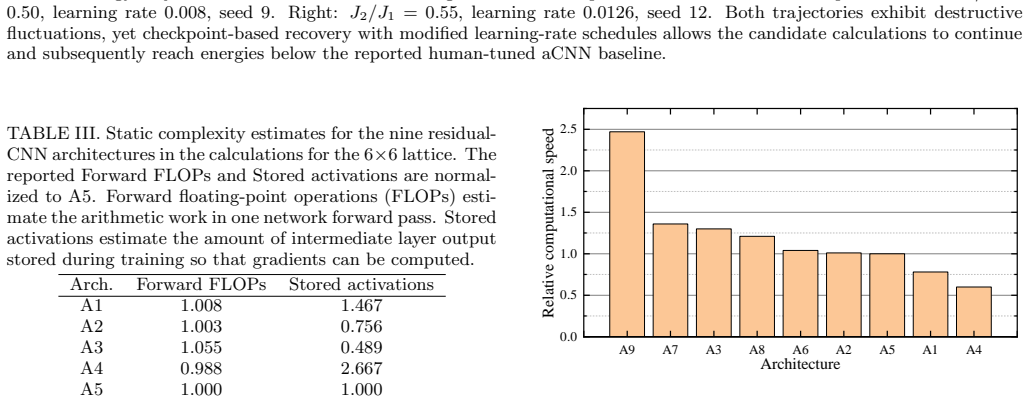
- A wide-and-shallow residual CNN performs competitively within the parameter-count-matched search space.
- Optimization trajectories' stability and recovery become relevant for judging NQS quality.
- A reproducible tuning protocol emerges that considers more than a single lowest-energy calculation.
Where Pith is reading between the lines
- The method could surface architecture preferences that differ from human intuition when applied to other quantum many-body models.
- Similar health monitoring might improve reliability in related variational approaches where optimization paths affect final accuracy.
- Testing the wide-and-shallow candidate on larger lattices or different interaction strengths would check whether its competitiveness holds beyond the original search space.
Load-bearing premise
The rules for detecting destructive events and computing anomaly-aware scores identify truly superior architectures without systematic bias or oversight of better candidates.
What would settle it
A side-by-side run of an architecture flagged as unstable by the rules that reaches a lower energy than the kept candidates when allowed to continue without interruption.
Figures
read the original abstract
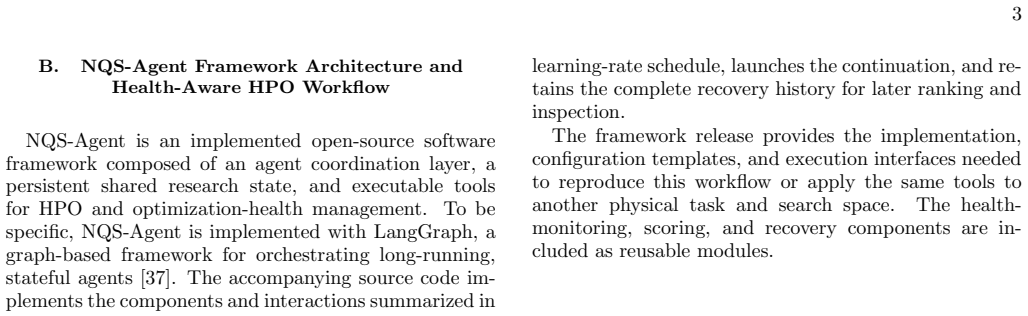
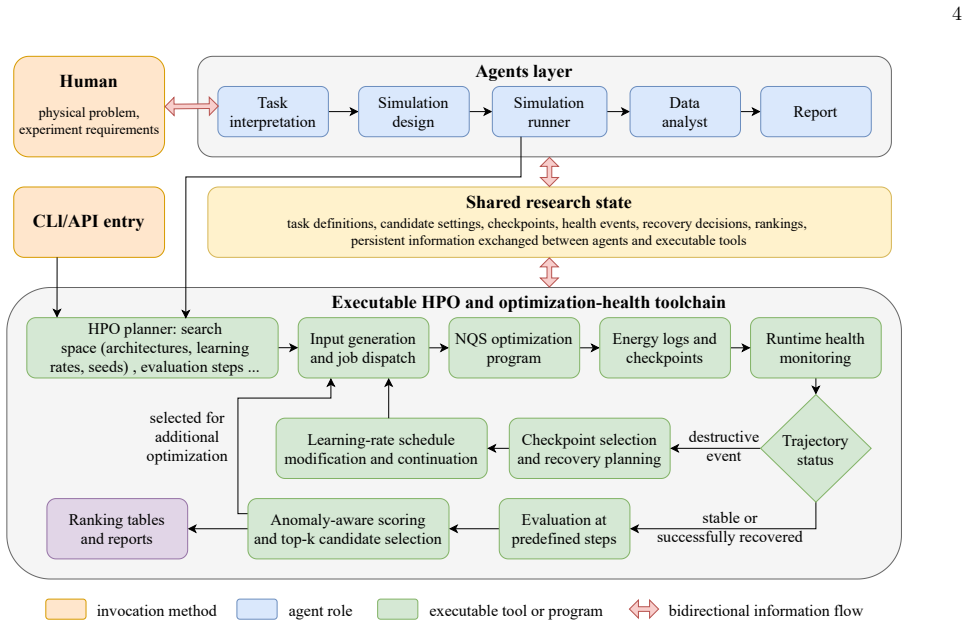
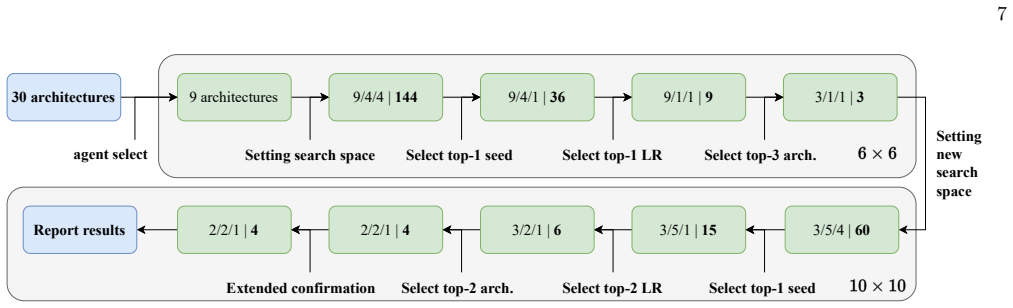
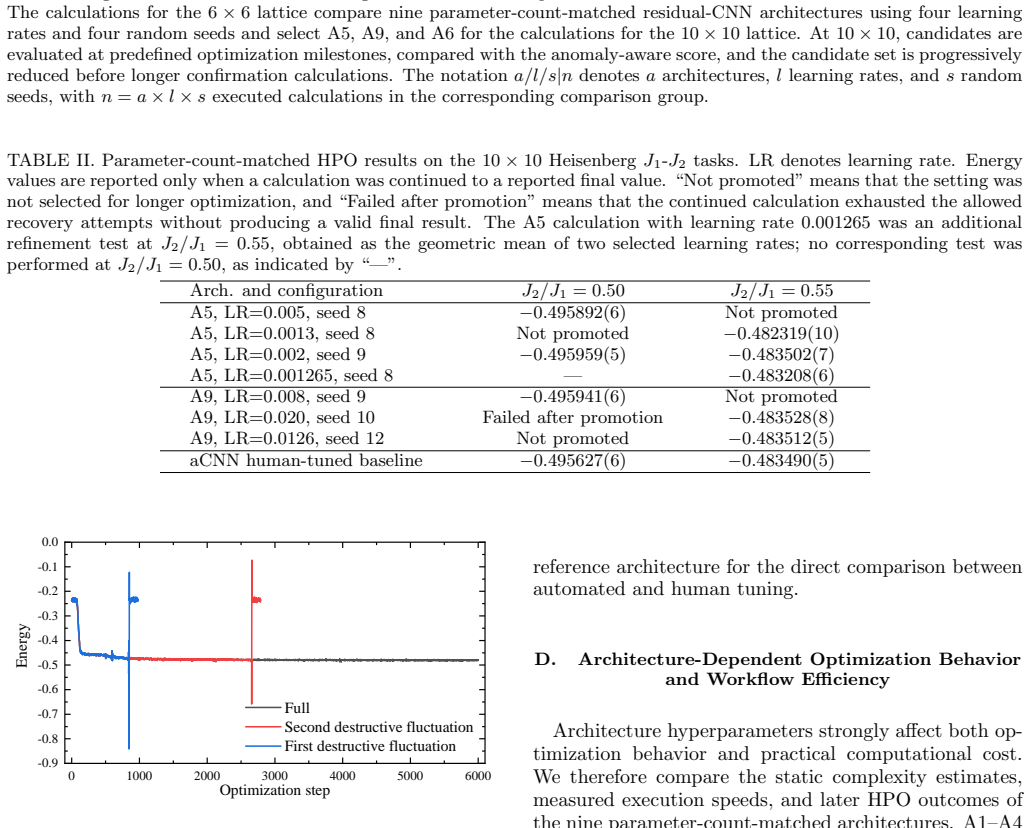
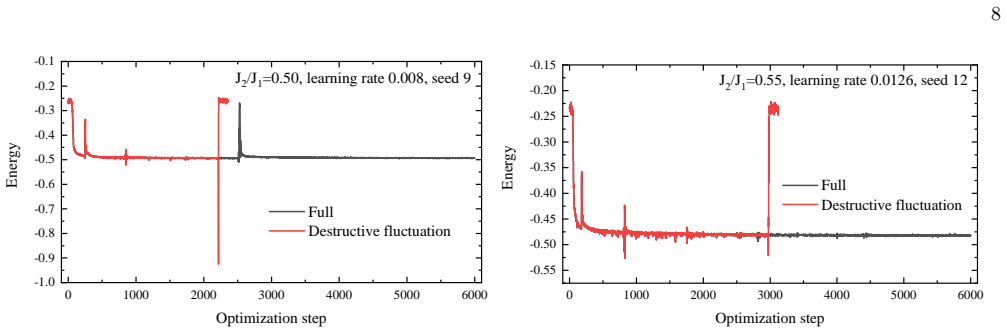
Neural-network quantum states (NQS) provide expressive variational representations for strongly correlated quantum many-body systems, but their practical accuracy depends sensitively on architecture-level hyperparameters and optimization schedules. Here we develop NQS-Agent, an implemented open-source software framework for health-aware hyperparameter optimization (HPO) in NQS calculations. Its workflow monitors energy trajectories, detects destructive optimization events, stops unstable calculations, modifies the learning-rate schedule, resumes optimization from safe checkpoints, and ranks candidates with an anomaly-aware score. We demonstrate the approach on a residual convolutional NQS for the square-lattice Heisenberg $J_1$-$J_2$ model, using architectures with parameter counts comparable to aCNN, a convolutional NQS architecture used here as a reference. The results show that NQS-Agent improves over the reported human-tuned aCNN baseline for the aCNN reference architecture and identifies a structurally distinct wide-and-shallow competitive candidate within the parameter-count-matched residual-CNN search space. These results show that the stability and recovery history of an optimization trajectory should be considered when assessing an NQS result. Health-aware HPO therefore provides a reproducible tuning protocol that goes beyond selecting a single lowest-energy calculation.
Editorial analysis
A structured set of objections, weighed in public.
Referee Report
Summary. The paper introduces NQS-Agent, an open-source framework implementing health-aware hyperparameter optimization for neural-network quantum states. The workflow monitors energy trajectories during variational Monte Carlo optimization, detects destructive events, halts unstable runs, adjusts learning-rate schedules, resumes from checkpoints, and ranks candidate architectures via an anomaly-aware score derived from stability and recovery history. Demonstrated on residual convolutional NQS architectures for the square-lattice J1-J2 Heisenberg model with parameter counts matched to the aCNN reference, the results claim an improvement over the reported human-tuned aCNN baseline and the discovery of a structurally distinct wide-and-shallow competitive architecture; the work concludes that optimization trajectory stability should be considered when assessing NQS results.
Significance. If the anomaly-aware scoring and health-monitoring rules prove reliable, the framework supplies a reproducible, automated protocol for architecture and schedule tuning in NQS that incorporates trajectory health rather than relying solely on final energy values. The open-source release and explicit comparison to an external baseline constitute concrete strengths that could improve the practical reliability of variational calculations for strongly correlated models.
major comments (3)
- [Abstract, §4] Abstract and §4 (Results): the central claim of improvement over the human-tuned aCNN baseline and identification of a competitive architecture is stated without quantitative details on error bars, exact variational energies, number of independent trials, or statistical significance tests. This absence directly undermines evaluation of whether the reported gains are robust or reproducible.
- [§3.2] §3.2 (Anomaly-aware scoring): the precise definition of the anomaly-aware score, the thresholds for destructive-event detection, and the weighting of recovery history are not supplied with equations or pseudocode. Without these, it is impossible to verify that the ranking is free of implicit bias toward particular trajectory shapes or that it would generalize beyond the tested residual-CNN space.
- [§4.3] §4.3 (Search-space definition): the claim that the wide-and-shallow candidate is competitive rests on a parameter-count-matched residual-CNN search space; no evidence is given that the same architecture would remain competitive if the search were expanded to other families (e.g., attention-based or graph networks) or if the anomaly-aware score were replaced by a conventional energy-only ranking.
minor comments (2)
- [§3] Notation for the anomaly-aware score and the health-monitoring rules should be introduced with a compact table or pseudocode block for clarity.
- [Figures in §4] Figure captions should explicitly state the number of independent runs and the precise definition of the plotted energy metric (e.g., median or lowest energy per trajectory).
Simulated Author's Rebuttal
We thank the referee for their constructive comments and for recognizing the value of the open-source framework and explicit baseline comparison. We address each major comment below, indicating revisions where the manuscript will be updated to improve clarity and completeness.
read point-by-point responses
-
Referee: [Abstract, §4] Abstract and §4 (Results): the central claim of improvement over the human-tuned aCNN baseline and identification of a competitive architecture is stated without quantitative details on error bars, exact variational energies, number of independent trials, or statistical significance tests. This absence directly undermines evaluation of whether the reported gains are robust or reproducible.
Authors: We agree that the original submission lacks sufficient quantitative detail for assessing robustness. The revised manuscript will report exact variational energies, error bars obtained from multiple independent trials, the number of trials performed, and the results of statistical significance tests comparing NQS-Agent outcomes to the human-tuned aCNN baseline. revision: yes
-
Referee: [§3.2] §3.2 (Anomaly-aware scoring): the precise definition of the anomaly-aware score, the thresholds for destructive-event detection, and the weighting of recovery history are not supplied with equations or pseudocode. Without these, it is impossible to verify that the ranking is free of implicit bias toward particular trajectory shapes or that it would generalize beyond the tested residual-CNN space.
Authors: We concur that explicit mathematical definitions are required for reproducibility and verification. The revised manuscript will include the precise equations for the anomaly-aware score together with pseudocode specifying the destructive-event detection thresholds and the weighting applied to recovery history. revision: yes
-
Referee: [§4.3] §4.3 (Search-space definition): the claim that the wide-and-shallow candidate is competitive rests on a parameter-count-matched residual-CNN search space; no evidence is given that the same architecture would remain competitive if the search were expanded to other families (e.g., attention-based or graph networks) or if the anomaly-aware score were replaced by a conventional energy-only ranking.
Authors: The demonstration is deliberately confined to the parameter-count-matched residual-CNN search space to enable a controlled comparison with the aCNN reference. We do not assert that the wide-and-shallow architecture would remain competitive under an expanded search or under energy-only ranking; such extensions lie outside the present scope. A clarifying statement will be added to §4.3 to delineate these boundaries. revision: partial
Circularity Check
No circularity: empirical demonstration with external baseline comparison
full rationale
The paper describes an implemented HPO framework whose central claims rest on running the method on a residual-CNN search space, stopping unstable trajectories, and comparing resulting energies to a previously reported human-tuned aCNN baseline. No equations, derivations, or self-referential definitions appear that would make the reported improvement or candidate identification equivalent to the input scoring rules by construction. The anomaly-aware score is an internal ranking tool, but the improvement claim is measured against an independent external reference; the demonstration therefore remains self-contained against external benchmarks.
Axiom & Free-Parameter Ledger
Reference graph
Works this paper leans on
-
[1]
A. W. Sandvik, Finite-size scaling of the ground-state pa- rameters of the two-dimensional Heisenberg model, Phys. Rev. B56, 11678 (1997)
1997
-
[2]
Liu, S.-S
W.-Y. Liu, S.-S. Gong, Y.-B. Li, D. Poilblanc, W.-Q. Chen, and Z.-C. Gu, Gapless quantum spin liquid and global phase diagram of the spin-1/2j 1-j2 square an- tiferromagnetic Heisenberg model, Science Bulletin67, 1034 (2022)
2022
-
[3]
Stoudenmire and S
E. Stoudenmire and S. R. White, Studying two- dimensional systems with the density matrix renormal- ization group, Annual Review of Condensed Matter Physics3, 111 (2012)
2012
-
[4]
S.-S. Gong, W. Zhu, D. N. Sheng, O. I. Motrunich, and M. P. A. Fisher, Plaquette ordered phase and quantum phase diagram in the spin-1/2J 1−J2 square Heisenberg model, Phys. Rev. Lett.113, 027201 (2014)
2014
-
[5]
Wang and A
L. Wang and A. W. Sandvik, Critical level crossings and gapless spin liquid in the square-lattice spin-1/2 J1 −J 2 Heisenberg antiferromagnet, Phys. Rev. Lett. 121, 107202 (2018)
2018
-
[6]
W.-J. Hu, F. Becca, A. Parola, and S. Sorella, Direct evidence for a gaplessZ 2 spin liquid by frustrating N´ eel antiferromagnetism, Phys. Rev. B88, 060402(R) (2013)
2013
-
[7]
Carleo and M
G. Carleo and M. Troyer, Solving the quantum many- body problem with artificial neural networks, Science 355, 602 (2017)
2017
-
[8]
Lange, A
H. Lange, A. Van de Walle, A. Abedinnia, and A. Bohrdt, From architectures to applications: a review of neural quantum states, Quantum Science and Technology9, 040501 (2024)
2024
-
[9]
Hermann, J
J. Hermann, J. Spencer, K. Choo, A. Mezzacapo, W. M. C. Foulkes, D. Pfau, G. Carleo, and F. No´ e, Ab initio quantum chemistry with neural-network wavefunc- tions, Nature Reviews Chemistry7, 692 (2023)
2023
-
[10]
Carrasquilla and G
J. Carrasquilla and G. Torlai, How to use neural net- works to investigate quantum many-body physics, PRX Quantum2, 040201 (2021)
2021
-
[11]
Nomura, Boltzmann machines and quantum many- body problems, Journal of Physics: Condensed Matter 36(2023)
Y. Nomura, Boltzmann machines and quantum many- body problems, Journal of Physics: Condensed Matter 36(2023)
2023
-
[12]
Medvidovi´ c and J
M. Medvidovi´ c and J. R. Moreno, Neural-network quan- tum states for many-body physics, The European Phys- ical Journal Plus139, 631 (2024)
2024
-
[13]
K. Choo, T. Neupert, and G. Carleo, Two-dimensional frustratedJ 1−J2 model studied with neural network quantum states, Phys. Rev. B100, 125124 (2019)
2019
-
[14]
Liang, W.-Y
X. Liang, W.-Y. Liu, P.-Z. Lin, G.-C. Guo, Y.-S. Zhang, and L. He, Solving frustrated quantum many-particle models with convolutional neural networks, Phys. Rev. B98, 104426 (2018)
2018
- [15]
-
[16]
Wang, H.-Q
J.-Q. Wang, H.-Q. Wu, R.-Q. He, and Z.-Y. Lu, Vari- ational optimization of the amplitude of neural-network quantum many-body ground states, Phys. Rev. B109, 245120 (2024)
2024
-
[17]
Hibat-Allah, M
M. Hibat-Allah, M. Ganahl, L. E. Hayward, R. G. Melko, and J. Carrasquilla, Recurrent neural network wave func- tions, Phys. Rev. Res.2, 023358 (2020)
2020
-
[18]
Lange, F
H. Lange, F. D¨ oschl, J. Carrasquilla, and A. Bohrdt, Neural network approach to quasiparticle dispersions in doped antiferromagnets, Communications Physics7, 187 (2024)
2024
-
[19]
D. Kochkov, T. Pfaff, A. Sanchez-Gonzalez, P. Battaglia, and B. K. Clark, Learning ground states of quantum Hamiltonians with graph networks, arXiv:2110.06390 (2021)
-
[20]
C. Roth, A. Szab´ o, and A. H. MacDonald, High-accuracy variational monte carlo for frustrated magnets with deep neural networks, Phys. Rev. B108, 054410 (2023)
2023
-
[21]
Zhang and M
Y.-H. Zhang and M. Di Ventra, Transformer quantum state: A multipurpose model for quantum many-body problems, Phys. Rev. B107, 075147 (2023)
2023
-
[22]
Rende, L
R. Rende, L. L. Viteritti, L. Bardone, F. Becca, and S. Goldt, A simple linear algebra identity to optimize large-scale neural network quantum states, Communica- tions Physics7, 260 (2024)
2024
-
[23]
Bergstra and Y
J. Bergstra and Y. Bengio, Random search for hyper- parameter optimization, Journal of Machine Learning Research13, 281 (2012)
2012
-
[24]
Bergstra, R
J. Bergstra, R. Bardenet, Y. Bengio, and B. K´ egl, Algo- rithms for hyper-parameter optimization, inAdvances in Neural Information Processing Systems, Vol. 24 (2011) pp. 2546–2554
2011
-
[25]
L. Li, K. Jamieson, G. DeSalvo, A. Rostamizadeh, and A. Talwalkar, Hyperband: A novel bandit-based ap- proach to hyperparameter optimization, Journal of Ma- chine Learning Research18, 1 (2018)
2018
-
[26]
L. Li, K. Jamieson, A. Rostamizadeh, E. Gonina, M. Hardt, B. Recht, and A. Talwalkar, A system for mas- sively parallel hyperparameter tuning, inProceedings of Machine Learning and Systems, Vol. 2 (2020) pp. 230– 246
2020
-
[27]
Falkner, A
S. Falkner, A. Klein, and F. Hutter, BOHB: Robust and efficient hyperparameter optimization at scale, inPro- ceedings of the 35th International Conference on Machine Learning, Proceedings of Machine Learning Research, Vol. 80 (2018) pp. 1437–1446
2018
-
[28]
Akiba, S
T. Akiba, S. Sano, T. Yanase, T. Ohta, and M. Koyama, Optuna: A next-generation hyperparameter optimiza- tion framework, inProceedings of the 25th ACM SIGKDD International Conference on Knowledge Dis- covery and Data Mining(2019) pp. 2623–2631. 11
2019
-
[29]
Hutter, L
F. Hutter, L. Kotthoff, and J. Vanschoren, eds.,Auto- mated Machine Learning: Methods, Systems, Challenges (Springer, 2019)
2019
-
[30]
S. Sorella, M. Casula, and D. Rocca, Weak binding be- tween two aromatic rings: Feeling the van der Waals attraction by quantum monte carlo methods, J. Chem. Phys127, 10.1063/1.2746035 (2007)
-
[31]
Chen and M
A. Chen and M. Heyl, Empowering deep neural quantum states through efficient optimization, Nature Physics20, 1476 (2024)
2024
-
[32]
Drissi, J
M. Drissi, J. W. T. Keeble, J. Rozal´ en Sarmiento, and A. Rios, Second-order optimization strategies for neural network quantum states, Philosophical Transactions of the Royal Society A: Mathematical, Physical and Engi- neering Sciences382, 20240057 (2024)
2024
-
[33]
J. Wei, Y. Yang, X. Zhang, Y. Chen, X. Zhuang, Z. Gao, D. Zhou, G. Wang, Z. Gao, J. Cao, Z. Qiu, M. Hu, C. Ma, S. Tang, J. He, C. Song, X. He, Q. Zhang, C. You, S. Zheng, N. Ding, W. Ouyang, N. Dong, Y. Cheng, S. Sun, L. Bai, and B. Zhou, From ai for science to agen- tic science: A survey on autonomous scientific discovery, arXiv:2508.14111 (2025)
-
[34]
X. Li, S. Wang, S. Zeng, Y. Wu, and Y. Yang, A survey on llm-based multi-agent systems: workflow, infrastructure, and challenges, Vicinagearth1, 9 (2024)
2024
-
[35]
S. Hong, M. Zhuge, J. Chen, X. Zheng, Y. Cheng, J. Wang, C. Zhang, Z. Wang, S. K. S. Yau, Z. Lin, L. Zhou, C. Ran, L. Xiao, C. Wu, and J. Schmidhuber, MetaGPT: Meta programming for a multi-agent collab- orative framework, inThe Twelfth International Confer- ence on Learning Representations(2024)
2024
-
[36]
Q. Wu, G. Bansal, J. Zhang, Y. Wu, B. Li, E. Zhu, L. Jiang, X. Zhang, S. Zhang, J. Liu, A. H. Awadallah, R. W. White, D. Burger, and C. Wang, Autogen: En- abling next-gen LLM applications via multi-agent con- versations, inFirst Conference on Language Modeling (2024)
2024
-
[37]
com/langchain-ai/langgraph(2026), accessed June 15, 2026
LangChain, Inc., LangGraph: A low-level orchestration framework for building stateful agents,https://github. com/langchain-ai/langgraph(2026), accessed June 15, 2026
2026
-
[38]
D. P. Kingma and J. Ba, Adam: A method for stochastic optimization, arXiv:1412.6980 (2017)
work page internal anchor Pith review Pith/arXiv arXiv 2017
-
[39]
Repository URL: https://github.com/QTMEC- RUC/NQS-Agents
discussion (0)
Sign in with ORCID, Apple, or X to comment. Anyone can read and Pith papers without signing in.