REVIEW 3 major objections 5 minor 2 cited by
JADES NIRSpec Spectroscopy of GN-z11: Evidence for Wolf-Rayet contribution to stellar populations at 430 Myr after Big Bang?
T0 review · 3 major / 5 minor · reviewed 2026-08-16 · deepseek-v4-flash
Pith's one-line read A model library that adds Wolf-Rayet stars to the stellar population of the z=10.6 galaxy GN-z11 reproduces the observed C III]/He II versus C III]/C IV line ratios, resolving a discrepancy in earlier starburst and AGN models.
desk verdict A useful WR-inclusive model grid for GN-z11 that demonstrates plausibility, but the 'essential' claim overreaches without a WR-off control. read the letter →
The pith
A machine-rendered reading of the paper's core claim, the machinery that carries it, and where it could break.
The reading
What carries the argument
The central machinery is a four-step modelling chain. The Starburst99 population synthesis code is updated with Parsec and Geneva evolutionary tracks that identify when massive stars enter the Wolf-Rayet phase. Each WR star is mapped onto the Potsdam (PoWR) grid of expanding, iron-line-blanketed, non-local-thermodynamic-equilibrium model atmospheres using the transformed radius $R_T$ and a weighted-mean temperature
What would settle it
A decisive test is to look for the broad stellar-wind emission wings that the models attach to He II 1640 and C IV 1550 in GN-z11's medium-resolution NIRSpec spectrum; if those lines are purely narrow nebular emission, the Wolf-Rayet contribution required by the models is absent.
Extended reading notes
Core claim
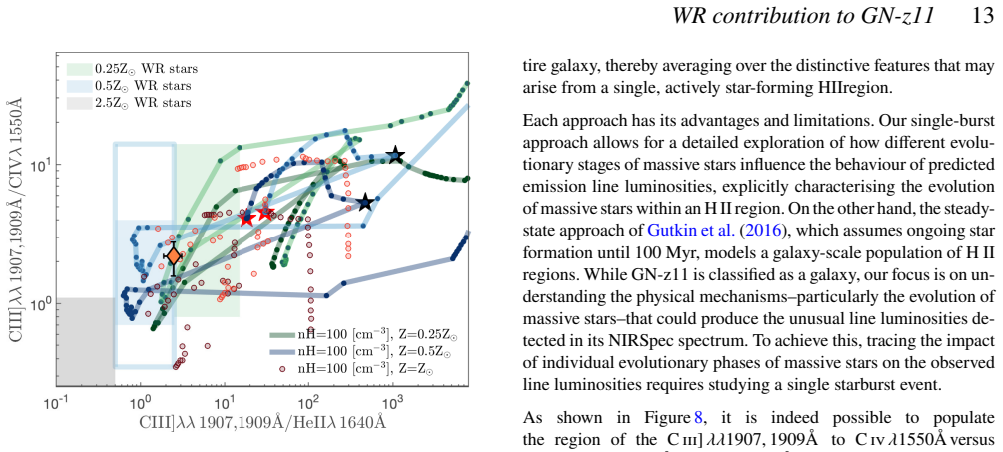
The central claim is that a young starburst whose population includes Wolf-Rayet stars produces enough hard ionizing photons to place a galaxy at the exact spot where GN-z11 sits in the C III]/He II versus C III]/C IV diagnostic diagram, something standard starburst models do not do. The same models yield a metallicity of 0.07–0.15 $Z_\odot$, an ionization parameter $\log U \approx -2$, and dominant stellar ages near 3–3.5 Myr, all compatible with earlier estimates. The paper also shows that these models under-predict the observed N III]/O III] ratio by more than an order of magnitude, so WR stars alone cannot account for the nitrogen enrichment. It therefore proposes that the carbon and helium lines trace the WR phase of the current burst, while the nitrogen excess requires additional mechanisms such as rapid chemical enrichment in a young, metal-poor environment.
Load-bearing premise
The whole argument hinges on how the paper converts a Wolf-Rayet star's evolutionary temperature into the effective temperature used to pick its model spectrum; if that conversion is off, the predicted line ratios shift and GN-z11 may no longer be reproduced.
Editorial extensions
If this is right
- The observed ultraviolet carbon and helium line ratios of GN-z11 no longer sit outside the star-forming model grid, so a massive-star starburst emerges as a viable explanation for the hard ionizing radiation at z=10.6.
- The model-derived metallicity, ionization parameter, and young stellar ages are consistent with earlier SED fitting, giving independent support to a low-metallicity, intense starburst interpretation.
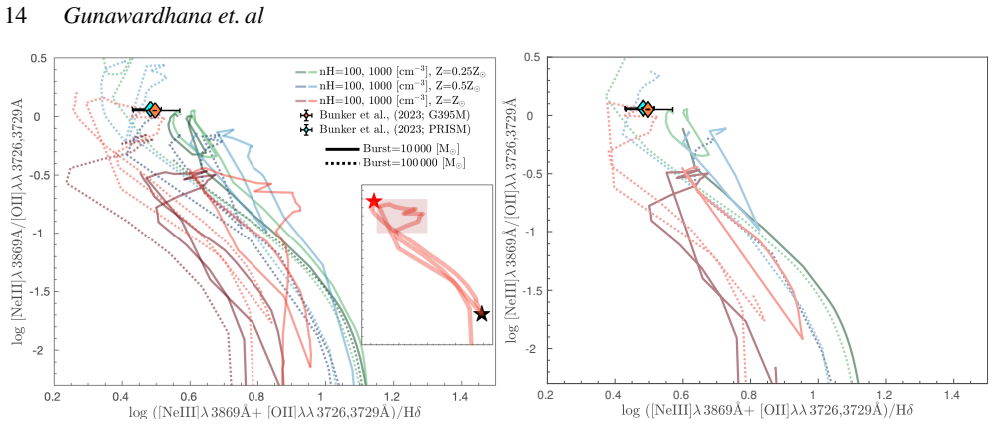
- During the WR phase, the models predict excursions into the AGN/composite region of optical BPT diagrams, meaning powerful starbursts can imitate AGN signatures in some diagnostics.
- The persistent under-prediction of N III]/O III] shows that WR stars alone cannot supply the nitrogen excess, so an additional enrichment channel must be operating at early times.
Reading between the lines
- If WR-dominated phases are common in very high-redshift starbursts, UV diagnostics used to separate AGNs from star-forming galaxies will need WR-inclusive tracks; otherwise some z>10 AGN candidates could be misclassified starbursts.
- The nitrogen under-prediction suggests a two-stage enrichment picture in which carbon and helium ratios trace the current burst's WR stars while the nitrogen excess is set by an earlier, faster enrichment channel, such as rotating massive-star winds or a prior generation of very massive stars.
- The same modelling pipeline could be applied to other JWST targets that show C III], C IV, and He II in order to estimate the Wolf-Rayet fraction and thereby probe the presence of the most massive stars in the first galaxies.
Signed reviews
Editorial analysis
A structured set of objections, weighed in public.
Referee Report
Summary. The paper models the z=10.6 galaxy GN-z11 with Starburst99/Cloudy, adding a high-resolution Wolf-Rayet (WR) spectral treatment based on PoWR atmosphere grids coupled to Parsec and Geneva stellar evolutionary tracks. The models are compared with the JADES NIRSpec line ratios of Bunker et al. (2023), with emphasis on the C III]/He II versus C III]/C IV diagnostic plane. The authors report that inclusion of WR stars is essential for reproducing GN-z11's position in that plane, that the derived metallicity (0.07 ≲ Z/Z⊙ ≲ 0.15) and log U ≈ -2 agree with previous estimates, and that the models under-predict N III]/O III] by more than an order of magnitude, indicating that WR stars alone cannot explain the nitrogen excess.
Significance. If established, the claim that WR stars are required to explain GN-z11's ultraviolet line ratios would be an important step toward understanding the ionizing sources in this exceptionally early galaxy, supporting a massive-star starburst interpretation over the AGN alternative. The paper has genuine strengths: it couples independent stellar-evolution and photoionization codes, uses external JADES data, and is explicit about the N III]/O III] shortfall. However, the central claim of necessity is currently supported only by a demonstration of sufficiency, because no WR-free control run is presented in the same model framework. With an added control and appropriately softened wording, the paper would constitute a useful contribution to the high-redshift stellar-population literature.
major comments (3)
- [Abstract; §5; Fig. 8] The central assertion that WR stars are essential is not established by the presented models. The tracks in Fig. 8 pass through the GN-z11 point only during ages within the WR phase, while the comparison models (Gutkin et al. 2016, as shown in Bunker et al. 2023) differ in multiple respects: continuous 100 Myr star formation versus an instantaneous burst, a different stellar library, and a galaxy-scale ensemble of H II regions rather than an individual burst. The pre-WR early-age segments of the same tracks are not a valid WR-off control because they sample younger, less evolved stellar populations with different O-star content and ionization parameter. I request a run in which the WR spectral contribution is suppressed while all other assumptions are held fixed (e.g., PoWR spectra replaced by the underlying CMFGEN/O-star spectra for stars classified as WR). If such a run also reaches the GN-z11 location, the conclusion should be reframed from 'essential' to 'sufficient' in the abstract and §6.
- [§3.3.1–3.3.2, Eq. (3), Fig. 1] The hybrid temperature correction T_WR = 0.6 T_hyd + 0.4 T_2/3 is calibrated at solar metallicity (Smith et al. 2002), yet the authors' own Fig. 1 shows that for the SMC grid the selected temperatures extend beyond the PoWR grids. Because the PoWR spectral selection controls the hardness of the ionizing spectrum, which directly sets the C III]/He II and C III]/C IV ratios in Fig. 8, this acknowledged inadequacy is a load-bearing uncertainty for the central claim. The paper should quantify how much the predicted diagnostic position changes under plausible variations of the weighting coefficients, or when the SMC/sub-SMC selections are excluded or interpolated, and state explicitly whether the GN-z11 overlap survives.
- [§5.3, Fig. 13(a)] The predicted carbon-line ratios are highly sensitive to the assumed C/O ratio, as the paper itself notes when discussing a 40% change in C/O. The models fix (C/O) = 0.44 (solar) and ξ_d = 0.36 following Gutkin et al. (2016), but the C/O ratio of GN-z11 is not fixed by the data used here; Cameron et al. (2023) report a lower bound of C/O > 0.17. Since the central diagnostic plane is carbon-based, the robustness of the WR-essential conclusion to C/O and depletion variations should be demonstrated, for example by recomputing Fig. 8 for the range of C/O values consistent with the GN-z11 constraints.
minor comments (5)
- [Fig. 5 caption] The caption lists two curves as '0.5Z⊙ (blue) and 0.5Z⊙ (green)', but the text and context indicate that one of these should be 0.25Z⊙.
- [§4.2] The phrase 'probes the the ionising continuum shape' contains a duplicated article and should read 'probes the ionising continuum shape'.
- [§3.3.2] The sentence 'For this phase to occur in Parsec models require higher stellar masses' is ungrammatical; consider 'For this phase to occur in the Parsec models requires higher stellar masses.'
- [Table 1, note (d)] The note writes '−0.5 ≲ U ≲ 4' where the surrounding text refers to log U; please clarify whether the quoted range applies to U or log U.
- [Abstract; §5] The abstract states a model-derived metallicity range 0.07 ≲ Z/Z⊙ ≲ 0.15, but Fig. 8 explicitly does not show the 0.07Z⊙ Parsec models, and the lowest Parsec metallicity shown is 0.25Z⊙; please make clear whether the low-metallicity end comes from the Geneva tracks, from the [Ne III]/[O II] diagnostics, or from the literature comparison.
Circularity Check
No significant circularity: the WR-plus-Cloudy grid is independently constructed and the observed line ratios are external; the 'essential' wording is under-supported but not a circular reduction.
full rationale
The derivation chain starts from independent inputs: Parsec/Geneva stellar evolution tracks, PoWR/CMFGEN/UVBlue atmosphere libraries, and the Cloudy photoionization code. The GN-z11 line ratios are external data from Bunker et al. (2023) plus continuum-subtracted measurements made in this paper. No parameter of the models is fitted to the C III]/He II versus C III]/C IV location; the overlap in Figure 8 is a computed consequence of the synthesis and therefore has independent content. The WR temperature weighting T_WR = 0.6 T_hyd + 0.4 T_2/3 (Eq. 3) is adopted from Smith et al. (2002), an external source, and the paper itself flags its inadequacy for the SMC grid in Section 3.3.2, which is an acknowledged limitation rather than a circular step. The under-prediction of N III]/O III] (Section 5.3, Figure 13f) is an honest non-fit, and the paper explicitly concludes that WR stars alone cannot explain the nitrogen excess. The self-citations (e.g., Gunawardhana et al. 2020; Brinchmann et al. 2004) appear in methodology or context and are not load-bearing. The central claim that WR stars are 'essential' is stronger than the evidence: no model suppresses WR spectral contributions while holding the stellar population fixed, so necessity is not demonstrated. But the models do demonstrate sufficiency, and the absence of a WR-off control is an evidential gap, not a by-construction equivalence. Accordingly, no circular step can be exhibited from the paper's equations or citation chain, and the minor self-citations do not carry the argument.
Assumptions & free parameters
free parameters (5)
- WR temperature weighting coefficients =
0.6 and 0.4 in T_WR = 0.6*T_hyd + 0.4*T_2/3 (Eq. 3)
- Wind clumping factor D =
4-10 (adopted range)
- Starburst strength and gas density grid =
log M_burst = 2-5 M_sun; n_H = 100, 500, 1000 cm^-3
- Dust attenuation normalization in continuum fitting =
free parameter with tau(lambda) proportional to lambda^-1.3
- Assumed C/O ratio and dust depletion fraction =
C/O = 0.44 (solar) and xi_d = 0.36
assumptions (5)
- domain assumption Single stellar population with Kroupa IMF and upper mass cutoff 120 M_sun
- domain assumption Gas-phase metallicity equals stellar metallicity for all models (Z_ISM = Z_s)
- domain assumption Spherical geometry for the HII region
- domain assumption PoWR grids apply to the selected WR evolutionary phases, with WO phases substituted by WC spectra
- domain assumption Nebular emission lines are dominated by the starburst, with no significant AGN contribution to the UV lines used in the diagnostics
Cite this review
Pith. "Pith review of JADES NIRSpec Spectroscopy of GN-z11: Evidence for Wolf-Rayet contribution to stellar populations at 430 Myr after Big Bang?." pith.science (2026). https://pith.science/paper/A5NFEFB4
@misc{pith2026250412584,
  author       = {Pith},
  title        = {Pith review of: JADES NIRSpec Spectroscopy of GN-z11: Evidence for Wolf-Rayet contribution to stellar populations at 430 Myr after Big Bang?},
  year         = {2026},
  howpublished = {\url{https://pith.science/paper/A5NFEFB4}},
  note         = {Machine review of arXiv:2504.12584}
}
abstract
We investigate the unusual emission line luminosity ratios observed in the JADES NIRSpec spectroscopy of GN-z11, which reveal exceptionally strong emission lines and a significant detection of the rarely observed N III] $\lambda1748-1753$\r{A} multiplet. These features suggest an elevated N/O abundance, challenging existing models of stellar populations and nebular emission. To assess whether Wolf-Rayet (WR) stars can account for the observed line ratios, we construct a suite of stellar and nebular models incorporating high-resolution stellar spectral libraries, enabling a more accurate treatment of WR evolution and its influence on the ionising radiation field. We find that the inclusion of WR stars is essential for reproducing the observed position of GN-z11 in the C III]/He II versus C III]/C iv diagnostic plane, resolving discrepancies from previous studies. The model-derived metallicity (0.07$\lesssim$Z/Z$_{\odot}\lesssim$0.15), ionisation parameter ($\log\,U$$\approx$-2) and stellar ages are consistent with the literature estimates. However, our models under-predict the N III/O III] ratio, suggesting that WR stars alone cannot fully explain the nitrogen enrichment. This suggests that additional mechanisms, such as rapid chemical enrichment in a young, metal-poor environment, may be necessary to explain the nitrogen excess. While our models successfully reproduce most observed line ratios, further refinements to the models are needed to fully characterise the stellar populations and the enrichment processes of high-redshift galaxies like GN-z11.
Figures


Figures from the paper (12 more)




Forward citations
Cited by 2 Pith papers
-
Discovery of a new transitional type of evolved massive stars with hard ionizing flux
The authors identify a new WN/WO transitional Wolf-Rayet stage in five hot, weak-winded massive stars, implying a direct WN to WO evolutionary path at low metallicity with strong hard ionizing flux.
-
MARTA: The connection between chemical enrichment, feedback, and dust in a Wolf-Rayet galaxy at z${\sim}$2
MARTA-4327, a z=2.2 galaxy, hosts a young Wolf-Rayet population whose localized effects include a higher gas-phase Fe/O ratio, while global abundances match local galaxies.
Reference graph
Works this paper leans on
-
[1]
G., Dopita M
Allen M. G., Dopita M. A., Tsvetanov Z. I., 1998, , 493, 571
1998
-
[2]
\'A lvarez-M \'a rquez J. et al. , 2024, arXiv e-prints, arXiv:2412.12826
arXiv 2024
-
[3]
J., Scott P., 2009, , 47, 481
Asplund M., Grevesse N., Sauval A. J., Scott P., 2009, , 47, 481
2009
-
[4]
, 2022, , 935, 167
Astropy Collaboration et al. , 2022, , 935, 167
2022
-
[5]
, 2018, , 156, 123
Astropy Collaboration et al. , 2018, , 156, 123
2018
-
[6]
A., Phillips M
Baldwin J. A., Phillips M. M., Terlevich R., 1981, PASP, 93, 5
1981
-
[7]
Bouwens R. J. et al. , 2010, , 725, 1587
2010
-
[8]
Bressan A., Marigo P., Girardi L., Salasnich B., Dal Cero C., Rubele S., Nanni A., 2012, MNRAS, 427, 127
2012
Show all 111 references
-
[9]
Brinchmann J., Charlot S., White S. D. M., Tremonti C., Kauffmann G., Heckman T., Brinkmann J., 2004, MNRAS, 351, 1151
2004
-
[10]
Brinchmann J., Pettini M., Charlot S., 2008, MNRAS, 385, 769
2008
-
[11]
Bunker A. J. et al. , 2023, , 677, A88
2023
-
[12]
J., Conroy C., Johnson B
Byler N., Dalcanton J. J., Conroy C., Johnson B. D., 2017, ApJ, 840, 44
2017
-
[13]
M., Stanway E
Byrne C. M., Stanway E. R., 2023, , 521, 4995
2023
-
[14]
C., Kinney A
Calzetti D., Armus L., Bohlin R. C., Kinney A. L., Koornneef J., Storchi-Bergmann T., 2000, ApJ, 533, 682
2000
-
[15]
Cameron A. J. et al. , 2023, , 677, A115
2023
-
[16]
A., 2004, , 604, 153
Chandar R., Leitherer C., Tremonti C. A., 2004, , 604, 153
2004
-
[17]
Charbonnel C., Meynet G., Maeder A., Schaller G., Schaerer D., 1993, A&AS, 101, 415
1993
-
[18]
M., 2000, ApJ, 539, 718
Charlot S., Fall S. M., 2000, ApJ, 539, 718
2000
-
[19]
Chatzikos M. et al. , 2023, , 59, 327
2023
-
[20]
Chen Y., Bressan A., Girardi L., Marigo P., Kong X., Lanza A., 2015, MNRAS, 452, 1068
2015
-
[21]
Chen Y., Girardi L., Bressan A., Marigo P., Barbieri M., Kong X., 2014, MNRAS, 444, 2525
2014
-
[22]
W., 2007, MNRAS, 382, 498
Coelho P., Bruzual G., Charlot S., Weiss A., Barbuy B., Ferguson J. W., 2007, MNRAS, 382, 498
2007
-
[23]
A., 2007, ARA&A, 45, 177
Crowther P. A., 2007, ARA&A, 45, 177
2007
-
[24]
A., Dessart L., Hillier D
Crowther P. A., Dessart L., Hillier D. J., Abbott J. B., Fullerton A. W., 2002, A&A, 392, 653
2002
-
[25]
Cunha K., Hubeny I., Lanz T., 2006, , 647, L143
2006
-
[26]
A., 1988, A&AS, 72, 259
de Jager C., Nieuwenhuijzen H., van der Hucht K. A., 1988, A&AS, 72, 259
1988
-
[27]
A., Hillier D
Dessart L., Crowther P. A., Hillier D. J., Willis A. J., Morris P. W., van der Hucht K. A., 2000, MNRAS, 315, 407
2000
-
[28]
A., Groves B
Dopita M. A., Groves B. A., Sutherland R. S., Binette L., Cecil G., 2002, , 572, 753
2002
-
[29]
A., Kewley L
Dopita M. A., Kewley L. J., Heisler C. A., Sutherland R. S., 2000, ApJ, 542, 224
2000
-
[30]
Doran E. I. et al. , 2013, , 558, A134
2013
-
[31]
Efstathiou A., Rowan-Robinson M., Siebenmorgen R., 2000, MNRAS, 313, 734
2000
-
[32]
J., Stanway E
Eldridge J. J., Stanway E. R., 2009, MNRAS, 400, 1019
2009
-
[33]
J., Stanway E
Eldridge J. J., Stanway E. R., Xiao L., McClelland L. A. S., Taylor G., Ng M., Greis S. M. L., Bray J. C., 2017, PASA, 34, e058
2017
-
[34]
Feltre A., Charlot S., Gutkin J., 2016, , 456, 3354
2016
-
[35]
Ferland G. J. et al. , 2013, RMxAA, 49, 137
2013
-
[36]
Ferruit P. et al. , 2022, , 661, A81
2022
-
[37]
H., Eggenberger P., 2015, in Wolf-Rayet Stars: Proceedings of an International Workshop held in Potsdam, Germany, 1-5 June 2015
Georgy C., Ekstr \"o m S., Hirschi R., Meynet G., Groh J. H., Eggenberger P., 2015, in Wolf-Rayet Stars: Proceedings of an International Workshop held in Potsdam, Germany, 1-5 June 2015. Edited by Wolf-Rainer Hamann, Andreas Sander, Helge Todt. Universit \"a tsverlag Potsdam, ...
2015
-
[38]
M., Hirschi R., Eggenberger P., Maeder A., 2012, A&A, 542, A29
Georgy C., Ekstr \"o m S., Meynet G., Massey P., Levesque E. M., Hirschi R., Eggenberger P., Maeder A., 2012, A&A, 542, A29
2012
-
[39]
M., Papaderos P., 2017, A&A, 603, A63
Gomes J. M., Papaderos P., 2017, A&A, 603, A63
2017
-
[40]
E., Groh J
G \"o tberg Y., de Mink S. E., Groh J. H., Leitherer C., Norman C., 2019, A&A, 629, A134
2019
-
[41]
Gr \"a fener G., Koesterke L., Hamann W.-R., 2002, A&A, 387, 244
2002
-
[42]
P., Grassitelli L., Langer N., 2017, , 608, A34
Gr \"a fener G., Owocki S. P., Grassitelli L., Langer N., 2017, , 608, A34
2017
-
[43]
J., Mackey J., Bestenlehner J
Grassitelli L., Langer N., Grin N. J., Mackey J., Bestenlehner J. M., Gr \"a fener G., 2018, , 614, A86
2018
-
[44]
J., 1998, Space Science Reviews, 85, 161
Grevesse N., Sauval A. J., 1998, Space Science Reviews, 85, 161
1998
-
[45]
A., Sutherland R
Groves B., Dopita M. A., Sutherland R. S., Kewley L. J., Fischera J., Leitherer C., Brandl B., van Breugel W., 2008, ApJS, 176, 438
2008
-
[46]
A., Dopita M
Groves B. A., Dopita M. A., Sutherland R. S., 2004, ApJS, 153, 9
2004
-
[47]
Gunawardhana M. L. P. et al. , 2020, , 497, 3860
2020
-
[48]
Gutkin J., Charlot S., Bruzual G., 2016, , 462, 1757
2016
-
[49]
Hainich R. et al. , 2014, , 565, A27
2014
-
[50]
Hamann W.-R., Gr \"a fener G., 2004, A&A, 427, 697
2004
-
[51]
Harris C. R. et al. , 2020, Nature, 585, 357
2020
-
[52]
J., 1991, A&A, 247, 455
Hillier D. J., 1991, A&A, 247, 455
1991
-
[53]
J., Miller D
Hillier D. J., Miller D. L., 1998, ApJ, 496, 407
1998
-
[54]
D., 2007, Computing in Science & Engineering, 9, 90
Hunter J. D., 2007, Computing in Science & Engineering, 9, 90
2007
-
[55]
Ji X. et al. , 2024, arXiv e-prints, arXiv:2405.05772
2024 arXiv
-
[56]
Kauffmann G. et al. , 2003, MNRAS, 346, 1055
2003
-
[57]
J., Dopita M
Kewley L. J., Dopita M. A., Sutherland R. S., Heisler C. A., Trevena J., 2001, ApJ, 556, 121
2001
-
[58]
Kobayashi C., Ferrara A., 2024, , 962, L6
2024
-
[59]
Kroupa P., 2001, MNRAS, 322, 231
2001
-
[60]
Kurucz CD-ROM No
Kurucz R., 1993, SYNTHE Spectrum Synthesis Programs and Line Data. Kurucz CD-ROM No. 18. Cambridge, Mass.: Smithsonian Astrophysical Observatory, 1993., 18
1993
-
[61]
L., 1992, in IAU Symposium, Vol
Kurucz R. L., 1992, in IAU Symposium, Vol. 149, The Stellar Populations of Galaxies, Barbuy B., Renzini A., eds., p. 225
1992
-
[62]
Langer N., 1989, , 210, 93
1989
-
[63]
B., Levesque E
Leitherer C., Ekstr \"o m S., Meynet G., Schaerer D., Agienko K. B., Levesque E. M., 2014, The Astrophysical Journal Supplement Series, 212, 14
2014
-
[64]
Leitherer C. et al. , 1999, APJS, 123, 3
1999
-
[65]
A., Heckman T
Leitherer C., Tremonti C. A., Heckman T. M., Calzetti D., 2011, , 141, 37
2011
-
[66]
M., Kewley L
Levesque E. M., Kewley L. J., Larson K. L., 2010, AJ, 139, 712
2010
-
[67]
M., Richardson M
Levesque E. M., Richardson M. L. A., 2014, , 780, 100
2014
-
[68]
A., 2013, PyNeb: Analysis of emission lines
Luridiana V., Morisset C., Shaw R. A., 2013, PyNeb: Analysis of emission lines . Astrophysics Source Code Library, record ascl:1304.021
2013
-
[69]
Maeder A., 1990, , 84, 139
1990
-
[70]
Maiolino R. et al. , 2024, , 627, 59
2024
-
[71]
Mazzolari G. et al. , 2024, , 691, A345
2024
-
[72]
Meynet G., 1995, , 298, 767
1995
-
[73]
Meynet G., Maeder A., 2005, , 429, 581
2005
-
[74]
Meynet G., Maeder A., Schaller G., Schaerer D., Charbonnel C., 1994, A&AS, 103, 97
1994
-
[75]
Mingozzi M. et al. , 2022, , 939, 110
2022
-
[76]
Mingozzi M. et al. , 2024, , 962, 95
2024
-
[77]
Moffat A. F. J., Drissen L., Lamontagne R., Robert C., 1988, ApJ, 334, 1038
1988
-
[78]
Munari U., Sordo R., Castelli F., Zwitter T., 2005, A&A, 442, 1127
2005
-
[79]
Nagao T., Maiolino R., Marconi A., 2006, , 459, 85
2006
-
[80]
Nagele C., Umeda H., 2023, , 949, L16
2023
-
[81]
Oesch P. A. et al. , 2016, , 819, 129
2016
-
[82]
Pacifici C. et al. , 2023, , 944, 141
2023
-
[83]
Paxton B. et al. , 2013, ApJS, 208, 4
2013
-
[84]
F., Contini T., D \' az \'A
P \'e rez-Montero E., H \"a gele G. F., Contini T., D \' az \'A . I., 2007, , 381, 125
2007
-
[85]
L., Lequeux J., Maurice E., Prevot L., Rocca-Volmerange B., 1984, A&A, 132, 389
Prevot M. L., Lequeux J., Maurice E., Prevot L., Rocca-Volmerange B., 1984, A&A, 132, 389
1984
-
[86]
Rizzuti F., Matteucci F., Molaro P., Cescutti G., Maiolino R., 2024, arXiv e-prints, arXiv:2412.05363
2024 arXiv
-
[87]
H., Chavez M., Bertone E., Buzzoni A., 2005, ApJ, 626, 411
Rodr \' guez-Merino L. H., Chavez M., Bertone E., Buzzoni A., 2005, ApJ, 626, 411
2005
-
[88]
Sander A., Hamann W.-R., Todt H., 2012, A&A, 540, A144
2012
-
[89]
D., 1998, , 497, 618
Schaerer D., Vacca W. D., 1998, , 497, 618
1998
-
[90]
Schaller G., Schaerer D., Meynet G., Maeder A., 1992, A&AS, 96, 269
1992
-
[91]
R., Wessolowski U., 1989, A&A, 210, 236
Schmutz W., Hamann W. R., Wessolowski U., 1989, A&A, 210, 236
1989
-
[92]
Schmutz W., Leitherer C., Gruenwald R., 1992, , 104, 1164
1992
-
[93]
Scholtz J. et al. , 2024, , 687, A283
2024
-
[94]
P., Rudie G
Senchyna P., Plat A., Stark D. P., Rudie G. C., Berg D., Charlot S., James B. L., Mingozzi M., 2024, , 966, 92
2024
-
[95]
Siebenmorgen R., Kr \"u gel E., 2007, A&A, 461, 445
2007
-
[96]
J., Norris R
Smith L. J., Norris R. P. F., Crowther P. A., 2002, MNRAS, 337, 1309
2002
-
[97]
Stark D. P. et al. , 2014, , 445, 3200
2014
-
[98]
Stark D. P. et al. , 2015, , 454, 1393
2015
-
[99]
Steidel C. C. et al. , 2014, , 795, 165
2014
-
[100]
Tang J., Bressan A., Rosenfield P., Slemer A., Marigo P., Girardi L., Bianchi L., 2014, MNRAS, 445, 4287
2014
-
[101]
B., 2005, in Astronomical Society of the Pacific Conference Series, Vol
Taylor M. B., 2005, in Astronomical Society of the Pacific Conference Series, Vol. 347, Astronomical Data Analysis Software and Systems XIV, Shopbell P., Britton M., Ebert R., eds., p. 29
2005
-
[102]
Todt H., Sander A., Hainich R., Hamann W.-R., Quade M., Shenar T., 2015, A&A, 579, A75
2015
-
[103]
Tremonti C. A. et al. , 2004, ApJ, 613, 898
2004
-
[104]
J., Rivero-Gonz \'a lez J
Vazdekis A., Ricciardelli E., Cenarro A. J., Rivero-Gonz \'a lez J. G., D \' az-Garc \' a L. A., Falc \'o n-Barroso J., 2012, , 424, 157
2012
-
[105]
A., Leitherer C., Schaerer D., Meynet G., Maeder A., 2007, , 663, 995
V \'a zquez G. A., Leitherer C., Schaerer D., Meynet G., Maeder A., 2007, , 663, 995
2007
-
[106]
Villar-Martin M., Tadhunter C., Clark N., 1997, , 323, 21
1997
-
[107]
S., 2024, arXiv e-prints, arXiv:2410.18980
Vink J. S., 2024, arXiv e-prints, arXiv:2410.18980
2024 arXiv
-
[108]
Virtanen P. et al. , 2020, Nature Methods, 17, 261
2020
-
[109]
R., Panek R
Walborn N. R., Panek R. J., 1984, , 286, 718
1984
-
[110]
Watanabe K. et al. , 2024, , 962, 50
2024
-
[111]
write newline
" write newline "" before.all 'output.state := FUNCTION fin.entry write newline FUNCTION new.block output.state before.all = 'skip after.block 'output.state := if FUNCTION new.sentence output.state after.block = 'skip output.state before.all = 'skip after.sentence 'output.stat...
Reviewed August 16, 2026 · model on record in the stance chip above.
Discussion (0). Continue with ORCID to comment.