REVIEW 2 major objections 5 minor 93 references
Unveiling Elite Developers' Activities in Open Source Projects
T0 review · 2 major / 5 minor · reviewed 2026-08-14 · deepseek-v4-flash
Pith's one-line read Using fine-grained event data from 20 large open source projects, this paper claims that elite developers' effort shifts from coding toward communication and support as projects mature, and that higher shares of such non-technical effort…
desk verdict A fresh descriptive map of elite OSS developers' effort, with solid RQ1/RQ2 findings and a softer RQ3 that needs time fixed effects before the negative correlations are taken at face value. read the letter →
The pith
A machine-rendered reading of the paper's core claim, the machinery that carries it, and where it could break.
The reading
What carries the argument
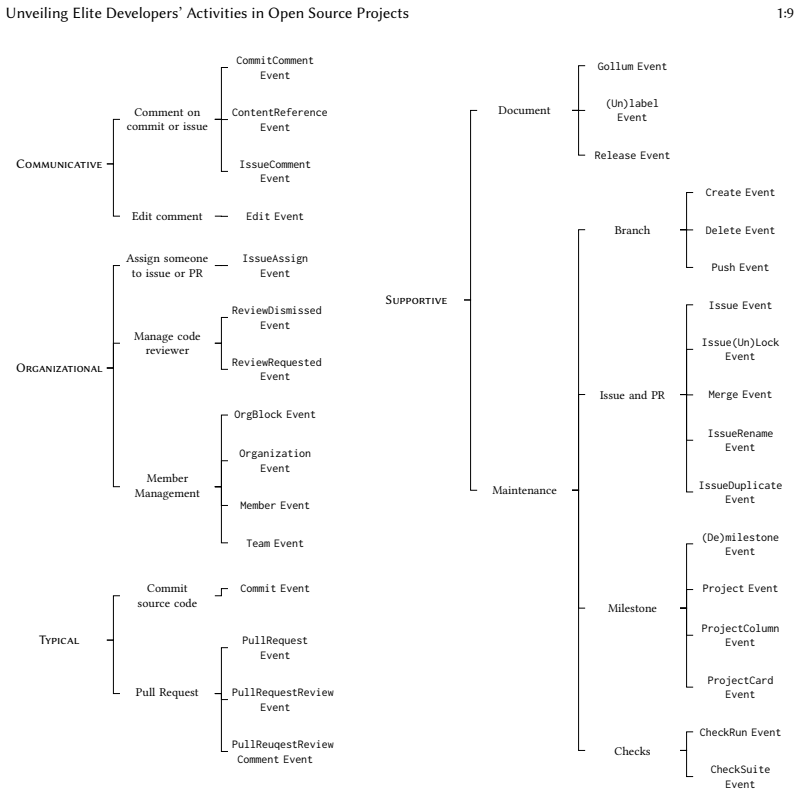
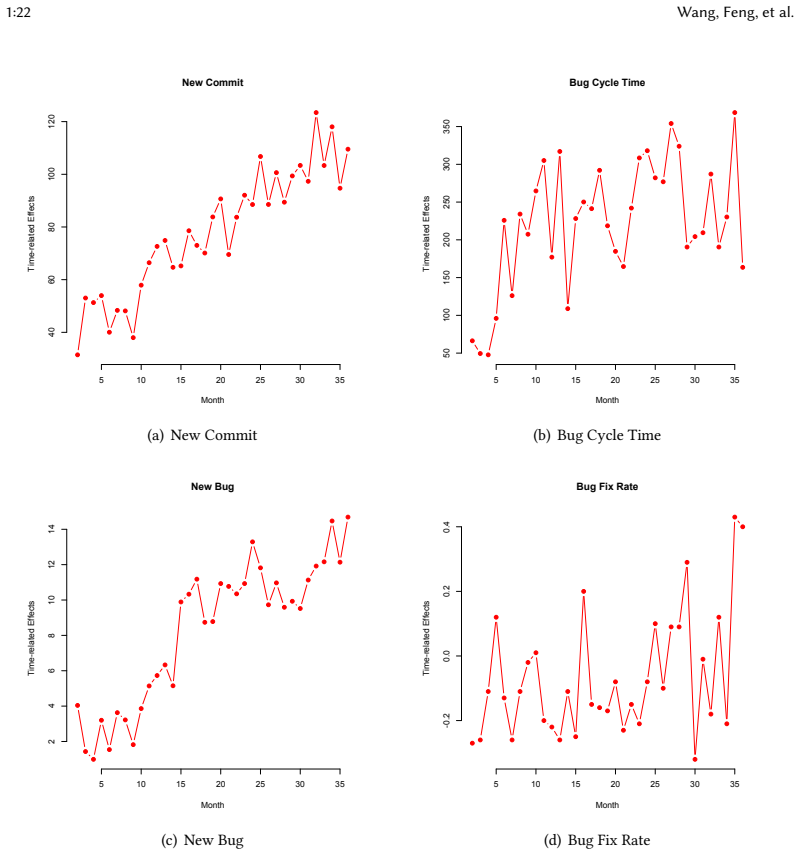
The load-bearing machinery is a four-category taxonomy of developer activity — communicative, organizational, supportive, and typical — adapted from prior field studies of software professionals and mapped onto 35 raw GitHub event types by closed card sorting, with 0.77 kappa agreement among the sorters. Elite status is identified dynamically: anyone observed performing an action that requires repository write permission is tagged as elite for a rolling 90-day window. The outcome analysis then runs LSDV (least-squares dummy variable) project fixed-effects panel regressions of four project-level indicators (new commits, bug cycle time, new bugs, bug fix rate) on the monthly shares of the three non-coding categories, with the coding share omitted because the four shares sum to one.
What would settle it
Re-estimate Models P1 and Q1 with month fixed effects added alongside project fixed effects; if the negative coefficients on communicative and supportive shares and the positive coefficients on organizational and supportive shares disappear or change sign, the claimed associations are artifacts of project maturation rather than evidence about effort allocation.
Extended reading notes
Core claim
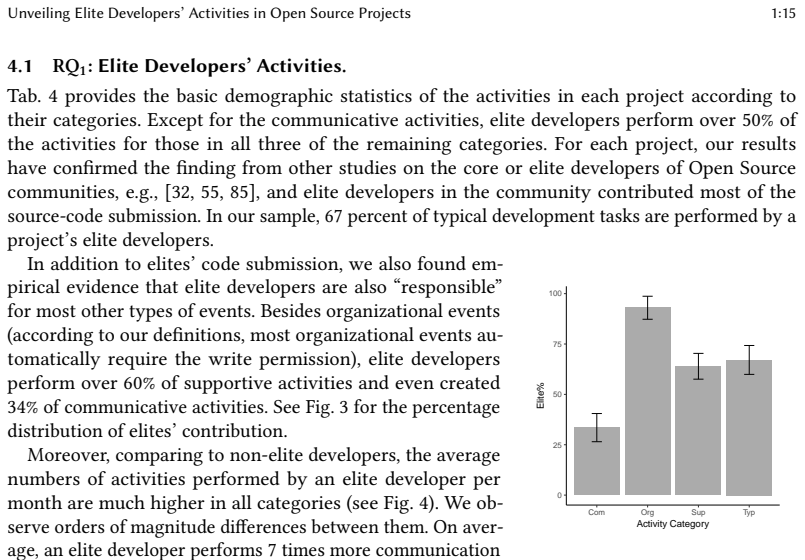
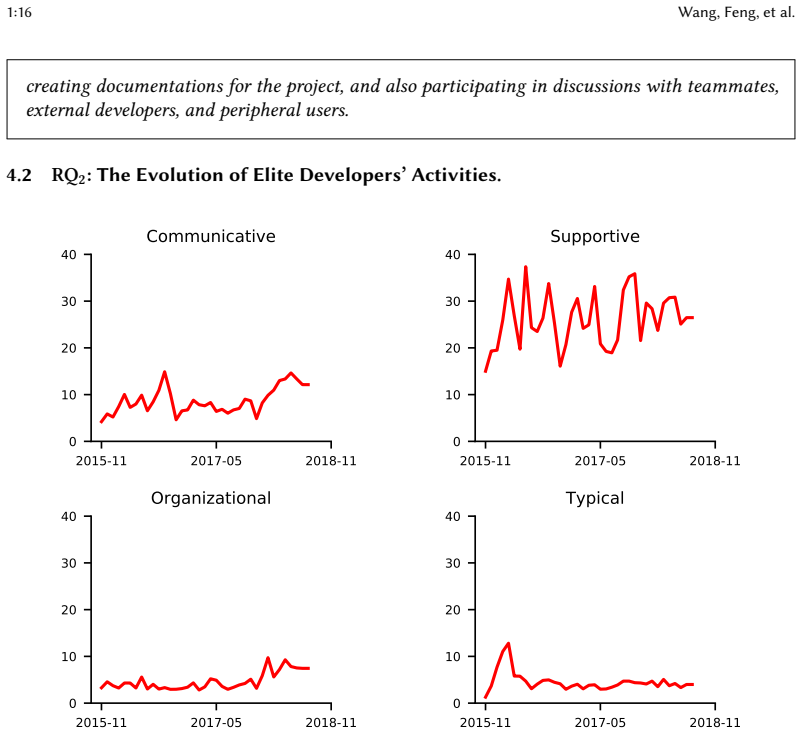
The paper's central claim is that elite developers' work is not mainly coding: across 20 large projects, typical (code-writing) events are a small part of an elite developer's monthly activity, while communicative, organizational, and supportive events dominate, and their share grows as the project ages. Using project fixed-effects panel regressions on 720 project-months, the paper finds that when elites devote a larger share of effort to communicative or supportive activities, the project's new commit count in that month is lower; more organizational and supportive effort is associated with more newly reported bugs; yet more supportive effort is also associated with a higher bug fix rate. The authors read these results as showing that elite time and attention are finite resources, so non-technical duties crowd out technical contribution, while some supportive work genuinely helps the defect-removal process, and they are careful to label the findings as correlations rather than established causes.
Load-bearing premise
The panel regressions assume that, once fixed project differences are removed, the month-to-month variation in elite effort shares is not confounded by an underlying project-lifecycle trend; the paper's own time-fixed-effect tests are significant for the new-commit and new-bug models.
Editorial extensions
If this is right
- If the associations are real, project managers should expect commit throughput to fall as a maintainer takes on more communication and support work, and should plan staffing accordingly.
- The positive link between supportive effort and bug fix rate suggests that labeling, documentation, branch management, and similar maintenance work is not pure overhead; it may be what keeps the defect-removal pipeline moving.
- Company-sponsored projects show stronger associations in this study, so corporate governance practices that add communication overhead may be the first place to look for savings.
- Automating routine organizational and supportive tasks (issue assignment, labeling, triage, release steps) would, under the paper's interpretation, free elite time for coding without giving up the quality benefits of support work.
- Decentralizing administrative privileges could both reduce elite burden and give non-elite contributors more involvement, addressing the concentration of authority the paper documents.
Reading between the lines
- Because the four effort shares sum to one, the regressions describe relative allocation only: a month with fewer commits mechanically has a higher non-coding share even if elites' absolute non-coding effort did not change. Re-running the analysis with per-elite activity counts, rather than shares, would separate 'communication crowds out coding' from 'coding fell for other reasons.'
- The paper's own time-fixed-effect tests are significant for the new-commit and new-bug models, so an omitted project-lifecycle trend is a live rival explanation; estimating the same models with month dummies would show whether the negative coefficients survive.
- A direct testable extension would follow a single project through an exogenous shock, such as a spike in issue inflow or a core maintainer going on leave, and compare months with high versus low elite communication after matching on bug volume.
- The event stream covers only public platform activity; if elites move coordination to private channels as projects mature, the reported growth in communicative effort may be underestimated.
Signed reviews
Editorial analysis
A structured set of objections, weighed in public.
Referee Report
Summary. The paper presents an empirical study of elite developers (developers with repository write permission) in 20 large open-source GitHub projects, using GHArchive and GitHub API event data from 2015 to 2018. The authors map raw events into four activity categories (communicative, organizational, supportive, typical) following Sonnentag's taxonomy, identify elite developers through a write-permission inference mechanism with a 90-day inactivity window, and analyze (RQ1) the distribution of elite activity across categories, (RQ2) the evolution of per-developer effort shares over project months using growth rates and ANOVA, and (RQ3) the association between elite effort shares and project outcomes (new commits, bug cycle time, new bugs, bug fix rate) using project-specific fixed-effects panel regressions. The headline findings are that elites dominate most activity categories (93% of organizational, 67% of typical), that their typical activities decline over time while communicative and supportive activities rise, and that non-technical effort shares are negatively associated with productivity and quality, with a positive association between supportive effort and bug fix rate.
Significance. If the results hold, the paper would provide a rare holistic view of elite developer work portfolios and useful evidence for effort-allocation guidance and automation tooling. The paper's strengths include a publicly released cleaned dataset, a structured card-sorting procedure with acceptable inter-rater agreement (kappa = 0.77), and the use of panel econometrics with fixed-effects and explicit diagnostics. However, the contribution is currently weakened by two load-bearing issues: the RQ1 organizational-activity share is partly definitional because elite status is inferred from write-permission-requiring events that largely coincide with the organizational category, and the RQ3 panel regressions omit time fixed effects despite the paper's own diagnostics showing significant time effects. The descriptive RQ1 and RQ2 findings are plausible and align with prior literature, but the central correlational claims of RQ3 require re-estimation before they can be accepted.
major comments (2)
- [Section 4.1 (Table 4) and Section 3.5] The claim that elite developers perform 93% of organizational activities (Table 4) is partly definitional: elite status is inferred from any action requiring write permission (Section 3.5), and most organizational event types in the taxonomy (assigning issues or PRs, requesting reviews, member/team events) require write permission by GitHubs design. The paper acknowledges this in Section 4.1: 'according to our definitions, most organizational events automatically require the write permission.' Consequently, the high elite share in the organizational category is a near-tautology and does not constitute independent evidence about elite developers' activity portfolio. Please report the fraction of organizational events that require write permission by construction, re-estimate RQ1 using an elite identification independent of the same event types (e.g., team membership or a contribution-threshold definition), and provide a robustness check that excludes the definitional overlap.
- [Section 3.6.3, Eqs. (2)-(5), and Section 4.3.3 (Tables 5 and 6)] The headline negative associations in Models P1 and Q1 may be artifacts of an omitted time trend. The panel regressions include only project-specific fixed effects; month dummies are not included, yet Section 4.3.3 reports that time-fixed effects are significant for the new-commit model (F(38,662)=1.59, p=0.02) and the new-bug model (F(38,662)=3.29, p<0.001). Because RQ2 establishes that elite effort shares trend over time (typical activities decline at -1.63% per month while communicative and supportive shares rise), and because project maturation plausibly affects commit counts and bug reports, the omitted common time trend is correlated with both the regressors and the outcomes. The statement that time effects are 'small' (adjusted R²=0.01) does not address omitted-variable bias, since even small confounders can substantially bias coefficients when they correlate with the regressors. Please add month fixed effects or a smooth time trend to Eqs. (2)-(5), report the resulting coefficients for S-Com, S-Org, and S-Sup, and conduct a formal test of whether the coefficients are stable. Without this re-analysis, the RQ3 conclusions are not supported.
minor comments (5)
- [Section 4.3.3] The sentence 'For Model P2, where the bug cycle time ... the time-fixed effects model is not significant (F(38,662) = 1.80, p < 0.01)' is self-contradictory because p < 0.01 is significant; also, the later paragraph about the bug fix rate refers to 'Model P2' but should refer to Model Q2.
- [Table 4] The project name 'splitebrowser' should be 'sqlitebrowser'.
- [Section 4.3.2] The opening sentence refers to 'the two project productivity indicators' for the quality models; it should say 'project quality indicators'.
- [Figure 2 and Section 3.3.4] The figure places PullRequestReviewComment and PullRequestReviewEvent under 'Typical', while Section 3.3.4 states that typical activities are 'counted as submitted commits and pull requests' and 'we only include commit activity under this category'; please reconcile these statements and clarify whether pull request review events are part of the typical category in the analysis.
- [Section 1 (Abstract)] The abstract's phrase 'technical contributions (e.g., coding) accounting for a small proportion only' is ambiguous because Table 4 shows elites perform 67% of typical activities; clarify that 'small proportion' refers to the share of elites' own effort distribution, not the project-wide share.
Circularity Check
Two construction overlaps make the elite share of organizational events and the supportive-effort/bug-fix-rate association partly tautological; the main negative RQ3 correlations remain empirical.
-
self definitional
[Section 3.5 (elite identification); Section 4.1 and Table 4 (RQ1 organizational share)]
"When a developer in the repository performs a task that requires the write permission, we tag this developer with 'elite-ship' of the repository. ... Besides organizational events (according to our definitions, most organizational events automatically require the write permission), elite developers perform over 60% of supportive activities and even created 34% of communicative activities."
The elite set is defined by performing write-permission-requiring actions, and the organizational category (Fig. 2) consists largely of such actions (member management, assigning issues/PRs, managing reviewers). Consequently the 93% mean elite share of organizational events in Table 4 is entailed by the identification rule: by construction, non-elites cannot perform most organizational events. The paper presents this as an empirical finding about elite responsibility, but it is a property of the operationalization.
-
self definitional
[Section 3.4 (BF R definition); Fig. 2 taxonomy (Supportive/Issue Event); Table 6 Model Q2]
"Supportive ... Issue and PR ... IssueDuplicateEvent, IssueRenameEvent, Merge Event, Issue(Un)LockEvent, Issue Event (Fig. 2); BF Rim = No. of Fixed Bugs / No. of Found Bugs, for project i in month m (Section 3.4)."
Closing a bug report is an IssueEvent, so it is counted in the supportive share S-Sup; the same closure also increments the numerator of the dependent variable BF R (fixed bugs). In Model Q2, the positive coefficient of S-Sup on BF R (1.12***) is therefore partly an identity: one action is recorded on both sides of the regression. The paper's interpretation that supportive effort improves the defect-removal process is contaminated by this definitional overlap.
full rationale
The paper's central negative RQ3 findings for New Commits, Bug Cycle Time, and New Bugs come from panel regressions whose coefficients are not forced by definition; those results are independent empirical correlations, so the paper is not wholly circular. However, two load-bearing results do reduce by construction. First, the RQ1 claim that elites perform 93% of organizational events follows from defining elites as actors who perform write-permission-requiring actions while defining most organizational events as write-permission-requiring; the paper itself concedes this. Second, the Bug Fix Rate outcome overlaps with the supportive activity category through IssueEvent/closing events, making the positive S-Sup coefficient in Model Q2 partly an accounting identity. The omitted time fixed effects concern noted in Section 4.3.3 is a validity threat, not a circularity, and no self-citation chain is load-bearing here; the score reflects these two definitional overlaps while recognizing that the main negative association claims retain independent empirical content.
Assumptions & free parameters
free parameters (2)
- Elite-ship inactivity window =
90 days
- Bug keyword list =
defect, error, bug, issue, mistake, incorrect, fault, flaw
assumptions (6)
- domain assumption GitHub public event data captures the relevant universe of elite developer activities across all four categories.
- domain assumption Sonnentag's four-category taxonomy (communicative, organizational, supportive, typical) transfers from in-house software developers to open source developers.
- domain assumption Performing any write-permission-requiring event marks a developer as elite, and a 90-day activity window captures current elite status.
- domain assumption Fixed-effects panel regressions without time fixed effects are sufficient to identify associations between effort shares and outcomes.
- domain assumption Issues whose title or tags contain one of eight keywords are bugs.
- standard math LSDV fixed-effects estimation and ANOVA are appropriate for the panel structure.
Cite this review
Pith. "Pith review of Unveiling Elite Developers' Activities in Open Source Projects." pith.science (2026). https://pith.science/paper/A5NNIMV6
@misc{pith2026190808196,
  author       = {Pith},
  title        = {Pith review of: Unveiling Elite Developers' Activities in Open Source Projects},
  year         = {2026},
  howpublished = {\url{https://pith.science/paper/A5NNIMV6}},
  note         = {Machine review of arXiv:1908.08196}
}
read the original abstract
Open-source developers, particularly the elite developers, maintain a diverse portfolio of contributing activities. They do not only commit source code but also spend a significant amount of effort on other communicative, organizational, and supportive activities. However, almost all prior research focuses on a limited number of specific activities and fails to analyze elite developers' activities in a comprehensive way. To bridge this gap, we conduct an empirical study with fine-grained event data from 20 large open-source projects hosted on GitHub. Thus, we investigate elite developers' contributing activities and their impacts on project outcomes. Our analyses reveal three key findings: (1) they participate in a variety of activities while technical contributions (e.g., coding) accounting for a small proportion only; (2) they tend to put more effort into supportive and communicative activities and less effort into coding as the project grows; (3) their participation in non-technical activities is negatively associated with the project's outcomes in term of productivity and software quality. These results provide a panoramic view of elite developers' activities and can inform an individual's decision making about effort allocation, thus leading to finer project outcomes. The results also provide implications for supporting these elite developers.
Figures

Figures from the paper (3 more)

Reference graph
Works this paper leans on
-
[1]
Mark Aberdour. 2007. Achieving quality in open-source software. IEEE Software 24, 1 (2007), 58–64
2007
-
[2]
Juan Jose Amor, Gregorio Robles, and Jesus M. Gonzalez-Barahona. 2006. Effort Estimation by Characterizing Developer Activity. In Proceedings of the 2006 International Workshop on Economics Driven Software Engineering Research (EDSER ’06). ACM, New York, NY, USA, 3–6. https://doi.org/10.1145/1139113.1139116
-
[3]
John Anvik, Lyndon Hiew, and Gail C. Murphy. 2006. Who Should Fix This Bug?. InProceedings of the 28th International Conference on Software Engineering (ICSE ’06) . ACM, New York, NY, USA, 361–370. https://doi.org/10.1145/1134285. 1134336
doi:10.1145/1134285 2006
-
[4]
Blake Ashforth. 2000. Role transitions in organizational life: An identity-based perspective . Routledge
2000
-
[5]
Sogol Balali, Igor Steinmacher, Umayal Annamalai, Anita Sarma, and Marco Aurelio Gerosa. 2018. Newcomers’ Barriers. . . Is That All? An Analysis of Mentors’ and Newcomers’ Barriers in OSS Projects. Computer Supported Cooperative Work (CSCW) 27, 3 (01 Dec 2018), 679–714. https://doi.org/10.1007/s10606-018-9310-8
-
[6]
Sebastian Baltes and Stephan Diehl. 2018. Towards a theory of software development expertise. In Proceedings of the 2018 26th ACM Joint Meeting on European Software Engineering Conference and Symposium on the Foundations of Software Engineering. ACM, 187–200
2018
-
[7]
Christian Bird. 2011. Sociotechnical coordination and collaboration in open source software. In 2011 27th IEEE International Conference on Software Maintenance (ICSM) . IEEE, 568–573
2011
-
[8]
Christian Bird, Nachiappan Nagappan, Brendan Murphy, Harald Gall, and Premkumar Devanbu. 2011. Don’t touch my code!: examining the effects of ownership on software quality. In Proceedings of the 19th ACM SIGSOFT symposium and the 13th European conference on Foundations of software engineering . ACM, 4–14
2011
Show all 93 references
-
[9]
Christian Bird, David Pattison, Raissa D’Souza, Vladimir Filkov, and Premkumar Devanbu. 2008. Latent Social Structure in Open Source Projects. In Proceedings of the 16th ACM SIGSOFT International Symposium on Foundations of Software Engineering (SIGSOFT ’08/FSE-16) . ACM, New ...
2008
-
[10]
Christian Bird, Peter C Rigby, Earl T Barr, David J Hamilton, Daniel M German, and Prem Devanbu. 2009. The promises and perils of mining git. In 2009 6th IEEE International Working Conference on Mining Software Repositories . IEEE, 1–10
2009
-
[11]
Tegawendé F Bissyandé, David Lo, Lingxiao Jiang, Laurent Réveillere, Jacques Klein, and Yves Le Traon. 2013. Got issues? who cares about it? a large scale investigation of issue trackers from github. In 2013 IEEE 24th international symposium on software reliability engineering...
2013
-
[12]
Kenneth S Bordens and Bruce B Abbott. 2002. Research Design and Methods: A Process Approach . McGraw-Hill
2002
-
[13]
danah boyd and Kate Crawford. 2012. Critical questions for big data: Provocations for a cultural, technological, and scholarly phenomenon. Information, Communication & Society 15 (01 2012), 662–679
2012
-
[14]
Robert L Brennan and Dale J Prediger. 1981. Coefficient kappa: Some uses, misuses, and alternatives. Educational and psychological measurement 41, 3 (1981), 687–699
1981
-
[15]
Felix C Brodbeck. 1994. Software-Entwicklung: Ein Tätigkeitsspektrum mit vielfältigen Kommunikations-und Lernan- forderungen. na
1994
-
[16]
Gerardo Canfora, Massimiliano Di Penta, Rocco Oliveto, and Sebastiano Panichella. 2012. Who is Going to Mentor Newcomers in Open Source Projects?. In Proceedings of the ACM SIGSOFT 20th International Symposium on the Foundations of Software Engineering (FSE ’12) . ACM, New Yor...
2012
-
[17]
Oscar Chaparro, Jing Lu, Fiorella Zampetti, Laura Moreno, Massimiliano Di Penta, Andrian Marcus, Gabriele Bavota, and Vincent Ng. 2017. Detecting Missing Information in Bug Descriptions. In Proceedings of the 2017 11th Joint Meeting on Foundations of Software Engineering (ESEC...
2017
-
[18]
Benjamin Collier, Moira Burke, Niki Kittur, and Robert E Kraut. [n.d.]. Promoting Good Management: Governance, Promotion, and Leadership in Open Collaboration Communities.. In Proceedings of the 2010 International Conference on Information Systems (ICIS’10). 220
2010
-
[19]
Josh Cowls and Ralph Schroeder. 2015. Causation, Correlation, and Big Data in Social Science Research. Policy & Internet 7 (08 2015), n/a–n/a. https://doi.org/10.1002/poi3.100
2015 doi
-
[20]
Yves Croissant and Giovanni Millo. 2008. Panel Data Econometrics in R: The plm Package. Journal of Statistical Software 27, 2 (2008), 1–43. https://doi.org/10.18637/jss.v027.i02
2008 doi
-
[21]
Kevin Crowston, Hala Annabi, James Howison, and Chengetai Masango. 2004. Effective Work Practices for Software En- gineering: Free/Libre Open Source Software Development. InProceedings of the 2004 ACM Workshop on Interdisciplinary Software Engineering Research (WISER ’04) . AC...
2004
-
[22]
Kevin Crowston and James Howison. 2005. The social structure of free and open source software development. First Monday 10, 2 (2005)
2005
-
[23]
Kevin Crowston and James Howison. 2006. Assessing the health of open source communities. Computer 39, 5 (2006), 89–91
2006
-
[24]
Kevin Crowston, Kangning Wei, James Howison, and Andrea Wiggins. 2008. Free/Libre Open-source Software Development: What We Know and What We Do Not Know. ACM Comput. Surv. 44, 2, Article 7 (March 2008), 35 pages. https://doi.org/10.1145/2089125.2089127
2008
-
[25]
Kevin Crowston, Kangning Wei, Qing Li, and James Howison. 2006. Core and periphery in free/libre and open source software team communications. In Proceedings of the 39th Annual Hawaii International Conference on System Sciences (HICSS’06), Vol. 6. IEEE, 118a–118a
2006
-
[26]
Daniel Alencar da Costa, Uirá Kulesza, Eduardo Aranha, and Roberta Coelho. 2014. Unveiling Developers Contributions Behind Code Commits: An Exploratory Study. InProceedings of the 29th Annual ACM Symposium on Applied Computing (SAC ’14). ACM, New York, NY, USA, 1152–1157. http...
2014
-
[27]
Laura Dabbish, Colleen Stuart, Jason Tsay, and Jim Herbsleb. 2012. Social coding in GitHub: transparency and collaboration in an open software repository. In Proceedings of the ACM 2012 conference on computer supported cooperative work. ACM, 1277–1286
2012
-
[28]
Barthélémy Dagenais, Harold Ossher, Rachel K. E. Bellamy, Martin P. Robillard, and Jacqueline P. de Vries. 2010. Moving into a New Software Project Landscape. In Proceedings of the 32Nd ACM/IEEE International Conference on Software Engineering - Volume 1 (ICSE ’10) . ACM, New ...
2010
-
[29]
Martyn Denscombe. 2014. The Good Research Guide: For Small-scale Social Research Projects . McGraw-Hill Education (UK)
2014
-
[30]
Luis Felipe Dias, Igor Steinmacher, and Gustavo Pinto. 2018. Who drives company-owned OSS projects: internal or external members? Journal of the Brazilian Computer Society 24, 1 (2018), 16
2018
-
[31]
Dino Distefano, Manuel Fähndrich, Francesco Logozzo, and Peter W. O’Hearn. 2019. Scaling Static Analyses at Facebook. Commun. ACM 62, 8 (July 2019), 62–70. https://doi.org/10.1145/3338112
2019 doi
-
[32]
Nicolas Ducheneaut. 2005. Socialization in an open source software community: A socio-technical analysis. Computer Supported Cooperative Work (CSCW) 14, 4 (2005), 323–368. ACM Trans. Softw. Eng. Methodol., Vol. 28, No. 1, Article 1. Publication date: January 2019. Unveiling El...
2005
-
[33]
Liran Einav and Jonathan Levin. 2014. Economics in the age of big data. Science 346 (11 2014), 1243089. https: //doi.org/10.1126/science.1243089
2014 doi
-
[34]
Kristin E Flegal and Michael C Anderson. 2008. Overthinking skilled motor performance: Or why those who teach canâĂŹt do. Psychonomic Bulletin & Review 15, 5 (2008), 927–932
2008
-
[35]
Matt Germonprez, Julie E Kendall, Kenneth E Kendall, Lars Mathiassen, Brett Young, and Brian Warner. 2016. A theory of responsive design: A field study of corporate engagement with open source communities. Information Systems Research 28, 1 (2016), 64–83
2016
-
[36]
Georgios Gousios, Margaret-Anne Storey, and Alberto Bacchelli. 2016. Work practices and challenges in pull-based development: the contributor’s perspective. In Proceedings of the 38th IEEE/ACM International Conference on Software Engineering (ICSE ’16) . IEEE, 285–296
2016
-
[37]
Philip J Guo, Thomas Zimmermann, Nachiappan Nagappan, and Brendan Murphy. 2011. Not my bug! and other reasons for software bug report reassignments. In Proceedings of the ACM 2011 conference on Computer supported cooperative work. ACM, 395–404
2011
-
[38]
Marvin Hanisch, Carolin Haeussler, Stefan Berreiter, and Sven Apel. 2018. Developers’ Progression from Periphery to Core in the Linux Kernel Development Project. In Academy of Management Proceedings , Vol. 2018. Academy of Management Briarcliff Manor, NY 10510, 14263
2018
-
[39]
James Howison and Kevin Crowston. 2014. Collaboration through open superposition: a theory of the open source way. Management Information Systems Quarterly 38, 1 (2014), 29–50
2014
-
[40]
Federico Iannacci. 2005. Coordination processes in open source software development: The Linux case study.Emergence: Complexity & Organization 7, 2 (2005)
2005
-
[41]
Chris Jensen and Walt Scacchi. 2007. Role Migration and Advancement Processes in OSSD Projects: A Comparative Case Study. In Proceedings of the 29th International Conference on Software Engineering (ICSE ’07) . IEEE Computer Society, Washington, DC, USA, 364–374. https://doi.o...
2007 doi
-
[42]
Corey Jergensen, Anita Sarma, and Patrick Wagstrom. 2011. The onion patch: migration in open source ecosystems. In Proceedings of the 19th ACM SIGSOFT symposium and the 13th European conference on Foundations of software engineering (FSE’11). ACM, 70–80
2011
-
[43]
Mitchell Joblin, Sven Apel, Claus Hunsen, and Wolfgang Mauerer. 2017. Classifying Developers into Core and Peripheral: An Empirical Study on Count and Network Metrics. In Proceedings of the 39th International Conference on Software Engineering (ICSE ’17) . IEEE Press, Piscataw...
2017 doi
-
[44]
Eirini Kalliamvakou, Georgios Gousios, Kelly Blincoe, Leif Singer, Daniel M German, and Daniela Damian. 2014. The promises and perils of mining GitHub. In Proceedings of the 11th working conference on mining software repositories (MSR). ACM, 92–101
2014
-
[45]
Foutse Khomh, Tejinder Dhaliwal, Ying Zou, and Bram Adams. 2012. Do faster releases improve software quality?: an empirical case study of Mozilla Firefox. In Proceedings of the 9th IEEE Working Conference on Mining Software Repositories. IEEE Press, 179–188
2012
-
[46]
Dongsun Kim, Yida Tao, Sunghun Kim, and Andreas Zeller. 2013. Where should we fix this bug? a two-phase recommendation model. IEEE Transactions on Software Engineering 39, 11 (2013), 1597–1610
2013
-
[47]
Sunghun Kim and E James Whitehead Jr. 2006. How long did it take to fix bugs?. InProceedings of the 2006 international workshop on Mining software repositories . ACM, 173–174
2006
-
[48]
Chakravanti Rajagopalachari Kothari. 2004. Research Methodology: Methods and Techniques . New Age International
2004
-
[49]
LaToza, Gina Venolia, and Robert DeLine
Thomas D. LaToza, Gina Venolia, and Robert DeLine. 2006. Maintaining Mental Models: A Study of Developer Work Habits. In Proceedings of the 28th International Conference on Software Engineering (ICSE ’06) . ACM, New York, NY, USA, 492–501. https://doi.org/10.1145/1134285.1134355
2006
-
[50]
Josh Lerner and Jean Tirole. 2002. Some simple economics of open source. The journal of industrial economics 50, 2 (2002), 197–234
2002
-
[51]
Ytzhak Levendel. 1990. Reliability analysis of large software systems: Defect data modeling. IEEE Transactions on Software Engineering 16, 2 (1990), 141–152
1990
-
[52]
Jiwei Li, Michel Galley, Chris Brockett, Jianfeng Gao, and Bill Dolan. 2016. A Diversity-Promoting Objective Function for Neural Conversation Models. In Proceedings of the 2016 Conference of the North American Chapter of the Association for Computational Linguistics: Human Lan...
2016
-
[53]
Bin Lin, Gregorio Robles, and Alexander Serebrenik. 2017. Developer turnover in global, industrial open source projects: Insights from applying survival analysis. In 2017 IEEE 12th International Conference on Global Software Engineering (ICGSE). IEEE, 66–75
2017
-
[54]
DV Luciv, DV Koznov, George A Chernishev, Andrey N Terekhov, K Yu Romanovsky, and DA Grigoriev. 2018. Detecting near duplicates in software documentation. Programming and Computer Software 44, 5 (2018), 335–343
2018
-
[55]
Fielding, and James D
Audris Mockus, Roy T. Fielding, and James D. Herbsleb. 2002. Two Case Studies of Open Source Software Development: Apache and Mozilla. ACM Trans. Softw. Eng. Methodol. 11, 3 (July 2002), 309–346. https://doi.org/10.1145/567793.567795 ACM Trans. Softw. Eng. Methodol., Vol. 28, ...
2002
-
[56]
Nigel Nicholson. 1984. A theory of work role transitions. Administrative science quarterly (1984), 172–191
1984
-
[57]
Siobhan O’Mahony and Fabrizio Ferraro. 2007. The emergence of governance in an open source community. Academy of Management Journal 50, 5 (2007), 1079–1106
2007
-
[58]
Brian T Pentland and Martha S Feldman. 2005. Organizational routines as a unit of analysis. Industrial and Corporate Change 14, 5 (2005), 793–815
2005
-
[59]
Huilian Sophie Qiu, Alexander Nolte, Anita Brown, A Serebrenik, and Bogdan Vasilescu. 2018. Going Farther Together: The Impact of Social Capital on Sustained Participation in Open Source. In International Conference on Software Engineering. IEEE Computer Society
2018
-
[60]
R Development Core Team. 2008. R: A Language and Environment for Statistical Computing . R Foundation for Statistical Computing, Vienna, Austria. http://www.R-project.org ISBN 3-900051-07-0
2008
-
[61]
Foyzur Rahman and Premkumar Devanbu. 2011. Ownership, experience and defects: a fine-grained study of authorship. In Proceedings of the 33rd International Conference on Software Engineering . ACM, 491–500
2011
-
[62]
Baishakhi Ray, Daryl Posnett, Vladimir Filkov, and Premkumar Devanbu. 2014. A large scale study of programming languages and code quality in github. In Proceedings of the 22nd ACM SIGSOFT International Symposium on Foundations of Software Engineering. ACM, 155–165
2014
-
[63]
Eric Raymond. 1999. The cathedral and the bazaar. Knowledge, Technology & Policy 12, 3 (1999), 23–49
1999
-
[64]
Rigby, Daniel M
Peter C. Rigby, Daniel M. German, and Margaret-Anne Storey. 2008. Open Source Software Peer Review Practices: A Case Study of the Apache Server. In Proceedings of the 30th International Conference on Software Engineering (ICSE ’08) . ACM, New York, NY, USA, 541–550. https://do...
2008
-
[65]
Jeffrey A Roberts, Il-Horn Hann, and Sandra A Slaughter. 2006. Understanding the motivations, participation, and performance of open source software developers: A longitudinal study of the Apache projects. Management science 52, 7 (2006), 984–999
2006
-
[66]
Bertil Rolandsson, Magnus Bergquist, and Jan Ljungberg. 2011. Open source in the firm: Opening up professional practices of software development. Research Policy 40, 4 (2011), 576–587
2011
-
[67]
Mike Savage and Roger Burrows. 2007. The Coming Crisis of Empirical Sociology. Sociology 41 (10 2007). https: //doi.org/10.1177/0038038507080443
2007 doi
-
[68]
Walt Scacchi. 2007. Free/Open Source Software Development. InProceedings of the the 6th Joint Meeting of the European Software Engineering Conference and the ACM SIGSOFT Symposium on The Foundations of Software Engineering (ESEC- FSE ’07). ACM, New York, NY, USA, 459–468. http...
2007
-
[69]
Mario Schaarschmidt, Gianfranco Walsh, and Harald FO von Kortzfleisch. 2015. How do firms influence open source software communities? A framework and empirical analysis of different governance modes. Information and Organization 25, 2 (2015), 99–114
2015
-
[70]
Sonali K Shah. 2006. Motivation, governance, and the viability of hybrid forms in open source software development. Management science 52, 7 (2006), 1000–1014
2006
-
[71]
Emad Shihab, Akinori Ihara, Yasutaka Kamei, Walid M Ibrahim, Masao Ohira, Bram Adams, Ahmed E Hassan, and Ken-ichi Matsumoto. 2013. Studying re-opened bugs in open source software. Empirical Software Engineering 18, 5 (2013), 1005–1042
2013
-
[72]
Sabine Sonnentag. 1995. Excellent software professionals: Experience, work activities, and perception by peers. Behaviour & Information Technology 14, 5 (1995), 289–299
1995
-
[73]
Sabine Sonnentag. 1998. Expertise in professional software design: A process study. Journal of applied psychology 83, 5 (1998), 703
1998
-
[74]
Igor Steinmacher, Tayana Conte, Marco Aurélio Gerosa, and David Redmiles. 2015. Social barriers faced by newcomers placing their first contribution in open source software projects. InProceedings of the 18th ACM conference on Computer supported cooperative work & social comput...
2015
-
[75]
Margaret-Anne Storey. 2019. Publish or Perish: Questioning the Impact of Our Research on the Software Developer. In Proceedings of the 41st International Conference on Software Engineering: Companion Proceedings (ICSE ’19) . IEEE Press, Piscataway, NJ, USA, 2–2. https://doi.or...
2019
-
[76]
Fei Liu Jeffrey Flanigan Sam Thomson and Norman Sadeh Noah A Smith. 2015. Toward Abstractive Summarization Using Semantic Representations. , 1077-1086 pages
2015
-
[77]
Marat Valiev, Bogdan Vasilescu, and James Herbsleb. 2018. Ecosystem-level determinants of sustained activity in open-source projects: a case study of the PyPI ecosystem. InProceedings of the 2018 26th ACM Joint Meeting on European Software Engineering Conference and Symposium ...
2018
-
[78]
Perry van Wesel, Bin Lin, Gregorio Robles, and Alexander Serebrenik. 2017. Reviewing career paths of the openstack developers. In Proceedings of the 2017 IEEE International Conference on Software Maintenance and Evolution (ICSME ’17) . IEEE, 544–548
2017
-
[79]
Bogdan Vasilescu, Kelly Blincoe, Qi Xuan, Casey Casalnuovo, Daniela Damian, Premkumar Devanbu, and Vladimir Filkov. 2016. The sky is not the limit: multitasking across GitHub projects. In 2016 IEEE/ACM 38th International ACM Trans. Softw. Eng. Methodol., Vol. 28, No. 1, Articl...
2016
-
[80]
Bogdan Vasilescu, Vladimir Filkov, and Alexander Serebrenik. 2013. Stackoverflow and github: Associations between software development and crowdsourced knowledge. In 2013 International Conference on Social Computing . IEEE, 188–195
2013
-
[81]
Bogdan Vasilescu, Daryl Posnett, Baishakhi Ray, Mark GJ van den Brand, Alexander Serebrenik, Premkumar Devanbu, and Vladimir Filkov. 2015. Gender and tenure diversity in GitHub teams. In Proceedings of the 33rd Annual ACM Conference on Human Factors in Computing Systems (CHI ’...
2015
-
[82]
Bogdan Vasilescu, Yue Yu, Huaimin Wang, Premkumar Devanbu, and Vladimir Filkov. 2015. Quality and productivity outcomes relating to continuous integration in GitHub. In Proceedings of the 2015 10th Joint Meeting on Foundations of Software Engineering (FSE ’15) . ACM, 805–816
2015
-
[83]
Georg Von Krogh and Eric Von Hippel. 2006. The promise of research on open source software. Management science 52, 7 (2006), 975–983
2006
-
[84]
Patrick Wagstrom. 2009. Vertical interaction in open software engineering communities . PhD dissertation. Carnegie Mellon University
2009
-
[85]
Patrick Wagstrom, Corey Jergensen, and Anita Sarma. 2012. Roles in a networked software development ecosystem: A case study in GitHub. (2012)
2012
-
[86]
Wasserstein and Nicole A
Ronald L. Wasserstein and Nicole A. Lazar. 2016. The ASA’s Statement on p-Values: Context, Process, and Purpose. The American Statistician 70, 2 (2016), 129–133
2016
-
[87]
Weiss, R
C. Weiss, R. Premraj, T. Zimmermann, and A. Zeller. 2007. How Long Will It Take to Fix This Bug?. InFourth International Workshop on Mining Software Repositories (MSR’07:ICSE Workshops 2007) . 1–1. https://doi.org/10.1109/MSR.2007.13
2007 doi
-
[88]
E. F. Weller. 2000. Practical applications of statistical process control [in software development projects].IEEE Software 17, 3 (May 2000), 48–55. https://doi.org/10.1109/52.896249
2000 doi
-
[89]
Tsung-Hsien Wen, Milica Gasic, Nikola Mrkšić, Pei-Hao Su, David Vandyke, and Steve Young. 2015. Semantically Conditioned LSTM-based Natural Language Generation for Spoken Dialogue Systems. In Proceedings of the 2015 Conference on Empirical Methods in Natural Language Processin...
2015
-
[90]
Terry Winograd, Fernando Flores, and Fernando F Flores. 1986. Understanding computers and cognition: A new foundation for design. Intellect Books
1986
-
[91]
Jeffrey M Wooldridge. 2015. Introductory Econometrics: A Modern Approach . Nelson Education
2015
-
[92]
Judy L Wynekoop and Diane B Walz. 2000. Investigating traits of top performing software developers. Information Technology & People 13, 3 (2000), 186–195
2000
-
[93]
Daniel Bärl Torsten Zesch and Iryna Gurevych. 2012. Text Reuse Detection Using a Composition of Text Similarity Measures. In Proceedings of the 24th International Conference on Computational Linguistics (COLING’212), Vol. 1. Citeseer, 167–184. ACM Trans. Softw. Eng. Methodol.,...
2012
Reviewed August 14, 2026 · model on record in the stance chip above.
Discussion (0). Continue with ORCID to comment.