REVIEW 3 major objections 4 minor 39 references
Planar Hall Effect and Anisotropic Magnetoresistance in a polar-polar interface of LaVO$_3$-KTaO$_3$ with strong spin-orbit coupling
T0 review · 3 major / 4 minor · reviewed 2026-08-14 · deepseek-v4-flash
Pith's one-line read A LaVO3–KTaO3 interface hosts a two-dimensional electron gas whose strong spin–orbit coupling shows up as two-fold anisotropic magnetoresistance.
desk verdict New LVO-KTO interface is a plausible oxide 2DEG with strong spin-orbit coupling, but the BSO = 4.4 T headline rests on a WAL fit outside the model's stated validity range. read the letter →
The pith
A machine-rendered reading of the paper's core claim, the machinery that carries it, and where it could break.
The reading
What carries the argument
The ILP weak-antilocalization formula (Iordanskii–Lyanda-Geller–Pikus) is used to extract the spin–orbit field B_SO from perpendicular-field magnetoconductance; it is the main quantitative evidence for strong spin–orbit coupling. For the in-plane anisotropy, the paper solves a Rashba Hamiltonian with an added Zeeman term, evaluates transition matrix elements between the two spin-split parabolas for momentum-reversing backscattering, and finds that the total transition probability follows $cos^{2}$(phi), which phenomenologically reproduces the low-field AMR.
What would settle it
Measure the magnetoconductance of the same interface and fit the ILP formula only for B < 0.3 T; if no good fit or a much smaller B_SO results, the strong-coupling claim fails. Separately, measure the in-plane AMR at 0.1–0.3 T; if the angular dependence deviates from $cos^{2}$(phi), the Rashba transition-probability explanation is falsified.
Extended reading notes
Core claim
The central claim is that the LaVO3–KTaO3 polar–polar interface hosts a high-mobility two-dimensional electron gas with strong spin–orbit coupling, evidenced by weak antilocalization with B_SO about 4.4 T. The in-plane anisotropic magnetoresistance oscillates with the angle between current and field as $cos^{2}$(phi) up to 8 T, which the paper explains by computing the angle-dependent transition probabilities for backscattering between Rashba-split spin bands. Above 8 T, AMR shows a $cos^{2}$(phi) + $cos^{2}$(2phi) pattern, which the paper states cannot be explained by the Rashba model alone. The paper proposes that the high-field structure may arise from the coupling of the relativistic 2DEG to uncompensated localized vanadium spins at the interface.
Load-bearing premise
The quantitative claim of strong spin–orbit coupling rests on fitting the weak-antilocalization formula to fields up to 1 T, even though the paper notes the formula is valid only below about 0.3 T for these samples; if the fit is not robust within the valid range, the extracted B_SO = 4.4 T is not reliable.
Editorial extensions
If this is right
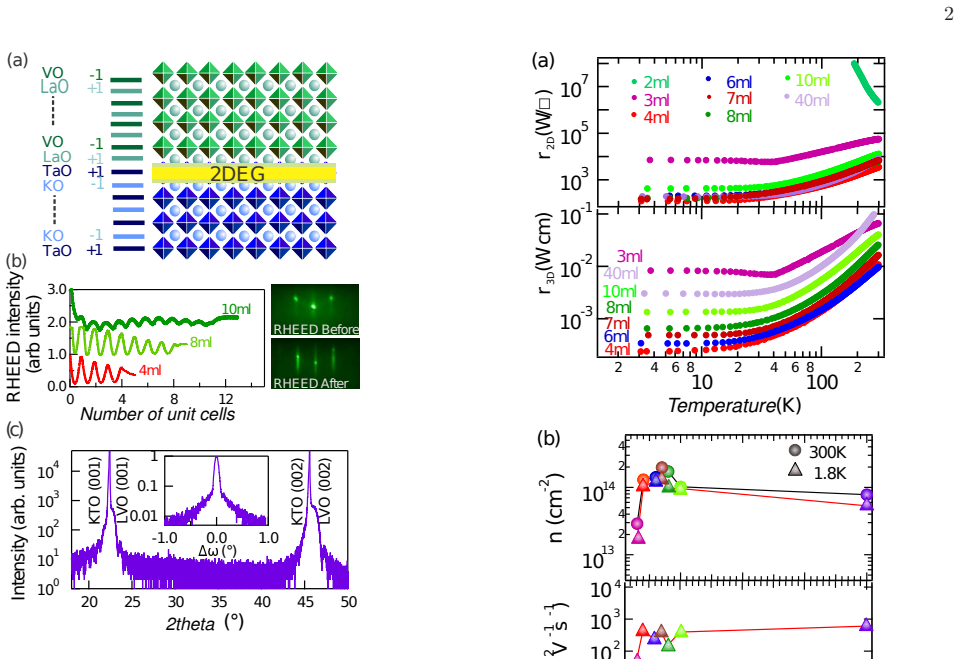
- The LaVO3–KTaO3 interface is a new conducting oxide interface whose carrier density and mobility are thickness-independent above 3 monolayers, consistent with electronic reconstruction against the polar catastrophe.
- A spin-precession length of 6 nm and B_SO of 4.4 T place this interface among the strongest spin–orbit-coupled oxide 2DEGs.
- The observed two-fold AMR and planar Hall effect up to 8 T support theoretical predictions that Rashba-split systems show in-plane magnetotransport anisotropy.
- The unexplained four-fold AMR at high fields indicates that a purely Rashba description is incomplete; a full model will need itinerant relativistic electrons, strong spin–orbit coupling, and localized moments.
Reading between the lines
- If B_SO ~ 4.4 T is confirmed by a measurement that respects the ILP validity bound, the LaVO3–KTaO3 interface could be a candidate for gate-tuned spin–orbit torque or spin-Hall devices without heavy-metal layers.
- The cos^2(phi) transition-probability calculation could be tested directly by fitting AMR at fields below 0.3 T, where the WL theory is strictly valid; a mismatch there would indicate that the anisotropy has a different origin.
- The four-fold AMR could be an independent probe of vanadium magnetism; growing samples with varying LaVO3 thickness and checking whether the four-fold onset field tracks the magnetization would test the proposed spin-coupling scenario.
Signed reviews
Editorial analysis
A structured set of objections, weighed in public.
Referee Report
Summary. The manuscript reports magnetotransport measurements on a LaVO3-KTaO3 (001) polar-polar interface and claims the realization of a high-mobility two-dimensional electron gas with strong Rashba spin-orbit coupling. The evidence consists of: (i) weak-antilocalization magnetoconductance fitted with the Iordanskii-Lyanda-Geller-Pikus (ILP) expression, yielding BSO ~4.4 T; (ii) in-plane angle-dependent longitudinal resistance showing 2-fold cos^2(phi) AMR at low magnetic fields, interpreted through spin-dependent transition probabilities in a Rashba-split band model; and (iii) a transition to 4-fold AMR above ~8 T, which the authors explicitly state cannot be explained by the Rashba model alone. The interface is characterized by RHEED, XRD, and transport measurements as a function of LaVO3 thickness, with a critical thickness of 3 monolayers and a carrier density near 1.0x10^14 cm^-2.
Significance. If the WAL fit and the transition-probability calculation are both valid, the LaVO3-KTaO3 interface would be a valuable new oxide 2DEG system with strong spin-orbit coupling, and the reported BSO value would place it at the high end of the comparison in Fig. 3(c). The paper is commendably explicit about the restricted validity range of the ILP theory and about the failure of the Rashba model for the 4-fold AMR component. However, the central quantitative claim currently rests on a fit performed outside the stated validity bound, and the derivation of the cos^2(phi) AMR is deferred to a supplementary section that is not present in the manuscript. These issues must be resolved before the strong-SOC claim can be considered established.
major comments (3)
- [Weak-antilocalization analysis, Eq. (1) and Fig. 3(b)] The text states that the ILP theory is valid only for B < hbar/2 e l_m^2, which for the 4 ml sample is estimated as 0.3 T, yet the magnetoconductance data are fitted up to 1 T and the extracted BSO is 4.4 T. Since BSO is the paper's primary quantitative evidence for strong spin-orbit coupling and the basis for the comparison in Fig. 3(c), the fit must be rerun in the restricted range (or the extension beyond 0.3 T justified with additional magnetoconductance corrections) and the resulting BSO and Bphi reported; without this, the central quantitative claim is not established.
- [AMR modeling, Fig. 4(e)-(f)] The cos^2(phi) dependence of the low-field AMR is attributed to transition probabilities T14, T23, T13, and T24, but the actual matrix elements are only referred to as 'described in detail in supplementary section,' and no supplementary material is supplied. Please provide the explicit calculation, including the eigenvectors and a transparent derivation of the angular dependence of each transition matrix element; as written, the agreement with cos^2(phi) is an assertion rather than a demonstrated result.
- [High-field AMR transition, Fig. 4(a) and 4(c)] The manuscript explicitly states that the 4-fold AMR above 8 T 'could not be explained using only Rashba spin-split energy spectra' and speculates about uncompensated vanadium spins. This acknowledged incompleteness means the phenomenological Rashba model cannot account for the full measured angular response; the claims about AMR should be correspondingly narrowed or accompanied by a quantitative treatment of the 4-fold component before the model is presented as explaining the AMR data.
minor comments (4)
- [Abstract] The word 'improvise' should be replaced by 'fabricate' or 'realize', and 'symmetery' is a typo for 'symmetry'.
- [Fig. 4 caption] The caption contains the typo 'Rahba energy-split bands'; it should read 'Rashba energy-split bands'.
- [Reference list] Reference [23] has a formatting error: 'author H.F. Legg' should simply be 'H.F. Legg'.
- [Fig. 4(a)-(b) fits] The blue fitted curves in Fig. 4(a)-(b) are not described with their functional forms or fitted parameters; please specify whether each curve is cos^2(phi) or cos^2(phi)+cos^2(2phi) and report the corresponding amplitudes and residuals.
Circularity Check
No significant circularity: the Rashba AMR analysis and the ILP weak-antilocalization fit rely on external theory and explicit fits, not on self-referential construction.
full rationale
The paper's derivation chain is not circular. The high-field four-fold AMR is explicitly left unexplained by the Rashba model, so that observation is not being manufactured by the model. The low-field two-fold AMR is analyzed with a Rashba Hamiltonian whose eigenvectors and parameters are stated, and the resulting cos^2(Phi) dependence is compared with the data as a fit; the transition matrix elements are deferred to a missing supplementary section, which is an incompleteness but not a circular reduction. The weak-antilocalization analysis uses the external ILP formula (Eq. 1) and obtains BSO = 4.4 T as a fitted parameter; the paper does not claim to predict BSO from first principles, and the acknowledged validity-range violation (fit up to 1 T versus the derived limit of 0.3 T) is a quantitative reliability concern rather than a logical circularity. Self-citations appear only for substrate preparation and prior KTO two-dimensional electron gas work and are not load-bearing for the central claim. No equation was found that is equivalent to its input by construction.
Assumptions & free parameters
free parameters (3)
- BSO (spin-orbit characteristic field) =
4.4 T
- Bphi (phase coherence field) =
0.03 T
- AMR cos^2(phi) amplitude =
not stated
assumptions (3)
- domain assumption The LVO-KTO interface hosts a 2DEG formed by electronic reconstruction (polar catastrophe)
- domain assumption Charge carriers form a single parabolic Rashba-split band with Zeeman splitting in an in-plane magnetic field
- domain assumption The ILP weak-antilocalization theory is applicable up to 1 T
invented entities (1)
-
Uncompensated localized vanadium spins at the interface
Cite this review
Pith. "Pith review of Planar Hall Effect and Anisotropic Magnetoresistance in a polar-polar interface of LaVO$_3$-KTaO$_3$ with strong spin-orbit coupling." pith.science (2026). https://pith.science/paper/A5W2MUWU
@misc{pith2026190806636,
  author       = {Pith},
  title        = {Pith review of: Planar Hall Effect and Anisotropic Magnetoresistance in a polar-polar interface of LaVO$_3$-KTaO$_3$ with strong spin-orbit coupling},
  year         = {2026},
  howpublished = {\url{https://pith.science/paper/A5W2MUWU}},
  note         = {Machine review of arXiv:1908.06636}
}
abstract
Among the perovskite oxide family, KTaO$_3$ (KTO) has recently attracted considerable interest as a possible system for the realization of the Rashba effect. In this work, we improvise a novel conducting interface by juxtaposing KTO with another insulator, namely LaVO$_3$ (LVO) and report planar Hall effect (PHE) and anisotropic magnetoresistance (AMR) measurements. This interface exhibits a signature of strong spin-orbit coupling. Our experimental observation of two fold AMR at low magnetic fields can be intuitively understood using a phenomenological theory for a Rashba spin-split system. At high fields ($\sim$8 T), we see a two fold to four fold transition in the AMR that could not be explained using only Rashba spin-split energy spectra. We speculate that it might be generated through an intricate process arising from the interplay between strong spin-orbit coupling, broken inversion symmetery, relativistic conduction electron and possible uncompensated localized vanadium spins.
Figures


Reference graph
Works this paper leans on
- [1]
- [2]
- [3]
- [4]
-
[5]
H. Murakawa, M.S. Bahramy, M. Tokunaga, Y. Kohama, C. Bell, Y. Kaneko, N. Nagaosa, H. Hwang, and Y. Tokura, Science 342, 1490 (2013)
work page 2013
-
[6]
J.P. Eisentein, H.L. Stormer, V. Narayanamurti, A.C. Gossard, and W. Wiegmann, Phys. Rev. Lett. 53, 2579 (1984)
work page 1984
- [7]
-
[8]
M. Bibes, J.E. Villegas, and A. Barthelemy, Advances in Physics 60(1), 5 (2011)
work page 2011
Show all 39 references
-
[9]
Shanavas, Z.S
K.V. Shanavas, Z.S. Popovic, and S. Satpathy, Phys. 6 Rev. B 90, 165108 (2014)
2014
-
[10]
Tokura, A
Y. Tokura, A. Urushibara, Y. Moritomo, T. Arima, A. Asamitsu, G. Kido, and N. Furukawa, J. Phys. Soc. Jpn. 63, 3931 (1994)
1994
-
[11]
Schooley, W.R
J.F. Schooley, W.R. Hosler, and M.L. Cohen, Phys. Rev. Lett. 17, 474 (1964)
1964
-
[12]
Tikhomirov H
O. Tikhomirov H. Jiang and J. Levy, Phys. Rev. Lett. 89, 147601 (2002)
2002
-
[13]
Lee, Y.W
J.S. Lee, Y.W. Xie, H.K. Sato, C. Bell, Y. Hikita, H.Y. Hwang, and C.C. Kao, Nat. Mater. 12, 703 (2013)
2013
-
[14]
Ohtomo and H.Y
A. Ohtomo and H.Y. Hwang, Nature 47, 424 (2004)
2004
-
[15]
Hotta, T
Y. Hotta, T. Susaki, and H.Y. Hwang, Phys. Rev. Lett. 99, 236805 (2007)
2007
-
[16]
Y. Chen, F. Trier, T. Kasama, D.V. Christenen, N. Bovet, Z.I. Balogh, H. Li, K.T.S. Thyden, W. Zhang, S. Yazdi, P. Norby, N. Pryds, and S. Linderoth, Nano Lett. 15, 1849 (2015)
2015
-
[17]
Tomar, N
R. Tomar, N. Wadehra, V. Budhiraja, B. Prakash, and S. Chakraverty, Appl. Surf. Sci. 427, 861 (2017)
2017
-
[18]
Shanavas, and S
K.V. Shanavas, and S. Satpathy, Phys. Rev. Lett. 112, 086802 (2014)
2014
-
[19]
Wadehra, R
N. Wadehra, R. Tomar, S. Halder, M. Sharma, I. Singh, N. Jena, B. Prakash, A.D Sarkar, C. Bera, A. Venkatesan, and S. Chakraverty, Phys. Rev. B 96, 115423 (2017)
2017
-
[20]
Nakamura, and T
H. Nakamura, and T. Kimura, Phys. Rev. B 80, 121308 (2009)
2009
-
[21]
V.D. Ky Phys. Stat. Sol. 26, 565 (1968)
1968
-
[22]
Goennenwein, R.S
S.T.B. Goennenwein, R.S. Keizer, S.W. Schink, I.V Dijk , T.M.. Klapwijk, G.X. Miao, G. Xiao, and A. Gupta, Appl. Phys. Lett. 90, 90 (2007)
2007
-
[23]
Taskin, author H.F
A.A. Taskin, author H.F. Legg, F. Yang, S. Sasaki, Y. Kanai, K. Matsumoto, A. Rosch, and Y. Ando, Nat. Commun. 8, 1340-1 (2017)
2017
-
[24]
Rakhmilevich, F
D. Rakhmilevich, F. Wang, W. Zhao, M.H. Chan, J.S. Moodera, C. Liu, and C.Z Chang, Phys. Rev. B 98, 094404 (2018)
2018
-
[25]
Trushin, K
M. Trushin, K. Vyborny, P. Moraczewski, A.A. Kovalev, J. Schliemann, and T. Jungwirth, Phys. Rev. B 80, 134405 (2009)
2009
-
[26]
Kozlov, and Y.A
I.V. Kozlov, and Y.A. Kolesnichenko, Phys. Rev. B 99, 085129 (2019)
2019
-
[27]
Hikami, A.I
S. Hikami, A.I. Larkin, and Y. Nagaoka, Prog. Theor. Phys. 63, 707 (1980)
1980
-
[28]
Iordanskii, Y.B
S.V. Iordanskii, Y.B. Lyanda-Geller, and G.E. Pikus, JETP Lett. 60, 206 (1994)
1994
-
[29]
J. Lee, J. Park, J.H. Lee, J.S. Kim, and H.J. Lee, Phys. Rev. B 86, 245321 (2012)
2012
-
[30]
Caviglia, M
A.D. Caviglia, M. Gabay, S. Gariglio, N. Reyren, C. Can- cellieri, and J.M. Triscone, Phys. Rev. Lett. 104, 126803 (2010)
2010
-
[31]
Herranz, G
G. Herranz, G. Singh, N. Bergeal, A. Jouan, J. Lesueur, J. Gazquez, M. Varela, M. Scigaj, N. Dix, F. Sanchez, and J. Fontcuberta, Nat. Commun. 6, 6028 (2015)
2015
-
[32]
Gopinadhan, A
K. Gopinadhan, A. Annadi, Y. Kim, A. Srivastava, B. Kumar, J. Chen, J.M.D. Coey, Ariando, and T. Venkate- san, Adv. Electron. Mater. 1, 1500114 (2015)
2015
-
[33]
M.J. Veit, R. Arras, B.J. Ramshaw, R. Pentcheva, and Y. Suzuki, Nat. Commun. 9, 1458 (2018)
2018
-
[34]
King, R.H
P.D.C. King, R.H. He, T. Eknapakul, S.K. Mo, Y. Kaneko, S. Harashima, Y. Hikita, M.S. Bahramy, C. Bell, Z. Hussain, Y. Tokura, Z.X. Shen, H.Y. Hwang, F. Baum- berger, and W. Meevasana, Phys. Rev. Lett. 108, 117602 (2012)
2012
-
[35]
A.F.S. Syro, F. Fortuna, C. Bareille, T.C. Rodel, G. Lan - dolt, N.C. Plumb, J.H. Dil, and M. Radovic, Nat. Mater. 13, 1085 (2014)
2014
-
[36]
Shalom, C.W
M.B. Shalom, C.W. Tai, Y. Lereah, M. Sachs, E. Levy, D. Rakhmilevitch, A. Palevski, and Y. Dagan, Phys. Rev. B 80, 140403 (2009)
2009
-
[37]
Annadi, Z
A. Annadi, Z. Huang, K. Gopinadhan, X.R. Wang, A. Srivastava, Z.Q. Liu, L.C. Zhang, H.H Ma, T.P. Sarkar, T. Venkatesan, and Ariando, Phys. Rev. B 87, 201102(R) (2013)
2013
-
[38]
H.J.H. Ma, J. Zhou, M. Yang, Y. Liu, S.W. Zeng, W.X. Zhou, L.C. Zhang, T. Venkatesan, Y.P. Feng, and Ar- iando, Phys. Rev. B 95, 155314 (2017)
2017
-
[39]
P.K. Rout, I. Agireen, E. Maniv, M. Goldstein, and Y Dagan, Phys. Rev. B 95, 241107(R) (2017)
2017
Reviewed August 14, 2026 · model on record in the stance chip above.
Discussion (0). Continue with ORCID to comment.