Skew column RSK dynamics and the box-ball system
Pith reviewed 2026-06-27 00:37 UTC · model grok-4.3
The pith
Skew column RSK dynamics on pairs of skew tableaux linearizes via an explicit bijection to soliton data, riggings and a decreasing sequence.
A machine-rendered reading of the paper's core claim, the machinery that carries it, and where it could break.
Core claim
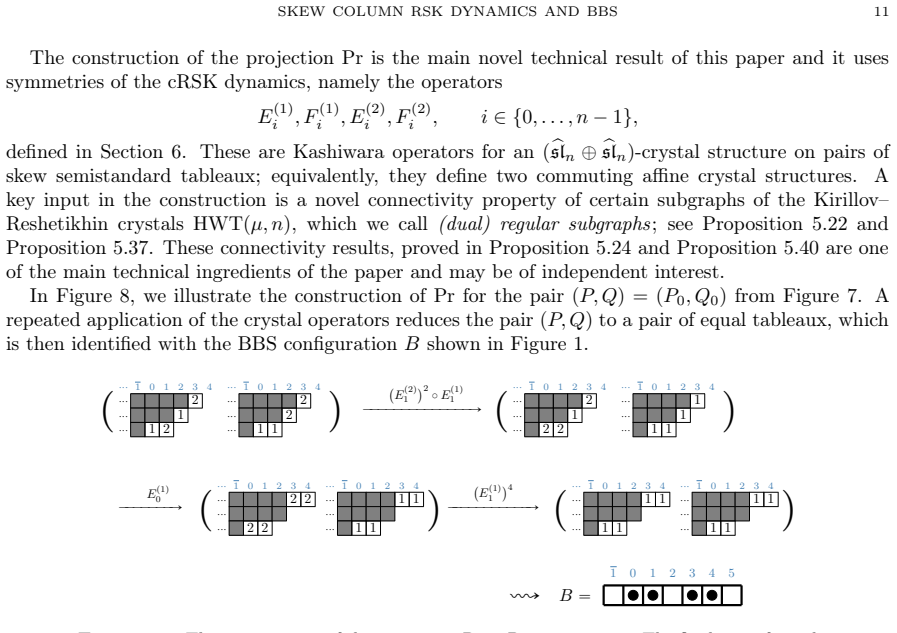
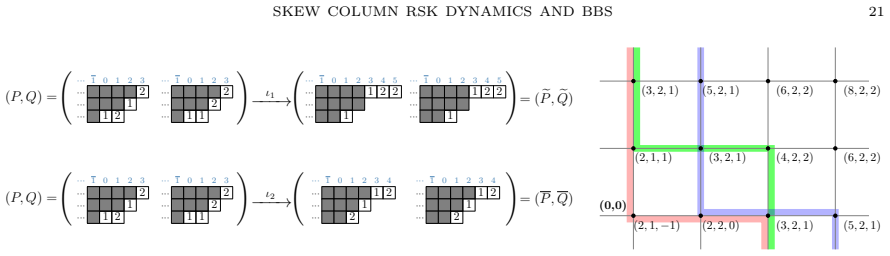
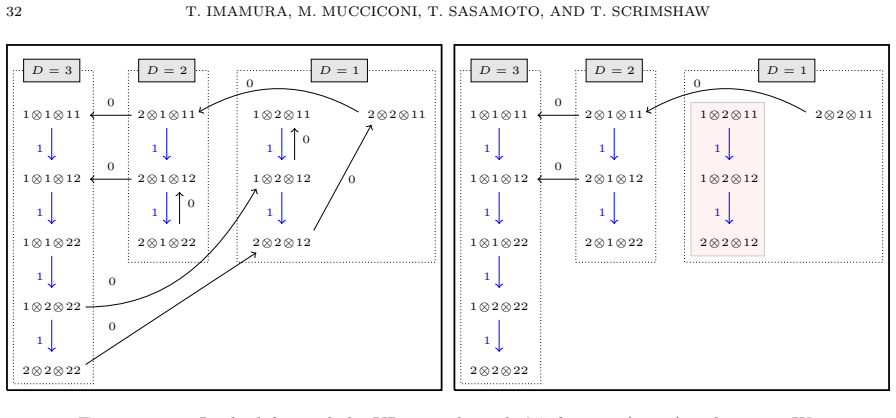
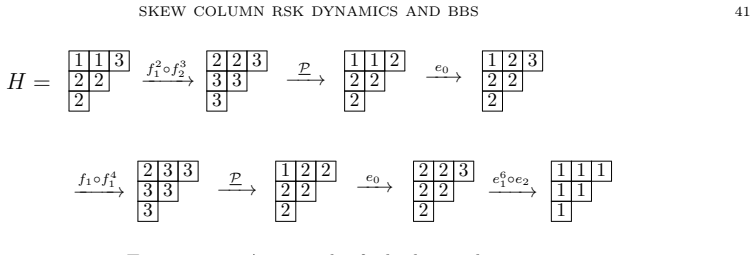
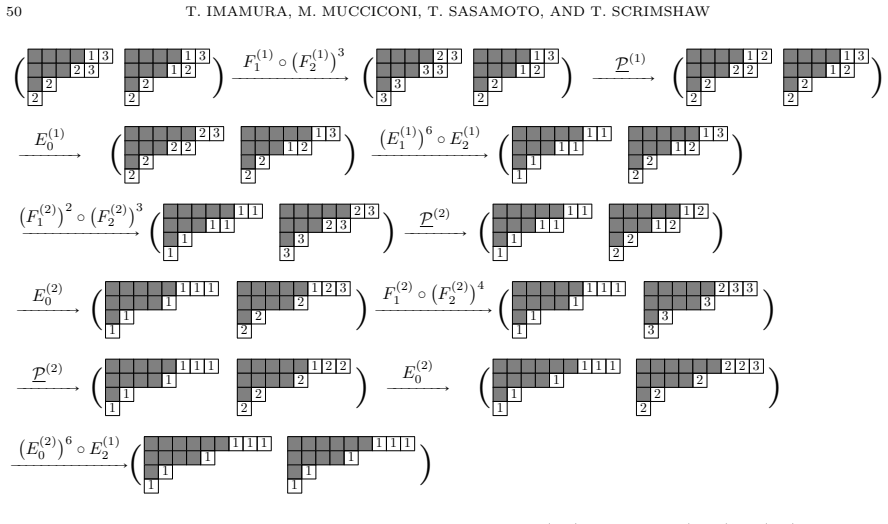
The skew column RSK dynamics on pairs (P_t, Q_t) of skew semistandard Young tableaux is linearized by the bijection (P, Q) ↔ (H1, H2, κ, ν), where H1 and H2 are horizontally weak tableaux recording asymptotic soliton data, κ are integer riggings, and ν is a weakly decreasing sequence of integers; the time evolution becomes linear shifts in these coordinates, established using two commuting affine crystal structures on skew tableaux and a connectivity theorem for distinguished subgraphs of tensor products of Kirillov-Reshetikhin crystals.
What carries the argument
The explicit bijection (P, Q) ↔ (H1, H2, κ, ν) that converts each pair of skew tableaux into asymptotic soliton tableaux, riggings, and a sequence, thereby linearizing the two-lane dynamics.
If this is right
- The time evolution of any initial pair decomposes into independent linear motions of the soliton data, riggings and sequence.
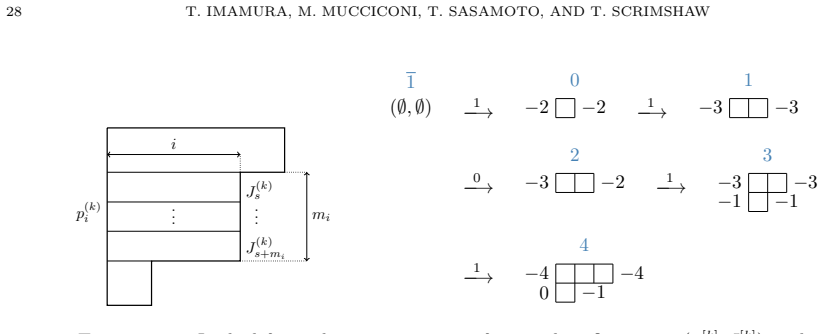
- The projection of the dynamics onto the classical box-ball system identifies the rigging coordinate κ with the Kerov-Kirillov-Reshetikhin rigging of the projected configuration.
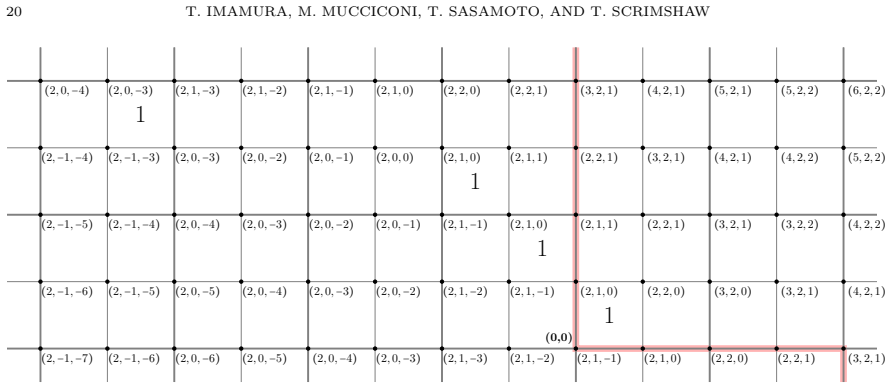
- Lengths of solitons are given by Greene-type formulas expressed as last-passage percolation times on a cylindrical environment.
- Generating functions in the linearizing coordinates supply bijective proofs of Cauchy and Kawanaka-Littlewood identities for transformed Hall-Littlewood polynomials.
Where Pith is reading between the lines
- The connectivity theorem used for the bijection may apply to other tensor products of Kirillov-Reshetikhin crystals beyond skew tableaux.
- The explicit projection to the one-dimensional box-ball system suggests that higher-dimensional generalizations could be studied by iterated projections.
- The linearizing coordinates may allow direct computation of long-term statistics without simulating the full tableau evolution.
Load-bearing premise
The two commuting affine crystal structures on pairs of skew tableaux admit a connectivity theorem for distinguished subgraphs of tensor products of Kirillov-Reshetikhin crystals.
What would settle it
A concrete pair of skew tableaux whose evolved state under the skew column RSK dynamics fails to match the state obtained by shifting the corresponding (H1, H2, κ, ν) coordinates by the predicted linear amount.
Figures

read the original abstract
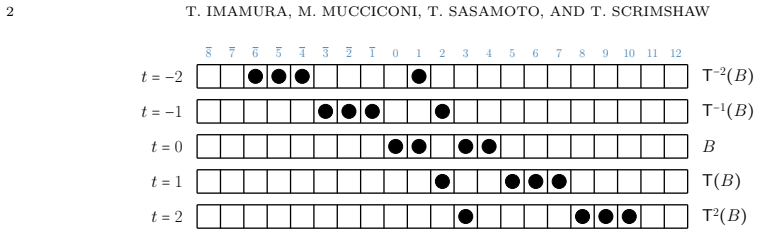
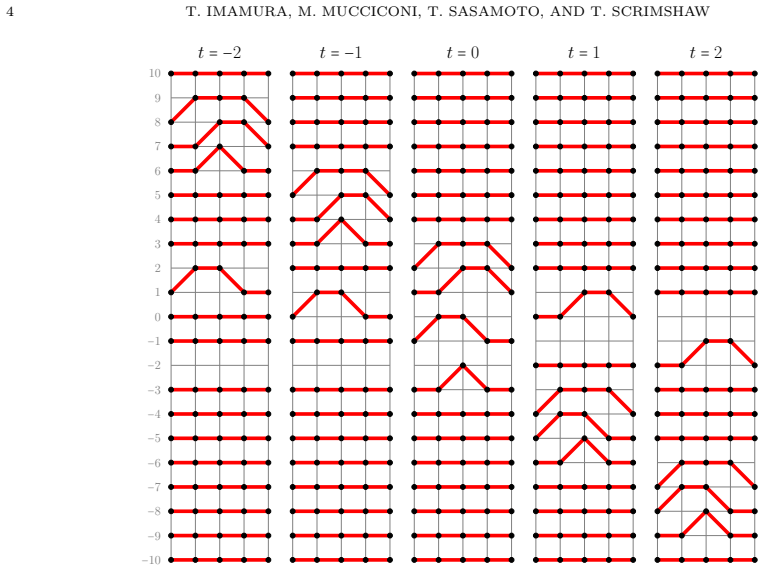
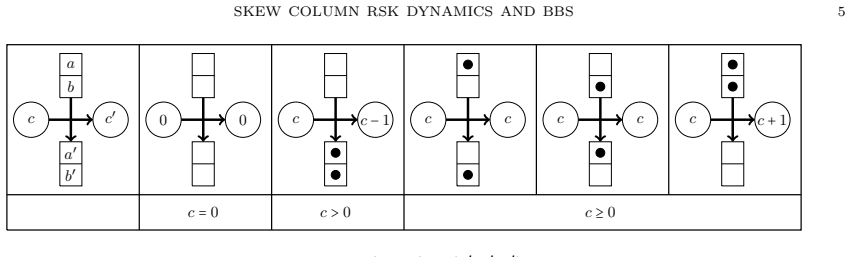
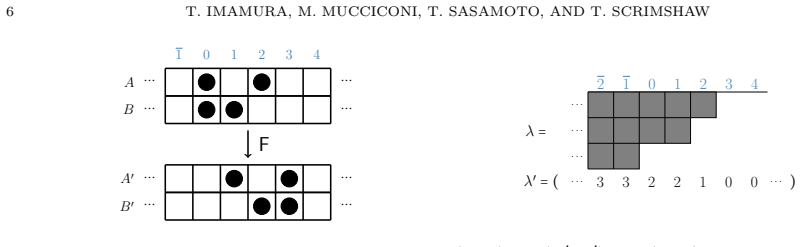
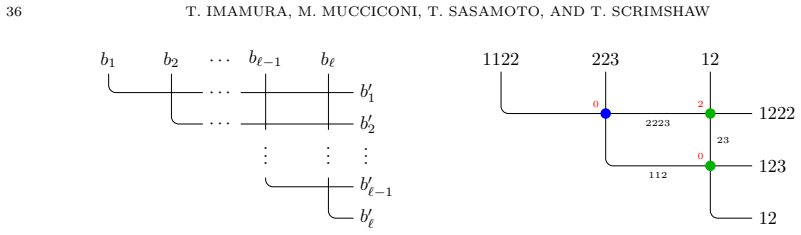
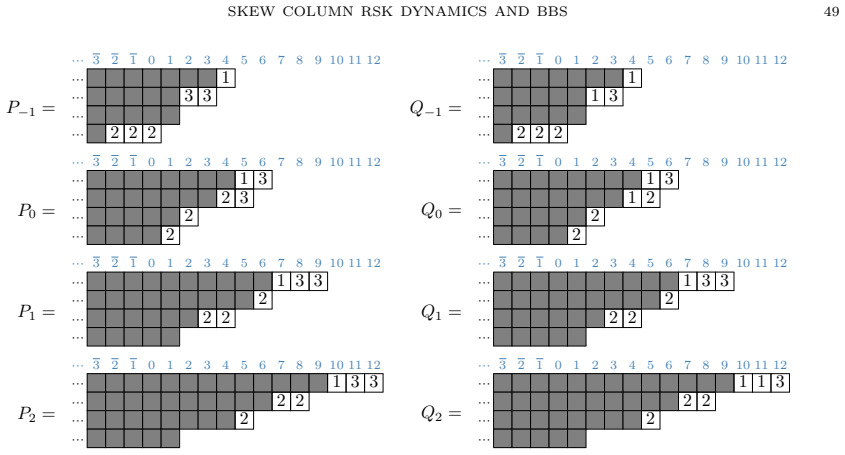
The Fomin local rules for Schensted column insertion can be seen as a two-lane box-ball system, in which a carrier moves particles forward or laterally. Running such two-lane dynamics in parallel on a periodic lattice gives rise to a two-dimensional generalization of the box-ball system, which we call the \emph{skew column RSK dynamics}. Equivalently, this is a deterministic dynamics on pairs of skew semistandard Young tableaux $(P_t,Q_t)_{t \in \mathbb{Z}}$. We prove that this dynamics exhibits solitonic behavior and construct an explicit bijection $(P,Q) \leftrightarrow (H_1,H_2,\kappa,\nu)$ that linearizes the time evolution. The resulting coordinates consist of two horizontally weak tableaux $H_1,H_2$ recording the asymptotic soliton data, integer riggings $\kappa$, and a weakly decreasing sequence of integers $\nu$. A key feature of the construction is an explicit projection from the skew column RSK dynamics to the classical box-ball system; under this projection, the rigging $\kappa$ is precisely the Kerov--Kirillov--Reshetikhin rigging of the associated box-ball configuration. Our proof uses two commuting affine crystal structures on pairs of skew tableaux and a novel connectivity theorem for distinguished subgraphs of tensor products of Kirillov--Reshetikhin crystals. We also derive Greene-type formulas for the soliton lengths in terms of last-passage percolation on the associated cylindrical environment. Finally, by taking generating functions in the linearizing coordinates, we obtain bijective proofs of Cauchy and Kawanaka--Littlewood-type identities for transformed Hall--Littlewood polynomials.
Editorial analysis
A structured set of objections, weighed in public.
Referee Report
Summary. The manuscript introduces the skew column RSK dynamics, a deterministic two-lane dynamics on pairs of skew semistandard Young tableaux (P_t, Q_t) that generalizes the classical box-ball system. It proves that the dynamics exhibits solitonic behavior and constructs an explicit bijection (P, Q) ↔ (H_1, H_2, κ, ν) that linearizes the time evolution, where H_1 and H_2 are horizontally weak tableaux recording asymptotic soliton data, κ are integer riggings, and ν is a weakly decreasing sequence. The construction relies on two commuting affine crystal structures on pairs of skew tableaux together with a novel connectivity theorem for distinguished subgraphs of tensor products of Kirillov-Reshetikhin crystals; it includes an explicit projection to the classical box-ball system (under which κ recovers the KKR rigging), Greene-type formulas for soliton lengths via last-passage percolation on a cylindrical environment, and bijective proofs of Cauchy and Kawanaka-Littlewood-type identities for transformed Hall-Littlewood polynomials.
Significance. If the central bijection and connectivity theorem hold, the work supplies a combinatorial linearization of a new integrable system, with the explicit projection to the classical box-ball system and the bijective proofs of the polynomial identities serving as particularly strong features. These elements connect RSK insertion, affine crystals, and soliton dynamics in a manner that could inform further study of Hall-Littlewood polynomials and periodic integrable systems.
major comments (2)
- [Proof of the linearizing bijection (crystal structures section)] The novel connectivity theorem for distinguished subgraphs of tensor products of Kirillov-Reshetikhin crystals (invoked in the proof of the linearizing bijection) is load-bearing for the claim that the coordinates (H_1, H_2, κ, ν) linearize the dynamics. The manuscript should clarify whether this theorem is established by a self-contained argument independent of the dynamics or whether any steps in its proof rely on post-hoc verification of connectedness for the specific subgraphs arising from skew tableaux pairs.
- [Projection to classical box-ball system] The projection from skew column RSK dynamics to the classical box-ball system is stated to recover the KKR rigging exactly for κ. It would strengthen the solitonic-behavior claim to include an explicit verification that the projected configuration satisfies the standard BBS evolution rules for at least one non-trivial periodic example with multiple solitons.
minor comments (2)
- The notation for the weakly decreasing sequence ν and its relation to the riggings κ could be clarified with an explicit example showing how ν is extracted from a given (P, Q) pair.
- The abstract and introduction both refer to 'transformed Hall-Littlewood polynomials'; a brief definition or reference to the precise transformation used would aid readers unfamiliar with the variant.
Simulated Author's Rebuttal
We thank the referee for their careful reading of the manuscript and for the constructive major comments. We address each point below and outline the revisions we will make to strengthen the paper.
read point-by-point responses
-
Referee: The novel connectivity theorem for distinguished subgraphs of tensor products of Kirillov-Reshetikhin crystals (invoked in the proof of the linearizing bijection) is load-bearing for the claim that the coordinates (H_1, H_2, κ, ν) linearize the dynamics. The manuscript should clarify whether this theorem is established by a self-contained argument independent of the dynamics or whether any steps in its proof rely on post-hoc verification of connectedness for the specific subgraphs arising from skew tableaux pairs.
Authors: The connectivity theorem (Theorem 4.2) is established via a self-contained argument that relies solely on the definitions of the affine crystal operators, the distinguished subgraphs, and standard facts about tensor products of Kirillov-Reshetikhin crystals; the proof makes no reference to the skew column RSK dynamics or to any post-hoc connectedness checks. We will insert a clarifying paragraph at the start of Section 4 stating this independence explicitly. revision: yes
-
Referee: The projection from skew column RSK dynamics to the classical box-ball system is stated to recover the KKR rigging exactly for κ. It would strengthen the solitonic-behavior claim to include an explicit verification that the projected configuration satisfies the standard BBS evolution rules for at least one non-trivial periodic example with multiple solitons.
Authors: The general projection and the exact recovery of the KKR rigging are proved in Theorem 5.3. We agree that an explicit low-dimensional periodic example would improve verification and readability. We will add a new subsection (5.4) containing a concrete two-soliton periodic configuration, displaying the first few time steps under both the skew column RSK dynamics and the projected BBS evolution, together with the corresponding riggings. revision: yes
Circularity Check
No significant circularity; explicit bijection and projection are independent of inputs
full rationale
The derivation constructs an explicit bijection (P,Q) ↔ (H1,H2,κ,ν) that linearizes the dynamics, anchored by a direct projection to the classical box-ball system (which supplies the KKR rigging as an external reference). The proof invokes affine crystal structures on skew tableaux together with a connectivity theorem on KR crystal subgraphs; this theorem is developed internally as part of the argument rather than presupposed from the target result. No self-definitional reductions, fitted parameters renamed as predictions, load-bearing self-citations, or ansatz smuggling appear in the given derivation chain. The central claims therefore remain non-circular and self-contained against the stated external anchor.
Axiom & Free-Parameter Ledger
axioms (2)
- domain assumption Fomin local rules for Schensted column insertion correspond to a two-lane box-ball system
- standard math Pairs of skew semistandard Young tableaux carry two commuting affine crystal structures
invented entities (1)
-
skew column RSK dynamics
no independent evidence
Reference graph
Works this paper leans on
-
[1]
Aggarwal, A
A. Aggarwal, A. Borodin, and M. Wheeler. Deformed polynuclear growth in (1+1) dimensions.Int. Math. Res. Not., 2023(7):5728–5780, 03 2023
2023
-
[2]
Aggarwal and J
A. Aggarwal and J. Huang. Strong characterization for the Airy line ensemble.Invent. Math., 243(2):293–605, 2026
2026
-
[3]
Akasaka and M
T. Akasaka and M. Kashiwara. Finite-dimensional representations of quantum affine algebras.Publ. Res. Inst. Math. Sci., 33(5):839–867, 1997
1997
-
[4]
T. H. Baker. An insertion scheme forCn crystals. InPhysical combinatorics (Kyoto, 1999), volume 191 ofProgr. Math., pages 1–48. Birkhäuser Boston, Boston, MA, 2000
1999
-
[5]
Benkart and J
G. Benkart and J. Stroomer. Tableaux and insertion schemes for spinor representations of the orthogonal Lie algebraso(2r+ 1,C).J. Combin. Theory Ser. A, 57(2):211–237, 1991
1991
-
[6]
A. Berele. A Schensted-type correspondence for the symplectic group.J. Combin. Theory Ser. A, 43(2):320–328, 1986
1986
-
[7]
Berenstein and A
A. Berenstein and A. Zelevinsky. Canonical bases for the quantum group of typeAr and piecewise-linear combi- natorics.Duke Math. J., 82(3):473–502, 1996
1996
-
[8]
A. Borodin and V. Gorin. Lectures on integrable probability. InProbability and Statistical Physics in St. Peters- burg, volume 91 ofProceedings of Symposia in Pure Mathematics, pages 155–214. AMS, 2016. arXiv:1212.3351 [math.PR]
Pith/arXiv arXiv 2016
-
[9]
Bufetov, M
A. Bufetov, M. Mucciconi, and L. Petrov. Yang–Baxter random fields and stochastic vertex models.Adv. Math., 388:107865, 2021
2021
-
[10]
Bump and A
D. Bump and A. Schilling.Crystal bases. World Scientific Publishing Co. Pte. Ltd., Hackensack, NJ, 2017. Repre- sentations and combinatorics
2017
-
[11]
Chari and A
V. Chari and A. Pressley.A guide to quantum groups. Cambridge University Press, Cambridge, 1995. Corrected reprint of the 1994 original
1995
-
[12]
Chmutov, J
M. Chmutov, J. B. Lewis, and P. Pylyavskyy. Monodromy in Kazhdan-Lusztig cells in affine type A.Math. Ann., 386(3-4):1891–1949, 2023. SKEW COLUMN RSK DYNAMICS AND BBS 65
1949
-
[13]
Chmutov, P
M. Chmutov, P. Pylyavskyy, and E. Yudovina. Matrix-ball construction of affine Robinson–Schensted correspon- dence.Selecta Math. (N.S.), 24(2):667–750, 2018
2018
-
[14]
I. Corwin and A. Hammond. Brownian gibbs property for airy line ensembles.Inventiones mathematicae, 195(2):441–508, 2014. arXiv:1108.2291 [math.PR]
Pith/arXiv arXiv 2014
-
[15]
D. A. Croydon and M. Sasada. Generalized hydrodynamic limit for the box–ball system.Communications in Mathematical Physics, 383(1):427–463, 2021
2021
-
[16]
V. Danilov and G. Koshevoy. Arrays and the octahedron recurrence.arXiv preprint math/0504299, 2005
Pith/arXiv arXiv 2005
-
[17]
V. Danilov and G. Koshevoy. The octahedron recurrence and rsk-correspondence.arXiv preprint math/0703414, 2007
Pith/arXiv arXiv 2007
-
[18]
Dauvergne, M
D. Dauvergne, M. Nica, and B. Virág. RSK in last passage percolation: a unified approach.Probability Surveys, 19:65–112, 2022
2022
-
[19]
B. Doyon. Lecture notes on Generalised Hydrodynamics.SciPost Phys. Lect. Notes, page 18, 2020
2020
-
[20]
P. A. Ferrari, C. Nguyen, L. T. Rolla, and M. Wang. Soliton decomposition of the box-ball system.Forum Math. Sigma, 9:Paper No. e60, 37, 2021
2021
-
[21]
S. Fomin. Schensted algorithms for dual graded graphs.J. Algebraic Combin., 4(1):5–45, 1995
1995
-
[22]
S. V. Fomin. The generalized Robinson-Schensted-Knuth correspondence.Zap. Nauchn. Sem. Leningrad. Otdel. Mat. Inst. Steklov. (LOMI), 155:156–175, 195, 1986
1986
-
[23]
Fourier, A
G. Fourier, A. Schilling, and M. Shimozono. Demazure structure inside Kirillov–Reshetikhin crystals.J. Algebra, 309(1):386–404, 2007
2007
-
[24]
Fukuda, Y
K. Fukuda, Y. Yamada, and M. Okado. Energy functions in box ball systems.Internat. J. Modern Phys. A, 15(9):1379–1392, 2000
2000
-
[25]
Garbali and M
A. Garbali and M. Wheeler. Modified Macdonald polynomials and integrability.Comm. Math. Phys., 374(3):1809– 1876, 2020
2020
-
[26]
C. Greene. An extension of Schensted’s theorem.Advances in Mathematics, 14(2):254–265, 1974
1974
-
[27]
Haglund.Theq,t-Catalan numbers and the space of diagonal harmonics, volume 41 ofUniversity Lecture Series
J. Haglund.Theq,t-Catalan numbers and the space of diagonal harmonics, volume 41 ofUniversity Lecture Series. American Mathematical Society, Providence, RI, 2008. With an appendix on the combinatorics of Macdonald polynomials
2008
-
[28]
Haglund, M
J. Haglund, M. Haiman, and N. Loehr. A combinatorial formula for Macdonald polynomials.J. Amer. Math. Soc., 18(3):735–761, 2005
2005
-
[29]
M. Haiman. Hilbert schemes, polygraphs and the Macdonald positivity conjecture.J. Amer. Math. Soc., 14(4):941– 1006, 2001
2001
-
[30]
Hatayama, K
G. Hatayama, K. Hikami, R. Inoue, A. Kuniba, T. Takagi, and T. Tokihiro. TheA(1) M automata related to crystals of symmetric tensors.J. Math. Phys., 42(1):274–308, 2001
2001
-
[31]
Hatayama, A
G. Hatayama, A. N. Kirillov, A. Kuniba, M. Okado, T. Takagi, and Y. Yamada. Character formulae ofbsln-modules and inhomogeneous paths.Nuclear Phys. B, 536(3):575–616, 1999
1999
-
[32]
Hatayama, A
G. Hatayama, A. Kuniba, M. Okado, and T. Takagi. CombinatorialRmatrices for a family of crystals:C(1) n and A(2) 2n−1 cases. InPhysical combinatorics (Kyoto, 1999), volume 191 ofProgr. Math., pages 105–139. Birkhäuser Boston, Boston, MA, 2000
1999
-
[33]
Hatayama, A
G. Hatayama, A. Kuniba, M. Okado, and T. Takagi. CombinatorialRmatrices for a family of crystals:B(1) n ,D (1) n , A(2) 2n, andD (2) n+1 cases.J. Algebra, 247(2):577–615, 2002
2002
-
[34]
G.Hatayama, A.Kuniba, M.Okado, T.Takagi, andZ.Tsuboi.Paths, crystalsandfermionicformulae.InMathPhys odyssey, 2001, volume 23 ofProg. Math. Phys., pages 205–272. Birkhäuser Boston, Boston, MA, 2002
2001
-
[35]
Hatayama, A
G. Hatayama, A. Kuniba, M. Okado, T. Takagi, and Y. Yamada. Remarks on fermionic formula. InRecent developments in quantum affine algebras and related topics (Raleigh, NC, 1998), volume 248 ofContemp. Math., pages 243–291. Amer. Math. Soc., Providence, RI, 1999
1998
-
[36]
Hatayama, A
G. Hatayama, A. Kuniba, M. Okado, T. Takagi, and Y. Yamada. Scattering rules in soliton cellular automata associated with crystal bases. InRecent developments in infinite-dimensional Lie algebras and conformal field theory (Charlottesville, VA, 2000), volume 297 ofContemp. Math., pages 151–182. Amer. Math. Soc., Providence, RI, 2002
2000
-
[37]
Hatayama, A
G. Hatayama, A. Kuniba, and T. Takagi. Soliton cellular automata associated with crystal bases.Nuclear Phys. B, 577(3):619–645, 2000
2000
-
[38]
J. He. Boundary current fluctuations for the half space ASEP and six vertex model.Proc. London Math. Soc., 128:e12585, 2024
2024
- [39]
-
[40]
He and M
J. He and M. Wheeler. Symmetries of periodic and free boundaryq-Whittaker measures.Sem. Loth. Combin., 93B:#133, 2025
2025
-
[41]
He and M
J. He and M. Wheeler. Periodicq-Whittaker and Hall–Littlewood processes.Selecta Mathematica, 32(1):11, 2026
2026
-
[42]
Hirota and S
R. Hirota and S. Tsujimoto. Conserved quantities of a class of nonlinear difference-difference equations.J. Phys. Soc. Japan, 64(9):3125–3127, 1995
1995
-
[43]
Imamura, M
T. Imamura, M. Mucciconi, and T. Sasamoto. Skew RSK dynamics: Greene invariants, affine crystals and appli- cations toq-Whittaker polynomials.Forum Math. Pi, 11:Paper No. e27, 101, 2023. 66 T. IMAMURA, M. MUCCICONI, T. SASAMOTO, AND T. SCRIMSHA W
2023
-
[44]
Imamura, M
T. Imamura, M. Mucciconi, and T. Sasamoto. Identity between restricted Cauchy sums for theq-Whittaker and skew Schur polynomials.SIGMA Symmetry Integrability Geom. Methods Appl., 20:Paper No. 064, 28, 2024
2024
-
[45]
Imamura, M
T. Imamura, M. Mucciconi, and T. Sasamoto. Solvable models in the kpz class: Approach through periodic and free boundary schur measures.Ann. Probab., 54(1):301–366, 2026
2026
-
[46]
Imamura, M
T. Imamura, M. Mucciconi, T. Sasamoto, and T. Scrimshaw. The periodic multi-layer polynuclear growth: Inte- grability and applications.Sem. Loth. Combin., 2026. (to appear)
2026
-
[47]
Inoue, A
R. Inoue, A. Kuniba, and T. Takagi. Integrable structure of box-ball system: crystal, Bethe ansatz, ultradiscretiza- tion and tropical geometry.Journal of Physics A: Mathematical and Theoretical, 45:073001, 2012
2012
-
[48]
K. Johansson. Discrete polynuclear growth and determinantal processes.Communications in Mathematical Physics, 242(1):277–329, 2003. arXiv:math/0206208 [math.PR]
Pith/arXiv arXiv 2003
-
[49]
S.-J. Kang, M. Kashiwara, and K. C. Misra. Crystal bases of Verma modules for quantum affine Lie algebras. Compositio Math., 92(3):299–325, 1994
1994
-
[50]
S.-J. Kang, M. Kashiwara, K. C. Misra, T. Miwa, T. Nakashima, and A. Nakayashiki. Affine crystals and vertex models. InInfinite analysis, Part A, B (Kyoto, 1991), volume 16 ofAdv. Ser. Math. Phys., pages 449–484. World Sci. Publ., River Edge, NJ, 1992
1991
-
[51]
S.-J. Kang, M. Kashiwara, K. C. Misra, T. Miwa, T. Nakashima, and A. Nakayashiki. Perfect crystals of quantum affine Lie algebras.Duke Math. J., 68(3):499–607, 1992
1992
-
[52]
Kashiwara
M. Kashiwara. Crystalizing theq-analogue of universal enveloping algebras.Comm. Math. Phys., 133(2):249–260, 1990
1990
-
[53]
Kashiwara
M. Kashiwara. On crystal bases of theQ-analogue of universal enveloping algebras.Duke Math. J., 63(2):465–516, 1991
1991
-
[54]
Kashiwara
M. Kashiwara. Crystal bases of modified quantized enveloping algebra.Duke Math. J., 73(2):383–413, 1994
1994
-
[55]
Kashiwara and T
M. Kashiwara and T. Nakashima. Crystal graphs for representations of the q-analogue of classical Lie algebras.J. Algebra, 165(2):295–345, 1994
1994
-
[56]
S. V. Kerov, A. N. Kirillov, and N. Y. Reshetikhin. Combinatorics, the Bethe ansatz and representations of the symmetric group.Zap. Nauchn. Sem. Leningrad. Otdel. Mat. Inst. Steklov. (LOMI), 155(Differentsialnaya Geometriya, Gruppy Li i Mekh. VIII):50–64, 193, 1986
1986
-
[57]
A. N. Kirillov and N. Y. Reshetikhin. The Bethe ansatz and the combinatorics of Young tableaux.Zap. Nauchn. Sem. Leningrad. Otdel. Mat. Inst. Steklov. (LOMI), 155(Differentsialnaya Geometriya, Gruppy Li i Mekh. VIII):65–115, 194, 1986
1986
-
[58]
A. N. Kirillov and R. Sakamoto. Generalized energy statistics and Kostka–Macdonald polynomials. In22nd Inter- national Conference on Formal Power Series and Algebraic Combinatorics (FPSAC 2010), volume AN ofDiscrete Math. Theor. Comput. Sci. Proc., pages 343–354. Assoc. Discrete Math. Theor. Comput. Sci., Nancy, 2010
2010
-
[59]
A. N. Kirillov, A. Schilling, and M. Shimozono. A bijection between Littlewood–Richardson tableaux and rigged configurations.Selecta Math. (N.S.), 8(1):67–135, 2002
2002
-
[60]
Krattenthaler
C. Krattenthaler. Growth diagrams, and increasing and decreasing chains in fillings of Ferrers shapes.Adv. in Appl. Math., 37(3):404–431, 2006
2006
-
[61]
Kulish, N
P. Kulish, N. Reshetikhin, and E. Sklyanin. Yang–Baxter equation and representation theory: I.Lett. Math. Phys., 5(5):393–403, 1981
1981
-
[62]
P. P. Kulish and E. K. Sklyanin. Quantum inverse scattering method and the Heisenberg ferromagnet.Phys. Lett. A, 70(5-6):461–463, 1979
1979
-
[63]
P. P. Kulish and E. K. Sklyanin. Quantum spectral transform method. Recent developments. InIntegrable quantum field theories (Tvärminne, 1981), volume 151 ofLecture Notes in Phys., pages 61–119. Springer, Berlin-New York, 1982
1981
-
[64]
Kuniba, G
A. Kuniba, G. Misguich, and V. Pasquier. Generalized hydrodynamics in box-ball system.Journal of Physics A: Mathematical and Theoretical, 53(40):404001, 2020
2020
-
[65]
Kuniba, K
A. Kuniba, K. C. Misra, M. Okado, T. Takagi, and J. Uchiyama. Paths, Demazure crystals, and symmetric functions.J. Math. Phys., 41(9):6477–6486, 2000
2000
-
[66]
Kuniba, T
A. Kuniba, T. Nakanishi, and J. Suzuki.T-systems andY-systems in integrable systems.J. Phys. A, 44(10):103001, 146, 2011
2011
-
[67]
Kuniba, M
A. Kuniba, M. Okado, R. Sakamoto, T. Takagi, and Y. Yamada. Crystal interpritation of Kerov-Kirillov- Reshetikhin bijection.Nuc. Phys. B, 740:299–327, 2006
2006
-
[68]
Kuniba, R
A. Kuniba, R. Sakamoto, and Y. Yamada. Tau functions in combinatorial Bethe ansatz.Nuclear Phys. B, 786(3):207–266, 2007
2007
-
[69]
Kwon and H
J.-H. Kwon and H. Lee. Affine RSK correspondence and crystals of level zero extremal weight modules.Transform. Groups, 30(1):331–392, 2025
2025
-
[70]
P. D. Lax. Integrals of nonlinear equations of evolution and solitary waves.Comm. Pure Appl. Math., 21:467–490, 1968
1968
-
[71]
Lecouvey
C. Lecouvey. Schensted-type correspondence, plactic monoid, and jeu de taquin for typeCn.J. Algebra, 247(2):295– 331, 2002
2002
-
[72]
Lecouvey
C. Lecouvey. Schensted-type correspondences and plactic monoids for typesBn andD n.J. Algebraic Combin., 18(2):99–133, 2003. SKEW COLUMN RSK DYNAMICS AND BBS 67
2003
-
[73]
C. Lenart. On the combinatorics of crystal graphs. I. Lusztig’s involution.Adv. Math., 211(1):204–243, 2007
2007
-
[74]
Lenart, S
C. Lenart, S. Naito, D. Sagaki, A. Schilling, and M. Shimozono. A uniform model for Kirillov–Reshetikhin crystals II. Alcove model, path model, andP=X.Int. Math. Res. Not. IMRN, (14):4259–4319, 2017
2017
-
[75]
Lenart and A
C. Lenart and A. Schilling. Crystal energy functions via the charge in typesAandC.Math. Z., 273(1-2):401–426, 2013
2013
-
[76]
Lewis, H
J. Lewis, H. Lyu, P. Pylyavskyy, and A. Sen. Scaling limit of soliton lengths in a multicolor box-ball system.Forum Math. Sigma, 12:Paper No. e120, 73, 2024
2024
-
[77]
Liu and T
X. Liu and T. Scrimshaw. A uniform approach to soliton cellular automata using rigged configurations.Ann. Henri Poincaré, 20(4):1175–1215, 2019
2019
-
[78]
Lothaire.Algebraic Combinatorics on Words
M. Lothaire.Algebraic Combinatorics on Words. Encyclopedia of Mathematics and its Applications. Cambridge University Press, 2002
2002
-
[79]
Lusztig.Introduction to quantum groups
G. Lusztig.Introduction to quantum groups. Modern Birkhäuser Classics. Birkhäuser/Springer, New York, 2010. Reprint of the 1994 edition
2010
-
[80]
Macdonald.Symmetric functions and Hall polynomials
I. Macdonald.Symmetric functions and Hall polynomials. Oxford University Press, 2nd edition, 1995
1995
discussion (0)
Sign in with ORCID, Apple, or X to comment. Anyone can read and Pith papers without signing in.