REVIEW 3 major objections 6 minor 94 references
A Resonant Beginning for the Solar System Terrestrial Planets
T0 review · 3 major / 6 minor · reviewed 2026-08-07 · deepseek-v4-flash
Pith's one-line read This paper argues that the present 3.05 Mars–Venus period ratio is a relic of a primordial 2:3:4:6 mean-motion resonance chain that the giant-planet instability broke, triggering the Moon-forming giant impact.
desk verdict A solid dynamical scenario with one overclaimed headline: the 3:1 Mars-Venus ratio is an imposed initial condition, but the post-instability physics is worth refereeing. read the letter →
The pith
A machine-rendered reading of the paper's core claim, the machinery that carries it, and where it could break.
The reading
What carries the argument
The load-bearing object is the 2:3:4:6 mean-motion resonance chain — a linked set of orbital-period commensurabilities that fixes Venus, proto-Earth, Theia, and Mars in a 3:1 Venus–Mars ratio with Theia near Earth. The chain is diagnosed by three-body resonance angles whose libration signals that the planets remain locked; the disk-migration prescription in Section 2.1 is used to build it, and the simplified pebble- and planetesimal-accretion models in Appendix A are adduced to show the chain can form. The breaking mechanism is the giant-planet instability: Saturn's parameterized outward migration, with a timescale between 0.8 and 16 Myr, excites Jupiter and sweeps the g5 secular resonance through the inner system, which diffuses the angular momentum deficit — a standard measure of how dynamically excited an orbital system is — and turns the librating angles into circulating ones. Once the chain dissolves, the tightly packed Theia–proto-Earth pair is the part that collides, while the more distant Venus and Mars are left unperturbed.
What would settle it
Run a self-consistent disk formation and migration calculation from a standard protoplanetary disk and check whether a 2:3:4:6 resonance chain among Venus, proto-Earth, Theia, and Mars appears without tuning the disk inner edge, gas density, and embryo injection history; if it does not, the period-ratio peak near 3 in the simulations is inherited from the imposed initial condition rather than a relic of early formation.
Extended reading notes
Core claim
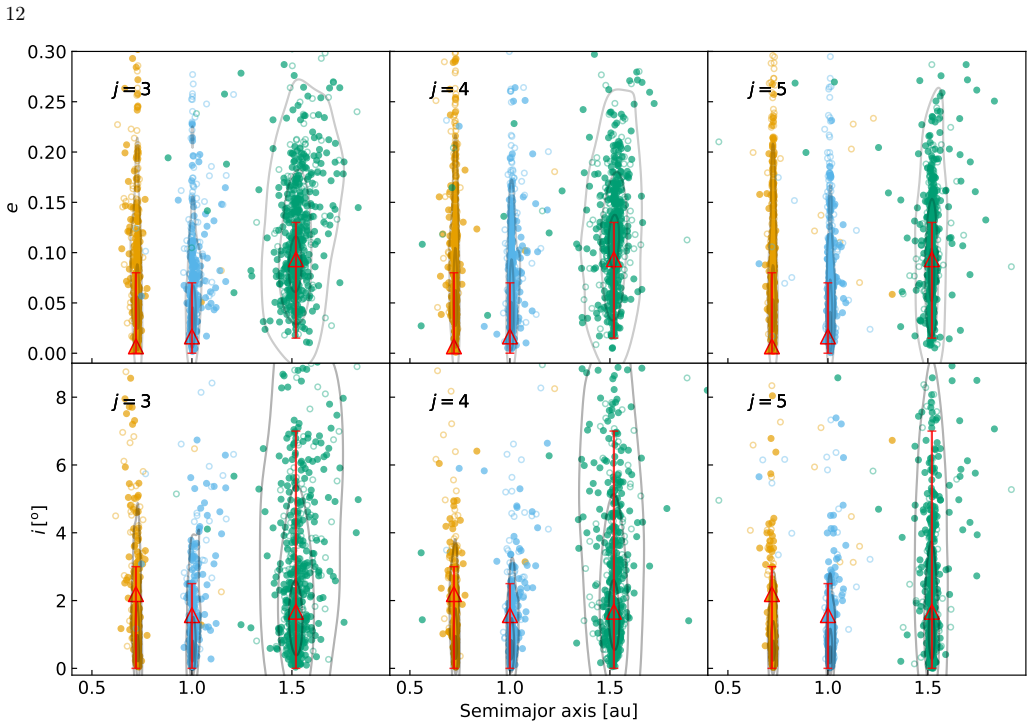
The central claim is that a single early event — capture of the four terrestrial planets into a 2:3:4:6 resonance chain while the gas disk was still present — explains the inner Solar System's present architecture. The chain fixes the Venus–Mars period ratio at 3:1; when Saturn's outward migration during the giant-planet instability stirs Jupiter's eccentricity, sweeping secular resonances diffuse the angular momentum deficit of the inner system and the resonance angles begin to circulate. Theia and proto-Earth, initially very close, then overlap and collide; the paper reports that this outcome occurs in 20–50% of the simulated systems depending on the Theia–Earth resonance, always with impact velocities at or below about 1.5 times the mutual escape velocity. The resulting eccentricities and inclinations match the present-day values, and the collision follows the instability by roughly 10 Myr or more, consistent with the dated Moon-forming event. The observed Mars–Venus period ratio of 3.057 falls within the quartile range of the simulated distribution and near its median, with probability density more than an order of magnitude higher than in the late collisional-growth model.
Load-bearing premise
The scenario stands or falls on the premise that Venus, proto-Earth, Theia, and Mars formed early and were captured into exactly the 2:3:4:6 resonance chain; the paper's Appendix A shows this chain can emerge from simplified pebble- and planetesimal-accretion models, but only with hand-chosen parameters such as a disk inner edge at 0.6 au and a fivefold enhancement of the gas density, so a realistic disk that does not reliably build this chain would leave the 3.05 ratio imposed rather than explained.
Editorial extensions
If this is right
- The observed Mars–Venus period ratio near 3.05 is no longer a numerical coincidence; it is the expected peak of the early-formation distribution, more than an order of magnitude more probable than in the late collisional-growth model.
- The Moon-forming giant impact is tied to the same instability that shaped the outer Solar System, occurring roughly 10 Myr or more after the onset of the giant-planet instability and within the 40–120 Myr window inferred for the real event.
- The Theia–proto-Earth impact in the simulations always occurs at or below about 1.5 times the mutual escape velocity, which fits the energetic-impact scenario for the Moon and favors a Theia mass between about 0.37 and 0.76 times proto-Earth's mass.
- According to this model, Venus received no giant impact and should retain a largely primordial mantle, providing a measurable isotopic contrast with Earth's mantle.
- Inner planetary systems that still display long resonance chains are expected to lack outer gas giants, since an external giant would typically have broken the chain; this can be searched for in systems like the well-known compact resonant exoplanet systems.
Reading between the lines
- The general pattern suggested here — an outer instability preserving the period ratio of the outermost and innermost members of a broken inner chain while erasing the middle — should apply to other systems that form in compact resonant chains, so a population-level search for inner systems with a surviving outer-inner period ratio and an outer giant companion would be a direct test.
- Because Mercury is excluded from the chain, the model implicitly predicts that Mercury's formation history was separate from that of Venus–Earth–Mars; comparing the model's required initial conditions with Mercury's bulk composition, or asking what happens to the 3:1 ratio when Mercury is added, would sharpen the claim.
- The paper treats the early-formation assumption as consistent with Mars isotope data and Earth oxidation state, but its strongest internal evidence is the period-ratio peak; a fuller disk-evolution survey with a wide parameter grid would show whether the chain is a robust attractor of migration or a carefully placed initial condition.
- The explicit prediction of an unprocessed Venus mantle with elevated 182W relative to Earth could be tested by a future Venus lander or sample-return mission; that would not test the Mars–Venus ratio itself but would distinguish the early-formation family of models from the late-collision family.
Editorial analysis
A structured set of objections, weighed in public.
Referee Report
Summary. The paper hypothesizes that Venus, proto-Earth, Theia, and Mars formed in a 2:3:4:6 mean-motion resonance chain in the gas disk, and that the giant planet instability, modeled as Saturn's outward exponential migration, broke the chain, triggered the Moon-forming Theia-Earth impact, and left the terrestrial planets with their present eccentricities and inclinations. The authors run REBOUND/REBOUNDx N-body simulations from such chains with j=3, 4, 5 for the Theia-Earth resonance, report that the Mars-Venus period ratio remains peaked near 3.01–3.05, that AMD, eccentricities, and inclinations match the current solar system, and that Theia-Earth collisions occur in 20–50% of their 'Solar-like' subset. They contrast this with a late collisional-growth model and claim an order-of-magnitude higher probability for the observed 3.05 ratio. The paper also draws two exoplanet/geochemical predictions.
Significance. If the initial 2:3:4:6 chain can be shown to be a robust outcome of disk accretion, the paper offers a compact scenario linking the Moon-forming impact, the Mars-Venus period ratio, and the low dynamical excitation of the inner solar system to the same dynamical event. The N-body methodology is reproducible (REBOUND, REBOUNDx, MERCURIUS), the parameter space for the post-disk evolution is explored sensibly, and the conditional tests—AMD, eccentricities, mutual inclinations, impact velocity, and impact timing—are meaningful and are the strongest part of the paper. The falsifiable predictions (primordial Venus mantle with high 182W; absence of outer giants in retained resonance-chain systems) are valuable. The main weakness is that the headline period-ratio 'prediction' is essentially the survival of an imposed 3:1 Venus-Mars ratio; the support for the chain's natural formation is a single-realization, fixed-parameter demonstration in Appendix A. The conditional N-body results therefore do not, by themselves, carry the full weight of the abstract's 'naturally arises' claim.
major comments (3)
- [Abstract; Section 3; Fig. 3] The headline result that the Mars-Venus period ratio is a 'relic' of the resonance chain is not an independent prediction: the initial 2:3:4:6 chain fixes P_M/P_V = 3:1, and Section 3 states explicitly that 'This resonance chain guarantees a 3:1 period ratio between Mars and Venus.' The simulated distribution peaking at 3.01 and the comparison with the late-growth model therefore demonstrate that an imposed 3:1 ratio can survive the prescribed instability, not that the model predicts 3.05 from a more general initial condition. Please either strengthen the formation evidence (see next comment) or reframe the abstract, Section 5, and the 'naturally arises' phrasing so that the period-ratio match is presented as a test of survival of the chain, not as an a priori prediction of its value.
- [Appendix A; Section 3, first paragraph] The statement that the 2:3:4:6 chain is 'a natural consequence regardless of whether planet formation proceeds via pebble accretion or planetesimal accretion' is not supported by the simulations shown. Appendix A presents one realization per accretion mode with fixed disk parameters (Σ_g,0 = 2400 g/cm^2, f_g = 5, R_in = 0.6 au, St = 0.01, α_t = 1e-4) and a fixed planetesimal ring (β_plts = -5.5, centered near 1 au), and it concedes 'lacking exhaustive parameter exploration.' Because the same appendix states that the final architecture depends on the injection time interval or spatial separation between adjacent embryos, the 3:1 Venus-Mars ratio is effectively selected rather than robustly produced. Since this ratio is the paper's central observable, please add a parameter study reporting the frequency of 2:3:4:6 chains over a plausible range of disk and accretion parameters, or explicitly downgrade the claim to a conditional scenario.
- [Section 3; Fig. 5; Fig. 7; Appendix B] All main-text statistics, including the '20–50%' moon-forming fraction quoted in the abstract, are computed only for the 'Solar-like' subset selected by requiring Jupiter's final free and forced eccentricities to lie within a circle of radius 0.01 of the present-day value in Fig. 7. The paper does not report the total number of simulations per parameter set or the fraction that passes this post hoc selection, so the reader cannot tell whether the quoted collision fractions are typical or rare conditional outcomes. Please report the full-ensemble statistics alongside the selected subset, and if the selection is meant to ensure a realistic giant-planet excitation, justify it as a prior constraint rather than a posterior match.
minor comments (6)
- [Fig. 2 caption] The resonance-angle definitions contain apparent typographical errors: φ_VET = 2λ_V − 6λ_E + 4λ_V should almost certainly end with 4λ_T, and φ_VEM = 2λ_V − 4λ_E + 2λ_M needs to be checked for the correct coefficients.
- [Fig. 8 caption] The caption says 'each column corresponds to a different initial Venus-Mars resonance,' but the columns vary the Theia-Earth resonance number j; the Venus-Mars 3:1 resonance is common to all columns.
- [Fig. 3 and Section 3] The text refers to 'the 25% range from the median' and to 'median 50% ranges' without defining these intervals; specifying the exact percentile convention (e.g., interquartile range) would make the comparison reproducible.
- [Eq. (4)] The derivation of the Theia-to-Earth mass ratio is hard to follow as typeset; please define P_⊕ and P_V in the equation and show the intermediate steps that yield 0.37, 0.54, and 0.76.
- [Appendix C] The Monte Carlo conversion from the fitted separation distribution (μ = 50.58, σ = 17.18 Hill radii) to the Venus-Mars period ratio should state the assumed semi-major axes and the treatment of the Venus-Earth and Earth-Mars pairs, so that the comparison in Fig. 3 is reproducible.
- [References] Several quantitative comparisons rely on 'in preparation' or unpublished works (Kokubo et al. 2025, Hu et al. in prep); please replace these with published versions or clearly mark the results as preliminary.
Circularity Check
The headline Mars-Venus period-ratio 'prediction' is the initial 2:3:4:6 resonance chain by construction; other N-body outcomes retain independent content.
-
self definitional
[Section 3, first paragraph (Comparison with Solar System); also Section 2, model description]
"Firstly, we hypothesize that the four terrestrial planets—Venus, Earth, Theia, and Mars—emerged from the gaseous disk in a 2:3:4:6 resonance chain. We find that this resonant architecture is a natural consequence regardless of whether planet formation proceeds via pebble accretion or planetesimal accretion (see Appendix A). This resonance chain guarantees a 3:1 period ratio between Mars and Venus."
The claimed prediction P_M/P_V ≈ 3.05 is not an emergent output but the initial condition of the N-body model: the 2:3:4:6 chain fixes Mars and Venus at a 3:1 period ratio, and the paper explicitly says the chain 'guarantees' that ratio and that Venus and Mars 'remain largely unchanged, thereby preserving the initial 3:1 period ratio.' The simulated distribution peaking near 3.01 is therefore the input ratio broadened by scattering, not an independent dynamical discovery. Appendix A's formation simulations are parameter-tuned (f_g = 5, R_in = 0.6 au, beta_plts = -5.5) and the paper concedes they are 'lacking exhaustive parameter exploration'; Section 2.1 also states disk details 'do not matter ...
full rationale
The N-body evolution itself is not circular: the Moon-forming impact rate, impact velocities, AMD, and final eccentricities and inclinations are genuine outputs of integrating the instability, and the paper's conditional comparison with the Solar System is a valid test of that scenario. The circularity is confined to the paper's principal advertised prediction, the Mars-Venus period ratio. The simulations are initialized in the 2:3:4:6 resonance chain, which the authors state 'guarantees a 3:1 period ratio between Mars and Venus,' and they further state that Venus and Mars remain largely unchanged, 'preserving the initial 3:1 period ratio.' The resulting P_M/P_V distribution peaks near 3.01 because the input ratio is carried through, not because the dynamics independently discovered 3.05. Appendix A is an attempted external justification of the initial condition, but it relies on hand-fixed parameters (f_g = 5, R_in = 0.6 au, beta_plts = -5.5, Mdot_dust = 10 Earth masses/Myr) and the paper concedes it is 'lacking exhaustive parameter exploration'; Section 2.1 also says the disk details 'do not matter' as long as the chain forms. Thus the chain's origin is not demonstrated robustly enough to make the period-ratio match an independent prediction. No load-bearing self-citation chain was found; citations to Huang & Ormel (2023) concern exoplanet period-ratio statistics, not the terrestrial chain. Overall score 7: the central period-ratio claim reduces by construction, while the other stated constraints retain independent dynamical content.
Assumptions & free parameters
free parameters (7)
- Initial eccentricity damping factor K_e =
10^2 to 10^4
- Saturn outward migration timescale tau_S =
0.8 to 16 Myr
- Initial Jupiter eccentricity e_J,ini =
0 to 0.05
- Initial resonance chain architecture (Venus:Earth:Theia:Mars = 2:3:4:6, with Theia-Earth resonance number j) =
2:3:4:6, j = 3, 4, 5
- Venus migration barrier location =
0.72 au
- Total mass of proto-Earth plus Theia =
1.05 M_Earth
- Disk model parameters in Appendix A (Sigma_g,0 = 2400 g/cm^2, f_g = 5, R_in = 0.6 au, St = 0.01, alpha_t = 1e-4) =
listed values
assumptions (7)
- domain assumption Terrestrial planets completed most of their growth in the gaseous protoplanetary disk, before disk dispersal.
- domain assumption Theia existed as a separate planetary embryo in a low-order mean-motion resonance with proto-Earth.
- ad hoc to paper The giant planet instability can be modeled as Saturn's outward exponential migration with timescale tau_S.
- ad hoc to paper The 2:3:4:6 resonance chain is a plausible outcome of disk-driven migration.
- domain assumption Venus halts at a migration barrier at 0.72 au, enabling convergent migration and resonant trapping.
- domain assumption A single perfect-merger collision between Theia and proto-Earth forms the Earth-Moon system at 1 au.
- domain assumption Planetary radii follow R proportional to m^0.29 for collision detection.
Cite this review
Pith. "Pith review of A Resonant Beginning for the Solar System Terrestrial Planets." pith.science (2026). https://pith.science/paper/A7BETFWX
@misc{pith2026250604164,
  author       = {Pith},
  title        = {Pith review of: A Resonant Beginning for the Solar System Terrestrial Planets},
  year         = {2026},
  howpublished = {\url{https://pith.science/paper/A7BETFWX}},
  note         = {Machine review of arXiv:2506.04164}
}
read the original abstract
In the past two decades, transit surveys have revealed a class of planets with thick atmospheres -- sub-Neptunes -- that must have completed their accretion in protoplanet disks. When planets form in the gaseous disk, the gravitational interaction with the disk gas drives their migration and results in the trapping of neighboring planets in mean motion resonances, though these resonances can later be broken when the damping effects of disk gas or planetesimals wane. It is widely accepted that the outer Solar System gas giant planets originally formed in a resonant chain, which was later disrupted by dynamical instabilities. Here, we explore whether the early formation of the terrestrial planets in a resonance chain (including Theia) can evolve to the present configuration. Using N-body simulations, we demonstrate that the giant planet instability would also have destabilized the terrestrial resonance chain, triggering moon-forming giant impacts in 20--50\% of our simulated systems, dependent on the initial resonance architecture. After the instability, the eccentricity and inclination of the simulated planets match their present-day values. Under the proposed scenario, the current period ratio of 3.05 between Mars and Venus -- devoid of any special significance in traditional late formation models -- naturally arises as a relic of the former resonance chain.
Figures


Figures from the paper (8 more)




Reference graph
Works this paper leans on
-
[1]
Agnor, C. B., & Lin, D. N. C. 2012, ApJ, 745, 143, doi: 10.1088/0004-637X/745/2/143
-
[2]
2021, AJ, 162, 19, doi: 10.3847/1538-3881/abf6ca
Ali-Dib, M., Marsset, M., Wong, W.-C., & Dbouk, R. 2021, AJ, 162, 19, doi: 10.3847/1538-3881/abf6ca
-
[3]
Andrews, S. M., Huang, J., Pérez, L. M., et al. 2018, ApJL, 869, L41, doi: 10.3847/2041-8213/aaf741
-
[4]
Asphaug, E., Emsenhuber, A., Cambioni, S., Gabriel, T. S. J., & Schwartz, S. R. 2021, PSJ, 2, 200, doi: 10.3847/PSJ/ac19b2
-
[5]
Barber, M. G., Mann, A. W., Vanderburg, A., et al. 2024, Nature, 635, 574, doi: 10.1038/s41586-024-08123-3
-
[6]
2017, Science Advances, 3, e1602365, doi: 10.1126/sciadv.1602365
Barboni, M., Boehnke, P., Keller, B., et al. 2017, Science Advances, 3, e1602365, doi: 10.1126/sciadv.1602365
-
[7]
Boss, A. P., Weinberger, A. J., Keiser, S. A., et al. 2017, AJ, 154, 103, doi: 10.3847/1538-3881/aa84b5
-
[8]
2016, Earth and Planetary Science Letters, 455, 85, doi: 10.1016/j.epsl.2016.09.013
Ida, S. 2016, Earth and Planetary Science Letters, 455, 85, doi: 10.1016/j.epsl.2016.09.013
Show all 94 references
-
[9]
Levison, H. F. 2009, A&A, 507, 1053, doi: 10.1051/0004-6361/200912878 Brož, M., Chrenko, O., Nesvorný, D., & Dauphas, N. 2021, Nature Astronomy, 5, 898, doi: 10.1038/s41550-021-01383-3
2009 doi
-
[10]
2024, arXiv e-prints, arXiv:2412.04583, doi: 10.48550/arXiv.2412.04583
Brown, G., Malhotra, R., & Rein, H. 2024, arXiv e-prints, arXiv:2412.04583, doi: 10.48550/arXiv.2412.04583
2024 doi
-
[11]
M., & Asphaug, E
Canup, R. M., & Asphaug, E. 2001, Nature, 412, 708, doi: 10.1038/35089010 16
2001 doi
-
[12]
M., Righter, K., Dauphas, N., et al
Canup, R. M., Righter, K., Dauphas, N., et al. 2023, Reviews in Mineralogy and Geochemistry, 89, 53, doi: 10.2138/rmg.2023.89.02
2023 doi
-
[13]
A., Droettboom, M., Lee, A., et al
Caswell, T. A., Droettboom, M., Lee, A., et al. 2021, matplotlib/matplotlib: REL: v3.4.2, v3.4.2, Zenodo, doi: 10.5281/zenodo.592536
2021 doi
-
[14]
Chambers, J. E. 1999, MNRAS, 304, 793, doi: 10.1046/j.1365-8711.1999.02379.x —. 2001, Icarus, 152, 205, doi: 10.1006/icar.2001.6639
1999
-
[15]
Charalambous, C., Teyssandier, J., & Libert, A. S. 2022, MNRAS, 514, 3844, doi: 10.1093/mnras/stac1554
2022 doi
-
[16]
S., Deienno, R., & Izidoro, A
Clement, M. S., Deienno, R., & Izidoro, A. 2023, Icarus, 389, 115260, doi: 10.1016/j.icarus.2022.115260
2023
-
[17]
S., Kaib, N
Clement, M. S., Kaib, N. A., Raymond, S. N., Chambers, J. E., & Walsh, K. J. 2019, Icarus, 321, 778, doi: 10.1016/j.icarus.2018.12.033
2019 doi
-
[18]
S., Raymond, S
Clement, M. S., Raymond, S. N., & Chambers, J. E. 2021, ApJL, 923, L16, doi: 10.3847/2041-8213/ac3e6d
2021 doi
-
[19]
2022, arXiv e-prints, arXiv:2210.09283
Dai, F., Masuda, K., Beard, C., et al. 2022, arXiv e-prints, arXiv:2210.09283. https://arxiv.org/abs/2210.09283
2022 arXiv
-
[20]
2024, AJ, 168, 239, doi: 10.3847/1538-3881/ad83a6 D’Angelo, G., & Lubow, S
Dai, F., Goldberg, M., Batygin, K., et al. 2024, AJ, 168, 239, doi: 10.3847/1538-3881/ad83a6 D’Angelo, G., & Lubow, S. H. 2010, ApJ, 724, 730, doi: 10.1088/0004-637X/724/1/730
2024 doi
-
[21]
2011, Nature, 473, 489, doi: 10.1038/nature10077
Dauphas, N., & Pourmand, A. 2011, Nature, 473, 489, doi: 10.1038/nature10077
2011 doi
-
[22]
J., Petigura, E
David, T. J., Petigura, E. A., Luger, R., et al. 2019, ApJL, 885, L12, doi: 10.3847/2041-8213/ab4c99 de Sousa, R. R., Morbidelli, A., Raymond, S. N., et al. 2020, Icarus, 339, 113605, doi: 10.1016/j.icarus.2019.113605
2019
-
[23]
2011, Earth and Planetary Science Letters, 310, 303, doi: 10.1016/j.epsl.2011.08.041 Drążkowska, J., Bitsch, B., Lambrechts, M., et al
Deguen, R., Olson, P., & Cardin, P. 2011, Earth and Planetary Science Letters, 310, 303, doi: 10.1016/j.epsl.2011.08.041 Drążkowska, J., Bitsch, B., Lambrechts, M., et al. 2023, in Astronomical Society of the Pacific Conference Series, Vol. 534, Protostars and Planets VII, ed....
-
[24]
H., Keller, C
Edwards, G. H., Keller, C. B., Newton, E. R., & Stewart, C. W. 2024, Nature Astronomy, 8, 1264, doi: 10.1038/s41550-024-02340-6
2024 doi
-
[25]
2021, A&A, 656, A69, doi: 10.1051/0004-6361/202038553
Emsenhuber, A., Mordasini, C., Burn, R., et al. 2021, A&A, 656, A69, doi: 10.1051/0004-6361/202038553
2021 doi
-
[26]
2025, MNRAS, 537, L14, doi: 10.1093/mnrasl/slae109
Fang, T., Bi, R., Zhang, H., et al. 2025, MNRAS, 537, L14, doi: 10.1093/mnrasl/slae109
2025 doi
-
[27]
Gillon, M., Triaud, A. H. M. J., Demory, B.-O., et al. 2017, Nature, 542, 456, doi: 10.1038/nature21360
2017 doi
-
[28]
2022, Icarus, 388, 115206, doi: 10.1016/j.icarus.2022.115206
Goldberg, M., Batygin, K., & Morbidelli, A. 2022, Icarus, 388, 115206, doi: 10.1016/j.icarus.2022.115206
2022
-
[29]
2024, A&A, 688, A202, doi: 10.1051/0004-6361/202450340
Morbidelli, A. 2024, A&A, 688, A202, doi: 10.1051/0004-6361/202450340
2024 doi
-
[30]
H., & Schlaufman, K
Hamer, J. H., & Schlaufman, K. C. 2024, AJ, 167, 55, doi: 10.3847/1538-3881/ad110e
2024 doi
-
[31]
Hansen, B. M. S. 2009, ApJ, 703, 1131, doi: 10.1088/0004-637X/703/1/1131
2009 doi
-
[32]
Harrison, T. M. 2009, Annual Review of Earth and Planetary Sciences, 37, 479, doi: 10.1146/annurev.earth.031208.100151
2009
- [33]
-
[34]
Huang, S., & Ormel, C. W. 2023, MNRAS, 522, 828, doi: 10.1093/mnras/stad1032
2023 doi
-
[35]
2002, MNRAS, 336, 483, doi: 10.1046/j.1365-8711.2002.05765.x
Ito, T., & Tanikawa, K. 2002, MNRAS, 336, 483, doi: 10.1046/j.1365-8711.2002.05765.x
2002
-
[36]
N., et al
Izidoro, A., Bitsch, B., Raymond, S. N., et al. 2021, A&A, 650, A152, doi: 10.1051/0004-6361/201935336
2021 doi
-
[37]
A., Morbidelli, A., Raymond, S
Jacobson, S. A., Morbidelli, A., Raymond, S. N., et al. 2014, Nature, 508, 84, doi: 10.1038/nature13172
2014 doi
-
[38]
2022, A&A, 662, A19, doi: 10.1051/0004-6361/202243480
Johansen, A., & Dorn, C. 2022, A&A, 662, A19, doi: 10.1051/0004-6361/202243480
2022 doi
- [39]
-
[40]
2021, Science Advances, 7, eabc0444, doi: 10.1126/sciadv.abc0444
Johansen, A., Ronnet, T., Bizzarro, M., et al. 2021, Science Advances, 7, eabc0444, doi: 10.1126/sciadv.abc0444
2021 doi
-
[41]
2023, A&A, 671, A74, doi: 10.1051/0004-6361/202142141
Bizzarro, M. 2023, A&A, 671, A74, doi: 10.1051/0004-6361/202142141
2023 doi
-
[42]
A., & Chambers, J
Kaib, N. A., & Chambers, J. E. 2016, MNRAS, 455, 3561, doi: 10.1093/mnras/stv2554
2016 doi
-
[43]
2019, A&A, 625, A118, doi: 10.1051/0004-6361/201935034
Keppler, M., Teague, R., Bae, J., et al. 2019, A&A, 625, A118, doi: 10.1051/0004-6361/201935034
2019 doi
-
[44]
2013, Icarus, 225, 122, doi: 10.1016/j.icarus.2013.03.006
Kobayashi, H., & Dauphas, N. 2013, Icarus, 225, 122, doi: 10.1016/j.icarus.2013.03.006
2013 doi
-
[45]
2002, ApJ, 581, 666, doi: 10.1086/344105
Kokubo, E., & Ida, S. 2002, ApJ, 581, 666, doi: 10.1086/344105
2002 doi
-
[46]
2025, In preparation
Kokubo, E., et al. 2025, In preparation
2025
-
[47]
1997, A&A, 317, L75
Laskar, J. 1997, A&A, 317, L75
1997
-
[48]
C., et al
Leleu, A., Alibert, Y., Hara, N. C., et al. 2021, arXiv e-prints, arXiv:2101.09260. https://arxiv.org/abs/2101.09260
2021 arXiv
-
[49]
F., Morbidelli, A., Tsiganis, K., Nesvorný, D., & Gomes, R
Levison, H. F., Morbidelli, A., Tsiganis, K., Nesvorný, D., & Gomes, R. 2011, AJ, 142, 152, doi: 10.1088/0004-6256/142/5/152
2011 doi
-
[50]
F., Morbidelli, A., Van Laerhoven, C., Gomes, R., & Tsiganis, K
Levison, H. F., Morbidelli, A., Van Laerhoven, C., Gomes, R., & Tsiganis, K. 2008, Icarus, 196, 258, doi: 10.1016/j.icarus.2007.11.035 17
2008 doi
- [51]
-
[52]
Lissauer, J. J. 1993, ARA&A, 31, 129, doi: 10.1146/annurev.aa.31.090193.001021
1993
-
[53]
2012, ApJ, 761, 122, doi: 10.1088/0004-637X/761/2/122
Lithwick, Y., Xie, J., & Wu, Y. 2012, ApJ, 761, 122, doi: 10.1088/0004-637X/761/2/122
2012 doi
-
[54]
N., & Jacobson, S
Liu, B., Raymond, S. N., & Jacobson, S. A. 2022, Nature, 604, 643, doi: 10.1038/s41586-022-04535-1
2022 doi
-
[55]
J., Stewart, S
Lock, S. J., Stewart, S. T., Petaev, M. I., et al. 2018, Journal of Geophysical Research (Planets), 123, 910, doi: 10.1002/2017JE005333
2018 doi
-
[56]
2017, Nature Astronomy, 1, 0129, doi: 10.1038/s41550-017-0129
Luger, R., Sestovic, M., Kruse, E., et al. 2017, Nature Astronomy, 1, 0129, doi: 10.1038/s41550-017-0129
2017 doi
-
[57]
P., Leleu, A., et al
Luque, R., Osborn, H. P., Leleu, A., et al. 2023, Nature, 623, 932, doi: 10.1038/s41586-023-06692-3
2023 doi
-
[58]
1991, PASJ, 43, 859
Makino, J. 1991, PASJ, 43, 859
1991
-
[59]
2024, arXiv e-prints, arXiv:2411.08659
Malamud, U., & Perets, H. 2024, arXiv e-prints, arXiv:2411.08659. https://arxiv.org/abs/2411.08659
2024 arXiv
-
[60]
J., & Canup, R
Marchi, S., Walker, R. J., & Canup, R. M. 2020, Science Advances, 6, eaay2338, doi: 10.1126/sciadv.aay2338
2020 doi
-
[61]
2010, MNRAS, 406, 1935, doi: 10.1111/j.1365-2966.2010.16804.x
Miguel, Y., & Brunini, A. 2010, MNRAS, 406, 1935, doi: 10.1111/j.1365-2966.2010.16804.x
2010
-
[62]
2022, Nature Astronomy, 6, 72, doi: 10.1038/s41550-021-01517-7
Morbidelli, A., Baillié, K., Batygin, K., et al. 2022, Nature Astronomy, 6, 72, doi: 10.1038/s41550-021-01517-7
2022 doi
- [63]
-
[64]
F., Tsiganis, K., & Gomes, R
Morbidelli, A., Levison, H. F., Tsiganis, K., & Gomes, R. 2005, Nature, 435, 462, doi: 10.1038/nature03540
2005 doi
-
[65]
2007, AJ, 134, 1790, doi: 10.1086/521705
Gomes, R. 2007, AJ, 134, 1790, doi: 10.1086/521705
2007 doi
-
[66]
2015, International Journal of Astrobiology, 14, 201, doi: 10.1017/S1473550414000263
Alibert, Y. 2015, International Journal of Astrobiology, 14, 201, doi: 10.1017/S1473550414000263
2015 doi
-
[67]
D., & Dermott, S
Murray, C. D., & Dermott, S. F. 1999, Solar system dynamics Nesvorný, D., Vokrouhlický, D., Bottke, W. F., & Levison, H. F. 2018, Nature Astronomy, 2, 878, doi: 10.1038/s41550-018-0564-3 Nesvorný, D., Vokrouhlický, D., & Deienno, R. 2014, ApJ, 784, 22, doi: 10.1088/0004-637X/784/1/22
1999 doi
-
[68]
V., & Efroimsky, M
Noyelles, B., Frouard, J., Makarov, V. V., & Efroimsky, M. 2014, Icarus, 241, 26, doi: 10.1016/j.icarus.2014.05.045 O’Brien, D. P., Morbidelli, A., & Bottke, W. F. 2007, Icarus, 191, 434, doi: 10.1016/j.icarus.2007.05.005
2014 doi
-
[69]
2024, ApJ, 972, 181, doi: 10.3847/1538-4357/ad65d5
Ogihara, M., Morbidelli, A., & Kunitomo, M. 2024, ApJ, 972, 181, doi: 10.3847/1538-4357/ad65d5
2024 doi
-
[70]
2022, Earth and Planetary Science Letters, 587, 117537, doi: 10.1016/j.epsl.2022.117537
Olson, P., Sharp, Z., & Garai, S. 2022, Earth and Planetary Science Letters, 587, 117537, doi: 10.1016/j.epsl.2022.117537
2022
-
[71]
L., & Sharp, Z
Olson, P. L., & Sharp, Z. D. 2023, Earth and Planetary Science Letters, 622, 118418, doi: 10.1016/j.epsl.2023.118418
2023
- [72]
-
[73]
W., & Liu, B
Ormel, C. W., & Liu, B. 2018, A&A, 615, A178, doi: 10.1051/0004-6361/201732562
2018 doi
-
[74]
Papaloizou, J. C. B., & Szuszkiewicz, E. 2005, MNRAS, 363, 153, doi: 10.1111/j.1365-2966.2005.09427.x
2005
-
[75]
C., Pichierri, G., Davies, M
Petit, A. C., Pichierri, G., Davies, M. B., & Johansen, A. 2020, A&A, 641, A176, doi: 10.1051/0004-6361/202038764 Portegies Zwart, S., Torres, S., Cai, M. X., & Brown, A. G. A. 2021, A&A, 652, A144, doi: 10.1051/0004-6361/202040096
2020 doi
-
[76]
Rein, H., & Liu, S. F. 2012, A&A, 537, A128, doi: 10.1051/0004-6361/201118085
2012 doi
-
[77]
M., Tamayo, D., et al
Rein, H., Hernandez, D. M., Tamayo, D., et al. 2019, MNRAS, 485, 5490, doi: 10.1093/mnras/stz769
2019 doi
-
[78]
A., & Militzer, B
Seager, S., Kuchner, M., Hier-Majumder, C. A., & Militzer, B. 2007, ApJ, 669, 1279, doi: 10.1086/521346
2007 doi
-
[79]
2017, ApJL, 840, L19, doi: 10.3847/2041-8213/aa70ea
Tamayo, D., Rein, H., Petrovich, C., & Murray, N. 2017, ApJL, 840, L19, doi: 10.3847/2041-8213/aa70ea
2017 doi
-
[80]
Tamayo, D., Rein, H., Shi, P., & Hernand ez, D. M. 2020, MNRAS, 491, 2885, doi: 10.1093/mnras/stz2870
2020 doi
-
[81]
Tanaka, H., & Ward, W. R. 2004, ApJ, 602, 388, doi: 10.1086/380992
2004 doi
-
[82]
M., Sprung, P., Fonseca, R
Thiemens, M. M., Sprung, P., Fonseca, R. O. C., Leitzke, F. P., & Münker, C. 2019, Nature Geoscience, 12, 696, doi: 10.1038/s41561-019-0398-3
2019 doi
-
[83]
Thommes, E., Nagasawa, M., & Lin, D. N. C. 2008, ApJ, 676, 728, doi: 10.1086/526408
2008 doi
-
[84]
2023, ApJ, 959, 38, doi: 10.3847/1538-4357/acfc40
Timpe, M., Reinhardt, C., Meier, T., Stadel, J., & Moore, B. 2023, ApJ, 959, 38, doi: 10.3847/1538-4357/acfc40
2023 doi
-
[85]
Tsiganis, K., Gomes, R., Morbidelli, A., & Levison, H. F. 2005, Nature, 435, 459, doi: 10.1038/nature03539
2005 doi
-
[86]
P., Bai, X.-N., & Fu, R
Weiss, B. P., Bai, X.-N., & Fu, R. R. 2021, Science Advances, 7, eaba5967, doi: 10.1126/sciadv.aba5967
2021 doi
-
[87]
N., Lee, D
Wiechert, U., Halliday, A. N., Lee, D. C., et al. 2001, Science, 294, 345, doi: 10.1126/science.1063037
2001 doi
-
[88]
2012, Nature Geoscience, 5, 18, doi: 10.1038/ngeo1350
Laskar, J., & Rambaux, N. 2012, Nature Geoscience, 5, 18, doi: 10.1038/ngeo1350
2012 doi
-
[89]
Woo, J. M. Y., Grimm, S., Brasser, R., & Stadel, J. 2021, Icarus, 359, 114305, doi: 10.1016/j.icarus.2021.114305 18
2021
-
[90]
Woo, J. M. Y., Nesvorný, D., Scora, J., & Morbidelli, A. 2024, Icarus, 417, 116109, doi: 10.1016/j.icarus.2024.116109
2024
-
[91]
2025, MNRAS, 536, L13, doi: 10.1093/mnrasl/slae102
Wu, Y., & Chen, Y.-X. 2025, MNRAS, 536, L13, doi: 10.1093/mnrasl/slae102
2025 doi
-
[92]
2024, ApJ, 971, 5, doi: 10.3847/1538-4357/ad5a09
Wu, Y., Malhotra, R., & Lithwick, Y. 2024, ApJ, 971, 5, doi: 10.3847/1538-4357/ad5a09
2024 doi
- [93]
-
[94]
D., Shahar, A., & Schlichting, H
Young, E. D., Shahar, A., & Schlichting, H. E. 2023, Nature, 616, 306, doi: 10.1038/s41586-023-05823-0
2023 doi
Reviewed August 7, 2026 · model on record in the stance chip above.
Discussion (0). Sign in to comment.