REVIEW 5 major objections 6 minor 13 references
UAVPairs: A Challenging Benchmark for Match Pair Retrieval of Large-scale UAV Images
T0 review · 5 major / 6 minor · reviewed 2026-08-07 · deepseek-v4-flash
Pith's one-line read UAVPairs, a new benchmark of 21,622 high-resolution UAV images annotated by structure-from-motion, and a ranked-list training loss improve match pair retrieval and downstream 3D reconstruction quality.
desk verdict Useful benchmark and training pipeline for UAV match-pair retrieval, but the SfM-based labels are bounded by BoW recall and the gains are modest; worth reviewing with fixes. read the letter →
The pith
A machine-rendered reading of the paper's core claim, the machinery that carries it, and where it could break.
The reading
What carries the argument
The load-bearing object is the SfM-derived geometric similarity label $GS(a,b) = |P_i(a) \cap P_i(b)|$, the count of 3D points shared by two images in a reconstructed scene model. This label is generated by a parallel SfM pipeline that clusters a BoW-guided view graph, reconstructs sub-models, and merges them, replacing weak GPS-based or mesh-reprojection annotations with labels tied to what the matcher can actually find. Training pairs are produced by batched nontrivial sample mining: the batch is built from a few scenes, positive samples are random images whose geometric similarity with the query exceeds a threshold, negatives are positive samples belonging to other queries, and samples with zero loss are discarded. The ranked list loss then optimizes the global similarity structure with two terms: $L_1$ pulls all positives inside a hypersphere of radius $\alpha - m$ while pushing all negatives outside radius $\alpha$, and $L_2$ forces positives to be ranked by geometric similarity.
What would settle it
A concrete falsifying experiment is to take a fresh UAV scene, exhaustively match all image pairs with SIFT to obtain the true set of matchable pairs, and then compare a UAVPairs-trained model's recall on pairs that the BoW-seeded SfM annotation missed versus pairs it found; if the missing pairs are recovered at much lower recall, the ground-truth completeness assumption fails. A parallel check is to retrain with the same batches but geometric similarity replaced by mesh-reprojection overlap; if the SfM-labeled model no longer wins on reconstruction, the claimed benefit comes from the label source rather than the ranked list loss.
Extended reading notes
Core claim
On its own terms, the paper's central discovery is that match pair retrieval for large-scale UAV images should be trained on geometric, not semantic, overlap labels computed from SfM tracks, and that the loss should optimize the full ranked list of positives and negatives rather than isolated pairs or triplets. The UAVPairs dataset encodes each image pair's geometric similarity as the number of common 3D points observed by both images, which guarantees a retrieved pair is actually matchable by the local features used downstream. Models trained this way improve retrieval accuracy on three unseen UAV test sets by average margins of 1.9%, 4.89%, and 9.35% for NetVLAD, GeM, and MIRorR respectively over the same architectures trained on existing datasets, and adding the ranked list loss adds a further 1.37-2.43 percentage points over triplet loss under the same sample mining. The paper also shows the best model, NetVLAD-O, constructs more connected view graphs and registers as many or more images and more 3D points in downstream SfM reconstruction on the tested scenes.
Load-bearing premise
The annotation assumes the BoW-seeded parallel SfM pipeline reconstructs every image pair that the downstream local features could match, so the geometric-similarity labels are complete; pairs the initial retrieval misses never appear as positives in training or evaluation.
Editorial extensions
If this is right
- Retraining existing global-feature architectures on UAVPairs beats retraining them on Pittsburgh, Flickr, or GL3D on UAV test scenes, with average gains of 1.9%, 4.89%, and 9.35% for NetVLAD, GeM, and MIRorR.
- Switching from triplet loss to ranked list loss with the same batched nontrivial mining adds 1.37-2.43 percentage points of retrieval accuracy across the three models.
- Better retrieval yields more connected view graphs and more complete SfM reconstructions, with thousands of additional 3D points and more registered images on the test scenes.
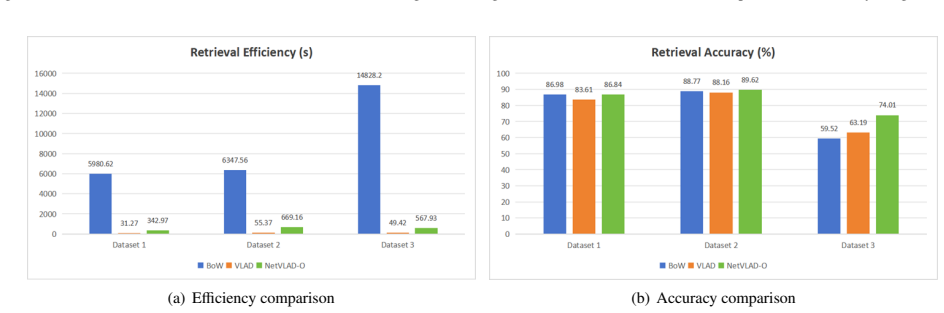
- The trained retrieval model outperforms BoW-based retrieval in accuracy on two of the three test datasets and is 9-26 times faster, and unlike VLAD it remains accurate on repetitive and weakly textured scenes.
Reading between the lines
- An implicit consequence is that the benchmark's value grows automatically as new scenes are captured and run through the same SfM annotation pipeline, since the annotation is automatic and the raw images plus parallel SfM code are released.
- Because ground truth is defined by one SfM pipeline, a natural extension is to test how much retrieval accuracy depends on the initial BoW retrieval that seeds the reconstruction; if the seeding recalls fewer overlapping pairs, the labels and the trained model may inherit that blind spot.
- The ranked list loss is not specific to UAV imagery; it could be applied to any retrieval task with geometric or spatial overlap labels, such as multi-view stereo frame selection or wide-baseline place recognition.
- One testable extension is replacing the fixed retrieval number (30 pairs per query) with a model-calibrated similarity threshold, which could improve efficiency without sacrificing reconstruction completeness.
Editorial analysis
A structured set of objections, weighed in public.
Referee Report
Summary. The paper introduces UAVPairs, a benchmark dataset of 21,622 high-resolution UAV images across 30 scenes, annotated automatically via SfM-based 3D reconstruction using the number of common 3D points as geometric similarity. It also proposes a training pipeline comprising a batched nontrivial sample mining strategy and a ranked list loss that optimizes the global similarity structure of a query against a set of positives and negatives. The authors evaluate the approach on three large-scale UAV datasets, reporting improved retrieval accuracy for models trained on UAVPairs compared to models trained on Pittsburgh, Flickr, and GL3D, and improved view graph connectivity and SfM reconstruction completeness relative to BoW, VLAD, and baseline NetVLAD. The dataset is promised to be publicly available.
Significance. If the central claims hold, UAVPairs would be a valuable, scalable resource for match pair retrieval in large-scale UAV photogrammetry, where existing datasets are either not UAV-specific, low-resolution, or not organized by scene. The proposed batched nontrivial sample mining strategy and ranked list loss address real training difficulties (expensive hard negative mining and the local nature of pair-based losses), and the end-to-end evaluation against SfM reconstruction is a strength. The paper includes extensive experiments on three real datasets and provides a reproducible training pipeline. However, the significance is curtailed by the lack of statistical rigor and, more fundamentally, by the demonstrated dependence of the ground-truth annotations on the very BoW candidate retrieval method that the paper aims to replace.
major comments (5)
- [Section 2.2, Formulas (4) and (6), and Section 4.5] The auto-annotation pipeline is censored by the BoW candidate retrieval stage. Section 2.2 states that the parallel SfM pipeline uses 'image pairs retrieved via BoW to guide feature matching.' Consequently, any overlapping pair not proposed by BoW cannot appear in any shared 3D track, so its geometric similarity in Formula (4) is zero and it is excluded from the positive set in Formula (6). This means the training labels are censored by exactly the retrieval method (BoW) that the paper later uses as a baseline in Section 4.5. A model trained on UAVPairs is never encouraged to retrieve BoW-missed pairs, even if those pairs have more than 15 SIFT inliers and would be deemed correct by the paper's own evaluation criterion in Section 4.1.2. The central claim that UAVPairs defines 'genuinely matchable' pairs is therefore implicitly predicated on the unstated assumption that BoW recall is nearly complete for the local features used. This is load-bearing and not tested. The authors should quantify the recall of the BoW candidate retrieval on a subset of scenes against an exhaustive pairwise matching reference, and discuss how any missed pairs affect the relative ranking of methods. Without this, the benchmark's advantage over BoW may partly reflect inherited BoW bias rather than a genuinely better match-pair definition.
- [Tables 5 and 6, Section 4.3] The claim that UAVPairs training leads to 'significantly improved' retrieval accuracy is not supported by statistical evidence. All results appear to be single runs with no error bars, no repeated training runs, and no significance tests. This is especially important because the training pipeline involves random selection of scenes and positives (Section 3.1 and Section 4.2, e.g., 'randomly select n scenes', 'randomly select m images'), so the reported differences—for instance, GeM going from 80.46 to 82.32 in Table 6, or NetVLAD's 1.1% average improvement—could be within random variation. The paper should report mean and standard deviation over at least three independent training runs with different random seeds, and ideally a paired significance test (e.g., Wilcoxon signed-rank) across the test datasets.
- [Table 5, Section 4.3.1] The comparison of training datasets is confounded by training protocol. The baseline models for Pittsburgh, Flickr, and GL3D are the official pretrained models from their respective papers, which were trained with different loss functions, hard-negative mining strategies, learning-rate schedules, and possibly different backbone initializations. In contrast, the UAVPairs-trained models are trained with a common protocol (triplet loss with margin 0.1 and global hard negative mining). To support the claim that UAVPairs is a superior training dataset, the authors should train the same architecture (same backbone and aggregation layer) on each dataset under identical conditions, including the same loss, margin, mining strategy, and training set size. The current comparison does not isolate the effect of the training dataset.
- [Section 4.1.2 and Table 6] The evaluation thresholds and loss hyperparameters appear to be chosen empirically without a validation protocol or sensitivity analysis. The retrieval number is 'fixed to 30 empirically', the correct match threshold to 15 inliers, and the margin α for the ranked list loss is set to 1.35, 0.9, and 0.9 for NetVLAD, GeM, and MIRorR, respectively. The paper does not explain how these values were selected, whether they were tuned on the test sets, or how sensitive the conclusions are to reasonable variations of these values. A sensitivity analysis (e.g., varying retrieval number from 10 to 50, and the inlier threshold from 10 to 20) would increase confidence that the reported improvements are not artifacts of a particular operating point.
- [Formula (19), Section 4.1.2] The primary retrieval accuracy metric in Formula (19) measures only precision—the fraction of retrieved pairs that are correct. Recall of the matchable pairs is not reported. Since the goal of match pair retrieval is to find all overlapping pairs, a method with high precision but low recall could still lead to incomplete SfM reconstructions. Although Section 4.4 indirectly addresses recall via reconstruction completeness, the paper should also report a recall metric (e.g., recall@k or the fraction of true matchable pairs that are retrieved). This would make the comparison more transparent, especially for the BoW and VLAD baselines, where low recall might explain certain reconstruction outcomes.
minor comments (6)
- [Section 4.5, Table 8 caption] The caption of Table 8 says 'The statistics of 3D reconstruction implemented with retrieval results from NetVLAD and NetVLAD-O', but the table includes results for BoW and VLAD as well; the caption should be updated accordingly.
- [Throughout] There are several typos and formatting issues: 'UA VPairs' appears with a space in the abstract and title and should be 'UAVPairs'; 'retreival' is misspelled in Section 3.2; Section 4.5 contains 'registers more images more'; and the caption of Figure 12 reads 'of of'. These should be corrected.
- [Section 2.2] The paper does not specify the BoW implementation used for the initial candidate retrieval in the auto-annotation pipeline (e.g., vocabulary size, source of the vocabulary, number of candidates per image). Since this is a central step in the annotation, the missing details prevent the reader from assessing the censoring concern. Please provide these details.
- [Section 4.2] It is stated that training images are downsampled to 480×320 and that test images are downsampled 5 times for feature extraction. The exact inference resolution for the test datasets (e.g., 5472/5 ≈ 1094×730 for Dataset 1) should be stated explicitly.
- [Section 2.1 and Abstract] The public availability of the dataset is only mentioned in the abstract via a GitHub link. The link and a clear statement about the license and intended usage should be included in the main text, ideally in the introduction or dataset section.
- [Formula (12)] In the L2 term of the ranked list loss, the notation D(A, p+1) assumes an ordering of the positive set. The text says the positives are sorted by geometric similarity, but it should be clarified whether ties in geometric similarity are broken by descriptor distance or random order, as this affects the gradient.
Circularity Check
No significant circularity: training labels come from SfM geometry, the ranked list loss is a new objective with manually set margins, and evaluation uses independent test datasets with direct feature-matching ground truth.
full rationale
The paper's central derivation chain is not circular. The UAVPairs labels are defined by Formula 4, GS(a,b)=|Pi(a)∩Pi(b)|, computed from 3D point tracks produced by an SfM pipeline. This is independent of the retrieval models being trained, which are optimized with the proposed ranked list loss (Formulas 10-13). The margins α and m are manually chosen hyperparameters, not fitted to reproduce the test labels. Evaluation is conducted on three separate UAV datasets using direct feature matching with a >15-inlier threshold (Section 4.1.2), so the test ground truth does not reduce to the training annotations. The acknowledged caveat is that the SfM auto-annotation in Section 2.2 starts from BoW-retrieved candidate pairs, so the positive-set labels are censored by BoW recall. This is a real completeness and potential bias concern, but it is not circular: the trained model is not defined in terms of those labels, and the test metric could in principle reward recovery of BoW-missed pairs. Self-citations, including the parallel SfM pipeline of Jiang et al. (2022) and the HNSW/evaluation discussion of Liu et al. (2024), are used as tools or external evidence rather than as load-bearing justifications of the paper's core claim. The core contributions—a new benchmark dataset and a new listwise loss—stand independently of any fitted parameter being renamed as a prediction.
Assumptions & free parameters
free parameters (6)
- alpha (ranked list loss margin) =
1.35 (NetVLAD), 0.9 (GeM), 0.9 (MIRorR)
- m (triplet and ranked list margin) =
0.1
- epsilon (positive pair threshold) =
not specified
- K_retrieval (retrieved pairs per query) =
30
- match_threshold (correct pair definition) =
15
- batch_hyperparams (n, m, t) =
n=5, m=3, t=2000
assumptions (4)
- domain assumption SfM reconstruction (with BoW-seeded matching) produces a complete set of matchable image pairs.
- domain assumption The number of common 3D points is a valid proxy for geometric overlap and matchability.
- domain assumption The local feature matcher (SIFT-like) used in SfM and in the evaluation metric (matches > 15) is the reference standard for matchability.
- standard math The edge weighting and parallel SfM clustering from Jiang et al. (2022) behave as described.
Cite this review
Pith. "Pith review of UAVPairs: A Challenging Benchmark for Match Pair Retrieval of Large-scale UAV Images." pith.science (2026). https://pith.science/paper/A7FYQKY3
@misc{pith2026250522098,
  author       = {Pith},
  title        = {Pith review of: UAVPairs: A Challenging Benchmark for Match Pair Retrieval of Large-scale UAV Images},
  year         = {2026},
  howpublished = {\url{https://pith.science/paper/A7FYQKY3}},
  note         = {Machine review of arXiv:2505.22098}
}
read the original abstract
The primary contribution of this paper is a challenging benchmark dataset, UAVPairs, and a training pipeline designed for match pair retrieval of large-scale UAV images. First, the UAVPairs dataset, comprising 21,622 high-resolution images across 30 diverse scenes, is constructed; the 3D points and tracks generated by SfM-based 3D reconstruction are employed to define the geometric similarity of image pairs, ensuring genuinely matchable image pairs are used for training. Second, to solve the problem of expensive mining cost for global hard negative mining, a batched nontrivial sample mining strategy is proposed, leveraging the geometric similarity and multi-scene structure of the UAVPairs to generate training samples as to accelerate training. Third, recognizing the limitation of pair-based losses, the ranked list loss is designed to improve the discrimination of image retrieval models, which optimizes the global similarity structure constructed from the positive set and negative set. Finally, the effectiveness of the UAVPairs dataset and training pipeline is validated through comprehensive experiments on three distinct large-scale UAV datasets. The experiment results demonstrate that models trained with the UAVPairs dataset and the ranked list loss achieve significantly improved retrieval accuracy compared to models trained on existing datasets or with conventional losses. Furthermore, these improvements translate to enhanced view graph connectivity and higher quality of reconstructed 3D models. The models trained by the proposed approach perform more robustly compared with hand-crafted global features, particularly in challenging repetitively textured scenes and weakly textured scenes. For match pair retrieval of large-scale UAV images, the trained image retrieval models offer an effective solution. The dataset would be made publicly available at https://github.com/json87/UAVPairs.
Figures


Figures from the paper (10 more)



Reference graph
Works this paper leans on
- [3]
-
[8]
Large-scale image retrieval 15 with compressed fisher vectors, in: 2010 IEEE computer society conference on computer vision and pattern recognition, IEEE. pp. 3384–3391. Philbin, J., Chum, O., Isard, M., Sivic, J., Zisserman, A.,
work page 2010
-
[10]
Lost in quanti- zation: Improving particular object retrieval in large scale image databases, in: 2008 IEEE conference on computer vision and pattern recognition, IEEE. pp. 1–8. Radenovi´c, F., Tolias, G., Chum, O.,
work page 2008
-
[2006]
Scalable recognition with a vocabulary tree, in: 2006 IEEE Computer Society Conference on Computer Vision and Pattern Recognition (CVPR’06), Ieee. pp. 2161–2168. Noh, H., Araujo, A., Sim, J., Weyand, T., Han, B.,
work page 2006
-
[2007]
Object retrieval with large vocabularies and fast spatial matching, in: 2007 IEEE conference on computer vision and pattern recognition, IEEE. pp. 1–8. Philbin, J., Chum, O., Isard, M., Sivic, J., Zisserman, A.,
work page 2007
-
[2008]
Hamming embedding and weak geo- metric consistency for large scale image search, in: Computer Vision–ECCV 2008: 10th European Conference on Computer Vision, Marseille, France, October 12-18, 2008, Proceedings, Part I 10, Springer. pp. 304–317. J´egou, H., Douze, M., Schmid, C., P ´erez, P.,
work page 2008
-
[2010]
Aggregating local descrip- tors into a compact image representation, in: 2010 IEEE computer society conference on computer vision and pattern recognition, IEEE. pp. 3304–
work page 2010
-
[2011]
Orb: An e fficient alternative to sift or surf, in: 2011 International conference on computer vision, Ieee. pp. 2564–2571. Schonberger, J.L., Frahm, J.M.,
work page 2011
Show all 13 references
-
[2015]
1269–1277
Aggregating local deep features for im- age retrieval, in: 2015 IEEE International Conference on Computer Vision (ICCV), pp. 1269–1277. Yang, M., He, D., Fan, M., Shi, B., Xue, X., Li, F., Ding, E., Huang, J.,
2015
-
[2018]
Dusmanu, M., Rocco, I., Pajdla, T., Pollefeys, M., Sivic, J., Torii, A., Sattler, T.,
Superpoint: Self-supervised interest point detection and description, in: 2018 IEEE/CVF Conference on Computer Vision and Pattern Recognition Workshops (CVPRW). Dusmanu, M., Rocco, I., Pajdla, T., Pollefeys, M., Sivic, J., Torii, A., Sattler, T.,
2018
-
[2019]
4685–4694
Arcface: Additive angular margin loss for deep face recognition, in: 2019 IEEE /CVF Conference on Computer Vision and Pattern Recognition (CVPR), pp. 4685–4694. Detone, D., Malisiewicz, T., Rabinovich, A.,
2019
-
[2020]
Solar: second-order loss and attention for image retrieval, in: Computer Vision–ECCV 2020: 16th European Conference, Glasgow, UK, August 23–28, 2020, Proceedings, Part XXV 16, Springer. pp. 253–270. Nister, D., Stewenius, H.,
2020
-
[2763]
Dalg: Deep attentive local and global modeling for image retrieval
Song, Y ., Zhu, R., Yang, M., He, D., 2022b. Dalg: Deep attentive local and global modeling for image retrieval. arXiv preprint arXiv:2207.00287 . Tian, Y ., Fan, B., Wu, F.,
Reviewed August 7, 2026 · model on record in the stance chip above.
Discussion (0). Sign in to comment.