REVIEW 3 major objections 5 minor 58 references
SlepNet: Spectral Subgraph Representation Learning for Neural Dynamics
T0 review · 3 major / 5 minor · reviewed 2026-08-15 · deepseek-v4-flash
Pith's one-line read SlepNet replaces global graph Fourier harmonics with Slepian harmonics concentrated on a learned subgraph, and reports higher classification accuracy across three fMRI and two traffic datasets plus more resolvable trajectory embeddings.
desk verdict SlepNet is a genuinely new architecture, but the reported outperformance is built on test-set model selection and is not supported as written. read the letter →
The pith
A machine-rendered reading of the paper's core claim, the machinery that carries it, and where it could break.
The reading
What carries the argument
The central object is the Slepian basis $Z$: eigenvectors of the concentration matrix $C=S_B^TU^TS_VUS_B$, which are graph Fourier harmonics bandlimited to the first $K$ Laplacian eigenvectors and maximally concentrated on a node subset selected by $S_V$. SlepNet learns $S_V$ through a sigmoidal or hard-Tanh attention mask over $\kappa=60$ spectral clusters, forms $Z$, and filters signals as $Z(\Theta Z^Tx)$. A neural eigenmapping network, trained by regression on eigendecompositions of a subset of nodes, approximates the Slepian harmonics to avoid the $O(N^3)$ cost of full eigendecomposition. This basis carries the argument because it provides spatially localized, canonical spectral filters, which the paper argues global Fourier harmonics and graph wavelets cannot provide.
What would settle it
At inference time, round the learned mask to 0/1, recompute the Slepian basis from that discrete subgraph, and rerun the classifier; if the accuracy falls to the Spectral GCN baseline, or if the gradients used in training cannot be matched to the rounded basis, then the network is not actually learning Slepian harmonics. As a second check, retraining with a random mask that keeps accuracy high would show the mask is not doing the localization work claimed.
Extended reading notes
Core claim
The central claim is that replacing the graph Fourier basis with Slepian harmonics, which are bandlimited functions optimally concentrated on a learned subgraph, improves both classification and representation of spatiotemporal signals on graphs. Concretely, the paper defines a graph convolution as $\tilde{x}=Z(\Theta Z^Tx)$, where $Z$ contains Slepian harmonics restricted to selected nodes, the selection comes from cluster-level attention weights, and both the mask and the diagonal filters $\Theta$ are learned end-to-end. Across the five datasets, one of the two SlepNet variants achieves the top accuracy in every case, with the strongest numbers being 84.70 percent on OCD-PVDM, 90.65 percent on OCD-RA, 74.13 percent on ASD-ABIDE, and 56.56 percent on PEMS03, compared with a best baseline of 62.62, 69.76, 57.68, and 56.31 percent respectively. The paper also claims that the learned mask recovers ground-truth informative subgraphs on synthetic graphs with 100 percent accuracy, and that SlepNet's embedding trajectories have high curvature and support better secondary classification of subject sex than baseline embeddings.
Load-bearing premise
SlepNet assumes that the continuous cluster-attention scores can be converted into the discrete yes-or-no choice of which nodes define the subgraph, and that this conversion can still be trained by gradient descent; the paper does not specify how the rounding happens or how gradients pass through it.
Editorial extensions
If this is right
- If SlepNet's reported accuracy holds, spectral GNNs for neuroimaging can be built around learned subgraph localization rather than global graph Fourier harmonics, yielding gains on disease classification tasks.
- The learned Slepian embeddings are resolved enough to be reused for an untrained secondary task, such as classifying subject sex from OCD data, indicating the representation itself carries signal beyond the original classifier.
- The mask learned on fMRI data highlights the parietal lobe, dorsolateral prefrontal cortex, and left temporal regions, which the paper ties to prior OCD findings, so the method offers interpretable region discovery rather than a black-box score.
- The neural eigenmapping approximation makes Slepian computation practical for graphs beyond roughly 1000 nodes, since full eigendecomposition scales as $O(N^3)$ while the approximating network has lower and more stable runtime.
- Ablations show that increasing the number of Slepian basis vectors from 5 to 500 monotonically improves classification accuracy, so the model's expressivity is directly tied to spectral bandwidth.
Reading between the lines
- The paper leaves open whether the learned mask is genuinely discrete when defining $S_V$; if a continuous mask is used in training but a rounded mask at inference, the network may not actually be optimizing the Slepian basis it claims to use.
- The same mask-plus-Slepian design could be applied to other signal-on-graph problems where the informative support is unknown, such as EEG source localization or anomaly detection in sensor networks, but the paper only demonstrates fMRI and traffic data.
- The differing performance of the energy-concentration and embedded-distance Slepian variants across datasets suggests that the choice of Slepian criterion is itself a tunable modeling decision; an adaptive or mixed criterion might further improve results.
- Because the mask operates at the level of $\kappa=60$ spectral clusters, the learned subgraph is coarse; a hierarchical or finer-grained mask could test whether cluster granularity is a bottleneck for localization accuracy.
Signed reviews
Editorial analysis
A structured set of objections, weighed in public.
Referee Report
Summary. SlepNet is a graph convolutional network that replaces graph Fourier harmonics with Slepian harmonics, which are designed to concentrate signal energy on a learned subgraph. The architecture consists of an attention-based mask that selects node clusters and a Slepian spectral filtering layer, with a neural eigenmapping approximation for scalability. The authors evaluate SlepNet on three fMRI datasets (OCD-PVDM, OCD-RA, ASD-ABIDE) and two traffic datasets (PEMS03, PEMS07), reporting that it outperforms GNN and graph-wavelet baselines in classification, that its learned masks recover ground-truth subgraphs in synthetic settings, and that its embeddings yield more structured temporal trajectories and better downstream classification. The paper includes ablations over the number of Slepian vectors, visualizations of learned brain masks, and a two-tier evaluation scheme.
Significance. If the empirical claims held, SlepNet would be a useful addition to graph-signal-processing tools for spatiotemporal neural data, offering a principled way to localize spectral filters to learned subgraphs. The synthetic mask-recovery experiment, the public code release, and the neural eigenmapping idea are concrete strengths. However, the central classification claim is undermined by the evaluation protocol described in Appendix G: models are selected on the test set, so the reported accuracies do not measure generalization. Because the paper's main contribution is empirical, this flaw is load-bearing and prevents the claimed outperformance from being established. The method description also leaves an important implementation detail unresolved regarding discretization of the attention mask.
major comments (3)
- [Appendix G (Experimental Details) and Table 1] The evaluation protocol selects the model with the highest test accuracy during 300 epochs of training, with no validation split and no independent early-stopping rule. This is test-set model selection: the reported numbers are optimistically biased, with the bias increasing in the number of epochs, and the margins in Table 1 cannot be interpreted as evidence that SlepNet outperforms the baselines. Since Table 1 is the central empirical claim, this issue is load-bearing.
- [Table 1 and Table 6 (Ablation Studies)] Table 1 reports SlepNet-I with K=100 Slepian vectors, but Table 6 shows K=500 yields substantially higher accuracy (e.g., 92.94% vs. 84.70% on OCD-PVDM). The headline results are therefore not the best configuration the authors themselves report, and the choice of K=100 for the main comparison is unexplained; this inconsistency further weakens the presentation of the central claim.
- [Section 4.1 (Attention-based Mask Learning Module)] The paper states that attention weights are sigmoidal or hard-Tanh values, but it never specifies how these continuous weights are converted into the 0/1 diagonal node-selection matrix S_V that defines the Slepian basis. If the mask is thresholded or rounded, the Slepian basis used in the forward pass is not the one that gradients see; if it is kept soft, S_V is not a valid selection matrix. This ambiguity affects the formal definition of the method and needs to be resolved.
minor comments (5)
- [Throughout] There are several typos and grammatical slips, including 'laerned', 'sucessfully', 'interpretiblity', and 'resovled'; the manuscript would benefit from a careful proofreading pass.
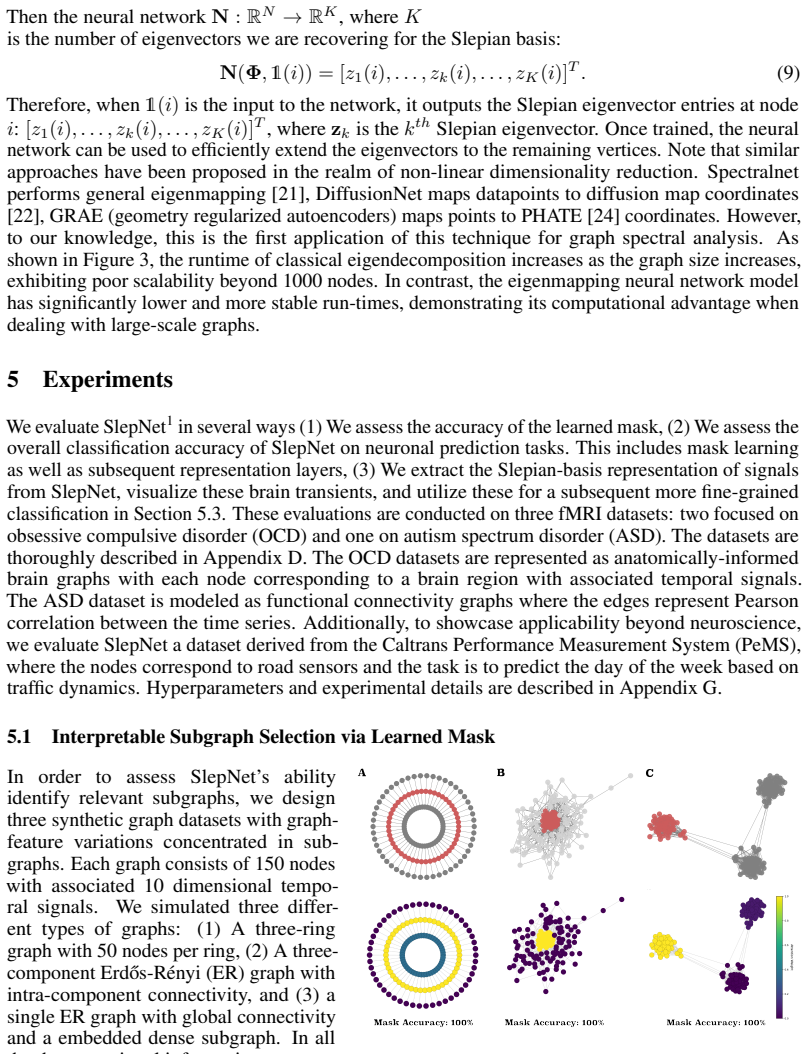
- [Section 5.1 and Figure 4] The claim that the learned mask recovers ground-truth subgraphs with 100% accuracy is stated without a quantitative metric or confidence interval; please specify how accuracy is computed and report variability over runs.
- [Section 4.2.1 and Figure 3] The right panel of Figure 3 reports performance of neural eigenmap predictions on unseen nodes, but the text does not define the error metric or the experimental setup; please clarify what quantity is plotted.
- [Appendix D, Table 5] The dataset table lists only the number of timepoints and subjects, not the graph sizes (number of nodes per subject) or the number of graph instances after temporal snapshotting; adding these details would improve reproducibility.
- [Tables 1 and 3] The paper does not report any statistical significance tests comparing SlepNet with the baselines; given the small subject counts in the fMRI datasets and the overlapping standard deviations for some comparisons, significance tests or confidence intervals for the differences should be provided.
Circularity Check
Reported accuracies are the maximum over 300 test-set epochs, so the headline outperformance claim is a test-fit statistic; the Slepian method itself is not circular.
-
fitted input called prediction
[Appendix G (Experimental Details), used for Table 1]
"We trained the model for 300 epochs on every dataset, saved and recorded the results of the model with highest test accuracy during training. All experiments were repeated for 10 iterations to compute mean and standard deviation of the accuracy. The datasets used are split into 80% training and 20% testing sets for each run."
Table 1, which supports the abstract's claim that 'SlepNet outperforms the baselines in all datasets,' is produced by selecting the epoch with the highest accuracy on the 20% test split over 300 epochs, with no validation split. Each reported number is therefore, by construction, max_epoch test_accuracy(epoch): the test labels are used as the model-selection criterion. Calling these numbers 'classification accuracy' presents a test-set-fitted statistic as an independent prediction. The protocol applies to every baseline, so it does not by itself favor SlepNet, but the central empirical claim is the result of a fitted-input-called-prediction step: the reported performance is an optimized envelope over the evaluation data rather than a generalization measurement.
full rationale
The core method is not circular: the Slepian basis is defined by the external concentration criterion of Van De Ville et al. [11] (Eq. 3), the mask is learned from supervised classification labels, and the Slepian filtering operation (Eq. 7) is a conventional spectral convolution. Proposition 1 is only a dual restatement of the same concentration criterion via the cyclic eigenvalue property; it is not used to force the empirical results. The self-citations (T-PHATE [28], BLISNet [7], geometric scattering [37], and the curvature reference [29]) are not load-bearing: they provide tools or baselines applied symmetrically to all models, and they do not define SlepNet's accuracy. The one substantive circularity is the evaluation protocol in Appendix G: selecting the highest test accuracy over 300 epochs means the reported predictions are fitted to the test labels. This is load-bearing for the abstract's central outperformance claim, though it does not make the architecture itself circular. The soft-mask-to-discrete-S_V gap and the K=100 vs. K=500 ablation inconsistency are correctness risks rather than circularity.
Assumptions & free parameters
free parameters (4)
- Slepian band limit K (number of Slepian harmonics) =
100 in main tables; 5 to 500 in ablation
- Mask cluster count kappa =
60
- Architecture depth and breadth =
L=3 layers, hidden dimension 64
- Learning rate and weight decay =
not reported
assumptions (6)
- standard math The graph Laplacian eigendecomposition U, Lambda exists and defines a valid graph Fourier basis.
- domain assumption Slepian harmonics are the eigenvectors of concentration matrix C = S_B^T U^T S_V U S_B and remain orthonormal over the graph.
- ad hoc to paper The learned soft attention mask can be interpreted as a valid node-selection matrix S_V during optimization.
- domain assumption Relevant signal energy in fMRI and traffic graphs is concentrated in learnable subgraphs, so the Slepian concentration premise matches the data.
- domain assumption Spectral clustering with kappa=60 produces coherent node clusters suitable for mask selection.
- ad hoc to paper Neural eigenmapping can approximate Slepian eigenvectors from one-hot node identifiers.
Cite this review
Pith. "Pith review of SlepNet: Spectral Subgraph Representation Learning for Neural Dynamics." pith.science (2026). https://pith.science/paper/A7J5QSVH
@misc{pith2026250616602,
  author       = {Pith},
  title        = {Pith review of: SlepNet: Spectral Subgraph Representation Learning for Neural Dynamics},
  year         = {2026},
  howpublished = {\url{https://pith.science/paper/A7J5QSVH}},
  note         = {Machine review of arXiv:2506.16602}
}
read the original abstract
Graph neural networks have been useful in machine learning on graph-structured data, particularly for node classification and some types of graph classification tasks. However, they have had limited use in representing patterning of signals over graphs. Patterning of signals over graphs and in subgraphs carries important information in many domains including neuroscience. Neural signals are spatiotemporally patterned, high dimensional and difficult to decode. Graph signal processing and associated GCN models utilize the graph Fourier transform and are unable to efficiently represent spatially or spectrally localized signal patterning on graphs. Wavelet transforms have shown promise here, but offer non-canonical representations and cannot be tightly confined to subgraphs. Here we propose SlepNet, a novel GCN architecture that uses Slepian bases rather than graph Fourier harmonics. In SlepNet, the Slepian harmonics optimally concentrate signal energy on specifically relevant subgraphs that are automatically learned with a mask. Thus, they can produce canonical and highly resolved representations of neural activity, focusing energy of harmonics on areas of the brain which are activated. We evaluated SlepNet across three fMRI datasets, spanning cognitive and visual tasks, and two traffic dynamics datasets, comparing its performance against conventional GNNs and graph signal processing constructs. SlepNet outperforms the baselines in all datasets. Moreover, the extracted representations of signal patterns from SlepNet offers more resolution in distinguishing between similar patterns, and thus represent brain signaling transients as informative trajectories. Here we have shown that these extracted trajectory representations can be used for other downstream untrained tasks. Thus we establish that SlepNet is useful both for prediction and representation learning in spatiotemporal data.
Figures


Figures from the paper (6 more)


Reference graph
Works this paper leans on
-
[1]
Spatio-temporal graph convolution for resting-state fMRI analysis
Soham Gadgil, Qingyu Zhao, Adolf Pfefferbaum, Edith V Sullivan, Ehsan Adeli, and Kilian M Pohl. Spatio-temporal graph convolution for resting-state fMRI analysis. In Medical Image Computing and Computer Assisted Intervention–MICCAI 2020: 23rd International Conference, Lima, Peru, October 4–8, 2020, Proceedings, Part VII 23, pages 528–538. Springer, 2020
work page 2020
-
[2]
Graph neural networks for brain graph learning: a survey
Xuexiong Luo, Jia Wu, Jian Yang, Shan Xue, Amin Beheshti, Quan Z Sheng, David McAlpine, Paul Sowman, Alexis Giral, and Philip S Yu. Graph neural networks for brain graph learning: a survey. In Proceedings of the Thirty-Third International Joint Conference on Artificial Intelligence, pages 8170–8178, 2024
work page 2024
-
[3]
Graph neural networks in brain connectivity studies: Methods, challenges, and future directions
Hamed Mohammadi and Waldemar Karwowski. Graph neural networks in brain connectivity studies: Methods, challenges, and future directions. Brain Sciences, 15(1):17, 2024
work page 2024
-
[4]
The emerging field of signal processing on graphs: Extending high-dimensional data analysis to networks and other irregular domains
David I Shuman, Sunil K Narang, Pascal Frossard, Antonio Ortega, and Pierre Vandergheynst. The emerging field of signal processing on graphs: Extending high-dimensional data analysis to networks and other irregular domains. IEEE signal processing magazine, 30(3):83–98, 2013
2013
-
[5]
Spectral networks and deep locally connected networks on graphs
Joan Bruna, Wojciech Zaremba, Arthur Szlam, and Yann LeCun. Spectral networks and deep locally connected networks on graphs. In 2nd International Conference on Learning Representations, ICLR, 2014
work page 2014
-
[6]
Semi-supervised classification with graph convolutional networks
Thomas N Kipf and Max Welling. Semi-supervised classification with graph convolutional networks. In International Conference on Learning Representations, 2017
2017
-
[7]
BLIS-Net: Classifying and Analyzing Signals on Graphs
Charles Xu, Laney Goldman, Valentina Guo, Benjamin Hollander-Bodie, Maedee Trank-Greene, Ian Adelstein, Edward De Brouwer, Rex Ying, Smita Krishnaswamy, and Michael Perlmutter. Blis-net: Classifying and analyzing signals on graphs, 2023. URL https://arxiv.org/abs/ 2310.17579
work page Pith review arXiv 2023
-
[8]
Learnable filters for geometric scattering modules
Alexander Tong, Frederik Wenkel, Dhananjay Bhaskar, Kincaid Macdonald, Jackson Grady, Michael Perlmutter, Smita Krishnaswamy, and Guy Wolf. Learnable filters for geometric scattering modules. IEEE Transactions on Signal Processing , 72:2939–2952, 2024. doi: 10.1109/TSP.2024.3378001
arXiv 2024
Show all 58 references
-
[9]
Graph filters for signal processing and machine learning on graphs
Elvin Isufi, Fernando Gama, David I Shuman, and Santiago Segarra. Graph filters for signal processing and machine learning on graphs. IEEE Transactions on Signal Processing , 72: 4745–4781, 2024
2024
-
[10]
Wavelets on graphs via spectral graph theory
David K Hammond, Pierre Vandergheynst, and Rémi Gribonval. Wavelets on graphs via spectral graph theory. Applied and Computational Harmonic Analysis, 30(2):129–150, 2011
2011
-
[11]
When Slepian meets Fiedler: Putting a focus on the graph spectrum
Dimitri Van De Ville, Robin Demesmaeker, and Maria Giulia Preti. When Slepian meets Fiedler: Putting a focus on the graph spectrum. IEEE Signal Processing Letters, 24(7):1001–1004, 2017
2017
-
[12]
Guided graph spectral embedding: Application to the C
Miljan Petrovic, Thomas AW Bolton, Maria Giulia Preti, Raphaël Liégeois, and Dimitri Van De Ville. Guided graph spectral embedding: Application to the C. elegans connectome.Network Neuroscience, 3(3):807–826, 2019
2019
-
[13]
Prolate spheroidal wave functions, Fourier analysis and uncertainty—i
David Slepian and Henry O Pollak. Prolate spheroidal wave functions, Fourier analysis and uncertainty—i. Bell System Technical Journal, 40(1):43–63, 1961
1961
-
[14]
Prolate spheroidal wave functions, Fourier analysis, and uncertainty — v: the discrete case
David Slepian. Prolate spheroidal wave functions, Fourier analysis, and uncertainty — v: the discrete case. The Bell System Technical Journal, 57(5):1371–1430, 1978
1978
-
[15]
Complex networks: A networking and signal processing perspective
BS Manoj, Abhishek Chakraborty, and Rahul Singh. Complex networks: A networking and signal processing perspective. Prentice Hall, 2018
2018
-
[16]
Graph signal processing and deep learning: Convolution, pooling, and topology
Mark Cheung, John Shi, Oren Wright, Lavendar Y Jiang, Xujin Liu, and José MF Moura. Graph signal processing and deep learning: Convolution, pooling, and topology. IEEE Signal Processing Magazine, 37(6):139–149, 2020. 17
2020
-
[17]
Convolutional neural networks on graphs with fast localized spectral filtering
Michaël Defferrard, Xavier Bresson, and Pierre Vandergheynst. Convolutional neural networks on graphs with fast localized spectral filtering. In Advances in Neural Information Processing Systems, volume 29, 2016
2016
-
[18]
On spectral clustering: Analysis and an algorithm
Andrew Ng, Michael Jordan, and Yair Weiss. On spectral clustering: Analysis and an algorithm. Advances in neural information processing systems, 14, 2001
2001
-
[19]
Matrix backpropagation for deep networks with structured layers
Catalin Ionescu, Orestis Vantzos, and Cristian Sminchisescu. Matrix backpropagation for deep networks with structured layers. In 2015 IEEE International Conference on Computer Vision (ICCV), pages 2965–2973, 2015
2015
-
[20]
Amortized eigendecomposition for neural networks
Tianbo Li, Zekun Shi, Jiaxi Zhao, and Min Lin. Amortized eigendecomposition for neural networks. Advances in Neural Information Processing Systems, 37:138809–138835, 2024
2024
-
[21]
Spectralnet: Spectral clustering using deep neural networks
Uri Shaham, Kelly Stanton, Henry Li, Boaz Nadler, Ronen Basri, and Yuval Kluger. Spectralnet: Spectral clustering using deep neural networks. arXiv preprint arXiv:1801.01587, 2018
2018 arXiv
-
[22]
Diffusion nets
Gal Mishne, Uri Shaham, Alexander Cloninger, and Israel Cohen. Diffusion nets. Applied and Computational Harmonic Analysis, 47(2):259–285, 2019
2019
-
[23]
Geometry regularized autoen- coders
Andres F Duque, Sacha Morin, Guy Wolf, and Kevin R Moon. Geometry regularized autoen- coders. IEEE transactions on pattern analysis and machine intelligence , 45(6):7381–7394, 2022
2022
-
[24]
Visual- izing structure and transitions in high-dimensional biological data
Kevin R Moon, David Van Dijk, Zheng Wang, Scott Gigante, Daniel B Burkhardt, William S Chen, Kristina Yim, Antonia van den Elzen, Matthew J Hirn, Ronald R Coifman, et al. Visual- izing structure and transitions in high-dimensional biological data. Nature biotechnology, 37 (12)...
2019
-
[25]
Graph attention networks, 2018
Petar Veliˇckovi´c, Guillem Cucurull, Arantxa Casanova, Adriana Romero, Pietro Liò, and Yoshua Bengio. Graph attention networks, 2018. URL https://arxiv.org/abs/1710.10903
2018 arXiv
-
[26]
How powerful are graph neural networks?, 2019
Keyulu Xu, Weihua Hu, Jure Leskovec, and Stefanie Jegelka. How powerful are graph neural networks?, 2019. URL https://arxiv.org/abs/1810.00826
2019 arXiv
-
[27]
Inductive representation learning on large graphs
Will Hamilton, Zhitao Ying, and Jure Leskovec. Inductive representation learning on large graphs. In I. Guyon, U. V on Luxburg, S. Bengio, H. Wallach, R. Fergus, S. Vishwanathan, and R. Garnett, editors, Advances in Neural Information Processing Systems, volume 30. Curran Asso...
2017
-
[28]
Busch, Jessie Huang, Andrew Benz, Tom Wallenstein, Guillaume Lajoie, Guy Wolf, Smita Krishnaswamy, and Nicholas B
Erica L. Busch, Jessie Huang, Andrew Benz, Tom Wallenstein, Guillaume Lajoie, Guy Wolf, Smita Krishnaswamy, and Nicholas B. Turk-Browne. Multi-view manifold learning of human brain-state trajectories. Nature Computational Science, 3(3):240–253, Mar 2023. ISSN 2662-
2023
-
[29]
Adam Noah, Smita Krishnaswamy, and Joy Hirsch
Rahul Singh, Yanlei Zhang, Dhananjay Bhaskar, Vinod Srihari, Cenk Tek, Xian Zhang, J. Adam Noah, Smita Krishnaswamy, and Joy Hirsch. Deep multimodal representations and classification of first-episode psychosis via live face processing. Frontiers in Psychiatry, V olume 16 - 2025,
2025
-
[30]
Kreyszig
E. Kreyszig. Differential Geometry. Differential Geometry. Dover Publications, 1991. ISBN 9780486667218. URL https://books.google.ca/books?id=B7yxgFaQKNAC
1991
-
[31]
Slepian guided filtering of graph signals
Miljan Petrovi´c and Dimitri Van De Ville. Slepian guided filtering of graph signals. In Wavelets and Sparsity XVIII, volume 11138, pages 129–143. SPIE, 2019
2019
-
[32]
Time-resolved analysis of dynamic graphs: An extended slepian design
Raphaël Liégeois, Ibrahim Merad, and Dimitri Van De Ville. Time-resolved analysis of dynamic graphs: An extended slepian design. In Wavelets and Sparsity XVIII, volume 11138, pages 315–321. SPIE, 2019
2019
-
[33]
Graph slepians to strike a balance between local and global network interactions: Application to functional brain imaging
Thomas AW Bolton, Younes Farouj, Silvia Obertino, and Dimitri Van De Ville. Graph slepians to strike a balance between local and global network interactions: Application to functional brain imaging. In 2018 IEEE 15th International Symposium on Biomedical Imaging (ISBI 2018), p...
2018
-
[34]
Guiding network analysis using graph slepians: An illustration for the c
Dimitri Van De Ville, Robin Demesmaeker, and Maria Giulia Preti. Guiding network analysis using graph slepians: An illustration for the c. elegans connectome. In Wavelets and sparsity xvii, volume 10394, pages 413–419. SPIE, 2017
2017
-
[35]
Graph wavelet neural network
Bingbing Xu, Huawei Shen, Qi Cao, Yunqi Qiu, and Xueqi Cheng. Graph wavelet neural network. In International Conference on Learning Representations, 2018
2018
-
[36]
Graph neural networks with lifting-based adaptive graph wavelets
Mingxing Xu, Wenrui Dai, Chenglin Li, Junni Zou, Hongkai Xiong, and Pascal Frossard. Graph neural networks with lifting-based adaptive graph wavelets. IEEE Transactions on Signal and Information Processing over Networks, 8:63–77, 2022
2022
-
[37]
Geometric scattering on measure spaces
Joyce Chew, Matthew Hirn, Smita Krishnaswamy, Deanna Needell, Michael Perlmutter, Holly Steach, Siddharth Viswanath, and Hau-Tieng Wu. Geometric scattering on measure spaces. Applied and Computational Harmonic Analysis, 70:101635, 2024. ISSN 1063-5203. doi: https: //doi.org/10...
2024
-
[38]
Schoenholz, Patrick F
Justin Gilmer, Samuel S. Schoenholz, Patrick F. Riley, Oriol Vinyals, and George E. Dahl. Neural message passing for quantum chemistry. In ICML, pages 1263–1272, 2017
2017
-
[39]
Graph attention networks
Petar Veliˇckovi´c, Guillem Cucurull, Arantxa Casanova, Adriana Romero, Pietro Liò, and Yoshua Bengio. Graph attention networks. In International Conference on Learning Representations, 2018
2018
-
[40]
Inductive representation learning on large graphs
Will Hamilton, Zhitao Ying, and Jure Leskovec. Inductive representation learning on large graphs. In Advances in Neural Information Processing Systems, volume 30, 2017
2017
-
[41]
How powerful are graph neural networks? In International Conference on Learning Representations, 2018
Keyulu Xu, Weihua Hu, Jure Leskovec, and Stefanie Jegelka. How powerful are graph neural networks? In International Conference on Learning Representations, 2018
2018
-
[42]
Subgraph neural networks
Emily Alsentzer, Samuel Finlayson, Michelle Li, and Marinka Zitnik. Subgraph neural networks. Advances in Neural Information Processing Systems, 33:8017–8029, 2020
2020
-
[43]
SHINE: Subhypergraph inductive neural network
Yuan Luo. SHINE: Subhypergraph inductive neural network. InAdvances in Neural Information Processing Systems, volume 35, pages 18779–18792, 2022
2022
-
[44]
Generalizing Weisfeiler-Lehman kernels to subgraphs
Dongkwan Kim and Alice Oh. Generalizing Weisfeiler-Lehman kernels to subgraphs. arXiv preprint arXiv:2412.02181, 2024
2024
-
[45]
Improving subgraph representation learning via multi-view augmentation
Yili Shen, Jiaxu Yan, Cheng-Wei Ju, Jun Yi, Zhou Lin, and Hui Guan. Improving subgraph representation learning via multi-view augmentation. In ICML 2022 2nd AI for Science Workshop, 2022
2022
-
[46]
Subgraph representation learning with self-attention and free adversarial training
Denggao Qin, Xianghong Tang, and Jianguang Lu. Subgraph representation learning with self-attention and free adversarial training. Applied Intelligence, 54(11):7012–7029, 2024
2024
-
[47]
OCD Influences Evidence Accumulation During Decision Making in Males but Not Females During Perceptual and Value-Driven Choice
Xiao Ma, Ashton Megli, Christopher Pittenger, and Helen Pushkarskaya. OCD Influences Evidence Accumulation During Decision Making in Males but Not Females During Perceptual and Value-Driven Choice. Frontiers in Psychiatry, 12, 2021. ISSN 1664-0640
2021
-
[48]
Gorgolewski, Demian Wassermann, Bertrand Thirion, and Arthur Mensch
Kamalaker Dadi, Gaël Varoquaux, Antonia Machlouzarides-Shalit, Krzysztof J. Gorgolewski, Demian Wassermann, Bertrand Thirion, and Arthur Mensch. Fine-grain atlases of functional modes for fMRI analysis. NeuroImage, 221:117126, 2020. ISSN 1053-8119
2020
-
[49]
MacLaren Kelly, Christopher Pittenger, and Ifat Levy
Helen Pushkarskaya, David Tolin, Lital Ruderman, Ariel Kirshenbaum, J. MacLaren Kelly, Christopher Pittenger, and Ifat Levy. Decision-making under uncertainty in obsessive- compulsive disorder. Journal of Psychiatric Research , 69:166–173, October 2015. ISSN 1879-1379. doi: 10...
2015 doi
-
[50]
Nelson, Aldo Rustichini, and Paul W
Ifat Levy, Jason Snell, Amy J. Nelson, Aldo Rustichini, and Paul W. Glimcher. Neural representation of subjective value under risk and ambiguity. Journal of Neurophysiology, 103 (2):1036–1047, February 2010. ISSN 1522-1598. doi: 10.1152/jn.00853.2009. 19
2010
-
[51]
Di Martino, C.-G
A. Di Martino, C.-G. Yan, Q. Li, E. Denio, F. X. Castellanos, K. Alaerts, J. S. Anderson, M. Assaf, S. Y . Bookheimer, M. Dapretto, B. Deen, S. Delmonte, I. Dinstein, B. Ertl-Wagner, D. A. Fair, L. Gallagher, D. P. Kennedy, C. L. Keown, C. Keysers, J. E. Lainhart, C. Lord, B. ...
2014
-
[52]
Lyttelton, Habib Benali, and Alan C
Pierre Bellec, Pedro Rosa-Neto, Oliver C. Lyttelton, Habib Benali, and Alan C. Evans. Multi- level bootstrap analysis of stable clusters in resting-state fMRI. NeuroImage, 51(3):1126–1139,
-
[53]
Freeway performance measurement system: Mining loop detector data
Chao Chen, Karl Petty, Alexander Skabardonis, Pravin Varaiya, and Zhanfeng Jia. Freeway performance measurement system: Mining loop detector data. Transportation Research Record, 1748(1):96–102, 2001. doi: 10.3141/1748-12. URL https://doi.org/10.3141/1748-12
2001 doi
-
[54]
Chamberlain, Angela R
Lara Menzies, Samuel R. Chamberlain, Angela R. Laird, Sarah M. Thelen, Barbara J. Sa- hakian, and Ed T. Bullmore. Integrating evidence from neuroimaging and neuropsycho- logical studies of obsessive-compulsive disorder: The orbitofronto-striatal model revisited. Neuroscience &...
2008 doi
-
[55]
Abnormal regional homogeneity in patients with obsessive-compulsive disorder and their unaffected siblings: A resting-state fmri study
Xiangyun Yang, Jia Luo, Zhaoxi Zhong, Xiaojie Yang, Shumin Yao, Pengchong Wang, Jian Gao, Rui Liu, Jing Sun, and Zhanjiang Li. Abnormal regional homogeneity in patients with obsessive-compulsive disorder and their unaffected siblings: A resting-state fmri study. Frontiers in P...
2019
-
[56]
Decoupled weight decay regularization, 2019
Ilya Loshchilov and Frank Hutter. Decoupled weight decay regularization, 2019. URL https: //arxiv.org/abs/1711.05101. 20
2019 arXiv
-
[2010]
URL https://www.sciencedirect.com/science/article/ pii/S1053811910002697
ISSN 1053-8119. URL https://www.sciencedirect.com/science/article/ pii/S1053811910002697
-
[8457]
URL https://doi.org/10.1038/s43588-023-00419-0
Reviewed August 15, 2026 · model on record in the stance chip above.
Discussion (0). Continue with ORCID to comment.