REVIEW 4 major objections 5 minor 34 references
This paper proposes SAGE, an EEG-guided soft-gating framework that keeps extracting the attended speaker while the listener switches attention mid-trial, reporting 8.67 dB SI-SDR, 88.24% STOI and a 2.04 s average switching latency on its sp
Reviewed by Pith at T0; open to challenge. T0 means a machine referee read the full paper against a public rubric. the ladder, T0–T4 →
T0 review · deepseek-v4-flash
2026-08-04 23:59 UTC pith:A7PIU7AM
load-bearing objection A plausible architecture for a real problem, with an open dataset, but the evaluation is under-specified: ASL/ACC are undefined, p_sw is never supervised, and the baselines' adaptation to in-trial switching is undisclosed, so the headline numbers are not yet supported. the 4 major comments →
SAGE: Switch-Aware EEG-Guided Soft Gating for Target Speaker Extraction with In-Trial Switching
The pith
A machine-rendered reading of the paper's core claim, the machinery that carries it, and where it could break.
Core claim
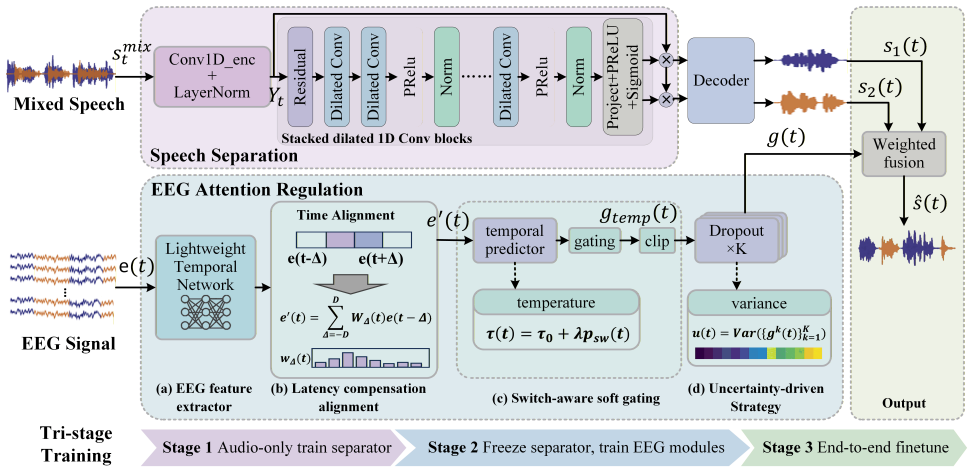
Central claim: in-trial attention switching should be treated as dynamic selection, not as a sequence of fixed references. SAGE separates the mixture into two candidate streams and fuses them with an EEG-driven soft gate ŝ(t)=g(t)·s1(t)+(1−g(t))·s2(t). The gate is switch-aware: a predicted switch probability raises sigmoid temperature and triggers local diffusion near switch centers, keeping transitions smooth; a differentiable module realigns EEG to true switch times; and Monte-Carlo dropout variance damps sharp decisions when EEG is unreliable. On an 18-participant spontaneous-switching dataset, SAGE reports 8.67 dB SI-SDR, 88.24% STOI and 2.04 s average switching latency, beating four bas
What carries the argument
The load-bearing object is the switch-aware soft gate g(t): a temperature-scaled sigmoid of an EEG-derived attention logit, σ(α(t)/τ(t)), whose temperature τ(t)=τ0+λ·psw(t) rises with predicted switch probability, followed by a learnable-width diffusion kernel near detected switch centers, so the fusion weight glides instead of jumping. It operates on two candidate streams from a Conv-TasNet-style separator, fusing them via ŝ(t)=g(t)s1(t)+(1−g(t))s2(t). Two supporting mechanisms drive it: a differentiable alignment module that resamples EEG over a bounded shift window to compensate neural latency, and an uncertainty estimate u(t)=Var{g(k)(t)} from K Monte-Carlo dropout passes that weights a
Load-bearing premise
The headline numbers assume all four baselines were evaluated on the same switching protocol with identical definitions of switch-detection accuracy and average switching latency, and were given a fair chance to adapt to in-trial switching; the paper does not say how the baselines were adapted or how the switch metrics are computed.
What would settle it
Run SAGE and the four baselines on a second, independently collected spontaneous-switching dataset under one shared protocol, with identical switch labels, identical ASL/ACC definitions, and baselines retrained with switch information. The advantage dissolves if the SI-SDR and ASL margins shrink to noise, or if a baseline retrained with switch information matches SAGE. A component-level check of the same claim: measure leakage of the non-target stream in a 200 ms window around true switch times; if soft gating removes no measurable transition artifact versus hard switching, the core mechanism
If this is right
- If the reported numbers hold, EEG-guided extraction no longer needs the static-attention assumption; spontaneous switches become a first-class part of the model.
- Soft gating replaces hard switching, which directly targets the audible discontinuities that fixed-reference extractors produce at switch points.
- The ablation's latency numbers (2.04 s full vs 2.58 s without alignment) imply that compensating neural delay buys more switch responsiveness than better decoding alone would.
- The complementary ablation pattern, with each removal costing more than 0.5 dB SI-SDR and several points of switch-detection accuracy, implies all three mechanisms are needed for the full gain.
- Latency compensation and uncertainty damping apply during steady listening too, so the framework's robustness benefits are not limited to the switch moments themselves.
Where Pith is reading between the lines
- The separate-then-blend recipe is not EEG-specific: any reference signal that tracks attention with noise and lag (eye gaze, pupillometry, MEG) could drive the same soft gate, provided the alignment and uncertainty modules are re-fit to that signal's delay statistics.
- Since the switch ground truth here comes from button presses, a natural deployment variant feeds button presses in as an auxiliary input and lets EEG govern the gate between presses; the paper does not test this.
- The learned temporal shifts could be compared against physiological estimates of auditory cortical latency (roughly 100–200 ms) to check whether the alignment module is compensating real neural delay or merely absorbing label noise; this test is not in the paper.
Editorial analysis
A structured set of objections, weighed in public.
Referee Report
Summary. The paper proposes SAGE, a switch-aware EEG-guided soft gating framework for target speaker extraction under in-trial auditory attention switching. The architecture combines a Conv-TasNet-style dual-stream separator with an EEG-driven gating module that produces a smooth fusion weight g(t) using temperature scaling based on a predicted switch probability p_sw(t), a latency-compensated alignment module, and an uncertainty-driven smoothness regularizer. The model is trained with a combination of SI-SDR loss, a switch-aware total-variation loss, and an uncertainty-weighted smoothness loss. Experiments on a custom spontaneous attention-switching EEG dataset report SI-SDR of 8.67 dB, STOI of 88.24%, average switching latency of 2.04 s, and switch detection accuracy of 78.02%, outperforming four baselines. Ablations indicate each module contributes positively.
Significance. If the reported numbers are taken at face value, SAGE would be a meaningful advance: it directly addresses in-trial attention switching, a realistic but under-studied scenario in EEG-guided target speaker extraction, and it demonstrates that a soft gating mechanism can track spontaneous switches while preserving speech quality. The use of SI-SDR and STOI against clean acoustic references is an external objective, and the dataset is released with a DOI, which are strengths. The tri-stage training and ablations also provide useful engineering insight. However, the central comparative claims currently rest on an evaluation protocol that is not specified: the headline metrics ACC and ASL are never defined, baseline adaptation to switching is not described, and the supervision of the switch probability p_sw is unexplained. These gaps make the headline results unverifiable as presented and must be addressed before the claims can be accepted.
major comments (4)
- [Section 3.2, Tables 1 and 2] ACC and ASL are listed in Section 3.2 as reported metrics but are never operationally defined. ASL appears in the abstract and Table 1 as a headline result, and ACC is the central metric in Table 2, yet there is no description of the switch-detection tolerance, how a continuous gating signal g(t) is converted into a detected switch point, or what reference event (button press, audio energy change, or annotated label) is used. Without these definitions, the values 2.04 s and 78.02% are not interpretable and the comparison between models is not reproducible.
- [Section 4.1, Table 1] The baseline comparison does not state how BASEN [25], NeuroHeed [14], NeuroSpex+ [26], and M3ANet [27] were adapted to the in-trial switching setting. These methods were designed for static attention with fixed references; if they were run without switch-aware mechanisms, the SI-SDR/STOI gaps are unsurprising. More critically, ASL for a baseline is undefined unless the baseline produces a gating signal or switch decision comparable to SAGE's p_sw. If ASL is instead computed from energy transitions in the extracted audio, the comparison is not like-for-like with SAGE's p_sw-derived latency. The paper must report the exact protocol per baseline, including any retraining or modification for switching.
- [Section 2.4, Eq. (9); Section 4.2, Table 2] The switch probability p_sw(t) is used to modulate temperature (Eq. 3), the TV-sw loss (Eq. 8), and to obtain switching centers for smoothing (Sec. 2.2), but the training objective in Eq. (9) contains no explicit supervision term for p_sw. The loss is a combination of negative SI-SDR, L_tv-sw, and L_smooth only. Table 2 reports a switch detection accuracy of 78.02%, which implies that ground-truth switch labels exist and are used in some way, but the paper never describes how p_sw is trained or how ACC is derived. Without a switch-label loss, p_sw is an unsupervised side output and the ACC value is not interpretable. Please add the p_sw supervision term (e.g., a cross-entropy or regression loss against switch labels) to Eq. (9) and describe the labeling procedure.
- [Section 4.1, Tables 1-2, Figure 2] No error bars or statistical tests are reported for SI-SDR, STOI, ASL, or ACC. Figure 2 includes 'p-value<0.001' but no test is described, and Table 1 reports single point estimates. Given the known inter-subject variability in EEG-based speech processing, the differences between SAGE and baselines (e.g., 1.54 dB over M3ANet) could be within subject-level variance. Report mean ± standard deviation across subjects or trials and specify the paired significance test used.
minor comments (5)
- [Section 2.3] Typo: 'Therefore, We also incorporate' should be 'Therefore, we also incorporate'. Also in Eq. (8), the notation p_sw(t) is written as 'psw(t)' in the text; unify the subscript style.
- [Section 3.1] Please provide basic dataset statistics: number of trials, number of switch events per trial, trial duration, and the distribution of switch counts across subjects. This context is needed to interpret ASL and ACC, and to understand the difficulty of the switching task.
- [Section 2.3 and 3.2] The number of MC-dropout passes K used in Eq. (6) is not reported. Include the K value used at inference and state whether dropout is enabled only in the EEG-related subnetworks or also in the separator.
- [Section 2.2] The thresholding procedure for detecting switching centers t_0 from p_sw(t) is not described. Specify the threshold criterion and peak-picking rule, as this directly affects the gating smoothing and the ASL metric.
- [Section 1 and introduction] Reference [18] (Wang et al., ICASSP 2026) appears closely related to this work; the distinction between SAGE and [18] (which combines EEG and eye-tracking) should be explicitly stated in the related-work discussion.
Circularity Check
No circular derivation: SAGE's results are empirical and grounded in external acoustic objectives; undefined metrics are a transparency issue, not circularity.
full rationale
SAGE's contribution is empirical; there is no chain of analytic derivation that could collapse into its inputs. The gating signal g(t) is trained by minimizing -SI-SDR (Eq. 9) against the clean target waveform, an external ground truth, plus smoothness regularizers; no reported metric (ACC, ASL) appears as a training loss, so the headline numbers are not fitted parameters renamed as predictions. The only self-citations are to the authors' own dataset [24] and prior EEG-TSE papers [13,18]; the dataset is released with a DOI and is externally checkable, and the prior papers are context, not load-bearing justification. The undefined ACC/ASL operationalizations and undisclosed baseline adaptations are protocol-transparency issues that affect verifiability, but they do not make any equation equal to its input by construction. Hence no circularity.
Axiom & Free-Parameter Ledger
free parameters (6)
- tau_0 (base temperature)
- lambda (temperature modulation strength)
- beta (TV-sw relaxation)
- gamma_1, gamma_2 (loss weights)
- D (max temporal shift window)
- K (MC-dropout passes)
axioms (4)
- domain assumption The 128 Hz, 64-channel EEG synchronized to the audio timeline carries decodable, time-varying attention evidence sufficient to track in-trial switches.
- domain assumption The button-press event marks the true attention-switch time for computing ASL.
- standard math MC-dropout with K forward passes yields a usable estimate of gating uncertainty u(t).
- standard math SI-SDR is a valid objective and evaluation metric for target speaker extraction.
Cite this review
Pith. "Pith review of SAGE: Switch-Aware EEG-Guided Soft Gating for Target Speaker Extraction with In-Trial Switching." pith.science (2026). https://pith.science/paper/A7PIU7AM
@misc{pith2026260801623,
  author       = {Pith},
  title        = {Pith review of: SAGE: Switch-Aware EEG-Guided Soft Gating for Target Speaker Extraction with In-Trial Switching},
  year         = {2026},
  howpublished = {\url{https://pith.science/paper/A7PIU7AM}},
  note         = {Machine review of arXiv:2608.01623}
}
read the original abstract
EEG-guided target speaker extraction is challenging under in-trial auditory attention switching, where neural noise and intrinsic latency can delay or destabilize attention tracking. Conventional methods struggle with dynamic switches and often cause discontinuities at switching points. Therefore, we propose SAGE, a switch-aware EEG-guided soft gating framework that treats in-trial switching as dynamic selection. SAGE generates two candidate speech streams with a robust separator and uses an EEG-guided switch-aware gating module to produce smooth fusion weights and suppress transition artifacts. We further integrate latency-compensated alignment and an uncertainty-driven conservative strategy to handle latency discrepancies and fluctuating EEG reliability. SAGE outperforms baselines, achieving 8.67 dB SI-SDR and 88.24% STOI while reducing average switching latency to 2.04 s. By coupling neural decoding with speech separation, it enables robust target extraction in dynamic scenarios.
Figures

Reference graph
Works this paper leans on
-
[1]
SAGE: Switch-Aware EEG-Guided Soft Gating for Target Speaker Extraction with In-Trial Switching
Introduction The cocktail party problem [1] describes the remarkable human ability to focus on a target talker in complex multi-speaker en- vironments through selective auditory attention. Target speaker extraction (TSE) aims to address this challenge by leveraging auxiliary cues to separate the attended speech signal from a mix- ture. Electroencephalogra...
work page internal anchor Pith review Pith/arXiv arXiv 2026
-
[2]
Method In this section, we propose a novel dynamic target speaker ex- traction method based on EEG signals, designed to overcome the limitations of traditional speech separation methods in han- dling in-trial target speaker switching. 2.1. Architecture As shown in Fig. 1, the overall framework consists of two main parts: speech separation and EEG attentio...
-
[3]
Experiments 3.1. Dataset In this study, we use a custom-built dataset for spontaneous auditory attention switching based on electroencephalogram (EEG) signals [24]. The experimental procedures have been approved by the Ethical Review Board of Southern University of Science and Technology (Approval No. 2022DZX003). The participants consisted of 18 healthy ...
-
[4]
Results and Discussion 4.1. Comparison with Baseline Methods To evaluate our EEG-based target speaker extraction approach, we compared it with several baseline models. As shown in Ta- ble 1, our method, SAGE, outperformed all baselines across all metrics on the spontaneous attention-switching dataset. SAGE achieved 8.67 dB in SI-SDR, surpassing BASEN (4.0...
-
[5]
Conclusion In this work, we propose SAGE, a switch-aware EEG-guided soft gating framework designed for dynamic target speaker ex- traction under in-trial attention switching in multi-speaker en- vironments. SAGE combines a dual-stream speech separator with a switch-aware soft gating module, leveraging adaptive temperature scaling to suppress artifacts and...
-
[6]
Acknowledgments This work was supported by the National Key Research and Development Program of China (2025YFF0518003, 2023YFF1203502), the National Natural Science Foundation of China (62371217), and the Center for Computational Science and Engineering at Southern University of Science and Tech- nology
-
[7]
Generative AI Use Disclosure All (co-)authors are responsible and accountable for the work and content of the paper, and consent to its submission. Gener- ative AI tools were used for editing and polishing manuscripts, but were not used for producing a significant part of the manuscript
-
[8]
The cocktail party problem. neural com- putation,
S. Haykin and Z. Chen, “The cocktail party problem. neural com- putation,”Neural Computation, vol. 17, no. 9, pp. 1875–1902, 2005
work page 1902
-
[9]
B. Mirkovic, S. Debener, M. Jaeger, and M. De V os, “Decoding the attended speech stream with multi-channel EEG: implications for online, daily-life applications,”Journal of Neural Engineer- ing, vol. 12, no. 4, p. 046007, 2016
work page 2016
-
[10]
Neural tracking to go: auditory attention decoding and saliency detection with mobile EEG,
L. Straetmans, B. Holtze, S. Debener, M. Jaeger, and B. Mirkovic, “Neural tracking to go: auditory attention decoding and saliency detection with mobile EEG,”Journal of Neural Engineering, vol. 18, no. 6, p. 066054, 2021
work page 2021
-
[11]
Single channel target speaker extraction and recog- nition with speaker beam,
M. Delcroix, K. Zmolikova, K. Kinoshita, A. Ogawa, and T. Nakatani, “Single channel target speaker extraction and recog- nition with speaker beam,” inProceedings of the Interna- tional Conference on Acoustics, Speech and Signal Processing (ICASSP), 2018, pp. 5554–5558
work page 2018
-
[12]
L-spex: Localized target speaker extraction,
M. Ge, C. Xu, L. Wang, E. Chng, J. Dang, and H. Li, “L-spex: Localized target speaker extraction,” inProceedings of the Inter- national Conference on Acoustics, Speech and Signal Processing (ICASSP), 2022, pp. 7287–7291
work page 2022
-
[13]
Spex: Multi-scale time domain speaker extraction network,
C. Xu, W. Rao, E. Chng, and H. Li, “Spex: Multi-scale time domain speaker extraction network,”IEEE/ACM Transactions on Audio, Speech, and Language Processing, vol. 18, pp. 1370–1384, 2020
work page 2020
-
[14]
Conv-tasnet: Surpassing ideal time–frequency magnitude masking for speech separation,
Y . Luo and N. Mesgarani, “Conv-tasnet: Surpassing ideal time–frequency magnitude masking for speech separation,” IEEE/ACM Transactions on Audio, Speech, and Language Pro- cessing, vol. 27, no. 8, pp. 1256–1266, 2019
work page 2019
-
[15]
Speaker-aware target speaker enhancement by jointly learning with speaker embedding extraction,
X. Ji, M. Yu, C. Zhang, D. Su, T. Yu, X. Liu, and D. Yu, “Speaker-aware target speaker enhancement by jointly learning with speaker embedding extraction,” inProceedings of the Inter- national Conference on Acoustics, Speech and Signal Processing (ICASSP), 2020, pp. 7294–7298
work page 2020
-
[16]
Spex+: A complete time domain speaker extraction network,
M. Ge, C. Xu, L. Wang, E. Chng, J. Dang, and H. Li, “Spex+: A complete time domain speaker extraction network,” inProceed- ings of the Interspeech, 2020, pp. 1406–1410
work page 2020
-
[17]
Neural spatial filter: Target speaker speech separa- tion assisted with directional information,
R. Gu, L. Chen, S. Zhang, J. Zheng, Y . Xu, M. Yu, D. Su, Y . Zou, and D. Yu, “Neural spatial filter: Target speaker speech separa- tion assisted with directional information,” inProceedings of the Interspeech, 2019, pp. 4290–4294
work page 2019
-
[18]
K. Ito, M. Yamamoto, and K. Nagamatsu, “Audio-visual speech enhancement method conditioned in the lip motion and speaker- discriminative embeddings,” inProceedings of the Interna- tional Conference on Acoustics, Speech and Signal Processing (ICASSP), 2021, pp. 6668–6672
work page 2021
-
[19]
End-to-end brain-driven speech enhancement in multi-talker conditions,
M. Hosseini, L. Celotti, and E. Plourde, “End-to-end brain-driven speech enhancement in multi-talker conditions,”IEEE/ACM Transactions on Audio, Speech, and Language Processing, vol. 30, pp. 1718–1733, 2022
work page 2022
-
[20]
X. Wang, Y . Ding, L. Wang, and F. Chen, “Smr-awarenet: an adaptive smr-aware neural network for EEG auditory attention guided target speech extraction,” inProceedings of the Interna- tional Conference on Acoustics, Speech and Signal Processing (ICASSP), 2025, pp. 1–5
work page 2025
-
[21]
NeuroHeed+: Improving neuro-steered speaker extraction with joint auditory attention detection,
Z. Pan, G. Wichern, F. G. Germain, S. Khurana, and J. Le Roux, “NeuroHeed+: Improving neuro-steered speaker extraction with joint auditory attention detection,” inProceedings of the Inter- national Conference on Acoustics, Speech and Signal Processing (ICASSP), 2024, pp. 11 456–11 460
work page 2024
-
[22]
DGSD: Dynamical graph self-distillation for EEG-based auditory spatial attention detection,
C. Fan, H. Zhang, W. Huang, J. Xue, J. Tao, J. Yi, Z. Lv, and X. Wu, “DGSD: Dynamical graph self-distillation for EEG-based auditory spatial attention detection,”Neural Networks, vol. 1, no. 179, p. 106580, 2024
work page 2024
-
[23]
Toward decoding selective attention from single-trial EEG data in cochlear implant users,
W. Nogueira, G. Cosatti, I. Schierholz, M. Egger, B. Mirkovic, and A. B ¨uchner, “Toward decoding selective attention from single-trial EEG data in cochlear implant users,”IEEE Transac- tions on Biomedical Engineering, vol. 67, no. 1, pp. 38–49, 2019
work page 2019
-
[24]
At- tentional selection in a cocktail party environment can be decoded from single-trial EEG,
J. O’sullivan, A. Power, N. Mesgarani, S. Rajaram, J. Foxe, B. Shinn-Cunningham, M. Slaney, S. Shamma, and E. Lalor, “At- tentional selection in a cocktail party environment can be decoded from single-trial EEG,”Cerebral Cortex, vol. 25, no. 7, pp. 1697– 1706, 2015
work page 2015
-
[25]
Eeg and eye-tracking driven dynamic target speaker extraction with spontaneous attention switching,
X. Wang, X. Chen, Y . Ding, Y . Ban, S. Yu, Y . Tsao, and F. Chen, “Eeg and eye-tracking driven dynamic target speaker extraction with spontaneous attention switching,” inProceedings of the In- ternational Conference on Acoustics, Speech and Signal Process- ing (ICASSP), 2026, pp. 6651–6655
work page 2026
-
[26]
EEG-based auditory attention detection and its possible future applications for passive BCI,
J. Belo, M. Clerc, and D. Sch ¨on, “EEG-based auditory attention detection and its possible future applications for passive BCI,” Frontiers in Computer Science, vol. 3, p. 661178, 2021
work page 2021
-
[27]
Electroencephalography-based auditory attention decoding: To- ward neurosteered hearing devices,
S. Geirnaert, S. Vandecappelle, E. Alickovic, A. De Cheveigne, E. Lalor, B. Meyer, S. Miran, T. Francart, and A. Bertrand, “Electroencephalography-based auditory attention decoding: To- ward neurosteered hearing devices,”IEEE Signal Processing Magazine, vol. 38, no. 4, pp. 89–102, 2021
work page 2021
-
[28]
J. O’Sullivan, Z. Chen, J. Herrero, G. McKhann, S. Sheth, A. Mehta, and N. Mesgarani, “Neural decoding of attentional selection in multi-speaker environments without access to clean sources,”Journal of Neural Engineering, vol. 14, no. 5, p. 056001, 2017
work page 2017
-
[29]
Noise-robust cortical tracking of attended speech in real-world acoustic scenes,
S. Fuglsang, T. Dau, and J. Hjortkjær, “Noise-robust cortical tracking of attended speech in real-world acoustic scenes,”Neu- roImage, vol. 156, pp. 435–444, 2017
work page 2017
-
[30]
Neural tracking of the speech envelope in cochlear implant users,
B. Somers, E. Verschueren, and T. Francart, “Neural tracking of the speech envelope in cochlear implant users,”Journal of Neural Engineering, vol. 16, no. 1, p. 016003, 2019
work page 2019
-
[31]
An open non- invasive eeg dataset for spontaneous auditory attention switch de- coding
X. Wang, Y . Ding, Y . Ban, L. Wang, and C. F., “An open non- invasive eeg dataset for spontaneous auditory attention switch de- coding.”Scientific Data, 2026
work page 2026
-
[32]
J. Zhang, Q. Xu, Q. Zhu, and Z. Ling, “BASEN: Time-domain brain-assisted speech enhancement network with convolutional cross attention in multi-talker conditions,” inProceedings of the Interspeech, 2023, pp. 3117–3121
work page 2023
-
[33]
D. De Silva, S. Cai, S. Pahuja, T. Schultz, and H. Li, “Neu- roSpex+: Dual-task training of neuro-guided speaker extraction with speech envelope and waveform,” inProceedings of the Inter- speech, 2025, pp. 5568–5572
work page 2025
-
[34]
C. Fan, Y . Chen, J. Zhou, Z. Pan, J. Zhang, Y . Gao, X. Yang, Z. Wen, and Z. Lv, “M3ANet: Multi-scale and multi-modal align- ment network for brain-assisted target speaker extraction,” inPro- ceedings of the International Joint Conference on Artificial Intel- ligence (IJCAI), 2025, pp. 8040–8048
work page 2025
discussion (0)
Sign in with ORCID, Apple, or X to comment. Anyone can read and Pith papers without signing in.