REVIEW 3 major objections 5 minor 88 references
A planetary-mass candidate imaged in the Young Suns Exoplanet Survey
T0 review · 3 major / 5 minor · reviewed 2026-08-15 · deepseek-v4-flash
Pith's one-line read This paper reports a candidate planetary-mass companion at 730 au from the young star 2M1006, whose motion matches the star's at the ~3σ level but whose bound nature cannot yet be confirmed because the host system's barycentre is unknown.
desk verdict Careful, honest wide-orbit candidate paper: the companion is real in H band and the astrometry is internally consistent, but the 3–5 M_J mass is conditional on an unproven age and an unsecured companionship link—still deserves a serious referee. read the letter →
The pith
A machine-rendered reading of the paper's core claim, the machinery that carries it, and where it could break.
The reading
What carries the argument
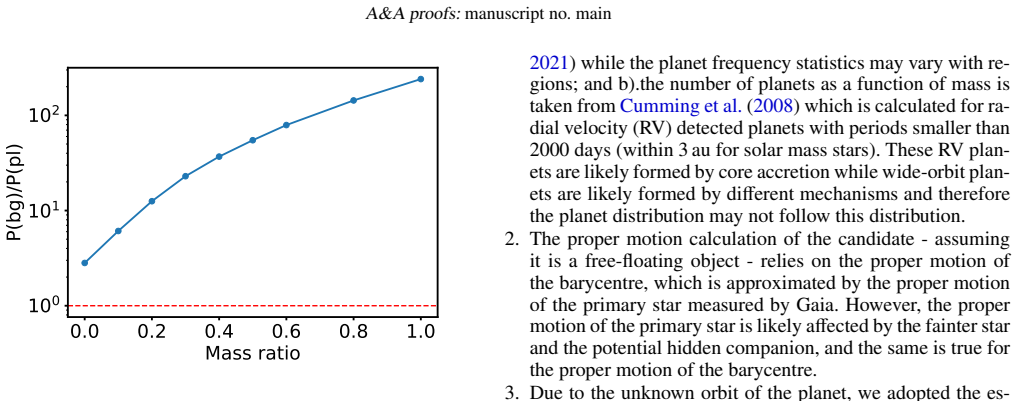
The load-bearing measurement is differential astrometry: PSF fitting of the faint source relative to the primary star in six epochs of SPHERE/IRDIS and MagAO-X images, which rejects a static background source by more than 3σ and yields proper motion consistent with the host. The companion hypothesis is converted into a mass with the ATMO2020 evolutionary model, which turns the candidate's H-band luminosity and assumed age into 3–5 Jupiter masses, while the odds of a background star versus a bound planet are assessed with a likelihood ratio that returns P(bg)/P(pl)=3–240 depending on the assumed mass ratio of the central binary. The unresolved complication is the barycentre: because the central star is probably a triple system, the reference frame for the common proper motion test is not yet known.
What would settle it
Measure the candidate's parallax or take a medium-resolution near-infrared spectrum: a bound companion at 136 pc would show a parallax of about 7.3 mas and planetary absorption features, while a background M dwarf would show a parallax near 0.2 mas, consistent with roughly 4.8 kpc, and stellar spectral bands. Alternatively, once the central binary orbit and the suspected third component fix the system's barycentre, re-test the candidate's motion relative to that barycentre; a deviation greater than about 3σ from comoving motion would rule out a bound companion.
Extended reading notes
Core claim
The central claim is the detection of a candidate companion with H=22.04±0.13 mag at a projected separation of 730±10 au from 2M1006, detected in the H band at signal-to-noise ratios above 5 and showing proper motion comparable to that of the primary star. On the paper's own terms this is a candidate, not a confirmed planet: the host is resolved as a G8–K0 primary plus an M dwarf, with strong circumstantial evidence for a third stellar component, and the unknown barycentre of that central system prevents a conventional common proper motion confirmation. If the candidate is bound, the paper estimates a mass of 3–5 Jupiter masses from the ATMO2020 evolutionary model, making it a low-mass, cool companion similar to 51 Eri b and AF Lep b, and one of the widest-orbit planets imaged to date.
Load-bearing premise
The argument that the candidate is a 3-5 Jupiter-mass planet rests on the assumption that it sits at the same distance (136 pc) and same age (19-28 Myr) as the primary star, with the ATMO2020 model converting its H-band brightness into mass; if the source is a background star or a free-floating object, that mass estimate is void.
Editorial extensions
If this is right
- If confirmed, the candidate would be one of the coolest directly imaged planets, comparable to 51 Eri b and AF Lep b.
- At 730 au it would join the small set of confirmed planets beyond 300 au, a regime where core-accretion timescales are problematic and where formation by gravitational instability, disk scattering, or capture of free-floating planets is usually invoked.
- The system would become an unusual laboratory: a young Sun-like star with a close binary, a suspected third component, and a wide planetary-mass candidate whose orbit would need to be solved against that multiple-star background.
- The candidate's faintness means only JWST-class spectroscopy can measure its atmosphere and decide between a clear-sky planet, a dusty brown dwarf, and a background M dwarf.
- The measured J2-J3 colour of 1.02±0.51 mag is too uncertain to discriminate between these possibilities, so deeper narrow-band photometry would be a cheaper next step.
Reading between the lines
- If confirmed, the candidate would add a data point in a largely unmeasured regime: planet occurrence beyond 300 au. Combining this detection with other direct-imaging surveys could begin to constrain whether the wide-orbit population is overabundant relative to core-accretion predictions.
- A testable extension the paper leaves implicit is that a single deep observation in adjacent narrow-band filters could distinguish a clear-atmosphere planet from a dusty brown dwarf more cheaply than a full spectrum, leveraging the predicted H2-H3 and J2-J3 colour differences.
- If the candidate turns out to be free-floating rather than bound, its measured proper motion is still interesting: measuring its parallax could place it in a nearby moving group and give a mass estimate independent of the host system.
- The suspected third star in the central system could be confirmed by high-cadence radial velocities of the primary; if the large H-alpha offset between the two visible stars is real, the wide candidate's companionship must be tested against a dynamically complex three-body reference frame.
Signed reviews
Editorial analysis
A structured set of objections, weighed in public.
Referee Report
Summary. This paper reports the detection of a candidate planetary-mass companion at a projected separation of 730±10 au from the young star 2M1006, based on six epochs of SPHERE and MagAO-X imaging between 2018 and 2024. The candidate is detected in the H band at S/N>5 in three epochs, with marginal detections in J2/J3 and non-detections in K bands. The relative astrometry is consistent with the primary's proper motion within roughly 1–2σ, but the primary is itself a likely triple system with an unknown barycentre, so the companionship cannot be confirmed. A Bayesian analysis in Sect. 5.1 gives P(bg)/P(pl)=3–240, preferring a background or free-floating interpretation. The paper estimates an age of 19–28 Myr for the primary and, if the candidate is a companion, a mass of 3–5 M_J and a separation of 730±10 au. The paper concludes with recommendations for future spectroscopic and astrometric follow-up.
Significance. The paper is a careful discovery paper for a candidate that, if confirmed, would be one of the widest-orbit planetary-mass companions known, with implications for gas giant formation. The analysis is thorough: it includes a detailed astrometric error budget, injection tests for the photometry and radial velocity measurements, a Bayesian comparison of background and planet scenarios, and an explicit statement of the limitations arising from the unknown barycentre of the central stellar system. The candidate status is clearly labelled, and the mass estimate is explicitly conditional on the assumption that the candidate is at the same distance and age as the primary. The paper is transparent about the statistical and systematic uncertainties, which makes it a useful contribution even though companionship is not established. The stress-test concern about the unsecured astrometric link is acknowledged directly in Sect. 4.2 and is not a fatal flaw; the paper does not overclaim confirmation.
major comments (3)
- [Abstract and Sect. 6] The abstract states that 'The planetary-mass candidate shows a significant proper motion comparable to that of the primary star,' and Sect. 6 states that it 'shares a common proper motion with the primary star.' These statements are in tension with the paper's own Bayesian analysis in Sect. 5.1, which yields P(bg)/P(pl)=3–240, and with Sect. 4.2, which states that companionship cannot be confirmed because the barycentre is unknown. The proper-motion consistency is not significant evidence of companionship; it is merely consistent within the uncertainties. Please revise the abstract and conclusion to reflect the statistical result, for example by stating that the candidate's proper motion is consistent with that of the primary within the uncertainties, but that a background or free-floating origin is currently preferred by a factor of 3–240.
- [Sects. 3.6 and 4.3] The mass estimate of 3–5 M_J presented in Sect. 4.3 is conditional on the adopted age of 19–28 Myr from Sect. 3.6. However, the age is not well constrained: the BAFFLES lithium age has a 95% confidence interval of 3–396 Myr (Sect. 3.6), the star is likely not a Sco-Cen member (Sect. 5.2), and the SED-derived luminosity may be biased by the suspected third stellar component (Sect. 3.5). Please provide the mass estimate for a wider range of ages (e.g., 10, 50, and 100 Myr) or explicitly state how the inferred mass would change, so that readers can assess the robustness of the planetary-mass interpretation.
- [Sect. 4.2] The astrometric evidence for common proper motion rests on only three epochs, two of which are nearly one year apart, so the parallax of the candidate is unconstrained (Fig. 10). This degeneracy means that the derived proper motion of the candidate is poorly determined. The text states that the positions 'match within 1σ,' but the relative motion between 2018 and 2023 has a magnitude of 20±14 mas, which is only marginally consistent with zero. Please add a quantitative statement of the significance of the common proper motion that explicitly accounts for the parallax uncertainty and the unknown barycentre of the central stars.
minor comments (5)
- [Sect. 2.2] The first sentence says 'The six-epoch observations were taken with the MagAO-X instrument,' but the MagAO-X data constitute only the final epoch. Please rephrase, e.g., 'The sixth-epoch observation was taken with the MagAO-X instrument.'
- [Sect. 3.5, item 3] The text reads 'The radius of the primary star from the SED fitting is too large if it has the same age as the primary star.' This should be 'The radius of the fainter star is too large if it has the same age as the primary star,' based on the preceding discussion.
- [Sect. 5.1] There is a typo: 'The colous of the candidate are compatible' should be 'The colours of the candidate are compatible.'
- [Sect. 5.1] The sentence 'If it is a free-floating object, it might be a planetary-mass object, a brown dwarf or a distant background star' is internally inconsistent, because a distant background star is not a free-floating object. Please rephrase to separate the free-floating and background hypotheses.
- [Fig. 9] The red arrow indicating the candidate's possible CMD position would be clearer if the blue and red colour limits were explicitly labelled on the plot, since the text refers to a 'blue limit' and a 'red limit.'
Circularity Check
Only mild circularity: the candidate's free-floating proper motion is fit using star A's proper motion, so the claimed agreement with A is partly built in; the paper flags this and does not use it to confirm companionship.
-
self definitional
[Section 5.1 (Bayesian background/planet comparison following Eq. 4; see also Section 4.2 astrometric analysis)]
"The relative measured projected velocity between the candidate and star A (from 2018 to 2023) is 4.8±3.8 mas yr−1 ... The proper motion calculation of the candidate - assuming it is a free-floating object - relies on the proper motion of the barycentre, which is approximated by the proper motion of the primary star measured by Gaia."
The candidate's 'free-floating' proper motion is not an independent absolute measurement: it is constructed from star A's Gaia proper motion plus the small measured relative drift between A and the candidate (4.8±3.8 mas yr−1). The paper then states that 'the primary star is within the 2σ range of the candidate' and uses this agreement as evidence against a background origin. That agreement is arithmetically forced by the construction: fitting PM_candidate ≈ PM_A + (small relative drift) guarantees PM_candidate ≈ PM_A at the ~1–2σ level. The comparison with background stars likewise inherits A's PM anomaly rather than independently measuring the candidate's motion.
full rationale
The central detection is an observational result: H=22.04±0.13 mag and a 730±10 au projected separation from aperture/PSF photometry and 2D-Gaussian astrometry, with injection tests for the uncertainties. The age (19–28 Myr) and distance (136 pc) come from Gaia parallax, SED fitting, and BT-Settl isochrones, which are external and not fitted to the candidate. The conditional 3–5 M_J mass estimate uses the external ATMO2020 evolutionary model under stated assumptions and is explicitly conditional on companionship. The paper does not invoke a load-bearing self-citation chain; citations to earlier YSES work are survey context, and the ATMO/BT-Settl/Besançon/orbitize references are external benchmarks. The one mild circularity is the proper-motion comparison described above: the candidate's free-floating PM is fit using star A's PM, so the subsequent agreement with A is partly by construction. However, the paper acknowledges this limitation, explicitly states that companionship cannot be confirmed because the barycentre is unknown, and reports P(bg)/P(pl)=3–240. Thus the flagged step is acknowledged and not load-bearing for the final conditional claim, warranting a low score rather than a charge of substantive circularity.
Assumptions & free parameters
free parameters (4)
- Mass ratio of fainter star B to primary A =
0 to 1 (scanned)
- Planet occurrence rate for wide orbits =
5.7% (from Vigan et al. 2021)
- Mass power-law index =
-1.31 (from Cumming et al. 2008)
- Separation power-law index =
-0.61 (from Nielsen et al. 2017)
assumptions (3)
- domain assumption The candidate is at the same distance as the primary star (136 pc) when deriving absolute magnitude and mass.
- domain assumption The ATMO2020 evolutionary model with chemical equilibrium is valid for estimating the mass of a young planetary-mass object.
- domain assumption The astrometric calibration (pixel scale, true north, distortion) is correct to the quoted uncertainties.
Cite this review
Pith. "Pith review of A planetary-mass candidate imaged in the Young Suns Exoplanet Survey." pith.science (2026). https://pith.science/paper/A7W4JU3T
@misc{pith2026250513295,
  author       = {Pith},
  title        = {Pith review of: A planetary-mass candidate imaged in the Young Suns Exoplanet Survey},
  year         = {2026},
  howpublished = {\url{https://pith.science/paper/A7W4JU3T}},
  note         = {Machine review of arXiv:2505.13295}
}
abstract
Directly imaged exoplanets in wide orbits challenge current gas giant formation theories. They need to form quickly and acquire enough material before the disk dissipates, which cannot be accommodated by in-situ formation by core accretion. We search for wide separation ($>$ 100 au) planetary-mass companions with the Young Suns Exoplanet Survey (YSES). Here, we present a planetary-mass candidate companion discovered in the survey. We conducted follow-up observations of the candidate system after the first epoch observations and obtained six epochs of observations for this system between 2018 and 2024, and integral field spectroscopy of the stellar component. We report the detection of a candidate companion with H=22.04 $\pm$ 0.13 mag at a projected separation of 730 $\pm$ 10 au away from the primary star. High angular resolution imaging observations of the central star show it is a visual binary. Acceleration data, orbital fitting, spectral energy distribution fitting and radial velocity differences all suggest that there is at least one more unresolved low-mass stellar companion in this system. The planetary-mass candidate shows a significant proper motion comparable to that of the primary star. We estimate an age of 19-28 Myr for the primary star. We cannot confirm the companionship of the candidate due to the unknown barycentre of the stars. Long-term imaging and radial velocity monitoring of the central stars, along with spectroscopy of the candidate companion, are key to resolving the nature of this system. If confirmed, the candidate companion would have a mass of 3-5 Mj estimated with the ATMO evolutionary model. It would be another cold low-mass planet imaged similar to 51 Eri b and AF Lep b. Its extremely wide separation from the host star would challenge the formation theory of gas giant exoplanets.
Figures


Figures from the paper (8 more)


Reference graph
Works this paper leans on
-
[1]
, " * write output.state after.block = add.period write newline
ENTRY address archiveprefix author booktitle chapter edition editor howpublished institution eprint journal key month note number organization pages publisher school series title type volume year label extra.label sort.label short.list INTEGERS output.state before.all mid.sentence after.sentence after.block FUNCTION init.state.consts #0 'before.all := #1 ...
-
[2]
write newline
" write newline "" before.all 'output.state := FUNCTION n.dashify 't := "" t empty not t #1 #1 substring "-" = t #1 #2 substring "--" = not "--" * t #2 global.max substring 't := t #1 #1 substring "-" = "-" * t #2 global.max substring 't := while if t #1 #1 substring * t #2 global.max substring 't := if while FUNCTION word.in bbl.in " " * FUNCTION format....
-
[3]
Allard , F., Homeier , D., Freytag , B., Schaffenberger , W., & Rajpurohit , A. S. 2013, Memorie della Societa Astronomica Italiana Supplementi, 24, 128
2013
-
[4]
& Quanz , S
Amara , A. & Quanz , S. P. 2012, , 427, 948
2012
-
[5]
M., Sip o cz , B
Astropy Collaboration , Price-Whelan , A. M., Sip o cz , B. M., et al. 2018, , 156, 123
2018
-
[6]
P., Tollerud , E
Astropy Collaboration , Robitaille , T. P., Tollerud , E. J., et al. 2013, , 558, A33
2013
-
[7]
Bailer-Jones , C. A. L., Rybizki , J., Fouesneau , M., Demleitner , M., & Andrae , R. 2021, , 161, 147
2021
-
[8]
2015, , 577, A42
Baraffe , I., Homeier , D., Allard , F., & Chabrier , G. 2015, , 577, A42
2015
Show all 88 references
-
[9]
2020, , 496, 1922
Belokurov , V., Penoyre , Z., Oh , S., et al. 2020, , 496, 1922
2020
-
[10]
Best , W. M. J., Liu , M. C., Magnier , E. A., & Dupuy , T. J. 2020, , 159, 257
2020
-
[11]
Best , W. M. J., Magnier , E. A., Liu , M. C., et al. 2018, , 234, 1
2018
-
[12]
L., Vigan , A., Mouillet , D., et al
Beuzit , J. L., Vigan , A., Mouillet , D., et al. 2019, , 631, A155
2019
-
[13]
A., Grandjean , A., Messina , S., et al
Biller , B. A., Grandjean , A., Messina , S., et al. 2022, , 658, A145
2022
-
[14]
J., Angelo , I., et al
Blunt , S., Wang , J. J., Angelo , I., et al. 2020, , 159, 89
2020
-
[15]
J., Ginski , C., Kenworthy , M
Bohn , A. J., Ginski , C., Kenworthy , M. A., et al. 2021, , 648, A73
2021
-
[16]
J., Kenworthy , M
Bohn , A. J., Kenworthy , M. A., Ginski , C., et al. 2019, , 624, A87
2019
-
[17]
J., Kenworthy , M
Bohn , A. J., Kenworthy , M. A., Ginski , C., et al. 2020 a , , 492, 431
2020
-
[18]
J., Kenworthy , M
Bohn , A. J., Kenworthy , M. A., Ginski , C., et al. 2020 b , , 898, L16
2020
-
[19]
2022, , 513, 5588
Bonavita , M., Fontanive , C., Gratton , R., et al. 2022, , 513, 5588
2022
-
[20]
Boss , A. P. 1997, Science, 276, 1836
1997
-
[21]
P., Liu , M
Bowler , B. P., Liu , M. C., Mawet , D., et al. 2017, , 153, 18
2017
-
[22]
M., et al
Brandner , W., Zinnecker , H., Alcal \'a , J. M., et al. 2000, , 120, 950
2000
-
[23]
R., et al
Castro-Ginard , A., Penoyre , Z., Casey , A. R., et al. 2024, , 688, A1
2024
-
[24]
M., et al
Chauvin , G., Desidera , S., Lagrange , A. M., et al. 2017, , 605, L9
2017
-
[25]
M., Zuckerman , B., et al
Chauvin , G., Lagrange , A. M., Zuckerman , B., et al. 2005, , 438, L29
2005
-
[26]
M., Males, J
Close, L. M., Males, J. R., Durney, O., et al. 2018, in Adaptive Optics Systems VI, Vol. 10703, SPIE, 1227--1236
2018
-
[27]
P., Marcy , G
Cumming , A., Butler , R. P., Marcy , G. W., et al. 2008, , 120, 531
2008
-
[28]
A., Robin , A
Czekaj , M. A., Robin , A. C., Figueras , F., Luri , X., & Haywood , M. 2014, , 564, A102
2014
-
[29]
J., Nielsen , E
De Rosa , R. J., Nielsen , E. L., Wahhaj , Z., et al. 2023, , 672, A94
2023
-
[30]
T., Hoogerwerf , R., de Bruijne , J
de Zeeuw , P. T., Hoogerwerf , R., de Bruijne , J. H. J., Brown , A. G. A., & Blaauw , A. 1999, , 117, 354
1999
-
[31]
A., Wilson , E
Dickson-Vandervelde , D. A., Wilson , E. C., & Kastner , J. H. 2020, Research Notes of the American Astronomical Society, 4, 25
2020
-
[32]
E., Veras , D., Ford , E
Dodson-Robinson , S. E., Veras , D., Ford , E. B., & Beichman , C. A. 2009, , 707, 79
2009
-
[33]
2008, in Society of Photo-Optical Instrumentation Engineers (SPIE) Conference Series, Vol
Dohlen , K., Langlois , M., Saisse , M., et al. 2008, in Society of Photo-Optical Instrumentation Engineers (SPIE) Conference Series, Vol. 7014, Ground-based and Airborne Instrumentation for Astronomy II, ed. I. S. McLean & M. M. Casali , 70143L
2008
-
[34]
Dupuy , T. J. & Kraus , A. L. 2013, Science, 341, 1492
2013
-
[35]
Dupuy , T. J. & Liu , M. C. 2012, , 201, 19
2012
-
[36]
P., & Bridges , M
Feroz , F., Hobson , M. P., & Bridges , M. 2009, , 398, 1601
2009
-
[37]
2023, , 268, 4
Fetherolf , T., Pepper , J., Simpson , E., et al. 2023, , 268, 4
2023
-
[38]
2018, , 618, A138
Flasseur , O., Denis , L., Thi \'e baut , \'E ., & Langlois , M. 2018, , 618, A138
2018
-
[39]
W., Lang , D., & Goodman , J
Foreman-Mackey , D., Hogg , D. W., Lang , D., & Goodman , J. 2013, , 125, 306
2013
-
[40]
P., Zhou , Y., et al
Franson , K., Bowler , B. P., Zhou , Y., et al. 2023, , 950, L19
2023
-
[41]
N., Theissen , C
Gagn \'e , J., Allers , K. N., Theissen , C. A., et al. 2018, , 854, L27
2018
-
[42]
Gaia Collaboration , Brown , A. G. A., Vallenari , A., et al. 2021, , 649, A1
2021
-
[43]
2004, , 42, 549
Goldreich , P., Lithwick , Y., & Sari , R. 2004, , 42, 549
2004
-
[44]
Y., Males, J
Haffert, S. Y., Males, J. R., Close, L. M., et al. 2022, arXiv preprint arXiv:2208.02720
2022 arXiv
-
[45]
R., Millman, K
Harris, C. R., Millman, K. J., van der Walt, S. J., et al. 2020, Nature, 585, 357
2020
-
[46]
V., et al
H g , E., Fabricius , C., Makarov , V. V., et al. 2000, , 355, L27
2000
-
[47]
Hunter, J. D. 2007, Computing In Science & Engineering, 9, 90
2007
-
[48]
2021, , 600, 231
Janson , M., Gratton , R., Rodet , L., et al. 2021, , 600, 231
2021
-
[49]
2019, , 623, A72
Kervella , P., Arenou , F., Mignard , F., & Th \'e venin , F. 2019, , 623, A72
2019
-
[50]
2012, , 62, 67
Kiraga , M. 2012, , 62, 67
2012
-
[51]
& Johansen , A
Lambrechts , M. & Johansen , A. 2012, , 544, A32
2012
-
[52]
Lange, J. U. 2023, , 525, 3181
2023
-
[53]
2014, in Society of Photo-Optical Instrumentation Engineers (SPIE) Conference Series, Vol
Langlois , M., Vigan , A., Dohlen , K., et al. 2014, in Society of Photo-Optical Instrumentation Engineers (SPIE) Conference Series, Vol. 9147, Ground-based and Airborne Instrumentation for Astronomy V, ed. S. K. Ramsay , I. S. McLean , & H. Takami , 91479P
2014
-
[54]
Lightkurve Collaboration , Cardoso , J. V. d. M., Hedges , C., et al. 2018, Lightkurve: Kepler and TESS time series analysis in Python , Astrophysics Source Code Library
2018
-
[55]
C., Dupuy , T
Liu , M. C., Dupuy , T. J., & Allers , K. N. 2016, , 833, 96
2016
-
[56]
D., Pearce , L., Haffert , S
Long , J. D., Pearce , L., Haffert , S. Y., et al. 2025, , 169, 36
2025
-
[57]
Luhman , K. L. 2022, , 163, 24
2022
-
[58]
R., Barman , T., et al
Macintosh , B., Graham , J. R., Barman , T., et al. 2015, Science, 350, 64
2015
-
[59]
2021, Journal of Astronomical Telescopes, Instruments, and Systems, 7, 035004
Maire , A.-L., Langlois , M., Delorme , P., et al. 2021, Journal of Astronomical Telescopes, Instruments, and Systems, 7, 035004
2021
-
[60]
R., Close, L
Males, J. R., Close, L. M., Haffert, S., et al. 2022, in Adaptive Optics Systems VIII, Vol. 12185, SPIE, 61--70
2022
-
[61]
2006, , 641, 556
Marois , C., Lafreni \`e re , D., Doyon , R., Macintosh , B., & Nadeau , D. 2006, , 641, 556
2006
-
[62]
2023, , 672, A93
Mesa , D., Gratton , R., Kervella , P., et al. 2023, , 672, A93
2023
-
[63]
A., Metchev , S., Luhman , K
Miles-P \'a ez , P. A., Metchev , S., Luhman , K. L., Marengo , M., & Hulsebus , A. 2017, , 154, 262
2017
-
[64]
2014, , 787, 5
Naud , M.-E., Artigau , \'E ., Malo , L., et al. 2014, , 787, 5
2014
-
[65]
L., Rosa , R
Nielsen , E. L., Rosa , R. J. D., Rameau , J., et al. 2017, , 154, 218
2017
-
[66]
Pecaut , M. J. & Mamajek , E. E. 2013, , 208, 9
2013
-
[67]
Pecaut , M. J. & Mamajek , E. E. 2016, , 461, 794
2016
-
[68]
Perets , H. B. & Kouwenhoven , M. B. N. 2012, , 750, 83
2012
-
[69]
Perryman , M. A. C., Lindegren , L., Kovalevsky , J., et al. 1997, , 323, L49
1997
-
[70]
W., Tremblin , P., Baraffe , I., et al
Phillips , M. W., Tremblin , P., Baraffe , I., et al. 2020, , 637, A38
2020
-
[71]
B., Hubickyj , O., Bodenheimer , P., et al
Pollack , J. B., Hubickyj , O., Bodenheimer , P., et al. 1996, , 124, 62
1996
-
[72]
& Mamajek , E
Preibisch , T. & Mamajek , E. 2008, in Handbook of Star Forming Regions, Volume II, ed. B. Reipurth , Vol. 5 (CUP), 235
2008
-
[73]
E., Alves , J., et al
Ratzenb \"o ck , S., Gro schedl , J. E., Alves , J., et al. 2023, , 678, A71
2023
-
[74]
W., et al
Riello , M., De Angeli , F., Evans , D. W., et al. 2021, , 649, A3
2021
-
[75]
2017, , 603, A57
Samland , M., Molli \`e re , P., Bonnefoy , M., et al. 2017, , 603, A57
2017
-
[76]
F., Cutri , R
Skrutskie , M. F., Cutri , R. M., Stiening , R., et al. 2006, , 131, 1163
2006
-
[77]
2012, , 755, L28
Soummer , R., Pueyo , L., & Larkin , J. 2012, , 755, L28
2012
-
[78]
A., Nielsen , E
Stanford-Moore , S. A., Nielsen , E. L., De Rosa , R. J., Macintosh , B., & Czekala , I. 2020, , 898, 27
2020
-
[79]
P., Todorov , K
Stolker , T., Quanz , S. P., Todorov , K. O., et al. 2020, , 635, A182
2020
-
[80]
Torres , C. A. O., Quast , G. R., da Silva , L., et al. 2006, , 460, 695
2006
-
[81]
2021, , 651, A72
Vigan , A., Fontanive , C., Meyer , M., et al. 2021, , 651, A72
2021
-
[82]
2010, , 407, 71
Vigan , A., Moutou , C., Langlois , M., et al. 2010, , 407, 71
2010
-
[83]
E., et al
Virtanen , P., Gommers , R., Oliphant , T. E., et al. 2020, Nature Methods, 17, 261
2020
-
[84]
J., Crundall , T
Z erjal , M., Ireland , M. J., Crundall , T. D., Krumholz , M. R., & Rains , A. D. 2023, , 519, 3992
2023
-
[85]
L., Casey , A
Wallace , A. L., Casey , A. R., Brown , A. G. A., & Castro-Ginard , A. 2025, , 536, 2485
2025
-
[86]
2000, , 143, 9
Wenger , M., Ochsenbein , F., Egret , D., et al. 2000, , 143, 9
2000
-
[87]
2017, , 153, 166
Zacharias , N., Finch , C., & Frouard , J. 2017, , 153, 166
2017
-
[88]
C., Claytor , Z
Zhang , Z., Liu , M. C., Claytor , Z. R., et al. 2021, , 916, L11
2021
Reviewed August 15, 2026 · model on record in the stance chip above.
Discussion (0). Continue with ORCID to comment.