REVIEW 4 major objections 8 minor 58 references
Efficient Simulation of Fluid Flow and Transport in Heterogeneous Media Using Graphics Processing Units (GPUs)
T0 review · 4 major / 8 minor · reviewed 2026-08-14 · deepseek-v4-flash
Pith's one-line read The paper shows that a single GPU, running a mixed-precision conjugate-gradient solver, speeds up pore-network and random-resistor-network flow simulations by an order of magnitude or better across a range of correlated, anisotropic, and…
desk verdict Plausible order-of-magnitude GPU speed-up for pore-network solvers, but the mixed-precision accuracy is never validated, so the central claim is not yet proven. read the letter →
The pith
A machine-rendered reading of the paper's core claim, the machinery that carries it, and where it could break.
The reading
What carries the argument
The load-bearing object is a mixed-precision iterative-refinement conjugate-gradient (CG) solver implemented on one GPU. The method solves $G P = b$ by running CG iterations in fast single precision in an inner loop, then switching to double-precision iterations in an outer loop to polish the solution, which keeps accuracy while cutting memory traffic in half. Its efficiency comes from the sparse matrix-vector multiplication kernel, where consecutive rows of the conductance matrix reuse the same pressure values, so those values are cached in shared memory and partial dot products are reduced across thread blocks. On the CPU side, a parallel message-passing scheme generates the fractional Brownian motion fields that supply the correlated conductances, avoiding the memory bottleneck of sequential FBM generation.
What would settle it
Run the same near-percolation network, for instance 3.6 million nodes with a fraction of insulating bonds near 0.5, on the GPU mixed-precision solver and on a double-precision CPU solver, and compare the computed pressures or effective permeability; if the relative difference exceeds the outer-loop tolerance, the speed-up comparison is unfair.
Extended reading notes
Core claim
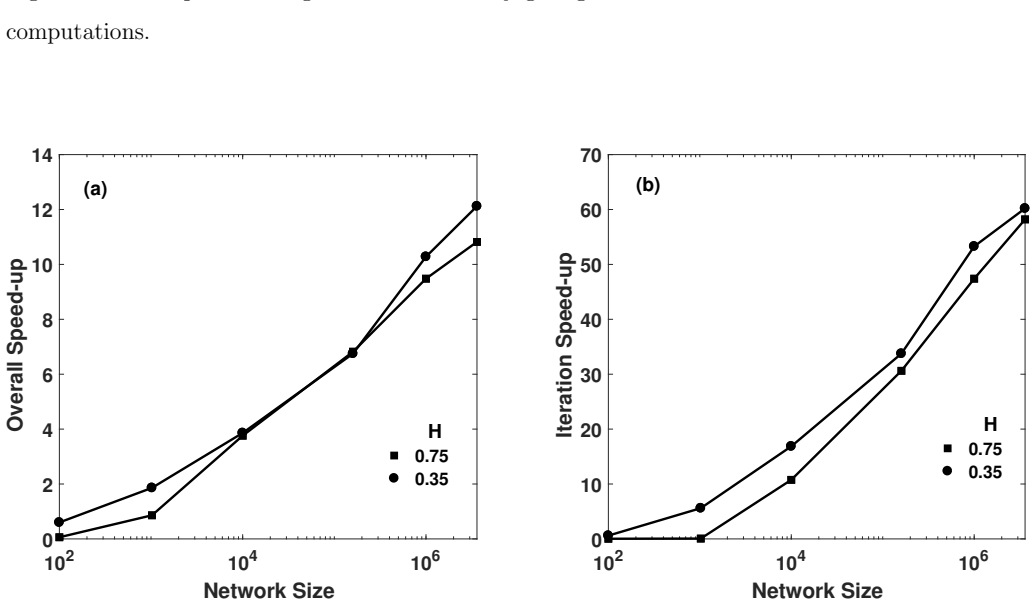
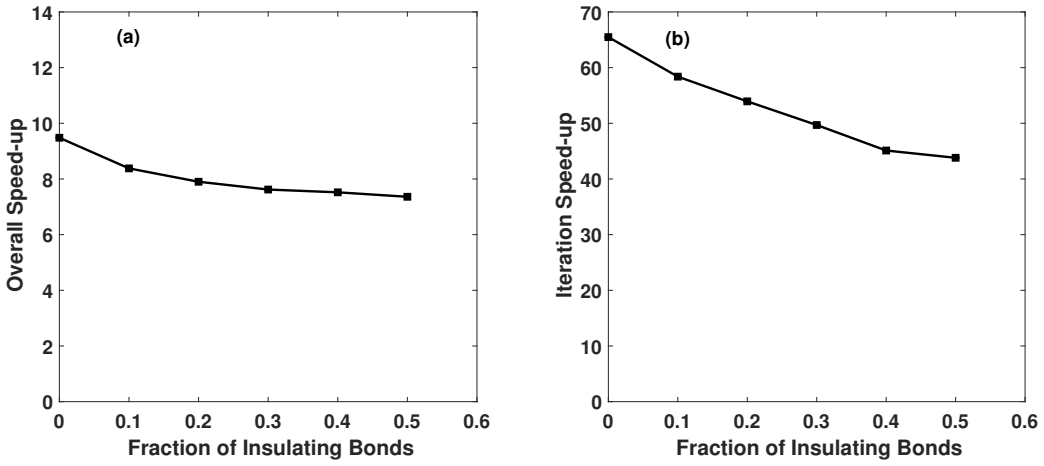
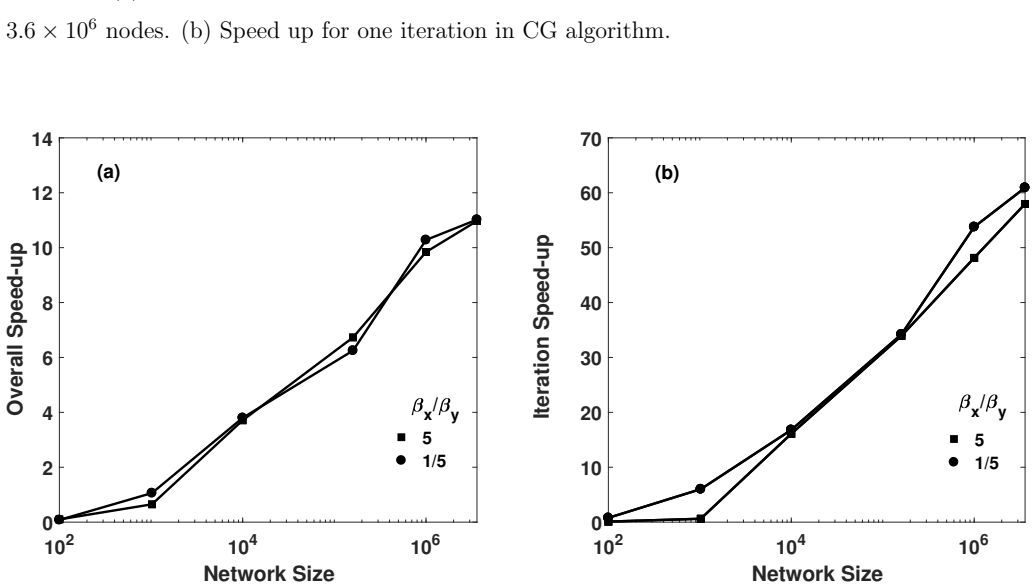
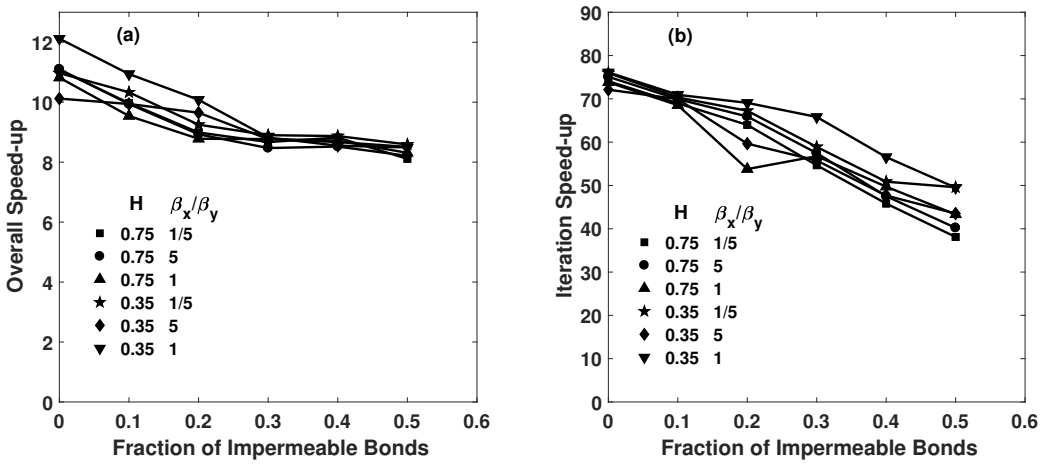
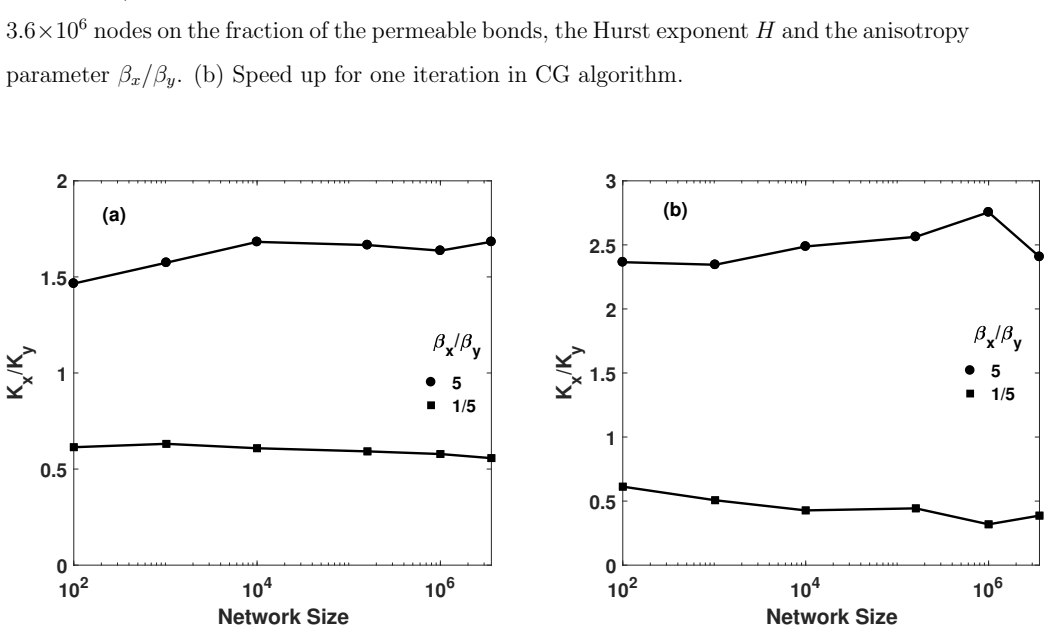
In the paper's own terms, the central discovery is a dual CPU+GPU computational strategy: the CPU (with message-passing parallel generation) builds large networks whose conductances follow a fractional Brownian motion with a generalized anisotropic power spectrum, and a single GPU solves the resulting sparse linear system $G P = b$ with a conjugate-gradient method that runs inner iterations in single precision and refines them with outer double-precision iterations. Across all tested cases---isotropic and anisotropic, correlated with Hurst exponents $H=0.75$ and $H=0.35$, and with up to $3.6\times10^6$ nodes and random or correlated percolation disorder---the overall speed-up is about one order of magnitude or better, and it increases with network size. Even as the fraction of insulating bonds approaches the percolation threshold, where the sample-spanning cluster becomes tortuous, the speed-up only drops by roughly 20 percent and stays near $7.5$--$10$. The same solver gives approximate bounds for the permeability anisotropy ratio $K_x/K_y$, finding values that depend on the Hurst exponent and the anisotropy parameter $\beta_x/\beta_y$.
Load-bearing premise
The speed-up is measured against a CPU solver, and the comparison is only meaningful if the mixed-precision GPU solver actually produces the same answer as the double-precision CPU solver within the same tolerance.
Editorial extensions
If this is right
- Pore-network simulations with several million nodes can be run on a single GPU workstation instead of a cluster.
- Denser matrices, such as those from three-dimensional networks or vector-transport models of fracture, should see even larger speed-ups because the GPU's advantage grows with matrix density.
- The speed-up near the percolation threshold means studies of critical behavior in disordered media can use larger lattices without losing the hardware benefit.
- The reported bounds on $K_x/K_y$ give a quick estimate of permeability anisotropy in stratified media from the Hurst exponent and anisotropy parameter.
- Because unsteady-state problems require many repeated solves, the per-solve speed-up compounds over thousands of time steps.
Reading between the lines
- A careful reader should verify the accuracy of the mixed-precision solver on their own ill-conditioned matrices; the paper does not report a validation against an independent double-precision reference for near-percolation networks.
- The approach likely transfers to other iterative solvers and to three-dimensional networks, but the speed-up ratio depends on the specific GPU/CPU hardware and on how much time the CPU spends generating the network.
- Moving the fractional Brownian motion generation onto the GPU as well could remove a remaining bottleneck and further increase the overall speed-up for very large arrays.
Signed reviews
Editorial analysis
A structured set of objections, weighed in public.
Referee Report
Summary. The paper presents a CPU+GPU approach for simulating flow and transport in pore-network (PN) and random-resistor-network (RRN) models, with the GPU used to accelerate a mixed-precision conjugate-gradient (CG) solver. The authors generate long-range correlated conductance fields using a spectral fractional Brownian motion (FBM) method parallelized with MPI, and they report speed-ups of about one order of magnitude or better for the overall simulation time compared with a sequential C++ CPU implementation. The studies include isotropic and anisotropic networks, networks with percolation disorder near the threshold, and estimates of the permeability anisotropy ratio Kx/Ky. The central claim is that a single GPU-based mixed-precision CG solver provides an order-of-magnitude speed-up for large PN/RRN simulations while maintaining accuracy.
Significance. If the central claim is correct, the paper would provide a practical and inexpensive way to simulate pore-network and random-resistor-network models with several million nodes on a single GPU, which is currently a computationally demanding task. The application to long-range correlated fields, anisotropic networks, and critical percolation disorder is relevant to porous media and composite materials. The paper also demonstrates an MPI-based FBM generator, which is useful in its own right. However, the reported speed-ups are not yet supported by a like-for-like accuracy comparison between the GPU mixed-precision solver and a double-precision CPU reference, and the absence of error bars and validation of secondary claims limits the strength of the conclusions.
major comments (4)
- [Section IV, Figs. 6-9] The central speed-up claim rests on the assumption that the GPU mixed-precision CG solver produces solutions with the same accuracy as the sequential double-precision CPU solver. The manuscript never reports the convergence tolerance, residual norms, or iteration counts for either solver, and it never validates the GPU solution against an independent double-precision reference or an analytical solution. This is particularly important near the percolation threshold (Figs. 7 and 9), where the conductance matrix is ill-conditioned and a single-precision inner loop in iterative refinement can stagnate when the condition number approaches 1/eps_single (~1e7). Without such a validation, the reported 'overall speed-up of about one order of magnitude' may partly reflect a looser stopping criterion on the GPU rather than genuine algorithmic acceleration.
- [Eq. (5), Section V, Figs. 6-9] The 'overall speed-up' as defined in Eq. (5) mixes two different parallelization gains: the MPI-based FBM generation on four CPU processes and the GPU-based CG solver. The text states that the parallel execution time is the sum of CPU generation and GPU solving, while the baseline is 'sequential PN generation and simulation algorithm in C++'. Therefore the abstract's claim that a 'single GPU-based solver' achieves the order-of-magnitude improvement is not directly supported by the overall speed-up figures. The iteration speed-up (panels (b) of Figures 6-9) is the relevant GPU-only metric, but it is not the metric cited in the abstract or summary.
- [Figure 6 caption, Figs. 6-10] The caption of Fig. 6 states that each data point represents the average of multiple realizations, but no error bars, standard deviations, or numbers of realizations are reported anywhere in the manuscript. Consequently, the claims that the Hurst exponent has only a minor effect on speed-up (Fig. 6), that the 20% speed-up drop near percolation is significant (Fig. 7), and that Kx/Ky varies with network size (Fig. 10) cannot be assessed quantitatively. The absence of variance estimates is a serious omission for a paper whose primary contribution is an empirical performance measurement.
- [Figure 10, Section VI B] The 'approximate but accurate bounds' for the permeability anisotropy ratio Kx/Ky are not validated against any independent reference, analytical solution, or literature data. The curves in Fig. 10 show a strong dependence on network size even at a fixed ratio beta_x/beta_y, and the term 'bounds' is never defined. Without a reference solution or at least a comparison with an established method, the accuracy claim for these anisotropy estimates is unsupported.
minor comments (8)
- [Section II] There are several typographical errors: 'fractional Browning motion' should be 'fractional Brownian motion', and 'intrtroduce' should be 'introduce'. In the Summary, 'simulatorss' should be 'simulators'. In Section IV, 'lunches' should be 'launches'.
- [Table 1] The 'Array Size' entries 224, 228, and 230 presumably mean 2^24, 2^28, and 2^30, but this notation is not defined. Please use superscripts or an explicit definition.
- [Figure 6] The horizontal axis label 'Network Size' is ambiguous. It should be stated whether this is the number of nodes (N^2) or the linear dimension N, and the corresponding values used in the text (e.g., 3.6x10^6 nodes) should be clearly connected to the axis scale.
- [Figures 8-10] The axis labels 'x/ y' appear to omit the beta symbol; they should read 'beta_x/beta_y' (or 'beta_x/beta_y') for readability.
- [Section V] Equation (6) defines the efficiency E(P) = S(P)/P using 'P processors', but in the parallel run, both CPUs and the GPU are used; the meaning of P in Eq. (6) and how the GPU is counted in P should be clarified, or the efficiency definition restricted to the MPI part only.
- [Section IV] The description of the first GPU kernel ('A 1D block of size 256 is used. For each part, the size of the network is set proportional to the total number of rows and blocksize') is unclear and would benefit from a more precise algorithmic pseudocode or a reference to a standard sparse matrix-vector multiplication layout.
- [Section VI B] The claim that 'with the exception of the wavelet coarsening method' all prior efficient methods work only near percolation is not central, but the sentence would benefit from citing the wavelet coarsening papers more precisely, since the reference list is somewhat crowded.
- [General] The manuscript does not mention the availability of the code or data. Given that the contribution is an implementation, providing the CUDA and C++ source code or a reproducibility statement would increase confidence in the results.
Circularity Check
No circularity: the speed-up is a measured timing ratio and Kx/Ky values are forward simulation outputs, not inverted parameters.
full rationale
The paper's central claim is an empirical performance comparison: speed-up S(P)=t(1,N)/t(P,N) is a measured ratio of runtimes, with no parameter fitted to the result it claims to predict. The permeability anisotropy values Kx/Ky in Fig. 10 are direct outputs of solving GP=b for networks generated with the stated spectrum; they are not obtained by fitting the model to the reported values. The anisotropic spectral form Eq. (2) is adopted from Ansari-Rad et al. [54] as an input model, not derived from the results, so citing it does not make the derivation circular even though one author overlaps. The only substantive weakness is that the mixed-precision GPU solver's accuracy is not independently validated against a double-precision reference, particularly near the percolation threshold; this is a correctness/verification concern, not circular reasoning. No equation in the paper is equivalent to another by construction, and no fitted input is renamed as a prediction.
Assumptions & free parameters
assumptions (3)
- standard math The power-spectrum method with S(ω) = a/(ω_x^2+ω_y^2)^(H+1) generates fractional Brownian motion fields correctly, and the anisotropic generalization Eq. (2) with βx and βy is valid.
- standard math The conjugate-gradient method with mixed-precision iterative refinement converges to the solution of the symmetric positive-definite system GP = b for the matrices considered, including ill-conditioned matrices near the percolation threshold.
- domain assumption The pore-network model with Hagen-Poiseuille conductance g_ij = π r^4/(8 μ ℓ) and mass balance at each node accurately describes steady single-phase flow in the simulated media.
Cite this review
Pith. "Pith review of Efficient Simulation of Fluid Flow and Transport in Heterogeneous Media Using Graphics Processing Units (GPUs)." pith.science (2026). https://pith.science/paper/A7XTQQGV
@misc{pith2026190803301,
  author       = {Pith},
  title        = {Pith review of: Efficient Simulation of Fluid Flow and Transport in Heterogeneous Media Using Graphics Processing Units (GPUs)},
  year         = {2026},
  howpublished = {\url{https://pith.science/paper/A7XTQQGV}},
  note         = {Machine review of arXiv:1908.03301}
}
abstract
Networks of interconnected resistors, springs and beams, or pores are standard models of studying scalar and vector transport processes in heterogeneous materials and media, such as fluid flow in porous media, and conduction, deformations, and electric and dielectric breakdown in heterogeneous solids. The computation time and required memory are two limiting factors that hinder the scalability of the computations to very large sizes. We present a dual approach, based on the use of a combination of the central processing units (CPUs) and graphics processing units (GPUs), to simulation of flow, transport, and similar problems using the network models. A mixed-precision algorithm, together with the conjugate-gradient method is implemented on a single GPU solver. The efficiency of the method is tested with a variety of cases, including pore- and random-resistor network models in which the conductances are long-range correlated, and also contain percolation disorder. Both isotropic and anisotropic networks are considered. To put the method to a stringent test, the long-range correlations are generated by a fractional Brownian motion (FBM), which we generate by a message-passing interface method. For all the cases studied an overall speed-up factor of about one order of magnitude or better is obtained, which increases with the size of the network. Even the critical slow-down in networks near the percolation threshold does not decrease the speed-up significantly. We also obtain approximate but accurate bounds for the permeability anisotropy $K_x/K_y$ for stratified porous media.
Figures
Figures from the paper (8 more)


Reference graph
Works this paper leans on
-
[1]
Torquato, Random Heterogeneous Materials (Springer, New York, 2002)
S. Torquato, Random Heterogeneous Materials (Springer, New York, 2002)
2002
-
[2]
Blunt, Multiphase Flow in Permeable Media (Cambridge University Press, London, 2017)
M.J. Blunt, Multiphase Flow in Permeable Media (Cambridge University Press, London, 2017)
work page 2017
-
[3]
Sahimi, Flow and Transport in Porous Media and Fractured Rock , 2nd ed
M. Sahimi, Flow and Transport in Porous Media and Fractured Rock , 2nd ed. (Wiley-VCH, Weinheim, Germany, 2011)
work page 2011
-
[4]
B. I. Shklovskii and A.L. Efros, Electronic Properties of Doped Semiconductors (Springer, Berlin, 1984)
work page 1984
-
[5]
Sahimi, Heterogeneous Materials I (Springer, New York, 2003)
M. Sahimi, Heterogeneous Materials I (Springer, New York, 2003)
work page 2003
-
[6]
B. K. Chakrabarti and L. Benguigui, Statistical Physics of Fracture and Breakdown in Disordered Systems (Oxford University Press, London, 1997)
work page 1997
-
[7]
Sahimi, Heterogeneous Materials II (Springer, New York, 2003)
M. Sahimi, Heterogeneous Materials II (Springer, New York, 2003)
work page 2003
-
[8]
Modelling Critical and Catastrophic Phenomena in Geoscience , edited by P. Bhat- tacharyya and B. K. Chakrabarti (Springer, Berlin, 2006)
work page 2006
Show all 58 references
-
[9]
Stauffer and A
D. Stauffer and A. Aharony, Introduction to Percolation Theory , 2nd ed. (Taylor and Francis, London, 1994)
1994
-
[10]
Sahimi, Applications of Percolation Theory (Taylor and Francis, London, 1994)
M. Sahimi, Applications of Percolation Theory (Taylor and Francis, London, 1994)
1994
-
[11]
J. Chu, B. Engquist, M. Prodanovic, and R. Tsai, A multiscale method coupling network and continuum models in porous media I: steady-state single phase flow, Multiscale Model. Simul. 10, 515 (2012)
2012
-
[12]
P.E. Øren, S. Bakke, and O.J. Arntzen, Extending predictive capabilities to network models, Soc. Pet. Eng. J. 3, 324 (1998)
1998
-
[13]
Ovaysi and M
S. Ovaysi and M. Piri, Direct pore-level modeling of incompressible fluid flow in porous media, J. Comput. Phys. 229, 7456 (2010)
2010
-
[14]
Piri and M.J
M. Piri and M.J. Blunt, Three-dimensional mixed-wet random pore-scale network modeling of two- and three-phase flow in porous media. I. Model description, Phys. Rev. E 71, 026301 (2005). 15
2005
-
[15]
Piri and M.J
M. Piri and M.J. Blunt, Three-dimensional mixed-wet random pore-scale network modeling of two- and three-phase flow in porous media. II. Results, Phys. Rev. E 71, 026302 (2005)
2005
-
[16]
Blunt, M.D
M.J. Blunt, M.D. Jackson, M. Piri, and P.H. Valvatne, Detailed physics, predictive capabilities and macroscopic consequences for pore-network models of multiphase flow, Adv. Water Resour. 25, 1069 (2002)
2002
-
[17]
Prat, Recent advances in pore-scale models for drying of porous media, Chem
M. Prat, Recent advances in pore-scale models for drying of porous media, Chem. Eng. J. 86, 153 (2002)
2002
-
[18]
Borgman, P
O. Borgman, P. Fantinel, W. Luhder, L. Goehring, and R. Holtzman, Impact of spatially correlated pore-scale heterogeneity on drying porous media, Water Resour. Res. 53, 56455658 (2017)
2017
-
[19]
Yiotis, D
A.G. Yiotis, D. Salin, and Y. C. Yortsos, Pore network modeling of drying pro- cesses in macroporous materials: Effects of gravity, mass boundary layer and pore microstructure, Transp. Porous Media 110, 175 (2015)
2015
-
[20]
Mehmani, T
Y. Mehmani, T. Sun, M.T. Balho, P. Eichhubl, and S. Bryant, Multiblock pore-scale modeling and upscaling of reactive transport: Application to carbon sequestration, Transp. Porous Media 95, 305 (2012)
2012
-
[21]
Nogues, J.P
J.P. Nogues, J.P. Fitts, M.A. Celia, and C.A. Peters, Permeability evolution due to dissolution and precipitation of carbonates using reactive transport modeling in pore networks, Water Resour. Res. 49, 6006 (2013)
2013
-
[22]
L. Li, C.A. Peters, and M.A. Celia, Upscaling geochemical reaction rates using pore-scale network modeling, Adv. Water Resour. 29, 1351 (2006)
2006
-
[23]
Dillard and M.J
L.A. Dillard and M.J. Blunt, Development of a pore network simulation model to study nonaqueous phase liquid dissolution, Water Resour. Res. 36, 439 (2000)
2000
-
[24]
Hekmatzadeh, M
M. Hekmatzadeh, M. Dadvar, and M. Sahimi, Pore-network simulation of unstable miscible displacements in porous media, Transp. Porous Media 113, 511 (2016). 16
2016
-
[25]
Ghanbarzadeh, M
S. Ghanbarzadeh, M. Prodanovic, and M. A. Hesse, Percolation and grain boundary wetting in anisotropic texturally equilibrated pore networks, Phys. Rev. Lett. 113, 048001 (2014)
2014
-
[26]
Tahmasebi, F
P. Tahmasebi, F. Javadpour, and M. Sahimi, Multiscale and multiresolution mod- eling of shales and their flow and morphological properties, Scientific Reports 5, 16373 (2015)
2015
-
[27]
Tahmasebi, M
P. Tahmasebi, M. Sahimi, A.H. Kohanpur, and A. Valocchi, Pore-scale simulation of flow of CO 2 and brine in reconstructed and actual 3D rock cores, J. Pet. Sci. Eng. 155, 21 (2017)
2017
-
[28]
Derrida and J
B. Derrida and J. Vannimenus, A transfer-matrix approach to random resistor net- works, J. Phys. A 15, L557 (1982)
1982
-
[29]
J. G. Zabolitzky, D. J. Bergman, and D. Stauffer, Precision calculation of elasticity for percolation, J. Stat. Phys. 44, 211 (1986)
1986
-
[30]
Normand and H.J
J.-M. Normand and H.J. Herrmann, Precise numerical determination of the super- conducting exponent of percolation in three dimensions, Int. J. Mod. Phys. C 1, 207 (1990)
1990
-
[31]
Mehrabi and M
A.R. Mehrabi and M. Sahimi, Coarsening of heterogeneous media: application of wavelets, Phys. Rev. Lett. 79, 4385 (1997)
1997
-
[32]
Ebrahimi and M
F. Ebrahimi and M. Sahimi, Multiresolution wavelet coarsening and analysis of transport in heterogeneous media, Physica A 316, 160 (2002)
2002
-
[33]
Sahimi, M
M. Sahimi, M. Naderian, and F. Ebrahimi, Efficient simulation of ac conduction in heterogeneous materials at low temperatures, Phys. Rev. B 71, 094208 (2005)
2005
-
[34]
Pazhoohesh, H
E. Pazhoohesh, H. Hamzehpour, and M. Sahimi, Numerical simulation of ac con- duction in three-dimensional heterogeneous materials, Phys. Rev. B 73, 174206 (2006)
2006
-
[35]
Aghaei and M
A. Aghaei and M. Piri, Direct pore-to-core up-scaling of displacement processes: Dynamic pore network modeling and experimentation, J. Hydrol. 522, 488 (2015). 17
2015
-
[36]
Jasti, G
J.K. Jasti, G. Jesion, and L. Feldkamp, Microscopic imaging of porous media with x-ray computed tomography, SPE Form. Eval. 8, 189 (1993)
1993
-
[37]
M. A. Knackstedt, A. P. Sheppard, and M. Sahimi, Pore network modeling of two- phase flow in porous rock: The effect of correlated heterogeneity, Adv. Water Resour. 24, 257 (2001)
2001
-
[38]
T. T. Tsotsis, H. Patel, B. F. Najafi, D. Racherla, M. A. Knackstedt, and M. Sahimi, An overview of laboratory and modeling studies of carbon dioxide sequestration in coalbeds, Ind. Eng. Chem. Res. 43, 2887 (2004)
2004
-
[39]
Nvidia Corporation, NVIDIA CUDA programming Guide, http://docs.nvidia.com/cuda/cuda- c-programming-guide/abstract
-
[40]
G. R. Markall, D. A. Ham, and P. H. J. Kelly, Generating optimised finite element solvers for GPU architectures, AIP Conference Proceedings 1281, 787 (2010)
2010
-
[41]
Tahmasebi, M
P. Tahmasebi, M. Sahimi, G. Mariethoz, and A. Hezarkhani, Accelerating geosta- tistical simulations using graphics processing units (GPU), Comput. Geosci. 46, 51 (2012)
2012
-
[42]
Markall, A
G.R. Markall, A. Slemmer, D.A. Ham, P. H. J. Kelly, C. D. Cantwell, and S. J. Sherwin, Finite element assembly strategies on multi- and many-core architectures, Int. J. Numer. Meth. Fluids 71, 8097 (2013)
2013
-
[43]
W. Liu, B. Schmidt, G. Voss, and W. Muller-Wittig, Accelerating molecular dy- namics simulations using graphics processing units with CUDA, Comput. Phys. Commun. 179, 634 (2008)
2008
-
[44]
Ufimtsev and T
I. Ufimtsev and T. J. Martinez, Quantum chemistry on graphical processing units. 3. Analytical energy gradients, geometry optimization, and first principles molecular dynamics, J. Chem. Theor. Comput. 5, 2619 (2009)
2009
-
[45]
Olivares-Amaya, M
R. Olivares-Amaya, M. A. Watson, R. G. Edgar, L. Vogt, Y. Shao, and A. Aspuru- Guzik, Accelerating correlated quantum chemistry calculations using graphical pro- 18 cessing units and a mixed precision matrix multiplication library, J. Chem. Theor. Comput. 6, 135 (2010)
2010
-
[46]
Zheng, X
M. Zheng, X. Li, and L. Guo, Algorithms of GPU-enabled reactive force field (ReaxFF) molecular dynamics, J. Mol. Graphics Model. 41, 1 (2013)
2013
-
[47]
Molz, H.H
F.J. Molz, H.H. Liu, and J. Szulga, Fractional Brownian motion and fractional Gaus- sian noise in subsurface hydrology: a review, presentation of fundamental properties, and extensions, Water Resour. Res. 33, 2273 (1997)
1997
-
[48]
Sahimi and S
M. Sahimi and S. Mukhopadhyay, Scaling properties of a percolation model with long-range correlations, Phys. Rev. E 54, 3870 (1996)
1996
-
[49]
Sahimi, Long-range correlated percolation and flow and transport in heteroge- neous porous media, J
M. Sahimi, Long-range correlated percolation and flow and transport in heteroge- neous porous media, J. de Physique I 4, 1263 (1994)
1994
-
[50]
Knackstedt, A.P
M.A. Knackstedt, A.P. Sheppard, and W.V. Pinczewski, Simulation of mercury porosimetry on correlated grids: evidence for extended correlated heterogeneity at the pore scale in rocks, Phys. Rev. E 58, R6923 (1998)
1998
-
[51]
Dashtian, G.R
H. Dashtian, G.R. Jafari, M. Sahimi, and M. Masihi, Scaling, multifractality, and long-range correlations in well log data of large-scale porous media, Physica A 390, 2096 (2011)
2011
-
[52]
Dashtian, Y
H. Dashtian, Y. Yang, and M. Sahimi, Nonuniversality of the Archie exponent due to multifractality of resistivity well logs, Geophys. Res. Lett. 42, 10655 (2015)
2015
-
[53]
Mandelbrot and J.W
B.B. Mandelbrot and J.W. van Ness, Fractional Brownian motion, fracrional Guas- sian noise, and their applications, SIAM Rev. 10, 422 (1968)
1968
-
[54]
Ansari-Rad, S.M
M. Ansari-Rad, S.M. Vaez Allaei, and M. Sahimi, Nonuniversality of roughness exponent of quasi-static fracture surfaces, Phys. Rev. E 85, 021121 (2012)
2012
-
[55]
Wilt, The CUDA Handbook: a Comprehensive Guide to GPU Programming (Addison-Wesley, New York, 2013)
N. Wilt, The CUDA Handbook: a Comprehensive Guide to GPU Programming (Addison-Wesley, New York, 2013)
2013
-
[56]
http://www.nvidia.com/object/nvidia-kepler.html 19
-
[57]
Barrett, M
R. Barrett, M. Berry, T.F. Chan, J. Demmel, J. Donato, J. Dongarra, V. Eijkhout, R. Pozo, C. Romine, and H. van der Vorst, Templates for the Solution of Lin- ear Systems: Building Blocks for Iterative Methods , 2nd ed. (SIAM, Philadelphia, 1994)
1994
-
[58]
Kirkpatrick, Percolation and conduction, Rev
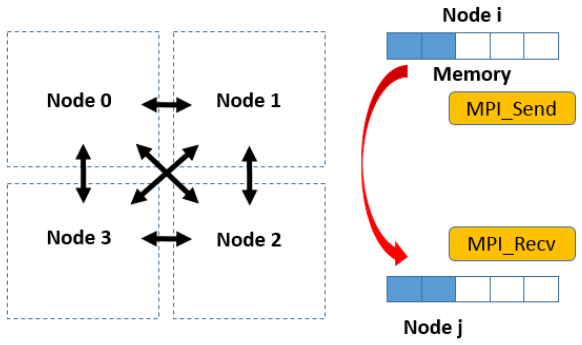
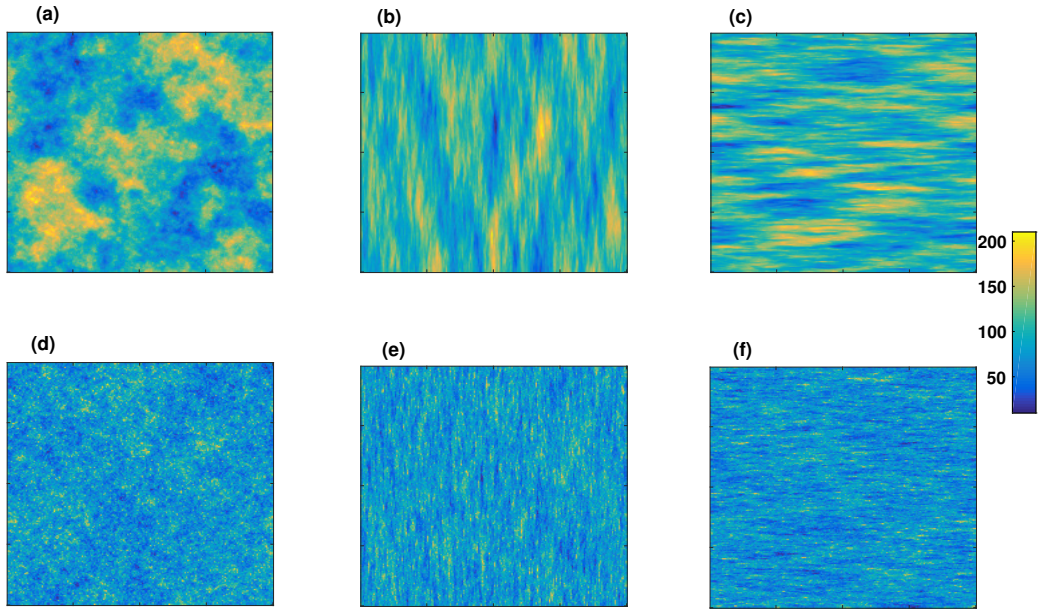
S. Kirkpatrick, Percolation and conduction, Rev. Mod. Phys. 45, 574 (1973). 20 Figure 1: Communications between four nodes (left) and point-to-point communication model. (a) (b) (c) (d) (e) (f) 50 100 150 200 Figure 2: Examples of the networks with correlated conductances. The...
1973
Reviewed August 14, 2026 · model on record in the stance chip above.
Discussion (0). Continue with ORCID to comment.