REVIEW 4 major objections 6 minor 62 references
Sharpening Neural Implicit Functions with Frequency Consolidation Priors
T0 review · 4 major / 6 minor · reviewed 2026-08-10 · deepseek-v4-flash
Pith's one-line read This paper claims that a frequency consolidation prior, learned from FFT-generated low-frequency and full-frequency SDF pairs, can recover high-frequency surface detail from low-frequency observations via a disentangled embedding and…
desk verdict The core idea is novel and the gains are plausible, but the test-time recovery step is underdetermined and the evaluation doesn't pin down whether the prior is truly recovering instance-specific frequencies or just sharpening generically. read the letter →
The pith
A machine-rendered reading of the paper's core claim, the machinery that carries it, and where it could break.
The reading
What carries the argument
The central object is the frequency consolidation prior: a data-driven mapping from a low-frequency SDF observation to its full-frequency coverage, represented by two neural SDF decoders $f_L(q, e_L)$ and $f_F(q, e_F)$ that share query conditioning and are trained jointly on pairs of low- and full-frequency occupancy fields. Low- and full-frequency fields are generated efficiently by an FFT-based Poisson surface reconstruction, avoiding the cost of eigen-decomposition of Laplace-Beltrami operators. The load-bearing identity is the embedding disentanglement $e_L = [e_F, e_C]$, which separates shape identity from frequency-corruption information; this is what allows a frozen $f_L$ to recover $e'_F$ at test time through self-reconstruction, after which $f_F(q, e'_F)$ yields the sharpened surface.
What would settle it
Evaluate the trained prior on low-frequency SDFs created by a different degradation mechanism than FFT truncation, for example SDFs learned by an MLP with spectral bias from sparse point clouds, and compare reconstruction error before and after sharpening; if the gain over the unsharpened input is much smaller than on FFT-truncated test pairs, the prior has learned to invert its own training degradation rather than to consolidate frequency coverage in general.
Extended reading notes
Core claim
The paper claims that full frequency coverage can be recovered from a low-frequency observation of a signed distance function, and that this recovery is the mechanism behind sharper and more complete surfaces. It builds a training set by solving Poisson surface reconstruction with an FFT-based solver, zeroing out high-frequency magnitudes to create low-frequency observations, and pairing each with its full-frequency reconstruction. It then learns two SDF decoders, one for low frequencies and one for full frequencies, connected by embeddings where the low-frequency embedding is the concatenation of a shape-identity/full-frequency embedding and a corruption embedding, $e_L = [e_F, e_C]$. At test time, the parameters of both decoders are frozen and only the embeddings are optimized to reproduce the observed low-frequency SDF; the optimized full-frequency embedding is decoded to produce the sharpened surface. The paper reports that this pipeline lowers Chamfer distances and raises normal consistency relative to the compared methods on ShapeNet, ABC, and ScanNet reconstructions.
Load-bearing premise
The load-bearing premise is that low-frequency observations made by zeroing high-frequency FFT magnitudes of a Poisson-reconstructed occupancy field are representative of the low-frequency artifacts that real neural SDFs acquire from sparse point clouds or multi-view images; if that match fails, the learned prior would fix synthetic truncation rather than real spectral bias.
Editorial extensions
If this is right
- The paper claims that an existing low-frequency SDF can be sharpened as a post-processing step by optimizing an embedding against it, without retraining the decoders.
- The paper claims the prior transfers to unobserved frequency bands, since it sharpens reconstructions produced by sparse-point-cloud methods such as NeuralTPS and OnSurf.
- The paper claims the recovered surfaces are not only sharper but also more complete, because the full-frequency supervision comes from watertight Poisson reconstructions.
- The paper claims the approach works on CAD models with sharp edges, where it reports lower mean and variance of Chamfer distance than the compared methods.
- The paper claims scene-level objects segmented from ScanNet scans are sharpened using priors learned from ShapeNet classes.
Reading between the lines
- A natural extension is to apply the same frequency-consolidation idea to other implicit fields, such as occupancy or unsigned distance functions, where the same spectral-bias problem appears; nothing in the method is strictly tied to signed distance.
- Because the synthetic training degradation is produced by FFT magnitude truncation, the prior's success on real reconstructions likely depends on how well that degradation mimics the spectral bias of neural networks; a reader should treat cross-domain results as the stronger evidence.
- The method could be combined with retrieval-based shape completion: the optimized full-frequency embedding sits in a semantic latent space, so it could serve as a shape descriptor for matching or interpolation rather than only for sharpening.
- Test-time self-reconstruction requires hundreds of optimization iterations per shape; an amortized predictor of the full-frequency embedding could remove this cost while retaining the prior.
Editorial analysis
A structured set of objections, weighed in public.
Referee Report
Summary. The paper proposes frequency consolidation priors (FCP) to sharpen low-frequency SDF observations by recovering their full-frequency counterparts. The method trains two SDF decoders, fL and fF, with per-shape embeddings eF shared between low- and full-frequency branches and an additional per-observation corruption code eC, so that eL = [eF, eC]. At test time, the learned fL is fixed and eF, eC are optimized by self-reconstruction from an unseen low-frequency observation (Eq. 3); the optimized eF is then decoded by fF to produce a sharper surface. Training pairs are generated by zeroing high-frequency FFT magnitudes of Poisson-reconstructed occupancy fields. The method is evaluated on ShapeNet, ABC, and ScanNet, reporting improved Chamfer distance and normal consistency over several recent baselines.
Significance. The conceptual contribution is interesting: disentangling a frequency-corruption code from a shape-identity code in order to enable test-time optimization is a plausible and generalizable mechanism for sharpening implicit functions, and it is supported by a useful release of code, data, and pretrained models. If the central claim is verified, the method would provide a practical post-processing prior for SDFs reconstructed from sparse point clouds or multi-view images. The paper also contains several positive elements: it tests across three datasets, includes visualizations of test-time optimization, and makes an effort to ablate the embedding design. However, the current evidence is not yet convincing enough to establish the central claim, because the test-time recovery step is insufficiently constrained and the evaluation protocol leaves important ambiguities.
major comments (4)
- [Generalizing Frequency Consolidation Priors, Eq. (3)] The central claim that test-time self-reconstruction recovers the true full-frequency embedding eF is not supported by an identifiability argument. Eq. (3) minimizes only the low-frequency residual ||sL - sgt_L'||^2 over both eF' and eC', with no regularization, no prior on the latent codes, and no uniqueness guarantee. Since eC' is a free per-observation code, many (eF', eC') pairs can fit the same low-frequency observation, and the optimizer may settle on an eF' that decodes to a plausible but incorrect full-frequency shape. The TSNE analysis in Fig. 12 concerns training embeddings, not test-time optima, so it does not address this concern. I recommend adding quantitative tests of embedding recovery, such as comparing the optimized eF' with the nearest training-shape embedding, or evaluating whether the decoded shape is closer to the ground-truth shape than to a category-level template. Without such evidence, the reported metric improvements could reflect generic sharpening rather than true frequency recovery.
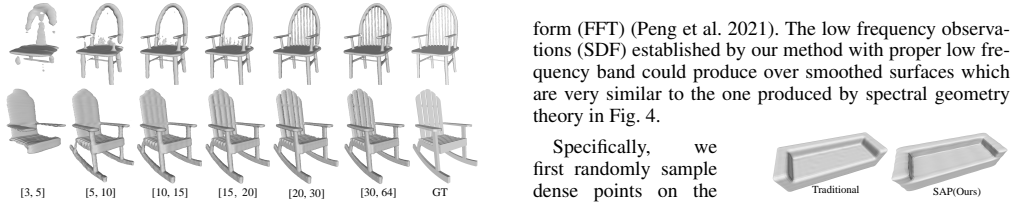
- [Evaluation on ShapeNets, Table 1] The evaluation protocol is under-specified. The paper states that for each test shape the authors 'generate low-frequency observations as described and use the worst observation to assess all methods,' but it does not define how 'worst' is determined, whether the same observation is used for all methods, or how the choice interacts with the six frequency subbands in Fig. 3. Table 1 reports a single mean value per metric per method, without error bars, per-band breakdowns, or significance tests. Given the large variation across frequency bands visible in Fig. 3, single means are not sufficient to support the claim of state-of-the-art performance. The authors should report per-band results, standard deviations, and the number of test shapes, and should specify the exact worst-observation protocol.
- [Supervisions for Learning Priors; Refining Reconstructions from Sparse Point clouds] The paper's main ShapeNet evaluation is conducted on test observations produced by the same frequency-removal pipeline used for training, which limits the strength of the generalization claim. The transfer experiments to NeuralTPS, OnSurf, and ScanNet are more convincing in spirit, but the paper does not quantify the distribution shift between synthetic low-frequency observations and real sparse-point-cloud or scanned reconstructions. The statement in 'Supervisions for Learning Priors' that the over-smoothed surfaces are 'very similar' to spectral geometry results is only supported by a single visual example (Fig. 4). I recommend adding quantitative spectral comparisons between the training distribution and the real test inputs, and reporting results separately for each degradation type rather than only as averages over mixed cases.
- [Related Work, Learning with Frequency; Tables 1–3] The paper cites BACON (Lindell et al. 2022) and SAP (Peng et al. 2021) as frequency-related methods but does not compare against them experimentally. Since the proposed method explicitly operates in the frequency domain and claims to recover high-frequency components, these are the most directly relevant baselines. Their absence from Tables 1–3 weakens the state-of-the-art claim. The authors should either include them in the comparisons or justify their exclusion with concrete technical reasons.
minor comments (6)
- [Introduction] There is a typo in the first sentence: 'Singed Distance Functions' should be 'Signed Distance Functions.'
- [Related Work] Several citations are incomplete or malformed, including 'Takikawa et al. 2021,?' and 'IDR (?)'; these should be resolved before publication.
- [Learning Frequency Consolidation Priors] The text says 'we use the first 5 low frequency observations' for each training shape, but Fig. 3 shows six subbands and the sampling procedure in 'Supervisions for Learning Priors' is described as random. The relationship between the six illustrated bands and the 'first 5' observations is unclear and should be clarified.
- [Table 2] In the NeuralTPS row, the normal consistency value appears as '50.899', which is likely a typo for '0.899'. Please check the table formatting.
- [Implementation Details] The paper does not specify the FFT resolution used for the Poisson solver, the number of training shapes per dataset, or the initialization of the embeddings. These details are needed for reproducibility.
- [Ablation Studies and Analysis] The t-SNE visualization in Fig. 12 is described as showing optimization paths, but the figure as printed is difficult to read. A larger figure with labeled axes and a legend would help the reader verify the claimed semantic structure.
Circularity Check
No circularity: the frequency consolidation prior is a learned mapping trained on synthetically degraded pairs and evaluated on external benchmarks; test-time embedding optimization is an empirical recovery step, not a definitional one.
full rationale
The paper's central derivation is self-contained and does not reduce to its inputs by construction. Training pairs are produced by an independent frequency-domain operation: dense point samples are converted to an occupancy field via a Poisson FFT solver, and low-frequency observations are formed by zeroing high-frequency magnitudes. The full-frequency output is generated by a separately trained decoder fF conditioned on an embedding eF, and this embedding is recovered at test time by optimizing Eq. (3) against the low-frequency branch fL. Nothing in Eqs. (1)-(3) makes the recovered full-frequency field definitionally equal to the input; it is a learned mapping that could fail or hallucinate. The evaluation includes out-of-distribution inputs from NeuralTPS, OnSurf, and ScanNet, so the claimed generalization is not guaranteed by the training procedure alone. The identifiability concern about Eq. (3) is a genuine correctness risk but is not circularity: an underdetermined optimization can produce wrong answers, yet the output is still not logically equivalent to the observed low-frequency field. Self-citations appear, but they are used as baselines or as preprocessing tools (e.g., NeuralPull), not as load-bearing evidence for the frequency consolidation prior itself. No step in the derivation chain is equivalent to its inputs by definition, and no fitted parameter is renamed as a prediction.
Assumptions & free parameters
free parameters (5)
- embedding dimensions eL and eF =
256 / 128
- query sampling sigmas (sigma1, sigma2) =
8 and 0.2
- number of low-frequency observations per training shape =
5
- frequency subband sampling strategy =
random cutoff from six subbands in [0,64]
- test-time optimization iterations and learning rate =
800 iterations, lr 0.005
assumptions (4)
- domain assumption Zeroing high-frequency FFT magnitudes of a Poisson-reconstructed occupancy field produces low-frequency meshes representative of real low-frequency neural SDF artifacts.
- domain assumption A full-frequency shape code eF is recoverable from a low-frequency observation by optimizing only the embeddings with the low-frequency branch held fixed.
- ad hoc to paper The factorization eL = [eF eC] is sufficient to model frequency corruption and shape identity.
- standard math FFT-based Poisson surface reconstruction produces an occupancy function whose zero-level set approximates the input surface.
Cite this review
Pith. "Pith review of Sharpening Neural Implicit Functions with Frequency Consolidation Priors." pith.science (2026). https://pith.science/paper/A7YVKDLH
@misc{pith2026241219720,
  author       = {Pith},
  title        = {Pith review of: Sharpening Neural Implicit Functions with Frequency Consolidation Priors},
  year         = {2026},
  howpublished = {\url{https://pith.science/paper/A7YVKDLH}},
  note         = {Machine review of arXiv:2412.19720}
}
read the original abstract
Signed Distance Functions (SDFs) are vital implicit representations to represent high fidelity 3D surfaces. Current methods mainly leverage a neural network to learn an SDF from various supervisions including signed distances, 3D point clouds, or multi-view images. However, due to various reasons including the bias of neural network on low frequency content, 3D unaware sampling, sparsity in point clouds, or low resolutions of images, neural implicit representations still struggle to represent geometries with high frequency components like sharp structures, especially for the ones learned from images or point clouds. To overcome this challenge, we introduce a method to sharpen a low frequency SDF observation by recovering its high frequency components, pursuing a sharper and more complete surface. Our key idea is to learn a mapping from a low frequency observation to a full frequency coverage in a data-driven manner, leading to a prior knowledge of shape consolidation in the frequency domain, dubbed frequency consolidation priors. To better generalize a learned prior to unseen shapes, we introduce to represent frequency components as embeddings and disentangle the embedding of the low frequency component from the embedding of the full frequency component. This disentanglement allows the prior to generalize on an unseen low frequency observation by simply recovering its full frequency embedding through a test-time self-reconstruction. Our evaluations under widely used benchmarks or real scenes show that our method can recover high frequency component and produce more accurate surfaces than the latest methods. The code, data, and pre-trained models are available at \url{https://github.com/chenchao15/FCP}.
Figures


Figures from the paper (6 more)


Reference graph
Works this paper leans on
-
[1]
, " * write output.state after.block = add.period write newline
ENTRY address archivePrefix author booktitle chapter edition editor eid eprint howpublished institution isbn journal key month note number organization pages publisher school series title type volume year label extra.label sort.label short.list INTEGERS output.state before.all mid.sentence after.sentence after.block FUNCTION init.state.consts #0 'before.a...
-
[2]
write newline
" write newline "" before.all 'output.state := FUNCTION n.dashify 't := "" t empty not t #1 #1 substring "-" = t #1 #2 substring "--" = not "--" * t #2 global.max substring 't := t #1 #1 substring "-" = "-" * t #2 global.max substring 't := while if t #1 #1 substring * t #2 global.max substring 't := if while FUNCTION word.in bbl.in capitalize " " * FUNCT...
-
[3]
Avetisyan, A.; Dahnert, M.; Dai, A.; Savva, M.; Chang, A. X.; and Niessner, M. 2019. Scan2CAD: Learning CAD Model Alignment in RGB-D Scans. In The IEEE Conference on Computer Vision and Pattern Recognition
work page 2019
-
[4]
Bokhovkin, A.; and Dai, A. 2022. Neural Part Priors: Learning to Optimize Part-Based Object Completion in RGB-D Scans
work page 2022
-
[5]
Bokhovkin, A.; Ishimtsev, V.; Bogomolov, E.; Zorin, D.; Artemov, A.; Burnaev, E.; and Dai, A. 2021. Towards Part-Based Understanding of RGB-D Scans. In In the IEEE Conference on Computer Vision and Pattern Recognition
work page 2021
-
[6]
Boulch, A.; and Marlet, R. 2022. POCO: Point Convolution for Surface Reconstruction. In IEEE Conference on Computer Vision and Pattern Recognition
work page 2022
-
[7]
E.; Ilg, E.; Schmidt, T.; Straub, J.; Lovegrove, S.; and Newcombe, R
Chabra, R.; Lenssen, J. E.; Ilg, E.; Schmidt, T.; Straub, J.; Lovegrove, S.; and Newcombe, R. A. 2020. Deep Local Shapes: Learning Local SDF Priors for Detailed 3D Reconstruction. In European Conference on Computer Vision, volume 12374, 608--625
work page 2020
-
[8]
Chang, A. X.; Funkhouser, T.; Guibas, L.; Hanrahan, P.; Huang, Q.; Li, Z.; Savarese, S.; Savva, M.; Song, S.; Su, H.; Xiao, J.; Yi, L.; and Yu, F. 2015. Shape N et: An Information-Rich 3D Model Repository . Technical Report arXiv:1512.03012 [cs.GR], Stanford University --- Princeton University --- Toyota Technological Institute at Chicago
arXiv 2015
Show all 62 references
-
[9]
Chen, C.; Han, Z.; and Liu, Y.-S. 2023. Unsupervised Inference of Signed Distance Functions from Single Sparse Point Clouds without Learning Priors. In In the IEEE Conference on Computer Vision and Pattern Recognition
2023
-
[10]
Chen, C.; Liu, Y.-S.; and Han, Z. 2022. Latent Partition Implicit with Surface Codes for 3D Representation. In European Conference on Computer Vision
2022
-
[11]
Chen, C.; Liu, Y.-S.; and Han, Z. 2023. GridPull: Towards Scalability in Learning Implicit Representations from 3D Point Clouds. In Proceedings of the IEEE International Conference on Computer Vision (ICCV)
2023
-
[12]
Chen, C.; Liu, Y.-S.; and Han, Z. 2024. Inferring Neural Signed Distance Functions by Overfitting on Single Noisy Point Clouds through Finetuning Data-Driven based Priors. In Advances in Neural Information Processing Systems
2024
-
[13]
Chen, C.; Liu, Y.-S.; and Han, Z. 2025. NeuralTPS : Learning Signed Distance Functions without Priors from Single Sparse Point Clouds. IEEE Transactions on Pattern Analysis and Machine Intelligence, 47(1): 565--582
2025
-
[14]
Chen, Z.; Tagliasacchi, A.; Funkhouser, T.; and Zhang, H. 2022. Neural Dual Contouring. ACM Transactions on Graphics (Special Issue of SIGGRAPH), 41(4)
2022
-
[15]
B.; Xu, D.; Gwak, J.; Chen, K.; and Savarese, S
Choy, C. B.; Xu, D.; Gwak, J.; Chen, K.; and Savarese, S. 2016. 3D-R2N2 : A Unified Approach for Single and Multi-view 3 D Object Reconstruction. In European Conference on Computer Vision, 628--644
2016
-
[16]
X.; Savva, M.; Halber, M.; Funkhouser, T.; and Nie ner, M
Dai, A.; Chang, A. X.; Savva, M.; Halber, M.; Funkhouser, T.; and Nie ner, M. 2017. ScanNet: Richly-annotated 3D Reconstructions of Indoor Scenes. In Proc. Computer Vision and Pattern Recognition (CVPR), IEEE
2017
-
[17]
Ehret, T.; Marí, R.; and Facciolo, G. 2022. Regularization of NeRFs using differential geometry. arXiv:2206.14938
2022 arXiv
-
[18]
J.; and Wimmer, M
Erler, P.; Guerrero, P.; Ohrhallinger, S.; Mitra, N. J.; and Wimmer, M. 2020. Points2Surf : Learning Implicit Surfaces from Point Clouds. In European Conference on Computer Vision
2020
-
[19]
Fu, Q.; Xu, Q.; Ong, Y.-S.; and Tao, W. 2022. Geo-Neus : Geometry-Consistent Neural Implicit Surfaces Learning for Multi-view Reconstruction. In Advances in Neural Information Processing Systems
2022
-
[20]
T.; and Funkhouser, T
Genova, K.; Cole, F.; Vlasic, D.; Sarna, A.; Freeman, W. T.; and Funkhouser, T. 2019. Learning Shape Templates with Structured Implicit Functions. In International Conference on Computer Vision
2019
-
[21]
Grattarola, D.; and Vandergheynst, P. 2022. Generalised implicit neural representations. Advances in Neural Information Processing Systems
2022
-
[22]
Guo, H.; Peng, S.; Lin, H.; Wang, Q.; Zhang, G.; Bao, H.; and Zhou, X. 2022. Neural 3D Scene Reconstruction with the Manhattan-world Assumption. In IEEE Conference on Computer Vision and Pattern Recognition
2022
-
[23]
Haghighi, Y.; Kumar, S.; Thiran, J.-P.; and Gool, L. V. 2023. Neural Implicit Dense Semantic SLAM. arXiv:2304.14560
2023 arXiv
-
[24]
Hu, P.; and Han, Z. 2023. Learning Neural Implicit through Volume Rendering with Attentive Depth Fusion Priors. In Advances in Neural Information Processing Systems
2023
-
[25]
Jiang, C.; Sud, A.; Makadia, A.; Huang, J.; Nie ner, M.; and Funkhouser, T. 2020 a . Local Implicit Grid Representations for 3D Scenes. In IEEE Conference on Computer Vision and Pattern Recognition
2020
-
[26]
Jiang, S.; Hua, J.; and Han, Z. 2023. Coordinate Quantized Neural Implicit Representations for Multi-view 3D Reconstruction. In IEEE International Conference on Computer Vision
2023
-
[27]
Jiang, Y.; Ji, D.; Han, Z.; and Zwicker, M. 2020 b . SDFDiff : Differentiable Rendering of Signed Distance Fields for 3D Shape Optimization. In IEEE Conference on Computer Vision and Pattern Recognition
2020
-
[28]
Koch, S.; Matveev, A.; Jiang, Z.; Williams, F.; Artemov, A.; Burnaev, E.; Alexa, M.; Zorin, D.; and Panozzo, D. 2019. ABC : A Big CAD Model Dataset For Geometric Deep Learning. In IEEE Conference on Computer Vision and Pattern Recognition
2019
-
[29]
G.; Willis, K.; Jayaraman, P
Lambourne, J. G.; Willis, K.; Jayaraman, P. K.; Zhang, L.; Sanghi, A.; and Malekshan, K. R. 2022. Reconstructing editable prismatic CAD from rounded voxel models. In SIGGRAPH Asia 2022 Conference Papers . ACM
2022
-
[30]
Li, P.; Guo, J.; Zhang, X.; and ming Yan, D. 2023. SECAD-Net : Self-Supervised CAD Reconstruction by Learning Sketch-Extrude Operations. In In IEEE Conference on Computer Vision and Pattern Recognition
2023
-
[31]
B.; Van Veen, D.; Park, J
Lindell, D. B.; Van Veen, D.; Park, J. J.; and Wetzstein, G. 2022. BACON : Band-limited coordinate networks for multiscale scene representation. In IEEE/CVF Conference on Computer Vision and Pattern Recognition (CVPR)
2022
-
[32]
Liu, S.-L.; Guo, H.-X.; Pan, H.; Wang, P.; Tong, X.; and Liu, Y. 2021. Deep Implicit Moving Least-Squares Functions for 3D Reconstruction. In IEEE Conference on Computer Vision and Pattern Recognition
2021
-
[33]
E.; and Cline, H
Lorensen, W. E.; and Cline, H. E. 1987. Marching cubes: A high resolution 3D surface construction algorithm. Computer Graphics, 21(4): 163--169
1987
-
[34]
Ma, B.; Han, Z.; Liu, Y.-S.; and Zwicker, M. 2021. Neural-Pull: Learning Signed Distance Functions from Point Clouds by Learning to Pull Space onto Surfaces. In International Conference on Machine Learning
2021
-
[35]
Ma, B.; Liu, Y.-S.; Zwicker, M.; and Han, Z. 2022. Reconstructing Surfaces for Sparse Point Clouds with On-Surface Priors. In IEEE Conference on Computer Vision and Pattern Recognition
2022
-
[36]
Mescheder, L.; Oechsle, M.; Niemeyer, M.; Nowozin, S.; and Geiger, A. 2019. Occupancy Networks: Learning 3 D Reconstruction in Function Space. In IEEE Conference on Computer Vision and Pattern Recognition
2019
-
[37]
Metzer, G.; Hanocka, R.; Giryes, R.; and Cohen-Or, D. 2021. Self-Sampling for Neural Point Cloud Consolidation. 40(5)
2021
-
[38]
P.; Tancik, M.; Barron, J
Mildenhall, B.; Srinivasan, P. P.; Tancik, M.; Barron, J. T.; Ramamoorthi, R.; and Ng, R. 2020. NeRF : Representing Scenes as Neural Radiance Fields for View Synthesis. In European Conference on Computer Vision
2020
-
[39]
Niemeyer, M.; Mescheder, L.; Oechsle, M.; and Geiger, A. 2020. Differentiable Volumetric Rendering: Learning Implicit 3D Representations without 3D Supervision. In IEEE Conference on Computer Vision and Pattern Recognition
2020
-
[40]
Noda, T.; Chen, C.; Zhang, W.; Liu, X.; Liu, Y.-S.; and Han, Z. 2024. MultiPull : Detailing Signed Distance Functions by Pulling Multi-Level Queries at Multi-Step. In Advances in Neural Information Processing Systems
2024
-
[41]
Oechsle, M.; Peng, S.; and Geiger, A. 2021. UNISURF : Unifying Neural Implicit Surfaces and Radiance Fields for Multi-View Reconstruction. In International Conference on Computer Vision
2021
-
[42]
Ouasfi, A.; and Boukhayma, A. 2022. Few 'Zero Level Set'-Shot Learning of Shape Signed Distance Functions in Feature Space. In European Conference on Computer Vision
2022
-
[43]
J.; Florence, P.; Straub, J.; Newcombe, R.; and Lovegrove, S
Park, J. J.; Florence, P.; Straub, J.; Newcombe, R.; and Lovegrove, S. 2019. DeepSDF : Learning Continuous Signed Distance Functions for Shape Representation. In IEEE Conference on Computer Vision and Pattern Recognition
2019
-
[44]
M.; Liao, Y.; Niemeyer, M.; Pollefeys, M.; and Geiger, A
Peng, S.; Jiang, C. M.; Liao, Y.; Niemeyer, M.; Pollefeys, M.; and Geiger, A. 2021. Shape As Points: A Differentiable Poisson Solver. In Advances in Neural Information Processing Systems
2021
-
[45]
W.; Hallacy, C.; Ramesh, A.; Goh, G.; Agarwal, S.; Sastry, G.; Askell, A.; Mishkin, P.; Clark, J.; Krueger, G.; and Sutskever, I
Radford, A.; Kim, J. W.; Hallacy, C.; Ramesh, A.; Goh, G.; Agarwal, S.; Sastry, G.; Askell, A.; Mishkin, P.; Clark, J.; Krueger, G.; and Sutskever, I. 2021. Learning Transferable Visual Models From Natural Language Supervision. CoRR, abs/2103.00020
2021 arXiv
-
[46]
Sara Fridovich-Keil and Alex Yu ; Tancik, M.; Chen, Q.; Recht, B.; and Kanazawa, A. 2022. Plenoxels: Radiance Fields without Neural Networks. In IEEE Conference on Computer Vision and Pattern Recognition
2022
-
[47]
Songyou, P.; Michael, N.; Lars, P., Mescheder adn Marc; and Andreas, G. 2020. Convolutional Occupancy Networks. In European Conference on Computer Vision
2020
-
[48]
Takikawa, T.; Litalien, J.; Yin, K.; Kreis, K.; Loop, C.; Nowrouzezahrai, D.; Jacobson, A.; McGuire, M.; and Fidler, S. 2021. Neural Geometric Level of Detail: Real-time Rendering with Implicit 3D Shapes. In IEEE Conference on Computer Vision and Pattern Recognition
2021
-
[49]
van der Maaten, L.; and Hinton, G. 2008. Visualizing Data using t-SNE . Journal of Machine Learning Research, 9: 2579--2605
2008
-
[50]
Vicini, D.; Speierer, S.; and Jakob, W. 2022. Differentiable Signed Distance Function Rendering. ACM Transactions on Graphics, 41(4): 125:1--125:18
2022
-
[51]
Wang, H.; Wang, J.; and Agapito, L. 2023. Co-SLAM: Joint Coordinate and Sparse Parametric Encodings for Neural Real-Time SLAM. In the IEEE Conference on Computer Vision and Pattern Recognition
2023
-
[52]
Wang, J.; Wang, P.; Long, X.; Theobalt, C.; Komura, T.; Liu, L.; and Wang, W. 2022 a . NeuRIS : Neural Reconstruction of Indoor Scenes Using Normal Priors. In European Conference on Computer Vision
2022
-
[53]
Wang, P.; Liu, L.; Liu, Y.; Theobalt, C.; Komura, T.; and Wang, W. 2021. NeuS : Learning Neural Implicit Surfaces by Volume Rendering for Multi-view Reconstruction. In Advances in Neural Information Processing Systems
2021
-
[54]
J.; Paschalidou, D.; You, S.; Wetzstein, G.; Guibas, L.; and Kadambi, A
Wang, Z.; Zhou, S.; Park, J. J.; Paschalidou, D.; You, S.; Wetzstein, G.; Guibas, L.; and Kadambi, A. 2022 b . ALTO: Alternating Latent Topologies for Implicit 3D Reconstruction. arXiv preprint arXiv:2212.04096
2022 arXiv
-
[55]
Ye, Y.; Yi, R.; Gao, Z.; Zhu, C.; Cai, Z.; and Xu, K. 2023. NEF: Neural Edge Fields for 3D Parametric Curve Reconstruction From Multi-View Images. In Proceedings of the IEEE/CVF Conference on Computer Vision and Pattern Recognition (CVPR), 8486--8495
2023
-
[56]
Yifan, W.; Rahmann, L.; and Sorkine-hornung, O. 2021. Geometry-Consistent Neural Shape Representation with Implicit Displacement Fields. In International Conference on Learning Representations
2021
-
[57]
Zhang, H.; van Kaick, O.; and Dyer, R. 2007. Spectral Methods for Mesh Processing and Analysis. In Proc. of Eurographics State-of-the-art Report, 1--22
2007
-
[58]
Zhang, W.; Shi, K.; Liu, Y.-S.; and Han, Z. 2024. Learning Unsigned Distance Functions from Multi-view Images with Volume Rendering Priors. In European Conference on Computer Vision
2024
-
[59]
Zhou, J.; Ma, B.; Li, S.; Liu, Y.-S.; Fang, Y.; and Han, Z. 2024 a . CAP-UDF : Learning Unsigned Distance Functions Progressively from Raw Point Clouds with Consistency-Aware Field Optimization. IEEE Transactions on Pattern Analysis and Machine Intelligence, 46(12): 7475--7492
2024
-
[60]
Zhou, J.; Ma, B.; Liu, Y.-S.; and Han, Z. 2024 b . Fast Learning of Signed Distance Functions from Noisy Point Clouds via Noise to Noise Mapping. IEEE Transactions on Pattern Analysis and Machine Intelligence, 46(12): 8936--8953
2024
-
[61]
, " * write output.state after.block = add.period write
ENTRY address author booktitle chapter doi edition editor eid howpublished institution journal key month note number organization pages publisher school series title type url volume year label INTEGERS output.state before.all mid.sentence after.sentence after.block FUNCTION in...
-
[62]
write newline
" write newline "" before.all 'output.state := FUNCTION n.dashify 't := "" t empty not t #1 #1 substring "-" = t #1 #2 substring "--" = not "--" * t #2 global.max substring 't := t #1 #1 substring "-" = "-" * t #2 global.max substring 't := while if t #1 #1 substring * t #2 gl...
Reviewed August 10, 2026 · model on record in the stance chip above.
Discussion (0). Continue with ORCID to comment.