REVIEW 5 major objections 5 minor 18 references
Pseudoscalar Meson Mixing, the Contribution of the Hadronic Continuum to Deviation from Factorization
T0 review · 5 major / 5 minor · reviewed 2026-08-14 · deepseek-v4-flash
Pith's one-line read The paper shows that specially chosen integration kernels can remove the hadronic continuum from kaon and B-meson mixing sum rules.
desk verdict A genuinely new kernel trick for taming the hadronic continuum in B_K sum rules, but the key suppression claim is not quantified and the numerical path needs work. read the letter →
The pith
A machine-rendered reading of the paper's core claim, the machinery that carries it, and where it could break.
The reading
What carries the argument
The load-bearing object is the kernel. For the kaon it is the quadratic polynomial $P(t)=1-0.768\,{\rm GeV}^{-2}t+0.14\,{\rm GeV}^{-4}t^{2}$, chosen so its roots coincide with $m^2_{K(1460)}$ and $m^2_{K(1830)}$; for the B meson it is the factor $(m'^2/t-1)$ inserted into inverse moments, with $m'$ near the first radial excitation (the two known candidates are 5.84 and 5.97 GeV). The kernel's zeros at the resonances, and its small values in a broad neighborhood, convert the unknown hadronic continuum into a suppressed contribution to the double contour integral, leaving large-circle integrals where the operator product expansion applies. It also removes the Borel-parameter stability-window problem: there is no unphysical mass $M^2$ to scan, and no gap parameters to fit.
What would settle it
Compute the kernel-weighted continuum integral $\int_{t_h}^{R} dt\, P(t)\,\rho(t)$ using a spectral function $\rho(t)$ obtained from lattice or experimental data; if this integral is not small compared with the quark-condensate pole contribution that fixes $B_K$, the claimed elimination fails. For the B system, a precise lattice value of $B_B$ is the decisive check: a value differing from 1.0 by more than the few-percent deviation quoted here would indicate the $(m'^2/t-1)^2$ factor did not suppress the first-resonance region as assumed.
Extended reading notes
Core claim
The central claim is that the continuum background, long treated as an unavoidable uncertainty in these sum rules, is removable. Starting from the three-point function of two pseudoscalar currents and the $\Delta S=2$ or $\Delta B=2$ operator, the paper writes double dispersion integrals and inserts a kaon kernel $P(t)=1-0.768\,{\rm GeV}^{-2}t+0.14\,{\rm GeV}^{-4}t^{2}$, whose zeros sit at the squared masses of $K(1460)$ and $K(1830)$. Because the kernel is very small in a broad region around those resonances, the double-pole term survives while the single poles and the cut contributions are suppressed; the remaining integrals over large circles are evaluated with the operator product expansion. The kaon analysis yields $m_0^2 \approx 1.0\,{\rm GeV}^2$ and $B_{\rm nf}=-0.09$, hence $B \approx 0.91$. For the B meson, the same idea is implemented with inverse moments and the factor $(m'^2/t-1)$, giving $B_B \approx 1.0$. The paper also uses the kernel method to obtain $f_K=0.107\,{\rm GeV}$ at five loops and $f_\pi=0.092\,{\rm GeV}$.
Load-bearing premise
The argument stands or falls on the assumption that the strange pseudoscalar continuum is dominated by the two radial excitations $K(1460)$ and $K(1830)$ (and, in the B system, that the first radial excitation mass $m'$ is known well enough), so that a kernel with zeros at those masses truly removes the continuum rather than merely reweighting a broad background.
Editorial extensions
If this is right
- The kaon B-parameter is predicted at $B_K \approx 0.91$, so factorization is violated at the ten-percent level in $K^0$-$\bar K^0$ mixing.
- The B-meson parameter comes out $B_B \approx 1.0$: in this calculation the $\Delta B=2$ matrix element is essentially factorized.
- The mixed quark-gluon condensate parameter is fixed independently at $m_0^2 \approx 1.0\,{\rm GeV}^2$, a quantity that enters many other QCD sum rules.
- The same kernel method yields $f_K=0.107\,{\rm GeV}$ and $f_\pi=0.092\,{\rm GeV}$ from five-loop QCD without Borel-parameter tuning.
- Because the continuum is removed by construction, the usual uncertainties from choosing the Borel mass and from parametrizing gaps are absent from these results.
Reading between the lines
- Going beyond the paper: the same kernel construction could be applied to other three-point sum rules with poorly known continua, such as $B_s$ mixing or $D$-meson mixing, where the first radial excitations are known less precisely.
- Going beyond the paper: the B-system result depends on taking $(m'/m_b)^2 = 2.0$; varying $m'$ over the two known candidates (5.84 and 5.97 GeV) would turn the quoted $B_B \approx 1.0$ into a small interval, giving a concrete systematic error.
- Going beyond the paper: the method predicts that high-precision lattice calculations of $B_K$ should land near 0.91 and of $B_B$ near 1.0; a lattice measurement outside those windows would indicate either the resonance-domination assumption or the operator-product-expansion truncation needs revision.
Signed reviews
Editorial analysis
A structured set of objections, weighed in public.
Referee Report
Summary. The manuscript proposes a new treatment of the hadronic continuum in QCD sum rules for neutral kaon and B-meson mixing. It replaces the Borel exponential kernel by polynomial or inverse-moment kernels chosen to vanish at assumed radial-excitation masses, allowing the cut integrals to be dropped and the double contour integral to be saturated by QCD on large circles. In the K system the method yields m0^2 ≈ 1.0 GeV^2, B_nf = −0.09 and hence B ≈ 0.91 for ΔS=2 mixing; the same framework gives a five-loop result fK ≈ 0.107 GeV. In the B system, inverse moments weighted by (m'^2/t − 1)^2 give B_B ≈ 1.0. The paper concludes that the hadronic continuum contributes negligibly in both cases and that deviations from factorization are small.
Significance. The paper addresses a genuine and longstanding problem: the hadronic continuum is a major source of uncertainty in sum-rule determinations of mixing parameters, and the contour treatment in Eqs. (8)–(18) is explicit and standard. The independent determination of m0^2 from Eq. (22) and the five-loop fK calculation are potentially useful, and the quoted numerical results (B ≈ 0.91, B_B ≈ 1.0, m0^2 ≈ 1.0 GeV^2) are concrete and falsifiable. However, the central claim that the chosen kernels 'practically eliminate' the continuum is not established quantitatively; the final numbers depend on an asserted two-resonance dominance of the spectral function and on kernel parameters that are not varied. Because this assumption is load-bearing for the main results, the paper is not yet acceptable in its present form.
major comments (5)
- [Section 2, after Eq. (10)] The statement that P(t) 'practically eliminates the contribution of the hadronic continuum' is not supported quantitatively. For P(t) = 1 − 0.768 t + 0.14 t^2, one finds P(t_h) ≈ 0.59 at the threshold t_h = (m_K + 2 m_pi)^2 ≈ 0.6 GeV^2 and P(1 GeV^2) ≈ 0.37; the kernel vanishes only at its roots t ≈ 2.13 and 3.36 GeV^2 and grows as 0.14 t^2 above the second root. The passage from Eq. (9) to Eq. (11), in which the cut integrals are dropped, is therefore equivalent to an assumption that the strange pseudoscalar spectral function is dominated by the two radial excitations, not a consequence of the kernel itself. Please provide a quantitative bound on the residual cut integral, for example by evaluating it with a model spectral function or by showing that the extracted B is stable against variations of the kernel coefficients.
- [Section 2, Eqs. (9)-(10)] The masses defining the kernel roots are not fixed consistently. Before Eq. (10) the radial excitations are given as K(1460) and K(1830), whose squared masses match the roots of the quoted polynomial (2.13 and 3.36 GeV^2), but the text after Eq. (10) refers to K(1400) and K(1870), whose squared masses are 1.96 and 3.50 GeV^2. The identification of the states is therefore mutually inconsistent, and no uncertainty is propagated from the kernel parameters to m0^2 or B. Please specify which states are used, quote the corresponding masses and PDG status, and give a sensitivity estimate.
- [Section 4, Eq. (43)] The factor (m'^2/t − 1)^2 annihilates the integrand only at t = m'^2. At the physical threshold t ≈ (m_B + m_pi)^2 ≈ 29 GeV^2, with (m'/m_b)^2 = 2 and m_b ≈ 4.18 GeV (so m'^2 ≈ 35 GeV^2), the factor (m'^2/t − 1) is about 0.16–0.21, and its square is about 0.03–0.05. The low-lying continuum is thus suppressed but not eliminated, and the numerical choice (m'/m_b)^2 = 2.0 is tuned between the two PDG candidates m' = 5.84 and 5.97 GeV without an uncertainty estimate. Please quantify the residual continuum contribution and show the dependence of B_B on the choice of m'.
- [Section 2, Eqs. (21)-(28)] The determination of m0^2 is not independent of the input used later. The dominant condensate combination in Eq. (27) is taken from the author's earlier paper [8], and m0^2 is extracted from Eq. (22) within the same duality framework that later produces B_nf in Eq. (21). The sentence following Eq. (27) ('This ... yields m0^2 ≈ 1.0 GeV^2') omits the actual solution of Eq. (22); please display that solution explicitly and propagate the uncertainties from (m_s + m_d) and the condensate value.
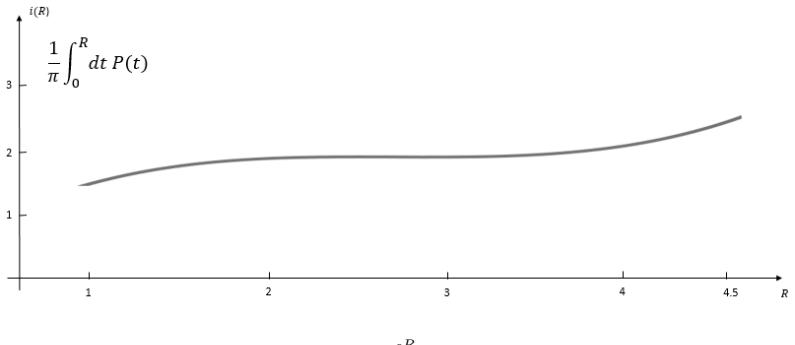
- [Section 2, Fig. 2] Figure 2 demonstrates the stability of the auxiliary integral i(R) = ∫_0^R P(t) dt, not of the physical quantities B, fK or B_B. The final values B ≈ 0.91, fK ≈ 0.107 GeV and B_B ≈ 1.0 are quoted without a stability window in R or a residual-continuum dependence. Please add plots showing the R-dependence of the extracted parameters and state the range of R over which the final results are stable.
minor comments (5)
- [Eq. (15)] The logarithms appear as ln(−t/µ^2) + ln(−t/µ^2); presumably the second argument should be t′. Please correct this typo.
- [Section 3, after Eq. (34)] The text reads 'ms = .10 GeV 4' and later '⟨asGG⟩ = .013 GeV 4'; the exponent '4' appears to be a typographical error for the mass and condensate units respectively. Also, the 'standard values' used here should be attributed to a reference.
- [References] Reference [13] is used twice for two different papers (Pivovarov, and Shifman, Vainshtein and Zakharov). Please renumber the references.
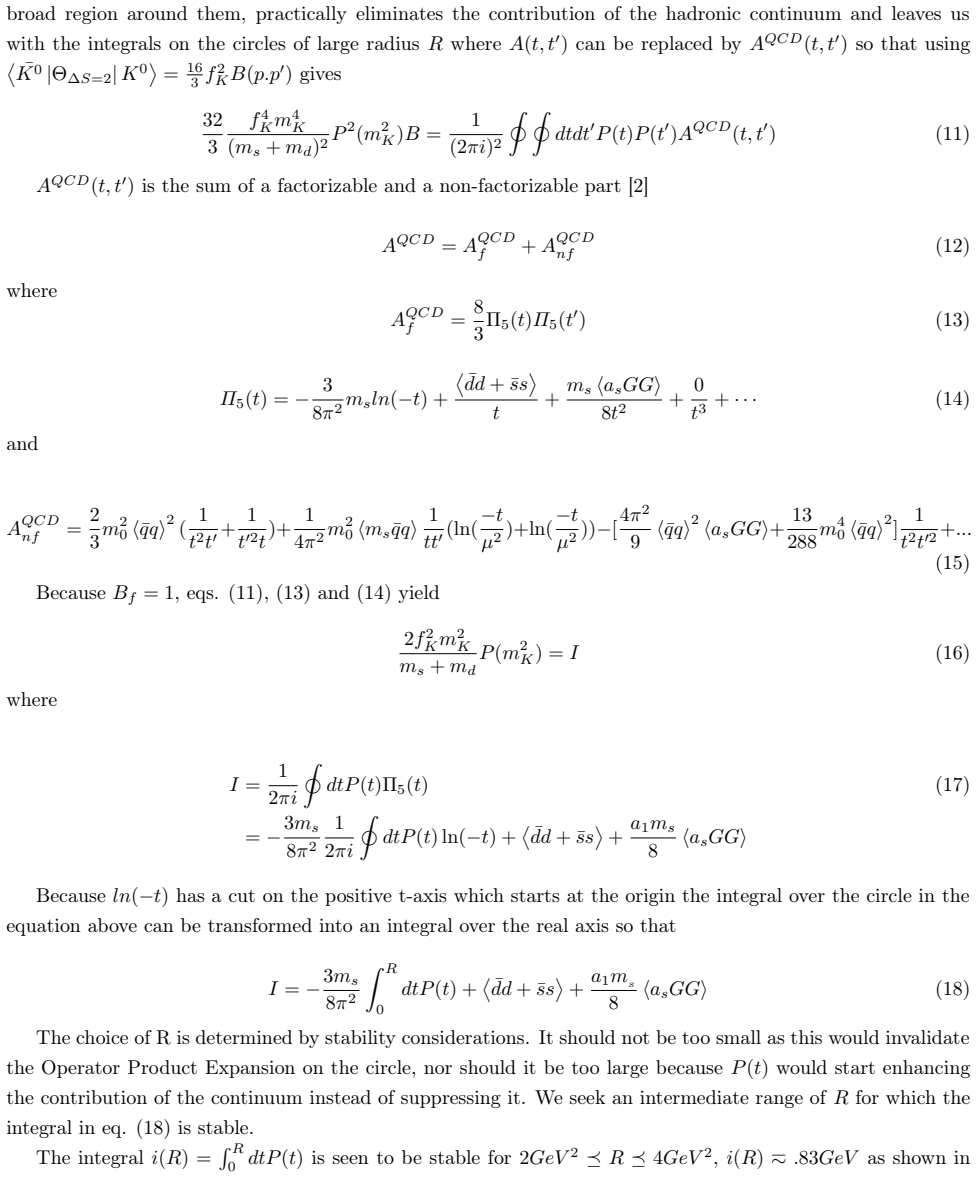
- [Figure captions] Figure 1 has no caption explaining the contours c and c′, and Figure 2 contains the misspelling 'Gev' for 'GeV'.
- [Throughout] The central numerical results are quoted without error bars: m0^2 ≈ 1.0 GeV^2, B ≈ 0.91, B_B ≈ 1.0 and fK ≈ 0.107 GeV all need an estimated theoretical uncertainty, especially in view of the neglected residual continuum.
Circularity Check
No significant circularity: continuum suppression is an explicit resonance-dominance assumption, and the self-cited five-loop condensate is externally anchored.
full rationale
The claimed predictions (B ≈ 0.91 and B_B ≈ 1.0) are not equivalent by construction to the inputs. The polynomial kernel in eq. (10) is tailored to vanish at the assumed K(1400)/K(1870) excitations, but that only implements the paper's stated premise that the strange pseudoscalar continuum is two-resonance dominated; the drop of the cut integrals in eqs. (9)–(11) is an approximation, not an identity forced by the kernel. The same holds for the B-system factor (m'^2/t − 1)^2 in eq. (43), which suppresses rather than annihilates the low-lying continuum. These are quantitative assumptions that may be numerically fragile, but fragility is a correctness risk, not circularity. The mixed-condensate parameter m0^2 entering eq. (21) is determined from the separate contour consistency condition eq. (22), and the dominant condensate input in eq. (27) is taken from the author's prior publication [8]; however, that value is a published five-loop GMOR-type result that can be checked against f_K, m_K, and quark masses, so the self-citation carries independent content rather than reducing the argument to itself. No equation here is defined in terms of the target B parameter, and no fitted parameter is relabeled as a prediction.
Assumptions & free parameters
free parameters (5)
- Kernel coefficients a1, a2 for the K-channel polynomial P(t) =
a1 = 0.768 GeV⁻², a2 = 0.14 GeV⁻⁴
- Integration radius R (upper duality scale), K sector =
2 GeV² ≤ R ≤ 4 GeV²; i(R) ≈ 0.83
- B-sector kernel point (m′/mb)² =
2.0
- Standard values for Section 3 inputs =
ms = 0.10 GeV, ⟨asGG⟩ = 0.013 GeV⁴, ⟨s̄s⟩ = 0.6⟨q̄q⟩, ⟨q̄q⟩ = 0.02 GeV³
- Renormalization scale μ in the log terms =
not stated
assumptions (6)
- domain assumption Global quark-hadron duality: on the large circles of radius R, A(t,t′) can be replaced by the truncated OPE expression A_QCD(t,t′) and the displayed terms are the complete QCD input.
- domain assumption The strange pseudoscalar spectral function is dominated by two narrow radial excitations, K(1460) and K(1830), so a quadratic kernel can cancel its contribution.
- domain assumption Higher-dimensional condensate terms beyond those displayed in eqs. (13)-(15) and (31)-(33) are negligible in the chosen stability window.
- domain assumption For the B system, the inverse-moment integrals converge fast enough that the factor (m′²/t − 1)² renders the continuum terms Δij and Δ′ij negligible.
- domain assumption Anomalous dimensions of the four-quark operator can be neglected in the definition of B.
- domain assumption The five-loop results of refs. [15,16] and the condensate values of ref. [17] are correct and applicable at scales R around 2 to 4 GeV².
Cite this review
Pith. "Pith review of Pseudoscalar Meson Mixing, the Contribution of the Hadronic Continuum to Deviation from Factorization." pith.science (2026). https://pith.science/paper/ABAQTKE6
@misc{pith2026190807455,
  author       = {Pith},
  title        = {Pith review of: Pseudoscalar Meson Mixing, the Contribution of the Hadronic Continuum to Deviation from Factorization},
  year         = {2026},
  howpublished = {\url{https://pith.science/paper/ABAQTKE6}},
  note         = {Machine review of arXiv:1908.07455}
}
abstract
The contribution of the hadronic continuum in the QCD sum rule calculation of the parameters entering in pseudoscalar meson mixing is evaluated by making use of simple integration kernels tailored in order to practically eliminate the contribution of the hadronic continuum. This approach avoids the arbitrariness and instability inherent to previous sum rule calculations. An independent evaluation of the mixed quark gluon condensate $\left\langle QGC\right\rangle =$$\left\langle g\bar{q}\sigma_{\mu\nu}\frac{\lambda^{a}}{2}G_{\mu\nu}^{a}q\right\rangle $ which enters in the calculation is presented as well as the calculation of the K-meson decay constant $f_{K}$ to five loops.
Figures

Reference graph
Works this paper leans on
-
[13]
A. A. Pivovarov, arXiv:9606.482
-
[8]
C. A. Dominguez, N. F. Nasrallah and K. Schilcher, JHEP 0802, 072 (2008)
work page 2008
-
[1]
See e.g: Ulrich Nierste, arXiv:0904.1869
-
[2]
I. Picek, Desy 86.036 (1988), R. Decker, Nucl. Phys. B227, 66 (1986), L. J. Reinders and S. Yazaki, Nucl. Phys. B288, 789 (1987), N. Bilic, C. A. Dominguez and B. Guberina, Z. Phys. C39, 355 (1988), N. Papadopoulos and H. Vogel, Z. Phys. C51, 73 (1991), E. Braaten, S. Narison and A. Pich, Nucl. Phys. B373, 581(1992)
work page 1988
-
[3]
J. G. Korner, A. I. Onishchenko, A. A. Petrov and A. A. Pivovarov, Phys. Rev. Lett. 91, 192002 (2003)
work page 2003
-
[4]
D. King, A. Lenz and T. Rauh, arXiv:1904.00940, M. Kirk, A. Lenz and T. Rauh, arXiv:1711.02100
arXiv 1904
- [5]
-
[6]
S. L. Glashow, Nucl. Phys. 579 (1961), S. Weinberg, Phys. Rev. Lett. 19, 1264 (1967), M. K. Gaillard and B. W. Lee, Phys. Rev. D397 (1974)
work page 1961
Show all 18 references
-
[7]
Gell-Mann, R
M. Gell-Mann, R. J. Oakes and B. Renner, Phys. Rev. 175, 2195 (1968)
1968
- [9]
-
[10]
Chang, X
Q. Chang, X. N. Li, X. Q. Li and F. Su, Chin. Phys. C42, 073102 (2018)
2018
-
[11]
H. M. Choi and C. R. Ji, Phys. Rev. D75, 034019 (2007)
2007
-
[12]
Carrasco et al., Phys
N. Carrasco et al., Phys. Rev. D91, 054507 (2015)
2015
-
[14]
M. A. Shifman, A. I. Vainshtein, V. I. Zakharov, Nucl. Phys. B147 (1979)
1979
-
[15]
C. A. Dominguez, N. F. Nasrallah and K. Schilcher, Phys. Rev. D80, 054014 (2009)
2009
-
[16]
K. G. Chetyrkin, B. A. Kniehl and M. Steinhauser, Phys. Rev. Lett. 79, 2184 (1997)
1997
-
[17]
P. A. Baikov, K. G. Chetyrkin and J. H. Kuhn. Phys. Rev. Lett. 101, 012002 (2008)
2008
-
[18]
Braaten, S
E. Braaten, S. Narison and A. Pich, Nucl. Phys. B373, 581 (1992) 10
1992
Reviewed August 14, 2026 · model on record in the stance chip above.
Discussion (0). Continue with ORCID to comment.