REVIEW 4 major objections 6 minor 34 references
Hierarchy of Qubit Dynamical Maps in the Presence of Symmetry and Coherence
T0 review · 4 major / 6 minor · reviewed 2026-08-15 · deepseek-v4-flash
Pith's one-line read This paper proves that U(1)-symmetric qubit dynamics cannot create local coherence from diagonal thermal states, and that adding a third, coherently prepared qubit with tuned XX couplings yields a Gibbs-preserving map that can generate…
desk verdict Worth a referee's time to check the central three-qubit map, but the construction as printed is unsupported and the minimality claims are inconsistent. read the letter →
The pith
A machine-rendered reading of the paper's core claim, the machinery that carries it, and where it could break.
The reading
What carries the argument
The load-bearing object is the charge $C(O_k)=(-1)^{n_x+n_y}$ of a Pauli string, which records whether the string contains an even or odd number of $\sigma_x/\sigma_y$ factors. Under a U(1)-symmetric (number-conserving) unitary this charge is conserved, so odd-parity terms are never created from even-parity ones. Working in the Bloch/affine representation, the paper tracks how the shift vector $\vec{\tau}$ and the $3\times 3$ matrix $T$ of the reduced CPTP map depend on these charges: diagonal environments force $\tau_x=\tau_y=0$, odd-parity environmental coherence makes them nonzero, and the three-qubit Hamiltonian $H_{\mathrm{tot}}=J\sum_{ij=SE,SR}(\sigma_{X,i}\sigma_{X,j}+\sigma_{Y,i}\sigma_{Y,j})+h\sum_i\sigma_{Z,i}$ supplies the tunable parameters ($b_3$, $f_3$, $J$) that cancel the unwanted terms and pin the Gibbs state as a fixed point.
What would settle it
Compute $\Phi_{\mathrm{GP}}(\rho_G)$ from Eq. (E8) at the claimed constraints. The fixed-point condition in the z-row becomes $\frac{1}{2}(b_3+f_3)\sin(2\sqrt{2}J)+r_G\cos(2\sqrt{2}J)=r_G$, and with $b_3+f_3=2r_G$ this reduces to $\sin(2\sqrt{2}J)+\cos(2\sqrt{2}J)=1$; checking a generic parameter point such as $b_3=0.3$, $r_G=0.45$, $J=0.25$ (where the left side is about $1.41$) would settle whether the construction really preserves the Gibbs state.
Extended reading notes
Core claim
The paper's central discovery is a symmetry-based no-go theorem with a constructive converse. On the no-go side, every U(1)-symmetric unitary on $N$ qubits is built only from Pauli strings with an even number of $\sigma_x$ and $\sigma_y$ factors; such unitaries conserve the charge $C(O_k)=(-1)^{n_x+n_y}$ of each Pauli string. Since diagonal states contain only charge $+1$ strings, their evolution can never produce a $\sigma_x$ or $\sigma_y$ on the system alone—so no local coherence is generated and the reduced map is phase-covariant with $\tau_x=\tau_y=0$. The converse is that odd-parity coherence, either inside an environment qubit or in system-environment correlations, supplies the charge $-1$ ingredient needed to make $\tau_x,\tau_y \neq 0$ and break phase-covariance. The paper then proves that three qubits are the minimal setting in which such symmetry-breaking resources can be fine-tuned to achieve genuine Gibbs preservation under a global energy-conserving XX Hamiltonian: with the constraints $b_3 \sin(2\sqrt{2}J)=-r_G\cos(2\sqrt{2}J)$, $f_3=2r_G-b_3$, and $J=\frac{1}{\sqrt{2}}\arctan\sqrt{-r_G/b_3}$, the reduced map satisfies $\Phi_{\mathrm{GP}}(\rho_G)=\rho_G$, preserving the Gibbs state while still being able to create coherence.
Load-bearing premise
Everything hangs on Eq. (E8), the formula for the reduced three-qubit map, which Appendix E states without derivation; if that formula is mis-transcribed or is not the exact reduced dynamics of Hamiltonian (19), the claimed Gibbs-preserving constraints no longer hold.
Editorial extensions
If this is right
- Any U(1)-symmetric operation acting on a diagonal (thermal) environment is phase-covariant: it cannot create coherence in the system, and its affine map has zero x and y shift.
- To exit the phase-covariant class, the composite must contain odd-parity coherence—coherence in an environment qubit or system-environment correlations with an odd number of $\sigma_x/\sigma_y$ factors; even-parity correlations do not help.
- Three qubits are the minimal energy-conserving XX model that supports genuine Gibbs preservation: tuning the couplings to satisfy $b_3 \sin(2\sqrt{2}J) = -r_G \cos(2\sqrt{2}J)$ and $f_3 = 2r_G - b_3$ makes the reduced channel preserve the target Gibbs state while still allowing coherence generation.
- Because the resulting Gibbs-preserving map is not phase-covariant, the strict inclusions phase-covariant $\subset$ Gibbs-preserving $\subset$ energy-preserving hold for these qubit maps.
- Gibbs-preserving dynamics yields measurable thermodynamic advantages over thermal operations: higher relative entropy relative to the thermal state (hence more extractable work) and slower decay of coherence under repeated application.
Reading between the lines
- The charge-parity argument is combinatorial, so the same no-go should reappear in any number-conserving model of $d$-level systems or ladder operators; testing the hierarchy there is an extension the paper does not make.
- The numerical behavior suggests the coherent resource is consumed gradually: the GP map keeps generating coherence while the PC map dies out, so one could define a per-step coherence consumption rate as an operationally meaningful cost.
- An explicit channel-tomography experiment on three qubits, preparing the resource state with $f_3=2r_G-b_3$ and selecting the interaction time set by $J$, would directly test whether the reduced channel's fixed point is the target Gibbs state for all inputs.
Signed reviews
Editorial analysis
A structured set of objections, weighed in public.
Referee Report
Summary. The paper studies open-system dynamics of a qubit coupled to environment/resource qubits under globally U(1)-symmetric (energy-conserving) unitaries. It proves a charge-conservation no-go theorem: starting from a diagonal state, U(1)-symmetric dynamics cannot generate local coherence; non-zero coherence shifts require environmental coherence or system-environment correlations. It then analyzes two- and three-qubit XX-type models, gives affine-form maps, and claims a minimal three-qubit construction of a Gibbs-preserving map with coherence generation, with numerical demonstrations of thermodynamic advantages. The central constructive result is Result VI.4, which is derived from the three-qubit map stated in Appendix E.4 (Eq. E8).
Significance. The no-go theorem is essentially the standard statement that thermal operations are phase-covariant and cannot create coherence; the Pauli-string charge-parity proof is a clean pedagogical route to that conclusion. If the three-qubit construction were fully and correctly derived, it would provide an explicit resource-allocation example of a non-thermal Gibbs-preserving map generated by an energy-conserving unitary, complementing existing work on the gap between thermal and Gibbs-preserving operations. The paper also honestly notes that two-qubit XX dynamics with only local environmental coherence is insufficient for Gibbs preservation. However, the advertised advance rests entirely on the three-qubit map in Eq. (E8), which is asserted without derivation and is internally inconsistent in its phase-covariant limit; moreover, the numerical demonstrations use parameter values that violate the paper's own feasibility constraints. The constructive core is therefore not established in the present form.
major comments (4)
- [VI.C and Appendix E.4, Eq. (E8)] Equation (E8) is the only basis for Result VI.4, but it is stated without derivation. The appendix does not show how tracing out the environment and resource qubits from the unitary generated by Hamiltonian (19) yields this matrix; the 'calculation' begins only after the matrix is presented. This is load-bearing, because the constraints (23)-(25) and all subsequent advantages are read off (E8). The matrix as printed is also internally inconsistent: the text says that for f1=f2=0 the map becomes phase-covariant, but the displayed x-y block [[A phi+, A phi-],[A phi-, A phi+]] has T12=T21, whereas phase covariance as defined in Eq. (7) requires T12=-T21. For h=pi/4, phi- = 1/8, so the conflict is not vacuous. I do not regard the z-row fixed-point equation as the main problem: reading the entries as s_{2J}^2 and c_{2J}^2, the z-row identity is consistent with the stated f1=f2=0 fixed state, and the x/y-row conditions reduce to Eq. (E9). But the phase-covariance inconsistency and the missing derivation mean that the central three-qubit result is currently unverified.
- [VI.D and Figs. 5-7] The numerical demonstrations purportedly compare the Gibbs-preserving map with a phase-covariant map, but the stated parameters do not satisfy the construction's own constraints. Equation (E9), equivalently Eq. (23), requires b3 s_J^2 = -rG c_J^2, so b3 and rG must have opposite signs; the text immediately after Eq. (E10) states this. The figures use b3=0.3, rG=0.45, and J=0.5, for which no real J solves tan^2(sqrt(2)J) = -rG/b3. The plotted 'Gibbs-preserving' curve is therefore not the map of Result VI.4, and the reported thermodynamic advantages in work extraction and distinguishability are not demonstrated for the paper's GP construction.
- [Abstract, Sec. V.B, VI.C, Conclusions] The abstract and introduction advertise 'a two-qubit construction that achieves Gibbs-preserving transformations', but the body's achieved Gibbs-preserving construction is three-qubit (Result VI.4). Section VI.B explicitly states that the two-qubit XX interaction with local coherence cannot achieve Gibbs preservation, and the two-qubit Gibbs-preserving map in Appendix E.3 requires fine-tuned initial correlations and is admitted not to be energy-conserving. The abstract should be reconciled with the actual construction. Relatedly, Result VI.4 claims 'exactly three qubits' as a minimality statement, but no lower-bound argument rules out a two-qubit uncorrelated construction with a different interaction; either a proof of minimality or a softened claim is needed.
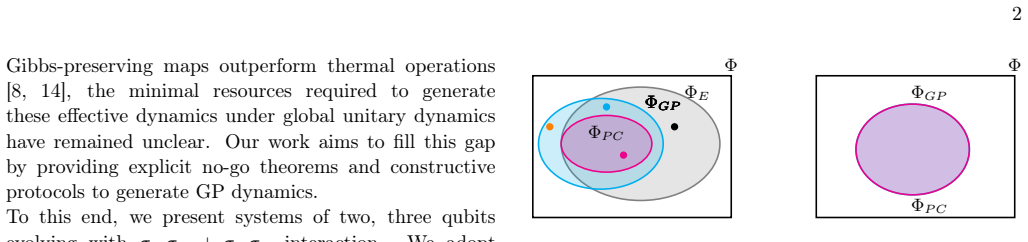
- [IV.C and Fig. 1] The hierarchy diagram states that phase-covariant maps are a proper subset of Gibbs-preserving maps. As written this is not generally true: an arbitrary phase-covariant map need not preserve the fixed Gibbs state of a given Hamiltonian unless its parameters are tuned to do so. The paper's later discussion of thermal operations versus general Gibbs-preserving maps is more careful, but the figure and the sentence in Sec. IV.C conflate 'phase-covariant maps arising from thermal operations' with all phase-covariant maps. This should be clarified, since it is part of the paper's advertised hierarchical framework.
minor comments (6)
- [Throughout] There are several typos, including 'seperable' in Sec. III.B, 'fasted' in the caption of Fig. 7, and 'correpsonds' in Appendix E.4; a careful proofread is needed.
- [Eq. (D1)] The symbol Phi is used for a unitary in Eq. (D1) but elsewhere denotes a dynamical map; use U or another letter for the unitary to avoid confusion.
- [Figs. 5-7] The bottom panel of Fig. 6 says the plot is 'as a function of the initial incoherent state z-Bloch vector component', but the abscissa is n; the caption should be corrected.
- [Appendix E.4, notation near Eq. (E8)] The notation s_{2J}, c_{2J}, s_J^2, c_J^2 is easy to confuse; the matrix entries s_{2J}^2 and c_{2J}^2 should be typeset explicitly with a notation table, since a misreading of these entries changes the fixed-point calculation.
- [Eq. (20) and surrounding text] The variables h_-, h_+, s_h+, c_h+ are used before their definitions are fully introduced; define h_+ = h1+h2 and h_- = h1-h2 at first use.
- [Footnote 24] Footnote 24 contains a CP condition and is cited in the text as '[24]', but it is a footnote, not a bibliography entry; the cross-reference should be fixed.
Circularity Check
No significant circularity: the Gibbs-preserving constraints are exactly the fixed-point conditions of the derived reduced map, with no fitted data and no load-bearing self-citation.
full rationale
The derivation chain is self-contained rather than circular. Results VI.1 and VI.3 follow from the charge-conservation lemma (Appendix B), which counts the parity of σX/σY factors in U(1)-symmetric Pauli-string expansions; this is an independent mathematical argument and does not presuppose the target no-go statement. The two-qubit maps (20)-(21) and the three-qubit map (E8) are presented as explicit partial-trace computations from Hamiltonians (17) and (19); no parameter is fitted to data. Result VI.4's constraints (23)-(25) are obtained by imposing the fixed-point equation Φ_GP(ρ_G)=ρ_G on the already-computed affine matrix (E8): with b3+f3=2rG and b3 s_{2J}^2 = -r_G c_{2J}^2, the map's z-row reproduces rG. This is the definition of Gibbs preservation applied to the derived map, not a fitted input renamed as a prediction. The thermodynamic comparisons in Section VI.D are numerical evaluations of the same constructed maps and therefore cannot be circular predictions. There is no load-bearing self-citation chain: the references to phase-covariant and thermal-operation frameworks [8-11, 21-22] are external prior work, and the paper does not import a uniqueness theorem from the author's own previous papers. Separately, the exact three-qubit map (E8) is asserted without a displayed derivation, the s_{2J}/s^2_J notation is ambiguous, and the abstract's 'two-qubit construction' wording conflicts with Result VI.4's 'exactly three qubits'; these are correctness and completeness risks, not circularity, so they do not raise the circularity score.
Assumptions & free parameters
free parameters (5)
- b3 =
0.3 in figures
- rG =
0.45 in figures
- f3 =
2rG - b3
- J =
0.25 or 0.5 in figures; tuned via arctan
- f1, f2 =
0.2, 0.1 in figures
assumptions (5)
- domain assumption Qubit energy basis aligns with the computational basis
- domain assumption Initial global state is a product state in the three-qubit protocol
- domain assumption Hamiltonian commutes with total sigma_z (U(1) symmetry)
- domain assumption XY form of the interaction
- standard math CPTP trace-preserving dynamics
Cite this review
Pith. "Pith review of Hierarchy of Qubit Dynamical Maps in the Presence of Symmetry and Coherence." pith.science (2026). https://pith.science/paper/ABNY2P2A
@misc{pith2026250904790,
  author       = {Pith},
  title        = {Pith review of: Hierarchy of Qubit Dynamical Maps in the Presence of Symmetry and Coherence},
  year         = {2026},
  howpublished = {\url{https://pith.science/paper/ABNY2P2A}},
  note         = {Machine review of arXiv:2509.04790}
}
read the original abstract
We investigate the relationship between symmetries and thermodynamic transformations by analyzing how global energy conservation and coherence resources affect the local dynamics of subsystems. We prove that U(1) conservation fundamentally constrains quantum thermodynamic operations through charge conservation of Pauli strings. Our no-go theorem shows that U(1) dynamics cannot generate local coherence from diagonal thermal states, restricting thermal operations to phase-covariant maps. Breaking this hierarchy requires environmental coherence with odd charge parity that couples unequal energy states. We establish the minimal resource requirements through a two-qubit construction that achieves Gibbs-preserving transformations beyond thermal operations. We demonstrate measurable thermodynamic advantages in work extraction and state distinguishability, revealing the fundamental role of quantum coherence in enhancing thermodynamic performance.
Figures


Figures from the paper (4 more)


Reference graph
Works this paper leans on
-
[1]
A No-go theorem showing that U(1) symmetric op- erations cannot generate local coherence from ther- mal states
-
[2]
A complete characterization of the resource hier- archy from thermal operations to Gibbs-preserving maps to general energy-preserving maps ϕPC ϕE ϕGP 0.0 0.5 1.0 1.5 2.0 0.0 0.2 0.4 0.6 0.8 1.0 n ||ρ-ρdiag||1 ρin=|+><+| ϕPC ϕE ϕGP 0.0 0.5 1.0 1.5 2.0 0.00 0.02 0.04 0.06 0.08 0.10 n ||ρ-ρdiag||1 ρin=|0><0| FIG. 6.The L1 norm between the of the off-diagonal...
-
[3]
An explicit construction demonstrating how min- imal quantum resources can achieve Gibbs- preservation
-
[4]
Quantitativemeasuresshowingthethermodynamic advantages of accessing broader transformation classes From a resource theory perspective, our work identifies the precise resources needed to move beyond thermal op- erations: environmental coherence and fine-tuned corre- lations. Thisprovidesaroadmapforunderstandingwhen and how quantum resources can enhance th...
-
[5]
complements characterization of covariant Gibbs- preserving maps by explicitly demonstrating the symmetry-breaking mechanisms required to transition between operation classes. While previous work estab- lished that free energy governs state convertibility with correlated catalysts, we show precisely how environmen- tal coherence and correlation resources ...
-
[6]
D. A. Lidar, arXiv preprintarXiv:1902.00967(2020)
arXiv 2020
-
[7]
Chitambar and G
E. Chitambar and G. Gour, Reviews of Modern Physics 91, 025001 (2019)
2019
-
[8]
A. Kolchinsky, I. Marvian, C. Gokler, Z.-W. Liu, P. Shor, O. Shtanko, K. Thompson, D. Wolpert, and S. Lloyd, Entropy27(2025), 10.3390/e27010091
Show all 34 references
-
[9]
Lostaglio, Reports on Progress in Physics82, 114001 (2019)
M. Lostaglio, Reports on Progress in Physics82, 114001 (2019)
2019
-
[10]
Brandão, M
F. Brandão, M. Horodecki, N. Ng, J. Oppenheim, and S. Wehner, Proceedings of the National Academy of Sci- ences112, 3275 (2015)
2015
-
[11]
R. W. Spekkens, Physical Review A75, 032110 (2007)
2007
-
[12]
Marvian and R
I. Marvian and R. W. Spekkens, Physical Review Letters 123, 020404 (2019)
2019
-
[13]
Faist and R
P. Faist and R. Renner, Physical Review X8, 021011 (2018)
2018
-
[14]
S. N. Filippov, A. N. Glinov, and L. Leppäjärvi, Lobachevskii Journal of Mathematics41, 617 (2020)
2020
-
[15]
W. Roga, M. Fannes, and K. Życzkowski, Reports on Mathematical Physics66, 311 (2010)
2010
-
[16]
Horodecki and J
M. Horodecki and J. Oppenheim, Nature Communica- tions4, 2059 (2013)
2013
-
[17]
N.Shiraishi,PhysicalReviewLetters134,160402(2025)
2025
-
[18]
Exploring the limits of open quantum dy- namics ii: Gibbs-preserving maps from the perspective of majorization,
F. vom Ende, “Exploring the limits of open quantum dy- namics ii: Gibbs-preserving maps from the perspective of majorization,” (2023), arXiv:2003.04164 [quant-ph]
2023 arXiv
-
[19]
Entropy, divergence, and majorization in classical and quantum thermodynamics,
T. Sagawa, “Entropy, divergence, and majorization in classical and quantum thermodynamics,” (2020), arXiv:2007.09974 [quant-ph]
2020 arXiv
-
[20]
Tajima and R
H. Tajima and R. Takagi, Physical Review Letters134, 170201 (2025)
2025
-
[21]
Shiraishi, Europhysics Letters149, 18001 (2025)
N. Shiraishi, Europhysics Letters149, 18001 (2025)
2025
-
[22]
Campbellet al., arXiv preprintarXiv:2504.20145 (2025)
S. Campbellet al., arXiv preprintarXiv:2504.20145 (2025)
2025
-
[23]
Jagadish and F
V. Jagadish and F. Petruccione, Quanta7, 54–67 (2018)
2018
-
[24]
M. B. Ruskai, S. Szarek, and E. Werner, Linear Algebra and its Applications347, 159 (2002)
2002
-
[25]
Lostaglio, K
M. Lostaglio, K. Korzekwa, D. Jennings, and T. Rudolph, Physical Review X5, 021001 (2015)
2015
-
[26]
Quantum homogenization,
M. Ziman, P. Stelmachovic, V. Buzek, M. Hillery, V. Scarani, and N. Gisin, “Quantum homogenization,” (2001), arXiv:quant-ph/0110164 [quant-ph]
2001 arXiv
-
[27]
Strasberg and A
P. Strasberg and A. Winter, PRX Quantum2, 030202 (2021)
2021
-
[28]
Fauseweh and J.-X
B. Fauseweh and J.-X. Zhu, Quantum Information Pro- cessing20(2021), 10.1007/s11128-021-03079-z
2021 doi
-
[29]
The map is completely positive only when|λz|+|τ z|≤1 and4λ 2 +τ 2 z≤[1 +λ z]2
-
[30]
11 Appendix A: U(1) symmetric qubit unitaries This appendix provides a mathematical characterization of unitary operators that commute with the U symmetry generatorG= P iσ(i) Z
We use units whereℏ=kB = 1. 11 Appendix A: U(1) symmetric qubit unitaries This appendix provides a mathematical characterization of unitary operators that commute with the U symmetry generatorG= P iσ(i) Z . As established in the main text, such unitaries exhibit a block-diagon...
-
[31]
Thermal operations and Phase-covariant dynamics For phase-covariant dynamics, we impose the following: (i)[HSE,HS +HE] =⇒h 1 =h 2 =h=⇒h − = 0,h + = 2handθ=J, (ii)[H E,ρE] = 0 =⇒b 1 =b 2 = 0and (iii) The system and environment are initially uncorrelated =⇒c ij = 0∀i,j= 1,2,3. T...
-
[32]
However, this time let the system and environment start with all possible two-body correlations
Thermal operations with system environment correlations We now consider the case where the following holds: (i)[HSE,HS +HE] =⇒h 1 =h 2 =h=⇒h − = 0,h + = 2handθ=Jand (ii)[H E,ρE] = 0 =⇒b 1 =b 2 = 0. However, this time let the system and environment start with all possible two-b...
-
[33]
While they can generate maps that have coherences, they do not have the Gibbs state as a fixed point
Correlation as a resource for single-shot Gibbs operations We have seen above that coherence in the environment/ancillary qubit|+⟩or system-environment correlations alone are not enough to generate a Gibbs-preserving map. While they can generate maps that have coherences, they...
-
[34]
A schematic of the setup is shown in Fig
Three-qubit system We will consider the three-qubit Hamiltonian discussed in the paper. A schematic of the setup is shown in Fig. 3. This Hamiltonian is energy-preserving and consequently is still in the class of covariant operations on the composite. Furthermore, we let the e...
Reviewed August 15, 2026 · model on record in the stance chip above.
Discussion (0). Continue with ORCID to comment.