REVIEW 3 major objections 5 minor 1 cited by
Holographic Einstein Ring of AdS Reissner Nordstr$\ddot{o}$m Black Holes with Euler Heisenberg Nonlinear Electrodynamics
T0 review · 3 major / 5 minor · reviewed 2026-08-15 · deepseek-v4-flash
Pith's one-line read Holographic Einstein rings of Euler–Heisenberg AdS-Reissner–Nordström black holes shrink with frequency, chemical potential, and source position, grow with charge and temperature, and are insensitive to the quantum-correction parameter.
desk verdict Routine extension of a known holographic imaging pipeline to a new black hole background, but the headline parametric claims are not anchored in the equations and the paper contradicts itself on temperature. read the letter →
The pith
A machine-rendered reading of the paper's core claim, the machinery that carries it, and where it could break.
The reading
What carries the argument
The central object is the holographic lensing response function $\langle K\rangle_{J_K}$: the boundary expectation value of the operator dual to the bulk scalar, computed mode-by-mode by solving the radial Klein–Gordon equation $z^2 F Y_l'' + (z^2F' - 2zF + 2i\omega z^2)Y_l' + [-2i\omega z - z^2 l(l+1)]Y_l = 0$, then passed through a virtual convex lens whose action is a Fourier transform (Eq. 20). The identity that carries the geometric-optics consistency check is $r_R/f = L/\omega$ (Eq. 28), which equates the wave-optics ring radius to the photon incident angle; inside the response, the shifted frequency $\tilde{\omega} = \omega + e\mu$ is the specific mechanism through which scalar charge and chemical potential move the ring.
What would settle it
Numerically vary the bulk source radial coordinate while holding frequency, charge, chemical potential, and temperature fixed, and track the brightness peak on the screen; if the peak position does not move, the claimed decrease of ring radius with $\rho$ is not a real effect. Equivalently, search the paper's equations for any occurrence of $\rho$; finding none would show that the trend is not derived.
Extended reading notes
Core claim
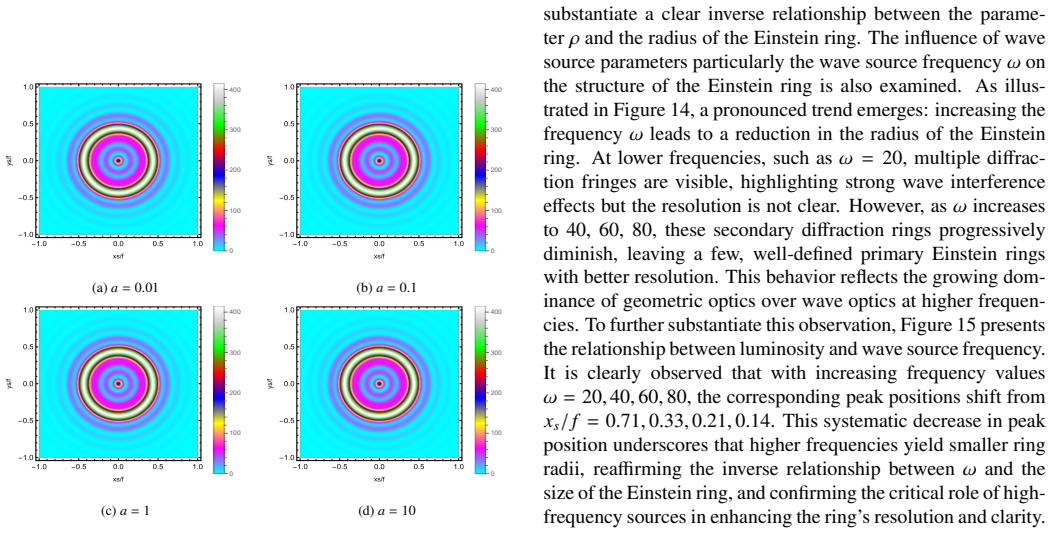
The paper's central claim is that the Einstein ring radius reconstructed from the holographic lensing response is a systematic function of boundary and bulk data: it decreases with the wave frequency $\omega$, the chemical potential $\mu$, and the radial location $\rho$, increases with the scalar-field charge $e$ and temperature $T$, and is independent of the Euler–Heisenberg parameter $a$. The mechanism is the response function $\langle K\rangle_{J_K}$, computed by solving the radial Klein–Gordon equation in the Euler–Heisenberg corrected metric; its shifted frequency $\tilde{\omega} = \omega + e\mu$ carries the charge and chemical-potential dependence, and its Fourier transform through a thin convex lens produces the screen image. In the geometric-optics limit the same ring angle is recovered from the photon incident angle, $\sin\theta_{\rm in} = L/\omega$, so the wave-optics and ray-based descriptions agree.
Load-bearing premise
The load-bearing premise is that the radial position $\rho$ is a genuine input to the computation, because the paper's equations never contain $\rho$; if the numerical runs vary some other quantity instead, the claimed decrease of ring radius with $\rho$ would be an artifact.
Editorial extensions
If this is right
- If the central claim is right, the Euler–Heisenberg correction $a$ cannot be read off from the ring radius; distinguishing quantum-corrected from classical charged AdS black holes will require the charge, temperature, and frequency dependence instead.
- The matching $r_R/f = L/\omega$ means wave-optics holographic imaging reproduces photon-ring data, so the same pipeline can be trusted for other asymptotically AdS black holes without a separate ray-tracing calculation.
- Increasing $\omega$ improves resolution while shrinking the ring, so high-frequency sources are the practical route to sharp holographic images.
- As the observer moves off-axis, the same response produces a ring, then an arc, then a bright spot, so the observed morphology directly encodes the observer's angular position.
Reading between the lines
- Because the ring radius is extracted from boundary data, the insensitivity to $a$ suggests that holographic ring size is a weak probe of one-loop QED corrections; the subleading diffraction fringes may carry more information than the ring radius.
- The identity $r_R/f = L/\omega$ should hold for any spherically symmetric asymptotically AdS spacetime with a photon sphere, so the same lensing pipeline can be applied to other nonlinear electrodynamics models to test whether the ring radius is controlled by the combination $e\mu$ and $\omega$ alone.
- As a caution grounded in the text, $\rho$ appears in the abstract, in figure captions, and in the prose of Section 4.1 but never in the equations; until an explicit $\rho$-dependent calculation is given, the reported decreasing trend in $\rho$ should be treated as unverified.
Signed reviews
Editorial analysis
A structured set of objections, weighed in public.
Referee Report
Summary. The manuscript studies holographic Einstein rings for AdS–Reissner–Nordström black holes with Euler–Heisenberg nonlinear electrodynamics. It sets up a massless charged scalar field in the bulk, computes the holographic response to a Gaussian source at the AdS boundary, and then applies a convex-lens wave-optics prescription to convert the boundary response into synthetic images. The authors report parametric dependencies of the ring radius on the scalar charge e, chemical potential μ, frequency ω, temperature T, quantum-correction parameter a, and a radial source/observer position ρ, and they compare the wave-optics ring angle with a geometric-optics photon-orbit computation using Eq. (28).
Significance. If the claims were supported, the paper would extend the established holographic-Einstein-ring program to a nonlinear-electrodynamics background and would add a systematic parameter scan, including effects of scalar charge and source position. The work has some genuine strengths: the wave-optics machinery follows the standard Hashimoto–Kinoshita–Murata and Liu–Chen–Zeng–Zhang–Zhang–Zhang prescriptions; no free parameters are fitted to produce the ring; and the geometric-optics consistency check is a nontrivial internal cross-check rather than a circular fit. However, the central parametric claims are not anchored in the equations actually solved: the parameter ρ is absent from all model equations, the temperature dependence is stated inconsistently between the abstract, Section 4.1, and Section 6, and the interpretation of e as an 'electromagnetic lensing strength' is not derived. These issues prevent the numerical results from being reproduced or falsified, so the paper in its current form does not meet the standard for publication.
major comments (3)
- [Sec. 4.1 and Figs. 12–13] The paper's headline claim that the Einstein-ring radius decreases with increasing radial source position ρ is not supported by any equation. The source is fixed at the boundary point θ0 = π in Eq. (11); the holographic response is computed from Eqs. (14)–(17), which contain no radial coordinate for the source or observer; and the lens transform in Eq. (20) depends only on the boundary angular coordinates, the aperture d, and the focal length f. Consequently, the curves labelled ρ = 10, 15, 20, 25 in Figs. 12 and 13 cannot be recomputed from the stated theory, and the claimed dependence of the ring radius on ρ is vacuous as written.
- [Abstract, Sec. 4.1, and Sec. 6] The temperature dependence of the ring radius is stated inconsistently. The abstract claims the radius increases with T, and Section 4.1 states that lower temperatures produce smaller ring radii (peak positions xs/f = 0.65, 0.38, 0.27, 0.21 as T decreases to 0.240449). In contrast, Section 6 states that the radius decreases with increasing T. These statements cannot both be correct, and the contradiction affects one of the four principal parametric claims.
- [Eq. (17) and Sec. 6] The scalar-field charge e enters the calculation only through the shifted frequency ω̃ = ω + eμ in Eq. (17), with no explicit gauge-coupling term in the radial equation (14). The claim that e enhances the 'electromagnetic lensing strength' and thereby broadens the ring is therefore an interpretive leap, not a derived mechanism; the observed peak shifts with e could be a trivial consequence of the frequency shift combined with the ω-dependence of the ring radius. The paper should demonstrate that the e-dependence is not solely mediated by the effective frequency ω̃.
minor comments (5)
- [Figure captions] Several figure captions contain undefined symbols or duplicated parameters: Fig. 18 uses c, Ω, and yh without definitions, and Fig. 17 lists e = 1 and then e = 0.5 in the same caption. Please define every symbol in each caption and remove duplicate parameter assignments.
- [Eq. (23)] Eq. (23), written as ˙r² = ω∗ − ˜Ly(r), is dimensionally inconsistent: the first term has dimensions of (energy)² while the second has dimensions of (angular momentum)². It should presumably read ˙r² = (ω∗)² − L̃²y(r). The notation also switches between L, L̃, and ˜L; please use one symbol consistently.
- [Numerical method, Sec. 3] No convergence or error analysis is reported for the pseudo-spectral solution of the radial equation (14). Since the ring radii are quoted to two decimal places from numerically extracted peak positions, a brief convergence check or estimated numerical uncertainty is needed to support the precision of the quoted values.
- [Introduction and structure] The introduction states that Section 4 provides the summary and conclusions, but the summary appears in Section 6. Please correct the cross-references.
- [Eqs. (24)–(25)] The derivation of sin²θin in Eq. (25) relies on substituting ˙r² from Eq. (23) and then taking the boundary limit; however, the intermediate steps are not shown and the result sinθin = L/ω∗ is used in Eq. (28). Please spell out the steps, especially the identification of the conserved quantities at r = ∞.
Circularity Check
No significant circularity: the ring computation is self-contained and the geometric-optics cross-check is an independent consistency test.
full rationale
The derivation chain is not circular. The holographic response is obtained by numerically solving the scalar Klein-Gordon radial equation (14) in the EH-AdS metric (1)-(2) with boundary conditions at the horizon and boundary; the response coefficients are then combined in (16) and passed through the lens transform (20). No free parameter is fitted to the ring radius, and the comparison in (28) is a consistency test between two independent consequences of the same spacetime, namely the wave-optics screen radius r_R/f and the null-geodesic incident angle L/omega, rather than a fit. The method is taken from external references [35,36,39], not from self-citations, and no load-bearing uniqueness claim is imported. I do note that the abstract and Section 4.1 claim a dependence of the ring radius on rho while rho never appears in any stated equation, for example Eqs. (11), (14), (16), or (20), and that Section 6's statement that the radius decreases with increasing T conflicts with the abstract and with Figures 16-17; however, these are missing-definition and internal-consistency defects, not circular reductions. Hence score 0.
Assumptions & free parameters
free parameters (2)
- ρ (source/observer radial position) =
varied 10, 15, 20, 25
- e (scalar field charge) =
varied 5, 10, 15, 20
assumptions (3)
- domain assumption The Euler-Heisenberg-AdS metric (Eq. 2) describes the one-loop QED corrected charged AdS black hole.
- domain assumption The pseudo-spectral solution of the radial equation (14) converges and yields the correct response coefficients ⟨K⟩_l.
- standard math The holographic dictionary identifying the boundary response ⟨K⟩^{JK} with the imaging observable is valid.
Cite this review
Pith. "Pith review of Holographic Einstein Ring of AdS Reissner Nordstr$\ddot{o}$m Black Holes with Euler Heisenberg Nonlinear Electrodynamics." pith.science (2026). https://pith.science/paper/AC3UZ46E
@misc{pith2026250513018,
  author       = {Pith},
  title        = {Pith review of: Holographic Einstein Ring of AdS Reissner Nordstr$\ddoto$m Black Holes with Euler Heisenberg Nonlinear Electrodynamics},
  year         = {2026},
  howpublished = {\url{https://pith.science/paper/AC3UZ46E}},
  note         = {Machine review of arXiv:2505.13018}
}
abstract
This study, situated within the framework of the AdS/CFT correspondence, employs wave optics methods to investigate the Einstein ring structure of quantum corrected AdS Reissner Nordstr$\ddot{o}$m black holes governed by Euler Heisenberg nonlinear electrodynamics. A wave source placed on the AdS boundary yields a response function on the antipodal side, from which a virtual optical system with a convex lens reconstructs the holographic image of the Einstein ring. The analysis systematically explores the impact of physical parameters and observer position on the ring's morphology. As the observer's position varies, the image transitions from a complete ring to an arc and eventually to a single bright point. The Einstein ring radius is observed to decrease with increasing radial source position $\rho$, wave frequency $\omega$, and chemical potential $\mu$, while it increases with electric charge $e$ and temperature $T$. In contrast, the quantum correction parameter $a$ has negligible effect on the ring radius or response amplitude, as its contribution falls off rapidly near the boundary and remains subleading in the wave dynamics. The parameter $e$ enhances the electromagnetic lensing strength, leading to a broader ring, whereas increasing $\rho$ alters wavefront propagation, affecting both brightness peak and ring location. Geometric optics analysis confirms that the incident angle of the photon ring matches the Einstein ring angle, validating consistency across frameworks. Overall, the results highlight how nonlinear electromagnetic effects and bulk field configurations manifest in observable boundary features, providing a means to distinguish quantum-corrected black holes from classical solutions.
Figures


Figures from the paper (14 more)




Forward citations
Cited by 1 Pith paper
-
High-order QED correction impacts on phase transition of the Euler-Heisenberg dS spacetime
The dual-horizon coexistence region in Euler-Heisenberg de Sitter spacetime exhibits van der Waals-like phase transitions whose order depends on a nonlinear parameter, with a constant topological number W=+1.
Reference graph
Works this paper leans on
-
[1]
J. M. Maldacena, Adv. Theor. Math. Phys. 2 (1998), 231-252
1998
-
[2]
S. A. Hartnoll, C. P. Herzog and G. T. Horowitz, JHEP 12 (2008), 015
2008
-
[3]
S. A. Hartnoll, C. P. Herzog and G. T. Horowitz, Phys. Rev. Lett. 101 (2008), 031601 11
work page 2008
-
[4]
S. S. Gubser, Phys. Rev. D 78 (2008), 065034
2008
-
[5]
Cubrovic, J
M. Cubrovic, J. Zaanen and K. Schalm, Science 325 (2009), 439-444
2009
-
[6]
H. Liu, J. McGreevy and D. Vegh, Phys. Rev. D 83 (2011), 065029
2011
-
[7]
Faulkner, H
T. Faulkner, H. Liu, J. McGreevy and D. Vegh, Phys. Rev. D 83 (2011), 125002
2011
-
[8]
Me fford and G
E. Me fford and G. T. Horowitz, Phys. Rev. D90 (2014) no.8, 084042
2014
Show all 75 references
-
[9]
Kiritsis and J
E. Kiritsis and J. Ren, JHEP 09 (2015), 168
2015
-
[10]
Donos and J
A. Donos and J. P. Gauntlett, JHEP 06 (2014), 007
2014
-
[11]
Shipley and S
J. Shipley and S. R. Dolan, Class. Quant. Grav. 33 (2016) no.17, 175001
2016
-
[12]
Bambi and K
C. Bambi and K. Freese, Phys. Rev. D 79 (2009), 043002
2009
-
[13]
Atamurotov, A
F. Atamurotov, A. Abdujabbarov and B. Ahmedov, Astrophys. Space Sci. 348 (2013), 179-188
2013
-
[14]
A. K. Mishra, S. Chakraborty and S. Sarkar, Phys. Rev. D 99 (2019) no.10, 104080
2019
-
[15]
P. G. Nedkova, V . K. Tinchev and S. S. Yazadjiev, Phys. Rev. D88 (2013) no.12, 124019
2013
-
[16]
Y . X. Chen, H. B. Zheng, K. J. He, G. P. Li and Q. Q. Jiang, Chin. Phys. C 48 (2024), no.12, 125104
2024
-
[17]
K. J. He, Z. Luo, S. Guo and G. P. Li, Chin. Phys. C 48, no.6, 065105 (2024)
2024
-
[18]
Shaikh, P
R. Shaikh, P. Kocherlakota, R. Narayan and P. S. Joshi, Mon. Not. Roy. Astron. Soc. 482 (2019) no.1, 52-64
2019
-
[19]
X. Wang, Z. Zhao, X. X. Zeng and X. Y . Wang, [arXiv:2501.08287 [gr- qc]]
-
[20]
C. Y . Yang, M. I. Aslam, X. X. Zeng and R. Saleem, [arXiv:2411.11807 [astro-ph.HE]]
-
[21]
K. J. He, G. P. Li, C. Y . Yang and X. X. Zeng, [arXiv:2411.11680 [astro- ph.HE]]
-
[22]
K. J. He, J. T. Yao, X. Zhang and X. Li, Phys. Rev. D 109, no.6, 064049 (2024)
2024
-
[23]
K. J. He, S. C. Tan and G. P. Li, Eur. Phys. J. C 82, no.1, 81 (2022)
2022
-
[24]
K. J. He, X. Zhang and X. Li, Chin. Phys. C 46, no.7, 075103 (2022)
2022
-
[25]
K. J. He, S. Guo, S. C. Tan and G. P. Li, Chin. Phys. C 46, no.8, 085106 (2022)
2022
-
[26]
X. X. Zeng, G. P. Li and K. J. He, Nucl. Phys. B 974, 115639 (2022)
2022
-
[27]
K. J. He, C. Y . Yang and X. X. Zeng, [arXiv:2501.06778 [astro-ph.HE]]
-
[28]
Some aspects of ModMax (A)dS black holes: Thermodynamics properties, heat engine, shadow, null geodesic and light trajectory,
B. Eslam Panah and N. Heidari, “Some aspects of ModMax (A)dS black holes: Thermodynamics properties, heat engine, shadow, null geodesic and light trajectory,” J. High Energy Astrophys.45, 181 (2025), doi:10.1016/j.jheap.2024.12.00
2025 doi
-
[29]
Thermodynamics and Optical Properties of Phantom AdS Black Holes in Massive Gravity,
Kh. Jafarzade, B. Eslam Panah and M. E. Rodrigues, “Thermodynamics and Optical Properties of Phantom AdS Black Holes in Massive Gravity,” Class. Quant. Grav. 41, 065007 (2024), doi:10.1088 /1361-6382/ad242e [arXiv:2402.08704 [gr-qc]]
2024 arXiv
-
[30]
Black holes in dRGT massive gravity with the signature of EHT observations of M87*,
S. H. Hendi, Kh. Jafarzade and B. Eslam Panah, “Black holes in dRGT massive gravity with the signature of EHT observations of M87*,” JCAP 02, 022 (2023), doi:10.1088 /1475-7516/2023/02/022 [arXiv:2206.05132 [gr-qc]]
2023 arXiv
-
[31]
Charged 4D Einstein- Gauss-Bonnet-AdS Black Holes: Shadow, Energy Emission, Deflec- tion Angle and Heat Engine,
B. Eslam Panah, Kh. Jafarzade and S. H. Hendi, “Charged 4D Einstein- Gauss-Bonnet-AdS Black Holes: Shadow, Energy Emission, Deflec- tion Angle and Heat Engine,” Nucl. Phys. B 961, 115269 (2020), doi:10.1016/j.nuclphysb.2020.115269 [arXiv:2004.04058 [gr-qc]]
2020
-
[32]
Thermal fluctuations of black holes with non-linear electrodynamics and charged Renyi entropy,
G. Arenas-Henriquez, F. Diaz and Y . Novoa, “Thermal fluctuations of black holes with non-linear electrodynamics and charged Renyi entropy,” J. High Energ. Phys. 2023, 72 (2023), doi:10.1007/JHEP05(2023)072
2023 doi
-
[33]
Akiyama et al
K. Akiyama et al. [Event Horizon Telescope], Astrophys. J. Lett. 875 (2019), L1
2019
-
[34]
Akiyama et al
K. Akiyama et al. [Event Horizon Telescope], Astrophys. J. Lett. 930 (2022) no.2, L12
2022
-
[35]
Hashimoto, S
K. Hashimoto, S. Kinoshita and K. Murata, Phys. Rev. Lett. 123 (2019) no.3, 031602
2019
-
[36]
Hashimoto, S
K. Hashimoto, S. Kinoshita and K. Murata, Phys. Rev. D 101 (2020) no.6, 066018
2020
-
[37]
Y . Kaku, K. Murata and J. Tsujimura, JHEP 09 (2021), 138
2021
-
[38]
I. R. Klebanov and E. Witten, Nucl. Phys. B 556 (1999), 89-114
1999
-
[39]
Y . Liu, Q. Chen, X. X. Zeng, H. Zhang, W. L. Zhang and W. Zhang, JHEP 10 (2022), 189
2022
-
[40]
X. X. Zeng, K. J. He, J. Pu, G. p. Li and Q. Q. Jiang, Eur. Phys. J. C 83 (2023) no.10, 897
2023
-
[41]
X. X. Zeng, L. F. Li and P. Xu, Eur. Phys. J. C 84 (2024) no.7, 714
2024
-
[42]
X. X. Zeng, M. I. Aslam, R. Saleem and X. Y . Hu, [arXiv:2311.04680 [gr-qc]]
-
[43]
X. Y . Hu, X. X. Zeng, L. F. Li and P. Xu, Results Phys.61 (2024), 107707
2024
-
[44]
G. P. Li, K. J. He, X. Y . Hu and Q. Q. Jiang, Front. Phys. (Beijing) 19 (2024), no.5, 54202
2024
-
[45]
K. J. He, Y . W. Han and G. P. Li, Phys. Dark Univ.44 (2024), 101468
2024
-
[46]
Z. Luo, K. J. He and J. Li, [arXiv:2409.11885 [gr-qc]]
-
[47]
X. X. Zeng, L. F. Li, P. Li, B. Liang and P. Xu, Sci. China Phys. Mech. Astron. 68 (2025) no.2, 220412
2025
-
[48]
X. X. Zeng, X. Y . Hu and K. J. He, [arXiv:2406.03083 [hep-th]]
-
[49]
J. Y . Gui, X. X. Zeng, K. J. He and H. Ye, [arXiv:2407.09069 [hep-th]]
-
[50]
K. J. He, Y . W. Han and G. P. Li, Nucl. Phys. B1010, 116768 (2025)
2025
-
[51]
Foundations of the new field theory,
M. Born and L. Infeld, “Foundations of the new field theory,” Proc. Roy. Soc. Lond. A 144, 852 (1934)
1934
-
[52]
Consequences of Dirac’s theory of positrons,
W. Heisenberg and H. Euler, “Consequences of Dirac’s theory of positrons,” Z. Phys. 98, 714 (1936)
1936
-
[53]
String loop corrections to e ffective actions,
L. Magnea, R. Russo and S. Sciuto, “String loop corrections to e ffective actions,” Int. J. Mod. Phys. A 21, 533 (2006)
2006
-
[54]
Duality, strings and non-linear electrodynamics,
S. Sciuto, “Duality, strings and non-linear electrodynamics,” Afr. J. Math. Phys. 3, 45 (2006)
2006
-
[55]
Geometrical aspects of light propagation in nonlinear electrodynamics,
M. Novello, V . A. De Lorenci, J. M. Salim and R. Klippert, “Geometrical aspects of light propagation in nonlinear electrodynamics,” Phys. Rev. D 61, 045001 (2000)
2000
-
[56]
Observation of Light-by-Light Scattering in Heavy- Ion Collisions,
M. Aaboud et al., “Observation of Light-by-Light Scattering in Heavy- Ion Collisions,” Nature Phys. 13, 852 (2017)
2017
-
[57]
Evidence for light-by-light scattering in heavy-ion colli- sions with the ATLAS detector at the LHC,
G. Aad et al., “Evidence for light-by-light scattering in heavy-ion colli- sions with the ATLAS detector at the LHC,”Phys. Rev. Lett. 123, 052001 (2019)
2019
-
[58]
Vacuum birefringence effects from a new perspective,
L. M. Capparelli, A. Damiano, L. Maiani and A. D. Polosa, “Vacuum birefringence effects from a new perspective,” Eur. Phys. J. C 77, 754 (2017)
2017
-
[59]
On Gauge Invariance and Vacuum Polarization,
J. S. Schwinger, “On Gauge Invariance and Vacuum Polarization,” Phys. Rev. 82, 664 (1951)
1951
-
[60]
The scattering of light by light in Dirac’s the- ory,
H. Euler and B. Kockel, “The scattering of light by light in Dirac’s the- ory,”Naturwiss. 23, 246 (1935)
1935
-
[61]
Further studies on light scattering in Dirac’s theory,
H. Euler, “Further studies on light scattering in Dirac’s theory,” Annalen Phys. 26, 398 (1936)
1936
-
[62]
Photon splitting in a strong magnetic field,
S. L. Adler, J. N. Bahcall, C. G. Callan and M. N. Rosenbluth, “Photon splitting in a strong magnetic field,” Phys. Rev. Lett. 25, 1061 (1970)
1970
-
[63]
Photon splitting and photon dispersion in a strong magnetic field,
S. L. Adler, “Photon splitting and photon dispersion in a strong magnetic field,” Annals Phys. (N.Y.) 67, 599 (1971)
1971
-
[64]
Nonlinear electrodynamics and black hole shadows,
M. Okyay and A. ¨Ovg¨un, “Nonlinear electrodynamics and black hole shadows,” JCAP 01, 009 (2022)
2022
-
[65]
E ffective Lagrangians in nonlinear electrody- namics,
W. Dittrich and H. Gies, “E ffective Lagrangians in nonlinear electrody- namics,” Phys. Rev. D 58, 025004 (1998)
1998
-
[66]
Plebanski, Lectures on Nonlinear Electrodynamics , Nordita, RX-476 (1970)
J. Plebanski, Lectures on Nonlinear Electrodynamics , Nordita, RX-476 (1970)
1970
-
[67]
Magnetically charged black holes from nonlinear electrodynamics and their shadows,
A. Allahyari, M. Khodadi, S. Vagnozzi and D. F. Mota, “Magnetically charged black holes from nonlinear electrodynamics and their shadows,” JCAP 2002, 003 (2020)
2020
-
[68]
Observational signature and gravitational lensing of black holes in nonlinear electrody- namics,
X. X. Zeng, K. J. He, G. P. Li, E. W. Liang and S. Guo, “Observational signature and gravitational lensing of black holes in nonlinear electrody- namics,” Eur. Phys. J. C 82, 764 (2022)
2022
-
[69]
Shadow and weak gravitational lensing of Born-Infeld-type black holes,
J. Y . Kim, “Shadow and weak gravitational lensing of Born-Infeld-type black holes,” Eur. Phys. J. C 82, 485 (2022)
2022
-
[70]
Thermodynamics of Einstein–Euler–Heisenberg black holes,
Y . Zhao and H. Cheng, “Thermodynamics of Einstein–Euler–Heisenberg black holes,” Chinese Phys. C 48, 125106 (2024)
2024
-
[71]
Thermal fluctuation corrections to EEH black holes,
H. Gursel, M. Mangut and E. Sucu, “Thermal fluctuation corrections to EEH black holes,” arXiv:2503.12306
-
[72]
Gravitational lensing by quantum corrected Ein- stein–Euler–Heisenberg black holes,
P. Su and C.-K. Qiao, “Gravitational lensing by quantum corrected Ein- stein–Euler–Heisenberg black holes,” arXiv:2410.02411
-
[73]
Accretion disk properties around EEH black holes,
Y .-H. Jiang and T. Wang, “Accretion disk properties around EEH black holes,” Phys. Rev. D 110, 103009 (2024)
2024
-
[74]
Black hole shadows and quasinormal modes in Einstein–Euler–Heisenberg gravity,
G. Lambiase, D. J. Gogoi, R. C. Pantig and A. ¨Ovg¨un, “Black hole shadows and quasinormal modes in Einstein–Euler–Heisenberg gravity,” Phys. Dark Univ. 48, 101886 (2025)
2025
-
[75]
Daniela Magos and Nora Bret ´on, Thermodynamics of the Eu- ler–Heisenberg–AdS black hole, Phys. Rev. D 102, 084011 (2020). 12
2020
Reviewed August 15, 2026 · model on record in the stance chip above.
Discussion (0). Continue with ORCID to comment.