REVIEW 3 major objections 5 minor 63 references
Efficient Detection Framework Adaptation for Edge Computing: A Plug-and-play Neural Network Toolbox Enabling Edge Deployment
T0 review · 3 major / 5 minor · reviewed 2026-08-11 · deepseek-v4-flash
Pith's one-line read A plug-and-play toolbox of three modules shrinks CNN object detectors for edge hardware while raising accuracy, demonstrated on a new helmet-band safety dataset.
desk verdict A useful engineering toolbox paper with a new safety dataset, but the complexity proof doesn't match the architecture and the HBDD real-world validation is weakened by synthetic negative samples. read the letter →
The pith
A machine-rendered reading of the paper's core claim, the machinery that carries it, and where it could break.
The reading
What carries the argument
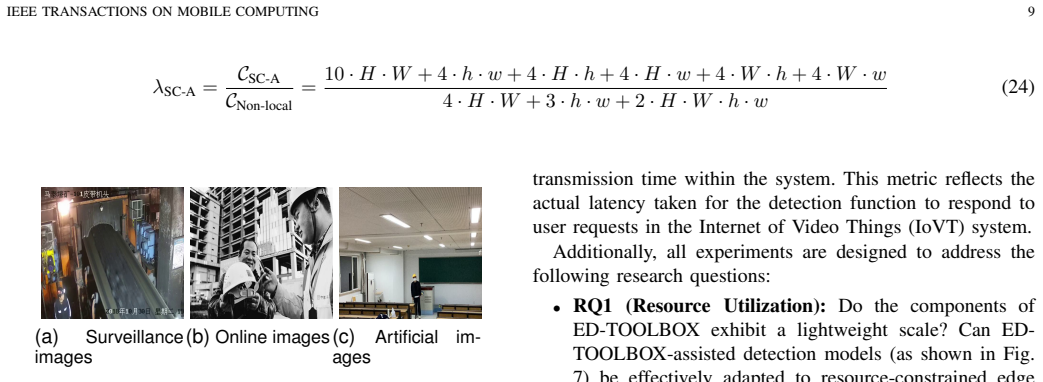
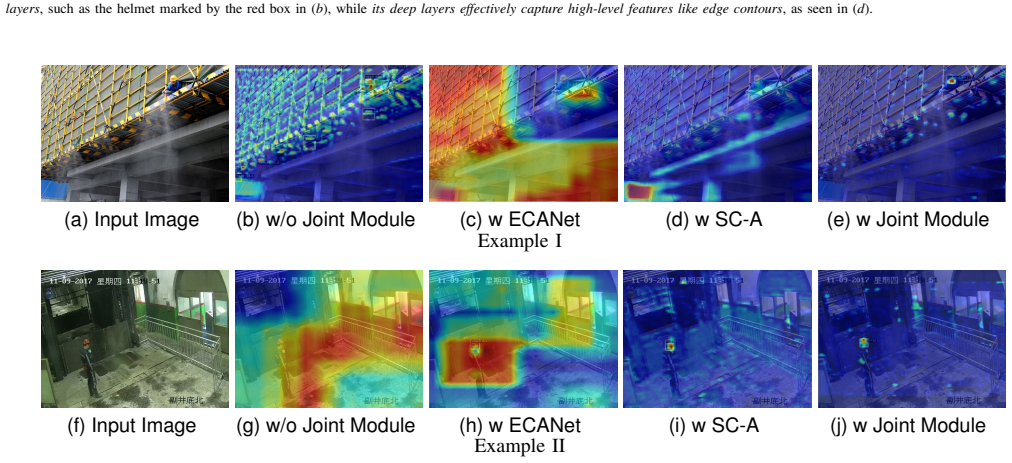
Three named components carry the argument. Rep-DConvNet (Reparameterized Dynamic Convolutional Network) is a lightweight block that splits channels into groups, applies weighted horizontal ($1\times3$), vertical ($3\times1$), and square ($3\times3$) depthwise convolutions with a residual, then channel-shuffles; during inference the branches fuse into one convolution, giving multi-branch training with lower inference cost. SC-A (Sparse Cross-Attention) is a parameter-free attention inside the Joint Module: it pools feature maps along horizontal and vertical directions to form $H+W$ tokens, computes cross-attention between current-module and upstream-module tokens, then expands back to spatial maps, capturing long-range dependencies at $\mathcal{O}(H+W)$ complexity instead of Non-local's $\mathcal{O}(H\cdot W \cdot h \cdot w)$. The Efficient Head replaces YOLOv8's dual-branch decoupled head with a single-branch Ghost-convolution head and adds a $160\times160$ detection branch for small objects.
What would settle it
Run ED-YOLO trained only on HBDD on a held-out set of genuine, unedited surveillance clips from working mines showing unfastened chin straps, and compare its mAP with the reported 91.34; a large drop would show the simulation-generated negative samples are not faithful proxies for real deployment.
Extended reading notes
Core claim
The central claim is that detection-specific plug-and-play modules are what let a detector stay accurate after being compressed for the edge, and the paper demonstrates this with three such modules. Rep-DConvNet replaces standard convolutions with weighted horizontal, vertical, and square depthwise branches plus a residual, fusing the branches at inference time; on a large public classification benchmark it uses 1.8 million parameters and 154.9 million FLOPs at 72.7% accuracy, below most lightweight baselines in size. SC-A, the parameter-free Sparse Cross-Attention inside the Joint Module, pools feature maps into horizontal and vertical tokens, computes cross-attention between the current module and its upstream neighbor, and expands the result back, capturing long-range dependencies without added parameters. The Efficient Head replaces YOLOv8's dual-branch decoupled head with a single-branch Ghost-convolution head and adds a $160\times160$ detection branch aimed at small objects. On the new HBDD benchmark, ED-YOLO reaches 91.34 mAP with 10.9 million parameters and 19.7 GFLOPs, and in a surveillance-system simulation on a low-power embedded GPU it sustains 21.6 FPS with 16.86 total FPS including data transmission, an accuracy level close to much heavier cloud models.
Load-bearing premise
The new dataset's negative examples (helmets worn without fastened straps) are partly simulation-generated, and the paper assumes these synthetic images match real mine-surveillance footage closely enough that the reported accuracy survives deployment.
Editorial extensions
If this is right
- ED-YOLO trained with the toolbox can be deployed on a low-power embedded GPU and still detect small helmet straps in near-real time, with total throughput of 16.86 FPS including data transmission in the simulated surveillance system.
- The same Rep-DConvNet backbone inserted into SSD lifts mAP by 9.22 points while cutting FLOPs by 16%, indicating the components transfer beyond YOLO to at least one other CNN detector.
- Removing any single component degrades the result: without Rep-DConvNet mAP falls 6.19 points and FLOPs rise 74.9%, and without the Joint Module mAP falls 3.61 points.
- The HBDD dataset introduces a safety-critical class absent from prior helmet datasets, unfastened chin straps, and the paper shows the toolbox detects these small targets when standard lightweight models miss them.
- The authors explicitly limit the toolbox to CNN-based detectors; Transformer detectors and other tasks such as segmentation and tracking are not supported.
Reading between the lines
- If HBDD's simulated negative images are visually faithful to real mine footage, the reported accuracy should transfer; the quickest check is a test set of genuine unfastened-strap surveillance images, which the authors do not provide.
- The SC-A tokenization (pooling to $H+W$ tokens) is a general complexity reduction that could be applied to other pairwise attention modules, such as multi-scale feature fusion for segmentation, although the paper does not claim this.
- The combination of a parameter-free attention module with reparameterized convolutions suggests that both training-time structural augmentation and inference-time fusion contribute to the small-object gain; an ablation varying only the fusion without the weighted branches could separate the two effects.
- The authors' future plan to fine-tune a pre-trained general module per task points toward a foundation-model-style deployment kit, but nothing in the current experiments tests that path.
Signed reviews
Editorial analysis
A structured set of objections, weighed in public.
Referee Report
Summary. The paper proposes ED-TOOLBOX, a set of plug-and-play modules for adapting CNN-based object detectors to edge devices: Rep-DConvNet (a reparameterized multi-branch backbone block), SC-A (a sparse cross-attention module forming a Joint Module), and an Efficient Head for YOLO-style detectors. The authors introduce the Helmet Band Detection Dataset (HBDD) for detecting improper helmet wearing, including chin-strap fastening, and evaluate ED-YOLO and ED-SSD on ImageNet, COCO, HBDD, and a Jetson TX2-based IoVT surveillance simulation. The central empirical claim is that ED-YOLO achieves 91.34 mAP on HBDD with 10.9M parameters and 19.7 GFLOPs, reducing parameters by 17% and FLOPs by 23% versus YOLOv8-s while improving mAP, and that it reaches 21.6 FPS on the edge device.
Significance. If the empirical results hold, the paper provides a practical and modular recipe for shrinking YOLO-family detectors while preserving or improving accuracy, plus a new dataset that targets an underexplored safety task (chin-strap detection). The zero-parameter SC-A module, the component-wise ablation, and the edge simulation are valuable assets. However, the theoretical complexity proofs contain a mismatch with the described architecture, and the real-world validity of the HBDD evaluation is weakened by the use of simulation-generated negative samples. The COCO evidence for generality is reported only in prose, not in a table. The core empirical claim is plausible but needs these points addressed before publication.
major comments (3)
- [Section III-B and IV-B] Eq. (2) defines branches with 1×3, 3×1, and 3×3 kernels but uses the sgn function in a way that does not select a single branch: with the standard convention sgn(0)=0, group i=1 receives negative contributions from the other branches; with sgn(0)=1, group i=2 receives two branches. Please replace this with an explicit per-group branch assignment. Moreover, Assumption 1 in Section IV-B states that all three convolution branches use 3×3 kernels, contradicting Eq. (2), and the complexity counts in Eqs. (10)–(15) use 9 multiply-adds for every branch. Since Theorem 1 is the basis for the 'lower complexity than RepVGG' claim, the assumption must be aligned with the actual kernels (1×3 and 3×1 each cost 3 multiply-adds) or the proof revised.
- [Section V-A and V-C] The HBDD negative samples are supplemented by simulation-generated images because real surveillance rarely contains improperly worn helmets, and the 8:2 random split is over the combined set, so the test set likely contains synthetic negatives. The paper gives no per-class AP, no separate results on real-only images, and no domain-gap analysis. As the practical-impact claim depends on accurate hatband detection in real CCTV footage, the reported mAP (Table V: 91.34; Table VII: 90.21) may not transfer to deployment. Please report per-class AP (especially 'noband'), evaluate on a real-only subset if feasible, or explicitly state that the test set includes synthetic images and temper the 'real-world validation' claim accordingly.
- [Section V-C, 'Numerical Results'] The COCO2017 comparison is given only in prose (ED-YOLO 61.5% vs YOLOv8-s 57.9%) without a table, training schedule, input resolution, or the other methods' COCO numbers. This result is load-bearing for the generality claim (RQ4). Please provide a full COCO comparison table with the same details as the HBDD experiments, or clearly label these numbers as preliminary.
minor comments (5)
- [Section V-C] 'Compared to the original ED-SSD' should read 'compared to the original SSD-VGG' (the same typo appears in the following sentence).
- [Section V-C] The stated parameter reduction of '17%' for ED-YOLO is inconsistent with Table V, which gives 14.3M → 10.9M, a 23.8% reduction.
- [Section V-D] The ablation text says removing Rep-DConvNet 'increases FLOPs by 74.9%', but Table VI shows 28.519 vs 19.725 GFLOPs, a 44.6% increase.
- [Eq. (12)] The expression '= 9+4 / (27·Cin+1)' should be written as '(9+4)/(27·Cin+1)' to avoid ambiguity.
- [Throughout] Typos such as 'Adittionally', 'inferece', 'Deteails', and 'A Edge Detection Toolbox' should be corrected.
Circularity Check
No significant circularity: the claimed gains are tested against external benchmarks and a new dataset, and the complexity bounds follow from stated assumptions rather than from the results they purport to explain.
full rationale
The paper's central claims are empirical: ED-TOOLBOX components improve accuracy and reduce model scale on ImageNet, COCO-2017, and the newly introduced HBDD. These evaluations are self-contained against external benchmarks, so the reported mAP, parameter, and FLOPs numbers are not constructed from the test data. The theoretical complexity claims (Theorems 1 and 2) are derived from explicitly stated assumptions (e.g., equal input/output channels, approximately square inputs) and are algebraic comparisons against RepVGG and Non-local baselines; they do not presuppose the empirical accuracy results. The ablation study (Table VI) tests each component by removal, which is a standard causal attribution rather than a circular definition of the component's contribution. The only self-citations, such as Refs. [4], [6], and [12], appear as related-work context and future-work inspiration, and none is load-bearing for the paper's central derivation or evaluation. The use of simulation-generated images to supplement HBDD negative samples is a limitation for real-world transferability, but it is not circular: the model is trained and evaluated on a held-out split of that dataset, and the claim is about performance on the constructed benchmark rather than an assumption of the benchmark's outcome. Overall, no derivation step reduces, by construction or by self-citation, to its own inputs.
Assumptions & free parameters
assumptions (5)
- ad hoc to paper Assumption 1: The multi-branch network consists of four branches, each employing a 3x3 convolutional layer.
- domain assumption Assumption 2: Input and output channels are equal (Cin = Cout).
- domain assumption Assumption 3: Channel shuffle cost c is negligible.
- domain assumption Assumption 4: Feature maps A and B have identical dimensions (H=h, W=w).
- domain assumption Assumption 5: Input aspect ratio is 1.
Cite this review
Pith. "Pith review of Efficient Detection Framework Adaptation for Edge Computing: A Plug-and-play Neural Network Toolbox Enabling Edge Deployment." pith.science (2026). https://pith.science/paper/ACUKMGI3
@misc{pith2026241218230,
  author       = {Pith},
  title        = {Pith review of: Efficient Detection Framework Adaptation for Edge Computing: A Plug-and-play Neural Network Toolbox Enabling Edge Deployment},
  year         = {2026},
  howpublished = {\url{https://pith.science/paper/ACUKMGI3}},
  note         = {Machine review of arXiv:2412.18230}
}
read the original abstract
Edge computing has emerged as a key paradigm for deploying deep learning-based object detection in time-sensitive scenarios. However, existing edge detection methods face challenges: 1) difficulty balancing detection precision with lightweight models, 2) limited adaptability of generalized deployment designs, and 3) insufficient real-world validation. To address these issues, we propose the Edge Detection Toolbox (ED-TOOLBOX), which utilizes generalizable plug-and-play components to adapt object detection models for edge environments. Specifically, we introduce a lightweight Reparameterized Dynamic Convolutional Network (Rep-DConvNet) featuring weighted multi-shape convolutional branches to enhance detection performance. Additionally, we design a Sparse Cross-Attention (SC-A) network with a localized-mapping-assisted self-attention mechanism, enabling a well-crafted joint module for adaptive feature transfer. For real-world applications, we incorporate an Efficient Head into the YOLO framework to accelerate edge model optimization. To demonstrate practical impact, we identify a gap in helmet detection -- overlooking band fastening, a critical safety factor -- and create the Helmet Band Detection Dataset (HBDD). Using ED-TOOLBOX-optimized models, we address this real-world task. Extensive experiments validate the effectiveness of ED-TOOLBOX, with edge detection models outperforming six state-of-the-art methods in visual surveillance simulations, achieving real-time and accurate performance. These results highlight ED-TOOLBOX as a superior solution for edge object detection.
Figures


Figures from the paper (12 more)






Reference graph
Works this paper leans on
-
[1]
Yolov8-qsd: An improved small object detection algorithm for autonomous vehicles based on yolov8,
H. Wang, C. Liu, Y . Cai, L. Chen, and Y . Li, “Yolov8-qsd: An improved small object detection algorithm for autonomous vehicles based on yolov8,” IEEE Transactions on Instrumentation and Measurement, 2024
work page 2024
-
[2]
A generalist vision–language foundation model for diverse biomedical tasks,
K. Zhang, R. Zhou, E. Adhikarla, Z. Yan, Y . Liu, J. Yu, Z. Liu, X. Chen, B. D. Davison, H. Ren et al., “A generalist vision–language foundation model for diverse biomedical tasks,” Nature Medicine, pp. 1–13, 2024
2024
-
[3]
J. Chen, J. Mei, X. Li, Y . Lu, Q. Yu, Q. Wei, X. Luo, Y . Xie, E. Adeli, Y . Wanget al., “Transunet: Rethinking the u-net architecture design for medical image segmentation through the lens of transformers,” Medical Image Analysis, vol. 97, p. 103280, 2024
work page 2024
-
[4]
J. Wu, R. Zheng, J. Jiang, Z. Tian, W. Chen, Z. Wang, F. R. Yu, and V . C. Leung, “A lightweight small object detection method based on multi-layer coordination federated intelligence for coal mine iovt,” IEEE Internet of Things Journal , 2024
work page 2024
-
[5]
D. K. Jain, X. Zhao, C. Gan, P. K. Shukla, A. Jain, and S. Sharma, “Fusion-driven deep feature network for enhanced object detection and tracking in video surveillance systems,” Information Fusion , vol. 109, p. 102429, 2024
work page 2024
-
[6]
J. Wu, R. Jing, Y . Bai, Z. Tian, C. Wei, S. Zhang, F. R. Yu, and V . C. Leung, “Small insulator defects detection based on multi-scale feature interaction transformer for uav-assisted power iovt,” IEEE Internet of Things Journal, 2024
work page 2024
-
[7]
Edge comput- ing with artificial intelligence: A machine learning perspective,
H. Hua, Y . Li, T. Wang, N. Dong, W. Li, and J. Cao, “Edge comput- ing with artificial intelligence: A machine learning perspective,” ACM Computing Surveys, vol. 55, no. 9, pp. 1–35, 2023
2023
-
[8]
Edge-computing-driven internet of things: A survey,
L. Kong, J. Tan, J. Huang, G. Chen, S. Wang, X. Jin, P. Zeng, M. Khan, and S. K. Das, “Edge-computing-driven internet of things: A survey,” ACM Computing Surveys , vol. 55, no. 8, pp. 1–41, 2022
work page 2022
Show all 63 references
-
[9]
Cloud computing in construction industry: Use cases, benefits and challenges,
S. A. Bello, L. O. Oyedele, O. O. Akinade, M. Bilal, J. M. D. Delgado, L. A. Akanbi, A. O. Ajayi, and H. A. Owolabi, “Cloud computing in construction industry: Use cases, benefits and challenges,” Automation in Construction, vol. 122, p. 103441, 2021
2021
-
[10]
Edge yolo: Real-time intelligent object detection system based on edge-cloud cooperation in autonomous vehicles,
S. Liang, H. Wu, L. Zhen, Q. Hua, S. Garg, G. Kaddoum, M. M. Hassan, and K. Yu, “Edge yolo: Real-time intelligent object detection system based on edge-cloud cooperation in autonomous vehicles,” IEEE Transactions on Intelligent Transportation Systems , vol. 23, no. 12, pp. 25 ...
2022
-
[11]
Cooperative multi- camera vehicle tracking and traffic surveillance with edge artificial intelligence and representation learning,
H. F. Yang, J. Cai, C. Liu, R. Ke, and Y . Wang, “Cooperative multi- camera vehicle tracking and traffic surveillance with edge artificial intelligence and representation learning,” Transportation research part C: emerging technologies , vol. 148, p. 103982, 2023
2023
-
[12]
A small object real-time detection method for power line inspection in low-illuminance environments,
Y . Zhao, J. Wu, W. Chen, Z. Wang, Z. Tian, F. R. Yu, and V . C. Leung, “A small object real-time detection method for power line inspection in low-illuminance environments,” IEEE Transactions on Emerging Topics in Computational Intelligence , 2024. IEEE TRANSACTIONS ON MOBILE...
2024
-
[13]
Mobilenets: Efficient convolutional neural networks for mobile vision applications,
A. G. Howard, “Mobilenets: Efficient convolutional neural networks for mobile vision applications,” arXiv preprint arXiv:1704.04861 , 2017
2017 arXiv
-
[14]
Mobilevit: Light-weight, general-purpose, and mobile-friendly vision transformer,
S. Mehta and M. Rastegari, “Mobilevit: Light-weight, general-purpose, and mobile-friendly vision transformer,” in International Conference on Learning Representations, 2022
2022
-
[15]
Efficientformer: Vision transformers at mobilenet speed,
Y . Li, G. Yuan, Y . Wen, J. Hu, G. Evangelidis, S. Tulyakov, Y . Wang, and J. Ren, “Efficientformer: Vision transformers at mobilenet speed,” Ad- vances in Neural Information Processing Systems , vol. 35, pp. 12 934– 12 949, 2022
2022
-
[16]
The yolo framework: A comprehensive review of evolution, applications, and benchmarks in object detection,
M. L. Ali and Z. Zhang, “The yolo framework: A comprehensive review of evolution, applications, and benchmarks in object detection,” 2024
2024
-
[17]
Ssd: Single shot multibox detector,
W. Liu, D. Anguelov, D. Erhan, C. Szegedy, S. Reed, C.-Y . Fu, and A. C. Berg, “Ssd: Single shot multibox detector,” in Computer Vision– ECCV 2016: 14th European Conference, Amsterdam, The Netherlands, October 11–14, 2016, Proceedings, Part I 14 . Springer, 2016, pp. 21–37
2016
-
[18]
Real- time automatic helmet detection of motorcyclists in urban traffic using improved yolov5 detector,
W. Jia, S. Xu, Z. Liang, Y . Zhao, H. Min, S. Li, and Y . Yu, “Real- time automatic helmet detection of motorcyclists in urban traffic using improved yolov5 detector,” IET Image Processing
-
[19]
Deep learning based protective equipment detection on offshore drilling platform,
F. Gong, X. Ji, W. Gong, and C. Gong, “Deep learning based protective equipment detection on offshore drilling platform,” Symmetry, 2021
2021
-
[20]
Internet of video things: Next-generation iot with visual sensors,
C. W. Chen, “Internet of video things: Next-generation iot with visual sensors,” IEEE Internet of Things Journal , vol. 7, no. 8, pp. 6676–6685, 2020
2020
-
[21]
Automated exploration and implementation of distributed cnn inference at the edge,
X. Guo, A. D. Pimentel, and T. Stefanov, “Automated exploration and implementation of distributed cnn inference at the edge,” IEEE Internet of Things Journal , vol. 10, no. 7, pp. 5843–5858, 2023
2023
-
[22]
Roofsplit: an edge com- puting framework with heterogeneous nodes collaboration considering optimal cnn model splitting,
Y . Huang, H. Zhang, X. Shao, X. Li, and H. Ji, “Roofsplit: an edge com- puting framework with heterogeneous nodes collaboration considering optimal cnn model splitting,” Future Generation Computer Systems, vol. 140, pp. 79–90, 2023
2023
-
[23]
A comprehensive survey of neural architecture search: Challenges and solutions,
P. Ren, Y . Xiao, X. Chang, P.-Y . Huang, Z. Li, X. Chen, and X. Wang, “A comprehensive survey of neural architecture search: Challenges and solutions,” ACM Computing Surveys (CSUR) , vol. 54, no. 4, pp. 1–34, 2021
2021
-
[24]
Hadas: Hardware-aware dynamic neural architecture search for edge performance scaling,
H. Bouzidi, M. Odema, H. Ouarnoughi, M. A. Al Faruque, and S. Niar, “Hadas: Hardware-aware dynamic neural architecture search for edge performance scaling,” in 2023 Design, Automation & Test in Europe Conference & Exhibition (DATE) . IEEE, 2023, pp. 1–6
2023
-
[25]
Finch: Enhancing federated learning with hierarchical neural architecture search,
J. Liu, J. Yan, H. Xu, Z. Wang, J. Huang, and Y . Xu, “Finch: Enhancing federated learning with hierarchical neural architecture search,” IEEE Transactions on Mobile Computing , 2023
2023
-
[26]
Neural architecture search algo- rithm to optimize deep transformer model for fault detection in electrical power distribution systems,
J. B. Thomas and K. Shihabudheen, “Neural architecture search algo- rithm to optimize deep transformer model for fault detection in electrical power distribution systems,” Engineering Applications of Artificial In- telligence, vol. 120, p. 105890, 2023
2023
-
[27]
Shufflenet: An extremely effi- cient convolutional neural network for mobile devices,
X. Zhang, X. Zhou, M. Lin, and J. Sun, “Shufflenet: An extremely effi- cient convolutional neural network for mobile devices,” in Proceedings of the IEEE conference on computer vision and pattern recognition , 2018, pp. 6848–6856
2018
-
[28]
Repvgg: Mak- ing vgg-style convnets great again,
X. Ding, X. Zhang, N. Ma, J. Han, G. Ding, and J. Sun, “Repvgg: Mak- ing vgg-style convnets great again,” in Proceedings of the IEEE/CVF conference on computer vision and pattern recognition , 2021, pp. 13 733–13 742
2021
-
[29]
Pose guided anchoring for detecting proper use of personal protective equipment,
R. Xiong and P. Tang, “Pose guided anchoring for detecting proper use of personal protective equipment,” Automation in Construction, vol. 130, no. 9, p. 103828, 2021
2021
-
[30]
Safety helmet wearing detection based on yolov5 of attention mechanism,
Z. Xu, Y . Zhang, J. Cheng, and G. Ge, “Safety helmet wearing detection based on yolov5 of attention mechanism,” in Journal of Physics: Conference Series, vol. 2213, no. 1. IOP Publishing, 2022, p. 012038
2022
-
[31]
Multi-scale safety helmet detection based on sas-yolov3-tiny,
R. Cheng, X. He, Z. Zheng, and Z. Wang, “Multi-scale safety helmet detection based on sas-yolov3-tiny,” Applied Sciences, vol. 11, no. 8, p. 3652, 2021
2021
-
[32]
Work Safety Law of China (2021) , Standing Committee of the National People’s Congress, Jun. 2021
2021
-
[33]
Condconv: Conditionally parameterized convolutions for efficient inference,
B. Yang, G. Bender, J. Ngiam, and Q. V . Le, “Condconv: Conditionally parameterized convolutions for efficient inference,” 2019
2019
-
[34]
Attention mechanisms in computer vision: A survey,
M.-H. Guo, T.-X. Xu, J.-J. Liu, Z.-N. Liu, P.-T. Jiang, T.-J. Mu, S.- H. Zhang, R. R. Martin, M.-M. Cheng, and S.-M. Hu, “Attention mechanisms in computer vision: A survey,”Computational visual media, vol. 8, no. 3, pp. 331–368, 2022
2022
-
[35]
Eca-net: Efficient channel attention for deep convolutional neural networks,
Q. Wang, B. Wu, P. Zhu, P. Li, W. Zuo, and Q. Hu, “Eca-net: Efficient channel attention for deep convolutional neural networks,” in Proceedings of the IEEE/CVF conference on computer vision and pattern recognition, 2020, pp. 11 534–11 542
2020
-
[36]
Non-local neural net- works,
X. Wang, R. Girshick, A. Gupta, and K. He, “Non-local neural net- works,” in Proceedings of the IEEE conference on computer vision and pattern recognition, 2018, pp. 7794–7803
2018
-
[37]
Coordinate attention for efficient mobile network design,
Q. Hou, D. Zhou, and J. Feng, “Coordinate attention for efficient mobile network design,” in Proceedings of the IEEE/CVF conference on computer vision and pattern recognition , 2021, pp. 13 713–13 722
2021
-
[38]
Strip pooling: Rethinking spatial pooling for scene parsing,
Q. Hou, L. Zhang, M. M. Cheng, and J. Feng, “Strip pooling: Rethinking spatial pooling for scene parsing,” in 2020 IEEE/CVF Conference on Computer Vision and Pattern Recognition (CVPR) , 2020
2020
-
[39]
Yolov6: A single-stage object detection framework for industrial applications,
C. Li, L. Li, H. Jiang, K. Weng, Y . Geng, L. Li, Z. Ke, Q. Li, M. Cheng, W. Nie et al. , “Yolov6: A single-stage object detection framework for industrial applications,” arXiv preprint arXiv:2209.02976 , 2022
2022 arXiv
-
[40]
Ghostnet: More features from cheap operations,
K. Han, Y . Wang, Q. Tian, J. Guo, C. Xu, and C. Xu, “Ghostnet: More features from cheap operations,” in Proceedings of the IEEE/CVF conference on computer vision and pattern recognition, 2020, pp. 1580– 1589
2020
-
[41]
Imagenet: A large-scale hierarchical image database,
J. Deng, W. Dong, R. Socher, L.-J. Li, K. Li, and L. Fei-Fei, “Imagenet: A large-scale hierarchical image database,” in 2009 IEEE conference on computer vision and pattern recognition . Ieee, 2009, pp. 248–255
2009
-
[42]
Microsoft coco: Common objects in context,
T.-Y . Lin, M. Maire, S. Belongie, J. Hays, P. Perona, D. Ramanan, P. Doll ´ar, and C. L. Zitnick, “Microsoft coco: Common objects in context,” in Computer Vision–ECCV 2014: 13th European Conference, Zurich, Switzerland, September 6-12, 2014, Proceedings, Part V 13 . Springer,...
2014
-
[43]
Deep residual learning for image recognition,
K. He, X. Zhang, S. Ren, and J. Sun, “Deep residual learning for image recognition,” in Proceedings of the IEEE conference on computer vision and pattern recognition , 2016, pp. 770–778
2016
-
[44]
Visual transformers: Token- based image representation and processing for computer vision,
B. Wu, C. Xu, X. Dai, A. Wan, P. Zhang, Z. Yan, M. Tomizuka, J. Gonzalez, K. Keutzer, and P. Vajda, “Visual transformers: Token- based image representation and processing for computer vision,” 2020
2020
-
[45]
Yolov11: An overview of the key architectural enhancements,
R. Khanam and M. Hussain, “Yolov11: An overview of the key architectural enhancements,” arXiv preprint arXiv:2410.17725 , 2024
2024 arXiv
-
[46]
A generic shared attention mecha- nism for various backbone neural networks,
Z. Huang, S. Liang, and M. Liang, “A generic shared attention mecha- nism for various backbone neural networks,” Neurocomputing, vol. 611, p. 128697, 2025
2025
-
[47]
Mobilenetv2: Inverted residuals and linear bottlenecks,
M. Sandler, A. Howard, M. Zhu, A. Zhmoginov, and L.-C. Chen, “Mobilenetv2: Inverted residuals and linear bottlenecks,” in Proceedings of the IEEE conference on computer vision and pattern recognition , 2018, pp. 4510–4520
2018
-
[48]
Shufflenet v2: Practical guidelines for efficient cnn architecture design,
N. Ma, X. Zhang, H.-T. Zheng, and J. Sun, “Shufflenet v2: Practical guidelines for efficient cnn architecture design,” in Proceedings of the European conference on computer vision (ECCV) , 2018, pp. 116–131
2018
-
[49]
Rethinking bottleneck structure for efficient mobile network design,
D. Zhou, Q. Hou, Y . Chen, J. Feng, and S. Yan, “Rethinking bottleneck structure for efficient mobile network design,” in Computer Vision– ECCV 2020: 16th European Conference, Glasgow, UK, August 23–28, 2020, Proceedings, Part III 16 . Springer, 2020, pp. 680–697
2020
-
[50]
Pp-lcnet: A lightweight cpu convolutional neural network,
C. Cui, T. Gao, S. Wei, Y . Du, R. Guo, S. Dong, B. Lu, Y . Zhou, X. Lv, Q. Liu et al., “Pp-lcnet: A lightweight cpu convolutional neural network,” arXiv preprint arXiv:2109.15099 , 2021
2021 arXiv
-
[51]
Aggregating global features into local vision transformer,
K. Patel, A. M. Bur, F. Li, and G. Wang, “Aggregating global features into local vision transformer,” in 2022 26th International Conference on Pattern Recognition (ICPR). IEEE, 2022, pp. 1141–1147
2022
-
[52]
Crossformer: Transformer utilizing cross- dimension dependency for multivariate time series forecasting,
Y . Zhang and J. Yan, “Crossformer: Transformer utilizing cross- dimension dependency for multivariate time series forecasting,” in The eleventh international conference on learning representations , 2023
2023
-
[53]
Vision transformer with deformable attention,
Z. Xia, X. Pan, S. Song, L. E. Li, and G. Huang, “Vision transformer with deformable attention,” in Proceedings of the IEEE/CVF conference on computer vision and pattern recognition , 2022, pp. 4794–4803
2022
-
[54]
Epsanet: An efficient pyramid split attention block on convolutional neural network,
H. Zhang, K. Zu, J. Lu, Y . Zou, and D. Meng, “Epsanet: An efficient pyramid split attention block on convolutional neural network,” CoRR, 2021
2021
-
[55]
End-to-end object detection with transformers,
N. Carion, F. Massa, G. Synnaeve, N. Usunier, A. Kirillov, and S. Zagoruyko, “End-to-end object detection with transformers,” in European conference on computer vision . Springer, 2020, pp. 213– 229
2020
-
[56]
Yolov7: Trainable bag-of-freebies sets new state-of-the-art for real-time object detectors,
C. Y . Wang, A. Bochkovskiy, and H. Y . M. Liao, “Yolov7: Trainable bag-of-freebies sets new state-of-the-art for real-time object detectors,” in arXiv, 2022
2022
-
[57]
Fcos: Fully convolutional one- stage object detection,
Z. Tian, C. Shen, H. Chen, and T. He, “Fcos: Fully convolutional one- stage object detection,” 2019
2019
-
[58]
Pp-yoloe: An evolved version of yolo,
S. Xu, X. Wang, W. Lv, Q. Chang, C. Cui, K. Deng, G. Wang, Q. Dang, S. Wei, and Y . Du, “Pp-yoloe: An evolved version of yolo,” 2022
2022
-
[59]
Transformer for object detection: Review and benchmark,
Y . Li, N. Miao, L. Ma, F. Shuang, and X. Huang, “Transformer for object detection: Review and benchmark,” Engineering Applications of Artificial Intelligence, vol. 126, p. 107021, 2023. IEEE TRANSACTIONS ON MOBILE COMPUTING 17
2023
-
[60]
Edge-assisted real-time instance segmentation for resource-limited iot devices,
Y . Xie, Y . Guo, Z. Mi, Y . Yang, and M. S. Obaidat, “Edge-assisted real-time instance segmentation for resource-limited iot devices,” IEEE Internet of Things Journal , vol. 10, no. 1, pp. 473–485, 2022
2022
-
[61]
Iot edge computing-enabled collaborative tracking system for manufacturing re- sources in industrial park,
Z. Zhao, P. Lin, L. Shen, M. Zhang, and G. Q. Huang, “Iot edge computing-enabled collaborative tracking system for manufacturing re- sources in industrial park,” Advanced Engineering Informatics , vol. 43, p. 101044, 2020
2020
-
[62]
On the opportunities and risks of foundation models,
R. Bommasani, D. A. Hudson, E. Adeli, R. Altman, S. Arora, S. von Arx, M. S. Bernstein, J. Bohg, A. Bosselut, E. Brunskill et al. , “On the opportunities and risks of foundation models,” arXiv preprint arXiv:2108.07258, 2021
2021 arXiv
-
[63]
On the challenges and perspectives of foundation models for medical image analysis,
S. Zhang and D. Metaxas, “On the challenges and perspectives of foundation models for medical image analysis,” Medical image analysis, vol. 91, p. 102996, 2024
2024
Reviewed August 11, 2026 · model on record in the stance chip above.
Discussion (0). Continue with ORCID to comment.