Evolving Quantum Error-Correcting Encodings for Molecular Simulation
Pith reviewed 2026-06-25 20:49 UTC · model grok-4.3
The pith
Language-model evolutionary search discovers constructor programs yielding Generalized Superfast Encodings with exact code distance 5 for tested molecular Hamiltonians.
A machine-rendered reading of the paper's core claim, the machinery that carries it, and where it could break.
Core claim
The search discovered interpretable constructor programs whose codes have exact distance 5 on the molecular instances tested, and distance 6 on one 20-mode instance, under strict stabilizer-coset semantics. To our knowledge these are the first GSE/superfast encodings beyond distance 3 for dense molecular Hamiltonians. A second search, guided by verifier analysis of the first artifact, found a circulant constructor that reaches a five-qubits-per-mode floor on the tested 12-, 14-, 16-, and 20-mode instances, with certified dense-rule fallback at the failing 18-mode case.
What carries the argument
LLM-driven evolutionary program synthesis loop that mutates constructor programs for the Generalized Superfast Encoding and retains those whose output mappings pass an external exact-distance verifier.
If this is right
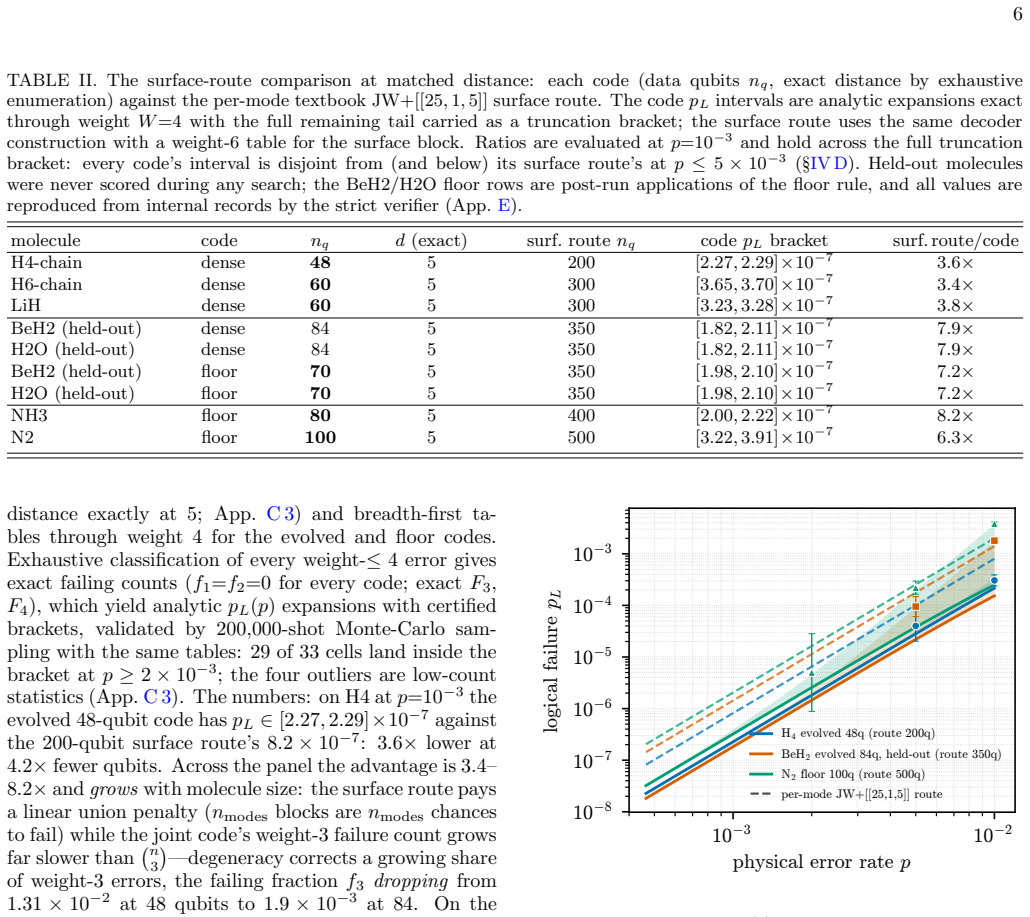
- The resulting encodings use 4.2–5.0 times fewer data qubits than a scoped per-mode Jordan-Wigner plus [[25,1,5]] surface route in a code-capacity memory comparison at p=10^{-3}.
- They exhibit 3.4–8.2 times lower logical-failure rates under finite-weight decoding tables with explicit truncation brackets.
- Rewarding distance alone selects trivial dense graphs, whereas holding verified distance fixed and rewarding compression selects structured rules.
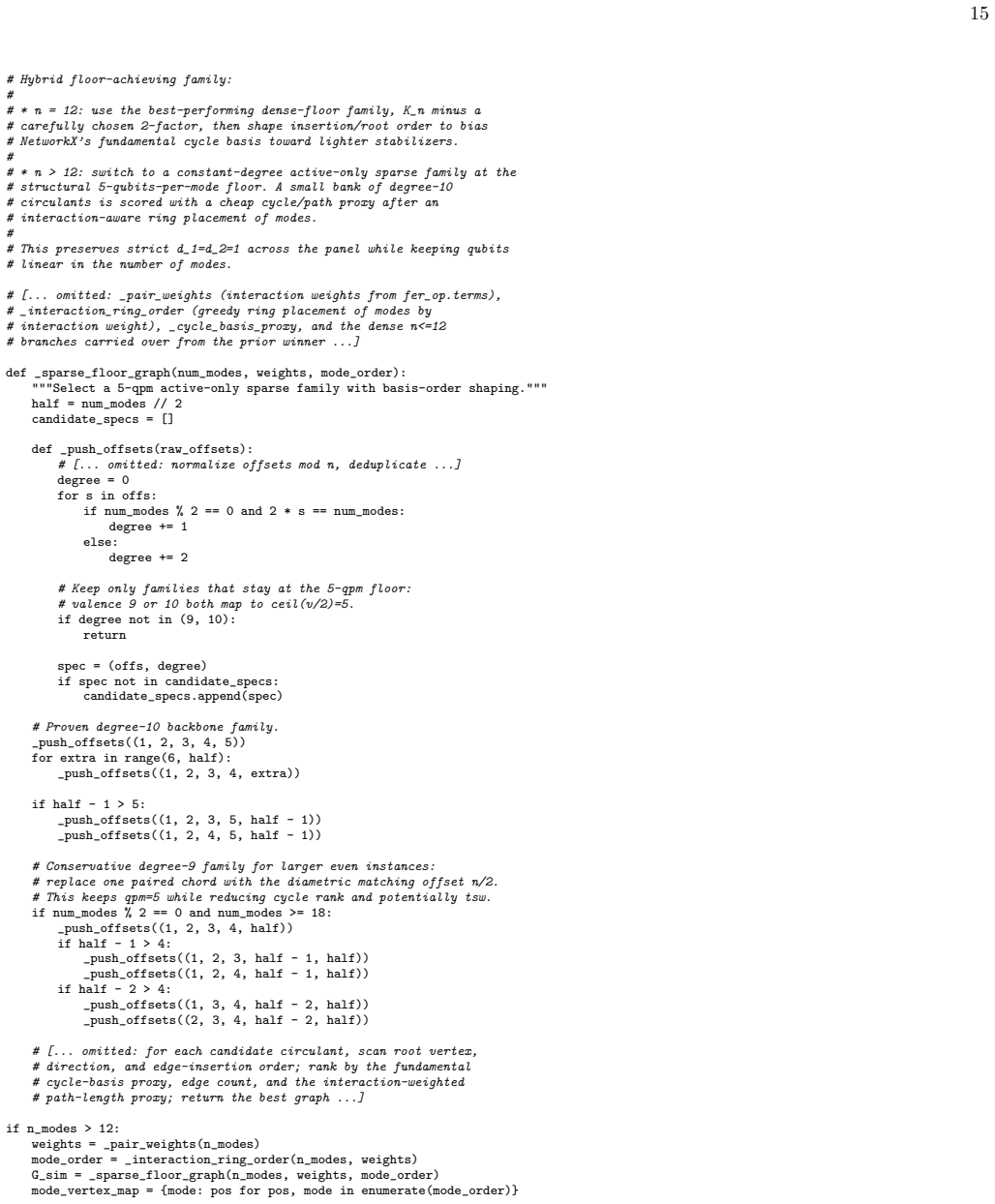
- A circulant constructor reaches a five-qubits-per-mode floor on 12-, 14-, 16-, and 20-mode instances with a fallback rule at 18 modes.
Where Pith is reading between the lines
- The same mutation-plus-verifier loop could be redirected to search for encodings optimized for other Hamiltonians or for circuit-level noise models.
- Because the discovered programs are short and human-readable, they may expose reusable algebraic patterns for constructing higher-distance superfast encodings.
- If the distance-5 codes remain stable when the molecular Hamiltonian is changed, the method supplies a practical route to reduce qubit overhead in near-term quantum chemistry simulations.
Load-bearing premise
The external verifier correctly computes exact code distance under strict stabilizer-coset semantics for the specific molecular Hamiltonians tested, and success on these instances generalizes to other dense molecular Hamiltonians without post-hoc adjustments.
What would settle it
Running the same discovered constructor programs on a new dense molecular Hamiltonian and finding that the minimum weight of a logical operator drops below 5 under the stabilizer-coset definition.
Figures
read the original abstract
Useful quantum algorithms require many coupled discrete design choices. We study LLM-driven evolutionary program synthesis -- a language model edits a program, an external verifier scores the result, and high-scoring programs are retained and re-mutated -- as a tool for quantum-computing research. As a case study, we apply this loop to the Generalized Superfast Encoding (GSE), a fermion-to-qubit encoding whose prior molecular constructions reach code distance $3$. The search discovered interpretable constructor programs whose codes have \emph{exact} distance $5$ on the molecular instances tested, and distance $6$ on one $20$-mode instance, under strict stabilizer-coset semantics. To our knowledge these are the first GSE/superfast encodings beyond distance $3$ for dense molecular Hamiltonians. A second search, guided by verifier analysis of the first artifact, found a circulant constructor that reaches a five-qubits-per-mode floor on the tested $12$-, $14$-, $16$-, and $20$-mode instances, with certified dense-rule fallback at the failing $18$-mode case. As secondary resource descriptors, in a code-capacity \emph{memory} comparison at $p=10^{-3}$ the resulting encodings use $4.2$--$5.0\times$ fewer data qubits than a scoped per-mode Jordan--Wigner $+$ $[[25,1,5]]$ surface route and have $3.4$--$8.2\times$ lower logical-failure rates under finite-weight decoding tables with explicit truncation brackets; we claim no circuit-level fault-tolerance or Trotter-cost advantage. The search trajectory illustrates a general operating lesson: rewarding distance alone selects trivial dense graphs, whereas holding verified distance fixed and rewarding compression selects structured rules.
Editorial analysis
A structured set of objections, weighed in public.
Referee Report
Summary. The paper applies LLM-driven evolutionary program synthesis to the Generalized Superfast Encoding (GSE) for mapping fermionic molecular Hamiltonians to qubits. An external verifier is used to discover constructor programs yielding exact code distances of 5 on tested molecular instances (and 6 on one 20-mode case) under stabilizer-coset semantics, claimed as the first such GSE constructions beyond distance 3. A follow-up search produces a circulant constructor achieving a five-qubits-per-mode floor on 12-20 mode instances (with dense-rule fallback at 18 modes). Secondary code-capacity memory comparisons at p=10^{-3} report 4.2-5.0x fewer data qubits and 3.4-8.2x lower logical failure rates versus Jordan-Wigner plus [[25,1,5]] surface code, with no claimed circuit-level or Trotter advantage. The search trajectory illustrates that distance-only rewards favor dense graphs while fixed-distance compression rewards structured rules.
Significance. If the distance certifications are reproducible, the work provides concrete, interpretable GSE constructions with improved distance for dense molecular Hamiltonians and explicit resource comparisons against standard benchmarks. The evolutionary-search methodology and the distinction between distance-only versus compression-guided objectives offer a general lesson for code design. The absence of machine-checked proofs or open verifier code limits immediate adoption, but the explicit numerical comparisons and fallback-rule handling are strengths that could be built upon if verification details are supplied.
major comments (3)
- [Abstract and verification description] The headline claims of exact distances 5 and 6 rest entirely on results from an external verifier under strict stabilizer-coset semantics. The manuscript provides no implementation details, test-instance list, coset-enumeration procedure, weight-truncation rules, or handling of the dense molecular Hamiltonian support, rendering the distance numbers and the 'first beyond distance 3' claim impossible to audit from the text alone. This is load-bearing for the central result.
- [Resource comparison paragraph] The resource-comparison claims (4.2-5.0x fewer data qubits, 3.4-8.2x lower logical-failure rates) are derived from code-capacity memory simulations at p=10^{-3} using finite-weight decoding tables with explicit truncation brackets. The choice of truncation brackets and their effect on the reported factors are not justified in sufficient detail to confirm that the advantage is not an artifact of the comparison setup.
- [Second-search results] The circulant constructor is reported to reach a five-qubits-per-mode floor on the tested 12-, 14-, 16-, and 20-mode instances with a certified dense-rule fallback only at the 18-mode case. No argument is given that this fallback rule (or the constructor itself) extends to other dense molecular Hamiltonians without further post-hoc adjustment, which undercuts the generalization implied by the weakest assumption.
minor comments (2)
- [Abstract] The abstract states 'on the molecular instances tested' without enumerating the specific Hamiltonians or mode counts used for the distance-5 and distance-6 claims; an explicit list would improve reproducibility.
- [Discussion] The operating lesson on rewarding distance versus compression is stated concisely; expanding it with one concrete example from the search trajectory would clarify the distinction for readers unfamiliar with the method.
Simulated Author's Rebuttal
We thank the referee for their thorough review and constructive comments on our manuscript. We address each major comment point by point below, indicating where revisions will be made.
read point-by-point responses
-
Referee: [Abstract and verification description] The headline claims of exact distances 5 and 6 rest entirely on results from an external verifier under strict stabilizer-coset semantics. The manuscript provides no implementation details, test-instance list, coset-enumeration procedure, weight-truncation rules, or handling of the dense molecular Hamiltonian support, rendering the distance numbers and the 'first beyond distance 3' claim impossible to audit from the text alone. This is load-bearing for the central result.
Authors: We agree that the current manuscript lacks sufficient implementation details to allow independent auditing of the distance claims. In the revised version we will expand the methods section with a full description of the coset-enumeration procedure, weight-truncation rules, and the handling of dense Hamiltonian support. We will also list the exact test instances used and release the verifier source code as supplementary material (or via a public repository). These additions directly address the load-bearing nature of the distance results. revision: yes
-
Referee: [Resource comparison paragraph] The resource-comparison claims (4.2-5.0x fewer data qubits, 3.4-8.2x lower logical-failure rates) are derived from code-capacity memory simulations at p=10^{-3} using finite-weight decoding tables with explicit truncation brackets. The choice of truncation brackets and their effect on the reported factors are not justified in sufficient detail to confirm that the advantage is not an artifact of the comparison setup.
Authors: We acknowledge that the justification for the truncation brackets is currently insufficient. The revised manuscript will include an expanded paragraph (or subsection) that states the precise truncation rules, provides a sensitivity analysis across a range of bracket widths, and demonstrates that the reported qubit-count and failure-rate advantages remain stable under those variations. This will confirm the comparisons are robust. revision: yes
-
Referee: [Second-search results] The circulant constructor is reported to reach a five-qubits-per-mode floor on the tested 12-, 14-, 16-, and 20-mode instances with a certified dense-rule fallback only at the 18-mode case. No argument is given that this fallback rule (or the constructor itself) extends to other dense molecular Hamiltonians without further post-hoc adjustment, which undercuts the generalization implied by the weakest assumption.
Authors: The circulant constructor and its fallback were obtained from instance-specific evolutionary searches; we do not assert universal generalization without re-tuning. To remove any implication of broader applicability, the revised text will explicitly state that the reported floor holds for the tested instances and that the fallback is applied only where the constructor fails, with the search methodology available for new Hamiltonians. This clarifies the scope without overstating generality. revision: partial
Circularity Check
No circularity; results from external evolutionary search and verifier
full rationale
The paper's claims rest on an LLM-driven search loop that mutates constructor programs and scores them via an external verifier for exact distance under stabilizer-coset semantics. No equations, fitted parameters, or self-citations are invoked to derive the distance-5/6 encodings or the five-qubits-per-mode floor; these are outputs of the search process itself. Resource comparisons reference external Jordan-Wigner + surface-code benchmarks rather than internal fits. The method contains no self-definitional loops, uniqueness theorems imported from the authors' prior work, or ansatzes smuggled via citation. The derivation chain is therefore self-contained against external benchmarks.
Axiom & Free-Parameter Ledger
axioms (1)
- domain assumption Stabilizer-coset semantics and code-distance definition for fermion-to-qubit encodings are standard and correctly implemented in the verifier.
Reference graph
Works this paper leans on
-
[1]
climb distance first
Objective functions Both regimes are additive, resource-normalized, per- molecule scores aggregated across the panel by a consistency-rewarding harmonic mean with offset, and share an identical resource term: relative to the conven- tional JW + [[5,1,3]] QEC reference for each molecule, a candidate is penalized by its excess physical qubits, Hamiltonian t...
-
[2]
Every number in this paper is recomputed offline from logged run artifacts by the strict verifier (App
Anti-tampering defenses The anti-tampering defenses referenced in the Method section: candidates are AST-scanned for forbidden im- ports and calls before execution; distance is never trusted from the candidate but recomputed by the exact verifier; evaluation is deterministic; the scoring logic lives in a file the model never sees; and the held-out panel i...
-
[3]
Molecular panel.The training panel comprises three molecular Hamiltonians at the sto-3g basis: the H4 hydrogen chain (8 spin-orbitals), the H6 hydrogen chain (12), and LiH (12)
Evaluation methodology a. Molecular panel.The training panel comprises three molecular Hamiltonians at the sto-3g basis: the H4 hydrogen chain (8 spin-orbitals), the H6 hydrogen chain (12), and LiH (12). Two molecules withheld en- tirely from the search form the held-out panel: BeH2 (14) and H2O (14, a bent out-of-distribution geometry), evaluated only af...
-
[4]
Table IV gives the construction specification and exact distance of every flagship encoding, so a reader can re- build each code without running the programs; Fig
Fixed-distance rungs and construction specifications Table III reports the fixed-distance compression appa- ratus (the compression stage) across both distance rungs. Table IV gives the construction specification and exact distance of every flagship encoding, so a reader can re- build each code without running the programs; Fig. 4 reproduces the floor-fami...
-
[5]
Dense” is the evolved constructor of Fig. 2 and its 2-factor generalization (a near-complete graph minus a deleted edge set drawn from the complement ofG int); “floor
Full logical-failure data Table VI reports the exact per-weight failure profile behind Fig. 3 and thep L ratios of Table II: exhaustive classification of every weight-≤WPauli error under the finite-weight minimum-weight decoder tables (App. C 1). f1 =f 2 = 0exactlyfor every code, consistent with the strict max corrected=2 certificates. Two structural fact...
-
[6]
F. ˇSimkovic IV, M. Leib, and F. R. F. Pereira, arXiv preprint arXiv:2402.15386 (2024), arXiv:2402.15386 [quant-ph]
arXiv 2024
-
[7]
J. Yu, Y. Liu, S. Sugiura, T. Van Voorhis, and S. Zeytino˘ glu, Journal of Chemical Theory and Compu- tation21, 9430 (2025), arXiv:2502.11933 [quant-ph]
arXiv 2025
-
[8]
Romera-Paredes, M
B. Romera-Paredes, M. Barekatain, A. Novikov, M. Ba- log, M. P. Kumar, E. Dupont, F. J. R. Ruiz, J. S. Ellen- berg, P. Wang, O. Fawzi, P. Kohli, and A. Fawzi, Nature 625, 468 (2024)
2024
-
[9]
P. Veliˇ ckovi´ c, A. Vitvitskyi, L. Markeeva, B. Ibarz, L. Buesing, M. Balog, and A. Novikov, arXiv preprint arXiv:2411.19744 (2024), 2411.19744
arXiv 2024
-
[10]
Novikovet al., arXiv preprint arXiv:2506.13131 (2025), arXiv:2506.13131 [cs.LG]
A. Novikovet al., arXiv preprint arXiv:2506.13131 (2025), arXiv:2506.13131 [cs.LG]
Pith/arXiv arXiv 2025
-
[11]
A. B¨ auerle, A. Connors, A. Novikov, A. Z. Wagner, N. V˜ u, F. Viegas, M. Wattenberg, and L. Dixon, arXiv preprint arXiv:2605.05921 (2026), 2605.05921
Pith/arXiv arXiv 2026
-
[12]
R. T. Lange, Y. Imajuku, E. Cetin,et al., arXiv preprint arXiv:2509.19349 (2025), open-source soft- ware:https://github.com/SakanaAI/ShinkaEvolve, arXiv:2509.19349 [cs.NE]
Pith/arXiv arXiv 2025
-
[13]
S. B. Bravyi and A. Y. Kitaev, Annals of Physics298, 210 (2002)
2002
-
[14]
Setia, S
K. Setia, S. Bravyi, A. Mezzacapo, and J. D. Whitfield, Physical Review Research1, 033033 (2019)
2019
- [15]
- [16]
-
[17]
M. Steudtner and S. Wehner, Physical Review A99, 022308 (2019), arXiv:1810.02681 [quant-ph]
arXiv 2019
- [18]
- [19]
-
[20]
D. Amodei, C. Olah, J. Steinhardt, P. Chris- tiano, J. Schulman, and D. Man´ e, arXiv preprint arXiv:1606.06565 (2016), arXiv:1606.06565 [cs.AI]
Pith/arXiv arXiv 2016
- [21]
-
[22]
Krakovna, J
V. Krakovna, J. Uesato, V. Mikulik, M. Rahtz, T. Everitt, R. Kumar, Z. Kenton, J. Leike, and S. Legg, Specification gaming: the flip side of AI ingenuity, DeepMind Blog (2020), https://deepmind.google/discover/blog/ specification-gaming-the-flip-side-of-ai-ingenuity/
2020
- [23]
-
[24]
de Moura and S
L. de Moura and S. Ullrich, inAutomated Deduction – CADE 28, Lecture Notes in Computer Science, Vol. 12699 (Springer, 2021) pp. 625–635
2021
-
[25]
E. Dennis, A. Kitaev, A. Landahl, and J. Preskill, Journal of Mathematical Physics43, 4452 (2002), arXiv:quant-ph/0110143
Pith/arXiv arXiv 2002
-
[26]
J. Brown, J. Iaconis, Y. Alexeev, L. Joseph, S. Churchill, K. Heitritter, W. Aguilar-Calvo, M. Roetteler, and M. Suchara, arXiv preprint arXiv:2605.06792 (2026), arXiv:2605.06792 [quant-ph]
Pith/arXiv arXiv 2026
-
[27]
E. Sabo, L. G. Gunderman, B. Ide, M. Vasmer, and G. Dauphinais, PRX Quantum5, 040302 (2024)
2024
-
[28]
Y.-A. Chen, A. V. Gorshkov, and Y. Xu, SciPost Physics 16, 033 (2024), arXiv:2210.08411 [quant-ph]
arXiv 2024
-
[29]
M. G. Algaba, M. Papiˇ c, I. de Vega, A. Calzona, and F. ˇSimkovic IV, arXiv preprint arXiv:2505.02916 (2025), arXiv:2505.02916 [quant-ph]
arXiv 2025
-
[30]
A. J. Landahl and B. C. A. Morrison, arXiv preprint arXiv:2110.10280 (2021), arXiv:2110.10280 [quant-ph]
arXiv 2021
-
[31]
R. Wei, A. Chung, L. Coffman, S.-K. Chu, and X. Gao, arXiv preprint arXiv:2509.00147 (2025), arXiv:2509.00147 [quant-ph]
arXiv 2025
-
[32]
M. Chiew and S. Strelchuk, Quantum7, 1145 (2023), arXiv:2110.12792 [quant-ph]
arXiv 2023
-
[33]
J. Cruz-Benito, A. W. Cross, D. Kremer, and I. Faro, arXiv preprint arXiv:2606.02418 (2026), arXiv:2606.02418 [quant-ph]
Pith/arXiv arXiv 2026
-
[34]
Z. Liu and F. Marquardt, arXiv preprint arXiv:2606.24808 (2026), arXiv:2606.24808 [quant- ph]
Pith/arXiv arXiv 2026
-
[35]
M. Cain, Q. Xu, R. King, L. R. B. Picard, H. Levine, M. Endres, J. Preskill, H.-Y. Huang, and D. Bluvstein, arXiv preprint arXiv:2603.28627 (2026), arXiv:2603.28627 [quant-ph]
Pith/arXiv arXiv 2026
-
[36]
M. Webster, A. Jacob, and O. Higgott, arXiv preprint arXiv:2603.22532 (2026), arXiv:2603.22532 [quant-ph]
arXiv 2026
-
[37]
A. Pan, K. Bhatia, and J. Steinhardt, inInternational Conference on Learning Representations (ICLR)(2022) arXiv:2201.03544 [cs.LG]
Pith/arXiv arXiv 2022
discussion (0)
Sign in with ORCID, Apple, or X to comment. Anyone can read and Pith papers without signing in.