REVIEW 2 major objections 5 minor 85 references
The Harmonic Structure of Information Contours
T0 review · 2 major / 5 minor · reviewed 2026-08-07 · deepseek-v4-flash
Pith's one-line read The paper claims that word-level surprisal in texts oscillates periodically, with the dominant periods matching the spans of elementary discourse units (EDUs).
desk verdict Solid boundary-effects paper with a novel method, but the periodicity claim needs a within-unit position baseline. read the letter →
The pith
A machine-rendered reading of the paper's core claim, the machinery that carries it, and where it could break.
The reading
What carries the argument
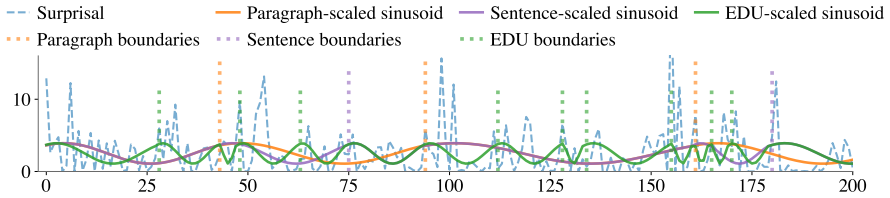
Harmonic regression is a linear regression whose predictors are sine and cosine components at integer multiples of a fundamental frequency, allowing a signal to be approximated as a sum of periodic trends. Time scaling modifies the period of those sinusoids by replacing absolute time with position normalized by the length of the structural unit containing the token, so that a first-order sinusoid completes exactly one oscillation per unit span. This machinery lets the authors test whether observed periodicity aligns with specific annotated structures: an EDU-scaled first-order sinusoid models one full cycle per elementary discourse unit, and its amplitude measures how strongly that particular period shapes surprisal. Feature selection uses L1 regularization, with significance assessed through one-way ANOVA and paired t-tests against a boundary-feature baseline.
What would settle it
Fit the same EDU-scaled harmonic regression to surprisal contours of texts whose clause order has been shuffled or whose EDU boundaries have been replaced by same-length random spans; if the first-order EDU sinusoid keeps its amplitude and significance, the periodic structure is not specific to real discourse segmentation. Equivalently, recompute the analysis with several different LLM families and check whether the EDU harmonic persists across models with different architectures and training data.
Extended reading notes
Core claim
The central claim is Hypothesis 2.3: the components of a document's surprisal contour vary periodically, with periods that correspond to the boundaries of structural units within that contour. Operationally, the authors fit harmonic regression models whose sine and cosine predictors are time-scaled by the token length of the containing document, paragraph, sentence, or EDU, and evaluate them with ten-fold cross-validation and ANOVA significance tests. In the maximal model, low-order EDU-scaled sinusoids show the highest amplitudes across languages, they persist through feature selection in all folds, and they are the only structure type whose retained sinusoids are consistently significant everywhere, while surprisal reliably decreases before discourse boundaries and increases after them. The authors take this as evidence that discourse constituents, especially elementary discourse units, are the periods that organize information flow in text.
Load-bearing premise
The load-bearing premise is that the transformer language models used to compute surprisal are faithful proxies for the unknown human language model; if their position-dependent predictions or boundary artifacts create the fitted sinusoids, then the periodic alignment is a property of those models rather than of language itself.
Editorial extensions
If this is right
- If the Harmonic Surprisal hypothesis holds, uniform information density is not contradicted but refined: surprisal regresses toward a mean while oscillating periodically around it, so global uniformity and structure-aligned modulation coexist.
- Position within an EDU, not just distance from a boundary, carries predictive information about surprisal, making discourse segmentation a useful feature for surprisal and reading-time modeling.
- The time-scaled harmonic regression framework is a general tool: any annotated structural unit, at any granularity, can be tested as a candidate period for information-rate fluctuations.
- The cross-linguistic consistency across English, Spanish, German, Dutch, Basque, and Brazilian Portuguese suggests the periodic pattern is a general property of written discourse rather than an artifact of one language or corpus.
- Surprisal's reliable dip before and rise after boundaries implies that speakers modulate information rate to align with processing costs that accumulate toward unit ends and reset at unit starts.
Reading between the lines
- The framework predicts a directly testable extension: applying time-scaled harmonic regression to syntactic constituents, multi-word expressions, or words should yield high-amplitude sinusoids at those finer periods, revealing a hierarchy of nested information cycles.
- The method could be applied to dialogue turns, prosodic units in speech, or explicitly structured text such as code, and if analogous periodicity appears there, the harmonic-surprisal claim would generalize beyond written expository discourse.
- A null test with randomly assigned same-length unit boundaries would isolate whether the EDU-aligned periodicity is genuine discourse alignment or merely an artifact of unit-length scaling; the paper's permutation checks rearrange surprisal values but not the structural segmentation itself.
- Because surprisal estimates come from one LLM per language, comparing the fitted EDU harmonic across models with different architectures, context lengths, and training objectives would measure how much of the signal is a property of language versus a property of the estimator.
Editorial analysis
A structured set of objections, weighed in public.
Referee Report
Summary. The paper proposes the Harmonic Surprisal (HS) hypothesis, according to which surprisal contours vary periodically and the dominant periods align with the boundaries of structural discourse units (EDUs, sentences, paragraphs). To test this, the authors introduce time-scaled harmonic regression, in which sine/cosine predictors for each token are scaled by the length of the token's containing structural unit, and compare such models against a linear baseline that includes boundary-window flags, previous surprisal, token length, and document-level relative position. Using LLM-derived surprisal estimates on RST-annotated corpora in six languages, they report that EDU-scaled sinusoids yield the lowest cross-validated MSE in five of six languages and that low-order EDU harmonics have the largest amplitudes. The paper also documents a systematic boundary profile (low surprisal before, high after boundaries) and includes a permutation control.
Significance. If established, the HS hypothesis would give a concrete, falsifiable functional form to the link between global information contours and discourse structure, and the time-scaling regression would be a reusable tool for probing periodicity at other linguistic levels. The paper has clear strengths: six languages, cross-validated model comparison with L1 feature selection, Holm-corrected significance tests, a permutation control in App. G, and publicly available code. However, as detailed below, the current evidence does not yet distinguish the periodicity claim from a much weaker non-periodic within-unit position effect, so the central empirical contribution remains under-supported. The paper is well written and the computational framework is a useful methodological contribution regardless of the outcome of that control.
major comments (2)
- [§3.2, Eq. (8); §5, Tables 1–2; App. E] EDU-scaled sinusoids can absorb a non-periodic within-EDU trend; the missing baseline makes the periodicity claim indeterminate. For a token t in an EDU of length U_t, sin(2πt/U_t) and cos(2πt/U_t) are smooth functions of the relative position t/U_t, so a fitted linear combination is any smooth within-EDU ramp of the kind documented for boundaries in Sec. 6 and Table 12. The baseline in App. E includes boundary-window flags of width 1, 2, and 4 tokens, document-level relative position, token length, and previous surprisal, but not a continuous or discretized relative-position feature within the EDU, sentence, or paragraph. Therefore the significant MSE reductions in Table 1 and the dominant low-order EDU amplitudes in Table 2 do not discriminate between Hypothesis 2.3 and the weaker structured-context account that surprisal follows relative position within the unit. In addition, Eq. (8) imposes the period rather than estimating it, so the analysis tests the predictive value of a particular set of unit-anchored functions, not whether the contour is periodic at those periods. I request a control condition with non-periodic within-unit positional features (linear, quadratic, or spline terms in relative position) and, if possible, a free-period condition in which the sinusoid periods are estimated from the data; the main claim should be re-evaluated after those controls.
- [§2.2; §4.2; Tab. 6] The cross-linguistic evidence rests on a single LLM per language, and several of the selected models are instruction-tuned; without estimator-level controls, the documented boundary effects could be artifacts of those models' tokenization or positional biases. The permutation control in App. G destroys the temporal structure of the surprisal values and therefore cannot address this concern; it shows only that the harmonic fit is not an artifact of arbitrary permutations. Adding a second, architecturally different surprisal estimator (e.g., an LSTM, a non-instruction-tuned causal LM, or an n-gram model) for at least one corpus per language would substantially strengthen the claim that the pattern is a property of linguistic information contours rather than of a particular model family. If the paper is intended only as a claim about LLM-computed surprisal, this concern is less severe, but the abstract and Hypothesis 2.3 are framed in language-general terms.
minor comments (5)
- [App. F] The sentence 'To account for the multiple comparisons, we we the Holm–Bonferroni correction' contains a typo and should read 'we used the Holm–Bonferroni correction.'
- [Tables 4–5] The column header 'Variance' appears to contain standard deviations (e.g., mean 12.87 tokens per English EDU with value 9.13); if so, the header should be corrected to 'Standard deviation' to avoid misreading.
- [Table 2] Amplitudes are reported as means over cross-validation folds without a measure of variability; since the table is used to support the claim that EDU harmonics are strongest, standard errors or per-fold ranges would be informative.
- [§5.1, Table 2] The text says all EDU-scaled sinusoids that remain after feature selection are consistently significant across folds; this is true for the reported EDU rows, but the sentence immediately follows a table that also contains non-EDU rows with fold subscripts lower than 10, so a reader could misread the claim as applying to the whole table.
- [Abstract and §5] The phrase 'Many dominant frequencies align with discourse structure' overstates the design: the periods are imposed by time scaling rather than discovered, so a more precise formulation would be 'EDU-anchored sinusoids are predictive of surprisal contours.'
Circularity Check
No significant circularity: the harmonic-surprisal test is an empirical held-out model comparison with negative controls.
full rationale
The paper's central claim (Hypothesis 2.3) is operationalized by fitting time-scaled sinusoids, but the evidence for it is not obtained by renaming the fit. The predictive claims rest on 10-fold cross-validated held-out MSE (Tab. 1), one-sided paired t-tests against a baseline, and ANOVA significance tests for individual harmonic components (Sec. 3.3, App. E, App. F). The baseline includes token length, previous surprisal, document relative position, and 1/2/4-token boundary indicators, so the reported improvement of EDU-scaled models is not a tautological consequence of the regression setup. The paper also includes a permuted-surprisal negative control (App. G), which shows the scaling differences disappear when surprisal is shuffled. The key choice of EDU, sentence, and paragraph periods is motivated by prior work, including the same authors' Structured Context hypothesis (Tsipidi et al., 2024), but that prior work is externally published and empirically testable, and the present comparisons would be meaningful even without those citations. A legitimate scientific concern is that the baseline does not include a smooth within-EDU relative-position trend, so the first-order EDU sinusoid may absorb a boundary ramp rather than demonstrate true oscillation; however, this is an omitted-variable/alternative-explanation issue, not a by-construction reduction of the result to its inputs. No equation in the paper equates a predicted quantity to a fitted input, and no self-citation is invoked as a uniqueness theorem to forbid alternatives. Therefore no significant circularity is present.
Assumptions & free parameters
free parameters (4)
- L1 penalty λ =
0.01 (0.1 considered for Brazilian Portuguese)
- Boundary window sizes =
1, 2, 4 tokens
- Harmonic order cap K =
length of the longest unit in the training fold for each granularity
- Significance level α =
0.001
assumptions (4)
- domain assumption Neural language model surprisal is an adequate proxy for the human language model's information rate.
- domain assumption RST-based EDU, sentence, and paragraph annotations are accurate and meaningful for the information structure.
- domain assumption Residuals are independent for significance testing.
- domain assumption BPE subword tokens are appropriate base units for surprisal contours.
Cite this review
Pith. "Pith review of The Harmonic Structure of Information Contours." pith.science (2026). https://pith.science/paper/AFKEJ5BV
@misc{pith2026250603902,
  author       = {Pith},
  title        = {Pith review of: The Harmonic Structure of Information Contours},
  year         = {2026},
  howpublished = {\url{https://pith.science/paper/AFKEJ5BV}},
  note         = {Machine review of arXiv:2506.03902}
}
read the original abstract
The uniform information density (UID) hypothesis proposes that speakers aim to distribute information evenly throughout a text, balancing production effort and listener comprehension difficulty. However, language typically does not maintain a strictly uniform information rate; instead, it fluctuates around a global average. These fluctuations are often explained by factors such as syntactic constraints, stylistic choices, or audience design. In this work, we explore an alternative perspective: that these fluctuations may be influenced by an implicit linguistic pressure towards periodicity, where the information rate oscillates at regular intervals, potentially across multiple frequencies simultaneously. We apply harmonic regression and introduce a novel extension called time scaling to detect and test for such periodicity in information contours. Analyzing texts in English, Spanish, German, Dutch, Basque, and Brazilian Portuguese, we find consistent evidence of periodic patterns in information rate. Many dominant frequencies align with discourse structure, suggesting these oscillations reflect meaningful linguistic organization. Beyond highlighting the connection between information rate and discourse structure, our approach offers a general framework for uncovering structural pressures at various levels of linguistic granularity.
Figures


Figures from the paper (3 more)


Reference graph
Works this paper leans on
- [1]
-
[2]
Matthew Aylett and Alice Turk. 2004. https://doi.org/10.1177/00238309040470010201 The smooth signal redundancy hypothesis: A functional explanation for relationships between redundancy, prosodic prominence, and duration in spontaneous speech . Language and Speech, 47(1):31--56. PMID: 15298329
-
[3]
Matthew Aylett and Alice Turk. 2006. https://doi.org/10.1121/1.2188331 Language redundancy predicts syllabic duration and the spectral characteristics of vocalic syllable nuclei . The Journal of the Acoustical Society of America, 119(5):3048--3058
-
[4]
Matthew P. Aylett. 1999. Stochastic suprasegmentals: Relationships between redundancy, prosodic structure and syllabic duration. In Proceedings of the XIVth International Congress of Phonetic Sciences, pages 289--292. American Institute of Physics
1999
-
[5]
Alan Bell, Daniel Jurafsky, Eric Fosler - Lussier, Cynthia Girand, Michelle Gregory, and Daniel Gildea. 2003. https://doi.org/10.1121/1.1534836 Effects of disfluencies, predictability, and utterance position on word form variation in E nglish conversation . The Journal of the Acoustical Society of America, 113(2):1001--1024
-
[6]
Claire Augusta Bergey and Simon DeDeo. 2024. http://arxiv.org/abs/2403.08890 From "um" to "yeah": Producing, predicting, and regulating information flow in human conversation
arXiv 2024
-
[7]
Paula C. F. Cardoso, Erick G. Maziero, Mara Luca Castro Jorge, Eloize R. M. Seno, Ariani Di Felippo, Lucia Helena Machado Rino, Maria das Graças Volpe Nunes, and Thiago A. S. Pardo. 2011. https://sites.icmc.usp.br/taspardo/RST2011-CardosoEtAl1.pdf Cstnews - a discourse-annotated corpus for single and multidocument summarization of news texts in brazilian ...
2011
- [8]
Show all 85 references
-
[9]
Lynn Carlson, Daniel Marcu, and Mary Ellen Okurovsky. 2001. https://aclanthology.org/W01-1605 Building a discourse-tagged corpus in the framework of R hetorical S tructure T heory . In Proceedings of the Second SIG dial Workshop on Discourse and Dialogue
2001
-
[10]
Raoul Cervantes and Glenn Gainer. 1992. http://www.jstor.org/stable/3586886 The effects of syntactic simplification and repetition on listening comprehension . TESOL Quarterly, 26(4):767--770. Wiley
1992
-
[11]
Clark and Deanna Wilkes-Gibbs
Herbert H. Clark and Deanna Wilkes-Gibbs. 1986. https://doi.org/https://doi.org/10.1016/0010-0277(86)90010-7 Referring as a collaborative process . Cognition, 22(1):1--39
1986 doi
-
[12]
Uriel Cohen Priva. 2015. https://doi.org/10.1515/lp-2015-0008 Informativity affects consonant duration and deletion rates . Laboratory Phonology, 6(2)
2015 doi
-
[13]
Michael Xavier Collins. 2014. https://doi.org/https://doi.org/10.1007/s10936-013-9273-3 Information density and dependency length as complementary cognitive models . Journal of Psycholinguistic Research, 43:651--681
2014 doi
-
[14]
Iria da Cunha, Juan-Manuel Torres-Moreno, and Gerardo Sierra. 2011. https://aclanthology.org/W11-0401 On the development of the RST S panish treebank . In Proceedings of the 5th Linguistic Annotation Workshop, pages 1--10, Portland, Oregon, USA. Association for Computational L...
2011
-
[15]
Jeffrey L. Elman. 1990. https://www.sciencedirect.com/science/article/pii/036402139090002E Finding structure in time . Cognitive Science, 14(2):179--211. Wiley Online Library
1990
-
[16]
Julen Etxaniz, Oscar Sainz, Naiara Perez, Itziar Aldabe, German Rigau, Eneko Agirre, Aitor Ormazabal, Mikel Artetxe, and Aitor Soroa. 2024. http://arxiv.org/abs/2403.20266 L atxa: An open language model and evaluation suite for B asque
2024 arXiv
-
[17]
a chtnis-konstanz im sprachlichen Informationsflu ? Zeitschrift f \
August Fenk and Gertraud Fenk. 1980. https://wwwg.uni-klu.ac.at/mk0/personal/bedienst/Kurzzeitgedaechtnis1980.pdf Konstanz im Kurzzeitged \"a chtnis-konstanz im sprachlichen Informationsflu ? Zeitschrift f \"u r experimentelle und angewandte Psychologie , 27(3):400--414
1980
-
[18]
Frank, and Gabriella Vigliocco
Irene Fernandez Monsalve, Stefan L. Frank, and Gabriella Vigliocco. 2012. https://aclanthology.org/E12-1041 Lexical surprisal as a general predictor of reading time . In Proceedings of the 13th Conference of the E uropean Chapter of the Association for Computational Linguistic...
2012
-
[19]
Austin F Frank and T Florain Jaeger. 2008. https://escholarship.org/content/qt7d08h6j4/qt7d08h6j4.pdf Speaking rationally: Uniform information density as an optimal strategy for language production . In Proceedings of the annual meeting of the cognitive science society, volume 30
2008
-
[20]
Stefan L Frank, Leun J Otten, Giulia Galli, and Gabriella Vigliocco. 2015. https://doi.org/10.1016/j.bandl.2014.10.006 The ERP response to the amount of information conveyed by words in sentences . Brain and Language, 140:1--11
2015 doi
-
[21]
Markus Frohmann, Igor Sterner, Ivan Vuli \'c , Benjamin Minixhofer, and Markus Schedl. 2024. https://doi.org/10.18653/v1/2024.emnlp-main.665 Segment any text: A universal approach for robust, efficient and adaptable sentence segmentation . In Proceedings of the 2024 Conference...
2024 doi
-
[22]
Richard Futrell. 2023. https://doi.org/10.1073/pnas.2220593120 Information-theoretic principles in incremental language production . Proceedings of the National Academy of Sciences, 120(39):e2220593120
2023 doi
-
[23]
Dmitriy Genzel and Eugene Charniak. 2002. https://doi.org/10.3115/1073083.1073117 Entropy rate constancy in text . In Proceedings of the 40th Annual Meeting of the Association for Computational Linguistics, pages 199--206, Philadelphia, Pennsylvania, USA. Association for Compu...
2002
-
[24]
Dmitriy Genzel and Eugene Charniak. 2003. https://aclanthology.org/W03-1009 Variation of entropy and parse trees of sentences as a function of the sentence number . In Proceedings of the 2003 Conference on Empirical Methods in Natural Language Processing, pages 65--72
2003
-
[25]
Edward Gibson. 1998. https://doi.org/https://doi.org/10.1016/S0010-0277(98)00034-1 Linguistic complexity: locality of syntactic dependencies . Cognition, 68(1):1--76
1998 doi
-
[26]
Edward Gibson. 2000. https://tedlab.mit.edu/tedlab_website/researchpapers/Gibson_2000_DLT.pdf The dependency locality theory: A distance-based theory of linguistic complexity . Image, language, brain/MIT Press
2000
-
[27]
Piantadosi, Isabelle Dautriche, Kyle Mahowald, Leon Bergen, and Roger Levy
Edward Gibson, Richard Futrell, Steven P. Piantadosi, Isabelle Dautriche, Kyle Mahowald, Leon Bergen, and Roger Levy. 2019. https://doi.org/https://doi.org/10.1016/j.tics.2019.02.003 How efficiency shapes human language . Trends in Cognitive Sciences, 23(5):389--407
2019 doi
-
[28]
Mario Giulianelli and Raquel Fern \'a ndez. 2021. https://doi.org/10.18653/v1/2021.conll-1.50 Analysing human strategies of information transmission as a function of discourse context . In Proceedings of the 25th Conference on Computational Natural Language Learning, pages 647...
2021 doi
-
[29]
Mario Giulianelli, Luca Malagutti, Juan Luis Gastaldi, Brian DuSell, Tim Vieira, and Ryan Cotterell. 2024 a . https://doi.org/10.18653/v1/2024.emnlp-main.1032 On the proper treatment of tokenization in psycholinguistics . In Proceedings of the 2024 Conference on Empirical Meth...
2024 doi
-
[30]
Mario Giulianelli, Andreas Opedal, and Ryan Cotterell. 2024 b . https://doi.org/10.18653/v1/2024.findings-emnlp.682 Generalized measures of anticipation and responsivity in online language processing . In Findings of the Association for Computational Linguistics: EMNLP 2024, p...
2024 doi
-
[31]
Mario Giulianelli, Arabella Sinclair, and Raquel Fern \'a ndez. 2021. https://doi.org/10.18653/v1/2021.emnlp-main.652 Is information density uniform in task-oriented dialogues? In Proceedings of the 2021 Conference on Empirical Methods in Natural Language Processing, pages 827...
2021 doi
-
[32]
Mario Giulianelli, Sarenne Wallbridge, Ryan Cotterell, and Raquel Fernández. 2024 c . https://doi.org/10.31234/osf.io/fhp84 Incremental alternative sampling as a lens into the temporal and representational resolution of linguistic prediction
2024 doi
-
[33]
Mario Giulianelli, Sarenne Wallbridge, and Raquel Fern \'a ndez. 2023. https://doi.org/10.18653/v1/2023.emnlp-main.343 Information value: Measuring utterance predictability as distance from plausible alternatives . In Proceedings of the 2023 Conference on Empirical Methods in ...
2023 doi
-
[34]
Adam Goodkind and Klinton Bicknell. 2018. https://doi.org/10.18653/v1/W18-0102 Predictive power of word surprisal for reading times is a linear function of language model quality . In Proceedings of the 8th Workshop on Cognitive Modeling and Computational Linguistics ( CMCL 20...
2018 doi
-
[35]
Sture Holm. 1979. A simple sequentially rejective multiple test procedure. Scandinavian journal of statistics, pages 65--70
1979
-
[36]
Eva Huber, Sebastian Sauppe, Arrate Isasi-Isasmendi, Ina Bornkessel-Schlesewsky, Paola Merlo, and Balthasar Bickel. 2024. https://doi.org/10.1162/nol_a_00121 Surprisal from language models can predict ERP s in processing predicate-argument structures only if enriched by an age...
2024 doi
-
[37]
Aranzabe, Arantza Diaz de Ilarraza, Itziar Gonzalez-Dios, Mikel Lersundi, and Oier Lopez de la Calle
Mikel Iruskieta, Mar\' i a J. Aranzabe, Arantza Diaz de Ilarraza, Itziar Gonzalez-Dios, Mikel Lersundi, and Oier Lopez de la Calle. 2013. https://www.ixa.eus/sites/default/files/dokumentuak/3960/2013RST-Basque-TB.pdf The rst basque treebank: An online search interface to check...
2013
-
[38]
Florian Jaeger
T. Florian Jaeger. 2010. https://doi.org/https://doi.org/10.1016/j.cogpsych.2010.02.002 Redundancy and reduction: Speakers manage syntactic information density . Cognitive Psychology, 61(1):23--62
2010 doi
-
[39]
Marcel A Just and Patricia A Carpenter. 1980. https://psycnet.apa.org/doiLanding?doi=10.1037 theory of reading: from eye fixations to comprehension. Psychological review, 87(4):329
1980
-
[40]
Gretchen Kambe Keith Rayner and Susan A. Duffy. 2000. https://doi.org/10.1080/713755934 The effect of clause wrap-up on eye movements during reading . The Quarterly Journal of Experimental Psychology Section A, 53(4):1061--1080. PMID: 11131813
2000 doi
-
[41]
Frank Keller. 2004. https://aclanthology.org/W04-3241 The entropy rate principle as a predictor of processing effort: An evaluation against eye-tracking data . In Proceedings of the 2004 Conference on Empirical Methods in Natural Language Processing, pages 317--324, Barcelona,...
2004
-
[42]
Florian Jaeger
Roger Levy and T. Florian Jaeger. 2006. https://proceedings.neurips.cc/paper_files/paper/2006/file/c6a01432c8138d46ba39957a8250e027-Paper.pdf Speakers optimize information density through syntactic reduction . In Advances in Neural Information Processing Systems, volume 19. MIT Press
2006
-
[43]
Edwin Herbert Lewis. 1894. https://archive.org/details/historyenglishp00lewigoog The history of the English paragraph . University of Chicago Press
-
[44]
Jiaxuan Li and Richard Futrell. 2024. https://escholarship.org/content/qt1fd682nd/qt1fd682nd_noSplash_e733707513b8f4be3d407d3f029acd2b.pdf?t=sgric3 An information-theoretic model of shallow and deep language comprehension . In Proceedings of the Annual Meeting of the Cognitive...
2024
-
[45]
Eliot Ma \"e s, Philippe Blache, and Leonor Becerra-Bonache. 2022. https://hal.science/hal-04151675/document Shared knowledge in natural conversations: c an entropy metrics shed light on information transfers? In 26th Conference on Computational Natural Language Learning, page...
2022
-
[46]
Piantadosi, and Edward Gibson
Kyle Mahowald, Evelina Fedorenko, Steven T. Piantadosi, and Edward Gibson. 2013. https://doi.org/https://doi.org/10.1016/j.cognition.2012.09.010 Info/information theory: Speakers choose shorter words in predictive contexts . Cognition, 126(2):313--318
2013 doi
-
[47]
Mann and Sandra A
William C. Mann and Sandra A. Thompson. 1988. https://doi.org/doi:10.1515/text.1.1988.8.3.243 Rhetorical structure theory: Toward a functional theory of text organization . Text - Interdisciplinary Journal for the Study of Discourse, 8(3):243--281
1988 doi
-
[48]
Marcus, Beatrice Santorini, Mary Ann Marcinkiewicz, and Ann Taylor
Mitchell P. Marcus, Beatrice Santorini, Mary Ann Marcinkiewicz, and Ann Taylor. 1999. https://catalog.ldc.upenn.edu/LDC99T42 Treebank-3 . Linguistic Data Consortium, 14
1999
-
[49]
Clara Meister, Mario Giulianelli, and Tiago Pimentel. 2024. https://doi.org/10.18653/v1/2024.emnlp-main.921 Towards a similarity-adjusted surprisal theory . In Proceedings of the 2024 Conference on Empirical Methods in Natural Language Processing, pages 16485--16498, Miami, Fl...
2024 doi
-
[50]
Clara Meister, Tiago Pimentel, Patrick Haller, Lena J \"a ger, Ryan Cotterell, and Roger Levy. 2021. https://doi.org/10.18653/v1/2021.emnlp-main.74 Revisiting the U niform I nformation D ensity hypothesis . In Proceedings of the 2021 Conference on Empirical Methods in Natural ...
2021 doi
-
[51]
Benjamin Minixhofer, Jonas Pfeiffer, and Ivan Vuli \'c . 2023. https://aclanthology.org/2023.acl-long.398 Where ' s the point? self-supervised multilingual punctuation-agnostic sentence segmentation . In Proceedings of the 61st Annual Meeting of the Association for Computation...
2023
-
[52]
Bowen Peng, Jeffrey Quesnelle, Honglu Fan, and Enrico Shippole. 2024. https://openreview.net/forum?id=wHBfxhZu1u Ya RN : Efficient context window extension of large language models . In The Twelfth International Conference on Learning Representations
2024
-
[53]
Ramon Pires, Hugo Abonizio, Thales Sales Almeida, and Rodrigo Nogueira. 2023. https://doi.org/10.1007/978-3-031-45392-2_15 Sabi \'a : Portuguese large language models . In Intelligent Systems, pages 226--240, Cham. Springer Nature Switzerland
2023 doi
-
[54]
Florian Jaeger
Ting Qian and T. Florian Jaeger. 2011. https://escholarship.org/content/qt6b0712jg/qt6b0712jg.pdf Topic shift in efficient discourse production . In Proceedings of the Annual Meeting of the Cognitive Science Society, volume 33
2011
-
[55]
Milena Rabovsky, Steven S Hansen, and James L McClelland. 2018. https://doi.org/https://www.nature.com/articles/s41562-018-0406-4 Modelling the N 400 brain potential as change in a probabilistic representation of meaning . Nature Human Behaviour, 2(9):693--705
2018
-
[56]
Radvansky and David E
Gabriel A. Radvansky and David E. Copeland. 2010. https://doi.org/10.1037/a0017258 Reading times and the detection of event shift processing. Journal of Experimental Psychology: Learning, Memory, and Cognition, 36(1):210--216. Place: US Publisher: American Psychological Association
2010 doi
-
[57]
Gisela Redeker, Ildik \'o Berzl \'a novich, Nynke van der Vliet, Gosse Bouma, and Markus Egg. 2012. http://www.lrec-conf.org/proceedings/lrec2012/pdf/887_Paper.pdf Multi-layer discourse annotation of a D utch text corpus . In Proceedings of the Eighth International Conference ...
2012
-
[58]
Hosseini, Nancy Kanwisher, Joshua B
Martin Schrimpf, Idan Asher Blank, Greta Tuckute, Carina Kauf, Eghbal A. Hosseini, Nancy Kanwisher, Joshua B. Tenenbaum, and Evelina Fedorenko. 2021. https://doi.org/10.1073/pnas.2105646118 The neural architecture of language: Integrative modeling converges on predictive proce...
2021 doi
-
[59]
Cory Shain, Idan Asher Blank, Marten van Schijndel , William Schuler, and Evelina Fedorenko. 2020. https://doi.org/https://doi.org/10.1016/j.neuropsychologia.2019.107307 fmri reveals language-specific predictive coding during naturalistic sentence comprehension . Neuropsycholo...
2020
-
[60]
Cory Shain, Clara Meister, Tiago Pimentel, Ryan Cotterell, and Roger Levy. 2024. https://doi.org/https://doi.org/10.1073/pnas.2307876121 Large-scale evidence for logarithmic effects of word predictability on reading time . Proceedings of the National Academy of Sciences, 121(1...
2024 doi
-
[61]
Claude E. Shannon. 1948. https://ieeexplore.ieee.org/document/6773024 A mathematical theory of communication . The Bell System Technical Journal, 27(3):379--423
1948
-
[62]
S kipper S eabold and J osef P erktold. 2010. https://doi.org/10.25080/Majora-92bf1922-011 S tatsmodels: E conometric and S tatistical M odeling with P ython . In P roceedings of the 9th P ython in S cience C onference , pages 92 -- 96
2010 doi
-
[63]
Meyer, and Andrea E
Sophie Slaats, Antje S. Meyer, and Andrea E. Martin. 2024. https://doi.org/10.1162/nol_a_00155 Lexical surprisal shapes the time course of syntactic structure building . Neurobiology of Language, 5(4):942--980
2024 doi
-
[64]
Smith and Roger Levy
Nathaniel J. Smith and Roger Levy. 2013. https://doi.org/https://doi.org/10.1016/j.cognition.2013.02.013 The effect of word predictability on reading time is logarithmic . Cognition, 128(3):302--319
2013 doi
-
[65]
Speer and Jeffrey M
Nicole K. Speer and Jeffrey M. Zacks. 2005. https://doi.org/https://doi.org/10.1016/j.jml.2005.02.009 Temporal changes as event boundaries: Processing and memory consequences of narrative time shifts . Journal of Memory and Language, 53(1):125--140
2005 doi
-
[66]
Manfred Stede. 2004. https://aclanthology.org/W04-0213 The P otsdam commentary corpus . In Proceedings of the Workshop on Discourse Annotation, pages 96--102, Barcelona, Spain. Association for Computational Linguistics
2004
-
[67]
Manfred Stede and Arne Neumann. 2014. http://www.lrec-conf.org/proceedings/lrec2014/pdf/579_Paper.pdf P otsdam commentary corpus 2.0: Annotation for discourse research . In Proceedings of the Ninth International Conference on Language Resources and Evaluation ( LREC '14) , pag...
2014
-
[68]
Fatemeh Torabi Asr and Vera Demberg. 2015. https://aclanthology.org/W15-0117 Uniform surprisal at the level of discourse relations: Negation markers and discourse connective omission . In Proceedings of the 11th International Conference on Computational Semantics, pages 118--1...
2015
-
[69]
Eleftheria Tsipidi, Franz Nowak, Ryan Cotterell, Ethan Wilcox, Mario Giulianelli, and Alex Warstadt. 2024. https://doi.org/10.18653/v1/2024.emnlp-main.1047 Surprise! U niform I nformation D ensity isn't the whole story: Predicting surprisal contours in long-form discourse . In...
2024 doi
-
[70]
van der Vliet , I
N.H. van der Vliet , I. Berzl \'a novich, G. Bouma, M. Egg, and G. Redeker. 2011. Building a discourse-annotated dutch text corpus. In Beyond Semantics, volume 3 of Bochumer Linguistische Arbeitsberichte, pages 157 -- 171. Ruhr-Universit \"a t Bochum. 2011/g.bouma/pub005, 2011...
2011
-
[71]
Bram Vanroy. 2024. http://arxiv.org/abs/2412.04092 Geitje 7b ultra: A conversational model for dutch
2024 arXiv
-
[72]
Vivek Verma, Nicholas Tomlin, and Dan Klein. 2023. https://doi.org/10.18653/v1/2023.findings-emnlp.1039 Revisiting entropy rate constancy in text . In Findings of the Association for Computational Linguistics: EMNLP 2023, pages 15537--15549, Singapore
2023 doi
-
[73]
O'Donnell, and Ryan Cotterell
Tim Vieira, Ben LeBrun, Mario Giulianelli, Juan Luis Gastaldi, Brian DuSell, John Terilla, Timothy J. O'Donnell, and Ryan Cotterell. 2024. http://arxiv.org/abs/2412.03719 From language models over tokens to language models over characters
2024 arXiv
-
[74]
Sarenne Wallbridge, Peter Bell, and Catherine Lai. 2022. https://www.isca-archive.org/interspeech_2022/wallbridge22_interspeech.pdf Investigating perception of spoken dialogue acceptability through surprisal . In Interspeech 2022: The 23rd Annual Conference of the Internationa...
2022
-
[75]
Ethan Gotlieb Wilcox, Jon Gauthier, Jennifer Hu, Peng Qian, and Roger P. Levy. 2020. https://cognitivesciencesociety.org/cogsci20/papers/0375/0375.pdf On the predictive power of neural language models for human real-time comprehension behavior . In Proceedings of the 42nd Annu...
2020
-
[76]
Ethan Gotlieb Wilcox, Tiago Pimentel, Clara Meister, Ryan Cotterell, and Roger P. Levy. 2023. https://doi.org/10.1162/tacl_a_00612 Testing the Predictions of Surprisal Theory in 11 Languages . Transactions of the Association for Computational Linguistics, 11:1451--1470
2023 doi
-
[77]
Weijie Xu, Jason Chon, Tianran Liu, and Richard Futrell. 2023. https://doi.org/10.18653/v1/2023.findings-emnlp.1052 The linearity of the effect of surprisal on reading times across languages . In Findings of the Association for Computational Linguistics: EMNLP 2023, pages 1571...
2023 doi
-
[78]
Yang Xu and David Reitter. 2016. https://doi.org/10.18653/v1/P16-1051 Entropy converges between dialogue participants: Explanations from an information-theoretic perspective . In Proceedings of the 54th Annual Meeting of the Association for Computational Linguistics (Volume 1:...
2016 doi
-
[79]
Yang Xu and David Reitter. 2018. https://doi.org/https://doi.org/10.1016/j.cognition.2017.09.018 Information density converges in dialogue: Towards an information-theoretic model . Cognition, 170:147--163
2018 doi
-
[80]
Yang Xu, Yu Wang, Hao An, Zhichen Liu, and Yongyuan Li. 2024. https://doi.org/10.18653/v1/2024.emnlp-main.564 Detecting subtle differences between human and model languages using spectrum of relative likelihood . In Proceedings of the 2024 Conference on Empirical Methods in Na...
2024 doi
-
[81]
Zuhao Yang, Yingfang Yuan, Yang Xu, Shuo Zhan, Huajun Bai, and Kefan Chen. 2023. https://proceedings.neurips.cc/paper_files/paper/2023/file/37094fdc81632915a5738293cf9b7ad4-Paper-Conference.pdf Face: E valuating natural language generation with F ourier analysis of cross-entro...
2023
-
[82]
Sinclair
Jun Sen Yee, Mario Giulianelli, and Arabella J. Sinclair. 2024. https://aclanthology.org/2024.lrec-main.494/ Efficiency and effectiveness in task-oriented dialogue: On construction repetition, information rate, and task success . In Proceedings of the 2024 Joint International ...
2024
-
[83]
George Kingsley Zipf. 1949. Human Behavior and the Principle of Least Effort. Addison-Wesley Press, Oxford, England
1949
-
[84]
URL: " 'urlintro :=
ENTRY address author booktitle chapter edition editor howpublished institution journal key month note number organization pages publisher school series title type volume year eprint doi pubmed url lastchecked label extra.label sort.label short.list INTEGERS output.state before...
-
[85]
write newline
" write newline "" before.all 'output.state := FUNCTION n.dashify 't := "" t empty not t #1 #1 substring "-" = t #1 #2 substring "--" = not "--" * t #2 global.max substring 't := t #1 #1 substring "-" = "-" * t #2 global.max substring 't := while if t #1 #1 substring * t #2 gl...
Reviewed August 7, 2026 · model on record in the stance chip above.
Discussion (0). Sign in to comment.