REVIEW 2 major objections 4 minor 63 references
NBM: an Open Dataset for the Acoustic Monitoring of Nocturnal Migratory Birds in Europe
T0 review · 2 major / 4 minor · reviewed 2026-08-11 · deepseek-v4-flash
Pith's one-line read A fine-grained dataset of 13,359 nocturnal bird calls lets a small object-detection model nearly match BirdNet's accuracy on 45 migratory species.
desk verdict A genuinely useful open dataset for nocturnal bird acoustic monitoring; the performance claims need a train/test provenance check before they can be taken at face value. read the letter →
The pith
A machine-rendered reading of the paper's core claim, the machinery that carries it, and where it could break.
The reading
What carries the argument
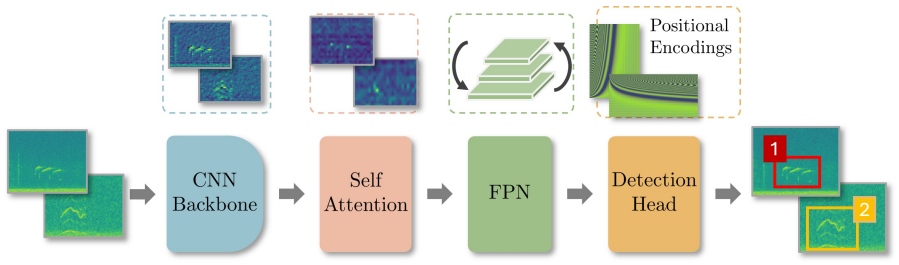
The load-bearing machinery is the reformulation of bird call recognition as object detection on spectrograms, carried by a two-stage Faster R-CNN architecture with an EfficientNetV2 backbone and a feature pyramid network. Two adaptations are specific to sound: a self-attention module that lets local predictions draw on the broader acoustic context, and sinusoidal positional encodings added to region-of-interest features, with an absolute encoding along the frequency axis and a relative encoding along the time axis. These encodings break the spatial invariance typical of image detectors, letting the model associate fundamental frequency with species identity. On the data side, the annotation protocol—marking the smallest identifiable call or song phrase in both time and frequency using Audacity—is what makes fine-grained detection possible.
What would settle it
A concrete check would be to compute audio fingerprints (e.g., spectral hashes) for all NBM-XC training files and all 270 test files and look for matches above a high similarity threshold; if any test file shares content with a training file, the reported mAP of 0.67 and the BirdNet comparison would need to be recomputed on a deduplicated split.
Extended reading notes
Core claim
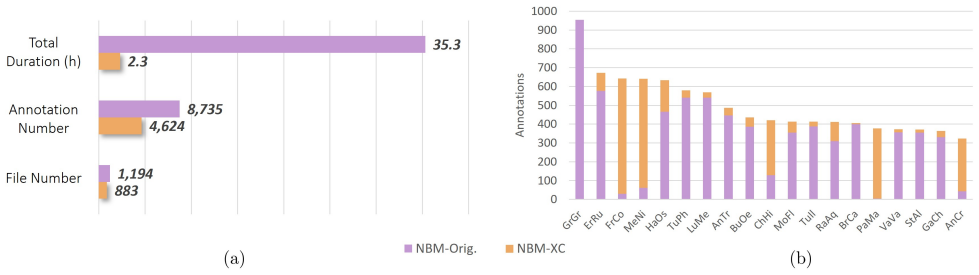
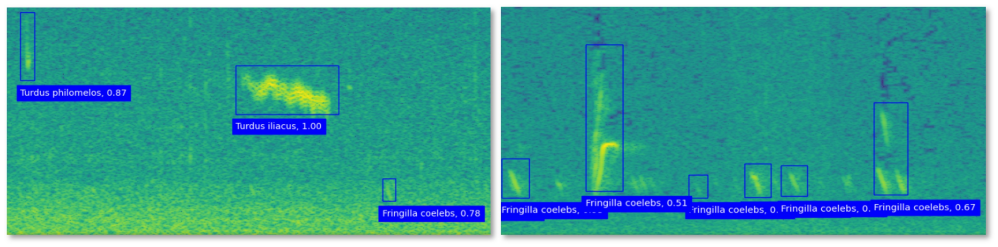
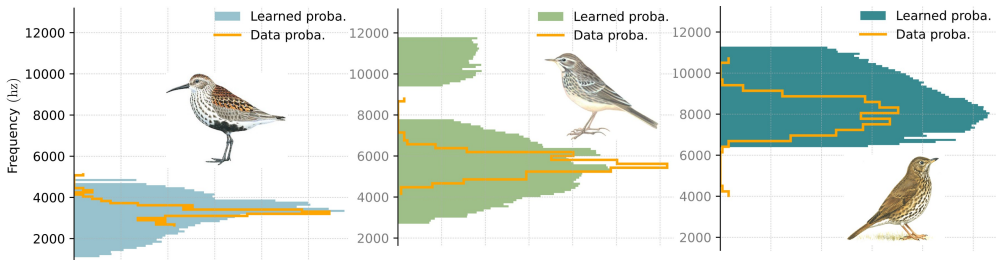
The central claim is that a crowd-sourced, precisely annotated dataset of nocturnal migratory bird calls, combined with an object-detection architecture adapted for sound, can localize individual calls in both time and frequency and compete with state-of-the-art multi-label classifiers trained on orders of magnitude more data. The NBM dataset contains 13,359 annotations across 2,077 files totalling almost 38 hours, assembled by volunteers across France and supplemented with manually annotated Xeno-Canto recordings to balance species coverage. The detection model, built on a Faster R-CNN backbone with a feature pyramid network, self-attention, and frequency-aware positional encodings, achieves a detection mAP@IoU0.5 of 0.67 on a 271-file test set and a multi-label mAP of 0.71 versus BirdNet's 0.78. The authors further show that the positional encoding causes the model to learn sensible frequency priors for each species, with predicted posterior frequency distributions aligning with training data, confirming that frequency location is informative for identification.
Load-bearing premise
The load-bearing premise is that the Xeno-Canto-derived training recordings and the Xeno-Canto-derived test recordings are effectively disjoint, since the paper reports no check for duplicated or near-duplicated audio between the two sets.
Editorial extensions
If this is right
- Object detection on spectrograms can enumerate individual calls, opening the door to counting birds in a migrating flock rather than only detecting species presence.
- A medium-scale, precisely annotated dataset of about 306 events per species can achieve multi-label accuracy close to BirdNet's, supporting the value of targeted annotation over sheer data volume.
- The NBM test set provides a reusable, versioned benchmark for nocturnal bird call detection in the Western Palearctic, allowing future models to be compared on the same 45 species.
- The demonstrated benefit of frequency-aware positional encodings suggests that other sound-event detection tasks where pitch or frequency position is discriminative could adopt similar architectural choices.
Reading between the lines
- If the approach generalizes beyond the 45 well-represented species, passive acoustic monitoring could yield species-level counts of nocturnal migration at continental scale, complementing radar-based passage estimates.
- The alignment between learned frequency posteriors and training-set frequency distributions offers a simple diagnostic: a model whose posterior drifts from expected band could flag out-of-distribution recordings or recording-device differences.
- The paper does not report any deduplication or provenance check between the Xeno-Canto-derived training files and the 270 test files, both sourced from Xeno-Canto; if near-identical recordings appear in both sets, the reported mAP and the BirdNet comparison could be inflated.
- A natural ablation study would test whether the self-attention and positional-encoding modules each contribute independently; such an ablation could also clarify when object detection outperforms sliding-window classification for other bioacoustic datasets.
Signed reviews
Editorial analysis
A structured set of objections, weighed in public.
Referee Report
Summary. The paper introduces the NBM (Nocturnal Bird Migration) dataset, a crowd-sourced collection of 13,359 time-frequency annotated vocalizations from 117 Western Palearctic bird species, supplemented by manually annotated Xeno-Canto recordings. It also presents a two-stage Faster R-CNN object detection model with self-attention and positional encodings for localizing bird calls on spectrograms. The model achieves an mAP@IoU0.5 of 0.67 on the NBM test set, and an aggregated multi-label mAP of 0.71 when compared with BirdNet's 0.78 on the same 45-species scope. All data and code are released openly.
Significance. If the overlap concern is resolved, the NBM dataset is a valuable, first-of-its-kind fine-grained benchmark for nocturnal bird call detection in the Western Palearctic. The authors' decision to release audio, annotations, and code under open licenses is a concrete strength, as is the use of a held-out, manually annotated test set as a baseline for future work. The model result is a useful proof of concept that object detection on spectrograms can localize short flight calls; the BirdNet comparison, while qualified by the authors, is meaningful enough to motivate further study. The main uncertainties concern the provenance of the test set and the statistical robustness of the reported metrics, not the internal logic of the dataset construction.
major comments (2)
- [Section 3.3 and 4.2.1] The paper never specifies whether the NBM-XC training files and the XC test files are disjoint, and the test-set count is inconsistent: Section 3.3 states six files per species for a total of 270 test files, while Section 4.2.1 refers to 271 hand-annotated XC recordings. Since both sets are drawn from Xeno-Canto, identical or near-identical recordings in both splits could inflate both the object-detection mAP@IoU0.5 (0.67) and the aggregated multi-label mAP (0.71) through instance-level memorization rather than species-level generalization. Please provide the full list of XC recording IDs used for training and testing, report any overlap, and either exclude overlapping recordings or quantify the effect of doing so. This is load-bearing for the headline numbers.
- [Section 4.2.1 and Table 1] All reported metrics are single-run point estimates without confidence intervals or variance across training runs. With only six test files per species, the per-species AP values in Table 1 are highly variable (e.g., 0.26 for Pluvialis apricaria and 0.31 for Emberiza citrinella), and the 0.07 mAP gap to BirdNet is within the range one would expect from random seed variation. Reporting the mean and standard deviation over several training runs, or bootstrap confidence intervals over test files, is necessary to support the claim of competitive accuracy.
minor comments (4)
- [Section 4.2.2] The concluding sentence of Section 4.2.2 calls the results 'highly competitive' even though the preceding paragraph acknowledges a possible overlap with BirdNet's XC training base; I suggest softening this to 'indicative' in the abstract and conclusion as well.
- [Section 4.1, Eq. (1)] The statement that 'all p(f) taking the same value' is ambiguous; please state explicitly that a uniform prior over frequency is assumed in the posterior calculation shown in Figure 4.
- [Section 3.1] The description of the manual annotation review would benefit from a quantitative reliability measure, such as the number of annotators per file or an inter-annotator agreement estimate.
- [References] Reference [39] is cited for the launch of the NBM project, but the cited article is a general study of participatory science data and does not describe the NBM project; please replace it with the project website or a publication that actually documents the initiative.
Circularity Check
No significant circularity: dataset and model are evaluated against an external benchmark and a hand-annotated test set, with no claim reducing to its own inputs.
full rationale
The paper's central contributions are an annotated dataset and a trained object detector. The headline accuracies (mAP@IoU0.5 = 0.67 and multi-label mAP = 0.71) are measured on a hand-annotated test set and compared against BirdNet, an external model trained on independently collected data. The posterior frequency distributions in Figure 4 are presented as a diagnostic of the positional encoding, comparing model behavior to the training distribution, not as a prediction derived from the model. No parameter is fitted to the test labels and then renamed as a prediction; no load-bearing argument reduces to a self-citation chain; and no uniqueness or ansatz is imported from the authors' prior work. The only identified concern is a possible overlap between NBM-XC training files and the XC-derived test set, which would be a data-leakage validity risk rather than circularity in the derivation chain.
Assumptions & free parameters
free parameters (1)
- Species inclusion thresholds =
100 training samples and 20 source files, plus three manually added species (Ixobrychus minutus and Anthus pratensis…
assumptions (4)
- domain assumption Annotator-defined 'smallest identifiable segments' are consistent enough to serve as ground truth labels.
- domain assumption Manually re-annotated Xeno-Canto files follow the same labeling standard as the original NBM base.
- domain assumption The Xeno-Canto test recordings do not overlap with the Xeno-Canto-derived training recordings.
- domain assumption Nighttime soundscapes have few anthropogenic noises, which reduces annotation variance.
Cite this review
Pith. "Pith review of NBM: an Open Dataset for the Acoustic Monitoring of Nocturnal Migratory Birds in Europe." pith.science (2026). https://pith.science/paper/AFKOZGWQ
@misc{pith2026241203633,
  author       = {Pith},
  title        = {Pith review of: NBM: an Open Dataset for the Acoustic Monitoring of Nocturnal Migratory Birds in Europe},
  year         = {2026},
  howpublished = {\url{https://pith.science/paper/AFKOZGWQ}},
  note         = {Machine review of arXiv:2412.03633}
}
read the original abstract
The persisting threats on migratory bird populations highlight the urgent need for effective monitoring techniques that could assist in their conservation. Among these, passive acoustic monitoring is an essential tool, particularly for nocturnal migratory species that are difficult to track otherwise. This work presents the Nocturnal Bird Migration (NBM) dataset, a collection of 13,359 annotated vocalizations from 117 species of the Western Palearctic. The dataset includes precise time and frequency annotations, gathered by dozens of bird enthusiasts across France, enabling novel downstream acoustic analysis. In particular, we prove the utility of this database by training an original two-stage deep object detection model tailored for the processing of audio data. While allowing the precise localization of bird calls in spectrograms, this model shows competitive accuracy on the 45 main species of the dataset with state-of-the-art systems trained on much larger audio collections. These results highlight the interest of fostering similar open-science initiatives to acquire costly but valuable fine-grained annotations of audio files. All data and code are made openly available.
Figures
Figures from the paper (1 more)
Reference graph
Works this paper leans on
-
[1]
Climate change and popu- lation declines in a long-distance migratory bird
Christiaan Both, Sandra Bouwhuis, CM Lessells, and Marcel E Visser. Climate change and popu- lation declines in a long-distance migratory bird. Nature, 441(7089):81–83, 2006
work page 2006
-
[2]
Di- rect mortality of birds from anthropogenic causes
Scott R Loss, Tom Will, and Peter P Marra. Di- rect mortality of birds from anthropogenic causes. Annual Review of Ecology, Evolution, and System- atics, 46(1):99–120, 2015
work page 2015
-
[3]
Migratory birds under threat.Sci- ence, 354(6312):547–548, 2016
Franz Bairlein. Migratory birds under threat.Sci- ence, 354(6312):547–548, 2016
work page 2016
-
[4]
Migratory diversity predicts population declines in birds
James J Gilroy, Jennifer A Gill, Stuart HM Butchart, Victoria R Jones, and Aldina MA Franco. Migratory diversity predicts population declines in birds. Ecology letters, 19(3):308–317, 2016
work page 2016
-
[5]
Christine Howard, Philip A Stephens, James W Pearce-Higgins, Richard D Gregory, Stuart HM Butchart, and Stephen G Willis. Disentangling the relative roles of climate and land cover change in driving the long-term population trends of euro- pean migratory birds.Diversity and Distributions, 26(11):1442–1455, 2020
work page 2020
-
[6]
Results of bird ringing in the study of migration routes and behaviour.Ardea, 89(1):7–19, 2001
F Bairlein. Results of bird ringing in the study of migration routes and behaviour.Ardea, 89(1):7–19, 2001
work page 2001
-
[7]
Citizens, science and bird conservation
Jeremy JD Greenwood. Citizens, science and bird conservation. Journal of Ornithology, 148(Suppl 1):77–124, 2007
work page 2007
-
[8]
Christopher R Du Feu, Jacquie A Clark, Michael Schaub, Wolfgang Fiedler, and Stephen R Baillie. The euring data bank–a critical tool for continental- scale studies of marked birds.Ringing & Migration, 31(1):1–18, 2016
work page 2016
Show all 63 references
-
[9]
Long-term changes in autumn migration dates at the strait of gibraltar reflect population trends of soaring birds
Michele Panuccio, Beatriz Martín, Michelangelo Morganti, Alejandro Onrubia, and Miguel Ferrer. Long-term changes in autumn migration dates at the strait of gibraltar reflect population trends of soaring birds. Ibis, 159(1):55–65, 2017
2017
-
[10]
Broad-scale patterns of the afro- palaearctic landbird migration.Global Ecology and Biogeography, 29(4):722–735, 2020
Martins Briedis, Silke Bauer, Peter Adamík, José A Alves, Joana S Costa, Tamara Emmenegger, Lars Gustafsson, Jaroslav Koleček, Miloš Krist, Felix Liechti, et al. Broad-scale patterns of the afro- palaearctic landbird migration.Global Ecology and Biogeography, 29(4):722–735, 2020
2020
-
[11]
The movebank system for studying global animal movement and demography.Methods in Ecology and Evolution, 13(2):419–431, 2022
Roland Kays, Sarah C Davidson, Matthias Berger, Gil Bohrer, Wolfgang Fiedler, Andrea Flack, Julian Hirt, Clemens Hahn, Dominik Gauggel, Benedict Russell, et al. The movebank system for studying global animal movement and demography.Methods in Ecology and Evolution, 13(2):419–431, 2022
2022
-
[12]
New frontiers in bird migration research.Current Biology, 32(20):R1187– R1199, 2022
Andrea Flack, Ellen O Aikens, Andrea Kölzsch, Elham Nourani, Katherine RS Snell, Wolfgang Fiedler, Nils Linek, Hans-Günther Bauer, Kasper Thorup, Jesko Partecke, et al. New frontiers in bird migration research.Current Biology, 32(20):R1187– R1199, 2022
2022
-
[13]
A quantitative study of the nocturnal migration of birds
George H Lowery. A quantitative study of the nocturnal migration of birds. 1951
1951
-
[14]
Flight by night or day? op- timal daily timing of bird migration.Journal of Theoretical Biology, 258(4):530–536, 2009
Thomas Alerstam. Flight by night or day? op- timal daily timing of bird migration.Journal of Theoretical Biology, 258(4):530–536, 2009
2009
-
[15]
Quantifying year-round nocturnal bird migration with a fluid dynamics model.Journal of the Royal Society Interface, 18(179):20210194, 2021
Raphaël Nussbaumer, Silke Bauer, Lionel Benoit, Grégoire Mariethoz, Felix Liechti, and Baptiste Schmid. Quantifying year-round nocturnal bird migration with a fluid dynamics model.Journal of the Royal Society Interface, 18(179):20210194, 2021
2021
-
[16]
Songbirds initiate migratory flights synchronously relative to civil dusk
Nathan W Cooper, Bryant C Dossman, Lucas E Berrigan, J Morgan Brown, Alicia R Brunner, Helen E Chmura, Dominic A Cormier, Camille Bégin-Marchand, Amanda D Rodewald, Philip D Taylor, et al. Songbirds initiate migratory flights synchronously relative to civil dusk. Movement Ecol...
2023
-
[17]
Using a network of wsr-88d weather surveillance radars to define patterns of bird migration at large spatial scales
Sidney A Gauthreaux, Carroll G Belser, and Don- ald Van Blaricom. Using a network of wsr-88d weather surveillance radars to define patterns of bird migration at large spatial scales. InAvian migration, pages 335–346. Springer, 2003
2003
-
[18]
Monitoring bird migration with a fixed-beam radar and a thermal-imaging camera.Journal of Field Ornithology, 77(3):319–328, 2006
Sidney A Gauthreaux Jr and John W Livingston. Monitoring bird migration with a fixed-beam radar and a thermal-imaging camera.Journal of Field Ornithology, 77(3):319–328, 2006
2006
-
[19]
A characterization of autumn nocturnal migration detected by weather surveillance radars in the northeastern usa.Ecological Applications, 26(3):752–770, 2016
Andrew Farnsworth, Benjamin M Van Doren, Wes- ley M Hochachka, Daniel Sheldon, Kevin Win- ner, Jed Irvine, Jeffrey Geevarghese, and Steve Kelling. A characterization of autumn nocturnal migration detected by weather surveillance radars in the northeastern usa.Ecological Applic...
2016
-
[20]
A continental system for forecasting bird migration
Benjamin M Van Doren and Kyle G Horton. A continental system for forecasting bird migration. Science, 361(6407):1115–1118, 2018
2018
-
[21]
Flight calls and their value for future ornithological studies and conservation research
Andrew Farnsworth. Flight calls and their value for future ornithological studies and conservation research. The Auk, 122(3):733–746, 2005
2005
-
[22]
Population density estimated from lo- cations of individuals on a passive detector array
Murray G Efford, Deanna K Dawson, and David L Borchers. Population density estimated from lo- cations of individuals on a passive detector array. Ecology, 90(10):2676–2682, 2009
2009
-
[23]
a dataset of acoustic measurements from sound- scapes collected worldwide during the covid-19 pan- demic
Samuel Challéat, Nicolas Farrugia, Jérémy SP Froidevaux, Amandine Gasc, and Nicolas Pajusco. a dataset of acoustic measurements from sound- scapes collected worldwide during the covid-19 pan- demic. Scientific Data, 11(1):928, 2024
2024
-
[24]
Birdnet: A deep learning so- lution for avian diversity monitoring.Ecological Informatics, 61:101236, 2021
Stefan Kahl, Connor M Wood, Maximilian Eibl, and Holger Klinck. Birdnet: A deep learning so- lution for avian diversity monitoring.Ecological Informatics, 61:101236, 2021
2021
-
[25]
google bird vocalization clas- sifier: A global bird embedding and classi- fication model
Google research. google bird vocalization clas- sifier: A global bird embedding and classi- fication model. https://tfhub.dev/google/ bird-vocalization-classifier/4
-
[26]
Nighthawk: acoustic monitor- ing of nocturnal bird migration in the americas
Benjamin M Van Doren, Andrew Farnsworth, Kate Stone, Dylan M Osterhaus, Jacob Drucker, and Grant Van Horn. Nighthawk: acoustic monitor- ing of nocturnal bird migration in the americas. Methods in Ecology and Evolution, 15(2):329–344, 2024
2024
-
[27]
Birdset: A multi-task benchmark for classifi- cation in avian bioacoustics
Lukas Rauch, Raphael Schwinger, Moritz Wirth, René Heinrich, Jonas Lange, Stefan Kahl, Bern- hard Sick, Sven Tomforde, and Christoph Scholz. Birdset: A multi-task benchmark for classifi- cation in avian bioacoustics. arXiv preprint arXiv:2403.10380, 2024
2024 arXiv
-
[28]
https://xeno-canto.org
Xeno-canto foundation and naturalis biodiversity center. https://xeno-canto.org
-
[29]
macaulay library
The cornell lab of ornithology. macaulay library. https://www.macaulaylibrary.org
-
[30]
Unsupervised classification to improve the quality of a bird song recording dataset
Félix Michaud, Jérôme Sueur, Maxime Le Cesne, and Sylvain Haupert. Unsupervised classification to improve the quality of a bird song recording dataset. Ecological Informatics, 74:101952, 2023
2023
-
[31]
Nips4bplus: a richly annotated birdsong audio dataset.PeerJ Computer Science, 5:e223, 2019
Veronica Morfi, Yves Bas, Hanna Pamuła, Hervé Glotin, and Dan Stowell. Nips4bplus: a richly annotated birdsong audio dataset.PeerJ Computer Science, 5:e223, 2019
2019
-
[32]
Symes, Viviana Ruiz-Gutiérrez, Ingrid Molina- Mora, Fernando Cediel, Luis Sandoval, and Hol- ger Klinck
Alvaro Vega-Hidalgo, Stefan Kahl, Laurel B. Symes, Viviana Ruiz-Gutiérrez, Ingrid Molina- Mora, Fernando Cediel, Luis Sandoval, and Hol- ger Klinck. A collection of fully-annotated sound- scape recordings from neotropical coffee farms in colombia and costa rica. https://zenodo...
-
[33]
Alexander Hopping, Stefan Kahl, and Holger Klinck
W. Alexander Hopping, Stefan Kahl, and Holger Klinck. A collection of fully-annotated soundscape recordings from the southwestern amazon basin. https://zenodo.org/records/7079124
-
[34]
A collection of fully-annotated soundscape recordings from the northeastern united states
Stefan Kahl, Russell Charif, and Holger Klinck. A collection of fully-annotated soundscape recordings from the northeastern united states. https:// zenodo.org/records/7018484
-
[35]
A col- lection of fully-annotated soundscape recordings from the island of hawai’i.https://zenodo.org/ records/7078499
Amanda Navine, Stefan Kahl, Ann Tanimoto- Johnson, Holger Klinck, and Patrick Hart. A col- lection of fully-annotated soundscape recordings from the island of hawai’i.https://zenodo.org/ records/7078499
-
[36]
A collection of fully-annotated soundscape recordings from the southern sierra nevada mountain range
Mary Clapp, Stefan Kahl, Erik Meyer, Megan McKenna, Holger Klinck, and Gail Patricelli. A collection of fully-annotated soundscape recordings from the southern sierra nevada mountain range. https://zenodo.org/records/7525805
-
[37]
Wood, Philip Chaon, M
Stefan Kahl, Connor M. Wood, Philip Chaon, M. Zachariah Peery, and Holger Klinck. A col- lection of fully-annotated soundscape recordings from the western united states.https://zenodo. org/records/7050014
-
[38]
Bird audio diarization with faster r-cnn
Roman Shrestha, Cornelius Glackin, Julie Wall, and Nigel Cannings. Bird audio diarization with faster r-cnn. InInternational Conference on Ar- tificial Neural Networks, pages 415–426. Springer, 2021
2021
-
[39]
Quantifying the value of participatory science data for conservation decision-making.Journal of Ap- plied Ecology, 2025
Allison D Binley, Jeffrey O Hanson, Orin J Robin- son, Gregory H Golet, and Joseph R Bennett. Quantifying the value of participatory science data for conservation decision-making.Journal of Ap- plied Ecology, 2025
2025
-
[40]
Faster r-cnn: Towards real-time object detection with region proposal networks
Shaoqing Ren, Kaiming He, Ross Girshick, and Jian Sun. Faster r-cnn: Towards real-time object detection with region proposal networks. IEEE transactions on pattern analysis and machine in- telligence, 39(6):1137–1149, 2016
2016
-
[41]
Feature pyramid networks for object detection
Tsung-Yi Lin, Piotr Dollár, Ross Girshick, Kaim- ing He, Bharath Hariharan, and Serge Belongie. Feature pyramid networks for object detection. In Proceedings of the IEEE conference on computer vision and pattern recognition, pages 2117–2125, 2017
2017
-
[42]
Overview of birdclef 2023: Automated bird species identification in eastern africa
Stefan Kahl, Tom Denton, Holger Klinck, Hen- drik Reers, Francis Cherutich, Hervé Glotin, Hervé Goëau, Willem-Pier Vellinga, Robert Planqué, and Alexis Joly. Overview of birdclef 2023: Automated bird species identification in eastern africa. In CLEF (Working Notes), pages 1934...
2023
-
[43]
Multi-label classification for acoustic bird species detection using transfer learning approach.Ecological Infor- matics, 80:102471, 2024
Bhuvaneswari Swaminathan, M Jagadeesh, and Subramaniyaswamy Vairavasundaram. Multi-label classification for acoustic bird species detection using transfer learning approach.Ecological Infor- matics, 80:102471, 2024
2024
-
[44]
Overview of birdclef 2022: Endangered bird species recognition in soundscape recordings
Stefan Kahl, Amanda Navine, Tom Denton, Holger Klinck, Patrick Hart, Hervé Glotin, Hervé Goëau, Willem-Pier Vellinga, Robert Planqué, and Alexis Joly. Overview of birdclef 2022: Endangered bird species recognition in soundscape recordings. In CLEF (Working Notes), pages 1929–1...
2022
-
[45]
Bird-db: A database for annotated bird song sequences.Ecological Infor- matics, 27:21–25, 2015
Julio G Arriaga, Martin L Cody, Edgar E Vallejo, and Charles E Taylor. Bird-db: A database for annotated bird song sequences.Ecological Infor- matics, 27:21–25, 2015
2015
-
[46]
Birdvox-full-night: A dataset and benchmark for avian flight call detection
Vincent Lostanlen, Justin Salamon, Andrew Farnsworth, Steve Kelling, and Juan Pablo Bello. Birdvox-full-night: A dataset and benchmark for avian flight call detection. In2018 IEEE interna- tional conference on acoustics, speech and signal processing (ICASSP), pages 266–270. IEEE, 2018
2018
-
[47]
Western mediterranean wetland birds dataset: A new annotated dataset for acous- tic bird species classification.Ecological Informat- ics, 75:102014, 2023
Joan Gómez-Gómez, Ester Vidaña-Vila, and Xavier Sevillano. Western mediterranean wetland birds dataset: A new annotated dataset for acous- tic bird species classification.Ecological Informat- ics, 75:102014, 2023
2023
-
[48]
Nursuriati Jamil, Ahmad Nazem Norali, Muham- mad Izzad Ramli, Ahmad Khusaini Mohd Kharip Shah, and Ismail Mamat. Siulmalaya: an anno- tated bird audio dataset of malaysia lowland forest birds for passive acoustic monitoring.Bulletin of Electrical Engineering and Informatics, 1...
2023
-
[49]
https: //bioacoustic-ai.github.io/ bioacoustics-datasets/
Datasets for bioacoustics. https: //bioacoustic-ai.github.io/ bioacoustics-datasets/
-
[50]
https://www.audacityteam.org/
Audacity. https://www.audacityteam.org/
-
[51]
You only look once: Unified, real-time object detection
Joseph Redmon, Santosh Divvala, Ross Girshick, and Ali Farhadi. You only look once: Unified, real-time object detection. InProceedings of the IEEE conference on computer vision and pattern recognition, pages 779–788, 2016
2016
-
[52]
Focal loss for dense object detection.arXiv preprint arXiv:1708.02002, 2017
T Lin. Focal loss for dense object detection.arXiv preprint arXiv:1708.02002, 2017
2017 arXiv
-
[53]
Efficientdet: Scalable and efficient object detec- tion
Mingxing Tan, Ruoming Pang, and Quoc V Le. Efficientdet: Scalable and efficient object detec- tion. In Proceedings of the IEEE/CVF conference on computer vision and pattern recognition, pages 10781–10790, 2020
2020
-
[54]
End-to-end object detection with trans- formers
NicolasCarion, FranciscoMassa, GabrielSynnaeve, Nicolas Usunier, Alexander Kirillov, and Sergey Zagoruyko. End-to-end object detection with trans- formers. In European conference on computer vi- sion, pages 213–229. Springer, 2020
2020
-
[55]
Real-time flying object detec- tion with yolov8.arXiv preprint arXiv:2305.09972, 2023
Dillon Reis, Jordan Kupec, Jacqueline Hong, and Ahmad Daoudi. Real-time flying object detec- tion with yolov8.arXiv preprint arXiv:2305.09972, 2023
2023 arXiv
-
[56]
Region-based convolutional net- works for accurate object detection and segmenta- tion
Ross Girshick, Jeff Donahue, Trevor Darrell, and Jitendra Malik. Region-based convolutional net- works for accurate object detection and segmenta- tion. IEEE transactions on pattern analysis and machine intelligence, 38(1):142–158, 2015
2015
- [57]
-
[58]
Deformable detr: De- formable transformers for end-to-end object detec- tion
Xizhou Zhu, Weijie Su, Lewei Lu, Bin Li, Xiao- gang Wang, and Jifeng Dai. Deformable detr: De- formable transformers for end-to-end object detec- tion. arXiv preprint arXiv:2010.04159, 2020
2010 arXiv
-
[59]
Efficientnetv2: Smaller models and faster training
Mingxing Tan and Quoc Le. Efficientnetv2: Smaller models and faster training. In Interna- tional conference on machine learning, pages10096– 10106. PMLR, 2021
2021
-
[60]
Path aggregation network for instance segmentation
Shu Liu, Lu Qi, Haifang Qin, Jianping Shi, and Jiaya Jia. Path aggregation network for instance segmentation. InProceedings of the IEEE confer- ence on computer vision and pattern recognition, pages 8759–8768, 2018
2018
-
[61]
Neural machine translation by jointly learning to align and translate.arXiv preprint arXiv:1409.0473, 2014
Dzmitry Bahdanau. Neural machine translation by jointly learning to align and translate.arXiv preprint arXiv:1409.0473, 2014
2014 arXiv
-
[62]
Attention is all you need.Advances in Neural Information Processing Systems, 2017
A Vaswani. Attention is all you need.Advances in Neural Information Processing Systems, 2017
2017
-
[63]
Mingxing Tan and Quoc V. Le. Efficientnet: Re- thinking model scaling for convolutional neural networks, 2020
2020
Reviewed August 11, 2026 · model on record in the stance chip above.
Discussion (0). Continue with ORCID to comment.