Sonochemically Boosted Hydrogen Evolution Activity of Janus TMD Monolayers
Pith reviewed 2026-06-27 09:12 UTC · model grok-4.3
The pith
Sonochemical treatment in polar solvents substantially improves hydrogen evolution in Janus TMD monolayers on gold, reaching near-platinum performance through induced strain and defects.
A machine-rendered reading of the paper's core claim, the machinery that carries it, and where it could break.
Core claim
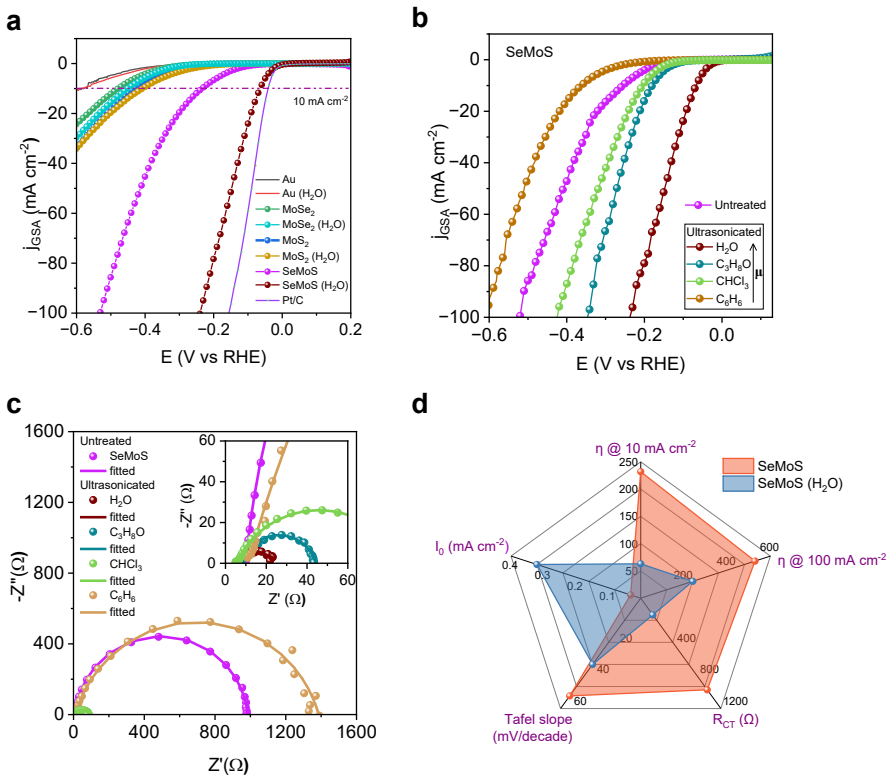
Janus transition metal dichalcogenide monolayers SeMoS and SeWS grown on Au foils exhibit significantly enhanced hydrogen evolution reaction activity compared with their parent TMDs, and sonochemical treatment in polar solvents produces a further substantial improvement by inducing tensile strain through Au surface restructuring together with defect formation, as verified by experiment and density functional theory; water-treated SeMoS reaches an overpotential of approximately 63 mV, Tafel slope of approximately 42 mV per decade, and exchange current density of approximately 10 to the minus 3 mA per square centimeter.
What carries the argument
Sonochemical treatment in polar solvents that induces tensile strain via Au surface restructuring and defect formation in the Janus monolayers.
If this is right
- Janus monolayers already outperform their parent TMDs before any treatment.
- Polar solvents produce a larger activity gain than non-polar solvents during sonication.
- The combination of strain and defects lowers the overpotential and Tafel slope to values approaching platinum.
- Density functional theory calculations reproduce the effect of the induced strain on hydrogen adsorption energetics.
- The treatment route offers a route to new catalytic systems based on Janus two-dimensional materials.
Where Pith is reading between the lines
- The same post-growth activation step could be tested on other families of two-dimensional materials to see whether strain-plus-defect engineering works beyond TMDs.
- If the defects remain stable under operating conditions, the method might reduce the need for expensive metal supports in scaled electrolyzers.
- Strain introduced this way might also affect neighboring reactions such as oxygen evolution or carbon dioxide reduction on the same monolayers.
- Repeating the treatment on transferred films rather than as-grown films would test whether the gold substrate is essential or merely convenient.
Load-bearing premise
The measured improvement in hydrogen evolution activity arises specifically from the tensile strain and defects created by the sonochemical treatment rather than from solvent residues or other unaccounted changes in the samples.
What would settle it
Direct measurement showing no increase in tensile strain or defect density after sonochemical treatment, or no correlation between those structural changes and the observed rise in exchange current density, would falsify the claimed mechanism.
Figures
read the original abstract
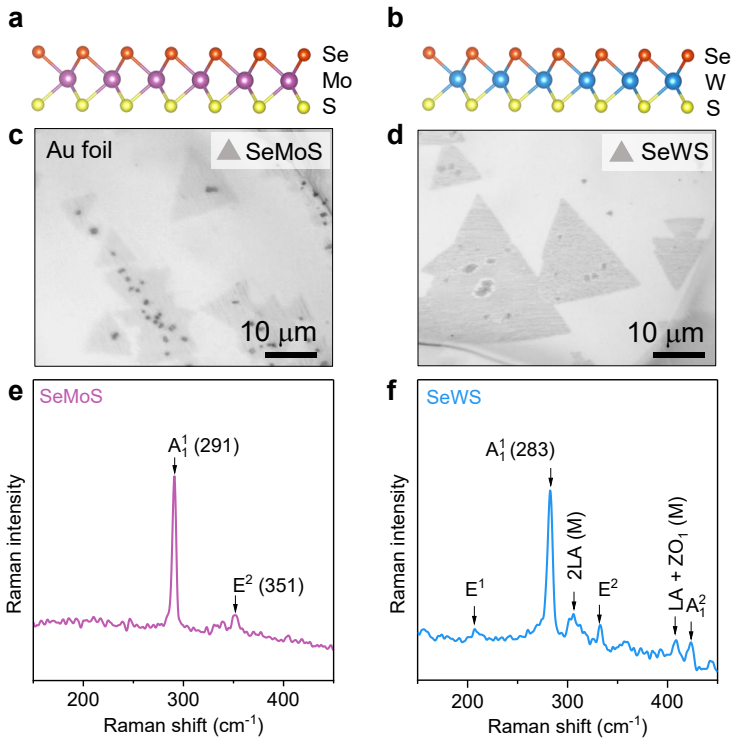
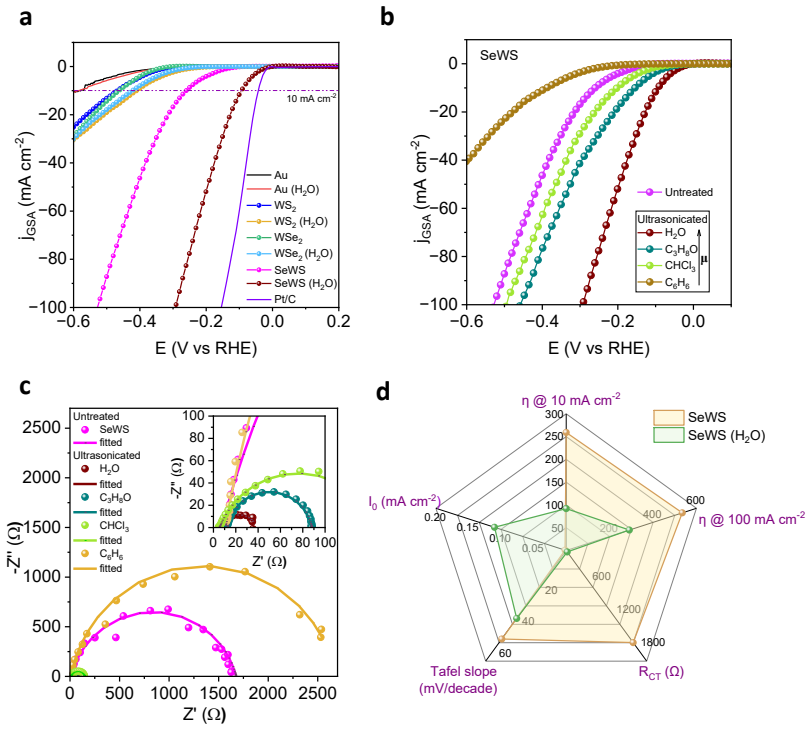
2D electrocatalysts that enable hydrogen evolution at low overpotentials offer an attractive alternative to expensive platinum-based systems. Here, we report the growth of Janus transition metal dichalcogenide (TMD) monolayers (MLs), SeMoS and SeWS, on Au foils using chemical vapor deposition, and systematically compare their catalytic properties in the context of hydrogen evolution reaction (HER) with those of their parent TMDs. The Janus MLs exhibited significantly enhanced catalytic performance relative to the parent TMDs. Furthermore, these MLs on Au foils were subjected to sonochemical treatment in polar and non-polar solvents, in which the treatment with polar solvents led to a substantial improvement in the HER activity of Janus MLs. In particular, SeMoS MLs treated with water showed a low overpotential of ~63 mV, a Tafel slope of ~42 mV/dec, and an exchange current density of ~10$^{-3}$ mA cm$^{- 2}$, approaching that of platinum. Analyses indicate that enhanced electrocatalytic activity is associated with tensile strain induced by Au surface restructuring and the formation of defects in Janus MLs, as shown by experimental observations and by density functional theory calculations. The enhancement in catalytic performance due to sonochemical treatment emphasizes the importance of our results for developing novel catalytic systems for HER based on Janus 2D materials.
Editorial analysis
A structured set of objections, weighed in public.
Referee Report
Summary. The manuscript reports the chemical vapor deposition growth of Janus transition metal dichalcogenide monolayers (SeMoS and SeWS) on Au foils and their hydrogen evolution reaction (HER) performance. The Janus monolayers show better activity than parent TMDs, and sonochemical treatment in polar solvents further improves it, with water-treated SeMoS achieving an overpotential of approximately 63 mV, Tafel slope of 42 mV/dec, and exchange current density of 10^{-3} mA cm^{-2}. The enhancement is attributed to tensile strain induced by Au surface restructuring and defect formation, supported by experimental observations and density functional theory calculations.
Significance. Should the reported performance metrics hold upon verification, this work would be significant as it provides a sonochemical method to enhance the HER activity of Janus TMDs to near-platinum levels, offering insights into strain and defect engineering in 2D materials for electrocatalysis. The use of both experimental data and DFT calculations strengthens the mechanistic interpretation.
minor comments (3)
- [Abstract] The overpotential value of ~63 mV should specify the reference current density (commonly 10 mA cm^{-2}) for standard comparison in HER literature.
- [Abstract] Details on the number of experimental replicates, error bars, and any data exclusion criteria for the reported HER metrics are not mentioned, which would improve the robustness assessment of the results.
- [Abstract] The term 'analyses indicate' is vague; specifying the experimental techniques (e.g., Raman, AFM) used to observe strain and defects would enhance clarity.
Simulated Author's Rebuttal
We thank the referee for their positive summary of our work on sonochemically treated Janus TMD monolayers and for recommending minor revision. No major comments were provided in the report.
Circularity Check
No significant circularity identified
full rationale
The paper's central claims rest on experimental growth of Janus TMD monolayers on Au foils, direct electrochemical measurements of HER metrics (overpotential, Tafel slope, exchange current density) before and after sonochemical treatment, and standard DFT calculations to associate activity with strain and defects. No derivation chain, fitted parameters renamed as predictions, self-definitional relations, or load-bearing self-citations appear in the abstract or described structure; the performance numbers are reported as measured quantities rather than outputs of any model that reduces to its own inputs by construction. The mechanistic attribution is presented as correlative support from observations plus DFT, without uniqueness theorems or ansatzes imported from prior author work that would force the result.
Axiom & Free-Parameter Ledger
axioms (1)
- domain assumption Standard assumptions of chemical vapor deposition growth and electrochemical characterization hold without major artifacts.
Reference graph
Works this paper leans on
-
[1]
George, C
A. George, C. Neumann, D. Kaiser, R. Mupparapu, T. Lehnert, U. Hübner, Z. Tang, A. Winter, U. Kaiser, I. Staude, A. Turchanin, JPhys Mater. 2019, 2, 016001
2019
-
[2]
Z. Gan, I. Paradisanos, A. Estrada-Real, J. Picker, E. Najafidehaghani, F. Davies, C. Neumann, C. Robert, P. Wiecha, K. Watanabe, T. Taniguchi, X. Marie, J. Biskupek, M. Mundszinger, R. Leiter, U. Kaiser, A. V . Krasheninnikov, B. Urbaszek, A. George, A. Turchanin, Adv. Mater. 2022, 34, 2205226
2022
-
[3]
Kresse, J
G. Kresse, J. Furthmüller, Comput. Mater. Sci. 1996, 6, 15
1996
-
[4]
Kresse, J
G. Kresse, J. Furthmüller, Phys. Rev. B. 1996, 54, 11169
1996
-
[5]
J. P. Perdew, K. Burke, M. Ernzerhof, Phys. Rev. Lett. 1996, 77, 3865
1996
-
[6]
Grimme, S
S. Grimme, S. Ehrlich, L. Goerigk, J. Comput. Chem. 2011, 32, 1456
2011
-
[7]
Pakhira, S
S. Pakhira, S. N. Upadhyay, Sustain. Energy Fuels 2022, 6, 1733
2022
-
[8]
Rahimi, Int
K. Rahimi, Int. J. Hydrog. Energy 2025, 161, 150744
2025
-
[9]
J. K. Nørskov, J. Rossmeisl, A. Logadottir, L. Lindqvist, J. R. Kitchin, T. Bligaard, H. Jónsson, J. Phys. Chem. B 2004, 108, 17886
2004
discussion (0)
Sign in with ORCID, Apple, or X to comment. Anyone can read and Pith papers without signing in.