REVIEW 3 major objections 5 minor 45 references
RIS-aided Latent Space Alignment for Semantic Channel Equalization
T0 review · 3 major / 5 minor · reviewed 2026-08-06 · deepseek-v4-flash
Pith's one-line read Jointly optimizing the pre-equalizer, post-equalizer, and RIS phases aligns independently trained semantic latent spaces better than separate physical and semantic equalization.
desk verdict Solid RIS extension with a real derivation flaw in the linear F-step; neural results are credible, linear needs re-derivation. read the letter →
The pith
A machine-rendered reading of the paper's core claim, the machinery that carries it, and where it could break.
The reading
What carries the argument
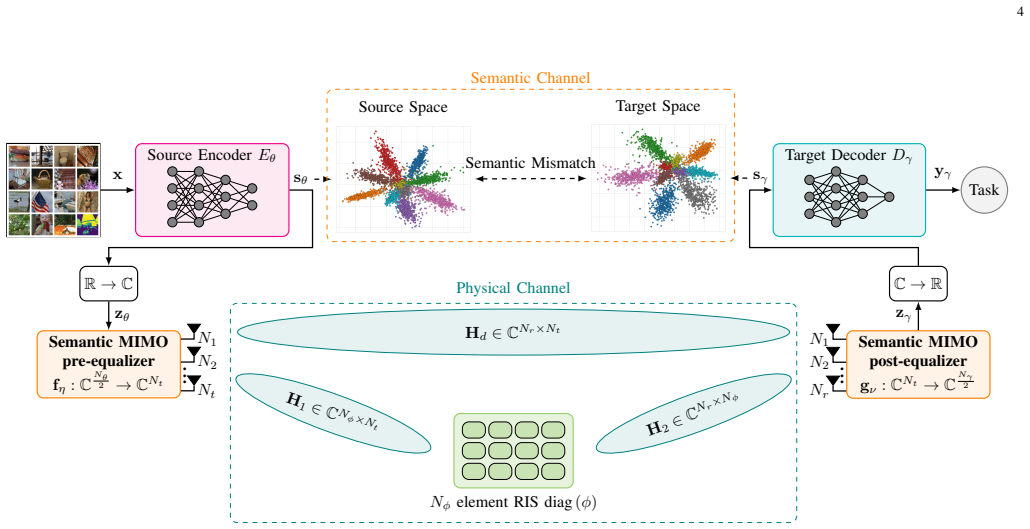
The load-bearing formulation is the constrained MMSE problem of Eq. (4)/(6): minimize the average squared distance between the receiver-side target latents $z_\gamma$ and the reconstructed latents $\hat z_\gamma = g_\nu(H_\phi f_\eta(z_\theta)+w)$, subject to an average transmit-power constraint and unit-modulus RIS phases $|\phi_i|=1$. The problem is fed by semantic pilots, paired latent vectors $(z_\theta(i), z_\gamma(i))$ obtained by running both encoders on a shared public dataset. For the linear solver, the variables $F$, $G$, and $\phi$ are updated alternately: $G$ in closed form, $F$ via a Sylvester equation, the power proxy $R$ by projection, and $\phi$ by a single projected-gradient step per iteration. For the neural solver, complex-valued DNNs implement $f_\eta$ and $g_\nu$, with power normalization and phase projection baked into the forward pass, plus hard-threshold pruning to control complexity. The compression factor $\zeta = KN_t/(N_\theta/2)$ quantifies how many complex channel symbols are sent per latent dimension, tying semantic compression into the same optimization.
What would settle it
A decisive test would train the equalizer after removing the receiver's latent vectors (only decoder outputs available) or on calibration data from a different distribution than the test set; either collapse would show the method depends on paired in-distribution latents, while robustness would confirm genuine semantic equalization.
Extended reading notes
Core claim
On its own terms, the paper's central claim is that semantic mismatch between independently trained encoders can be repaired at the physical layer by solving a single constrained MMSE problem that couples three stages: a pre-equalizer $f_\eta$ at the transmitter, the RIS phase configuration $\phi$ in the channel, and a post-equalizer $g_\nu$ at the receiver. Using paired semantic pilots $(z_\theta(i), z_\gamma(i))$ obtained by running both encoders on a shared public dataset, the paper minimizes the average squared distance $\mathbb{E}\|z_\gamma - g_\nu(H_\phi f_\eta(z_\theta) + w)\|^2$ under a transmit-power budget and the unit-modulus constraint $|\phi_i|=1$. Two solvers are developed: a linear chain solved by ADMM-style alternating updates (closed-form $G$, Sylvester equation for $F$, projection for the power variable, projected gradient for $\phi$), and a nonlinear chain based on complex-valued DNNs with power normalization and phase projection in the forward pass. The paper reports that both solvers consistently outperform disjoint baselines that align semantic spaces first and equalize the physical channel separately, across compression factors, RIS sizes, SNRs, and calibration-set sizes, and that re-optimizing only $\phi$ can restore performance after the direct channel is blocked.
Load-bearing premise
The whole scheme rests on a calibration phase in which the receiver exposes its encoder's latent vectors for a shared public dataset, so an agent that will not reveal those outputs cannot be equalized.
Editorial extensions
If this is right
- Independently trained transmitters and receivers can communicate meaningfully over MIMO channels without retraining either model, as long as a calibration set of semantic pilots is available.
- The RIS can be re-optimized alone to restore communication after a sudden channel blockage, preserving equalizers trained for the old channel.
- Compression and alignment should be co-designed: communication-agnostic compression followed by alignment is strictly worse across compression factors and RIS sizes.
- A sparse neural equalizer can match the per-sample computation of the linear equalizer while keeping higher accuracy, but the linear equalizer remains the better choice when calibration data are scarce.
- Latent MSE is an imperfect proxy for task accuracy; a weighted MSE that emphasizes large latent components is the paper's suggested next objective.
Reading between the lines
- A natural extension the paper does not develop is asymmetric calibration that avoids exposing the receiver's latent vectors, for instance aligning through decoder outputs or relative representations; the framework's reliance on paired latents suggests this is where privacy constraints would bind.
- The RIS-as-computation result suggests programmable surfaces could act as in-channel analog processors for semantic alignment, not just passive reflectors; testing whether this scales to larger semantic spaces would require more than the reported $N_t=4$ scenario.
- The MSE-accuracy mismatch hints that task-oriented objectives, such as classification loss, could be plugged into the same alternating or gradient machinery whenever the receiver's output space is known; the paper only sketches this.
- The calibration protocol leaks information about the receiver's encoder through the exposed latent vectors $z_\gamma$, so a system designer must weigh semantic alignment against model privacy, a tradeoff the paper leaves unquantified.
Editorial analysis
A structured set of objections, weighed in public.
Referee Report
Summary. The paper proposes a joint physical and semantic channel equalization framework for RIS-aided MIMO semantic communications. The transmitter and receiver use independently trained encoders, and the authors formulate a constrained MMSE problem over a linear or neural pre-equalizer, a post-equalizer, and the RIS phase shifts, using paired latent semantic pilots on a shared calibration set. Two solvers are presented: an ADMM-based alternating optimization for the linear equalizer and a constrained SGD procedure for the neural equalizer. Simulations over CIFAR-10 show that the proposed methods outperform disjoint alignment-and-transmission baselines across compression factors, RIS sizes, SNR values, and training-set sizes, and that the RIS can adapt to channel changes while leaving the equalizers fixed.
Significance. The topic is timely and the system model is well motivated: semantic mismatch between independently trained agents is a real obstacle for multi-vendor semantic communication, and the paper is among the first to combine semantic equalization with RIS and MIMO. The empirical study is broad, covering compression, SNR, RIS size, number of pilots, and a complexity trade-off, and the observation that latent MSE and downstream accuracy can de-correlate is a useful practical insight. If the derivations were correct, the claimed consistent gains over disjoint equalization would be a meaningful contribution. However, the linear equalizer derivation contains concrete algebraic inconsistencies that are load-bearing for the central claim, because the reported Linear Equalizer results are presented as the solution of the stated MMSE problem. The neural equalizer results are less affected by these issues, but the paper currently does not separate the two claims carefully. The absence of released code also prevents checking whether the implemented F update matches the equations.
major comments (3)
- [Section III, Eq. (8)] The recast problem is not equivalent to problem (7). Equation (7) includes the noise term Tr(G^H G Σ_w), while Eq. (8) replaces it with Tr(G^H G) without stating any assumption such as Σ_w = I. The subsequent G update in Eq. (10) reintroduces Σ_w, so the ADMM algorithm is not solving a consistent surrogate of (7). This should be corrected either by retaining Tr(G^H G Σ_w) in the recast or by explicitly assuming that the noise covariance is whitened.
- [Section III-B, Eqs. (17)-(20)] The Sylvester equation for F does not follow from the first-order condition of Eq. (11). Setting the Wirtinger gradient of (11) to zero, with M = G^(k+1) H_phi^(k), gives (1/N) M^H(M F Z_theta - Z_gamma) Z_theta^H + rho(F - R^(k) + S^(k)) = 0. Under the paper's whitening assumption Z_theta Z_theta^H ≈ N I, this reduces to (M^H M + rho I) F = rho(R^(k) - S^(k)) + (1/N) M^H Z_gamma Z_theta^H. The paper instead defines A = M^H M, B = N rho (Z_theta Z_theta^H)^(-1) ≈ rho I, and C = N rho(R^(k) - S^(k)) + M^H Z_gamma Z_theta^H, which yields (M^H M + rho I) F = N rho(R^(k) - S^(k)) + M^H Z_gamma Z_theta^H, differing by a factor of N on both right-hand-side terms. More generally, the exact Sylvester form should have C = [N rho(R^(k) - S^(k)) + M^H Z_gamma Z_theta^H] (Z_theta Z_theta^H)^(-1). The reported linear equalizer is therefore not minimizing the stated MMSE objective even approximately. This point must be fixed and the affected experiments re-run or re-justified.
- [Section II, Eq. (5)] The method's feasibility relies on the receiver exposing its encoder outputs z_gamma(i) = E_gamma(x(i)) on a shared calibration set. The statement that a public dataset 'ensuring that no agent is required to disclose private data' is too strong: the latent vectors themselves are functions of the proprietary receiver model and may leak information about that model. If the receiver cannot or will not provide E_gamma outputs, the semantic pilots in Eq. (5) cannot be formed and the entire MMSE formulation in Eq. (6) collapses. This operational assumption should be stated as a limitation, and the paper should discuss the privacy implications of sharing z_gamma.
minor comments (5)
- [Section V-B, Eq. (42)] In the baseline equalization update, H_phi^(k+1)_e is written as H_d + H_2 diag(phi^(k)) H_1, whereas the effective channel in Eq. (3) includes the Kronecker product I_K ⊗ (...). Please use the full expression or clarify that the figure/experiment uses K = 1.
- [Section V-D, text and Figure 5] The paragraph refers to 'compression factors η' when varying the compression factor; this appears to be a typo for ζ.
- [Section IV, Eq. (37) and Algorithm 1] There is a typo 'an the corresponding semantic pilots'; also, Algorithm 1 prunes the weights of η and ν but not the RIS phases φ, which should be stated explicitly.
- [Section V-D] No code is released. Given the F-step discrepancy identified above, releasing the implementation (or at least the exact update used for F) would be necessary to verify that the reported Linear Equalizer results correspond to a corrected derivation.
- [Section V] The text says that seed ranges are displayed as the highest and lowest values across seeds, but the figures appear to show only mean curves without visible error bars or shaded ranges. Please make the ranges visible or remove the claim.
Circularity Check
No significant circularity: the derivation chain is self-contained, the central claim is an empirical comparison on held-out data, and the self-citations are contextual rather than load-bearing.
full rationale
Score 0 reflects no significant circularity. The central claim—that the proposed joint linear and neural equalizers outperform disjoint physical-plus-semantic equalization baselines—is an empirical result: models are trained on N semantic pilots (N = 5 x 10^3 by default) and evaluated on the held-out 10^4 - N test samples (Section V), so the reported MSE and accuracy are out-of-sample and are not fitted inputs renamed as predictions. The derivation chain is self-contained: problem (4) minimizes the expected distance to z_gamma, which is the receiver encoder output (data, not a paper-defined fitted constant); (6) is a data-driven approximation via semantic pilots; the linear solver is derived in-paper via ADMM updates (10)-(15), the closed-form G step (16), the Sylvester equation (17)-(20), the projection (21)-(28), and PGD (29)-(36); the neural solver uses standard SGD over the loss (37). No mathematical step is justified by a self-citation, and no uniqueness theorem from the authors' prior work is imported to declare the design forced. The self-citations that occur—[25] for the concept of semantic mismatch and semantic channel equalization, [37] for the preliminary conference formulation and the disjoint baseline design, and [31] for the MSE-accuracy de-correlation observation—are contextual: they supply background and comparison methodology, while the optimization derivations and the performance comparison rest on the paper's own equations and experiments. Separately flagged as a correctness risk rather than circularity: the stationary condition of (11) under the stated whitening Z_theta Z_theta^H = N I yields M^H M F + rho F = rho(R - S) + (1/N) M^H Z_gamma Z_theta^H, whereas (17)-(20) give A F + F B = C with C = N rho (R - S) + M^H Z_gamma Z_theta^H, a mismatch in both right-hand-side terms; likewise Eq. (8) drops the Tr(G^H G Sigma_w) term of (7) before (10) restores it. These inconsistencies undermine the claimed MMSE guarantee of the linear solver's derivation as written, but they are derivation errors, not equivalences-by-construction, and they do not raise the circularity score. The paper also candidly disclaims its own optimization metric in the Conclusions (MSE 'may be suboptimal due to its relatively weak correlation with task-specific performance'), which is the opposite of a self-justifying loop.
Assumptions & free parameters
free parameters (5)
- ADMM regularization coefficient rho =
Not reported
- PGD step size alpha for the phi update =
Not reported
- Neural training hyperparameters: learning rate, optimizer, epochs, batch size =
Not reported
- Sparsity factor beta =
Range {1, 2, 4, 6, ..., 20}
- Number of outer iterations =
30
assumptions (5)
- domain assumption ADMM converges to a useful solution of the non-convex problem (8)
- domain assumption Semantic pilots (z_theta(i), z_gamma(i)) can be obtained for a shared public dataset with access to both encoders
- standard math The covariance of z_theta can be whitened to identity without loss of generality
- domain assumption Channel matrices Hd, H1, and H2 are known for training the equalizers
- domain assumption The direct channel is blocked in the main comparison scenarios
Cite this review
Pith. "Pith review of RIS-aided Latent Space Alignment for Semantic Channel Equalization." pith.science (2026). https://pith.science/paper/AFZO2CUB
@misc{pith2026250716450,
  author       = {Pith},
  title        = {Pith review of: RIS-aided Latent Space Alignment for Semantic Channel Equalization},
  year         = {2026},
  howpublished = {\url{https://pith.science/paper/AFZO2CUB}},
  note         = {Machine review of arXiv:2507.16450}
}
read the original abstract
Semantic communication systems introduce a new paradigm in wireless communications, focusing on transmitting the intended meaning rather than ensuring strict bit-level accuracy. These systems often rely on Deep Neural Networks (DNNs) to learn and encode meaning directly from data, enabling more efficient communication. However, in multi-user settings where interacting agents are trained independently-without shared context or joint optimization-divergent latent representations across AI-native devices can lead to semantic mismatches, impeding mutual understanding even in the absence of traditional transmission errors. In this work, we address semantic mismatch in Multiple-Input Multiple-Output (MIMO) channels by proposing a joint physical and semantic channel equalization framework that leverages the presence of Reconfigurable Intelligent Surfaces (RIS). The semantic equalization is implemented as a sequence of transformations: (i) a pre-equalization stage at the transmitter; (ii) propagation through the RIS-aided channel; and (iii) a post-equalization stage at the receiver. We formulate the problem as a constrained Minimum Mean Squared Error (MMSE) optimization and propose two solutions: (i) a linear semantic equalization chain, and (ii) a non-linear DNN-based semantic equalizer. Both methods are designed to operate under semantic compression in the latent space and adhere to transmit power constraints. Through extensive evaluations, we show that the proposed joint equalization strategies consistently outperform conventional, disjoint approaches to physical and semantic channel equalization across a broad range of scenarios and wireless channel conditions.
Figures


Figures from the paper (3 more)


Reference graph
Works this paper leans on
-
[1]
Survey on 6g frontiers: Trends, applications, require- ments, technologies and future research,
C. De Alwis, A. Kalla, Q.-V . Pham, P. Kumar, K. Dev, W.-J. Hwang, and M. Liyanage, “Survey on 6g frontiers: Trends, applications, require- ments, technologies and future research,” IEEE Open Journal of the Communications Society , vol. 2, pp. 836–886, 2021
work page 2021
-
[2]
6g networks: Beyond shannon towards semantic and goal-oriented communications,
E. Calvanese Strinati and S. Barbarossa, “6g networks: Beyond shannon towards semantic and goal-oriented communications,” Computer Net- works, vol. 190, p. 107930, 2021
work page 2021
-
[3]
Beyond transmitting bits: Context, semantics, and task-oriented communications,
D. G ¨und¨uz, Z. Qin, I. E. Aguerri, H. S. Dhillon, Z. Yang, A. Yener, K. K. Wong, and C.-B. Chae, “Beyond transmitting bits: Context, semantics, and task-oriented communications,” IEEE Journal on Selected Areas in Communications, vol. 41, no. 1, pp. 5–41, 2022
2022
-
[4]
Goal-oriented and semantic communication in 6g ai- native networks: The 6g-goals approach,
E. Calvanese Strinati, P. Di Lorenzo, V . Sciancalepore, A. Aijaz, M. Kountouris, D. G ¨und¨uz, P. Popovski, M. Sana, P. A. Stavrou, B. Soret, et al. , “Goal-oriented and semantic communication in 6g ai- native networks: The 6g-goals approach,” in 2024 Joint European Con- ference on Networks and Communications & 6G Summit (EuCNC/6G Summit), pp. 1–6, IEEE, 2024
work page 2024
-
[5]
Recent contributions to the mathematical theory of com- munication,
W. Weaver, “Recent contributions to the mathematical theory of com- munication,” 1949
work page 1949
-
[6]
An outline of a theory of semantic in- formation,
R. Carnap, Y . Bar-Hillel, et al. , “An outline of a theory of semantic in- formation,” Research Laboratory of Electronics, Massachusetts Institute of Technology, 1952
work page 1952
-
[7]
Towards a theory of semantic communication,
J. Bao, P. Basu, M. Dean, C. Partridge, A. Swami, W. Leland, and J. A. Hendler, “Towards a theory of semantic communication,” in 2011 IEEE Network Science Workshop , pp. 110–117, IEEE, 2011
work page 2011
-
[8]
The semantic communication game,
B. G ¨uler, A. Yener, and A. Swami, “The semantic communication game,” IEEE Transactions on Cognitive Communications and Network- ing, vol. 4, no. 4, pp. 787–802, 2018
2018
Show all 45 references
-
[9]
Effective communication with dynamic feature compression,
P. Talli, F. Pase, F. Chiariotti, A. Zanella, and M. Zorzi, “Effective communication with dynamic feature compression,” IEEE Transactions on Communications , 2024
2024
-
[10]
Lossy compression for lossless prediction,
Y . Dubois, B. Bloem-Reddy, K. Ullrich, and C. J. Maddison, “Lossy compression for lossless prediction,” Advances in Neural Information Processing Systems, vol. 34, pp. 14014–14028, 2021
2021
-
[11]
Opportunistic information-bottleneck for goal-oriented feature extraction and commu- nication,
F. Binucci, P. Banelli, P. Di Lorenzo, and S. Barbarossa, “Opportunistic information-bottleneck for goal-oriented feature extraction and commu- nication,” IEEE Open Journal of the Communications Society , vol. 5, pp. 2418–2432, 2024
2024
-
[12]
Deep joint source- channel coding for wireless image transmission,
E. Bourtsoulatze, D. B. Kurka, and D. G ¨und¨uz, “Deep joint source- channel coding for wireless image transmission,” IEEE Transactions on Cognitive Communications and Networking , vol. 5, no. 3, pp. 567–579, 2019
2019
-
[13]
Deep learning enabled semantic communication systems,
H. Xie, Z. Qin, G. Y . Li, and B.-H. Juang, “Deep learning enabled semantic communication systems,” IEEE Transactions on Signal Pro- cessing, vol. 69, pp. 2663–2675, 2021
2021
-
[14]
Learning semantics: An opportunity for effective 6g communications,
M. Sana and E. Calvanese Strinati, “Learning semantics: An opportunity for effective 6g communications,” in 2022 IEEE 19th Annual Consumer Communications & Networking Conference (CCNC) , pp. 631–636, IEEE, 2022
2022
-
[15]
Semantic communication systems for speech transmission,
Z. Weng and Z. Qin, “Semantic communication systems for speech transmission,” IEEE Journal on Selected Areas in Communications , vol. 39, no. 8, pp. 2434–2444, 2021
2021
-
[16]
Learning task-oriented communication for edge inference: An information bottleneck approach,
J. Shao, Y . Mao, and J. Zhang, “Learning task-oriented communication for edge inference: An information bottleneck approach,” IEEE Journal on Selected Areas in Communications , vol. 40, no. 1, pp. 197–211, 2021
2021
-
[17]
Semantic information recovery in wireless networks,
E. Beck, C. Bockelmann, and A. Dekorsy, “Semantic information recovery in wireless networks,” Sensors, vol. 23, no. 14, p. 6347, 2023
2023
-
[18]
Adaptive semantic token communication for transformer-based edge inference,
A. Devoto, J. Pomponi, M. Merluzzi, P. Di Lorenzo, and S. Scardapane, “Adaptive semantic token communication for transformer-based edge inference,” arXiv preprint arXiv:2505.17604 , 2025
2025 arXiv
-
[19]
Effective communi- cations: A joint learning and communication framework for multi-agent reinforcement learning over noisy channels,
T.-Y . Tung, S. Kobus, J. P. Roig, and D. G ¨und¨uz, “Effective communi- cations: A joint learning and communication framework for multi-agent reinforcement learning over noisy channels,” IEEE Journal on Selected Areas in Communications , vol. 39, no. 8, pp. 2590–2603, 2021
2021
-
[20]
Deep joint source-channel coding for adaptive image transmission over mimo channels,
H. Wu, Y . Shao, C. Bian, K. Mikolajczyk, and D. G ¨und¨uz, “Deep joint source-channel coding for adaptive image transmission over mimo channels,” IEEE Transactions on Wireless Communications , 2024
2024
-
[21]
Ofdm-guided deep joint source chan- nel coding for wireless multipath fading channels,
M. Yang, C. Bian, and H.-S. Kim, “Ofdm-guided deep joint source chan- nel coding for wireless multipath fading channels,” IEEE Transactions on Cognitive Communications and Networking , vol. 8, no. 2, pp. 584– 599, 2022
2022
-
[22]
Deepjscc-f: Deep joint source-channel coding of images with feedback,
D. B. Kurka and D. G ¨und¨uz, “Deepjscc-f: Deep joint source-channel coding of images with feedback,” IEEE Journal on Selected Areas in Information Theory , vol. 1, no. 1, pp. 178–193, 2020
2020
-
[23]
Semantic communications: Overview, open issues, and future research directions,
X. Luo, H.-H. Chen, and Q. Guo, “Semantic communications: Overview, open issues, and future research directions,” IEEE Wireless Communi- cations, vol. 29, no. 1, pp. 210–219, 2022
2022
-
[24]
Robust semantic communications with masked vq-vae enabled codebook,
Q. Hu, G. Zhang, Z. Qin, Y . Cai, G. Yu, and G. Y . Li, “Robust semantic communications with masked vq-vae enabled codebook,” IEEE Transactions on Wireless Communications , vol. 22, no. 12, pp. 8707– 8722, 2023
2023
-
[25]
Semantic channel equalizer: Mod- elling language mismatch in multi-user semantic communications,
M. Sana and E. Calvanese Strinati, “Semantic channel equalizer: Mod- elling language mismatch in multi-user semantic communications,” in GLOBECOM 2023-2023 IEEE Global Communications Conference , pp. 2221–2226, IEEE, 2023
2023
-
[26]
Semantics alignment via split learning for resilient multi-user semantic communication,
J. Choi, J. Park, S.-W. Ko, J. Choi, M. Bennis, and S.-L. Kim, “Semantics alignment via split learning for resilient multi-user semantic communication,” IEEE Transactions on V ehicular Technology, 2024
2024
-
[27]
Pragmatic goal- oriented communications under semantic-effectiveness channel errors,
T. Huttebraucker, M. Sana, and E. Calvanese Strinati, “Pragmatic goal- oriented communications under semantic-effectiveness channel errors,” in IEEE Consumer Communications & Networking Conference, pp. 683– 689, IEEE, 2024
2024
-
[28]
Soft partitioning of latent space for semantic channel equalization,
T. H ¨uttebr¨aucker, M. Sana, and E. Calvanese Strinati, “Soft partitioning of latent space for semantic channel equalization,” in 2024 19th In- ternational Symposium on Wireless Communication Systems (ISWCS) , pp. 1–6, IEEE, 2024
2024
-
[29]
Relative representations enable zero-shot latent space com- munication,
L. Moschella, V . Maiorca, M. Fumero, A. Norelli, F. Locatello, and E. Rodol `a, “Relative representations enable zero-shot latent space com- munication,” arXiv preprint arXiv:2209.15430 , 2022
2022 arXiv
-
[30]
Dynamic relative representations for goal-oriented semantic communi- cations,
S. Fiorellino, C. Battiloro, E. Calvanese Strinati, and P. Di Lorenzo, “Dynamic relative representations for goal-oriented semantic communi- cations,” in 2024 32nd European Signal Processing Conference (EU- SIPCO), pp. 2107–2111, 2024
2024
-
[31]
Relative representations of latent spaces enable efficient semantic channel equalization,
T. H ¨uttebr¨aucker, S. Fiorellino, M. Sana, P. Di Lorenzo, and E. Cal- vanese Strinati, “Relative representations of latent spaces enable efficient semantic channel equalization,” proc. of IEEE Globecom workshops 2024, Cape Town, South Africa. , 2024. 15
2024
-
[32]
Ris-enhanced semantic communications adaptive to user requirements,
P. Jiang, C.-K. Wen, S. Jin, and G. Y . Li, “Ris-enhanced semantic communications adaptive to user requirements,” IEEE Transactions on Communications, 2024
2024
-
[33]
Drl-based intelligent resource allocation for physical layer semantic communication with irs,
B. Hu, J. Ma, Z. Sun, J. Liu, R. Li, and L. Wang, “Drl-based intelligent resource allocation for physical layer semantic communication with irs,” Physical Communication , vol. 63, p. 102270, 2024
2024
-
[34]
A joint communication and computation design for distributed riss assisted probabilistic semantic communication in iiot,
Z. Zhao, Z. Yang, C. Huang, L. Wei, Q. Yang, C. Zhong, W. Xu, and Z. Zhang, “A joint communication and computation design for distributed riss assisted probabilistic semantic communication in iiot,” IEEE Internet of Things Journal , 2024
2024
-
[35]
Enhanced semantic information transfer on ris-assisted communication systems,
J. Ma, Q. Li, R. Liu, A. Pandharipande, and X. Ge, “Enhanced semantic information transfer on ris-assisted communication systems,” IEEE Wireless Communications Letters , 2024
2024
-
[36]
Reconfigurable intelligent surface assisted semantic communication systems,
J. Shi, T.-T. Chan, H. Pan, and T.-M. Lok, “Reconfigurable intelligent surface assisted semantic communication systems,” in IEEE Interna- tional Conference on Signal Processing, Communications and Comput- ing, pp. 1–6, IEEE, 2023
2023
-
[37]
Latent space alignment for ai-native mimo semantic communications,
M. E. Pandolfo, S. Fiorellino, E. Calvanese Strinati, and P. Di Lorenzo, “Latent space alignment for ai-native mimo semantic communications,” International Joint Conference on Neural Networks , 2025
2025
-
[38]
Distributed optimization and statistical learning via the alternating direction method of multipliers,
S. Boyd, N. Parikh, E. Chu, B. Peleato, J. Eckstein, et al. , “Distributed optimization and statistical learning via the alternating direction method of multipliers,” F oundations and Trends® in Machine learning , vol. 3, no. 1, pp. 1–122, 2011
2011
-
[39]
Boyd and L
S. Boyd and L. Vandenberghe, Convex optimization. Cambridge univer- sity press, 2004
2004
-
[40]
Algorithm 432 [c2]: Solution of the matrix equation ax+ xb= c [f4],
R. H. Bartels and G. W. Stewart, “Algorithm 432 [c2]: Solution of the matrix equation ax+ xb= c [f4],” Communications of the ACM , vol. 15, no. 9, pp. 820–826, 1972
1972
-
[41]
timm: Pytorch image models,
R. Wightman, “timm: Pytorch image models,” 2019. Version X.X.X, available at: https://github.com/rwightman/pytorch-image-models
2019
-
[42]
Imagenet: A large-scale hierarchical image database,
J. Deng, W. Dong, R. Socher, L.-J. Li, K. Li, and L. Fei-Fei, “Imagenet: A large-scale hierarchical image database,” in 2009 IEEE conference on computer vision and pattern recognition , pp. 248–255, Ieee, 2009
2009
-
[43]
Learning multiple layers of features from tiny images,
A. Krizhevsky, G. Hinton, et al. , “Learning multiple layers of features from tiny images,” 2009
2009
-
[44]
Gaussian error linear units (gelus),
D. Hendrycks and K. Gimpel, “Gaussian error linear units (gelus),” arXiv preprint arXiv:1606.08415, 2016
2016 arXiv
-
[45]
Reconfigurable, intelligent, and sustainable wireless environments for 6g smart connectivity,
E. Calvanese Strinati, G. C. Alexandropoulos, H. Wymeersch, B. Denis, V . Sciancalepore, R. d’Errico, A. Clemente, D.-T. Phan-Huy, E. De Car- valho, and P. Popovski, “Reconfigurable, intelligent, and sustainable wireless environments for 6g smart connectivity,”IEEE Communicati...
2021
Reviewed August 6, 2026 · model on record in the stance chip above.
Discussion (0). Sign in to comment.