REVIEW 3 major objections 5 minor 41 references
Two-dimensional magnetic semiconductors with room Curie temperatures
T0 review · 3 major / 5 minor · reviewed 2026-08-14 · deepseek-v4-flash
Pith's one-line read Three technetium-based monolayers predicted to be ferromagnetic semiconductors up to 538 K.
desk verdict A worthwhile computational prediction of Tc-based 2D ferromagnetic semiconductors, but the headline Curie temperatures are softer than they look because they rest on an untested Hubbard U and a nearest-neighbor Ising fit with competing AFM states close in energy. read the letter →
The pith
A machine-rendered reading of the paper's core claim, the machinery that carries it, and where it could break.
The reading
What carries the argument
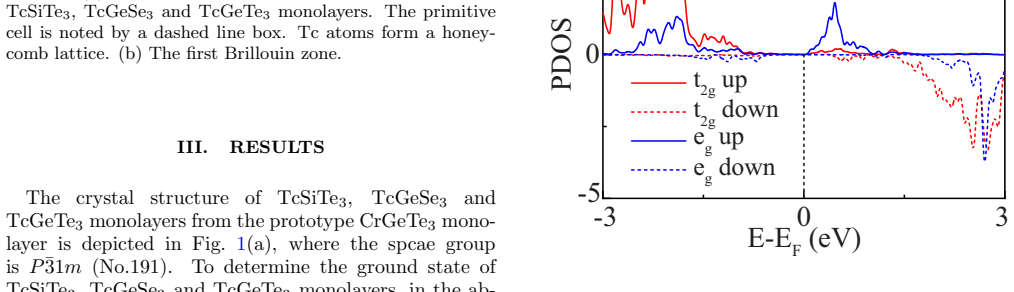
The central object is the Tc 4d-electron state in an octahedral Te/Se environment, specifically the partially occupied $t_{2g}$ and $e_g$ orbitals that emerge when the crystal field and the Hubbard $U$ are comparable. This partial occupation supplies a large orbital moment $L \approx 0.5\ \mu_B$, which, combined with the large atomic spin-orbit coupling $\lambda$ of 4d Tc, gives a strong spin-orbit coupling $H_{\rm SOC} = \lambda \mathbf{S}\cdot\mathbf{L}$. The resulting single-ion anisotropy selects out-of-plane Ising order, and the exchange coupling $J$ is estimated from superexchange through Te/Se with near-90-degree Tc-X-Tc bonds. The comparison scan over $M$GeTe$_3$ compounds identifies Tc as unique through its unusually large orbital moment and magnetocrystalline anisotropy energy.
What would settle it
Grow or exfoliate a monolayer of TcSiTe3 and measure its magnetization versus temperature under an out-of-plane field: a ferromagnetic transition near 538 K with a per-atom moment of about $2\ \mu_B$ would support the central prediction, whereas a transition far below 300 K or a strongly reduced moment would rule out the $U_{\rm eff} = 2$ eV picture.
Extended reading notes
Core claim
The authors' central claim is that TcSiTe3, TcGeSe3, and TcGeTe3 monolayers, modeled on the experimentally known CrGeTe3 structure, are kinetically and thermally stable 2D ferromagnetic semiconductors. In GGA+SOC+U calculations, the out-of-plane ferromagnetic state is lowest in energy, with spin moments near $2\ \mu_B$ per Tc atom and orbital moments around $0.5\ \mu_B$. From a nearest-neighbor Ising Hamiltonian with exchange constants $J = 7.625$, $2.997$, and $2.647$ meV, Monte Carlo simulations yield Curie temperatures of 538 K, 212 K, and 187 K. The large orbital moment is attributed to comparable crystal-field and Coulomb-interaction scales for the Tc 4d electrons; the resulting strong spin-orbit coupling produces magnetocrystalline anisotropy energies of tens of meV, anomalous Hall conductivities of order $10^3\ (\Omega\,\text{cm})^{-1}$, and Kerr rotations near $3.6^\circ$. These numbers are presented as evidence that Tc-based monolayers form a new family of 2D ferromagnetic semiconductors suitable for spintronics.
Load-bearing premise
All the headline numbers depend on the choice $U_{\rm eff} = 2$ eV for the Tc 4d electrons; if the true correlation strength is different, the orbital moments, anisotropy, exchange coupling, and Curie temperatures could shift substantially.
Editorial extensions
If this is right
- If the 538 K prediction holds, TcSiTe3 monolayers would provide a room-temperature 2D magnet with an out-of-plane easy axis, making it a candidate for ultra-thin spintronic memory and switching devices.
- The combination of a ferromagnetic semiconductor band gap and large Kerr rotation (about $3.6^\circ$) suggests these monolayers could serve in magneto-optical readout without requiring metallic ferromagnets.
- Anomalous Hall conductivity on the order of $10^3\ (\Omega\,\text{cm})^{-1}$ in both p-type and n-type TcGeTe3 implies that electrical readout of the magnetic state may be possible in this family.
- Because the mechanism is tied to Tc's 4d electron correlations, the design rule extends to other Tc-based chalcogenides and possibly to 5d analogues, where even larger spin-orbit effects might be expected.
- The strong Ising-type anisotropy overcomes the Mermin-Wagner restriction, so finite-temperature order in these 2D monolayers is consistent with the model used.
Reading between the lines
- The paper does not test how the orbital moment, magnetocrystalline anisotropy, exchange coupling, or Curie temperature vary with the Hubbard $U_{\rm eff}$ beyond confirming structural stability; a systematic $U_{\rm eff}$ scan would show how robust the room-temperature ferromagnetism is.
- The predicted Curie temperatures come from a classical Ising Monte Carlo model on a finite lattice, so quantum fluctuations and phonon-mediated renormalization are not included and could lower the actual ordering temperatures.
- Technetium has no stable isotopes, so experimental realization would face radioactivity handling challenges that the paper does not discuss; this may push practical development toward related 4d or 5d analogues if any can mimic the same orbital-moment mechanism.
Signed reviews
Editorial analysis
A structured set of objections, weighed in public.
Referee Report
Summary. The manuscript proposes three two-dimensional Tc-based compounds (TcSiTe3, TcGeSe3, TcGeTe3) as Ising-type ferromagnetic semiconductors with the same crystal structure as CrGeTe3. Using DFT+U and DFT+SOC+U, the authors report ferromagnetic ground states, structural stability from phonon and ab initio molecular dynamics calculations, large orbital moments near 0.5 μB per Tc, large magnetocrystalline anisotropy, and Curie temperatures of 538 K, 212 K, and 187 K obtained from Monte Carlo simulations of a nearest-neighbor Ising model. They also report large anomalous Hall conductivities and Kerr rotation angles, and they place the results in a broader context by surveying MGeTe3 monolayers for M = 3d, 4d, and 5d transition metals.
Significance. If the quantitative predictions survive scrutiny, this paper would identify a promising family of 2D ferromagnetic semiconductors with exceptionally large orbital moments, magnetocrystalline anisotropy, anomalous Hall conductivity, and magneto-optical Kerr rotation, and it would provide a useful chemical trend across the MGeTe3 series. Strengths of the paper include the benchmark against CrGeTe3 (whose calculated TC of 19 K is consistent with the known low ordering temperature), the structural stability checks at several Ueff values, the systematic comparison across 3d/4d/5d metals, and the transparent superexchange-based microscopic discussion. The main limitations are that the headline quantities (exchange coupling, orbital moment, and TC) are computed at a single Hubbard Ueff, that the exchange model used in the Monte Carlo is truncated to a single nearest-neighbor coupling without quantifying the error from omitted couplings, and that the Monte Carlo methodology is incompletely specified. These limitations affect the central quantitative claims rather than only the presentation.
major comments (3)
- [II (Method) and III (Results), Table I] Section II fixes Ueff = U − J = 2 eV for the Tc 4d electrons and justifies this by saying the value is “reasonable,” while Section III attributes the large orbital moment (L ≈ 0.54 μB) and the large exchange coupling (J = 7.625 meV for TcSiTe3) to the comparable magnitudes of the crystal field and electron correlation. This is exactly the regime in which results are most sensitive to the Hubbard parameter. The manuscript reports that the structures remain stable at Ueff = 1 and 3 eV, but it does not report how J, the orbital moment, the MAE, the magnetic gap, or the Curie temperature change with Ueff. Because the headline prediction of room-temperature ferromagnetism in TcSiTe3 rests on this single parameter, a Ueff scan of J (and ideally of the resulting Monte Carlo TC) together with L and MAE is required to establish that the claim is not an artifact of the chosen Ueff.
- [III, Table I and the text after Fig. 4] The exchange coupling J is extracted from only one antiferromagnetic configuration (ZAFMz for TcSiTe3 and CrGeTe3, SAFMz for TcGeSe3 and TcGeTe3), and the Monte Carlo then uses the nearest-neighbor Ising Hamiltonian H = −J Σ⟨i,j⟩ S_i^z S_j^z. However, Table I contains three independent AFM energies, and for TcSiTe3 these lie 122.0 (ZAFMz), 165.1 (SAFMz), and 310.4 meV (NAFMz) above the FMz ground state, with analogous spread for the other two Tc compounds. A single nearest-neighbor J cannot be assumed to reproduce all three energies, and the fact that the lowest AFM state changes between TcSiTe3 (ZAFMz) and TcGeSe3/TcGeTe3 (SAFMz) indicates that additional exchange couplings or configuration-dependent contributions are present. The paper neither includes these couplings in the Monte Carlo Hamiltonian nor quantifies the error incurred by neglecting them, so the quoted Curie temperatures carry an unquantified model error. The authors should either include the additional couplings in the spin model or demonstrate numerically that the TC is insensitive to them.
- [III, Monte Carlo simulations (paragraph after the Ising Hamiltonian)] The Monte Carlo section reports a 60×60 honeycomb lattice and 10^6 steps per temperature, but it does not state the spin length S used in H = −J Σ S_i^z S_j^z, the number of warm-up steps, or statistical error bars. The quoted TC of 538 K for TcSiTe3 appears to correspond to a classical Ising simulation with S = 2 on the honeycomb lattice; this assignment should be stated explicitly, and the sensitivity of TC to using S = 2 rather than the computed ⟨S⟩ ≈ 1.87 μB from Table I should be discussed. Without this information and without finite-size scaling checks, the reported TC values are presented as single numbers with no error estimate, which is disproportionate to their central role in the paper's claims.
minor comments (5)
- [Title and Abstract] The phrase “room Curie temperatures” in the title overstates the calculated results, since two of the three proposed monolayers have TC below room temperature (212 K and 187 K). Please revise the title and abstract to say “high Curie temperatures” or to specify that only TcSiTe3 is predicted to be above room temperature.
- [Abstract] The abstract contains the phrase “around 200-0500 K,” which should read “200–500 K.”
- [I (Introduction) and Fig. 1 caption] There are typos: “filed” should be “field” in the introduction, and “spcae group” should be “space group” in the Fig. 1 caption.
- [Fig. 3 caption and associated text] Please state explicitly which calculations include SOC; in particular, the HSE06 band structure in Fig. 3(c) appears to be a non-SOC calculation, and the reported 0.4 eV gap should be labeled as an HSE06 estimate without SOC.
- [References] Reference 4 is incomplete (missing volume, page, and year), and the author list of Ref. 15 appears to contain an encoding artifact (“M. Kl?ui”).
Circularity Check
No significant circularity: the reported Curie temperatures follow from a self-contained first-principles DFT+U to Monte Carlo chain, with J derived from total-energy differences rather than fitted to experiment.
full rationale
The paper's central predictions are obtained from a standard, non-circular pipeline. The exchange parameter J is computed from total-energy differences between FMz and the lowest-energy AFM configuration (Table I), and the Curie temperature is then obtained by Monte Carlo simulation of the resulting Ising Hamiltonian. No experimental Curie temperature is used as an input, and no fitted parameter is relabeled as a prediction. The choice Ueff = 2 eV is taken from the literature for Tc 4d electrons and is a model assumption, not a quantity fitted to the target results; the paper checks structural stability at other Ueff values, though not magnetic-property sensitivity, which is a robustness limitation rather than circularity. The Ising form is justified by the large calculated single-ion anisotropy and the energy ordering of spin configurations, not by assuming the answer. The self-citations (Refs. 20 and 37) appear as routine references in introductory or contextual statements and do not carry the derivation. Overall, the prediction chain is self-contained and no step reduces by construction to its own input.
Assumptions & free parameters
free parameters (2)
- Hubbard U for Tc 4d electrons =
U = 2.3 eV, J_H = 0.3 eV, Ueff = 2 eV
- Hubbard U for Cr 3d electrons in benchmark CrGeTe3 =
U = 4 eV
assumptions (5)
- domain assumption The PBE exchange-correlation functional with GGA+U accurately describes the electronic structure of Tc-based 2D materials.
- domain assumption The synthesized monolayers adopt the CrGeTe3 crystal structure (space group P-31m).
- domain assumption The magnetism is described by a nearest-neighbor Ising model H = -J sum S_i^z S_j^z on a honeycomb lattice.
- domain assumption Monte Carlo on a 60x60 lattice with 10^6 steps per temperature is sufficient for converged Curie temperatures.
- domain assumption The superexchange estimate J = |V|^2 / |Ep-Ed| captures the dominant exchange mechanism.
Cite this review
Pith. "Pith review of Two-dimensional magnetic semiconductors with room Curie temperatures." pith.science (2026). https://pith.science/paper/AGB26HIL
@misc{pith2026190805836,
  author       = {Pith},
  title        = {Pith review of: Two-dimensional magnetic semiconductors with room Curie temperatures},
  year         = {2026},
  howpublished = {\url{https://pith.science/paper/AGB26HIL}},
  note         = {Machine review of arXiv:1908.05836}
}
abstract
We propose two-dimensional (2D) Ising-type ferromagnetic semiconductors TcSiTe3, TcGeSe3, and TcGeTe3 with high Curie temperatures around 200-0500 K. Owing to large spin-orbit couplings, the large magnetocrystalline anisotropy energy (MAE), large anomalous Hall conductivity, and large magneto-optical Kerr effect were discovered in these intriguing 2D materials. By comparing all possible 2D MGeTe3 materials (M = 3d, 4d, 5d transition metals), we found a large orbital moment around 0.5 $\mu$B per atom and a large MAE for TcGeTe3. The large orbital moments are revealed to be from the comparable crystal fields and electron correlations in these Tc-based 2D materials. The microscopic mechanism of the high Curie temperature is also addressed. Our findings reveal the unique magnetic behaviors of 2D Tc-based materials and present a family of 2D ferromagnetic semiconductors with large MAE and Kerr rotation angles that would have wide applications in designing spintronic devices.
Figures


Figures from the paper (3 more)


Reference graph
Works this paper leans on
-
[1]
author author A. Soumyanarayanan , author N. Reyren , author A. Fert , \ and\ author C. Panagopoulos ,\ 10.1038/nature19820 journal journal Nature \ volume 539 ,\ pages 509 ( year 2016 ) NoStop
-
[2]
author author M. T. \ Johnson , author P. J. H. \ Bloemen , author F. J. A. \ den Broeder , \ and\ author J. J. \ de Vries ,\ 10.1088/0034-4885/59/11/002 journal journal Rep. Prog. Phys. \ volume 59 ,\ pages 1409 ( year 1996 ) NoStop
-
[3]
author author M. Wu , author J. Jiang , \ and\ author M. Weng ,\ 10.1016/j.physrep.2010.04.002 journal journal Phys. Rep. \ volume 493 ,\ pages 61 ( year 2010 ) NoStop
-
[4]
author author D. L. \ Mills \ and\ author S. M. \ Rezende ,\ in\ 10.1007/3-540-46097-7_2 booktitle Topics in Applied Physics \ ( publisher Springer Berlin Heidelberg )\ pp.\ pages 27--59 NoStop
-
[5]
author author T. R. \ McGuire , author R. D. \ Hempstead , \ and\ author S. Krongelb ,\ in\ 10.1063/1.30426 booktitle AIP Conference Proceedings \ ( publisher AIP ,\ year 1976 ) NoStop
-
[6]
author author N. Nagaosa , author J. Sinova , author S. Onoda , author A. H. \ MacDonald , \ and\ author N. P. \ Ong ,\ 10.1103/revmodphys.82.1539 journal journal Rev. Mod. Phys. \ volume 82 ,\ pages 1539 ( year 2010 ) NoStop
-
[7]
author author A. Manchon , author H. C. \ Koo , author J. Nitta , author S. M. \ Frolov , \ and\ author R. A. \ Duine ,\ 10.1038/nmat4360 journal journal Nat. Mater. \ volume 14 ,\ pages 871 ( year 2015 ) NoStop
doi:10.1038/nmat4360 2015
-
[8]
author author A. Manchon \ and\ author A. Belabbes ,\ in\ 10.1016/bs.ssp.2017.07.001 booktitle Solid State Physics \ ( publisher Elsevier ,\ year 2017 )\ pp.\ pages 1--89 NoStop
Show all 41 references
-
[9]
author author I. M. \ Miron , author K. Garello , author G. Gaudin , author P.-J. \ Zermatten , author M. V. \ Costache , author S. Auffret , author S. Bandiera , author B. Rodmacq , author A. Schuhl , \ and\ author P. Gambardella ,\ 10.1038/nature10309 journal journal Nature ...
-
[10]
Liu , author C.-F
author author L. Liu , author C.-F. \ Pai , author Y. Li , author H. W. \ Tseng , author D. C. \ Ralph , \ and\ author R. A. \ Buhrman ,\ 10.1126/science.1218197 journal journal Science \ volume 336 ,\ pages 555 ( year 2012 ) NoStop
2012 doi
-
[11]
Garello , author C
author author K. Garello , author C. O. \ Avci , author I. M. \ Miron , author M. Baumgartner , author A. Ghosh , author S. Auffret , author O. Boulle , author G. Gaudin , \ and\ author P. Gambardella ,\ 10.1063/1.4902443 journal journal Appl. Phys. Lett. \ volume 105 ,\ pages...
-
[12]
author author I. M. \ Miron , author T. Moore , author H. Szambolics , author L. D. \ Buda-Prejbeanu , author S. Auffret , author B. Rodmacq , author S. Pizzini , author J. Vogel , author M. Bonfim , author A. Schuhl , \ and\ author G. Gaudin ,\ 10.1038/nmat3020 journal journa...
-
[13]
\ Yang , author K.-S
author author S.-H. \ Yang , author K.-S. \ Ryu , \ and\ author S. Parkin ,\ 10.1038/nnano.2014.324 journal journal Nat. Nanotechnol. \ volume 10 ,\ pages 221 ( year 2015 ) NoStop
2014 doi
-
[14]
Jiang , author P
author author W. Jiang , author P. Upadhyaya , author W. Zhang , author G. Yu , author M. B. \ Jungfleisch , author F. Y. \ Fradin , author J. E. \ Pearson , author Y. Tserkovnyak , author K. L. \ Wang , author O. Heinonen , author S. G. E. \ te Velthuis , \ and\ author A. Hof...
-
[15]
Woo , author K
author author S. Woo , author K. Litzius , author B. Krger , author M.-Y. \ Im , author L. Caretta , author K. Richter , author M. Mann , author A. Krone , author R. M. \ Reeve , author M. Weigand , author P. Agrawal , author I. Lemesh , author M.-A. \ Mawass , author P. Fisch...
-
[16]
Jiang , author X
author author W. Jiang , author X. Zhang , author G. Yu , author W. Zhang , author X. Wang , author M. B. \ Jungfleisch , author J. E. \ Pearson , author X. Cheng , author O. Heinonen , author K. L. \ Wang , author Y. Zhou , author A. Hoffmann , \ and\ author S. G. E. \ te Vel...
-
[17]
author author K. S. \ Burch , author D. Mandrus , \ and\ author J.-G. \ Park ,\ 10.1038/s41586-018-0631-z journal journal Nature \ volume 563 ,\ pages 47 ( year 2018 ) NoStop
2018 doi
-
[18]
Huang , author G
author author B. Huang , author G. Clark , author E. Navarro-Moratalla , author D. R. \ Klein , author R. Cheng , author K. L. \ Seyler , author D. Zhong , author E. Schmidgall , author M. A. \ McGuire , author D. H. \ Cobden , author W. Yao , author D. Xiao , author P. Jarill...
-
[19]
Gong , author L
author author C. Gong , author L. Li , author Z. Li , author H. Ji , author A. Stern , author Y. Xia , author T. Cao , author W. Bao , author C. Wang , author Y. Wang , author Z. Q. \ Qiu , author R. J. \ Cava , author S. G. \ Louie , author J. Xia , \ and\ author X. Zhang ,\ ...
-
[20]
\ Dong , author J.-Y
author author X.-J. \ Dong , author J.-Y. \ You , author B. Gu , \ and\ author G. Su ,\ 10.1103/physrevapplied.12.014020 journal journal Phys. Rev. Appl. \ volume 12 ,\ pages 014020 ( year 2019 ) NoStop
2019 doi
-
[21]
author author N. D. \ Mermin \ and\ author H. Wagner ,\ 10.1103/physrevlett.17.1133 journal journal Phys. Rev. Lett. \ volume 17 ,\ pages 1133 ( year 1966 ) NoStop
1966 doi
-
[22]
Suzuki , author T
author author Y. Suzuki , author T. Katayama , author S. Yoshida , author K. Tanaka , \ and\ author K. Sato ,\ 10.1103/physrevlett.68.3355 journal journal Phys. Rev. Lett. \ volume 68 ,\ pages 3355 ( year 1992 ) NoStop
1992 doi
-
[23]
author author W. R. \ Bennett , author W. Schwarzacher , \ and\ author W. F. \ Egelhoff ,\ 10.1103/physrevlett.65.3169 journal journal Phys. Rev. Lett. \ volume 65 ,\ pages 3169 ( year 1990 ) NoStop
1990 doi
-
[24]
Weller , author H
author author D. Weller , author H. Br?ndle , \ and\ author C. Chappert ,\ 10.1016/0304-8853(93)91246-4 journal journal J. Magn. Magn. Mater. \ volume 121 ,\ pages 461 ( year 1993 ) NoStop
1993 doi
-
[25]
Yao , author L
author author Y. Yao , author L. Kleinman , author A. H. \ MacDonald , author J. Sinova , author T. Jungwirth , author D. S. Wang , author E. Wang , \ and\ author Q. Niu ,\ 10.1103/physrevlett.92.037204 journal journal Phys. Rev. Lett. \ volume 92 ,\ pages 037204 ( year 2004 ) NoStop
-
[26]
Wang , author J
author author X. Wang , author J. R. \ Yates , author I. Souza , \ and\ author D. Vanderbilt ,\ 10.1103/physrevb.74.195118 journal journal Phys. Rev. B \ volume 74 ,\ pages 195118 ( year 2006 ) NoStop
2006 doi
-
[27]
Wang , author D
author author X. Wang , author D. Vanderbilt , author J. R. \ Yates , \ and\ author I. Souza ,\ 10.1103/physrevb.76.195109 journal journal Phys. Rev. B \ volume 76 ,\ pages 195109 ( year 2007 ) NoStop
2007 doi
-
[28]
Kresse \ and\ author J
author author G. Kresse \ and\ author J. Furthmuller ,\ 10.1103/physrevb.54.11169 journal journal Phys. Rev. B \ volume 54 ,\ pages 11169 ( year 1996 ) NoStop
1996 doi
-
[29]
author author P. E. \ Blochl ,\ 10.1103/physrevb.50.17953 journal journal Phys. Rev. B \ volume 50 ,\ pages 17953 ( year 1994 ) NoStop
1994 doi
-
[30]
author author J. P. \ Perdew , author K. Burke , \ and\ author M. Ernzerhof ,\ 10.1103/physrevlett.77.3865 journal journal Phys. Rev. Lett. \ volume 77 ,\ pages 3865 ( year 1996 ) NoStop
1996 doi
-
[31]
Mravlje , author M
author author J. Mravlje , author M. Aichhorn , \ and\ author A. Georges ,\ 10.1103/physrevlett.108.197202 journal journal Phys. Rev. Lett. \ volume 108 ,\ pages 197202 ( year 2012 ) NoStop
2012 doi
-
[32]
author author H. J. \ Monkhorst \ and\ author J. D. \ Pack ,\ 10.1103/physrevb.13.5188 journal journal Phys. Rev. B \ volume 13 ,\ pages 5188 ( year 1976 ) NoStop
1976 doi
-
[33]
Togo \ and\ author I
author author A. Togo \ and\ author I. Tanaka ,\ 10.1016/j.scriptamat.2015.07.021 journal journal Scr. Mater. \ volume 108 ,\ pages 1 ( year 2015 ) NoStop
2015 doi
-
[34]
author author A. A. \ Mostofi , author J. R. \ Yates , author G. Pizzi , author Y.-S. \ Lee , author I. Souza , author D. Vanderbilt , \ and\ author N. Marzari ,\ 10.1016/j.cpc.2014.05.003 journal journal Comput. Phys. Commun. \ volume 185 ,\ pages 2309 ( year 2014 ) NoStop
2014 doi
-
[35]
Xiang , author C
author author H. Xiang , author C. Lee , author H.-J. \ Koo , author X. Gong , \ and\ author M.-H. \ Whangbo ,\ 10.1039/c2dt31662e journal journal Dalton Trans. \ volume 42 ,\ pages 823 ( year 2013 ) NoStop
2013 doi
-
[36]
Wolff ,\ 10.1103/physrevlett.62.361 journal journal Phys
author author U. Wolff ,\ 10.1103/physrevlett.62.361 journal journal Phys. Rev. Lett. \ volume 62 ,\ pages 361 ( year 1989 ) NoStop
1989 doi
-
[37]
Gu , author S
author author B. Gu , author S. Takahashi , \ and\ author S. Maekawa ,\ 10.1103/physrevb.96.214423 journal journal Phys. Rev. B \ volume 96 ,\ pages 214423 ( year 2017 ) NoStop
2017 doi
-
[38]
Krinchik \ and\ author V
author author G. Krinchik \ and\ author V. Artemev ,\ @noop journal journal Sov. Phys. JETP \ volume 26 ,\ pages 1080 ( year 1968 ) NoStop
1968
-
[39]
author author J. B. \ Goodenough ,\ 10.1103/physrev.100.564 journal journal Phys. Rev. \ volume 100 ,\ pages 564 ( year 1955 ) NoStop
1955 doi
-
[40]
Kanamori ,\ 10.1063/1.1984590 journal journal J
author author J. Kanamori ,\ 10.1063/1.1984590 journal journal J. Appl. Phys. \ volume 31 ,\ pages S14 ( year 1960 ) NoStop
1960 doi
-
[41]
author author P. W. \ Anderson ,\ 10.1103/physrev.115.2 journal journal Phys. Rev. \ volume 115 ,\ pages 2 ( year 1959 ) NoStop
1959 doi
Reviewed August 14, 2026 · model on record in the stance chip above.
Discussion (0). Continue with ORCID to comment.