Deep Spectral Models for Robust Dental Shape Generation
Pith reviewed 2026-07-01 06:05 UTC · model grok-4.3
The pith
Synchronized spectral embeddings allow generative modeling of dental crown shapes with performance matching or exceeding spatial methods while preserving compactness and interpretability.
A machine-rendered reading of the paper's core claim, the machinery that carries it, and where it could break.
Core claim
By synchronizing Laplace-Beltrami eigenbases across dental crown meshes, the framework learns a latent manifold of shapes in a compact spectral space, mitigating eigenbasis instability and enabling robust generative modeling even when connectivity varies between samples.
What carries the argument
Spectral synchronization of Laplace-Beltrami eigenbases, which aligns intrinsic geometric representations to support stable low-dimensional generative learning across inconsistent meshes.
If this is right
- The framework suits limited-size datasets common in dental and medical fields.
- Compact coefficients and low-dimensional space support real-world use where mesh connectivity is not consistent across clinics.
- Geometric interpretability is retained through the spectral representation.
- Performance holds up under robustness analysis and ablation studies compared to spatial baselines.
Where Pith is reading between the lines
- This method could extend to other anatomical structures modeled as surface meshes with variable sampling.
- The alignment technique might reduce preprocessing needs for mesh registration in shape analysis pipelines.
- Low-dimensional spectral models may enable faster inference or training on smaller hardware setups.
- Future work could test the synchronization on non-dental shapes to check domain generality.
Load-bearing premise
The spectral synchronization reliably aligns the eigenbases of meshes with varying connectivity without creating artifacts that reduce generative performance.
What would settle it
If a new set of dental crown meshes with deliberately varied connectivity produces lower reconstruction accuracy or poorer generative samples with the synchronized spectral model than with a standard point-cloud autoencoder, the advantage would be disproven.
Figures


read the original abstract
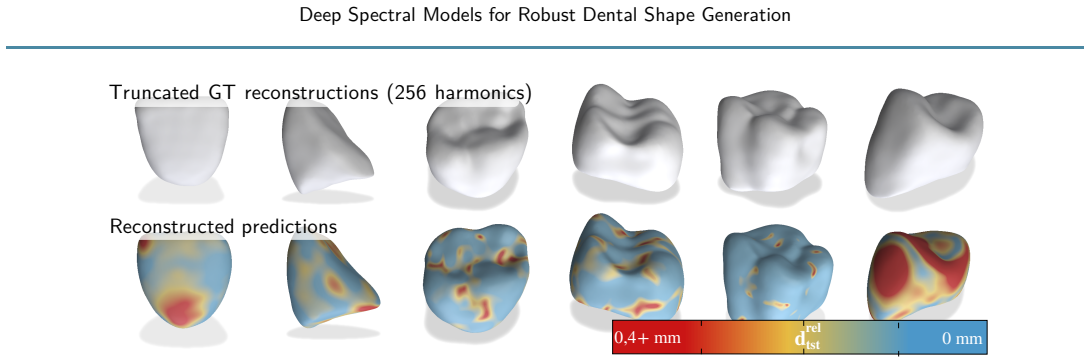
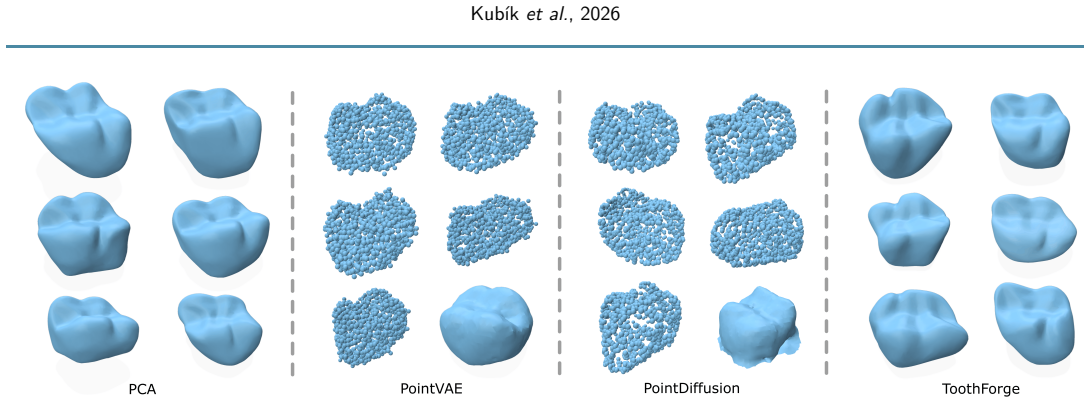
Accurate modeling of dental crown morphology is fundamental for diagnosis, orthodontic planning, and computer-aided restoration design. However, datasets suitable for training such models are typically limited in size. We present ToothForge, a deep spectral generative framework that models dental crown geometries from compact, intrinsic representations. By operating in the spectral domain, ToothForge learns a latent manifold of 3D tooth shapes through synchronized spectral embeddings, ensuring consistent modeling across samples with varying connectivity. Spectral synchronization mitigates the instability of Laplace-Beltrami eigenbases and enables efficient learning in a low-dimensional space. The framework is thoroughly evaluated through robustness analysis, ablation studies, and benchmarking against PCA-based statistical shape models and point-based generative frameworks. Results show that synchronized spectral modeling achieves reconstruction and generative performance comparable to or exceeding spatial approaches, while maintaining compactness and geometric interpretability. Together, the compact synchronized coefficients and low-dimensional learning space make the framework particularly suitable for limited datasets, as often encountered in dental and medical domains, and applicable in real-world scenarios where guaranteeing consistent connectivity across shapes from various clinics is unrealistic.
Editorial analysis
A structured set of objections, weighed in public.
Referee Report
Summary. The manuscript introduces ToothForge, a deep spectral generative framework for dental crown morphologies. It operates on synchronized spectral embeddings derived from Laplace-Beltrami eigenbases to produce consistent low-dimensional representations across meshes with varying connectivity. The central claim is that this synchronized spectral approach yields reconstruction and generative performance comparable to or exceeding PCA-based statistical shape models and point-based generative frameworks, while offering greater compactness, geometric interpretability, and suitability for limited-size medical datasets.
Significance. If the synchronization procedure reliably aligns eigenbases without introducing artifacts, the framework would provide a compact, intrinsic alternative to spatial deep generative models for shape modeling in domains with small datasets and inconsistent triangulations. The emphasis on geometric interpretability and limited-data applicability is a potential strength for clinical translation in orthodontics and CAD restoration.
major comments (2)
- [robustness analysis / evaluation sections] The robustness analysis (mentioned in the abstract and evaluation sections) asserts that spectral synchronization mitigates Laplace-Beltrami eigenbasis instability across varying mesh connectivities, yet reports no quantitative diagnostics such as pre-/post-synchronization eigenfunction correlation coefficients, mode-swap rates, or reconstruction error stratified by mesh resolution/topology differences. This leaves the load-bearing assumption unverified for the performance claim.
- [benchmarking / results sections] Benchmarking results are described as showing performance 'comparable to or exceeding' spatial baselines, but the abstract and evaluation summary provide no numerical values, error bars, dataset sizes, or exclusion criteria. Without these, it is impossible to assess whether the compactness advantage is achieved without degradation on real clinical meshes.
minor comments (2)
- [methods] Notation for the synchronized coefficients and the exact form of the synchronization operator should be defined explicitly with equations in the methods section to allow reproduction.
- [evaluation] The abstract states that the framework is 'thoroughly evaluated' via ablations and benchmarking; the corresponding sections should include explicit tables with all metrics, sample counts, and statistical tests.
Simulated Author's Rebuttal
We thank the referee for the detailed and constructive feedback. We appreciate the emphasis on quantitative verification of the synchronization procedure and the need for explicit numerical results in the benchmarking. We address each major comment below and will revise the manuscript to incorporate the requested details.
read point-by-point responses
-
Referee: The robustness analysis (mentioned in the abstract and evaluation sections) asserts that spectral synchronization mitigates Laplace-Beltrami eigenbasis instability across varying mesh connectivities, yet reports no quantitative diagnostics such as pre-/post-synchronization eigenfunction correlation coefficients, mode-swap rates, or reconstruction error stratified by mesh resolution/topology differences. This leaves the load-bearing assumption unverified for the performance claim.
Authors: We agree that the current version does not include the specific quantitative diagnostics mentioned. In the revised manuscript we will add a new subsection under robustness analysis reporting: (i) average pre- and post-synchronization eigenfunction correlation coefficients across the dataset, (ii) mode-swap rates before and after synchronization, and (iii) reconstruction error stratified by mesh resolution and topology differences. These additions will directly verify the effectiveness of the synchronization step. revision: yes
-
Referee: Benchmarking results are described as showing performance 'comparable to or exceeding' spatial baselines, but the abstract and evaluation summary provide no numerical values, error bars, dataset sizes, or exclusion criteria. Without these, it is impossible to assess whether the compactness advantage is achieved without degradation on real clinical meshes.
Authors: We acknowledge that the manuscript currently presents only qualitative statements without accompanying numerical values. In the revision we will expand the evaluation section with tables containing mean and standard-deviation values for all reported metrics (including error bars on figures), the precise training/validation/test split sizes, and the exclusion criteria used for the clinical meshes. This will enable quantitative assessment of the claimed performance and compactness advantages. revision: yes
Circularity Check
No circularity: framework relies on external spectral synchronization without self-referential fitting or load-bearing self-citations
full rationale
The provided abstract and reader summary describe a spectral generative model using synchronized Laplace-Beltrami embeddings, with performance claims benchmarked against PCA and point-based baselines. No equations are shown that define a quantity in terms of itself, no fitted parameters are relabeled as predictions on the same data, and no self-citations are invoked to justify uniqueness or ansatzes. The synchronization step is presented as a methodological choice whose robustness is evaluated via ablation and external comparison rather than derived from the model's own outputs. This satisfies the default expectation of a non-circular paper.
Axiom & Free-Parameter Ledger
Reference graph
Works this paper leans on
-
[1]
and Levoy, M
Rusinkiewicz, S. and Levoy, M. , booktitle=. Efficient variants of the ICP algorithm , year=
-
[2]
Point Set Registration: Coherent Point Drift , journal =
Myronenko, Andriy and Song, Xubo , year =. Point Set Registration: Coherent Point Drift , journal =
-
[3]
ToothForge: Automatic Dental Shape Generation Using Synchronized Spectral Embeddings
Kub \'i k, Tibor and Guibault, Fran c ois and S pan e l, Michal and Lombaert, Herv \'e. ToothForge: Automatic Dental Shape Generation Using Synchronized Spectral Embeddings. Information Processing in Medical Imaging (IPMI). 2026
2026
-
[4]
Brain Transfer: Spectral Analysis of Cortical Surfaces and Functional Maps
Lombaert, Herve and Arcaro, Michael and Ayache, Nicholas. Brain Transfer: Spectral Analysis of Cortical Surfaces and Functional Maps. Information Processing in Medical Imaging (IPMI). 2015
2015
-
[5]
and Yi, Li and Su, Hao and Guibas, Leonidas J
Qi, Charles R. and Yi, Li and Su, Hao and Guibas, Leonidas J. , title =. 2017 , booktitle =
2017
-
[6]
International Conference on Computer Vision (ICCV) , year =
Zhang, Lvmin and Rao, Anyi and Agrawala, Maneesh , title =. International Conference on Computer Vision (ICCV) , year =
-
[7]
Journal of Prosthodontics , year=
A latent variable deep generative model for 3D anterior tooth shape , author=. Journal of Prosthodontics , year=
-
[8]
International Conference on Computer Vision (ICCV) , year=
Pointflow: 3d point cloud generation with continuous normalizing flows , author=. International Conference on Computer Vision (ICCV) , year=
-
[9]
Conference on Computer Vision and Pattern Recognition (CVPR) , year=
Uncovering the disentanglement capability in text-to-image diffusion models , author=. Conference on Computer Vision and Pattern Recognition (CVPR) , year=
-
[10]
Exploring palatal and dental shape variation with 3D shape analysis and geometric deep learning , journal =
Nauwelaers, Nele and Matthews, Harold and Fan, Yi and Croquet, Balder and Hoskens, Hanne and Mahdi, Soha and El Sergani, Ahmed and Gong, Shunwang and Xu, Tianmin and Bronstein, Michael and Marazita, Mary and Weinberg, Seth and Claes, Peter , year =. Exploring palatal and dental shape variation with 3D shape analysis and geometric deep learning , journal =
-
[11]
European Journal of Orthodontics , year=
Early crossbite correction: a three-dimensional evaluation , author=. European Journal of Orthodontics , year=
-
[12]
European Journal of Orthodontics , year=
Effects of palate depth, modified arm shape, and anchor screw on rapid maxillary expansion: a finite element analysis , author=. European Journal of Orthodontics , year=
-
[13]
Journal of endodontics , year=
Root and root canal morphology of the human permanent maxillary first molar: a literature review , author=. Journal of endodontics , year=
-
[14]
International Endodontic Journal , year=
Root canal morphology of mandibular permanent molars at different ages , author=. International Endodontic Journal , year=
-
[15]
Journal of Prosthodontics: Implant, Esthetic and Reconstructive Dentistry , year=
Immediate implant placement: clinical decisions, advantages, and disadvantages , author=. Journal of Prosthodontics: Implant, Esthetic and Reconstructive Dentistry , year=
-
[16]
Periodontology , year=
Implant placement in the esthetic area: criteria for positioning single and multiple implants , author=. Periodontology , year=
-
[17]
BMC Oral Health , year=
Application of artificial intelligence in dental crown prosthesis: a scoping review , author=. BMC Oral Health , year=
-
[18]
Medical Image Computing and Computer Assisted Intervention (MICCAI) , year =
Hosseinimanesh, Golriz and Ghadiri, Farnoosh and Guibault, Francois and Cheriet, Farida and Keren, Julia , title =. Medical Image Computing and Computer Assisted Intervention (MICCAI) , year =
-
[19]
Medical Image Computing and Computer Assisted Intervention (MICCAI) , year =
Yang, Su and Han, Jiyong and Lim, Sang-Heon and Yoo, Ji-Yong and Kim, SuJeong and Song, Dahyun and Kim, Sunjung and Kim, Jun-Min and Yi, Won-Jin , title =. Medical Image Computing and Computer Assisted Intervention (MICCAI) , year =
-
[20]
Journal of Healthcare Engineering , year =
Tian, Sukun and Huang, Renkai and Li, Zhenyang and Fiorenza, Luca and Dai, Ning and Sun, Yuchun and Ma, Haifeng , title =. Journal of Healthcare Engineering , year =
-
[21]
1987 , author =
Principal component analysis , journal =. 1987 , author =
1987
-
[22]
Conference on Computer Vision and Pattern Recognition (CVPR) , year=
Variational relational point completion network , author=. Conference on Computer Vision and Pattern Recognition (CVPR) , year=
-
[23]
Can Point Cloud Networks Learn Statistical Shape Models of Anatomies?
Adams, Jadie and Elhabian, Shireen Y. Can Point Cloud Networks Learn Statistical Shape Models of Anatomies?. Medical Image Computing and Computer Assisted Intervention (MICCAI). 2023
2023
-
[24]
Conference on Computer Vision and Pattern Recognition (CVPR) , year=
Foldingnet: Point cloud auto-encoder via deep grid deformation , author=. Conference on Computer Vision and Pattern Recognition (CVPR) , year=
-
[25]
Neural Information Processing Systems (NeurIPS) , year=
Isolating sources of disentanglement in variational autoencoders , author=. Neural Information Processing Systems (NeurIPS) , year=
-
[26]
Computers & Graphics , year =
Clément Lemeunier and Florence Denis and Guillaume Lavoué and Florent Dupont , title =. Computers & Graphics , year =
-
[27]
PointLLM: Empowering Large Language Models to Understand Point Clouds
Xu, Runsen and Wang, Xiaolong and Wang, Tai and Chen, Yilun and Pang, Jiangmiao and Lin, Dahua. PointLLM: Empowering Large Language Models to Understand Point Clouds. European Conference on Computer Vision (ECCV). 2025
2025
-
[28]
Achlioptas, Panos and Huang, Ian and Sung, Minhyuk and Tulyakov, Sergey and Guibas, Leonidas , booktitle=
-
[29]
Bioengineering , YEAR =
Kubík, Tibor and Španěl, Michal , TITLE =. Bioengineering , YEAR =
-
[30]
Scientific Data , year=
A 3D dental model dataset with pre/post-orthodontic treatment for automatic tooth alignment , author=. Scientific Data , year=
-
[31]
Coupling Bracket Segmentation and Tooth Surface Reconstruction on 3D Dental Models
Tan, Yuwen and Xiang, Xiang and Chen, Yifeng and Jing, Hongyi and Ye, Shiyang and Xue, Chaoran and Xu, Hui. Coupling Bracket Segmentation and Tooth Surface Reconstruction on 3D Dental Models. Medical Image Computing and Computer Assisted Intervention (MICCAI). 2023
2023
-
[32]
2025 , author =
Personalized dental crown design: A point-to-mesh completion network , journal =. 2025 , author =
2025
-
[33]
Conference on Computer Vision and Pattern Recognition (CVPR) , year=
Pointnet: Deep learning on point sets for 3d classification and segmentation , author=. Conference on Computer Vision and Pattern Recognition (CVPR) , year=
-
[34]
Conference on Computer Vision and Pattern Recognition (CVPR) , year=
Point transformer v3: Simpler faster stronger , author=. Conference on Computer Vision and Pattern Recognition (CVPR) , year=
-
[35]
Computer-Aided Design , year=
Laplace--Beltrami spectra as ‘Shape-DNA’of surfaces and solids , author=. Computer-Aided Design , year=
-
[36]
Computers & Graphics , year=
Discrete Laplace--Beltrami operators for shape analysis and segmentation , author=. Computers & Graphics , year=
-
[37]
2023 , author =
SpecTrHuMS: Spectral transformer for human mesh sequence learning , journal =. 2023 , author =
2023
-
[38]
2021 , author =
Discriminative and generative models for anatomical shape analysis on point clouds with deep neural networks , journal =. 2021 , author =
2021
-
[39]
Conference on Computer Vision and Pattern Recognition (CVPR) , year =
Luo, Shitong and Hu, Wei , title =. Conference on Computer Vision and Pattern Recognition (CVPR) , year =
-
[40]
2020 , booktitle =
Naeem, Muhammad Ferjad and Oh, Seong Joon and Uh, Youngjung and Choi, Yunjey and Yoo, Jaejun , title =. 2020 , booktitle =
2020
-
[41]
Medical Imaging with Deep Learning (MIDL) , year=
Point-Based Shape Representation Generation with a Correspondence-Preserving Diffusion Model , author=. Medical Imaging with Deep Learning (MIDL) , year=
-
[42]
Biffi, Carlo and Cerrolaza, Juan J. and Tarroni, Giacomo and Bai, Wenjia and de Marvao, Antonio and Oktay, Ozan and Ledig, Christian and Le Folgoc, Loic and Kamnitsas, Konstantinos and Doumou, Georgia and Duan, Jinming and Prasad, Sanjay K. and Cook, Stuart A. and O’Regan, Declan P. and Rueckert, Daniel , journal=. Explainable Anatomical Shape Analysis Th...
discussion (0)
Sign in with ORCID, Apple, or X to comment. Anyone can read and Pith papers without signing in.