REVIEW 3 major objections 7 minor 82 references
Microscopic description of the fission process including intrinsic excitations. Part I: 240Pu adiabatic and asymmetric fission path within the Schrodinger Collective Intrinsic Model
T0 review · 3 major / 7 minor · reviewed 2026-08-10 · deepseek-v4-flash
Pith's one-line read Overlap-constrained Link and Drop methods build a continuous one-dimensional adiabatic path for 240Pu fission from the ground state through scission and beyond.
desk verdict First practical SCIM adiabatic path with real methodological novelty, but the scission energy balance has a hard internal inconsistency and the V-phase prescription casts a shadow on overlap-derived numbers. read the letter →
The pith
A machine-rendered reading of the paper's core claim, the machinery that carries it, and where it could break.
The reading
What carries the argument
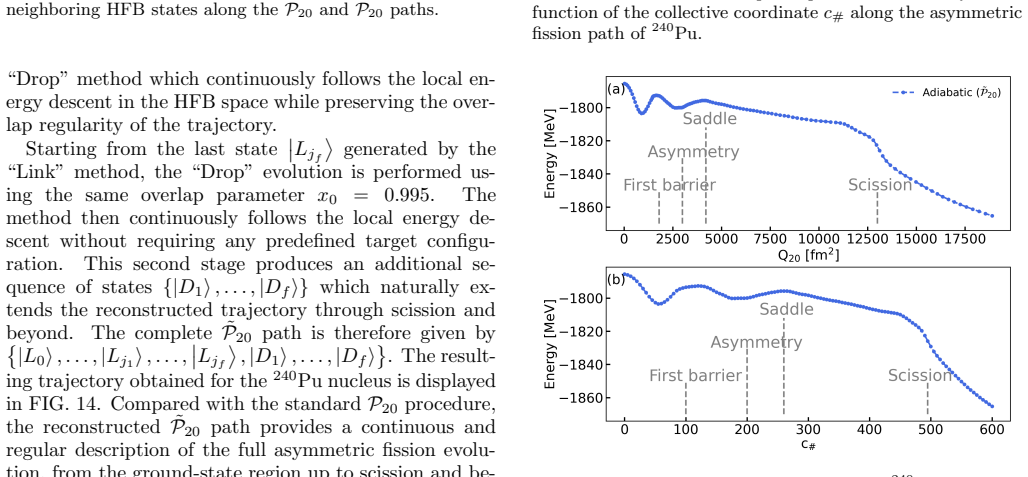
The machinery is the overlap metric: each elementary step between neighboring HFB states is fixed by a constraint on the modulus of the overlap, |⟨Φi|Φi+1⟩|=x0=0.995, rather than on a multipole moment. Link constructs the trajectory between known attractor states; Drop continues the local energy descent without a target state; together they define the collective coordinate c#, one unit per elementary overlap step. The V-phase prescription of Eq. (D58) fixes the sign ambiguity of nearly degenerate (Ω,τ) blocks by choosing the sign that maximizes each block determinant, making the overlap a phase-consistent distance. The numerical evaluation rests on Pfaffian overlap formulas for HFB states in two different two-center harmonic-oscillator representations.
What would settle it
Recompute the ~P20 path with an independent phase convention for the V matrices (for example, fixing signs by continuity of pairing-gap sub-blocks instead of by Eq. D58) and with overlap spacing x0=0.99 and 0.999; if the c#≈495 location of the simultaneous chemical-potential peaks, the neck neutron-to-proton ratio, or the extracted fragment energies shift by more than a few MeV, the scission characterization is an artifact of the construction rather than a robust physical signature.
Extended reading notes
Core claim
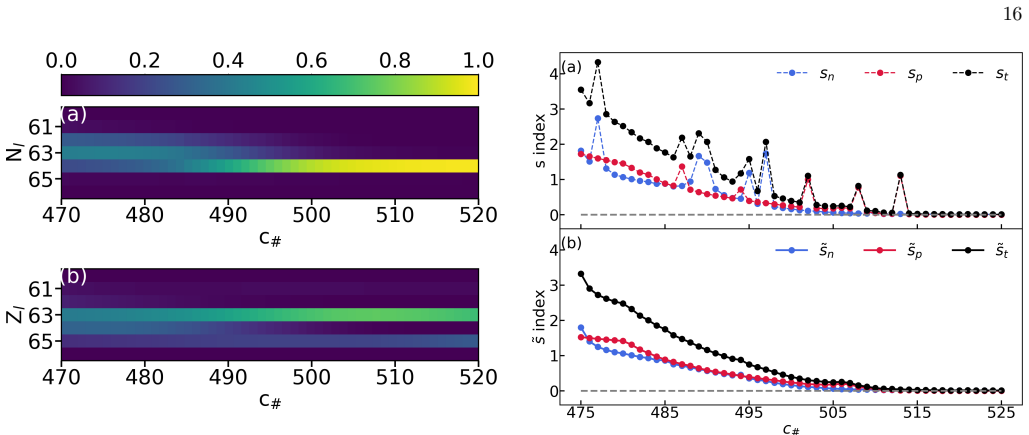
The paper's central claim is that the ~P20 procedure — Link and Drop combined with overlap spacing x0=0.995, an attractor threshold of 0.5, and a stop overlap of 0.9 — produces a continuous, regular one-dimensional adiabatic HFB path for asymmetric fission of 240Pu, running from the ground state through scission and beyond. On this path, the overlap and Hamiltonian kernels satisfy the local-GOA relation with a relative error of at most about 0.46% for the relative-coordinate range s∈[-10,10] in c# units. The paper identifies scission near c#=495 through simultaneous neutron and proton chemical-potential peaks, a neck neutron-to-proton density ratio reaching about 4.5, proton odd–even staggering in the fragment distributions, and a static energy balance with roughly ΔE_def≈26.85 MeV of fragment deformation energy, E_Coulomb≈178.74 MeV of Coulomb interaction energy, and E_int≈153 MeV of total fragment interaction energy.
Load-bearing premise
The load-bearing premise is that the overlap distance between neighboring HFB states, after the V-phase sign prescription and with step parameters x0=0.995, attractor threshold 0.5, and stop overlap 0.9, faithfully measures physical collective distance; if that metric is not stable, the path and every scission conclusion built on it are not either.
Editorial extensions
If this is right
- SCIM dynamics can now be formulated along a one-dimensional fission path whose overlap and Hamiltonian kernels are regular enough to construct collective potential, inertia, and dissipation terms over the whole trajectory from ground state through scission.
- Expressed in c#, barrier widths and descent steepness differ from their Q20 parametrization, so collective dynamics computed with the overlap metric will generally differ from dynamics computed with quadrupole parametrization.
- Scission is characterized as a finite region: before the fragments relax, about 26.85 MeV is stored in their deformation and about 153 MeV of interaction energy remains, of which roughly 178.74 MeV is Coulomb energy contributing to final kinetic energy.
- Proton odd–even staggering in fragment charge distributions emerges naturally from the HFB pairing content and is localized near the scission region, offering a microscopic origin for the staggering seen in experimental charge yields.
- The Link and Drop construction is compatible with additional multipole constraints, and the paper sketches a GOA-guided two-dimensional paving, opening a route toward multi-dimensional SCIM paths.
Reading between the lines
- Because the path geometry is fixed by the V-phase prescription and hand-set parameters, an independent multi-dimensional adiabatic path — for example, constrained in both Q20 and Q30 or with a neck operator — would be the natural test of whether the c#≈495 scission markers are intrinsic; the paper does not perform that check.
- If c# is accepted as the true collective distance, collective inertia and dissipation expressed in c# will differ from Q20-based values, so fission lifetimes and fragment yields predicted by SCIM dynamics could shift relative to standard TDGCM calculations.
- The large residual nuclear interaction at scission implies that post-scission dynamics must retain nuclear interaction beyond pure Coulomb repulsion; approximating fragment interaction by Coulomb alone would likely overestimate the final kinetic energy.
- The same overlap-spacing construction could be generalized to a two-dimensional grid using the GOA-guided paving geometry the paper sketches, providing a concrete route to multi-dimensional SCIM surfaces.
Editorial analysis
A structured set of objections, weighed in public.
Referee Report
Summary. This paper constructs a one-dimensional adiabatic asymmetric fission path for 240Pu within the Schrödinger Collective Intrinsic Model (SCIM) framework, combining the overlap-based Link and Drop methods into a procedure labeled ~P20. It introduces a collective coordinate c# based on constant overlap steps, validates the path's regularity by comparing the Hamiltonian kernel with the Gaussian Overlap Approximation (Fig. 17), and analyzes the scission region: chemical-potential peaks, neutron enrichment of the neck, fragment particle-number distributions, and a static energy balance with deformation and interaction energies. Appendices D–F contain detailed derivations of overlap and Hamiltonian kernels between HFB states built on different two-center harmonic-oscillator bases.
Significance. If the path is accepted as a faithful collective trajectory, the paper provides a practical route toward SCIM dynamics with intrinsic excitations and a microscopic characterization of the scission region. The technical derivations in Appendices D–F, especially the overlap and Hamiltonian kernels for different two-center bases with rectangular overlap matrices, are a substantial methodological contribution. The GOA comparison gives a quantitative check of the local approximation used in the SCIM/GOA formalism, and the qualitative scission findings (chemical-potential peaks, neutron-rich neck, proton odd-even staggering) are interesting and falsifiable in future SCIM calculations. The main caveats are the dependence of the path on the V-phase prescription and on hand-set algorithm parameters, and an internal inconsistency in the reported scission energy ratio.
major comments (3)
- [Section IV.C.3, Eq. (72), Fig. 27] The ratio r_c is defined as 100×E_int^Coulomb/E_int and is reported as ≈83% at c#=495, but the values quoted in the same paragraph (E_int^Coulomb ≈ 178.74 MeV, E_int ≈ 153 MeV) give r_c ≈ 117%. Since E_int = E_Coulomb + E_nuclear, this implies E_nuclear ≈ −25.7 MeV at scission, i.e., a net attractive nuclear contribution, which is a different physical statement from the text's claim that the total interaction 'remains comparable to the Coulomb interaction.' The numeric value and the associated interpretation must be corrected.
- [Appendix D.8, Eq. (D58); Section III.D] The path and the c# coordinate are built from overlap values whose magnitudes depend on the sign of V in each (Ω,τ) block. The paper states that the numerical origin of the observed sign flips was not identified, and Eq. (D58) is an ad hoc prescription (choosing, per block, the sign that maximizes the absolute determinant). Since the scission observables in Section IV (chemical-potential peaks, neck enrichment, fragment distributions, energy balance) are all extracted along this path, their stability under alternative but equally allowed phase conventions is not demonstrated. The GOA comparison in Fig. 17 tests the regularity of the chosen path, not the uniqueness of the path. Please add a sensitivity test (e.g., reconstructing the scission segment with the opposite sign convention or with several sign assignments) or explicitly state that the results are conditional on this regularization.
- [Section III.D; Section IV] The ~P20 procedure contains several hand-set parameters (attractor overlap threshold 0.5, overlap step x0=0.995, stopping overlap 0.9; plus the QP rotation and cut-off criteria in the fragment analysis). The paper shows for the Drop method only that the PES depends weakly on x0 (Fig. 13), and it does not quantify the sensitivity of the scission observables to the algorithm parameters or compare the resulting path with an independent multi-dimensional adiabatic path (e.g., a 2D Q20–Q30 surface). A robustness check on at least the scission segment would be needed to support the claim that the quoted observables characterize the physical scission process rather than the specific regularization choices.
minor comments (7)
- [Fig. 17 caption and Eq. (64)] The caption says 'Absolute error on the Hamiltonian kernel,' but Eq. (64) defines a relative error (100 times the ratio of absolute difference to the kernel magnitude). Please align the wording with the formula.
- [Introduction and Section IV.C.3] Please fix typos: 'Bertsh et al.' should be 'Bertsch et al.' in the Introduction, and 'adressed' should be 'addressed' in Section IV.C.3.
- [Appendix D.8 heading] The heading 'The V phasis' should be 'The V phase'.
- [References [53]] Reference [53] appears twice with the same title and authors; please merge the journal and preprint versions or distinguish them clearly.
- [Abstract and Conclusions] The phrase 'first practical implementation of the SCIM' is stronger than what this article delivers: the paper constructs and analyzes adiabatic paths, while the dynamical SCIM equations are deferred to the third paper of the trilogy. Consider softening to 'first practical construction of the adiabatic ingredients for SCIM.'
- [Section III.D.3 and Eq. (64)] The statement that quantities in Eq. (64) and Fig. 17 are 'expressed in units of the new collective coordinate c#' is ambiguous, because c# is defined only as a step counter; please specify the unit convention used for the kernel plots.
- [Section IV.B, Fig. 21] The quantity c_odd^2 in Fig. 21 is not formally defined in the text; please define the decomposition of the fragment distributions used to extract the odd components.
Circularity Check
No significant circularity: the path and scission observables are generated by an overlap-constrained HFB procedure and are not fitted to the claims; only mild self-referential methodology (authors' own Link/Drop and SCIM formalisms) warrants a low nonzero score.
full rationale
The central derivation chain is not circular. The ~P20 path is generated by the Link/Drop algorithms with fixed overlap parameter x0=0.995 and attractor threshold 0.5; the scission observables (chemical-potential peaks, neck rho ratio, odd-even staggering, Delta_E_def, E_int) are computed from the resulting HFB states and are not used as inputs to select the path. The new coordinate c# is defined as an elementary overlap step, so it is a reparametrization rather than a fitted prediction; no equation equates a 'prediction' with an input. The GOA comparison (Eqs. 63-64, Fig. 17) is an internal consistency check of the overlap geometry, not an independent derivation, but it does not reduce the claims to the GOA assumption. Self-citations to Ref. [38] (Link/Drop) and Refs. [34,44] (SCIM) are not load-bearing: the SCIM equations are re-derived in Section II and Appendices A-C, and the Link/Drop protocols are re-described and benchmarked here (16O and P20 comparisons), so the cited works are not the sole support. The V-phase prescription of Eq. (D58) is an acknowledged ad hoc regularization ("We were unable to identify the numerical origin of the observed sign changes"), and the path and c# are conditional on it; this is a robustness/uncertainty caveat, not a circular step, because no observable is fitted to it. One internal numerical inconsistency should be flagged separately: E_Coulomb=178.74 MeV and E_int=153 MeV give r_c=117%, not the reported 83%; this affects the correctness assessment, not circularity. Overall, the paper is self-contained against its benchmarks and deserves a low score reflecting only methodological self-referentiality.
Assumptions & free parameters
free parameters (6)
- overlap step x0 =
0.995
- attractor overlap threshold =
0.5
- Link stopping overlap threshold =
0.9
- QP amplitude cutoff for fragment analysis =
1e-4
- QP rotation criteria for fragment disentangling =
s1+s2>0.005 and |v1^2-v2^2|<1e-4
- neck position z_neck =
abscissa minimizing Q_neck in HFB3
assumptions (8)
- domain assumption SCIM/GCM continuity hypothesis: the HFB configurations vary continuously with the collective coordinate q.
- domain assumption Second-order truncation in SOPO for H_SCIM and convergence of the J^{-1/2} series.
- domain assumption Single dominant 1D adiabatic trajectory assumption.
- domain assumption Adiabatic Hamiltonian kernel approximates overlap kernel times local energy, Eq. (59).
- domain assumption GOA relation Eq. (63) for overlap distances is the correct geometry of adiabatic collective motion.
- domain assumption D1S Gogny force with Slater Coulomb and imposed axial and time-reversal symmetries adequately represents 240Pu fission.
- ad hoc to paper V-phase overlap prescription Eq. (D58) choosing the sign that maximizes the absolute determinant yields physically consistent overlaps.
- ad hoc to paper Fragment separation via canonical-basis spatial localization plus QP rotations gives the physical fragmentation.
invented entities (2)
-
c# collective coordinate
-
c-flat (c flat) coordinate and Nuclear Paving method
Cite this review
Pith. "Pith review of Microscopic description of the fission process including intrinsic excitations. Part I: 240Pu adiabatic and asymmetric fission path within the Schrodinger Collective Intrinsic Model." pith.science (2026). https://pith.science/paper/AHRFGMDA
@misc{pith2026260807121,
  author       = {Pith},
  title        = {Pith review of: Microscopic description of the fission process including intrinsic excitations. Part I: 240Pu adiabatic and asymmetric fission path within the Schrodinger Collective Intrinsic Model},
  year         = {2026},
  howpublished = {\url{https://pith.science/paper/AHRFGMDA}},
  note         = {Machine review of arXiv:2608.07121}
}
read the original abstract
This article is the first in a trilogy aimed at presenting the first practical implementation of the Schrodinger Collective-Intrinsic Model (SCIM) applied to nuclear fission. Within the SCIM framework, the many-body wave function explicitly couples collective motion to intrinsic excitations, necessitating sets of Hartree-Fock-Bogoliubov (HFB) configurations that remain continuous and regular across a broad deformation range, from the ground state to scission and beyond. This paper focuses on constructing adiabatic HFB paths suitable for subsequent SCIM dynamical calculations. Standard constrained adiabatic paths often suffer from discontinuities and irregularities, which prevent the direct application of the formalism. To address these challenges, we implement two recently proposed overlap-based protocols, the Link and Drop methods, and combine them into a new numerical procedure.A comparison with the exact Gaussian Overlap Approximation confirms that the resulting adiabatic kernels exhibit properties consistent with the assumptions of the SCIM formalism. The regularized path is then analyzed in the scission region. We identify characteristic structures in the proton and neutron chemical potentials, a pronounced neutron enrichment of the neck at scission, and fragment particle-number distributions displaying a strong odd-even staggering in the proton sector. Finally, using a microscopic fragment-separation procedure formulated in the canonical basis, we extract static scission properties including fragment deformation energies and both Coulomb and nuclear contributions to the fragment interaction energy. These results establish the adiabatic foundations required for future SCIM calculations with intrinsic excitations and provide a microscopic characterization of the scission region in 240Pu.
Figures


Figures from the paper (21 more)






Reference graph
Works this paper leans on
-
[1]
Finally, it is possible to jump from ac ♭ level to another using the GOA predictions once again. In FIG. 31, we have represented this latter idea showing how a state E(c #,c♭) is defined from two other states D (c#,c♭ −1) and B (c #,c♭ −2). We have tested these ideas locally around the scission 21 FIG. 32. Panel (a): 5×5 grid produced by the NP method acc...
-
[2]
The quantityUcan then be expressed as U= N (1) R ∂ ∂q (1) + N (2) R ∂ ∂q (2) = u1 ∂ ∂q (1) + u2 ∂ ∂q (2)
Expression ofJ −1/2 In this section, we give the explicit expression of the operatorJ −1/2, which reads as: J −1/2(¯q) =j0(¯q) + j1(¯q)∂ ∂q (1) + j2(¯q)∂ ∂q (2) .(C3) From Eq.(B13), the inverse square root of the operator Jis calculated thanks to a Taylor series expansion trun- cated at the second order: J −1/2(¯q) =I− 1 2 U(¯q) +3 8 U 2(¯q).(C4) To simpl...
-
[3]
Expression ofH SCIM We start by rewriting the expression (C1) ofH SCIM in terms of the quantitiesFandJ −1/2 HSCIM (¯q) =J−1/2(¯q)F−1(¯q) × ¯H(¯q)F−1T (¯q)J−1/2(¯q),(C9) where the quantity ¯Hhas for expression: ¯H(¯q) =H(0)(¯q) + H(1)(¯q)∂ ∂q (1) + 1 2 H(2)(¯q)∂ ∂q (2) (C10) Now, one defines the operatorhsuch that: h(¯q) =h0(¯q) + h1(¯q)∂ ∂q (1) + h2(¯q)∂ ...
-
[4]
HFB states normalization We begin by presenting the expression for the normal- ization factorNof a given HFB state, which will play a crucial role in the subsequent discussion. Let|Φ⟩de- note an HFB state defined by the set of QP annihilation operators{ξ i}: |Φ⟩=N Y i ξi |0⟩.(D1) We transform the set of QP annihilation operators{ξ i} into the set{η k}, wh...
-
[5]
Overlap between HFB states built with the same harmonic-oscillator representations We consider two distinct HFB states,|Φ 0⟩and|Φ 1⟩, associated with the QP annihilation operators{ξ 0,i}and {ξ1,i}, respectively. By applying the Thouless theorem and denotingU (0),V (0) andU (1),V (1) as the Bogoli- ubov matrices corresponding to the states|Φ 0⟩and|Φ 1⟩, re...
-
[6]
Application to the axial and time-reversal invariance with the same harmonic-oscillator representations In the special case of axial and time-reversal invariant HFB states, the matrices ˜U (i) and ˜V (i) (wherei= 0 or
-
[7]
are real and exhibit the following structures: ˜U (i) = U (i) 0 0U (i) ˜V (i) = 0−V (i) V (i) 0 .(D24) Here, theU (i) andV (i) are of dimensionn/2. Eq.(D24) implies that the matricesM (i) defined in Eq.(D10) also have a special structure: M (i) = 0−V (i)U (i)−1 V (i)U (i)−1 0 .(D25) It is important to remark that the matricesM (i) are skew-symmetric, whil...
-
[8]
Link with the “Onishi-Y oshida” formula The “Onishi-Yoshida” formula [65] gives the absolute value of the overlap between two given HFB states such that: |⟨Φ0|Φ1⟩|= q Det(U (0)+U (1) +V (0)+V (1)) .(D29) Starting from Eq.(D23), one uses the Pfaffian properties and obtains: |⟨Φ0|Φ1⟩|=|⟨0|Φ 1⟩ ⟨Φ0|0⟩| × q Det(M (1))Det(−M (0)∗ +M (1)−1) .(D30) From Eq.(D8),...
Show all 82 references
-
[9]
They allow us to consider two distinct harmonic- oscillator representations of different dimensions without the need to compute their rectangular overlap matrixR
Overlap between HFB states built with two different harmonic-oscillator representations The derivations presented in this section are entirely novel. They allow us to consider two distinct harmonic- oscillator representations of different dimensions without the need to compute...
-
[10]
[66], the following expression is proposed for the calculation of the norm of the overlap|⟨Φ 0|Φ1⟩|: |⟨Φ0|Φ1⟩|= (D44)q Det(U (0)T (RT )−1U (1)∗ +V (0)T RV (1)∗)Det(R)
Link with Robledo’s formula In Ref. [66], the following expression is proposed for the calculation of the norm of the overlap|⟨Φ 0|Φ1⟩|: |⟨Φ0|Φ1⟩|= (D44)q Det(U (0)T (RT )−1U (1)∗ +V (0)T RV (1)∗)Det(R) . This formula has two major drawbacks. First, it requires to completeRint...
-
[11]
Haider-Gogny
Link with the “Haider-Gogny” formula In this section, we connect the previously obtained re- sults to the “Haider-Gogny” [67]. Below, we consider two HFB states,|Φ 0⟩and|Φ 1⟩, both constructed using the same harmonic-oscillator basis. We begin by writing the canonical transfor...
-
[12]
V phasis
The “V phasis” In our PES calculations using theP 20 procedure, we have observed unusual behavior in the overlap distance. Specifically, some neighboring states with nearly iden- tical multipole moments exhibited a significant overlap distance (close to one). Furthermore, the ...
-
[13]
We will consider the general case directly, which includes two different two-center harmonic-oscillator rep- resentations
Relevant contractions This subsection is devoted to the evaluation of the con- tractions relevant to the calculation of Hamiltonian ker- nels. We will consider the general case directly, which includes two different two-center harmonic-oscillator rep- resentations. Indeed, the...
-
[14]
They are labeled by the representationnand the particle state numberαor QP state numberi
Expressions ofW, ¯W,Zand ¯Z In this part, we give the explicit expressions of the fol- lowing quantities: Wαi = ⟨Φ0|c 1,αξ+ 1,i |Φ1⟩ ⟨Φ0|Φ1⟩ ,(E34) ¯Wjβ = ⟨Φ0|ξ 0,jc+ 0,β |Φ1⟩ ⟨Φ0|Φ1⟩ ,(E35) and Zα¯i = ⟨Φ0|c + 0,α ¯ξ+ 1,i |Φ1⟩ ⟨Φ0|Φ1⟩ ,(E36) ¯Zj ¯β = ⟨Φ0|ξ 0,j ¯c1,β |Φ1⟩ ⟨Φ0|Φ...
-
[15]
Link” and “Drop
Expressions ofY,TandS The use of 2QP excited states introduces the matricesY, T, andSdefined by: Yj¯j′ = ⟨Φ0|ξ 0,j ¯ξ0,j′ |Φ1⟩ ⟨Φ0|Φ1⟩ ,(E44) Ti¯i′ = ⟨Φ0|ξ + 1,i ¯ξ+ 1,i′ |Φ1⟩ ⟨Φ0|Φ1⟩ ,(E45) and Sji = ⟨Φ0|ξ 0,jξ+ 1,i |Φ1⟩ ⟨Φ0|Φ1⟩ .(E46) All these quantities are linked to theW,...
-
[16]
Carpentier, N
P. Carpentier, N. Pillet, R. Bernard, L. Robledo, D. Lacroix, N. Dubray, D. Regnier, and W. Younes, Mi- croscopic description of fission process including intrin- sic excitations. Part I: 240Pu adiabatic and asymmetric fission path within the Schr¨ odinger Collective Intrinsic...
2026
-
[17]
Carpentier, N
P. Carpentier, N. Pillet, R. Bernard, L. Robledo, D. Lacroix, N. Dubray, D. Regnier, and W. Younes, Mi- croscopic description of fission process including intrinsic excitations. Part II: 240Pu excited and asymmetric fission paths within the Schr¨ odinger Collective Intrinsic M...
2026
-
[18]
Carpentier, N
P. Carpentier, N. Pillet, R. Bernard, L. Robledo, D. Lacroix, N. Dubray, D. Regnier, and W. Younes, Mi- croscopic description of fission process including intrinsic excitations. Part III: 240Pu fission dynamics along 1D asymmetric paths within the Schr¨ odinger Collective In- ...
2026
-
[19]
Bender, R
M. Bender, R. Bernard, G. Bertsch, S. Chiba, J. Dobaczewski, N. Dubray, S. A. Giuliani, K. Hagino, D. Lacroix, Z. Li, P. Magierski, J. Maruhn, W. Nazarewicz, J. Pei, S. P´ eru, N. Pillet, J. Ran- drup, D. Regnier, P.-G. Reinhard, L. M. Robledo, W. Ryssens, J. Sadhukhan, G. Sca...
2020
-
[20]
Schunck and D
N. Schunck and D. Regnier, Theory of nuclear fission, Progress in Particle and Nuclear Physics125, 103963 (2022)
2022
-
[21]
T. H. R. Skyrme, Cvii. the nuclear surface, The Philosophical Magazine: A Journal of Theoretical Experimental and Applied Physics1, 1043 (1956), https://doi.org/10.1080/14786435608238186
1956 doi
-
[22]
Skyrme, The effective nuclear potential, Nuclear Physics9, 615 (1958)
T. Skyrme, The effective nuclear potential, Nuclear Physics9, 615 (1958)
1958
-
[23]
Vautherin and D
D. Vautherin and D. M. Brink, Hartree-Fock calculations with Skyrme’s interaction. i. spherical nuclei, Phys. Rev. C5, 626 (1972)
1972
-
[24]
Vautherin, Hartree-Fock calculations with Skyrme’s interaction
D. Vautherin, Hartree-Fock calculations with Skyrme’s interaction. ii. axially deformed nuclei, Phys. Rev. C7, 296 (1973)
1973
-
[25]
Gogny, Proceedings of the international conference on nuclear physics, munich, august 27-september 1, 1973 (1973) p
D. Gogny, Proceedings of the international conference on nuclear physics, munich, august 27-september 1, 1973 (1973) p. 48
1973
-
[26]
Gogny, Self-consistent pairing calculations (North- Holland Publishing Company, 1975)
D. Gogny, Self-consistent pairing calculations (North- Holland Publishing Company, 1975)
1975
-
[27]
Decharg´ e and D
J. Decharg´ e and D. Gogny, Hartree-Fock-Bogolyubov cal- culations with thed1 effective interaction on spherical nuclei, Phys. Rev. C21, 1568 (1980)
1980
-
[28]
Berger, M
J. Berger, M. Girod, and D. Gogny, Constrained Hartree- Fock and beyond, Nuclear Physics A502, 85 (1989)
1989
-
[29]
Chappert, N
F. Chappert, N. Pillet, M. Girod, and J.-F. Berger, Gogny force with a finite-range density dependence, Phys. Rev. C91, 034312 (2015)
2015
-
[30]
Zietek, N
G. Zietek, N. Pillet, M. Anguiano, P. Carpentier, N. Dubray, R. Bernard, G. Blanchon, and D. Regnier, Im- pact of finite-range spin-orbit and tensor terms in gogny edf on structure and fission properties, Physics Letters B 872, 140072 (2026)
2026
-
[31]
P. Ring, E. Litvinova, and D. Vretenar, Covariant density functional theory and nuclear dynamics far from stability, Progress in particle and nuclear physics59, 393 (2007)
2007
-
[32]
Agbemava, A
S. Agbemava, A. Afanasjev, D. Ray, and P. Ring, Global performance of covariant energy density function- als: Ground state observables of even-even nuclei and the estimate of theoretical uncertainties, Physical Review C 89, 054320 (2014)
2014
-
[33]
Yang and J
J. Yang and J. Piekarewicz, Covariant density functional theory in nuclear physics and astrophysics, Annual Re- view of Nuclear and Particle Science70, 21 (2020)
2020
-
[34]
Simenel, Nuclear quantum many-body dynamics, The European Physical Journal A48, 152 (2012)
C. Simenel, Nuclear quantum many-body dynamics, The European Physical Journal A48, 152 (2012)
2012
-
[35]
Sekizawa, Tdhf theory and its extensions for the multinucleon transfer reaction: A mini review, Frontiers in PhysicsV olume 7 - 2019, 10.3389/fphy.2019.00020 (2019)
K. Sekizawa, Tdhf theory and its extensions for the multinucleon transfer reaction: A mini review, Frontiers in PhysicsV olume 7 - 2019, 10.3389/fphy.2019.00020 (2019). 43
2019
-
[36]
Scamps, C
G. Scamps, C. Simenel, and D. Lacroix, Superfluid dy- namics of 258Fm fission, Phys. Rev. C92, 011602 (2015)
2015
-
[37]
Bulgac, P
A. Bulgac, P. Magierski, K. J. Roche, and I. Stetcu, Induced fission of 240Pu within a real-time microscopic framework, Phys. Rev. Lett.116, 122504 (2016)
2016
-
[38]
D. L. Hill and J. A. Wheeler, Nuclear constitution and the interpretation of fission phenomena, Phys. Rev.89, 1102 (1953)
1953
-
[39]
J. J. Griffin and J. A. Wheeler, Collective motions in nu- clei by the method of generator coordinates, Phys. Rev. 108, 311 (1957)
1957
-
[40]
Berger, M
J. Berger, M. Girod, and D. Gogny, Time-dependent quantum collective dynamics applied to nuclear fission, Computer Physics Communications63, 365 (1991)
1991
-
[41]
Goutte, J
H. Goutte, J. F. Berger, P. Casoli, and D. Gogny, Micro- scopic approach of fission dynamics applied to fragment kinetic energy and mass distributions in 238U, Phys. Rev. C71, 024316 (2005)
2005
-
[42]
Regnier, N
D. Regnier, N. Dubray, N. Schunck, and M. Verri` ere, Fission fragment charge and mass distributions in 239Pu(n, f) in the adiabatic nuclear energy density func- tional theory, Phys. Rev. C93, 054611 (2016)
2016
-
[43]
Verriere and D
M. Verriere and D. Regnier, The time-dependent gen- erator coordinate method in nuclear physics, Frontiers in PhysicsV olume 8 - 2020, 10.3389/fphy.2020.00233 (2020)
2020
-
[44]
B. Li, D. Vretenar, T. Nikˇ si´ c, P. W. Zhao, and J. Meng, Time-dependent density functional theory study of induced-fission dynamics of 226Th, Phys. Rev. C110, 034302 (2024)
2024
-
[45]
Tanimura, D
Y. Tanimura, D. Lacroix, and S. Ayik, Microscopic phase-space exploration modeling of 258Fm spontaneous fission, Phys. Rev. Lett.118, 152501 (2017)
2017
-
[46]
B. Li, D. Vretenar, T. Nikˇ si´ c, P. W. Zhao, and J. Meng, Microscopic model for yields and total kinetic energy in nuclear fission, Phys. Rev. C111, L051302 (2025)
2025
-
[47]
Dietrich, J.-J
K. Dietrich, J.-J. Niez, and J.-F. Berger, Microscopic transport theory of nuclear processes, Nuclear Physics A832, 249 (2010)
2010
-
[48]
Bernard, Couplages modes collectifs-excitations in- trins` eques dans le processus de fission, Th` ese de doctorat Paris VI (2011)
R. Bernard, Couplages modes collectifs-excitations in- trins` eques dans le processus de fission, Th` ese de doctorat Paris VI (2011)
2011
-
[50]
G. F. Bertsch and K. Hagino, Modeling fission dynamics at the barrier in a discrete-basis formalism, Phys. Rev. C107, 044615 (2023)
2023
-
[51]
J. Zhao, T. Nikˇ si´ c, and D. Vretenar, Time-dependent generator coordinate method study of fission: Dissipa- tion effects, Phys. Rev. C105, 054604 (2022)
2022
-
[52]
Dubray and D
N. Dubray and D. Regnier, Numerical search of disconti- nuities in self-consistent potential energy surfaces, Com- puter Physics Communications183, 2035 (2012)
2012
-
[53]
Carpentier, N
P. Carpentier, N. Pillet, D. Lacroix, N. Dubray, and D. Regnier, Construction of continuous collective energy landscapes for large amplitude nuclear many-body prob- lems, Phys. Rev. Lett.133, 152501 (2024)
2024
-
[54]
A. K. Kerman and S. E. Koonin, Quantum theory of dissipation for nuclear collective motion, Physica Scripta 10, 118 (1974)
1974
-
[55]
Didong, H
M. Didong, H. M¨ uther, K. Goeke, and A. Faessler, Cou- pling of two-quasiparticle and collective excitations in ge and zn isotopes, Phys. Rev. C14, 1189 (1976)
1976
-
[56]
M¨ uther, K
H. M¨ uther, K. Goeke, K. Allaart, and A. Faessler, Single- particle degrees of freedom and the generator coordinate method, Phys. Rev. C15, 1467 (1977)
1977
-
[57]
Holzwarth, The connection between the generator co- ordinate method and bose expansions, Nuclear Physics A185, 268 (1972)
G. Holzwarth, The connection between the generator co- ordinate method and bose expansions, Nuclear Physics A185, 268 (1972)
1972
-
[58]
Tajima, H
N. Tajima, H. Flocard, P. Bonche, J. Dobaczewski, and P.-H. Heenen, Diabatic effects in 186pb: A generator co- ordinate analysis, Nuclear Physics A551, 409 (1993)
1993
-
[59]
Bernard, H
R. Bernard, H. Goutte, D. Gogny, and W. Younes, Mi- croscopic and nonadiabatic schr¨ odinger equation derived from the generator coordinate method based on zero- and two-quasiparticle states, Phys. Rev. C84, 044308 (2011)
2011
-
[60]
Ring and P
P. Ring and P. Schuck,The Nuclear Many-Body Problem (Springer-Verlag, Berlin, Germany, 2000)
2000
-
[61]
Younes, D
W. Younes, D. M. Gogny, and J.-F. Berger,A Micro- scopic Theory of Fission Dynamics Based on the Genera- tor Coordinate Method, 1st ed., Lecture Notes in Physics, 950 (Springer International Publishing, Cham, 2019)
2019
-
[62]
N. N. Bogoliubov, A new method in the theory of super- conductivity, Sov. Phys. JETP7 41. 245 (1958)
1958
-
[63]
N. N. Bogoliubov, The compensation principle and the self-consistent field method, Sov. Phys. Usp. 2. 236. 245 (1959)
1959
-
[64]
N. N. Bogoliubov and V. G. Soloviev, On a variational principle in the many-body problem, Sov. Phys. Doklady
-
[65]
245, 254 (1959)
143. 245, 254 (1959)
1959
-
[66]
J. G. Valatin, Generalized Hartree-Fock method, Phys. Rev.122, 1012 (1961)
1961
-
[67]
Ring and P
P. Ring and P. Schuck, The nuclear many-body problem, Springer-Verlag, New-York (1980)
1980
-
[68]
Berger, Approche microscopique auto-consistante des processus nucl´ eaires collectifs de grande amplitude ` a basse ´ energie
J.-F. Berger, Approche microscopique auto-consistante des processus nucl´ eaires collectifs de grande amplitude ` a basse ´ energie. application ` a la diffusion d’ions lourds et ` a la fission, Th` ese de doctorat Paris XI (1985)
1985
-
[69]
Dubray, J
N. Dubray, J. P. Ebran, P. Carpentier, M. Frosini, A. Zdeb, N. Pillet, J. Newsome, M. Verri` ere, G. Accorto, and D. Regnier, HFB3: an axial HFB solver with Gogny forces using a 2-center ho basis (c++/python), European Physical Journal A61, 222 (2025)
2025
-
[70]
Dubray, J
N. Dubray, J. P. Ebran, P. Carpentier, M. Frosini, A. Zdeb, N. Pillet, J. Newsome, M. Verri` ere, G. Accorto, and D. Regnier, HFB3: an axial HFB solver with gogny forces using a 2-center ho basis (c++/python) (2025)
2025
-
[71]
J. C. Slater, A simplification of the Hartree-Fock method, Phys. Rev.81, 385 (1951)
1951
-
[72]
Warda, L
M. Warda, L. Egido, L. M. Robledo, and K. Pomorski, Self-consistent calculations of fission barriers in the fm region, Physical Review C66, 014310 (2002)
2002
-
[73]
Bonche, J
P. Bonche, J. Dobaczewski, H. Flocard, P.-H. Hee- nen, and J. Meyer, Analysis of the generator coordinate method in a study of shape isomerism in 194hg, Nuclear Physics A510, 466 (1990)
1990
-
[74]
Abdurrahman, M
I. Abdurrahman, M. Kafker, A. Bulgac, and I. Stetcu, Neck rupture and scission neutrons in nuclear fission, Phys. Rev. Lett.132, 242501 (2024)
2024
-
[75]
Simenel, Particle transfer reactions with the time- dependent Hartree-Fock theory using a particle num- ber projection technique, Phys
C. Simenel, Particle transfer reactions with the time- dependent Hartree-Fock theory using a particle num- ber projection technique, Phys. Rev. Lett.105, 192701 (2010)
2010
-
[76]
Verriere, N
M. Verriere, N. Schunck, and T. Kawano, Number of particles in fission fragments, Phys. Rev. C100, 024612 (2019). 44
2019
-
[77]
Morfouace, J
P. Morfouace, J. Taieb, A. Chatillon, L. Audouin, G. Blanchon, R. Bernard, N. Dubray, N. Pillet, D. Reg- nier, H. Alvarez-Pol, F. Amjad, P. Andr´ e, G. Au- thelet, L. Atar, T. Aumann, J. Benlliure, K. Boret- zky, L. Bott, T. Brecelj, C. Caesar, P. Carpentier, E. Casarejos, J. ...
2025
-
[78]
Younes and D
W. Younes and D. Gogny, Nuclear scission and quantum localization, Phys. Rev. Lett.107, 132501 (2011)
2011
-
[79]
Carpentier,Microscopic and dynamical descrip- tion of the fission process including intrinsic exci- tations, Ph.D
P. Carpentier,Microscopic and dynamical descrip- tion of the fission process including intrinsic exci- tations, Ph.D. thesis, Th` ese de doctorat, Universit´ e Paris-Saclay (2024), available athttps://theses.hal. science/tel-04761482v1
2024
-
[80]
L. M. Robledo, Sign of the overlap of Hartree-Fock- Bogoliubov wave functions, Phys. Rev. C79, 021302 (2009)
2009
-
[81]
Onishi and S
N. Onishi and S. Yoshida, Generator coordinate method applied to nuclei in the transition region, Nuclear Physics 80, 367 (1966)
1966
-
[82]
L. M. Robledo, Formulation of the generator coordinate method with arbitrary bases, Phys. Rev. C105, L021307 (2022)
2022
-
[83]
Haider and D
Q. Haider and D. Gogny, Microscopic approach to the generator coordinate method with pairing correlations and density-dependent forces, Journal of Physics G: Nu- clear and Particle Physics18, 993 (1992)
1992
Reviewed August 10, 2026 · model on record in the stance chip above.
Discussion (0). Continue with ORCID to comment.