REVIEW 3 major objections 4 minor 1 cited by
A Nonlinear Finite Element Heterogeneous Multiscale Method for the Homogenization of Hyperelastic Solids and a Novel Staggered Two-Scale Solution Algorithm
T0 review · 3 major / 4 minor · reviewed 2026-08-14 · deepseek-v4-flash
Pith's one-line read In nonlinear two-scale homogenization, fully converged micro solutions inside each macro iteration are neither necessary nor efficient; alternating single micro and macro Newton iterations reproduces the same displacements with speedups…
desk verdict Solid numerical study of a nonlinear FE-HMM and a plausibly faster alternating two-scale Newton scheme; the speedup is real, but the 'safely replaced' claim outruns the evidence because final micro residuals are unreported. read the letter →
The pith
A machine-rendered reading of the paper's core claim, the machinery that carries it, and where it could break.
The reading
What carries the argument
The load-bearing mechanism is the alternating staggered iteration. Instead of the standard embedded loop that solves each micro problem to a tight tolerance before a macro update, the algorithm performs one Newton step on the micro problems, transfers the current stress and tangent stiffness to the macro scale, takes one macro Newton step, and sends the updated deformation back; this cycle repeats until the macro residual is small, after which one final micro iteration polishes the micro equilibrium. The other piece of machinery is the nonlinear FE-HMM formulation itself: macro quadrature points carry microscopic sampling domains, and the micro-to-macro stiffness transfer is made through a transformation matrix built from micro displacement solutions induced by macro unit displacement states, with the averaged second Piola-Kirchhoff stress used for the macro residual.
What would settle it
Re-run one of the paper's examples, for instance the periodic two-phase microstructure under four load steps, with both algorithms and record the final micro equilibrium residual norm on every sampling domain; if the alternating scheme's micro residuals are orders of magnitude above those of the nested scheme, or if the macro displacements differ by more than the discretization error, the central claim fails. A sharper test would use a microstructure with a non-monotone or near-unstable constitutive response where a single micro iteration per macro step cannot track the micro path.
Extended reading notes
Core claim
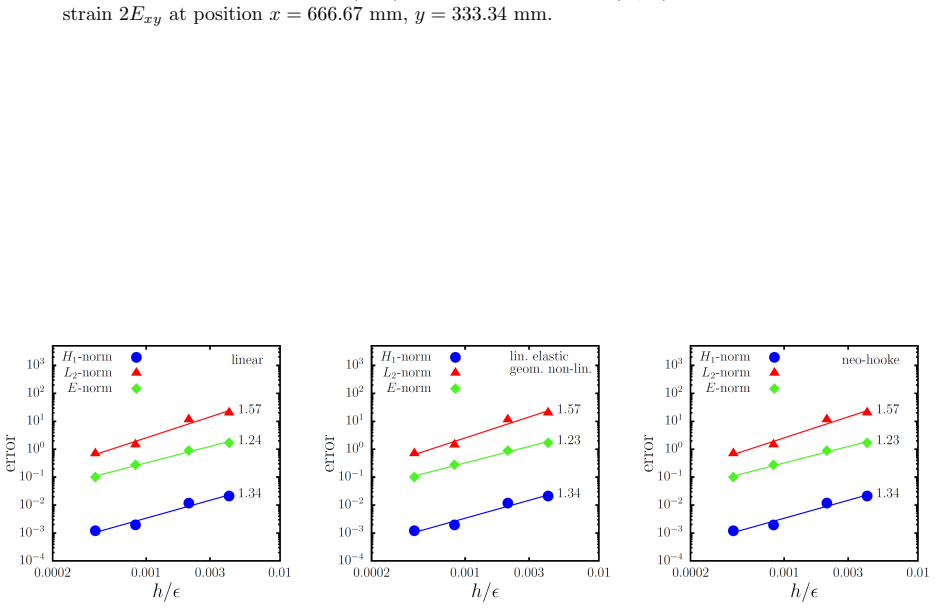
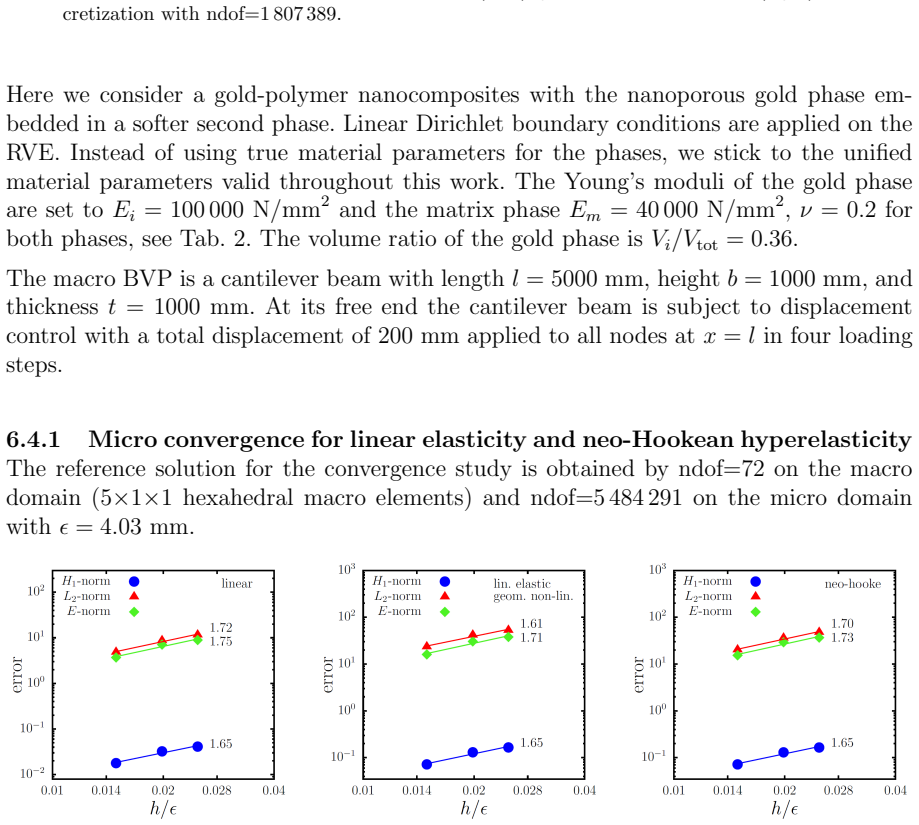
On the paper's own terms, the central discovery is that the fully converged solution of the micro problems inside each macro iteration is neither necessary for convergence nor favorable for efficiency in nonlinear FE-HMM homogenization. The nested two-level Newton scheme, in which each macro step embeds a complete micro solve, can be replaced by direct alternations: one micro Newton iteration, one macro Newton iteration, repeated until the macro residual drops, followed by a final single micro iteration as an accuracy polish. The numerical examples with periodic, Dirichlet, and image-based microstructures show identical maximum nodal displacements between the two schemes, with speedup factors from 1.05 to 2.6 in 2D and 1.7 to 2.0 in 3D. The same section of the paper assesses the linear a priori error estimates in the nonlinear regime and finds measured convergence orders close to the linear ones, attributing order reductions to micro-problem regularity rather than to material or geometric nonlinearity.
Load-bearing premise
The claim of equal endpoint accuracy rests on the assumption that the single final micro Newton iteration, performed after the macro loop has converged, leaves the microscopic residual effectively as small as fully converged inner loops would, so neither displacements nor stresses differ between the schemes; the paper reports maximum nodal displacements but not final micro residual norms.
Editorial extensions
If this is right
- Existing FE2/FE-HMM codes can switch from nested to alternating Newton by reordering the loops, without changing discretizations, and obtain the same macro displacement endpoints.
- Computational savings grow with the cost share of micro solves: measured speedups rise when the micro mesh is refined relative to the macro mesh.
- The alternation tolerates large load steps; in the examples it converged in the same number of macro iterations, or one more, than the standard scheme.
- Because the paper's FE-HMM and FE2 differ only in how stiffness is transferred, the alternating scheme transfers directly to FE2 implementations.
- The assessed a priori estimates imply that optimal uniform micro-macro refinement strategies from linear FE-HMM remain usable for hyperelastic solids with sufficient regularity.
Reading between the lines
- If micro problems are strongly nonlinear, for example near instability or snap-through, the one-iteration exchange may lose the quadratic convergence the nested scheme buys; a test would be to run the alternation on a microstructure with a non-convex energy and watch for stall or divergence.
- The speedup mechanism is essentially block coordinate descent on the coupled macro-micro system, so it should generalize to any staggered multiscale coupling, such as thermo-mechanical, electro-mechanical, or poromechanical, whenever the coupled iteration is contractive; that generalization is not shown in the paper.
- For path-dependent inelastic microstructures the single-iteration alternation may need adjustment, because the micro load history must be integrated accurately at every step, not only at the end; the paper explicitly defers inelastic analysis.
- A practical rule suggested by the data: monitor the macro residual and keep the final micro polish; if the macro loop needs extra iterations, the break-even point for switching back to nested solves can be computed on the fly.
Signed reviews
Editorial analysis
A structured set of objections, weighed in public.
Referee Report
Summary. The paper develops a nonlinear finite element heterogeneous multiscale method (FE-HMM) in a Lagrangian setting for hyperelastic solids, assesses whether the existing linear-elasticity a priori error estimates still predict the observed convergence behavior, and proposes replacing the standard nested-loop micro-macro Newton iteration with an alternating scheme in which a single micro Newton iteration is performed after each macro iteration. The numerical study covers four microstructures (two 2D Escher-type tessellations, a pixel-based 2D micrograph, and a 3D nanoporous gold composite), compares the alternating scheme with the standard nested scheme, and reports speedup factors between 1.05 and 2.6 in 2D and 1.7 to 2.0 in 3D. The authors conclude in Section 7 that the fully converged solution of micro problems at each macro iteration is neither necessary nor favorable, and that the nested scheme can be safely and efficiently replaced by direct alternations.
Significance. If the central algorithmic claim is valid, the paper offers a practically useful simplification of FE2/FE-HMM for nonlinear hyperelastic homogenization, with potential savings in computing time and implementation effort. The numerical study is extensive, spans 2D and 3D problems with different microstructures, and reports convergence rates and speedups without fitting parameters to data. The proposed alternating scheme is simple and clearly described in pseudocode. However, the load-bearing evidence for the replacement claim is currently incomplete: the comparisons establish agreement in maximum nodal displacements and macro residuals, but not the equivalence of the two-scale equilibrium state, because final micro residual norms and stopping tolerances are not reported. The paper is significant as a numerical and algorithmic contribution, but the strength of the claims in Section 7 exceeds the current evidence.
major comments (3)
- [Section 7, item 3; Tables 3 and 6] The central claim that the nested scheme 'can safely and efficiently be replaced' by direct alternations is not fully supported by the reported data. The endpoint comparison is made through maximum nodal displacements and macro residual histories only; no final micro residual norms are reported, and the micro Newton stopping tolerance is not stated. Because the macro stress is computed from the terminal micro state via Eq. (20), the alternating scheme could in principle stop at a state where macro equilibrium holds but micro equilibrium does not. Agreement in max displacement is necessary but not sufficient to establish that the alternating scheme reaches the same two-scale solution as the nested scheme. Please report final micro residual norms for both schemes (for example, in Tables 3 and 6) and state the exact macro and micro stopping tolerances used in Algorithms 1 and 2.
- [Section 5.2 and Figure 4] The 'accuracy polish' performed by the final single micro Newton iteration is asserted to bring the micro state to the same level of convergence as the fully converged inner loops of the standard method, but no measurement supports this assertion. In Table 4 the alternating scheme is terminated with macro residuals around 1e-6 while the standard scheme reaches about 1e-8. Without a direct comparison of micro residuals at the end of each load step, the reader cannot verify that the alternating endpoint is comparably accurate in the two-scale sense. A quantitative comparison of the final micro residual under both schemes is needed for this load-bearing claim.
- [Section 7, item 3] The phrase 'can safely and efficiently be replaced' is an empirical generalization based on four examples, all of which use the same macro boundary value problem (a cantilever beam) and a single load path per example. The authors should either restrict the claim to the tested configurations or provide a supporting argument, such as a local analysis of the coupled fixed-point iteration showing that one micro Newton step per macro iteration does not degrade the attainable endpoint accuracy. As written, the broader generalization goes beyond the evidence presented.
minor comments (4)
- [Algorithms 1 and 2] The loop conditions read 'while macro residual < macro tolerance do', which is the opposite of the intended termination criterion; the condition should be 'while the macro residual exceeds the macro tolerance' (i.e., '>' rather than '<').
- [Section 4, Eq. (48)-(52)] The symbol C is used both for the generic constant in the a priori estimates and for the right Cauchy-Green tensor in Section 6; please disambiguate the notation.
- [Section 6.1.2 and Tables 5, 7, 8, 9] The speedup factors are reported only as aggregate numbers; stating the precise stopping tolerances used in each run would strengthen the reproducibility of the efficiency comparison.
- [Section 6.4] The nanoporous gold example uses the unified material parameters from Table 2 rather than true gold/polymer parameters; this limitation is stated in the text but should also be recalled when the speedup numbers are interpreted as representative of actual nanoporous gold simulations.
Circularity Check
No significant circularity: convergence rates and speedups are measured against independent reference solutions; self-citations are attributional and not load-bearing.
full rationale
The paper's three contributions are a nonlinear FE-HMM formulation, a numerical assessment of existing a priori estimates in the nonlinear regime, and a modified alternating Newton solution scheme. None of these reduces to its own inputs by construction. The convergence studies in Section 6 compute errors against fine-mesh reference solutions, so the measured rates are not fitted or renamed inputs. The speedup factors in Tables 3, 5, 6, 7, 8, and 9 are direct wall-clock comparisons between the nested and alternating algorithms; they are not derived from an assumed identity. The central claim in Section 7, item 3, that fully converged micro problems are neither necessary nor favorable, is explicitly introduced as a hypothesis in Section 5.2 and then tested on four independent microstructures. A genuine evidence gap exists: the paper reports maximum nodal displacements and macro residuals but not final micro residual norms, so the assertion that the alternating scheme reaches the same two-scale equilibrium as the nested scheme is only partially verified. That is a correctness and evidence limitation, not circularity. Self-citations to the authors' prior works, e.g. [2], [16], and [44], attribute the origin of FE-HMM variants, earlier error analyses, and the first introduction of the alternating scheme; they are not invoked as proof of the present numerical conclusions. Therefore no circular step is established.
Assumptions & free parameters
free parameters (1)
- Newton stopping tolerances (macro and micro) =
not stated
assumptions (6)
- domain assumption Scale separation: L_macro >> L_micro, and the RVE is statistically representative.
- domain assumption Hill-Mandel energy equivalence between macro and micro stress power (Eq. 9).
- domain assumption First-order homogenization: the macro deformation imposed on each RVE is homogeneous (linearized displacement, Eq. (29)).
- domain assumption The micro problem has sufficient regularity for the a priori estimates (48)-(50) to apply.
- ad hoc to paper One micro Newton iteration per macro iteration is sufficient for coupled convergence, with final micro balance achieved by a single accuracy-polish iteration.
- domain assumption Reference solutions computed on very fine meshes accurately represent the exact homogenized solution for error measurement.
Cite this review
Pith. "Pith review of A Nonlinear Finite Element Heterogeneous Multiscale Method for the Homogenization of Hyperelastic Solids and a Novel Staggered Two-Scale Solution Algorithm." pith.science (2026). https://pith.science/paper/AHT6GUQR
@misc{pith2026190808292,
  author       = {Pith},
  title        = {Pith review of: A Nonlinear Finite Element Heterogeneous Multiscale Method for the Homogenization of Hyperelastic Solids and a Novel Staggered Two-Scale Solution Algorithm},
  year         = {2026},
  howpublished = {\url{https://pith.science/paper/AHT6GUQR}},
  note         = {Machine review of arXiv:1908.08292}
}
abstract
In this paper we address three aspects of nonlinear computational homogenization of elastic solids by two-scale finite element methods. First, we present a nonlinear formulation of the finite element heterogeneous multiscale method FE-HMM in a Lagrangean formulation that covers geometrical nonlinearity and, more general, hyperelasticity. Second, a-priori estimates of FE-HMM, which exist so far only for the fully linear elastic case in solid mechanics, are assessed in the regime of nonlinear elasticity. The measured convergence rates agree fairly well with those of the fully linear regime. Third, we revise the standard solution algorithm of FE$^2$ which is a staggered scheme in terms of a nested loop embedding the full solution of the micro problem into one macro solution iteration step. We demonstrate that suchlike staggered scheme, which is typically realized by a nested two-level Newton algorithm, can safely and efficiently be replaced by direct alternations between micro and macro iterations. The novel algorithmic structure is exemplarily detailed for the proposed nonlinear FE-HMM, its efficiency is substantiated by a considerable speedup in numerical tests.
Figures


Figures from the paper (14 more)





Forward citations
Cited by 1 Pith paper
-
Error Analysis for Quadtree-Type Mesh-Coarsening Algorithms Adapted to Pixelized Heterogeneous Microstructures
A phase-aware error estimator and two coarsening algorithms let pixelized microstructure meshes be coarsened by about 90 percent with modest error increase, validated on 2D elasticity examples.
Reference graph
Works this paper leans on
-
[44]
Bernhard Eidel, Andreas Fischer, and Ajinkya Gote. A nonlinear FE-HMM for- mulation along with a novel algorithmic structure for finite deformation elasticity. PAMM, 18(1):e201800457, 2018
work page 2018
-
[1]
Analysis of the heterogeneous multiscale FEM for problems in elas- ticity
Assyr Abdulle. Analysis of the heterogeneous multiscale FEM for problems in elas- ticity. Mathematical Models and Methods in Applied Sciences , 16(04):615–635, 2006. A Nonlinear FE-HMM and a Novel Solution Concept for FE-HMM & FE 2 30
work page 2006
-
[2]
Bernhard Eidel and Andreas Fischer. The heterogeneous multiscale finite element method for the homogenization of linear elastic solids and a comparison with the FE2 method. Computer Methods in Applied Mechanics and Engineering , 329:332– 368, 2018
work page 2018
-
[3]
J. C. Michel, H. Moulinec, and P. Suquet. Effective properties of composite materi- als with periodic microstructure: a computational approach. Computer Methods in Applied Mechanics and Engineering , 172(1-4):109–143, 1999
work page 1999
-
[4]
Christian Miehe, J¨ org Schr¨ oder, and Jan Schotte. Computational homogenization analysis in finite plasticity simulation of texture development in polycrystalline ma- terials. Computer Methods in Applied Mechanics and Engineering, 171(3-4):387–418, 1999
work page 1999
-
[5]
Christian Miehe, Jan Schotte, and J¨ org Schr¨ oder. Computational micro–macro tran- sitions and overall moduli in the analysis of polycrystals at large strains. Computa- tional Materials Science , 16(1-4):372–382, 1999
work page 1999
-
[6]
Computer Methods in Applied Mechanics and Engineering , 183(3-4):309–330, 2000
Fr´ ed´ eric Feyel and Jean-Louis Chaboche.FE2 multiscale approach for modelling the elastoviscoplastic behaviour of long fibre sic/ti composite materials. Computer Methods in Applied Mechanics and Engineering , 183(3-4):309–330, 2000
work page 2000
-
[7]
V. Kouznetsova, W. A. M. Brekelmans, and F. P. T. Baaijens. An approach to micro- macro modeling of heterogeneous materials. Computational Mechanics, 27(1):37–48, 2001
work page 2001
Show all 64 references
-
[8]
Heterogeneous multiscale methods : A review
Weinan E, Bj¨ orn Engquist, Xiantao Li, Weiqing Ren, and Eric Vanden-Eijnden. Heterogeneous multiscale methods : A review. Communications in Computational Physics, 2(3):367–450, 2007
2007
-
[9]
The finite element heterogeneous multiscale method: A computational strategy for multiscale PDEs
Assyr Abdulle. The finite element heterogeneous multiscale method: A computational strategy for multiscale PDEs. GAKUTO International Series Mathematical Sciences and Applications, 31:133–181, 2009
2009
-
[10]
The heteroge- neous multiscale method
Assyr Abdulle, Weinan E, Bj¨ orn Engquist, and Eric Vanden-Eijnden. The heteroge- neous multiscale method. Acta Numerica, 21:1–87, 2012
2012
-
[11]
Assyr Abdulle and Martin E. Huber. Error estimates for finite element approxi- mations of nonlinear monotone elliptic problems with application to numerical ho- mogenization. Numerical Methods for Partial Differential Equations , 32(3):955–969, 2016
2016
-
[12]
Error control and adaptivity for heterogeneous multiscale approximations of nonlinear monotone problems.Discrete and Continuous Dynamical Systems - Series S , 8(1):119–150, 2015
Patrick Henning and Mario Ohlberger. Error control and adaptivity for heterogeneous multiscale approximations of nonlinear monotone problems.Discrete and Continuous Dynamical Systems - Series S , 8(1):119–150, 2015
2015
-
[13]
Parallel inelastic heterogeneous multi- scale simulations
Ramin Shirazi Nejad and Christian Wieners. Parallel inelastic heterogeneous multi- scale simulations. In Stefan Diebels and Sergej Rjasanow, editors, Multi-scale Simu- lation of Composite Materials , volume 23 of Mathematical Engineering, pages 57–96. Springer Berlin Heidelber...
2019
-
[14]
Analysis of the heterogeneous mul- tiscale method for elliptic homogenization problems
Weinan E, Pingbing Ming, and Pingwen Zhang. Analysis of the heterogeneous mul- tiscale method for elliptic homogenization problems. Journal of the American Math- ematical Society, 18(01):121–157, 2005
2005
-
[15]
A posteriori error estimates for the heterogeneous multiscale fi- nite element method for elliptic homogenization problems
Mario Ohlberger. A posteriori error estimates for the heterogeneous multiscale fi- nite element method for elliptic homogenization problems. Multiscale Modeling & Simulation, 4(1):88–114, 2005
2005
-
[16]
Convergence and error analysis of FE- HMM/FE2 for energetically consistent micro-coupling conditions in linear elastic solids
Andreas Fischer and Bernhard Eidel. Convergence and error analysis of FE- HMM/FE2 for energetically consistent micro-coupling conditions in linear elastic solids. European Journal of Mechanics - A/Solids , 77, 2019
2019
-
[17]
Moulinec and P
H. Moulinec and P. Suquet. A fast numerical method for computing the linear and nonlinear mechanical properties of composites. Comptes rendus de l’Acad´ emie des Sciences Paris II , 318:1417–14230, 1994
1994
-
[18]
Moulinec and P
H. Moulinec and P. Suquet. A numerical method for computing the overall response of nonlinear composites with complex microstructure. Computer Methods in Applied Mechanics and Engineering, 157(1-2):69–94, 1998
1998
-
[19]
Zeller and P
R. Zeller and P. H. Dederichs. Elastic constants of polycrystals. Physica Status Solidi (b), 55(2):831–842, 1973
1973
-
[20]
Statistical continuum mechanics: Course held
Ekkehart Kr¨ oner. Statistical continuum mechanics: Course held ... October 1971 , volume no. 92 ofCourses and lectures / International Centre for Mechanical Sciences. Springer, Wien, 1972
1971
-
[21]
Computational homogenization of elasticity on a staggered grid
Matti Schneider, Felix Ospald, and Matthias Kabel. Computational homogenization of elasticity on a staggered grid. International Journal for Numerical Methods in Engineering, 105(9):693–720, 2016
2016
-
[22]
FFT-based homogenization for microstructures discretized by linear hexahedral elements
Matti Schneider, Dennis Merkert, and Matthias Kabel. FFT-based homogenization for microstructures discretized by linear hexahedral elements. International Journal for Numerical Methods in Engineering , 109(10):1461–1489, 2017
2017
-
[23]
Yvonnet and Q.-C
J. Yvonnet and Q.-C. He. The reduced model multiscale method (R3M) for the non-linear homogenization of hyperelastic media at finite strains. Journal of Com- putational Physics, 223(1):341–368, 2007
2007
-
[24]
POD-based model reduction with empirical interpolation applied to nonlinear elasticity
Annika Radermacher and Stefanie Reese. POD-based model reduction with empirical interpolation applied to nonlinear elasticity. International Journal for Numerical Methods in Engineering, 107(6):477–495, 2016
2016
-
[25]
A numerical study of different projection-based model reduction techniques applied to computational homogenisation
Dominic Soldner, Benjamin Brands, Reza Zabihyan, Paul Steinmann, and Ju- lia Mergheim. A numerical study of different projection-based model reduction techniques applied to computational homogenisation. Computational Mechanics , 60(4):613–625, 2017
2017
-
[26]
Approximation of random microstructures by periodic statistically similar representative volume elements based on lineal-path functions
J¨ org Schr¨ oder, Daniel Balzani, and Dominik Brands. Approximation of random microstructures by periodic statistically similar representative volume elements based on lineal-path functions. Archive of Applied Mechanics, 81(7):975–997, 2011. A Nonlinear FE-HMM and a Novel Sol...
2011
-
[27]
Robust feti-dp methods for heterogeneous three dimensional elasticity problems
Axel Klawonn and Oliver Rheinbach. Robust feti-dp methods for heterogeneous three dimensional elasticity problems. Computer Methods in Applied Mechanics and Engineering, 196(8):1400–1414, 2007
2007
-
[28]
Klawonn and O
A. Klawonn and O. Rheinbach. Highly scalable parallel domain decomposition meth- ods with an application to biomechanics. Journal of Applied Mathematics and Me- chanics, 90(1):5–32, 2010
2010
-
[29]
Review of FIB-tomography
Lorenz Holzer and Marco Cantoni. Review of FIB-tomography. In Ivo Utke, Stanislav Moshkalev, and Phillip Russell, editors, Nanofabrication Using Focused Ion and Electron Beams, volume 559201222 of Oxford series on nanomanufacturing , pages 410–435. Oxford University Press, Oxf...
2011
-
[30]
Saenger, Frieder Enzmann, Youngseuk Keehm, and Holger Steeb
Erik H. Saenger, Frieder Enzmann, Youngseuk Keehm, and Holger Steeb. Digital rock physics: Effect of fluid viscosity on effective elastic properties.Journal of Applied Geophysics, 74(4):236–241, 2011
2011
-
[31]
Saenger, Ratnanabha Sain, Nishank Saxena, Sarah Ricker, Andreas Wiegmann, and Xin Zhan
Heiko Andr¨ a, Nicolas Combaret, Jack Dvorkin, Erik Glatt, Junehee Han, Matthias Kabel, Youngseuk Keehm, Fabian Krzikalla, Minhui Lee, Claudio Madonna, Mike Marsh, Tapan Mukerji, Erik H. Saenger, Ratnanabha Sain, Nishank Saxena, Sarah Ricker, Andreas Wiegmann, and Xin Zhan. Di...
2013
-
[32]
Legrain, P
G. Legrain, P. Cartraud, I. Perreard, and N. Mo¨ es. An X-FEM and level set com- putational approach for image-based modelling: Application to homogenization. In- ternational Journal for Numerical Methods in Engineering , 86(7):915–934, 2011
2011
-
[33]
W. D. Lian, G. Legrain, and P. Cartraud. Image-based computational homoge- nization and localization: comparison between X-FEM/levelset and voxel-based ap- proaches. Computational Mechanics, 51(3):279–293, 2013
2013
-
[34]
Error analysis for quadtree-type mesh- coarsening algorithms adapted to pixelized heterogeneous microstructures, 2019
Andreas Fischer and Bernhard Eidel. Error analysis for quadtree-type mesh- coarsening algorithms adapted to pixelized heterogeneous microstructures, 2019
2019
-
[35]
Miehe and A
C. Miehe and A. Koch. Computational micro-to-macro transitions of discretized microstructures undergoing small strains. Archive of Applied Mechanics (Ingenieur Archiv), 72(4-5):300–317, 2002
2002
-
[36]
Computational micro-to-macro transitions for discretized micro- structures of heterogeneous materials at finite strains based on the minimization of averaged incremental energy
Christian Miehe. Computational micro-to-macro transitions for discretized micro- structures of heterogeneous materials at finite strains based on the minimization of averaged incremental energy. Computer Methods in Applied Mechanics and Engi- neering, 192(5-6):559–591, 2003
2003
-
[37]
A multilevel finite element method(FE2) to describe the response of highly non-linear structures using generalized continua
Fr´ ed´ eric Feyel. A multilevel finite element method(FE2) to describe the response of highly non-linear structures using generalized continua. Computer Methods in Applied Mechanics and Engineering , 192(28-30):3233–3244, 2003
2003
-
[38]
V. G. Kouznetsova, M.G.D. Geers, and W.A.M. Brekelmans. Multi-scale second- order computational homogenization of multi-phase materials: a nested finite element solution strategy. Computer Methods in Applied Mechanics and Engineering, 193(48- 51):5525–5550, 2004. B. Eidel, A. F...
2004
-
[39]
¨Ozdemir, W.A.M
I. ¨Ozdemir, W.A.M. Brekelmans, and M.G.D. Geers. FE2 computational homoge- nization for the thermo-mechanical analysis of heterogeneous solids. Computer Meth- ods in Applied Mechanics and Engineering , 198(3-4):602–613, 2008
2008
-
[40]
Temizer and P
˙I. Temizer and P. Wriggers. On the computation of the macroscopic tangent for multi- scale volumetric homogenization problems. Computer Methods in Applied Mechanics and Engineering, 198(3-4):495–510, 2008
2008
-
[41]
A numerical two-scale homogenization scheme: theFE2-method
J¨ org Schr¨ oder. A numerical two-scale homogenization scheme: theFE2-method. In Friedrich Pfeiffer, Franz G. Rammerstorfer, Elisabeth Guazzelli, Bernhard Schrefler, Paolo Serafini, J¨ org Schr¨ oder, and Klaus Hackl, editors,Plasticity and Beyond , vol- ume 550 of CISM Internat...
2014
-
[42]
Aspects of computational homogenization at finite deformations: A unifying review from Reuss’ to Voigt’s bound
Saba Saeb, Paul Steinmann, and Ali Javili. Aspects of computational homogenization at finite deformations: A unifying review from Reuss’ to Voigt’s bound. Applied Mechanics Reviews, 68(5):050801, 2016
2016
-
[43]
Compu- tational homogenization with million-way parallelism using domain decomposition methods
Axel Klawonn, Stephan K¨ ohler, Martin Lanser, and Oliver Rheinbach. Compu- tational homogenization with million-way parallelism using domain decomposition methods. Computational Mechanics, 21(1):1, 2019
2019
-
[45]
Papanicolau, A
G. Papanicolau, A. Bensoussan, and J. L. Lions. Asymptotic Analysis for Periodic Structures. Elsevier, Burlington, 1978
1978
-
[46]
Non-homogenous media and vibration theory
Enrique Sanchez-Palencia. Non-homogenous media and vibration theory . Springer- Verlag, Berlin, 1980
1980
-
[47]
Preprocessing and postprocessing for materials based on the homogenization method with adaptive finite element methods
Jos´ eMiranda Guedes and Noboru Kikuchi. Preprocessing and postprocessing for materials based on the homogenization method with adaptive finite element methods. Computer Methods in Applied Mechanics and Engineering , 83(2):143–198, 1990
1990
-
[48]
Homogenization and two-scale convergence
Gr´ egoire Allaire. Homogenization and two-scale convergence. SIAM Journal on Mathematical Analysis, 23(6):1482–1518, 1992
1992
-
[49]
Cioranescu and Patrizia Donato
D. Cioranescu and Patrizia Donato. An introduction to homogenization , volume 17 of Oxford lecture series in mathematics and its applications. Oxford University Press, Oxford and New York, 1999
1999
-
[50]
R. Hill. Elastic properties of reinforced solids: Some theoretical principles. Journal of the Mechanics and Physics of Solids , 11(5):357–372, 1963
1963
-
[51]
Material spatial randomness: From statistical to repre- sentative volume element
Martin Ostoja-Starzewski. Material spatial randomness: From statistical to repre- sentative volume element. Probabilistic Engineering Mechanics, 21(2):112–132, 2006
2006
-
[52]
K. Sab. On the homogenization and the simulation of random materials. European Journal of Mechanics A-Solids , 11(5):585–607, 1992. A Nonlinear FE-HMM and a Novel Solution Concept for FE-HMM & FE 2 34
1992
-
[53]
W. J. Drugan and J. R. Willis. A micromechanics-based nonlocal constitutive equa- tion and estimates of representative volume element size for elastic composites. Jour- nal of the Mechanics and Physics of Solids , 44(4):497–524, 1996
1996
-
[54]
Plasticit´ e classique et viscoplasticit´ e, volume No 97 of Courses and Lectures, International centre for mechanical sciences
Jean Mandel. Plasticit´ e classique et viscoplasticit´ e, volume No 97 of Courses and Lectures, International centre for mechanical sciences. Springer, Vienna, 1972
1972
-
[55]
R. Hill. On constitutive macro-variables for heterogeneous solids at finite strain. Proceedings of the Royal Society A: Mathematical, Physical and Engineering Sciences, 326(1565):131–147, 1972
1972
-
[56]
The heterogeneous multiscale methods
Weinan E and Bjorn Engquist. The heterogeneous multiscale methods. Communi- cations in Mathematical Sciences , 1(1):87–132, 2003
2003
-
[57]
E. A. de Souza Neto and R. A. Feij´ oo. On the equivalence between spatial and ma- terial volume averaging of stress in large strain multi-scale solid constitutive models. Mechanics of Materials , 40(10):803–811, 2008
2008
-
[58]
Grytz and G
R. Grytz and G. Meschke. Consistent micro-macro transitions at large objective strains in curvilinear convective coordinates. International Journal for Numerical Methods in Engineering, 73(6):805–824, 2008
2008
-
[59]
N. P. van Dijk. Formulation and implementation of stress-driven and/or strain-driven computational homogenization for finite strain. International Journal for Numerical Methods in Engineering, 107(12):1009–1028, 2016
2016
-
[60]
The heterogeneous multiscale finite element method FE-HMM for the homogenization of linear elastic solids
Bernhard Eidel and Andreas Fischer. The heterogeneous multiscale finite element method FE-HMM for the homogenization of linear elastic solids. PAMM, 16(1):521– 522, 2016
2016
-
[61]
Numerical experiments for multiscale problems in linear elasticity
Orane Jecker and Assyr Abdulle. Numerical experiments for multiscale problems in linear elasticity. In B¨ ulent Karas¨ ozen, Murat Manguo˘ glu, M¨ unevver Tezer-Sezgin, Serdar G¨ oktepe, and¨Om¨ ur U˘ gur, editors,Numerical Mathematics and Advanced Ap- plications ENUMATH 2015,...
2015
-
[62]
Atomic origins of the high catalytic activity of nanoporous gold
Takeshi Fujita, Pengfei Guan, Keith McKenna, Xingyou Lang, Akihiko Hirata, Ling Zhang, Tomoharu Tokunaga, Shigeo Arai, Yuta Yamamoto, Nobuo Tanaka, Yoshi- fumi Ishikawa, Naoki Asao, Yoshinori Yamamoto, Jonah Erlebacher, and Mingwei Chen. Atomic origins of the high catalytic ac...
2012
-
[63]
Surface-stress induced macroscopic bending of nanoporous gold cantilevers
Dominik Kramer, Raghavan Nadar Viswanath, and J¨ org Weissm¨ uller. Surface-stress induced macroscopic bending of nanoporous gold cantilevers. Nano Letters, 4(5):793– 796, 2004
2004
-
[64]
Emma Griffiths, Swantje Bargmann, and B. D. Reddy. Elastic behaviour at the nanoscale of innovative composites of nanoporous gold and polymer. Extreme Me- chanics Letters, 17:16–23, 2017
2017
Reviewed August 14, 2026 · model on record in the stance chip above.
Discussion (0). Continue with ORCID to comment.