REVIEW 5 major objections 4 minor 42 references
Pitch-Synchronous Single Frequency Filtering Spectrogram for Speech Emotion Recognition
T0 review · 5 major / 4 minor · reviewed 2026-08-14 · deepseek-v4-flash
Pith's one-line read The paper's central claim is that averaging a single-frequency-filtering spectrogram over each pitch cycle improves CNN-based emotion recognition on IEMOCAP, reaching 70.4% weighted accuracy and recovering happy speech that the STFT…
desk verdict A plausible new input representation for SER with an interesting happy-class recovery, but the headline numbers are unsupported without run variance and per-class counts. read the letter →
The pith
A machine-rendered reading of the paper's core claim, the machinery that carries it, and where it could break.
The reading
What carries the argument
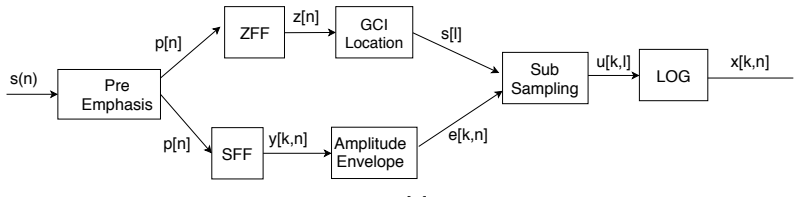
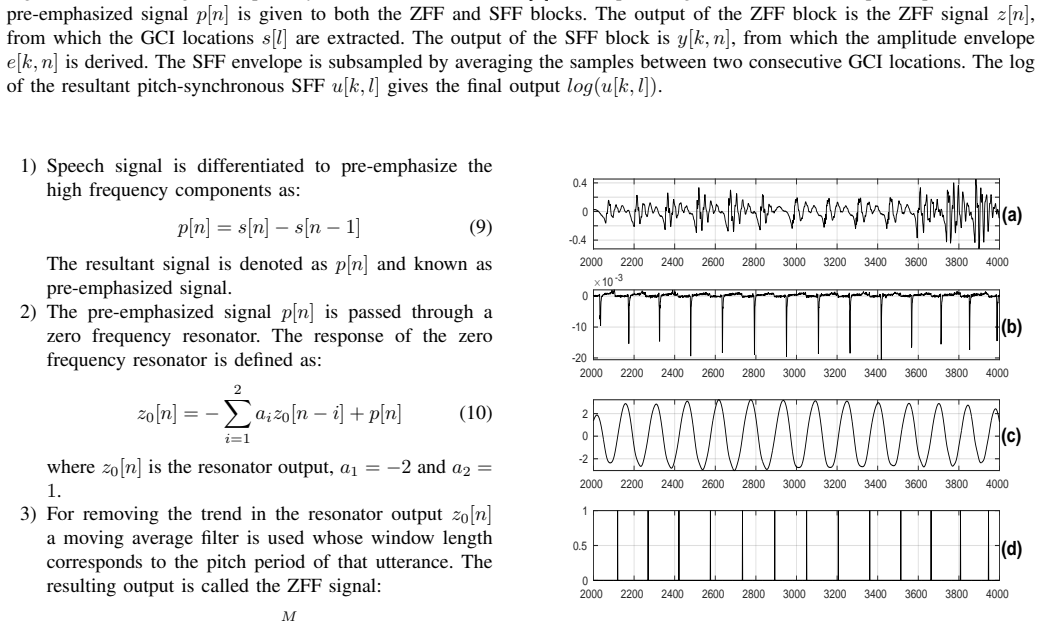
The central object is the pitch-synchronous SFF spectrogram: a time-frequency image in which each pixel is the log-amplitude of a single-frequency-filtered envelope, averaged over one glottal cycle. It is built in three steps: (1) the speech signal is shifted in frequency and passed through a single-pole resonator at Nyquist to produce a complex SFF envelope at every sample; (2) glottal closure instants are found with a zero frequency filter, and the envelope is averaged over the samples between successive instants, giving one time bin per pitch period; (3) the logarithm is taken. This construction is what carries the argument: the averaging shrinks the SFF feature matrix to a size a CNN can ingest, and the pitch-aligned binning lets the representation reflect emotion-specific pitch dynamics and harmonic or timbre structure instead of imposing a fixed frame size. The same CNN architecture with batch normalisation is applied to the proposed representation and to the STFT and SFF-20 ms baselines, so the reported differences are attributed to the input representation.
What would settle it
Replace the pitch-synchronous bins in the feature matrix with fixed-length bins of the same average duration, or with randomly placed boundaries matched to the same distribution of cycle lengths, and retrain the same CNN: if either version matches the 63.95% unweighted accuracy, the claim that aligning to glottal closure instants is what preserves emotion information fails. A more direct check would run the same model on whispered or strongly degraded speech, where zero-frequency GCI detection is unreliable; a disproportionate loss would confirm the dependence on clean epoch locations.
Extended reading notes
Core claim
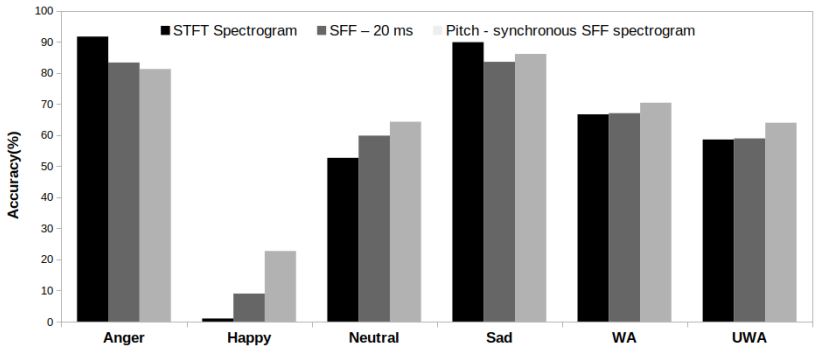
The central claim is that pitch-synchronous SFF spectrograms are a better input representation for CNN-based emotion recognition than STFT spectrograms. SFF gives an independent amplitude-envelope sample at every time instant for every frequency, so it does not trade time resolution against frequency resolution the way windowed Fourier analysis does. The paper's modification averages these envelope samples between successive glottal closure instants, making the time axis of the spectrogram a sequence of pitch periods rather than fixed frames. The authors report that this representation gives 63.95% unweighted and 70.4% weighted accuracy on four emotion classes from IEMOCAP, improving on the STFT-spectrogram CNN baseline by 7.35 and 4.3 percentage points, and that it lifts happy-emotion recognition from 0% to 22.7% while keeping anger and sadness accuracy roughly unchanged.
Load-bearing premise
Emotional speech is close enough to stationary between two successive glottal closure instants that averaging the SFF envelope over each pitch period keeps all the information needed to tell emotions apart.
Editorial extensions
If this is right
- If the central claim holds, SFF-based spectrograms become a practical alternative to STFT spectrograms for emotion recognition, with pitch-synchronous averaging doing the dimension reduction that makes SFF usable as CNN input.
- The comparison with SFF-20 ms (59.09% unweighted) versus pitch-synchronous SFF (63.95%) implies that aligning the time axis to glottal cycles, rather than simply using SFF's high resolution, contributes most of the improvement over STFT.
- The recovery of happy speech from 0% to 22.7% accuracy suggests that pitch-cycle-level dynamics carry information for emotions that are otherwise confusable with neutral, and that the representation is especially valuable for minority emotion classes.
- On the four IEMOCAP emotions used here, sadness and anger accuracy stay roughly the same as the baseline, so the benefit is class-dependent rather than a uniform accuracy lift.
Reading between the lines
- A testable extension the paper leaves implicit is an ablation that scrambles the GCI positions while keeping their average spacing: if recognition accuracy survives the scrambling, the active ingredient is the average cycle length rather than the physiological alignment to glottal closure.
- Because the SFF envelope is computed at every sample, the difference between the within-cycle envelope and the proposed cycle average could be fed to the same CNN as a separate channel; a model that uses the residual would show how much emotion information the averaging step discards.
- If pitch-synchronous SFF encodes timbre and pitch dynamics this directly, it may transfer to other tasks where glottal timing matters, such as speaker state monitoring or assessment of disordered voice, but the paper does not perform those experiments.
Signed reviews
Editorial analysis
A structured set of objections, weighed in public.
Referee Report
Summary. The paper proposes a pitch-synchronous single frequency filtering (SFF) spectrogram for speech emotion recognition (SER). The SFF amplitude envelope is averaged over intervals between glottal closure instants (GCIs), detected with zero frequency filtering, to reduce feature size while preserving pitch-cycle-level structure. The representation is fed to a CNN evaluated on the IEMOCAP dataset for four emotions (angry, happy, neutral, sad). The authors report an unweighted accuracy (UWA) of 63.95% and a weighted accuracy (WA) of 70.4%, corresponding to claimed improvements of +7.35% and +4.3% over the STFT-based CNN baseline of Satt et al. [32], and a happy-class recall of 22.7% versus 0% for that baseline.
Significance. If the reported gains are reproducible, the contribution is a useful new input representation for SER. The paper includes a controlled comparison in which the same CNN is used for STFT, SFF with 20 ms frames, and pitch-synchronous SFF, and the SFF-20ms condition acts as an ablation for the pitch-synchronous subsampling. These are genuine strengths. However, the central evidence is a single-run accuracy point estimate with no variance, no repeated runs, and no significance test, and the paper contains internal inconsistencies. The significance of the claimed improvement is therefore provisional until the statistical and consistency issues are resolved.
major comments (5)
- [IV, Table II] The central claim is supported only by single-run point estimates in Table II; no standard deviations, number of initializations, or significance tests are reported. Section IV also acknowledges that overfitting was not completely avoided, so the +7.35% UWA and +4.3% WA gaps over [32] cannot be distinguished from seed or run noise. Please report the mean and standard deviation over multiple runs and perform a paired test across folds or runs.
- [IV, Table III] The text states 'All the samples of happy emotion are predicted as neutral using the STFT spectrogram,' but Table III shows that happy samples are predicted as anger 40.91%, neutral 50%, and sad 9.1%, with 0% correct. The abstract similarly claims a happy recall of 0% 'for state-of-the-art results' without identifying which result; please correct the textual description or the table.
- [I, Eq. (7)] The introduction says 'the pattern of emotional speech varies rapidly within a glottal cycle due to the opening and closing of the glottis,' while the contribution list says 'an emotional speech is near stationary between two successive GCI locations.' These statements are in direct tension, and the averaging in Eq. (7) discards the within-cycle variability emphasized earlier. Please provide quantitative evidence that within-cycle variability is not emotion-relevant, or revise the motivation.
- [II-A, Eq. (7)] Equation (7) divides by (s[l+1] - s[l]) although the summation from i = s[l] to s[l+1] is an inclusive interval containing (s[l+1] - s[l] + 1) samples, creating an off-by-one error in the feature definition. The notation is also inconsistent because u[k,l] becomes x[k,n] in Eq. (8); please correct the equation and align all indices.
- [III] In the LOSO protocol, the validation speaker is taken from the same session as the test speaker. Because IEMOCAP sessions may share recording conditions, selecting the model based on a validation speaker from the test session can leak session-specific information into the reported numbers. Please clarify the session-level split and discuss whether any session leakage is possible.
minor comments (4)
- [V, Conclusion] The sentence reporting '+7.35% and +4.3% for weighted and unweighted accuracy values respectively' reverses the adjectives; the corresponding unweighted and weighted improvements are 7.35% and 4.3%. Please correct.
- [Table I and Section III] The stated feature matrix size is 200 x 1077, but the first convolution output in Table I is 189 x 284 x 16, which would correspond to an input of about 200 x 300. Please state whether the spectrograms are resized or cropped before being fed to the CNN.
- [II-C and III] The learning rate, batch size, number of epochs, dropout rate, and Adam parameters are not reported; please add these hyperparameters to the experimental setup.
- [Throughout] There are several typographical errors, including 'matirx' (Section I), 'the the' (Section III), 'Convolution Neural Network' (Index Terms), 'pannel' (Figure 5 caption), and 'sepctrogram' (Abstract).
Circularity Check
No significant circularity: the claimed accuracy gains are empirical comparisons against external IEMOCAP baselines, not consequences of fitted parameters or self-citation chains.
full rationale
The paper's central claim is an empirical accuracy comparison on the IEMOCAP dataset between the proposed pitch-synchronous SFF spectrogram and STFT/SFF-20ms baselines. The construction in Sec. II derives the input representation from the SFF envelope (Eq. 6) by averaging samples between GCI locations (Eq. 7) and applying the log (Eq. 8); no parameter in these equations is fitted to emotion labels or to the reported accuracies. GCI locations are obtained from the external zero frequency filtering algorithm [26], and the SFF method itself comes from prior external work [3], [4], [17], [29]. The only self-cited item, reference [38], supports the peripheral introductory claim that emotional speech varies rapidly within a glottal cycle; it is not load-bearing for the proposed representation or for the measured results. The comparisons are made against an external state-of-the-art result [32] and an implemented STFT baseline under the same CNN architecture. Therefore no step reduces by construction to its own inputs. Concerns about single-run accuracy, missing variance, and the small happy-class counts are statistical reproducibility issues, not circularity.
Assumptions & free parameters
free parameters (5)
- SFF filter pole radius r =
0.9394
- SFF filter spacing Delta f =
20 Hz
- ZFF trend window length
- CNN training hyperparameters
- Class weights for imbalanced training =
inverse class frequencies
assumptions (5)
- domain assumption The SFF amplitude envelope achieves high temporal and spectral resolution simultaneously without windowing.
- domain assumption Emotional speech is approximately stationary between two successive GCI locations.
- domain assumption ZFF detects GCI locations accurately on emotional speech.
- domain assumption IEMOCAP categorical labels are reliable ground truth for the four emotions used.
- domain assumption A CNN trained on the proposed spectrogram learns emotion-discriminative patterns.
Cite this review
Pith. "Pith review of Pitch-Synchronous Single Frequency Filtering Spectrogram for Speech Emotion Recognition." pith.science (2026). https://pith.science/paper/AIEYSWIZ
@misc{pith2026190803054,
  author       = {Pith},
  title        = {Pith review of: Pitch-Synchronous Single Frequency Filtering Spectrogram for Speech Emotion Recognition},
  year         = {2026},
  howpublished = {\url{https://pith.science/paper/AIEYSWIZ}},
  note         = {Machine review of arXiv:1908.03054}
}
read the original abstract
Convolutional neural networks (CNN) are widely used for speech emotion recognition (SER). In such cases, the short time fourier transform (STFT) spectrogram is the most popular choice for representing speech, which is fed as input to the CNN. However, the uncertainty principles of the short-time Fourier transform prevent it from capturing time and frequency resolutions simultaneously. On the other hand, the recently proposed single frequency filtering (SFF) spectrogram promises to be a better alternative because it captures both time and frequency resolutions simultaneously. In this work, we explore the SFF spectrogram as an alternative representation of speech for SER. We have modified the SFF spectrogram by taking the average of the amplitudes of all the samples between two successive glottal closure instants (GCI) locations. The duration between two successive GCI locations gives the pitch, motivating us to name the modified SFF spectrogram as pitch-synchronous SFF spectrogram. The GCI locations were detected using zero frequency filtering approach. The proposed pitch-synchronous SFF spectrogram produced accuracy values of 63.95% (unweighted) and 70.4% (weighted) on the IEMOCAP dataset. These correspond to an improvement of +7.35% (unweighted) and +4.3% (weighted) over state-of-the-art result on the STFT sepctrogram using CNN. Specially, the proposed method recognized 22.7% of the happy emotion samples correctly, whereas this number was 0% for state-of-the-art results. These results also promise a much wider use of the proposed pitch-synchronous SFF spectrogram for other speech-based applications.
Figures

Figures from the paper (3 more)

Reference graph
Works this paper leans on
-
[32]
Efficient emotion recognition from speech using deep learning on spectrograms
Aharon Satt, Shai Rozenberg, and Ron Hoory. Efficient emotion recognition from speech using deep learning on spectrograms. Proc. Interspeech 2017, pages 1089–1093, 2017
work page 2017
-
[1]
Gender Identification using MFCC for Telephone Applications - A Comparative Study
Jamil Ahmad, Mustansar Fiaz, Soon-il Kwon, Maleerat Sodanil, Bay V o, and Sung Wook Baik. Gender identification using mfcc for telephone applications-a comparative study. arXiv preprint arXiv:1601.01577, 2016
work page Pith review arXiv 2016
-
[2]
Masato Akagi, Xiao Han, Reda Elbarougy, Yasuhiro Hamada, and Junfeng Li. Toward affective speech-to-speech translation: Strategy for emotional speech recognition and synthesis in multiple languages. In Signal and Information Processing Association Annual Summit and Conference (APSIPA), 2014 Asia-Pacific, pages 1–10. IEEE, 2014
work page 2014
-
[3]
Single frequency filtering approach for discriminating speech and nonspeech
G Aneeja and B Yegnanarayana. Single frequency filtering approach for discriminating speech and nonspeech. IEEE/ACM Transactions on Audio, Speech and Language Processing (TASLP), 23(4):705–717, 2015
work page 2015
-
[4]
G Aneeja and B Yegnanarayana. Extraction of fundamental frequency from degraded speech using temporal envelopes at high snr fre- quencies. IEEE/ACM Transactions on Audio, Speech, and Language Processing, 25(4):829–838, 2017
work page 2017
-
[5]
Speech emotion recognition from spectrograms with deep convolutional neural network
Abdul Malik Badshah, Jamil Ahmad, Nasir Rahim, and Sung Wook Baik. Speech emotion recognition from spectrograms with deep convolutional neural network. In Platform Technology and Service (PlatCon), 2017 International Conference on, pages 1–5. IEEE, 2017
work page 2017
-
[6]
Deep features-based speech emotion recognition for smart affective services
Abdul Malik Badshah, Nasir Rahim, Noor Ullah, Jamil Ahmad, Khan Muhammad, Mi Young Lee, Soonil Kwon, and Sung Wook Baik. Deep features-based speech emotion recognition for smart affective services. Multimedia Tools and Applications, 78(5):5571–5589, 2019
work page 2019
-
[7]
Spectro-temporal analysis of speech signals using zero-time windowing and group delay function
Yegnanarayana Bayya and Dhananjaya N Gowda. Spectro-temporal analysis of speech signals using zero-time windowing and group delay function. Speech Communication, 55(6):782–795, 2013
work page 2013
Show all 42 references
-
[8]
Iemocap: Interactive emotional dyadic motion capture database
Carlos Busso, Murtaza Bulut, Chi-Chun Lee, Abe Kazemzadeh, Emily Mower, Samuel Kim, Jeannette N Chang, Sungbok Lee, and Shrikanth S Narayanan. Iemocap: Interactive emotional dyadic motion capture database. Language resources and evaluation , 42(4):335, 2008
2008
-
[9]
Multi-column deep neural networks for image classification
Dan Cires ¸an, Ueli Meier, and J ¨urgen Schmidhuber. Multi-column deep neural networks for image classification. arXiv preprint arXiv:1202.2745, 2012
2012 arXiv
-
[10]
A tutorial on the cross-entropy method
Pieter-Tjerk De Boer, Dirk P Kroese, Shie Mannor, and Reuven Y Rubinstein. A tutorial on the cross-entropy method. Annals of operations research, 134(1):19–67, 2005
2005
-
[11]
Survey on speech emotion recognition: Features, classification schemes, and databases
Moataz El Ayadi, Mohamed S Kamel, and Fakhri Karray. Survey on speech emotion recognition: Features, classification schemes, and databases. Pattern Recognition, 44(3):572–587, 2011
2011
-
[12]
Eval- uating deep learning architectures for speech emotion recognition
Haytham M Fayek, Margaret Lech, and Lawrence Cavedon. Eval- uating deep learning architectures for speech emotion recognition. Neural Networks, 92:60–68, 2017
2017
-
[13]
Acoustical properties of speech as indicators of depression and suicidal risk
Daniel Joseph France, Richard G Shiavi, Stephen Silverman, Marilyn Silverman, and M Wilkes. Acoustical properties of speech as indicators of depression and suicidal risk. IEEE transactions on Biomedical Engineering, 47(7):829–837, 2000
2000
-
[14]
On the importance of glottal flow spectral energy for the recognition of emotions in speech
Ling He, Margaret Lech, and Nicholas Allen. On the importance of glottal flow spectral energy for the recognition of emotions in speech. In Eleventh Annual Conference of the International Speech Communication Association, 2010
2010
-
[15]
Batch normalization: Accelerat- ing deep network training by reducing internal covariate shift
Sergey Ioffe and Christian Szegedy. Batch normalization: Accelerat- ing deep network training by reducing internal covariate shift. arXiv preprint arXiv:1502.03167, 2015
2015 arXiv
-
[16]
Application of the wavelet transform for pitch detection of speech signals
Shubha Kadambe and Gloria Faye Boudreaux-Bartels. Application of the wavelet transform for pitch detection of speech signals. IEEE transactions on Information Theory , 38(2):917–924, 1992
1992
-
[17]
Epoch extraction from emotional speech using single frequency filtering approach
Sudarsana Reddy Kadiri and B Yegnanarayana. Epoch extraction from emotional speech using single frequency filtering approach. Speech Communication, 86:52–63, 2017
2017
-
[18]
Speaker identification using spectrograms of varying frame sizes
HB Kekre, Vaishali Kulkarni, Prashant Gaikar, and Nishant Gupta. Speaker identification using spectrograms of varying frame sizes. International Journal of Computer Applications , 50(20), 2012
2012
-
[19]
Adam: A method for stochastic optimization
Diederik P Kingma and Jimmy Ba. Adam: A method for stochastic optimization. arXiv preprint arXiv:1412.6980 , 2014
2014 arXiv
-
[20]
The perceptual importance of selected voice quality parameters
Gudrun Klasmeyer. The perceptual importance of selected voice quality parameters. In 1997 IEEE International Conference on Acoustics, Speech, and Signal Processing , volume 3, pages 1615–
1997
-
[21]
Improvement of the backpropagation algorithm for training neural networks
James Leonard and MA Kramer. Improvement of the backpropagation algorithm for training neural networks. Computers & Chemical Engineering, 14(3):337–341, 1990
1990
-
[22]
Automatic speaker age and gender recognition using acoustic and prosodic level infor- mation fusion
Ming Li, Kyu J Han, and Shrikanth Narayanan. Automatic speaker age and gender recognition using acoustic and prosodic level infor- mation fusion. Computer Speech & Language , 27(1):151–167, 2013
2013
-
[23]
Learning salient features for speech emotion recognition using con- volutional neural networks
Qirong Mao, Ming Dong, Zhengwei Huang, and Yongzhao Zhan. Learning salient features for speech emotion recognition using con- volutional neural networks. IEEE Transactions on Multimedia , 16(8):2203–2213, 2014
2014
-
[24]
Age and gender classification using fusion of acoustic and prosodic features
Hugo Meinedo and Isabel Trancoso. Age and gender classification using fusion of acoustic and prosodic features. In Eleventh Annual Conference of the International Speech Communication Association , 2010
2010
-
[25]
Automatic speech emotion recognition using recurrent neural networks with local attention
Seyedmahdad Mirsamadi, Emad Barsoum, and Cha Zhang. Automatic speech emotion recognition using recurrent neural networks with local attention. In Acoustics, Speech and Signal Processing (ICASSP), 2017 IEEE International Conference on , pages 2227–2231. IEEE, 2017
2017
-
[26]
Epoch extraction from speech signals
K Sri Rama Murty and B Yegnanarayana. Epoch extraction from speech signals. IEEE Transactions on Audio, Speech, and Language Processing, 16(8):1602–1613, 2008
2008
-
[27]
Rectified linear units improve restricted boltzmann machines
Vinod Nair and Geoffrey E Hinton. Rectified linear units improve restricted boltzmann machines. In Proceedings of the 27th interna- tional conference on machine learning (ICML-10) , pages 807–814, 2010
2010
-
[28]
Attentive convolutional neural network based speech emotion recognition: A study on the impact of input features, signal length, and acted speech
Michael Neumann and Ngoc Thang Vu. Attentive convolutional neural network based speech emotion recognition: A study on the impact of input features, signal length, and acted speech. arXiv preprint arXiv:1706.00612, 2017
2017 arXiv
-
[29]
Robust estimation of fundamental frequency using single frequency filtering approach
Vishala Pannala, G Aneeja, Sudarsana Reddy Kadiri, and B Yegna- narayana. Robust estimation of fundamental frequency using single frequency filtering approach. In INTERSPEECH, pages 2155–2159, 2016
2016
-
[30]
On the convergence of adam and beyond
Sashank J Reddi, Satyen Kale, and Sanjiv Kumar. On the convergence of adam and beyond. 2018
2018
-
[31]
A direct adaptive method for faster backpropagation learning: The rprop algorithm
Martin Riedmiller and Heinrich Braun. A direct adaptive method for faster backpropagation learning: The rprop algorithm. In Proceedings of the IEEE international conference on neural networks , volume 1993, pages 586–591. San Francisco, 1993
1993
-
[33]
Speech emotion recognition combining acoustic features and linguistic information in a hybrid support vector machine-belief network architecture
Bj ¨orn Schuller, Gerhard Rigoll, and Manfred Lang. Speech emotion recognition combining acoustic features and linguistic information in a hybrid support vector machine-belief network architecture. In 2004 IEEE International Conference on Acoustics, Speech, and Signal Processi...
2004
-
[34]
Modeling prosodic feature sequences for speaker recognition
Elizabeth Shriberg, Luciana Ferrer, Sachin Kajarekar, Anand Venkataraman, and Andreas Stolcke. Modeling prosodic feature sequences for speaker recognition. Speech Communication , 46(3- 4):455–472, 2005
2005
-
[35]
Adieu features? end-to-end speech emotion recognition using a deep convolutional recurrent network
George Trigeorgis, Fabien Ringeval, Raymond Brueckner, Erik Marchi, Mihalis A Nicolaou, Bj ¨orn Schuller, and Stefanos Zafeiriou. Adieu features? end-to-end speech emotion recognition using a deep convolutional recurrent network. In 2016 IEEE international con- ference on acou...
2016
-
[36]
Spectral-temporal receptive fields and mfcc balanced feature extraction for robust speaker recognition
Jia-Ching Wang, Chien-Yao Wang, Yu-Hao Chin, Yu-Ting Liu, En- Ting Chen, and Pao-Chi Chang. Spectral-temporal receptive fields and mfcc balanced feature extraction for robust speaker recognition. Multimedia Tools and Applications , 76(3):4055–4068, 2017
2017
-
[37]
Text-independent speech emotion recognition using frequency adaptive features
Chenjian Wu, Chengwei Huang, and Hong Chen. Text-independent speech emotion recognition using frequency adaptive features. Mul- timedia Tools and Applications , 77(18):24353–24363, 2018
2018
-
[38]
Epoch detection from emotional speech signal using zero time windowing
Jainath Yadav, Md Shah Fahad, and K Sreenivasa Rao. Epoch detection from emotional speech signal using zero time windowing. Speech Communication, 96:142–149, 2018
2018
-
[39]
Method for identifying autho- rized users using a spectrogram and apparatus of the same, August 22
Tsuei-Chi Yeh and Wen-Yuan Chen. Method for identifying autho- rized users using a spectrogram and apparatus of the same, August 22
-
[40]
Speech emotion recognition using spectrogram & phoneme embedding
Promod Yenigalla, Abhay Kumar, Suraj Tripathi, Chirag Singh, Sib- sambhu Kar, and Jithendra Vepa. Speech emotion recognition using spectrogram & phoneme embedding. In Interspeech, 2018
2018
-
[41]
Spectrogram based multi-task audio classification
Yuni Zeng, Hua Mao, Dezhong Peng, and Zhang Yi. Spectrogram based multi-task audio classification. Multimedia Tools and Applica- tions, 78(3):3705–3722, 2019
2019
-
[2002]
09/884,287
US Patent App. 09/884,287
Reviewed August 14, 2026 · model on record in the stance chip above.
Discussion (0). Continue with ORCID to comment.