REVIEW 3 major objections 5 minor 3 cited by
Neutrino mass model with a modular $S_4$ symmetry
T0 review · 3 major / 5 minor · reviewed 2026-08-14 · deepseek-v4-flash
Pith's one-line read A modular $S_4$ symmetry whose weights forbid a tree-level neutrino mass generates the masses radiatively and predicts a normal hierarchy, $\sum m_i$ near 58–62 meV, $\langle m_{ee}\rangle$ 1.2–4 meV, and a $Z_2$-stabilized dark matter…
desk verdict A clean but routine modular S4 Ma-model extension that fits NH data; the DM mass is borrowed, not computed, so the predictions are less robust than the abstract suggests. read the letter →
The pith
A machine-rendered reading of the paper's core claim, the machinery that carries it, and where it could break.
The reading
What carries the argument
The load-bearing mechanism is the modular $S_4$ symmetry with fixed modular weights, integers that control how fields transform under the modular group and which couplings are allowed. The lowest-weight modular forms $Y_2^{(2)}$, expressed through the eta function and its derivative, generate the higher-weight triplets $Y_3^{(4)}$ and $Y_{3'}^{(4)}$ that enter the Yukawa matrices. These matrices feed the one-loop radiative seesaw formula for the neutrino mass, where the inert scalar doublet $\eta$ runs in the loop; the same assignments that forbid the tree-level mass produce a remnant $Z_2$ parity that stabilizes the lightest $\eta$ component as dark matter.
What would settle it
Recompute the thermal relic density of the full model with the new Yukawa couplings $y_\eta$ and the quartic scalar couplings included; if the dark matter mass required to match the observed abundance moves outside the assumed $534\pm8.5$ GeV window, the input scalar masses used for the neutrino fit are invalid and the predicted $\sum m_i$ and $\langle m_{ee}\rangle$ windows shift. Separately, a measurement of $\sum m_i$ outside 58–62 meV, or of $\langle m_{ee}\rangle$ outside 1.2–4 meV, at $5\sigma$ would rule out the normal-hierarchy solution.
Extended reading notes
Core claim
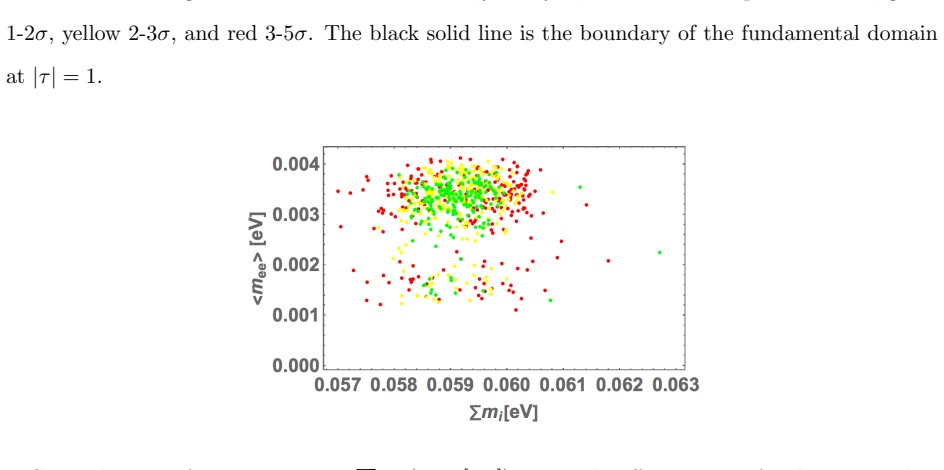
The central discovery is that the modular weights themselves do the structural work: assigning weight $-2$ to the lepton fields and weight $-1$ to the Majorana fields makes the tree-level neutrino mass matrix vanish, so the leading contribution is the one-loop diagram with the inert doublet $\eta$. After modular symmetry breaking a $Z_2$ subgroup survives, odd parity for odd-weight fields and even for even-weight fields, and the imaginary component of $\eta^0$ is the stable dark matter. The Yukawa sector is then structured by modular forms built from the eta function and its derivative, and a $\chi^2$ fit to current neutrino oscillation data selects a narrow region of the modular parameter $\tau$ near $-0.5+1.35i$. In that region the model reproduces the normal hierarchy and predicts $58\,\text{meV}\lesssim\sum m_i\lesssim62\,\text{meV}$, $1.2\,\text{meV}\lesssim\langle m_{ee}\rangle\lesssim4\,\text{meV}$, and a Dirac phase that clusters near $\pi/2$; it finds no solution for the inverted hierarchy. Two sample points are exhibited, one minimizing $\Delta\chi^2$ and one reproducing the best-fit $\delta_{CP}=195^\circ$.
Load-bearing premise
The dark matter mass is imported from a relic-density calculation that only includes the scalar kinetic term, even though the model's new Yukawa and quartic couplings would change the annihilation rate; if the full calculation moves the required mass, all the numerical predictions built on it shift.
Editorial extensions
If this is right
- The model selects the normal hierarchy: no parameter choices were found that fit the inverted hierarchy.
- The sum of neutrino masses is confined to 58–62 meV, within reach of upcoming cosmological and neutrino-mass experiments.
- The neutrinoless double beta decay effective mass sits between 1.2 and 4 meV, below current limits but potentially observable by next-generation experiments.
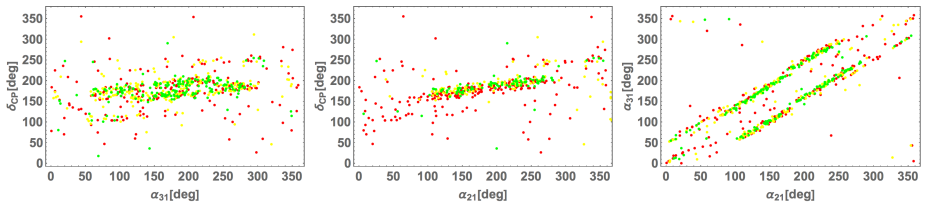
- The Dirac CP phase clusters near $\pi/2$ in the $5\sigma$ allowed region, while the Majorana phases show a linear correlation rather than being free.
- Lepton flavor violating branching ratios stay far below current bounds, so the model introduces no observable flavor problem.
Reading between the lines
- Inference: recomputing the relic density with the full coupling set would likely move the allowed dark matter mass, and because $m_R$ and $m_I$ enter the one-loop neutrino mass formula, the predicted $\sum m_i$ and $\langle m_{ee}\rangle$ windows could shift accordingly.
- Inference: the same modular parameter $\tau$ that sets the flavor structure also determines the scalar mass spectrum through the potential, so a search for the charged inert scalar $\eta^\pm$ could test the neutrino and dark matter regions in a way the paper does not spell out.
- Inference: the allowed region sits near $\tau\approx -0.5+1.35i$ rather than at the fixed point $\tau=i$, suggesting the predictions are not a pure symmetry-forced accident; variants that impose exact fixed-point values would give different correlations between $\delta_{CP}$ and the Majorana phases.
Signed reviews
Editorial analysis
A structured set of objections, weighed in public.
Referee Report
Summary. The paper proposes a lepton model with a modular S4 symmetry in which neutrino masses arise from a radiative seesaw at one-loop order. An inert scalar doublet eta and heavy Majorana fermions are introduced; well-assigned modular weights forbid a tree-level neutrino mass and leave a remnant Z2 symmetry that stabilizes the lightest inert scalar component as dark matter. The authors specify the charged-lepton, Dirac Yukawa, and heavy-neutrino mass matrices, derive the one-loop neutrino mass formula, and perform a chi-square scan of the parameter space. They report that the normal hierarchy of neutrino masses is reproduced, that the inverted hierarchy is disfavored, and that the model predicts the sum of neutrino masses (58-62 meV), the neutrinoless double beta decay mass (1.2-4 meV), and a Dirac CP phase localized near pi/2, while satisfying charged-lepton flavor violation bounds.
Significance. If the numerical results are robust, the model would provide an interesting connection between modular flavor symmetry, radiative neutrino mass, and dark matter stability, with concrete testable predictions for the neutrino mass sum, 0nu beta beta decay, and the Dirac CP phase. The manuscript is transparent in specifying the field content, the Lagrangian, the mass matrices, and the chi-square procedure, and it explicitly checks lepton flavor violation constraints. Its main limitations are that the dark matter mass range is imported from a simplified relic-density calculation, and the solar mass-squared difference is used as an input to fix the quartic coupling rather than being a prediction, which reduces the claimed predictive content.
major comments (3)
- [II.A] The scan restricts m_R to 525.5-542.5 GeV using the dark matter mass window 534 +/- 8.5 GeV from Ref. [48]. That reference computes the thermal relic density for an inert scalar doublet whose interactions consist only of the gauge and kinetic terms. The present model contains additional couplings, notably the Yukawa matrix y_eta in Eq. (II.9) and the quartic scalar couplings lambda_Heta, lambda'_Heta, lambda''_Heta in Eq. (II.10), which provide extra annihilation and coannihilation channels for the DM candidate eta_I with eta_R, eta+- and lepton final states. The paper neither computes Omega h^2 in this full model nor demonstrates that the quoted window remains valid once these couplings are switched on. Since m_R enters the neutrino mass loop function in Eq. (II.18) and the chi-square scan, a shift in the required DM mass would force a re-evaluation of the numerical predictions. This issue is load-bearing for the central claim, and should be addressed either by computing the relic density in the model or by treating m_R as an independent parameter and showing the quoted ranges for sum m_i and <m_ee> are stable.
- [II, Eq. (II.21)] The quartic coupling lambda''_Heta is fixed by Eq. (II.21) to reproduce the solar mass-squared difference Delta m^2_sol. Consequently, the solar splitting is an input to the fit, not a prediction of the model. The chi-square analysis in Sec. II.A includes Delta m^2_sol as one of the five observables, so the effective number of independently predicted observables is smaller than the nominal five. The abstract and conclusion should be qualified to state clearly which quantities are predictions (mixing angles, phases, mass ratios, and the correlated ranges for sum m_i and <m_ee>) and which are used as inputs (the charged-lepton masses and the solar splitting).
- [II, Eqs. (II.12)-(II.13) and Sec. II.A] There is an inconsistency in the sign of the mass-splitting relation. From Eqs. (II.12) and (II.13), m_R^2 - m_I^2 = lambda''_Heta v_H^2. With a positive lambda''_Heta, the real scalar is heavier than the imaginary one, which is the correct hierarchy for eta_I to be the dark matter candidate. However, the text in Sec. II.A states m_I = sqrt(m_R^2 + 2 lambda''_Heta v_H^2), which implies m_I^2 - m_R^2 = 2 lambda''_Heta v_H^2 and would make m_I heavier for positive lambda''. This sign error affects the expression used in the numerical scan and, through the sign of the loop function in Eq. (II.18), the neutrino mass matrix. Please correct the formula and verify that the numerical results in Table III and Figs. 1-3 correspond to the correct sign convention.
minor comments (5)
- [Sec. II.A] In the list of input parameters, 'alpha_D' appears twice; presumably one is 'alpha_eta' or another Yukawa coupling. Please correct this typo.
- [Fig. 3 caption and Sec. III] The phrase 'Mojorana phases' should be 'Majorana phases'.
- [Table III caption] The caption reads 'at the sample points of NH and IH', but the text and the values indicate that both sample points are for the normal hierarchy. Since the paper concludes that IH is disfavored, the caption should be changed to 'NH'.
- [Appendix] The probability density function is written as f(x,nu) = x^{nu/2 - 1} exp(x/2) / (2^{nu/2} Gamma(x/2)); the Gamma function argument should be nu/2, not x/2.
- [Sec. II.A and Fig. 1] The scan region for tau is Re(tau) in [-1.5, 1.5], which extends beyond the standard fundamental domain of the modular group. Since modular transformations identify points outside the fundamental domain, the authors should either restrict tau to the fundamental domain or explain why the larger scan region is justified.
Circularity Check
Solar mass splitting is set by construction via Eq. (II.21) yet counted among the chi^2 observables; the DM mass window from Ref. [48] is an explicit external input and a robustness risk, not a circular step.
-
self definitional
[Sec. II.A, Eq. (II.21) and the chi^2-analysis paragraph]
"We use λ′′Hη given by the following relation: λ′′Hη = sqrt(Δm^2_sol)/(˜m^2_ν2−˜m^2_ν1) ... we adopt the accuracy of χ2 for five well known dimensionless observables such as ∆m^2_atm, sin^2θ23, sin^2θ13, ∆m^2_sol, and sin^2θ12."
Equation (II.21) defines λ′′Hη so that, after substituting into the neutrino mass matrix, the solar mass-squared splitting m_ν2^2 − m_ν1^2 equals the experimental input Δm^2_sol by construction, independent of the scanned parameters. The paper then includes Δm^2_sol among the five observables entering χ2, so this observable contributes identically zero to the fit and the reported confidence regions are based on at most four effective constraints. This is a self-definitional step in the statistical derivation, although the final sum-mass and ⟨m_ee⟩ ranges also depend on the other fitted parameters and are not fully forced by this relation alone.
full rationale
The paper's central numerical work is a transparent χ2 fit to NuFIT 5.0 observables; charged-lepton masses are fixed explicitly and are not presented as predictions, and the claimed ranges for Σm_i and ⟨m_ee⟩ are outputs of the parameter scan rather than quoted inputs. The model is self-contained against external benchmark data, and no load-bearing self-citation chain or imported uniqueness theorem forces the central results. The one concrete circular element is the treatment of Δm^2_sol: Eq. (II.21) fixes λ′′Hη to reproduce the solar splitting by definition, yet Δm^2_sol is subsequently counted as one of the five fitted observables in the χ2 analysis, inflating the number of effective constraints and the confidence levels. The DM mass window 534 ± 8.5 GeV is imported from Ref. [48], where the relic density arises from the kinetic term only; the paper explicitly states 'we simply assume mη±≈mI' and 'Here, we work on this range.' That assumption is load-bearing for the numerical scan, but it is an explicitly admitted external input and a correctness/robustness concern rather than a circular derivation, since the paper does not present the DM mass as a prediction of its own equations. Overall, the circularity is partial and localized rather than global, so the score is moderate.
Assumptions & free parameters
free parameters (7)
- Modulus tau =
Sample points: -0.528716+1.41775i, -0.483662+1.37078i
- Charged-lepton Yukawa couplings alpha_l, beta_l, gamma_l =
Sample: [0.000490, -0.369, 0.479] and [-0.000408, -0.368, 0.469]
- Dirac Yukawa couplings alpha_eta, beta_eta, gamma_eta =
Sample: [0.0081e^{1.18i}, 0.107e^{-0.20i}, 0.174e^{-0.015i}]
- Heavy Majorana mass parameters M0, M1 =
Sample: M0=38.2 TeV, M1=0.363 TeV and M0=58.7 TeV, M1=0.365 TeV
- Scalar mass m_R (mass of the real neutral component of eta) =
Sample: 537.322 GeV and 539.162 GeV
- Quartic coupling lambda''_Heta =
Sample: 4.93e-8 and 3.69e-8
- Dark matter mass m_I (or m_eta+-) =
534 +/- 8.5 GeV
assumptions (5)
- standard math The S4 modular forms y1..y5 in Eq. (II.2) are doublets/triplets with the stated modular weights (2, 4).
- standard math S4 multiplication rules and Clebsch-Gordan coefficients used to build Y_3^(4), Y_3'^(4) and the Yukawa couplings.
- ad hoc to paper The modular weight assignments in Table I (-2,-2,-2,-1,-1,0,-1) forbid the tree-level neutrino mass and leave a remnant Z2 that stabilizes the DM candidate.
- domain assumption The neutrino mass formula (II.18) uses the approximation lambda''_Heta v_H^2 = m_R^2 - m_I^2 << m_0^2.
- domain assumption The DM relic density is determined by the kinetic term only, fixing m_I about 534 +/- 8.5 GeV.
invented entities (2)
-
Heavy Majorana neutrinos N_R (singlet N_R3 and doublet (N_R1,N_R2) under S4)
-
Inert scalar doublet eta
Cite this review
Pith. "Pith review of Neutrino mass model with a modular $S_4$ symmetry." pith.science (2026). https://pith.science/paper/AIJZ7ICA
@misc{pith2026190808409,
  author       = {Pith},
  title        = {Pith review of: Neutrino mass model with a modular $S_4$ symmetry},
  year         = {2026},
  howpublished = {\url{https://pith.science/paper/AIJZ7ICA}},
  note         = {Machine review of arXiv:1908.08409}
}
abstract
We propose a predictive lepton model under a modular $S_4$ symmetry, where the neutrino mass matrix arises from a radiative seesaw at one-loop level. The tree-level mass matrix is forbidden by well-assigned modular weights, which also play an important role in stabilizing dark matter candidate due to a remnant $Z_2$ symmetry even after breaking the modular symmetry. Supposing three families of the Majorana neutrinos, right-handed charged-leptons and left-handed charged-leptons to be embedded respectively into singlet, doublet, and triplet under $S_4$, we obtain the predictive mass matrices in the normal hierarchy. Then, we show our numerical results such as phases, mixings, and neutrino masses, applying $\chi^2$ analysis. We also demonstrate two sample points, imposing on minimizing $\chi^2$ and best fit value of $\delta_{CP}^\ell$ of $195^\circ$.
Figures

Forward citations
Cited by 3 Pith papers
-
Radiative lepton model in a non-invertible fusion rule
A radiative lepton mass model with a Z2-gauged Z5 non-invertible fusion rule can fit neutrino oscillation data and predicts charged-lepton EDMs that indirectly bound 0νββ to ≲28–33.5 meV.
-
Leptonic Flavor from Modular $A_4$: UV Mediators and SMEFT Realizations
This paper classifies lepton-coupled UV mediators under modular A4 symmetry and derives experimental lower bounds on their masses from lepton flavor observables.
-
Neutrino Mass Predictions with an AI-based Algorithm under $A_4$ Modular Symmetry
An A4 modular linear-seesaw neutrino model is fitted with the ILA optimizer, and the fitted parameters agree with oscillation and cosmological bounds.
Reference graph
Works this paper leans on
-
[48]
L. M. G. De La Vega, R. Ferro-Hernandez and E. Peinado, Phys. Rev. D 99, no. 5, 055044 (2019) doi:10.1103/PhysRevD.99.055044 [arXiv:1811.10619 [hep-ph]]
work page Pith review arXiv 2019
-
[1]
The maximum values of BR(µ→eγ), BR(τ→eγ), and BR(τ→µγ) are respectively 1.3× 10⁻¹⁷, 1.4× 10⁻¹⁹, and 8.0× 10⁻²⁰. The ranges of DN are respectively 40 TeV 9 ≤DN1≤ 80 TeV, 130 TeV≤DN2≤ 420 TeV, and 160 TeV≤DN3≤ 480 TeV. These suggest that they are totally safe for LFV constraints
-
[2]
+ 32η′(4τ) η(4τ)− η′(τ 4) η(τ 4)− η′(τ+1 4 ) η(τ+1 4 )− η′(τ+2 4 ) η(τ+2 4 )− η′(τ+3 4 ) η(τ+3 4 ) ) , y2(τ) = i √ 3 8 (η′(τ 4) η(τ 4)− η′(τ+1 4 ) η(τ+1 4 ) + η′(τ+2 4 ) η(τ+2 4 )− η′(τ+3 4 ) η(τ+3 4 ) ) y3(τ) = i (η′(τ + 1 2) η(τ + 1 2)− 4η′(4τ) η(4τ) ) , y4(τ) = i 4 √ 2 ( −η′(τ 4) η(τ
-
[3]
The Dirac CP phase tends to be localized at nearby π/2, even though there is whole allowed range within 5σ. While the Mojorana phases α21,31 run over whole the range, but there is a linear correlation between them
-
[4]
+iη′(τ+1 4 ) η(τ+1 4 ) + η′(τ+2 4 ) η(τ+2 4 )−iη′(τ+3 4 ) η(τ+3 4 ) ) , y5(τ) = i 4 √ 2 ( −η′(τ 4) η(τ 4)−iη′(τ+1 4 ) η(τ+1 4 ) + η′(τ+2 4 ) η(τ+2 4 ) +iη′(τ+3 4 ) η(τ+3 4 ) ) . (II.2) Then, higher weights are constructed by multiplication rules ofS4, and one finds the following couplings: Y (4) 3 = −2y2y3 √ 3y1y5 +y2y4 √ 3y1y4 +y2y5 , Y (4) 3...
work page 2011
-
[5]
Therefore, we have concluded IH is disfavored in our model
In case of IH, we would not find any solutions to satisfy the neutrino oscillation data. Therefore, we have concluded IH is disfavored in our model. III. CONCLUSION AND DISCUSSION We have explored a predictive lepton model with a modular S4 symmetry, in which we have generated the neutrino mass matrix at one-loop level. The tree-level mass matrix is forbid...
-
[6]
In Fig. 1, we have demonstrated that the allowed region within the range of 2 σ tends to be localized at nearby τ =±0.5 + 1.35i. This region is not a fixed point, but there exists small allowed region at nearby τ =i, which is a fixed point
-
[7]
2, we have found that 1.2 meV ≲⟨mee⟩ ≲ 4 meV and 58 meV ≲∑m ≲ 62 meV within the range of 5σ
In Fig. 2, we have found that 1.2 meV ≲⟨mee⟩ ≲ 4 meV and 58 meV ≲∑m ≲ 62 meV within the range of 5σ. Notice here that the total neutrino masses are consistent with the recent cosmological constraint; ∑mi≤ 120 meV
Show all 61 references
-
[8]
LFVs constraints are totally safe in our model, since the maximum values of BR( µ→ eγ), BR(τ → eγ), and BR( τ → µγ) are respectively 1 .3× 10−17, 1.4× 10⁻¹⁹, and 10 8.0× 10⁻²⁰
-
[9]
We would not have found any allowed regions in case of IH. Acknowledgments This research was supported by an appointment to the JRG Program at the APCTP through the Science and Technology Promotion Fund and Lottery Fund of the Korean Gov- ernment. This was also supported by th...
-
[10]
It is normalized by ∫ ∞ 0 f(x,ν )dx = 1
, (.1) where ν is the degree of freedom (DOF). It is normalized by ∫ ∞ 0 f(x,ν )dx = 1. (.2) The CL for ν DOF is given by ∫ ∆χ2 0 f(x,ν )dx, (.3) where ∆χ2 =∑ν i=1 ( χ2 i−χ2 i,min ) and all parameters are independent. We can get the values χ2 i and χ2 i,min from NuFIT 5.0 [49]...
-
[11]
Ma, Phys
E. Ma, Phys. Rev. D 73, 077301 (2006) doi:10.1103/PhysRevD.73.077301 [hep-ph/0601225]. 11 CL(%) ν = 1 ν = 2 ν = 3 ν = 4 ν = 5 ν = 6 68.27 (1σ) 1.00 2.30 3.53 4.72 5.89 7.04 95.45 (2σ) 4.00 6.18 8.02 9.72 11.31 12.85 99.73 (3σ) 9.00 11.83 14.16 16.25 18.21 20.06 100−5.7×10⁻⁵ (5...
2006 arXiv
-
[12]
de Adelhart Toorop, F
R. de Adelhart Toorop, F. Feruglio and C. Hagedorn, Nucl. Phys. B 858, 437 (2012) [arXiv:1112.1340 [hep-ph]]
2012 arXiv
-
[13]
Feruglio, doi:10.1142/9789813238053 0012 arXiv:1706.08749 [hep-ph]
F. Feruglio, doi:10.1142/9789813238053 0012 arXiv:1706.08749 [hep-ph]
-
[14]
J. C. Criado and F. Feruglio, arXiv:1807.01125 [hep-ph]
-
[15]
Kobayashi, N
T. Kobayashi, N. Omoto, Y. Shimizu, K. Takagi, M. Tanimoto and T. H. Tatsuishi, JHEP 1811, 196 (2018) doi:10.1007/JHEP11(2018)196 [arXiv:1808.03012 [hep-ph]]
2018 arXiv
-
[16]
Okada and M
H. Okada and M. Tanimoto, Phys. Lett. B 791, 54 (2019) doi:10.1016/j.physletb.2019.02.028 [arXiv:1812.09677 [hep-ph]]
2019 arXiv
- [17]
- [18]
-
[19]
F. J. de Anda, S. F. King and E. Perdomo, arXiv:1812.05620 [hep-ph]
-
[20]
P. P. Novichkov, S. T. Petcov and M. Tanimoto, arXiv:1812.11289 [hep-ph]
- [21]
- [22]
- [23]
-
[24]
Kobayashi, K
T. Kobayashi, K. Tanaka and T. H. Tatsuishi, Phys. Rev. D 98 (2018) no.1, 016004 [arXiv:1803.10391 [hep-ph]]
2018 arXiv
-
[25]
Kobayashi, Y
T. Kobayashi, Y. Shimizu, K. Takagi, M. Tanimoto, T. H. Tatsuishi and H. Uchida, Phys. Lett. B 794, 114 (2019) doi:10.1016/j.physletb.2019.05.034 [arXiv:1812.11072 [hep-ph]]
2019 arXiv
-
[26]
Kobayashi, Y
T. Kobayashi, Y. Shimizu, K. Takagi, M. Tanimoto and T. H. Tatsuishi, arXiv:1906.10341 [hep-ph]
1906 arXiv
- [27]
-
[28]
J. T. Penedo and S. T. Petcov, Nucl. Phys. B 939, 292 (2019) 12 doi:10.1016/j.nuclphysb.2018.12.016 [arXiv:1806.11040 [hep-ph]]
2019 arXiv
-
[29]
P. P. Novichkov, J. T. Penedo, S. T. Petcov and A. V. Titov, JHEP 1904, 005 (2019) doi:10.1007/JHEP04(2019)005 [arXiv:1811.04933 [hep-ph]]
2019 arXiv
-
[30]
Kobayashi, Y
T. Kobayashi, Y. Shimizu, K. Takagi, M. Tanimoto and T. H. Tatsuishi, arXiv:1907.09141 [hep-ph]
1907 arXiv
-
[31]
P. P. Novichkov, J. T. Penedo, S. T. Petcov and A. V. Titov, arXiv:1812.02158 [hep-ph]
-
[32]
G. J. Ding, S. F. King and X. G. Liu, arXiv:1903.12588 [hep-ph]
1903 arXiv
-
[33]
A. Baur, H. P. Nilles, A. Trautner and P. K. S. Vaudrevange, arXiv:1901.03251 [hep-th]
1901 arXiv
-
[34]
G. J. Ding, S. F. King, C. C. Li and Y. L. Zhou, JHEP 08, 164 (2020) doi:10.1007/JHEP08(2020)164 [arXiv:2004.12662 [hep-ph]]
2020 arXiv
-
[35]
de Medeiros Varzielas, S
I. de Medeiros Varzielas, S. F. King and Y. L. Zhou, arXiv:1906.02208 [hep-ph]
1906 arXiv
-
[36]
X. G. Liu and G. J. Ding, arXiv:1907.01488 [hep-ph]
1907 arXiv
-
[37]
Altarelli and F
G. Altarelli and F. Feruglio, Rev. Mod. Phys. 82 (2010) 2701 [arXiv:1002.0211 [hep-ph]]
2010 arXiv
-
[38]
Ishimori, T
H. Ishimori, T. Kobayashi, H. Ohki, Y. Shimizu, H. Okada and M. Tanimoto, Prog. Theor. Phys. Suppl. 183 (2010) 1 [arXiv:1003.3552 [hep-th]]
2010 arXiv
-
[39]
Ishimori, T
H. Ishimori, T. Kobayashi, H. Ohki, H. Okada, Y. Shimizu and M. Tanimoto, Lect. Notes Phys. 858 (2012) 1, Springer
2012
-
[40]
Hernandez and A
D. Hernandez and A. Y. Smirnov, Phys. Rev. D 86 (2012) 053014 [arXiv:1204.0445 [hep-ph]]
2012 arXiv
-
[41]
S. F. King and C. Luhn, Rept. Prog. Phys. 76 (2013) 056201 [arXiv:1301.1340 [hep-ph]]
2013 arXiv
-
[42]
S. F. King, A. Merle, S. Morisi, Y. Shimizu and M. Tanimoto, arXiv:1402.4271 [hep-ph]
-
[43]
S. F. King, Prog. Part. Nucl. Phys. 94 (2017) 217 doi:10.1016/j.ppnp.2017.01.003 [arXiv:1701.04413 [hep-ph]]
2017 arXiv
-
[44]
S. T. Petcov, Eur. Phys. J. C 78 (2018) no.9, 709 [arXiv:1711.10806 [hep-ph]]
2018 arXiv
-
[45]
A. Baur, H. P. Nilles, A. Trautner and P. K. S. Vaudrevange, arXiv:1908.00805 [hep-th]
1908 arXiv
-
[46]
Hirsch, S
M. Hirsch, S. Morisi, E. Peinado and J. W. F. Valle, Phys. Rev. D 82, 116003 (2010) doi:10.1103/PhysRevD.82.116003 [arXiv:1007.0871 [hep-ph]]
2010 arXiv
-
[47]
J. M. Lamprea and E. Peinado, Phys. Rev. D 94, no. 5, 055007 (2016) doi:10.1103/PhysRevD.94.055007 [arXiv:1603.02190 [hep-ph]]
2016 arXiv
-
[49]
P. P. Novichkov, J. T. Penedo, S. T. Petcov and A. V. Titov, arXiv:1905.11970 [hep-ph]. 13
1905 arXiv
-
[50]
S. Baek, T. Nomura and H. Okada, Phys. Lett. B 759, 91 (2016) doi:10.1016/j.physletb.2016.05.055 [arXiv:1604.03738 [hep-ph]]
2016 arXiv
-
[51]
Lindner, M
M. Lindner, M. Platscher and F. S. Queiroz, Phys. Rept. 731, 1 (2018) doi:10.1016/j.physrep.2017.12.001 [arXiv:1610.06587 [hep-ph]]
2018 arXiv
-
[52]
A. M. Baldini et al. [MEG Collaboration], Eur. Phys. J. C 76, no. 8, 434 (2016) [arXiv:1605.05081 [hep-ex]]
2016 arXiv
-
[53]
Renga [MEG Collaboration], Hyperfine Interact
F. Renga [MEG Collaboration], Hyperfine Interact. 239, no. 1, 58 (2018) [arXiv:1811.05921 [hep-ex]]
2018 arXiv
-
[54]
Aubert et al
B. Aubert et al. [BaBar Collaboration], Phys. Rev. Lett. 104 (2010) 021802 [arXiv:0908.2381 [hep-ex]]
2010 arXiv
- [55]
-
[56]
Vagnozzi, E
S. Vagnozzi, E. Giusarma, O. Mena, K. Freese, M. Gerbino, S. Ho and M. Lattanzi, Phys. Rev. D 96, no. 12, 123503 (2017) doi:10.1103/PhysRevD.96.123503 [arXiv:1701.08172 [astro- ph.CO]]
2017 arXiv
-
[57]
Gando et al
A. Gando et al. [KamLAND-Zen Collaboration], Phys. Rev. Lett. 117, no. 8, 082503 (2016) Addendum: [Phys. Rev. Lett. 117, no. 10, 109903 (2016)] doi:10.1103/PhysRevLett.117.109903, 10.1103/PhysRevLett.117.082503 [arXiv:1605.02889 [hep-ex]]
2016 arXiv
-
[58]
Hambye, F.-S
T. Hambye, F.-S. Ling, L. Lopez Honorez and J. Rocher, JHEP 0907, 090 (2009) Erratum: [JHEP 1005, 066 (2010)] doi:10.1007/JHEP05(2010)066, 10.1088/1126-6708/2009/07/090 [arXiv:0903.4010 [hep-ph]]
2009 arXiv
-
[59]
Esteban, M
I. Esteban, M. C. Gonzalez-Garcia, M. Maltoni, T. Schwetz and A. Zhou, JHEP 09, 178 (2020) doi:10.1007/JHEP09(2020)178 [arXiv:2007.14792 [hep-ph]]
2020 arXiv
-
[60]
Abe et al
K. Abe et al. [T2K Collaboration], Phys. Rev. Lett. 121, no. 17, 171802 (2018) doi:10.1103/PhysRevLett.121.171802 [arXiv:1807.07891 [hep-ex]]
2018 arXiv
-
[61]
Adamson et al
P. Adamson et al. [NOvA Collaboration], Phys. Rev. Lett. 118, no. 23, 231801 (2017) doi:10.1103/PhysRevLett.118.231801 [arXiv:1703.03328 [hep-ex]]. 14
2017 arXiv
Reviewed August 14, 2026 · model on record in the stance chip above.
Discussion (0). Continue with ORCID to comment.